DOI: 10.1534/genetics.109.110247
Note
A Problem With the Correlation Coefficient as a Measure of
Gene Expression Divergence
Vini Pereira,
1David Waxman and Adam Eyre-Walker
Centre for the Study of Evolution, School of Life Sciences, University of Sussex, Brighton BN1 9QG, United Kingdom
Manuscript received September 24, 2009 Accepted for publication September 25, 2009
ABSTRACT
The correlation coefficient is commonly used as a measure of the divergence of gene expression profiles between different species. Here we point out a potential problem with this statistic: if measurement error is large relative to the differences in expression, the correlation coefficient will tend to show high divergence for genes that have relatively uniform levels of expression across tissues or time points. We show that genes with a conserved uniform pattern of expression have significantly higher levels of expression divergence, when measured using the correlation coefficient, than other genes, in a data set from mouse, rat, and human. We also show that the Euclidean distance yields low estimates of expression divergence for genes with a conserved uniform pattern of expression.
I
T is now possible to measure the expression levels ofthousands of genes in multiple tissues at multiple times. This has led to investigations into the evolution of gene expression and how the pattern of expression changes on a genomic scale. In some analyses, the evolution of expression is considered only within one tissue, but in many studies the evolution across multiple tissues is investigated. In this latter case, the evolution of an expression profile—a vector of expression levels of a gene across several tissues—is considered.
Several different statistics have been proposed to measure the divergence between gene expression profiles. The two most popular measures are the
Euclidean distance ( Jordan et al. 2005; Kim et al.
2006; Yanai et al. 2006; Urrutia et al. 2008) and
Pearson’s correlation coefficient (Makova and Li
2003; Huminiecki and Wolfe 2004; Yanget al. 2005;
Kimet al.2006; Liao and Zhang2006a,b; Xing et al.
2007; Urrutiaet al.2008). The correlation coefficient
is often subtracted from one, so that the statistic varies from zero, when there has been no expression di-vergence, to a maximum of two; we refer to this statistic
as the Pearson distance. Here we describe a significant
shortcoming of the Pearson distance that is not shared by the Euclidean distance.
To investigate properties of these two measures of expression divergence, we compiled a data set of 2859 orthologous genes from human, mouse, and rat for which we had microarray expression data from nine homologous tissues: bone marrow, heart, kidney, large intestine, pituitary, skeletal muscle, small intestine, spleen, and thymus). The expression data for rat came
from Walkeret al.(2004), the mouse data from Suet al.
(2004), and the human data from Geet al.(2005). Each
tissue experiment had two replicates in mouse, a varying number of replicates in rat, and one in humans; some genes were also matched by multiple probe sets. To obtain an average across experiments and probe sets we processed the data as follows:
i. Raw CEL files of gene expression levels were obtained from the NCBI Gene Expression Omnibus database (http://www.ncbi.nlm.nih.gov/projects/geo/). ii. The results from the mouse, rat, and human arrays
were normalized separately using both the MAS5
(Affymetrix 2001) and the RMA algorithms
(Irizarryet al.2003) as implemented in
Bioconduc-tor (Gentlemanet al.2004). The results are
qualita-tively similar for the two normalization procedures, although recent analyses suggest that MAS5
normal-ization is generally better (Ploneret al. 2005; Lim
et al.2007).
iii. The expression of each gene within a tissue was averaged across experiments and probe sets.
Supporting information is available online athttp://www.genetics.org/
cgi/content/full/genetics.109.110247/DC1.
1Corresponding author:Theoretical Systems Biology, Institute of Food
Research, Norwich Research Park, Colney, Norwich NR4 7UA, United
Kingdom. E-mail: [email protected]
We computed expression distances (ED) between orthologous gene expression profiles, for each of the three species comparisons, rat–mouse, rat–human, and mouse–human, according to the two different distance metrics, the Euclidean distance and the Pearson distance:
EucD¼
ffiffiffiffiffiffiffiffiffiffiffiffiffiffiffiffiffiffiffiffiffiffiffiffiffiffiffiffiffiffi Xk
j¼1
ðx1jx2jÞ2 v
u u t
PeaD¼1
Pk
j¼1ðx1jx1Þðx2jx2Þ ffiffiffiffiffiffiffiffiffiffiffiffiffiffiffiffiffiffiffiffiffiffiffiffiffiffiffiffiffiffiffiffiffiffiffiffiffiffiffiffiffiffiffiffiffiffiffiffiffiffiffiffiffiffiffiffiffiffiffiffiffiffiffiffiffi Pk
j¼1ðx1jx1Þ2Pkj¼1ðx2jx2Þ2
q :
ð1Þ
Here xij is the expression level of the gene under
consideration in species i in tissue j, and xi is the
average expression level of the gene in speciesiacross
tissues. Expression levels are known in a total ofktissues.
Because expression levels are measured on different microarray platforms in the three species, we compute relative abundance (RA) values, before calculating the
Euclidean distance (Liaoand Zhang2006a). The RA is
the expression of a gene in a particular tissue divided by the sum of the expression values of that gene across all tissues. We calculated RA values to remove ‘‘probe’’ effects (the tendency for a gene to bind its probe set on one platform more efficiently than on another platform). Because of probe effects it is not easy to distinguish absolute changes in expression and differences in bind-ing efficiency. Calculatbind-ing RA values removes this problem from the Euclidean distance. Pearson’s distance does not change under such a rescaling and so this is unnecessary.
In some analyses the logarithm of the expression or RA
values are used (e.g., Makovaand Li2003; Kimet al.2006;
Xinget al.2007), and in others the expression values are
used without this transformation (e.g., Huminieckiand
Wolfe2004; Jordanet al.2005; Yanget al.2005; Liao
and Zhang 2006a,b; Yanai et al.2006; Urrutiaet al.
2008). We calculated both the Pearson and the Euclidean distances on log-transformed and untransformed expres-sion values. The results are qualitatively similar so here we present only the results obtained using the logarithm of the expression or RA values.
It is natural to expect the two measures of expression divergence to be positively correlated with one another; however, the Euclidean and Pearson distances are almost completely uncorrelated (MAS5 normalization,
mouse–rat correlation coefficient¼0.06, human–ratr¼
0.13, human–mouse r ¼ 0.10; RMA normalization,
mouse–rat correlation coefficient¼ 0.12, human–rat
r ¼ 0.00, human–mouser ¼ 0.08; Figure 1). This
could, plausibly, be because the two statistics measure different aspects of divergence. However, irrespective of this, there is a potential problem associated with the Pearson distance. Imagine that we have a gene that is
expressed at identicallevels in all tissues in two species
(i.e., expression levels are uniform between tissues and
Figure 1.—The correlation between the Euclidean and
Pearson distances for (a) mouse–rat, (b) human–rat, and (c) human–mouse. Only the results from MAS5 normaliza-tion are shown; qualitatively similar results were obtained with RMA.
also between species). We quite reasonably assume that measured expression levels contain noise. Thus each measured expression level (xij) is the sum of the
(as-sumed) uniform expression level and an independent random number representing noise. In this case there is no real divergence in the expression profile between the species. However, the two measures of divergence may differ greatly in this case. The Euclidean distance re-flects only the noise present in the data and hence will be small if the noise is small. By contrast, the Pearson distance will have a value close to 1 since the second term in PeaD in Equation 1 will be close to zero, reflecting the fact that the noise components of different expression levels are independent. Thus the Pearson distance will give the impression that expression divergence is great, but all this apparent divergence is noise. This will be a problem with Pearson’s distance whenever measure-ment error is of the same magnitude as the differences in expression between tissues. This will therefore tend to be a problem for lowly expressed genes, where measure-ment error can be large relative to the true value.
The above example is unrealistic because real gene expression profiles are rarely perfectly uniform. To investigate whether this shortcoming of the Pearson distance is a problem in real data sets, we determined genes with a relatively uniform pattern of expression in all three species considered above. To do this we
computed theentropyof a gene’s expression, which is a
measure of uniformity in expression across tissues (Schuget al.2005): the higher the value of the entropy, the more uniform is the expression. We calculated the entropy for each gene in each of the three species, averaged these across species, and then took those genes in the upper quartile of mean entropy values as a data set of genes with a relatively conserved pattern of uniform expression.
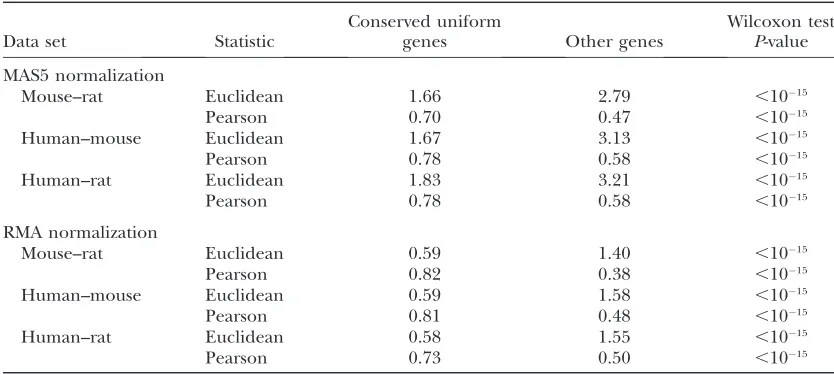
It is natural to expect those genes with a conserved uniform pattern of expression to have relatively low expression divergence; however, on average these genes have significantly higher Pearson distances than other
genes (Table 1; Figure 2; supporting information,
Figure S1 and Figure S2). By contrast, the Euclidean TABLE 1
The median expression divergence for genes that have a conserved uniform pattern of expression (upper quartile of mean entropy values)vs.all other genes
Data set Statistic
Conserved uniform
genes Other genes
Wilcoxon test
P-value
MAS5 normalization
Mouse–rat Euclidean 1.66 2.79 ,1015
Pearson 0.70 0.47 ,1015
Human–mouse Euclidean 1.67 3.13 ,1015
Pearson 0.78 0.58 ,1015
Human–rat Euclidean 1.83 3.21 ,1015
Pearson 0.78 0.58 ,1015
RMA normalization
Mouse–rat Euclidean 0.59 1.40 ,1015
Pearson 0.82 0.38 ,1015
Human–mouse Euclidean 0.59 1.58 ,1015
Pearson 0.81 0.48 ,1015
Human–rat Euclidean 0.58 1.55 ,1015
Pearson 0.73 0.50 ,1015
Figure2.—The distribution of expression di-vergence values for those genes with a uniform pattern of expression that is conserved across
species vs. the distribution for all genes for
(a) Pearson and (b) Euclidean distances
for mouse–rat. We present similar values for
human–mouse and human–rat in Figure S1
distance shows the pattern one would anticipate; all of the conserved uniform genes have low expression divergence. It therefore seems likely that the Pearson distance is sensitive to measurement error and hence may not be a good measure of expression divergence.
We note that there are two additional advantages of the Euclidean distance. First, it can take into account differences in the absolute level of expression if those data are available, either because the method of assay allows this, for example, if ESTs, SAGE, sequencing, or RNA-Seq data are used, or because expression in the two species has been assessed on the same platform using probes that are conserved between the two species. Second, the square of the Euclidean distance is
ex-pected to increase linearly with time. Khaitovichet al.
(2004) have previously shown that the squared differ-ence in log expression level increases linearly with time under a Brownian motion model of gene expression evolution. It is therefore expected that the squared Euclidean distance will increase with time since the squared Euclidean distance is the sum of the squared
differences across tissues. We prove this inFile S1; we
also show that this linearity holds, approximately, when
relative abundance values are used (see also Pereira
et al.2009).
We are grateful to a referee for helpful comments. V.P. and A.E.W. were supported by the Biotechnology and Biological Sciences Re-search Council.
LITERATURE CITED
Affymetrix, 2001 Statistical Algorithms Reference Guide.Affymetrix,
Santa Clara, CA.
Ge, X., S. Yamamoto, S. Tsutsumi, Y. Midorikawa, S. Iharaet al.,
2005 Interpreting expression profiles of cancers by genome
wide survey of breadth of expression in normal tissues. Genomics
86:127–141.
Gentleman, R. C., V. J. Carey, D. M. Bates, B. Bolstad,
M. Dettlinget al., 2004 Bioconductor: open software
develop-ment for computational biology and bioinformatics. Genome
Biol.5:R80.
Huminiecki, L., and K. H. Wolfe, 2004 Divergence of spatial gene
expression profiles following species-specific gene duplications
in human and mouse. Genome Res.14:1870–1879.
Irizarry, R. A., B. Hobbs, F. Collin, Y. D. Beazer-Barclay,
K. J. Antonelliset al., 2003 Exploration, normalization, and
summaries of high density oligonucleotide array probe level data.
Biostatistics4:249–264.
Jordan, I. K., L. Marino-Ramirez and E. V. Koonin, 2005
Evo-lutionary significance of gene expression divergence. Gene345:
119–126.
Khaitovich, P., G. Weiss, M. Lachmann, I. Hellmann, W. Enard
et al., 2004 A neutral model of transcriptome evolution. PLoS
Biol.2:E132.
Kim, R. S., H. Jiand W. H. Wong, 2006 An improved distance
mea-sure between the expression profiles linking co-expression and
co-regulation in mouse. BMC Bioinformatics7:44.
Liao, B.-Y., and J. Zhang, 2006a Evolutionary conservation of
ex-pression profiles between human and mouse orthologous genes.
Mol. Biol. Evol.23:530–540.
Liao, B. Y., and J. Zhang, 2006b Low rates of expression profile
di-vergence in highly expressed genes and tissue-specific genes
during mammalian evolution. Mol. Biol. Evol.23:1119–1128.
Lim, W. K., K. Wang, C. Lefebvre and A. Califano,
2007 Comparative analysis of microarray normalization
proce-dures: effects on reverse engineering gene networks.
Bioinfor-matics23:i282–i288.
Makova, K. D., and W. H. Li, 2003 Divergence in the spatial pattern
of gene expression between human duplicate genes. Genome
Res.13:1638–1645.
Pereira, V., D. Enardand A. Eyre-Walker, 2009 The effect of
transposable element insertions on gene expression evolution
in rodents. PLoS ONE4:e4321.
Ploner, A., L. D. Miller, P. Hall, J. Bergh and Y. Pawitan,
2005 Correlation test to assess low-level processing of
high-density oligonucleotide microarray data. BMC Bioinformatics6:80.
Schug, J., W. P. Schuller, C. Kappen, J. M. Salbaum, M. Bucanet al.,
2005 Promoter features related to tissue specificity as measured
by Shannon entropy. Genome Biol.6:R33.
Su, A. I., T. Wiltshire, S. Batalov, H. Lapp, K. A. Chinget al.,
2004 A gene atlas of the mouse and human protein coding
transcriptomes. Proc. Natl. Acad. Sci. USA101:6062–6067.
Urrutia, A. O., L. B. Ocanaand L. D. Hurst, 2008 Do Alu repeats
drive the evolution of the primate transcriptome? Genome Biol.
9:R25.
Walker, J. R., A. I. Su, D. W. Self, J. B. Hogenesch, H. Lappet al.,
2004 Applications of a rat multiple tissue gene expression data
set. Genome Res.14:742–749.
Xing, Y., Z. Ouyang, K. Kapur, M. P. Scott and W. H. Wong,
2007 Assessing the conservation of mammalian gene
expres-sion using high-density exon arrays. Mol. Biol. Evol.24:1283–
1285.
Yanai, I., J. O. Korbel, S. Boue, S. K. McWeeney, P. Borket al.,
2006 Similar gene expression profiles do not imply similar
tis-sue functions. Trends Genet.22:132–138.
Yang, J., A. I. Suand W. H. Li, 2005 Gene expression evolves faster
in narrowly than in broadly expressed mammalian genes. Mol.
Biol. Evol.22:2113–2118.
Communicating editor: I. Hoeschele
Supporting Information
http://www.genetics.org/cgi/content/full/genetics.109.110247/DC1
A Problem With the Correlation Coefficient as a Measure of Gene
Expression Divergence
Vini Pereira, David Waxman and Adam Eyre-Walker
Copyright © 2009 by the Genetics Society of America
V. Pereira et al.
2 SI
! "#$%&'( )*+, +,' -$##'&.+*$/ -$'0-*'/+ .1 . ('.12#' $3 4'/'
'5"#'11*$/ 6*7'#4'/-'8
!"##$%&%'()*+ ,'-.*&)(,.'
/,', 0%*%,*)1 2)3,4 5)6&)' 7 84)& 9+*%:5)$;%*
<' (=,> >"##$%&%'()*+ ,'-.*&)(,.' ?% %>()@$,>= (?. *%>"$(> "'4%* ) *)':
4.& ?)$; &.4%$ .- A%'% %6#*%>>,.' -*.& )' )'B%>(*)$ >()(%C D,E F=% >G")*%
.- (=% 9"B$,4%)' 4,>()'B% .- A%'% %6#*%>>,.' #*.H$%> ,'B*%)>%
!"#$%&!' (")*
)"+$
C D,,E F=% 9"B$,4%)' 4,>()'B% .- (=% *%$)(,3% )@"'4)'B% 3)$"%> .- ) A%'%
%,,&-."+%)$!'
,'B*%)>%>
!"#$%&!' (")* )"+$
C DF=% *%$)(,3% )@"'4)'B% 3)$"%
) A%'% ,' ) (,>>"% ,> ,(> %6#*%>>,.' $%3%$ ,' (=)( (,>>"% 4,3,4%4 @+ (=% >"&
.-,(> %6#*%>>,.' 3)$"%> .3%* )$$ (,>>"%>EC
5% B.'>,4%* %3.$"(,.' .- A%'% %6#*%>>,.' $%3%$> .- ) '"&@%* .- 4,I%*%'(
A%'%> ,'
!
(,>>"%>C J%(
"
!4%'.(% (=% %6#*%>>,.' $%3%$ .- ) #)*(,B"$)* A%'%1
,' ) #)*(,B"$)* >#%B,%>1 ,' (,>>"%
#C 5% B.$$%B( (=%>% %6#*%>>,.' $%3%$> ,'(.
) 3%B(.*
!
"
!$ "
"$ %%%$ "
""
*%#*%>%'(,'A (=% %6#*%>>,.' $%3%$ .- (=% A%'% ,' )$$
!
(,>>"%> )'4 *%-%* (. (=,> 3%B(.* )> (=% %6#*%>>,.' $%3%$ #*.H$% .- (=% A%'%C
5% &);% (=% )>>"&#(,.' (=)( (=% %6#*%>>,.' $%3%$> .- 4,I%*%'( A%'%>1 ,'
4,I%*%'( (,>>"%>1 )*% (=% ."(B.&% .-
"#/$,$#/$#) +0!)",!"1%)"2$ &%#/-+ (%!34
-*.& )' )'B%>(*)$ %6#*%>>,.' $%3%$C F=% )'B%>(.* ,> ();%' (. .BB"* )( (,&%
&
# $
)'4 (=% %6#*%>>,.' $%3%$ .- ) #)*(,B"$)* A%'% ,' (,>>"%
#
,' (=% )'B%>(.*
,> ?*,((%'
"
!!$"
C F=% B.**%>#.'4,'A A%'% %6#*%>>,.' $%3%$ )-(%*
&
A%'%*)(,.'>
,>
"
!!
&
" #
'
#'
#!!%%%'"'!"!!$"
?=%*% (=% -)B(.*>
'
")*% ,'4%#%'4%'( *)'4.&
3)*,)@$%>1 ?=%*%
%&'
'
",> '.*&)$ ?,(= &%)'
$
)'4 3)*,)'B%
(
!D,C%C1 (=%
'
")*%
$.A:'.*&)$ *)'4.& 3)*,)@$%>EC F=% 3)',>=,'A &%)' .-
%&'
'
"B.**%>#.'4> (.
'
")'4
'
"!!@%,'A %G")$$+ $,;%$+1 >. A%'%> )*% %G")$$+ $,;%$+ (. @% "# .* 4.?'
*%A"$)(%4 @+ (=% >)&% -)B(.*C 5% %6#$,B,($+ )$$.? (=% 3)*,)'B% .-
%&'
'
"(.
4%#%'4 .' (,>>"% (+#% D,C%C1 .'
#EC
!,'B% ) >"& .- ,'4%#%'4%'( '.*&)$ *)'4.& 3)*,)@$%> ,> )$>. '.*&)$1 ,(
-.$$.?> (=)(
%&'
"
!!
&
"
,> ) '.*&)$ *)'4.& 3)*,)@$% ?,(= &%)'
%&'
"
!!$"
)'4
3)*,)'B%
(
"!
&
)'4 ?% B)' ?*,(%
%&'
"
!!
&
" # %&'
"
!!$" (
(
!!
&)
!.* %G",3)$%'($+
"
!!
&
" #
"
!!$" )*+
!
(
!!
&)
!"
1 ?=%*% =%*% )'4 %$>%?=%*%1
)K> ?,(= 4,I%*%'(
!%5$!4
)*% ,'4%#%'4%'( )'4 ,4%'(,B)$$+ 4,>(*,@"(%4 '.*&)$ *)'4.& 3)*,)@$%>
?,(= &%)' L%*. )'4 3)*,)'B% "',(+C
M.(% (=)( (=% )'B%>(*)$ %6#*%>>,.' 3)$"%> D(=%
"
!!$"
E1 -.* 4,I%*%'( A%'%>
)'4 4,I%*%'( (,>>"%> A%'%*)$$+ ();% 4,I%*%'( 3)$"%>C
9'12&+1 3$# 2/1-.&'6 '5"#'11*$/ "#$:&'1
N
V. Pereira et al. 3 SI
!" #$%&'(") *+" ",-)"&&'$% ."/". $0 1 2'/"% 2"%" '% ('3")"%* *'&&4"&5 6+"
.$2 ",-)"&&'$%7."/". -)$8." $0 *+" 2"%" '&
!
!
!
" #
"
$
!
!
!
#
!$
!% #
"$
"% &&&% #
!$
!"
9")"
"
# !%&'
'
!!("%
%&'
'
"!("% &&&%
%&'
'
!!(""
'& *+" .$2 ",-)"&&'$%7."/". $0 *+"
2"%" '% *+" #$::$% 1%#"&*") ;+'#+ ",'&*& 1* *':"
!
# (
5 6+" ('/")2"%#"
$0 ",-)"&&'$% ."/". -)$8." 0)$: *+" 1%#"&*)1. /1.4" $0 *+" 2"%" '&
!
!
!
"
"
"
#
!
!
!
#
!$
!% #
"$
"% &&&% #
!$
!"
1%( *+'& +1& 1% ",-"#*"( /1.4" $0 <")$=
(
)
!
!
!
"
"
"
* #
(
5 6+" >?)1%#+ ."%2*+@ 1&&$#'1*"( ;'*+ *+" ",-)"&&'$% ."/". $0 *+" 2"%" '& *+"
&A41)"( B4#.'("1% ."%2*+
#
!
!
!
"
"
"
#
"#
!
!
!"#!!
#
""
"
!
$
""
"
5 6+'& "/'("%*.C
'%#)"1&"& .'%"1).C ;'*+ *':"D 1& ($"& '*& ",-"#*"( /1.4"=
(
)
#
!
!
!
"
"
"
#
"* #
!
!
!"#!!
#
""
"5
!"#$%& '()*$%+
E"* 4& %$; #$%&'(") ."( (1*15 6+" (1*1 '& ."( F%$):1.'&"(G &4#+
*+1* 0$) 1 2'/"% 2"%"D *+"
!"# $% &'( )$*#+,-!(. (/0*(!!-$) ,(1(,! $1(* +,,
&-!!"(! -! ")-&2
5 6+" %$):1.'&"( ",-)"&&'$% -)$8." 0$) 1 2'/"% 2"%" '& *+4&
)
"!
!
" #
'
"!
!
"
!
! ##!'
#!
!
"
FHG
1%( *+'& &1*'&8"&
!
!"#!)
"!
!
" # +
5 I% *"):& $0 *+"
$
J&D ;" +1/"
)
"!
!
" #
'
"!(" ,-.
"
#
"!
!$
"#
!
!##!
'
#!(" ,-.
"
#
#!
!$
##
&
FKG
61L'%2 .$2& C'".(&
*
"!
!
"
$%&$
%/ )
)
"!
!
"* #
!
!#
"$
"$
"
"!
!
"
;+")"
"
"!
!
"
$%&$
%/ )
)
"!("*
"
%/
$%
!##!
)
#!(" ,-.
&
#
#!
!$
#'(
&
FMG
!" *1L" *+"
*
"!
!
"
0$) 1 2'/"% 2"%" *$ #$%&*'*4*" ".":"%*& $0 1
*$3
/"#*$)
!
1%( &':'.1).C *+"
"
"!
!
"
#$%&*'*4*" ".":"%*& $0 1
*$3
/"#*$)
"
!
!
"
5 6+"%
!
!
!
" #
!
!
!
#
!$
!% #
"$
"% &&&% #
!$
!" $
"
!
!
"
FNG
'& *+" .$2 *)1%&0$):"(D %$):1.'&"( ",-)"&&'$% -)$8." $0 1 2'/"% 2"%" 1* *':"
!
5 6+"
4'+)5(
'% *+'& A41%*'*C 0)$: *+" 1%#"&*)1. /1.4" '&
!
!
!
"
"
!
!(" #
!
!
!
#
!$
!% #
"$
"% &&&% #
!$
!" $
"
!
!
"
"
"
!("
FOG
V. Pereira et al.
4 SI
!"# $%&' '#() *+ '"# (,-"' "%+. &,.# */ 012 345 6*)7$,6%'#& )%''#(&2 8#
)%9# %+ %77(*:,)%',*+; %&&<),+- '"%' /*( %$$ ',&&<#&
!
!!"
!
!
#
3=5
!",& 6*+.,',*+ 6*((#&7*+.& '* 6"%+-#& ,+ #:7(#&&,*+ $#>#$& ?#'@##+ #:'%+'
&7#6,#& %+. '"# 6*))*+ %+6#&'*( ?#,+- 'A7,6%$$A &)%$$2 !"#+
$
!"
"
#
"
$% &
%
!"'#(
#
$%
!"
" #"#%
#"'#
#
! )
!
#$
"&
#$%
* $% &
%
!"'#(
#
$%
#
! )
"
"#"#
%
#"'#
!
#$
"&
#$
"
$% &
%
!"'#(
#
$
"
"
"#"#
%
#"'#
!
#&
#3B5
@,'" 6*((#6',*+& */ *(.#(
!
!"2 !"#+
'
!"
"
#
#
'
!"'#
"
$
"
#
!
!&
!#
"
"#"#
%
#"'#
!
#&
#$
#
3C5
!",& "%& %+ #:7#6'#. >%$<# '"%' >%+,&"#& '* $#%.,+- *(.#( ,+
$
!
!"
%+. %
&1<%(#. 0<6$,.#%+ $#+-'" */
%
!
"
"
#
#
!
"'#
%
!"
"
#
!
!&
!#
&
"#"#
%
#"'#
!
#&
#$
!@",6" ,& $,+#%( ,+
!
!"; '* $#%.,+- *(.#( %+. @",6" "%& %+ #:7#6'%',*+ */
(
'
%
!
"
"
#
#
!
"'#
%
!(
"
"
""
!"#
(
)#
!
!&
!#
"
"#"#
%
#"'#
!
#&
#$
!*
*
"
""
!"#
!
!!'
!
#
+
%
!"'# )
)%
!!"'#
(
#
3D5
!"#$%& '()
!"# .,&'(,?<',*+ */ #:7(#&&,*+ .,>#(-#+6# >%$<#& /*( '"*&#
-#+#& @,'" % <+,/*() 7%''#(+ #:7(#&&,*+ '"%' '",& ,& 6*+&#(>#. %6(*&& &7#6,#&;
>#(&<& '"# .,&'(,?<',*+ /*( %$$ -#+#& /*( 3%5 E#%(&*+ %+. 3?5 0<6$,.#%+ .,&F
'%+6#& /*( "<)%+F)*< G+$A '"# (#&<$'& /(*) HIJK +*()%$,L%',*+ %(#
&"*@+M 1<%$,'%',>#$A &,),$%( (#&<$'& @#(# *?'%,+#. @,'" NHI2
!"#$%& '*)
!"# .,&'(,?<',*+ */ #:7(#&&,*+ .,>#(-#+6# >%$<#& /*( '"*&#
-#+#& @,'" % <+,/*() 7%''#(+ #:7(#&&,*+ '"%' '",& ,& 6*+&#(>#. %6(*&& &7#6,#&;
>#(&<& '"# .,&'(,?<',*+ /*( %$$ -#+#& /*( 3%5 E#%(&*+ %+. 3?5 0<6$,.#%+ .,&F
'%+6#& /*( "<)%+F(%'2 G+$A '"# (#&<$'& /(*) HIJK +*()%$,L%',*+ %(# &"*@+M
1<%$,'%',>#$A &,),$%( (#&<$'& @#(# *?'%,+#. @,'" NHI2
4
V. Pereira et al. 5 SI
all genes
genes with conserved `uniform' expression profiles
PeaD
Frequency
0.0 0.5 1.0 1.5 2.0
01
00
200
300
400
500
EucD
Frequency
0 5 10 15 20
0
200
400
600
800
1000
1200
all genes
genes with conserved `uniform' expression profiles
a)
b)
V. Pereira et al.
6 SI
all genes
genes with conserved `uniform' expression profiles
PeaD
Frequency
0.0 0.5 1.0 1.5 2.0
01
00
200
300
400
500
EucD
Frequency
0 5 10 15 20
0
200
400
600
800
1000
1200
1400 all genes
genes with conserved `uniform' expression profiles