DOI: 10.1534/genetics.106.060921
The Impact of Male-Killing Bacteria on Host Evolutionary Processes
Jan Engelsta¨dter
1and Gregory D. D. Hurst
Department of Biology, University College London, London NW1 2HE, United Kingdom
Manuscript received May 18, 2006 Accepted for publication October 19, 2006
ABSTRACT
Male-killing bacteria are maternally inherited endosymbionts that selectively kill male offspring of their arthropod hosts. Using both analytical techniques and computer simulations, we studied the impact of these bacteria on the population genetics of their hosts. In particular, we derived and corroborated for-mulas for the fixation probability of mutant alleles, mean times to fixation and fixation or extinction, and heterozygosity for varying male-killer prevalence. Our results demonstrate that infections with male-killing bacteria impede the spread of beneficial alleles, facilitate the spread of deleterious alleles, and reduce genetic variation. The reason for this lies in the strongly reduced fitness of infected females combined with no or very limited gene flow from infected females to uninfected individuals. These two properties of male-killer-infected populations reduce the population size relevant for the initial emergence and spread of mutations. In contrast, use of Wright’s equation relating sex ratio to effective population size produces misleading predictions. We discuss the relationship to the similar effect of background selection, the impact of other sex-ratio-distorting endosymbionts, and how our results affect the interpretation of empirical data on genetic variation in male-killer-infected populations.
M
ALE-KILLING bacteria are maternally inherited endosymbionts that selectively kill male hosts early in their development. They have been reported in many insect species from all major orders and also in pseudoscorpions (e.g., Williamsonand Poulson1979; Werren et al. 1986; Hurst et al. 1999; Fialho and Stevens2000; Montenegroet al.2000; Zehet al.2005). Male-killers are taxonomically diverse and include members of the bacterial genera Wolbachia, Rickettsia, Spiroplasma, and Arsenophonus (reviewed in Hurstet al.2003). The prevalence of male-killing bacteria varies considerably both between and within species, with values ranging from close to 0% to 99%. Because of the maternal mode of transmission, male-killing is not se-lectively disfavored in the bacteria, and it can even be a selectively advantageous behavior if sisters benefit from the death of their brothers (Hurstand Majerus1993; Jaenikeet al.2003).
It has been suggested that male-killing bacteria play an important role in shaping the ecology and evolu-tion of their hosts (Hurstand McVean1998; Jiggins
et al. 2000; Randerson et al. 2000; Normark 2004; Engelsta¨ dterand Hurst2006). One aspect that has attracted attention recently is the impact of male-killing infections on the hosts’ population genetics. However, almost all studies conducted so far have focused on the population genetics of the mitochondrial genome, because of the obvious impact of disequilibrium with
any other maternally inherited agents ( Johnstoneand Hurst 1996; Schulenburg et al.2002; Jiggins 2003; Dyer and Jaenike 2004; Hurst and Jiggins 2005; Jigginsand Tinsley 2005). To our knowledge, there is only one study on the impact of male-killing bacteria on the population genetics of nuclear genes (Telschow
et al.2006). In this theoretical investigation, the process of host adaptation was analyzed in a two-island model, and it was demonstrated that adaptation can be im-peded when one population is infected with male-killing bacteria and the other is not infected.
Here, we investigate the interplay between selection and drift acting on nuclear alleles in populations in-fected with male-killing bacteria. We present both an-alytic approximations and simulation results on the probability of fixation of mutant alleles, the rate of evo-lution, and expected times until fixation or extinction of alleles. We demonstrate that with respect to these quantities, a male-killer-infected population behaves ap-proximately as it would if it consisted of uninfected individuals only. This means, for example, that the prob-ability of fixation of deleterious alleles is increased in infected compared to uninfected populations, while beneficial alleles have a lower chance of fixation in infected populations. This effect is not due to the dis-torted population sex ratio, but stems from the peculiar inheritance pattern of nuclear alleles in male-killer-infected populations, in which gene flow from male-killer-infected to uninfected individuals is constrained. The effects are observed even when the male-killer is inefficiently transmitted.
1Corresponding author: Department of Biology, University College
London, The Galton Laboratories, Wolfson House, 4 Stephenson Way, London NW1 2HE, United Kingdom. E-mail: [email protected]
THE MODEL
We assume a host population of diploid individuals that reproduce sexually in discrete, nonoverlapping generations. Each individual is characterized by its sex, its genotype, and its infection state (infected or not in-fected with male-killing bacteria). For the genotype, we consider one autosomal locus with two alleles, the wild type and a mutant allele. Starting withNadult individ-uals, we assume a life cycle that consists of the following steps:
1. Random mating: Genotype–cytotype frequencies of the zygotes in the next generation are obtained. We assume fair meiosis,i.e., the genotype frequencies in the gametes are the same as in the parent population. The primary sex ratio is assumed to be 1:1. Trans-mission of the male-killing bacteria is strictly mater-nal. Uninfected females produce uninfected eggs only, while infected females produce a proportiona
of infected eggs and 1auninfected eggs.
2. Male-killing: All infected male zygotes are killed by the male-killing bacteria.
3. Fitness compensation: Following Hurst(1991), the fitness of siblings of killed males is increased by a factor [11ba/(2a)]. Here, we assume that the re-sources freed by the death of males are equally dis-tributed among the surviving siblings and that fitness increases linearly with the amount of resources. The parameterbgives the fraction of resources freed by
the death of males that is reallocated to increase the surviving siblings’ fitness, and the transmission ratea
gives the proportion of male zygotes that are killed. 4. Selection according to genotype: We assume that
individuals that are homozygous for the mutant allele have their fitness altered by the factor 11s, and het-erozygous individuals have their fitness altered by 11
hs. scan take both negative and positive values, reflect-ing deleterious and beneficial mutations, respectively. 5. Random survival: On the basis of the genotype– cytotype frequencies obtained in the above steps of the life cycle,Nnew mature adult individuals are ran-domly drawn. We thus assume that the prevalence of the male-killing bacteria does not affect total pop-ulation size.
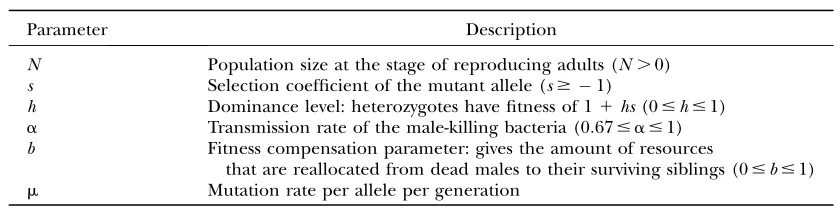
The parameters of the model are summarized in Table 1, and the variables that we use to describe properties of the host population are given in Table 2.
PERFECT TRANSMISSION
Throughout this section we assume that all offspring of infected females are again infected (i.e.,a¼1) and that daughters from infected mothers do not receive any fitness benefit through the death of their brothers (i.e.,b¼0). The assumption of perfect transmission not only is convenient for the derivation of analytic approx-imations, but also is a situation found in some natural TABLE 1
Parameters of the model
Parameter Description
N Population size at the stage of reproducing adults (N.0)
s Selection coefficient of the mutant allele (s$ 1)
h Dominance level: heterozygotes have fitness of 11hs(0#h#1) a Transmission rate of the male-killing bacteria (0:67# a #1)
b Fitness compensation parameter: gives the amount of resources
that are reallocated from dead males to their surviving siblings (0#b#1)
m Mutation rate per allele per generation
TABLE 2
Variables of the model
Variable Description
y,y* Actual and equilibrium prevalence of the male-killing bacteria
(i.e., fraction of infected females among all females in the population)
u0,uMK Fixation probability of newly arisen mutations in uninfected and male-killer-infected populations, respectively
tˆ0,tˆMK Expected times until fixation of new mutations, provided fixation occurs
˜t0,˜tMK Expected times until either fixation or extinction of new mutations
FMK,HMK Expected homozygosity and heterozygosity in a male-killer-infected population
populations infected with male-killing bacteria (e.g., Jigginset al.2002; Dysonand Hurst2004). Moreover, we assume that the prevalence of the male-killing bac-teria and the population sex ratio remain constant over the time frame under consideration.
The probability of fixation of a mutant allele: Fol-lowing Kimura (1962) the fixation probability for a newly arisen mutant allele in an uninfected population with even sex ratio can be approximated by
u0¼ Ð1=ð2NÞ
0 GðxÞdx Ð1
0 GðxÞdx
; ð1Þ
with
GðxÞ ¼exp½4Nshx2Nsð12hÞx2:
We now consider the case where the population is infected with a male-killing parasite with perfect mater-nal transmission. We assume that the prevalence of the male-killer is fixed at a proportionyof infected females among all females and the sex ratio is distorted ac-cordingly. The relative proportions of infected females, uninfected females, and uninfected males in the adult population are then given byy=ð2yÞ,ð1yÞ=ð2yÞ, andð1yÞ=ð2yÞ, respectively.
A newly arisen nuclear mutant allele will be found either in an infected female [with probabilityy=ð2yÞ] or in an uninfected individual [with probabilityð22yÞ=
ð2yÞ]. However, if the mutant allele emerges in an infected female, the chances of quick extinction are extremely high unless the allele confers a very large fitness advantage to its carrier in the heterozygous state. This is simply because nuclear genes in infected females havea prioria fitness that is only about half that of the same allele in uninfected females (see Sullivan and Jaenike2006 for a similar argument).
We can thus assume that neutral alleles, detrimental alleles, and slightly or moderately beneficial alleles will invariably become extinct when they arise in infected females. Therefore, only alleles that arise in the unin-fected proportion of the population have a chance of becoming fixed in the population. Since alleles can spread only from uninfected males to infected females, but not from infected females to uninfected individuals, the dynamics of new alleles are completely determined by the uninfected individuals in the population. Thus, building upon Equation 1, we can approximate the fixation probability of a newly arisen allele by
uMK¼ 22y
2y
Ðð2yÞ=4Nð1yÞ
0 Ð GðxÞdx 1
0 GðxÞdx
ð2Þ
with
GðxÞ ¼exp 8N1y
2yshx4N
1y
2ysð12hÞx
2
:
In this approximation, we take into account the prob-ability that a mutation occurs in an uninfected individ-ual and replace the population sizeNof Equation 1 with the number of uninfected individuals in the population, 2Nð1yÞ=ð2yÞ. Note that the sex ratio within the uninfected part of the population is even, so that no sex-ratio distortion needs to be taken into account.
Unfortunately, in general Equation 2 cannot be sim-plified. However, we can shed light on the fixation probability of nuclear alleles in populations infected with male-killers by making two specific assumptions about the selection and dominance coefficientssandh.
Neutral alleles: With s¼0, the function G(x) greatly simplifies toGðxÞ[1, yieldinguMK¼1=2N. As expected from neutral theory, this is the same fixation probability as for a neutral allele in an uninfected population.
Semidominance (h ¼0.5): For a semidominant allele, the fixation probability in an infected population sim-plifies to
uMK ¼ 22y
2y 3
1expðsÞ
1exp½4Nsð1yÞ=ð2yÞ:
It can be proved thatuMK,u0always fors.0, anduMK. u0whens, 0 (seeappendix). Thus, male-killing bac-teria hinder the spread of beneficial and foster the spread of deleterious alleles. Moreover, for large values ofNs,uMKu0ð22yÞ=ð2yÞholds;i.e., the probabil-ity that a beneficial allele becomes fixed in a sufficiently large population is approximately the fraction of un-infected individuals multiplied by the probability of fixation of the same allele in an uninfected population of the same size.
Figure 1 shows estimates of the fixation probability in populations carrying a male-killer relative to fixation probabilities in uninfected populations (i.e., uMK=u0) for different slices of the parameter space. Also shown are the average fixation rates observed in computer simulations, in which we ran at least 106simulations per data point. As can be seen, the simulation results are in very good agreement with our analytic predictions. Finally, Figure 1 gives the predictions for the fixation probability derived from the application of Wright’s equation relating effective population size to sex ratio,
Ne¼4NmNf=ðNm1NfÞ(Wright 1931). Here, the re-sulting formula in terms of the actual population sizeN
and the male-killer prevalence y, Ne ¼4Nð1yÞ= ð2yÞ2
, was inserted into the functionG(x) instead of
N in Equation 1. As can be seen, the prediction based on the skewed sex ratio is not appropriate for male-killer-infected populations.
computer simulations with randomly chosen param-eterss,h,N, andy. The results shown in Figure 2 confirm that the male-killer infection makes the fixation of dele-terious alleles more likely, and the fixation of beneficial alleles less so, across all parameter values.
Expected time until fixation:The expected time until fixation for a mutant allele in a population of sizeNwas estimated by Kimuraand Ohta(1969). As has become apparent in the previous section, for a mutant allele to
spread and become fixed in a male-killer-infected pop-ulation, it is necessary that the mutant arises and spreads in the uninfected individuals of the population. Fixa-tion within the uninfected individuals will be followed quickly by fixation of the allele within infected females, because of the strong influx of the allele each genera-tion through males. Hence, we can estimate the ex-pected time until fixation in an infected population simply as that found in an uninfected population with size equal to the uninfected fraction of the infected population. Denoting bytˆ0ðNÞthe expected time until fixation in an uninfected population of size N and by
tˆMKðN;yÞthe expected time until fixation in a popula-tion of sizeNand with male-killer prevalencey, we have
tˆMKðN;yÞ ¼tˆ0 22y 2yN
: ð3Þ
For a selectively neutral allele, the expected time until fixation in an uninfected population is tˆ0ðNÞ 4N
(Kimuraand Ohta1969). Accordingly, in an infected population we havetˆMKðN;yÞ ¼4Nð22yÞ=ð2yÞfor neutral alleles. Thus, the expected time until fixation of neutral alleles is decreased in infected compared to uninfected populations.
Expected time until either fixation or extinction: Aside from this conditional time until fixation, we can also ask what the expected time is for a mutant allele to either become fixed or be lost. Let us denote by˜t0ðNÞ the expected time until fixation or extinction of an al-lele in an uninfected population of sizeN. An approx-imate formula for˜t0ðNÞis readily derived from Kimura and Ohta(1969).
To derive an approximation for the unconditioned time a mutant allele stays polymorphic in a male-killer-infected population, it is again useful to consider the Figure1.—Fixation probabilities of nuclear mutations in male-killer-infected populations, relative to fix-ation probabilities in uninfected populations. The solid curve gives the analytic approximation, and open triangles represent fixation rates averaged over (A) 107or (B– D) 106simulations per datum. The dotted lines give fixation probability estimates based on Wright’s approx-imation for effective population size in populations with biased sex ratio. Unless varied, parameters take the valuesN¼1000,s¼0.01,h¼0.5,
y¼0.5.
different individuals the mutant allele might arise in. With probability (22y)/(2y), the mutant arises in an uninfected individual, in which case the expected time until fixation or loss can be estimated by˜t0ðð22yÞ= ð2yÞNÞ. To get an estimate for the expected time until fixation or loss when the mutant arises in an infected female, we do not attempt an approximation based on the diffusion equation, but adopt a more direct ap-proach. We assume that the fitness effects of the allele itself are negligible compared to the deleterious effect that the male-killing bacteria have on the allele’s fitness, namely a fitness reduction by one-half. The probability distribution of the frequency of the mutant allele in infected females is described by a Markov chain with transition matrix
ðPÞij¼
M=2 i
j M
i
Mj M
M=2i
ij
i;j2 0;1;. . .;M 2
;
ð4Þ
whereM :¼2Ny=ð2yÞis the number of alleles present in the infected females. ðPÞij is the probability that i
mutant alleles are present in the infected females provided that j mutant alleles were present in the previous generation. Note that the maximum number of mutant alleles present in infected females is M/2 only, because every infected female inherits one wild-type allele from her father. The probability that the allele is extinct at generationkafter the mutation event is given byðPkÞ
01. In our approximation, we consider only the first two generations, as the probability that the mutant allele survives longer than that is very low.
Putting all these considerations together, we get as an estimate for the expected time until fixation or loss of a mutant allele in a population infected with male-killers:
˜tMKðN;yÞ ¼ 22y
2y 3˜t0
22y
2yN
1 y
2y3
X‘
k¼0 kðPkÞ
01
22y
2y 3˜t0
22y
2yN
1 y
2y3
X2
k¼0 kðPkÞ
01
¼22y
2y 3˜t0
22y
2yN
1 y
2y3
M1
M
M=2
12X M=2
l¼0 M=2
l
"
3 1 M
l M1
M
M=2l Ml
M
M=2#
:
ð5Þ
Estimates for both the conditional expected time until fixation and the expected time until fixation or extinction of mutant alleles in male-killer-infected pop-ulations are shown in Figure 3, again relative to the respective expected times in uninfected populations (i.e.,tˆMK=tˆ0 and˜tMK=˜t0). Both expected times are lower
in infected than in uninfected populations and de-crease with increasing frequency of the male-killer. Also shown in Figure 3 are simulation results for the relative expected times until fixation and fixation or extinction, which are in good agreement with the analytical predictions.
Genetic variation: One measure of genetic variation in a population is the level of heterozygosity H, the proportion of heterozygous individuals in a population. This quantity is equal to 1F, whereFis the proportion of homozygous individuals in the population. Consider a locus where mutations occur at rate m, and each mutation leads to a new allele not previously present in the population (‘‘infinite-alleles model,’’ Kimura and Crow1964).
Assuming that the actual population size equals the effective population size and that all alleles are selec-tively neutral, the expected equilibrium homozygosity has then been estimated (Kimura and Crow1964) to beF0 ¼1=ð4Nm11Þ. Applying this fundamental result to a population infected with male-killing bacteria, we first note that the equilibrium homozygosity in the uninfected part of the population will be equal to the equilibrium homozygosity of an uninfected population that has the same size as the uninfected part of the infected population. This is simply because there is no gene flow from infected females to uninfected individ-uals. Thus,
Funinf ¼ 1
4½ð22yÞN=ð2yÞm11
¼ 2y
8ð1yÞNm12y: ð6Þ
population will be approximately the same as the homo-zygosity in the uninfected fraction of that population, as given in Equation 6.
Given this reasoning, the expected equilibrium heterozygosity in a male-killer-infected population is approximately
HMK¼1FMK ¼1Funinf ¼
8ð1yÞNm
8ð1yÞNm12y:
ð7Þ
Clearly, the expected genetic variability in a male-killer-infected population as measured by heterozygosity is smaller than that in an uninfected population of the same size. Figure 4 shows how the expected equilibrium heterozygosity in male-killer-infected populations de-clines with increasing prevalence of the male-killers. The decline is most notable for prevalence values.0.6; here marked reductions in heterozygosity are observed. Also shown are the results of computer simulations that confirm our analytical approximations.
IMPERFECT TRANSMISSION
In the previous section, we assumed perfect transmis-sion of the bacteria. However, in many cases, infected females also produce some uninfected offspring. Trans-mission rates ranging from 80 to 100% have been reported, although they are usually in the range of 95– 100% (Hurstand Majerus1993; Jigginset al. 2002; Dyerand Jaenike2004). Thus, let us now assume that only a proportionað0:67,a,1Þ of the offspring of infected females inherit the infection, and (1a) of the offspring are uninfected (a.0.67 is required for male-killer invasion). We also assume that surviving sib-lings of infected females receive a fitness compensation benefitbdue to the death of their brothers and relax our
previous assumption of a constant prevalence of the male-killing bacteria. We do not attempt to derive approxima-tions for the case of imperfect male-killer transmission, but rather determine by computer simulations the extent to which fixation probabilities and times until fixation and/or extinction deviate from the approximations de-rived for perfect transmission.
In a deterministic model, the polymorphic equilib-rium frequency of the male-killing bacteria (proportion of infected females among all females) is given by
y*¼3a2a 2ð1
bÞ
ba ; ð8Þ
and this equilibrium is always stable when it exists (Hurst1991). This equilibrium corresponds to the ex-pected frequency of the male-killing bacteria in our stochastic model, as long as the male-killer does not be-come extinct and the population does not go extinct due to lack of males.
How can we expect inefficient transmission to affect the population genetics of host alleles? First, given a certain frequency of the male-killing bacteria within females, decreasing transmission rates will both increase the fitness of infected females and lead to gene flux from infected females to uninfected individuals. This will result in fixation probabilities and expected times to fixation and/or extinction that lie in between the pre-dictions for an uninfected population and an infected population with perfect male-killer transmission. Sec-ond, we also need to take into account that the male-killing bacteria themselves will be subject to random genetic drift. For a given equilibrium male-killer fre-quency, drift will become stronger with increasing trans-mission rate and correspondingly decreasing fitness compensation benefitb. The impact of male-killer drift on the drift of the nuclear alleles is not straightforward to predict.
We obtained simulation estimates for fixation prob-abilities of alleles with different selection coefficients
s and dominance levelshfor varying transmission eff-iciencies, a (Figure 5). In these simulations, the ex-pected frequency of the male-killing bacteriay* was kept at a constant value with varyingaby adjusting the fitness compensation parameter b according to Equation 8. Each simulation was initiated with the male-killing bacteria at their expected frequency.
As can be seen in Figure 5, the predictions based on perfect transmission give fairly good approximations for a wide range of transmission rates ,1. For low trans-mission rates, estimates for the fixation probabilities
uMK are slightly closer tou0 than predicted by the esti-mates for perfect transmission and fixed male-killer frequency. This is in accord with the above reasoning. We also compared the average times until fixation and until fixation or extinction of alleles to the predictions based on perfect transmission (results not shown). Figure 4.—Predicted heterozygosity (lines) derived from
Again, the deviations of the simulation results from the predictions based on perfect transmission are not severe, and the direction of the deviations is toward the expected times in an uninfected population.
To determine regions of the parameter space where deviations in fixation probabilities from the analytical predictions are highest, we performed simulations with randomly chosen parameters N, s, a, and b. Plotting relative fixation probabilities against the selection co-efficientsyields a graph very similar to that in Figure 2 (not shown), confirming that imperfect transmission does not qualitatively alter our fundamental result of increased and decreased fixation probabilities of dele-terious and beneficial alleles, respectively.
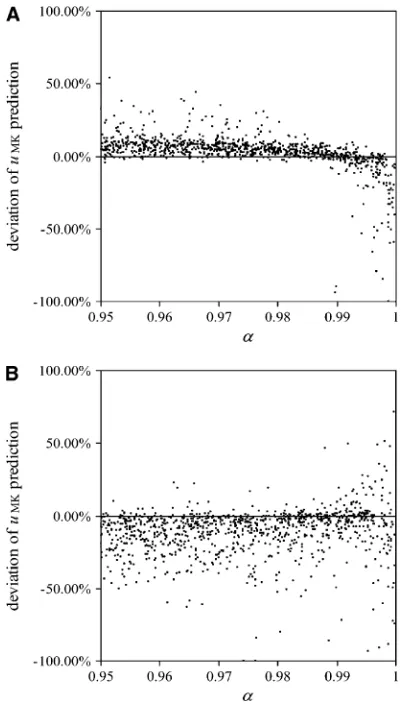
Figure 6 shows relative deviations of fixation rates yielded from these simulations from the analytical predictions with perfect transmission. For beneficial alleles (Figure 6A), most deviations are relatively small and tend to be positive, at least for low transmission rates. This means that the actual fixation rates are higher than the predictions based on the assumption of perfect transmission and thus closer to fixation probabilities in uninfected populations. However, for very high transmission rates, deviations become nega-tive, meaning that fixation rates are even lower than predicted. The strongest negative deviations are ob-served with high transmission rate and high equilibrium frequency (i.e., when bothaandbare high). This may be explained by the surmise that with male-killing bacteria drifting at high frequencies, the frequencies above the equilibrium will have a much stronger impact
than frequencies below the equilibrium. The reasoning behind this conjecture is an analogy with populations of fluctuating size, in which it has been demonstrated that the effective population size is given by the harmonic mean of population sizes and, thus, is smaller than the arithmetic mean (Kimuraand Crow1963).
For deleterious alleles (Figure 6B), deviations of fixa-tion rates from the predicfixa-tions tend to be higher than those for beneficial alleles, as can be expected from the fact that such fixation events are very rare and thus the variance of fixation rates in a finite set of simulations is much higher than that for beneficial alleles. Most deviations are negative;i.e., fixations occurred less often than predicted. Again, this is explained by the fact that Figure5.—The effect of relaxing the assumption of perfect
vertical transmission. Simulation results are given with varying rates of imperfect transmission. The plots show simulation es-timates for relative fixation rates of alleles, depending on the transmission rate of the male-killing bacteriaa. Three differ-ent allele classes have been assumed in these simulations: a beneficial semidominant allele with s ¼ 0.01 and h ¼ 0.5 (open squares), a neutral allele (solid circles), and a delete-rious recessive allele withs¼ 0.001 andh¼0 (shaded tri-angles). Each datum represents an average of 33106 simulations. Solid lines show the analytical predictions based on perfect transmission. Other parameters take the values
N¼1000 andy*¼0:5; the fitness compensation parameter
bwas varied according to transmission rate to keep equilib-rium male-killer frequency constant.
with imperfect transmission, there is allele flux from infected females to uninfected individuals and thus more efficient purging of deleterious mutations.
DISCUSSION
We have studied basic aspects of the population genetics of populations infected with male-killing bac-teria. Our results suggest that when maternal trans-mission of the bacteria is perfect and their prevalence in the population stable, the population behaves approx-imately as if it consisted of the uninfected part of the population only. This includes increased fixation prob-abilities for deleterious alleles and decreased fixation probabilities for beneficial alleles, decreased times to fixation and fixation or extinction, and reduced genetic variation. When transmission of the male-killing bacte-ria is imperfect, the effect is somewhat mitigated, but still strong.
In contrast to what might be expected at first glance, the distorted sex ratio in populations infected with male-killing bacteria is not primarily connected to these results. Rather, the reason for the effects observed is that alleles arisen in an infected female cannot spread, be-cause (1) infected females have only about half the fit-ness of uninfected females, and (2) the nucleotype of infected females is tightly linked to the male-killing cyto-type. Thus, although reproducing, the infected females in the population can be regarded as ‘‘living deads’’ [to use a metaphor framed for individuals of inferior geno-type in asexual populations (Rice 2002)], and their number has almost no impact on population genetics (see also Sullivan and Jaenike 2006). Our results can also be understood in terms of reduction of effec-tive population size due to different genetic contribu-tions of different classes within the population (e.g., Caballero 1994; Woolliams et al. 1999). In fact, a male-killer-infected population can be regarded as an extreme case of class structure: a potentially large fraction of the population, although reproducing, con-tributes either very little or nothing genetically in the long term, and this class structure is stable over a long time period, as long as infection persists.
Selection for or against alleles is not completely deter-mined by the phenotype that the allele induces, but also by linkage to other alleles. For example, recurrently arising deleterious mutations can reduce genetic vari-ability at linked neutral loci, a process known as ‘‘back-ground selection’’ (Charlesworth et al. 1993). The effect of male-killing endosymbionts is similar to back-ground selection, as both stem from linkage to delete-rious genetic elements. However, provided that their prevalence is sufficiently high, male-killing bacteria can be expected to have a stronger impact on genetic vari-ability than deleterious nuclear alleles. This is because first, linkage of all newly arisen alleles in infected
fe-males to the male-killing element is complete or at least very high. Linkage here corresponds to the vertical transmission rate of the male-killing bacteria, for which quantity values in the range of 0.8–1 have been reported in natural and laboratory populations of various insect species (Hurst and Majerus 1993 and references therein; Jiggins et al. 2002; Dyer and Jaenike2004). Second, despite their being strongly deleterious to nuclear alleles, male-killing bacteria carry a drive and can be stably maintained in populations at high fre-quencies (Dyerand Jaenike2004; Dysonand Hurst 2004). This is in contrast to deleterious nuclear alleles, which are constantly purged and usually kept at low frequencies. Combined, these two aspects are expected to result in very strong selection even against beneficial alleles when they arise in infected females and corre-spondingly in a strong reduction in neutral genetic variation and adaptability.
One assumption in our model is that changes in the prevalence do not affect the total population size. In con-trast, there may be either a positive or a negative impact of male-killer prevalence on population size, depending on the type of density-dependent population dynamics (P. Kirkby and G. D. D. Hurst, unpublished results; see also Hatcheret al.1999). Two different types of im-pacts of change in population size as a consequence of a male-killer infection need to be distinguished. First, the population size when the male-killer is at equilibrium frequency in the host population may be different from that if the population is uninfected. This is important when one is interested in how the infection of a partic-ular population with male-killing bacteria changed the population genetics of that population. On the other hand, if one is interested in how the population genetics of a male-killer-infected population deviate from the ex-pectations if it were not known that the population is infected, it is irrelevant how the equilibrium male-killer frequency affects the population size. (The former case is a comparison prior and, after infection, the latter a comparison of an infected and an uninfected popula-tion of the same size.) Second, and independent of the type of question asked, fluctuations in population size as a result of fluctuations in the male-killer prevalence need to be taken into account. Fluctuations of this kind are likely to make the effects found in our model more severe, as the effective population size will be decreased below the population size where the male-killer is at equilibrium frequency.
additionally, that some infections appear to be long lived (e.g., Dyerand Jaenike2004), and, in these cases, the hallmark of male-killer infection on the host ge-nome will be most apparent.
We can also examine the extent to which the results revealed for male-killing infections are likely to be true for other factors distorting the sex ratio. Feminization is another strategy of reproductive parasitism that is found in arthropods. The best-studied example is the wood-louse Armadillidium vulgare, which is infected by femi-nizing Wolbachia (reviewed in Rigaud1997). In some populations, the ancestral sex determination of female heterogamety has been replaced by a system where all infected individuals are females and all uninfected in-dividuals are males; the W chromosome has become extinct, so that all individuals are ‘‘genetic males’’ with a ZZ constitution. Thus, females produce offspring in a female-biased sex ratio that corresponds to the trans-mission rate of Wolbachia. Correspondingly, as with male-killer infections, the population sex ratio is female biased. However, in contrast to a male-killer infection, there is unrestricted gene flow between infected and uninfected individuals (i.e., females and males). There-fore, the effect of selection and drift on nuclear alleles will be the same as that in any uninfected population with the same population sex ratio, and applying Wright’s (1931) formula for the effective population size should be adequate. Similarly, Wright’s equations should be sufficient for describing cases of X chromo-some meiotic drive.
Our results imply that caution needs to be taken when estimating population genetic properties such as fixa-tion rates or genetic variability in arthropod populafixa-tions with biased sex ratio. Clearly, it is not sufficient to ap-ply Wright’s formula for the effective population size without determining the reason for the distorted sex ratio. In studies comparing mitochondrial with nuclear DNA variation in male-killer-infected populations (e.g., Jiggins2003; Dyerand Jaenike2004), this may lead to overestimates of mitochondrial genetic variability rela-tive to nuclear variability and, correspondingly, the age of a male-killer infection may be overestimated.
Moreover, we caution against disregarding the pecu-liar population genetics of male-killer-infected popula-tions in ESS models (e.g., Hurst and McVean1998). Whether a beneficial gene will spread or not will largely depend on its fitness impact in uninfected individuals. Taking the average of the fitness effect in infected and uninfected individuals will often produce misleading conclusions. Aside from genes that suppress male-killing (Hornettet al. 2006) we can expect adaptations bene-ficial solely in infected females to be strongly impeded if genes conferring these adaptations are maladaptive in uninfected individuals. By contrast, the evolution of traits that are adaptive for uninfected and infected indi-viduals alike (e.g., alterations in mate choice and mating behavior, as suggested by Randersonet al. 2000) will not
be impeded beyond the impediment due to decreased effective population size as reported in this article.
We thank Kelly Dyer, Kirsten Hilgenbro¨cker, Matthias Flor, and three anonymous reviewers for helpful comments on the manuscript. We acknowledge support of a University College London Graduate School Research Scholarship to J.E. and funding from the National Environment Research Council to G.H.
LITERATURE CITED
Caballero, A., 1994 Developments in the prediction of effective
population size. Heredity73:657–679.
Charlesworth, B., M. T. Morgan and D. Charlesworth,
1993 The effect of deleterious mutations on neutral molecular variation. Genetics134:1289–1303.
Dyer, K. A., and J. Jaenike, 2004 Evolutionarily stable infection by a
male-killing endosymbiont inDrosophila innubila.Genetics168:
1443–1455.
Dyson, E. A., and G. D. D. Hurst, 2004 Persistence of an extreme
sex-ratio bias in a natural population. Proc. Natl. Acad. Sci. USA
101:6520–6523.
Engelsta¨ dter, J., and G. D. D. Hurst, 2006 Can maternally
trans-mitted endosymbionts facilitate the evolution of haplodiploidy? J. Evol. Biol.19:194–202.
Fialho, R. F., and L. Stevens, 2000 Male-killingWolbachiain a flour
beetle. Proc. R. Soc. Lond. Ser. B Biol. Sci.267:1469–1473. Hatcher, M. J., D. E. Taneyhill, A. M. Dunn and C. Tofts,
1999 Population dynamics under parasitic sex ratio distortion. Theor. Popul. Biol.56:11–28.
Hornett, E. A., S. Charlat, A. M. R. Duplouy, N. Davies, G. K.
Rodericket al., 2006 Evolution of male killer suppression in
a natural population. PLoS Biol.4:e283.
Hurst, G. D. D., and F. M. Jiggins, 2005 Problems with
mitochon-drial DNA as a marker in population, phylogeographic and phy-logenetic studies: the effects of inherited symbionts. Proc. R. Soc. Lond. Ser. B Biol. Sci.272:1525–1534.
Hurst, G. D. D., and M. E. N. Majerus, 1993 Why do maternally
inherited microorganisms kill males? Heredity71:81–95. Hurst, G. D. D., and G. T. McVean, 1998 Parasitic male-killing
bac-teria and the evolution of clutch-size. Ecol. Entomol.23:350– 353.
Hurst, G. D. D., F. M. Jiggins, J. H. G. V. D. Schulenburg, D.
Bertrand, S. A. West et al., 1999 Male-killing Wolbachiain
two species of insect. Proc. R. Soc. Lond. Ser. B Biol. Sci.266:
735–740.
Hurst, G. D. D., F. M. Jigginsand M. E. N. Majerus, 2003
In-herited microorganisms that selectively kill male hosts: The hid-den players of insect evolution?, pp. 177–198 inInsect Symbiosis, edited by K. Bourtzisand T. A. Miller. CRC Press, Boca Raton,
FL.
Hurst, L. D., 1991 The incidences and evolution of cytoplasmic
male killers. Proc. R. Soc. Lond. Ser. B Biol. Sci.244:91–99. Jaenike, J., K. A. Dyer and L. K. Reed, 2003 Within-population
structure of competition and the dynamics of male-killing Wolba-chia.Evol. Ecol. Res.5:1023–1036.
Jiggins, F. M., 2003 Male-killingWolbachiaand mitochondrial DNA:
selective sweeps, hybird introgression and parasite population dy-namics. Genetics164:5–12.
Jiggins, F. M., and M. C. Tinsley, 2005 An ancient mitochondrial
polymorphism inAdalis bipunctatalinked to a sex-ratio-distorting bacterium. Genetics71:1115–1124.
Jiggins, F. M., G. D. D. Hurstand M. E. N. Majerus, 2000
Sex-ratio-distortingWolbachiacauses sex-role reversal in its butterfly host. Proc. R. Soc. Lond. Ser. B Biol. Sci.267:69–73.
Jiggins, F. M., J. P. Randerson, G. D. D. Hurst and M. E. N.
Majerus, 2002 How can sex ratio distorters reach extreme
prevalences? Male-killingWolbachiaare not suppressed and have near-perfect vertical transmission efficiency in Acraea encedon.
Evolution56:2290–2295.
Johnstone, R. A., and G. D. D. Hurst, 1996 Maternally inherited
Kimura, M., 1962 On the probability of fixation of mutant genes
in a population. Genetics47:713–719.
Kimura, M., and J. F. Crow, 1963 The measurement of effective
population number. Evolution17:279–288.
Kimura, M., and J. F. Crow, 1964 The number of alleles that can be
maintained in a finite population. Genetics49:725–738. Kimura, M., and T. Ohta, 1969 Average number of generations
un-til fixation of a mutant allele in a finite population. Genetics61:
763–771.
Montenegro, H., W. N. Souza, D. D. Leiteand L. B. Klaczko,
2000 Male-killing selfish cytoplasmic element causes sex-ratio distortion inDrosophila melanogaster.Heredity85:465–470. Normark, B. B., 2004 Haplodiploidy as an outcome of coevolution
between male-killing cytoplasmic elements and their hosts. Evo-lution58:790–798.
Randerson, J. P., F. M. Jigginsand L. D. Hurst, 2000 Male killing
can select for male mate choice: a novel solution to the paradox of the lek. Proc. R. Soc. Lond. Ser. B Biol. Sci.267:867–874. Rice, W. R., 2002 Experimental test for the adaptive significance of
sexual recombination. Nat. Rev. Genet.3:241–251.
Rigaud, T., 1997 Inherited microorganisms and sex determination
of arthropod hosts, pp. 81–102 inInfluential Passengers: Inherited Microorganisms and Invertebrate Reproduction, edited by S. L. O’Neill, A. A. Hoffmannand J. H. Werren. Oxford University
Press, New York.
Schulenburg, J. H. G. V. D., G. D. D. Hurst, D. Tetzlaff, G. E.
Booth, I. A. Zakharovet al., 2002 History of infection with
dif-ferent male-killing bacteria in the two-spot ladybird beetleAdalia bipunctatarevealed through mitochondrial DNA sequence anal-ysis. Genetics160:1075–1086.
Sullivan, J., and J. Jaenike, 2006 Male-killingWolbachiaand male
mate choice: a test withDrosophila innubila.Evol. Ecol. Res.8:
91–102.
Telschow, A., J. Engelsta¨ dter, N. Yamamura, P. Hammerstein
and G. D. D. Hurst, 2006 Asymmetric gene flow and
con-straints on adaptation caused by sex ratio distorters. J. Evol. Biol.
19:869–878.
Werren, J. H., S. W. Skinnerand A. M. Huger, 1986 Male-killing
bacteria in a parasitic wasp. Science231:990–992.
Williamson, D. L., and D. F. Poulson, 1979 Sex ratio organisms
(Spiroplasmas) of Drosophila, pp. 175–208 inThe Mycoplasmas, edited by R. F. Whitcomb and J. G. Tully. Academic Press,
New York.
Woolliams, J. A., P. Bijma and B. Villanueva, 1999 Expected
genetic contributions and their impact on gene flow and genetic gain. Genetics153:1009–1020.
Wright, S., 1931 Evolution in Mendelian populations. Genetics16:
97–159.
Zeh, D. W., J. A. Zehand M. Bonilla, 2005 Wolbachia, sex ratio bias
and apparent male killing in the harlequin beetle riding pseudo-scorpion. Heredity95:41–49.
Communicating editor: D. M. Rand
APPENDIX
In what follows we demonstrate that in the case of semidominance (h¼1
2) and perfect transmission of the male-killer, the fixation probability of a positively selected mutant allele is always lower in an infected than in an uninfected population; i.e., uMK,u0. We have
u0¼
1expðsÞ
1expð2NsÞ ðA1Þ
resulting from Equation 1 and
uMK ¼ 22y
2y 3
1expðsÞ
1exp½4Nsð1yÞ=ð2yÞ ðA2Þ
from Equation 2. Lets.0 and 0,y,1 be true, and let
A:¼2Ns(A.0) andB:¼ ð22yÞ=ð2yÞ(0,B,1). ThenuMK,u0is equivalent to
1BexpðABÞ1BexpðAÞ.0: ðA3Þ
The left side of this equality is zero forA¼0. Also, the derivative of the left side with respect to A,