ISSN(Online): 2319-8753 ISSN (Print): 2347-6710
I
nternational
J
ournal of
I
nnovative
R
esearch in
S
cience,
E
ngineering and
T
echnology
(An ISO 3297: 2007 Certified Organization)
Website: www.ijirset.com
Vol. 6, Issue 6, June 2017
Evaluation of Properties of Cinder As a
Replacement for Aggregate in the Construction of
Base and Subbase Layers of Pavement
Subash G.C 1, Sushmitha R1, Suresh K.B1, Mipe Sora1, Gowtham B2
U.G Student, Department of Civil Engineering, Sai Vidya Institute of Technology, Bengaluru, Karnataka, India1
Assistant Professor, Department of Civil Engineering, Sai Vidya Institute of Technology, Bengaluru, Karnataka, India2
ABSTRACT: Cinder is a highly porous pyroclastic material and is vitric in nature and does meet the conventional road base and subbase specification. Cinder dust can be a replacement for fine aggregates for both construction industries as well as for road construction. Results & analysis shows that the gravelly cinder does satisfy the CBR strength requirements specified by code, (≥ 20% for Low volume roads and ≥ 30% for High volume roads). The CBR
value of Grading III (mix design 1, 2 & 3) and materials found sufficient to be used as sub base course for Low volume roads and High volume roads respectively.Replacing aggregates with cinder by 50% will reduce 6.5 lakh of overall construction cost of the pavement. It is possible to conserve more quantity of aggregate, but the same affect the performance of the road in long run.
KEYWORDS: Cinder, Aggregates, CBR, Gradation.
I. INTRODUCTION
Transport is a key infrastructure of a country. The rate at which a country’s economy grows is very closely linked to the rate at which the transport sector grows. To meet the demands of industrialization and urbanization high volume of road network is required and construction methods should be done in a manner so as to achieve good roads with minimum expenditure. Performance of the roads depends on the structural components such as subgrade, subbase, base and surface courses. Presently conventional materials required for construction of roads are insufficient at many locations. Recent years coarse aggregate has become most precious material in civil engineering works and hence it has become scarce and most expensive along with fine aggregates. Using these conventional materials the road construction end up with the uneconomical pavement construction. Hence it is necessary to find the alternative materials for economical road construction. Cinder is a highly porous pyro elastic material and is vitric in nature and does meet the conventional road base and subbase specification. The suitability of a cinder for a particular use should be determined based on its engineering characteristics and not on visual inspection or apparent similarities to other coarse aggregate. The consideration presented in the study is to explore the cinder and its properties and its replacement on conventional coarse aggregate for road construction works.
II. REVIEW OF THE LITERATURE
Experimental use of cinder gravels on roads in Ethiopia
D.Newill & R.Robinson Transport and Road Research Laboratory, Crowthorne, Berkshire, UK Kassaye Aklilu EthiopianT ransport Construction Authority, Addis Ababa
ISSN(Online): 2319-8753 ISSN (Print): 2347-6710
I
nternational
J
ournal of
I
nnovative
R
esearch in
S
cience,
E
ngineering and
T
echnology
(An ISO 3297: 2007 Certified Organization)
Website: www.ijirset.com
Vol. 6, Issue 6, June 2017
200 vpd for 7Y 2 years giving a total of 440,000 Msa in one direction. Monitoring was carried out by taking quantitative measurements of. The performance of the road pavement throughout this period. As a result of the study, recommendations are made for the use of cinders in both paved and unpaved roads. For unpaved roads, recommendations are made for a particle size distribution which provides a road surface that is resistant to corrugations. Improved performance can be obtained by mechanically stabilising cinders with plastic fines. For paved roads, it is concluded that the types of materials used in this experiment are all capable of carrying in excess of 400,000 Msa when sealed with a surface dressing and designed according to Road Note 31. Ready mixed asphalt is not a suitable surfacing for cinder gravels. In addition to the cinders, other materials also performed satisfactorily including a dry bound macadam, an agglomerate and a tuff. Cinders are easier to compact when they are mechanically stabilized with 10 percent of volcanic ash soil.
III. OBJECTIVE
1. To evaluate engineering properties of cinder
2. To investigate effectiveness and suitability of the cinder as a pavement construction material (Base and Subbase) at different blending percentage with aggregate as specifications suggested by IRC.
3. To find out optimum blending percentage of cinder.
4. Cost analysis of pavement construction before blending and after blending with cinder.
IV.MATERIALSANDMETHODOLOGY
The following are the various materials used in the present study. 1. Aggregate
2. Aggregate dust 3. Cinder
4. Cinder dust 5. Cement
METHODOLOGY
1. Evaluation of physical properties and characterization of cinder, aggregate and cinder mixed aggregate.
Aggregate and cinder samples of 40mm and 20mm down size are collected and sampled materials are characterized for the following properties,
1. Aggregate impact value 2. Specific gravity 3. Water absorption
4. Flakiness and elongation index
2. Evaluation of strength properties of an aggregate and cinder mixed aggregate at different proportions.
Aggregate are mixed with different proportion of cinder and tested to analyze the strength and hardness properties as mixed proportion must achieve required values specified by IRC to use it in the construction of base and sub base layers.
1. Crushing test 2. Compaction test 3. CBR
ISSN(Online): 2319-8753 ISSN (Print): 2347-6710
I
nternational
J
ournal of
I
nnovative
R
esearch in
S
cience,
E
ngineering and
T
echnology
(An ISO 3297: 2007 Certified Organization)
Website: www.ijirset.com
Vol. 6, Issue 6, June 2017
3. Combined gradation for subbase and base design [Grading-III] at different proportion of cinder mixed aggregate.
The effect of different mix designs with various additives blended with cinder and aggregates are studied in terms of consistency Limits, Compaction, California Bearing Ratio (CBR) and Permeability.
4. Compilation of all the results and suggesting suitable proportion of cinder and aggregate as it suits in the construction of base and subbase layer of the pavement.
5. Cost analysis of construction of base and subbase layers for aggregates alone and cinder mixed aggregates.
V. EXPERIMENTAL RESULTS
The proportioning of aggregates and blending of filler materials to produce the required gradation is achieved in the laboratory by “Job Mix Formula”. Gradation requirements of coarse graded granular sub base for grading III are satisfied according to IRC: SP: 20-2002. To satisfy the grading limits, individual and combined gradation of 20 mm down size aggregates for grading III is considered along with cinder and other filler materials. The effect of different mix designs with various additives blended with cinder and aggregates are studied in terms of consistency Limits, Compaction, California Bearing Ratio (CBR) and Permeability.
Table:1 Physical Properties of the coarse aggregates
Test Average ValuesIn % IRC &MoRT&HSpecified Values
(Shall not be less then in %)
Aggregate Impact Test 29.44 30
Crushing Test 34.22 30
Abrasion Test 35.84 40
Specific Gravity 2.74 2.5
Flakiness Index 11.05 15
Elongation Index 20.3 20
Table:2 Physical Properties of the Cinder aggregates
Test Average Values In % IRC & MoRT&H Specified values
(Shall not be less then in %)
Aggregate Impact Test 30 30
Crushing Test 31.35 30
Abrasion Test 37.87 40
Specific Gravity 2.48 2.6
Table:3 Gradation requirement for open graded Granular Sub-base course(SP: 20-2002) & (IRC: 37-2012)
IS Sieve Size Mm
% by weight Passing the IS Sieve
Grading III
53 --
ISSN(Online): 2319-8753 ISSN (Print): 2347-6710
I
nternational
J
ournal of
I
nnovative
R
esearch in
S
cience,
E
ngineering and
T
echnology
(An ISO 3297: 2007 Certified Organization)
Website: www.ijirset.com
Vol. 6, Issue 6, June 2017
4.75 25-45
2.36 --
0.425 --
0.075 <10
Table:4 Combined gradation Mix design to study the suitability of compaction, strength and drainage parameters for sub base course
Particulars Mix Design % of Materials Test Conducted
Grading III
(20mm Down Size
Aggregates)
Mix Design 1 A – 75% AD – 25%
Combined gradation,
Compaction, CBR,
Permeability
Mix Design 2 C – 75% CD – 25%
Combined gradation,
Compaction, CBR,
Permeability
Mix Design 3
A – 50%
C – 25%
CD – 25%
Combined gradation,
Compaction, CBR,
Permeability
Note: A-Aggregate, AD- Aggregate Dust, C-Cinder, CD-Cinder dust.
4.1 Mix design 1: In this conventional mix design to meet the gradation requirements of grading III limits, 20 mm down size aggregates and 4.75mm down size aggregate dust has been used. Aggregates of 75% and Aggregate dust of 25% by the total weight of the mix were found sufficient to meet the gradation requirements. The details of combined gradation are shown in Table 5
.
Table:5 Combined Gradation for Mix design 1 (Grading III)
AGGREGATES (%) AGGREGATES DUST (%)
Sieve Size % Passing 75 % Passing 25 Obtained
Gradation
Specified
Gradation
26.5mm 100 75 100 25 100 100
4.75mm 6.07 4.55 100 25 29.55 25.55
2.36mm -- -- -- -- -- --
425μ m -- -- -- -- -- --
ISSN(Online): 2319-8753 ISSN (Print): 2347-6710
I
nternational
J
ournal of
I
nnovative
R
esearch in
S
cience,
E
ngineering and
T
echnology
(An ISO 3297: 2007 Certified Organization)
Website: www.ijirset.com
Vol. 6, Issue 6, June 2017
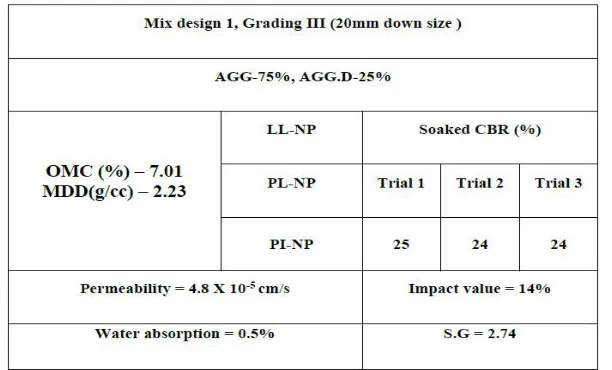
Table:6 Consistency limits, Compaction, CBR, Permeability values of Mix design1 (Grading III)
Comment: Table 6 shows the Consistency limits, Compaction, CBR, andPermeability values of Mix design 1. The average 4 days soaked CBR values obtained for the design mix is 25% and is found to be sufficient to be used as a granular sub base material for high volume roads. The material is found to non-plastic thus eliminates the possibilities of swelling and shrinkage.
4.2 Mix design 2: In this mix design 75% of 20 mm down size Cinder and 25% of Cinder dust has been used to achieve the gradation. Details of the mix design results is out lined in Table 7.
Table:7 Combined Gradation for Mix design 2 (Grading III)
CINDER (%) CINDER DUST(%)
Sieve Size % Passing 75 % Passing 25 Obtained
Gradation
Specified Gradation
26.5mm 100 75 100 25 100 100
4.75mm 11.4 8.5 100 25 33.5 25-45
2.36mm ….. ….. ….. ….. ….. …..
425 μ
ISSN(Online): 2319-8753 ISSN (Print): 2347-6710
I
nternational
J
ournal of
I
nnovative
R
esearch in
S
cience,
E
ngineering and
T
echnology
(An ISO 3297: 2007 Certified Organization)
Website: www.ijirset.com
Vol. 6, Issue 6, June 2017
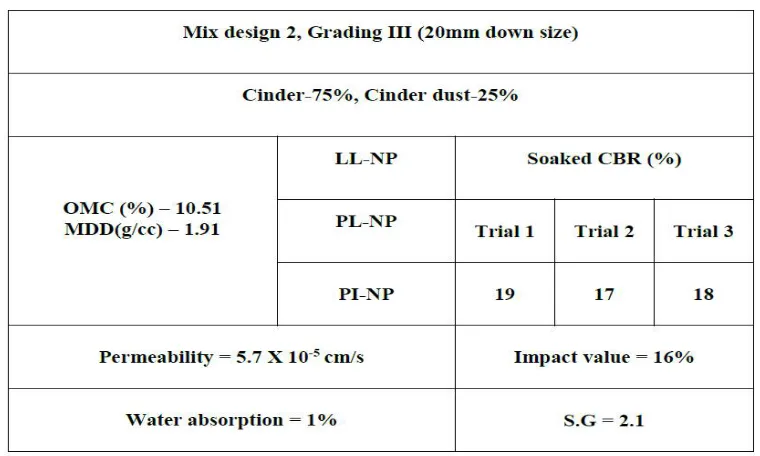
Table:8 Consistency limits, Compaction, CBR, Permeability values of Mix design 2 (Grading III)
Comment: Table 8 shows the Consistency limits, Compaction, CBR and Permeability values of Mix design 2. The average 4 days soaked CBR values obtained for the mix design 2 is about 20% and is sufficient to be used as a granular sub base material for low volume roads. This mix design is also found to be non-plastic.
4.3 Mix design 3: In this mix design of 50% of 20 mm down size aggregates, 25% of cinder, 25% of cinder dust has
been used to meet the Grading III specifications. The details of combined gradation are tabulated in Table 9.
Table:9 Combined Gradation for Mix design 3 (Grading III)
AGGREGATES (%) Cinder (%) CINDER DUST (%)
Sieve Size
% Passing 50 %
Passing
25 % Passing 25 Obtained Gradation
Specified Gradation
26.5mm 100 100 100 100 100
4.75mm
2.36mm ... ... ... ... ... ... ... ...
425 μ ... ... ... ... ... ... ... ...
ISSN(Online): 2319-8753 ISSN (Print): 2347-6710
I
nternational
J
ournal of
I
nnovative
R
esearch in
S
cience,
E
ngineering and
T
echnology
(An ISO 3297: 2007 Certified Organization)
Website: www.ijirset.com
Vol. 6, Issue 6, June 2017
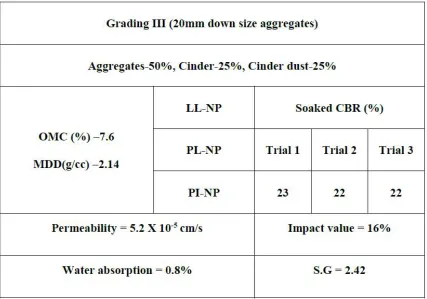
Table:10 Consistency limits, Compaction, CBR, Permeability values of Mix design 3 (Grading III)
Comment: Table 10 shows the Consistency limits, Compaction, CBR, and Permeability values of Mix design 3. The average 4 days soaked CBR values obtained for the design mix is 23% and is found sufficient to be used as a granular sub base material for high volume roads.
Summary: It is possible to replace about half a portion of conventional aggregates by cinder to meet the grading requirements, but the major drawback is its brittleness. The permeability characteristics of all the mix designs are found to be satisfactory. Among the various mix designs studied in the present investigation, Mix design 1 and 3 are sufficient to be used as a sub base course for high volume roads and mix design 2 is sufficient to be used as a sub base for low volume roads.
VI.COST COMPARISON
5.1 Pavement design for obtained CBR value
(a) Wearing course – Bituminous Concrete (BC) =50 mm
(b) Binder course – Dense Bituminous Macadam (DBM) =150mm
(c) Granular Base – Wet mix Macadam (WMM) =250 mm
(d) Granular Sub-base = 200 mm
(e) Subgrade = 500 mm
ISSN(Online): 2319-8753 ISSN (Print): 2347-6710
I
nternational
J
ournal of
I
nnovative
R
esearch in
S
cience,
E
ngineering and
T
echnology
(An ISO 3297: 2007 Certified Organization)
Website: www.ijirset.com
Vol. 6, Issue 6, June 2017
Table:11 Cost comparison of conventional aggregate sub-base and cinder-aggregate sub-base
Sub-base Condition Design Method Total Amount
(crores) Saving per Km (lakhs) Conventional
Aggregate Sub-base
IRC: 37-2012
1.71
6.5 Cinder-Aggregate
sub-base 1.645
Table 11 shows, the inclusion of Cinder-Aggregate in sub-base layer as a replacement for conventional road aggregates of about 50% by its total volume resulting in an economical pavement construction with the saving of about Rs 6.5 lakhs per km stretch of road. A portion of cinder can also be replaced in base course to have an overall economical pavement construction.
VII. CONCLUSION
As per IRC & MoRT&H the physical properties of the Cinder aggregates meet the requirements of the Conventional aggregates hence it can be used as the replacement with Coarse aggregates.
From the studies it has been concluded that, addition of cinder to considerable proportions to the aggregate does satisfy code specifications (Liquid Limit ≤ 25% and Plasticity Index ≤6%), but cinder alone as sub base might not
perform better as in comparison with conventional aggregate roads.
Cinder dust can be a replacement for fine aggregates for both construction industries as well as for road construction.
Cinder-Aggregate mixture found to be effective in conserving 20% of aggregates, which might result in an economical pavement construction, but the performance of the pavement for long run cannot be guaranteed and found to be risky.
Replacing aggregates with cinder by 50% will reduce 6.5 lakh of overall construction cost of the pavement. It is
possible to conserve more quantity of aggregate, but the same affect the performance of the road in long run.
Cinder can also be included in the construction of other layers which would result in more economical pavement construction.
REFERENCES
1. D.Newill, R.Robinson (1984), “Experimental use of cinder gravels on roads in Ethiopia”, Journal of materials in Civil Engineering, ASCE/089 2. A.U. Ravi Shankar, Harisha Kumara Rai, Ramesha Mithanthaya (2009), “ Bio-enzyme stabilized lateritic soil as a highway material”, Journal of the Indian Road Congress, Paper No. 553
3. Agapitus Amadi (2010), “Permeability of lateritic soil treated with lime and fly ash”, Federal University of Technology, AU J.T 12(2):115-120. 4. D.V.Bhavanna Rao (2009), “A technical presentation on IRC: SP- 20-2002 - Guide Lines and Construction of Rural Roads”, http://www.scribd.com/doc/83024781/IRC-SP-20-2002-Guide-Lines-and-Construction-of-Rural-Roads.
5. David A Alao (1982), “ Geology and engineering properties of laterities from Nigeria”, Esilver science publishers,19(1982/83)111-118.
6. Emmanuel Sunday Ajayi (2012), “Effect of Lime Variation on the Moisture Content and Dry Density of Lateritic Soil in Ilorin, Nigeria”, International Journal of Forest, Soil and Erosion, volume 2, No 4 (2012)
7. Eze-Uzomaka, Osondu Johnson (2012), “Suitability of Quarry Dust as Improvement to Cement Stabilized- Laterite for Road Bases”, EJGC, Vol. 15 [2010], Bund.
8. Onyelowe, Ken (2012), “Geophysical Use of Quarry Dust (As Admixture) As Applied to Soil Stabilization And Modification-A Review”, ARPN Journal of Earth Sciences, VOL. 1, NO. 1, OCTOBER 2012.
9. Technical Bulletin (2002), “Road Construction-Hydrated Lime and Quicklime”.