Application of Fuzzy Graph Coloring in
Traffic Light Problem
Rakesh Jaiswal1 , Shweta Rai 2
Assistant Professor, Dept. of Mathematics & Statistics, Christian Eminent College, DAVV, Indore, MP , India1,2
ABSTRACT: Let G= (V,E,σ,μ) be a simple connected undirected fuzzy graph. In this paper, we use a fuzzy graph
model to represent a traffic network of a city and discuss a method to find the different type of accidental zones in a traffic flows. This paper is based on fuzzy coloring of fuzzy graphs and fuzziness of vertices. Using this approach, we can minimize the total waiting time of a traffic flow. It will help to reduce the traffic jam of a road.
KEYWORDS: Fuzzy graphs, fuzzy graph coloring, traffic lighting
I. INTRODUCTION
Fuzzy graphs were introduced by Rosenfeld [2], ten years after Zadeh’s landmark paper‘‘Fuzzy Sets” [8]. Fuzzy graph theory is now finding numerous applications in modern science and technology especially in the fields of information theory, neural network, expert systems, cluster analysis, medical diagnosis, control theory, etc. Rosenfeld has obtained the fuzzy analogues of several basic graph-theoretic concepts like bridges, paths, cycles, trees and connectedness and established some of their properties [8]. Bhattacharya [11] has established some connectivity concepts regarding fuzzy cut nodes and fuzzy bridges. Arindam Dey and Anita Pal 170 In graph theory, arc analysis is not very important as all arcs are strong in the sense of [4]. But in fuzzy graphs it is very important to identify the nature of arcs and no such analysis on arcs is available in the literature except the division of arcs as strong and non strong in [12]. Depending on
the strength of an arc, the authors Sunil Mathew and Sunitha[13] classify strong arcs into two types namely α -strong
and β-strong and introduce two other types of arcs in fuzzy graphs which are not strong and are termed as δ and δ* arcs.
Graph coloring is one of the most important concepts in graph theory and is used in many real time applications like job scheduling, aircraft scheduling, computer network security, map coloring and GSM mobile phone networks, automatic channel allocation for small wireless local area networks. The proper coloring of a graph is the coloring of the vertices with minimal number of colors such that no two adjacent vertices should have the same color. The minimum number of colors is called as the chromatic number and the graph is called properly colored graph. The fuzzy coloring of a fuzzy graph was defined by the authors in Eslahchi and Onagh [9]. Then Pourpasha [10] also introduced different approaches to color the fuzzy graph.
II. PRELIMINARY NOTES
In this Section, we present some definitions related to fuzzy graph and their properties.
Definition A:[17]
A fuzzy set defined on a non empty set X is the family = {( , ( ))/ ∈ }, where ∶ → is the membership function. In classical fuzzy set theory the set is usually defined as the interval [0,1] such that ( ) =
0∶ ∉
1∶ ∈
Definition B:
Let be a finite nonempty set. The triple Ĝ = ( , , ) is called a fuzzy graph on where and are fuzzy sets on and , respectively, such that ( )≤ ( )Ʌ ( ) for all , ∈ and ∈ . For fuzzy graph Ĝ =
( , , ),the elements and are called set of vertices and set of edges of respectively.
Definition C:
A fuzzy graph Ĝ = ( , , ) is called a complete fuzzy graph if ( ) = ( )Ʌ ( ) for all , ∈
and ∈ . We denote this complete fuzzy graph byĜ .
Definition D:
Two vertices and in Ĝ are called adjacent if (½)[ ( ) Ʌ ( )] ≤ ( ).
Definition E:
The edge of Ĝ is called strong if and are adjacent. Otherwise it is called weak.
Definition F:
A family = { , , … . . , } of fuzzy sets on is called a k-fuzzy coloring of Ĝ = ( , , ) if a) Ʌ =
b) ˄ = 0
c) For every strong edge of Ĝ, ( )˄ ( ) = 0 1 ≤ ≤ .
The above definition of k-fuzzy coloring was defined by the authors Eslahchi and Onagh [1] on fuzzy set of vertices.
III TRAFFIC LIGHTS PROBLEM AND ITS SOLUTION USING FUZZY GRAPH COLOURING[16]
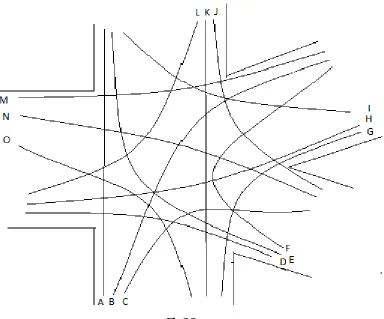
Fig 3.1
vertex A B C D E F G H I J K L M N O
Membership value
L M H L L M M H H L M M L L M
Fig 3.2
In this paper, we represent each possibility of accident with an edge and their membership value. Membership values of edges are given below in Table 2.
Edge AD AH AL AM AN AO BD BE BH BI
Membership value M L L L L L L L H H
Edge BJ BK BN BO CD CE CF CG CK CO
Membership value L M L M M M H H H H
Edge DJ DK DO EG EH EK EL EM EN FG
Membership value L L L L M L L L L M
Edge FH FI FJ FN GJ GN HJ HK HN HO
Membership value H H L L L L M H M H
Edge IJ IK IL IM JM KM KN LM LN LO
Membership value M H H M L L L L L M
Table 2: Membership values of the edges
The fuzzy graph Ĝ = ( , , ) corresponding to our example is defined as follow:
( ) =
= , , , , ,
= , , , , ,
= , , 0 ℎ
( , ) =
⎩ ⎪ ⎨ ⎪
⎧ , = { , , ,, ,, ,, ,, ,, ,, ,, ,, ,} , , , , , ,
, = {AD, BK, BO, CD, CE, EH, FG, HJ, HN, IJ, IM, LO}
, = {BH, BI, CF, CG, CK, CO, FH, FI, HK, HO, IK, IL}
The fuzzy graph for above problem is shown below
Let Let = { , , … . . , } be a family of fuzzy set defined on where
( ) =
, =
, =
, =
, ℎ
, ( ) =
, = ,
, =
, ℎ
, ( ) =
, =
, = ,
, ℎ
( ) =
, =
, = ,
, ℎ
, ( ) =
, = ,
, =
, ℎ
Thus we get a efficient way of designing the traffic signal pattern which consist of five phases as follow
1. Traffic light pattern
Phase I Only A, B, C proceeds
Phase II Only D, E, F proceeds
Phase III Only G, H, I proceeds
Phase IV Only J, K, L proceeds
Phase V Only M, N, O proceeds
Since the number of vehicles in all the path are not equal, therefore we need minimum time duration for low traffic flow, maximum time duration for high traffic flow and medium time duration for medium traffic flow. But in these type of traffic light pattern waiting time for each phase is more, due to these total waiting time of vehicles will be more. To minimize the waiting time for vehicles we can follow the following traffic light pattern
Let Let = { , , … . . , } be a family of fuzzy set defined on where
( ) = , = , , , ℎ , ( ) = , = , , , ℎ , ( ) = , = , , , ℎ ( ) = , = , , , ℎ , ( ) = , = , , , ℎ ,
Here we can see that the family = { , , … . . , }also satisfies the conditions of definition of fuzzy graph coloring. Now new traffic light pattern is as follow
2. Traffic light pattern
Phase I Only A, E, J proceeds
Phase II Only B, F, L proceeds
Phase III Only D, M, N proceeds
Phase IV Only G, K, O proceeds
Phase V Only C, H, I proceeds
IV. CONCLUSION
In the concept of crisp incompatibly among the nodes of graph we cannot describe the vagueness or partial information about a problem. In this paper, we represent the traffic flows using a fuzzy graph whose vertices and edges both are fuzzy vertices and fuzzy arcs. So we can describe vagueness in vertices and also in edges. With the help of these type of fuzzy graph colouring we can minimize the waiting time of vehicles.
REFERENCES 1. J. N. Mordeson and C.S.Peng, Operations on fuzzy graphs, Information Sciences, 79 (1994),
2. A. Rosenfield, Fuzzy graphs, In Fuzzy Sets and their Applications to Cognitive and Decision Processes, Zadeh. L.A., Fu, K.S., Shimura, M., Eds; Academic Press, New York (1975) 77-95.
3. R.T.Yeh and S.Y.Bang, Fuzzy relations, Fuzzy graphs and their applications to clustering analysis, In Fuzzy Sets and their Applications to Cognitive and Decision processes, Zadeh, L.A., Fu, K.S., Shimura, M., Eds; Academic press, New York (1975) 125-149.
4. P.Bhattacharya and F.Suraweera, An algorithm to compute the max-min powers and property of fuzzy graphs, Pattern Recognition Lett., 12 (1991) 413-20.
5. K.R. Bhutani, On automorphisms of fuzzy graphs, Pattern Recognition Lett., 9(1989),159- 162. 6. J.N.Mordeson, Fuzzy line graphs, Pattern Recognition Lett., 4 (1993), 381-384.
7. S. Lavanya and R. Sattanathan, Fuzzy total coloring of fuzzy graphs, International Journal of Information Technology and Knowledge Management,(2009), 37-39.
8. Lotfi.A.Zadeh, Fuzzy sets, Inform and Control, 8(1965), 338-353.
9. Ch. Eslahchi and B. N. Onagh, Vertex strength of fuzzy graph, Hindawi Publishing Corporation,(2006).
10. D.A. Mojdeh and M. M. Pourpasha, Fuzzy defining number of the edge fuzzy graph, International mathematical forum, 2, (2007),893-904 11. P. Bhattacharya, Some remarks on fuzzy graphs, Pattern Recognition Letters,6(1987), 297–302.
13. S.Mathew and M.S. Sunitha, Types of arcs in a fuzzy graph, Information Sciences, 179 (2009), 1760–1768.
14. M.Blue, B.Bush and J.Puckett, Unified approach to fuzzy graph problems, Fuzzy Sets and Systems, 125 (2002), 355–368.
15. Senthilraj. S, “Fuzzy Graph Application of Job Allocation”, International Journal of Engineering &Innovative Technology, Vol.1, 2012. 16. Arinam Dey and Anita Pal “Fuzzy Graph Coloring Technique to Classify the Accidental Zone of a Traffic Light” Annals of pure and Applied Mathematics, Vol. 3, No. 2,2013, 169-178.