Image Annotation with ISO-Space:
Distinguishing Content from Structure
James Pustejovsky and Zachary Yochum
Brandeis University Waltham, Massachusetts USA
{jamesp,zyocum}@cs.brandeis.edu
Abstract
Natural language descriptions of visual media present interesting problems for linguistic annotation of spatial information. This paper explores the use of ISO-Space, an annotation specification to capturing spatial information, for encoding spatial relations mentioned in descriptions of images. Especially, we focus on the distinction between references to representational content and structural components of images, and the utility of such a distinction within a compositional semantics. We also discuss how such a structure-content distinction within the linguistic annotation can be leveraged to compute further inferences about spatial configurations depicted by images with verbal captions.
Keywords:linguistic annotation, ISO-Space, image annotation, image description, spatial relations, spatial reasoning
1.
Introduction
Image annotation involves the identification of objects in a scene and the spatial relations that exist between them. Im-ages, landscapes, and scenes pose an interesting challenge for spatial description languages, as they involve a fixed frame of reference, and the description of the objects and their positions is relative to this frame. This is quite differ-ent from news articles and narratives, where the description is of events from no fixed frame of references. In this pa-per, we illustrate the challenges faced by interpreting the verbal descriptions associated with images, and how a gen-eral specification language for spatial information, such as ISO-Space, can help in distinguishing thestructural prop-erties of the image from thecontentproperties, denoted by the linguistic expressions. This, in turn, allows us to make a restricted number of compositionally derived inferences, relating content and structure in the image.
The annotation of images with natural language descrip-tions has been the focus of attention within several re-search areas, in particular, content-based image retrieval (CBIR). One approach is to examine the different ways that geo-referenced images can be described using geography (Purves et al., 2008; Edwardes et al., 2007), while another elicits human inputs withom interactive games (von Ahn and Dabbish, 2004; Von Ahn and Dabbish, 2008). Much of the work on text-based image retrieval has relied on ex-tracting information about the image from image captions, as well as the surrounding text and related metadata, such as filenames and anchor text extracted from the referring web pages, as for example, in Yahoo!’sImage Search(Datta et al., 2008; Klavans et al., 2008; Salway et al., 2008). Another kind of image annotation data has become avail-able with the rise of “citizen geography”. User-annotated geo-referenced digital photo collections allowing for im-age content labeling and annotation are being generated in distributed environments, such as Flickr and GoogleEarth. Images are indexed with user-supplied labels that typically form a particular language subset (Grefenstette, 2008). Other techniques have recently emerged for boosting im-age annotation performance using textual features (Feng
and Lapata, 2008; Leong and Mihalcea, 2009), as well as the use of crowdsourcing strategies (Rashtchian et al., 2010). In addition to these approaches, some recent work focuses on linking annotations in the image more closely to the textual description in the caption (Elliott and Keller, 2011; Elliott and Keller, 2013). (Kordjamshidi et al., 2010) approach the task of image annotation as one of spatial role labeling. The annotation scheme they employ involves identifying and classifying certain elements of a text as spa-tial arguments and then relating these arguments to each other. Spatial role labeling is analogous to semantic role labeling. The related specification is referred to as Holis-tic Spatial SemanHolis-tics (HSS) because the complete utterance rather than an isolated word is the main unit of analysis. In practice, this means that annotation is performed at the sen-tence level. For annotating images described by captions, (Kordjamshidi et al., 2010) use a mixture of mereotopolog-ical and orientational relations.
While we build on prior image labeling work, our focus here comes from an interest in unrestricted linguistic de-scriptions of the spatial relations between objects in images. More specifically, our goal is to apply the ISO-Space spec-ification language to landscape, scene, and image annota-tion. In the remainder of this abstract, we illustrate how the sublanguage of image captions, as well as verbal descrip-tions of landscapes and scenes more generally, make refer-ence to both properties of the image as an artifact (image structure regions), and properties of the objects denoted by the image regions (image content). We then present the ba-sic elements of the ISO-Space specification, which allows this distinction to be made naturally in the annotation. Fi-nally, we discuss the implications of content vs. structure relation annotation for image interpretation and inference.
2.
Spatial Relations in Image Annotation
captions can refer to both structural features of the image, as well as content-dependent features of the objects denoted in the scene; properties of the objects in the image do not necessarily correspond to those properties in the denoted scene. We examine each of these characteristics briefly be-low.
Static spatial relations as expressed in language employ a combination of three semantic properties (Herskovits, 1986; Vandeloise, 1991; Randell et al., 1992; Wolter and Zakharyaschev, 2000):
(1) a. Mereotopological:in,touching,outside; b. Orientational:behind,left of,in front of; c. Metric:near,far,close by;
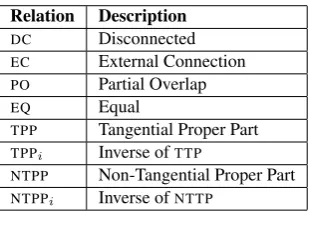
Mereotopological relations (within 2D) can be captured with the relations shown in Table (1) below.
Relation Description
DC Disconnected
EC External Connection PO Partial Overlap
EQ Equal
TPP Tangential Proper Part TPPi Inverse ofTTP
NTPP Non-Tangential Proper Part NTPPi Inverse ofNTTP
Table 1:RCC8 Relations.
Orientational (or projective) relations are typically inter-preted relative to a specific frame of reference. We follow Levinson (2003) in distinguishing between three frames of reference (FRs) for spatial relations:
(2) a. ABSOLUTE: bird’s eye view of a scene; b.RELATIVE: viewer perspective;
c. INTRINSIC: makes reference to inherent orienta-tion of an object.
The default assumption in image captioning is that orienta-tional expressions, such asleft ofandbehind, are anchored from the perspective of the viewer, hence a relative FR. There are exceptions, however, and captions can often ex-press an intrinsic FR. Consider the images of a tree and a bench in Figure (1).
(a) (b)
Figure 1: “The tree is behind the bench.”
The caption is inherently underspecified as to what perspec-tive is being referenced. In Figure (1b), the viewer’s relaperspec-tive FR aligns with the intrinsic FR associated with the bench, while in Figure (1a), they are unaligned, thereby permitting additional, but consistent orientational descriptions. That
is, two additional captions accompany (Figure 1a) but not (Figure 1b), as shown in (3).1
(3) a. “The tree is to the left of the bench.”
b. “There is a bench to the right of the tree.”
While such ambiguities are present when doing spatial an-notation over most natural language texts, one problem that is unique to image annotation is the ability for captions to reference structural properties of the image itself. As men-tioned above, spatial relations in captions can refer to “con-tent configurations”, such as where one object is relative to another object in the depicted situation, or “structural con-figurations”, such as where one object is positioned within the structure of the image. Consider the following addi-tional annotations for Figure (1).
(4) a. On the left side of the picture is a big tree. (Figure 1a)
b. A tree is in the center of the scene. (Figure 1b)
c. The tree’s shadow is in the lower left corner. (Figure 1b)
Positional terms, such asside,corner,center,middle,top, are orientational relations inherent to the viewer (relative) frame of reference. When the frame is an image, however, they can refer to relations between structural regions within the image. Formally, such expressions map from image structure to image content. This distinction is brought out very clearly in the image in Figure (2) along with its cap-tion.2
Figure 2: “View of a city with green fields in the center and several mountains with snow covered peaks in the back-ground.”
The content configurations inherent in this caption include relations such as the following (informally stated):3
1
Notice that “A bench is in front of a tree.” is acceptable for (Figure 1b), but not (Figure 1a).
2
IAPRTC image 2157 (M¨uller et al., 2010; M¨uller et al., 2012; Kiros and Szepesv´ari, 2012).
(5) a. in(fields,city)
b. in front of(city,mountains)
c. in(mountains,background)
There are also two structural configurations associated with the caption. Here, we capitalize reference to structural as-pects of the image.
(6) a. in(city,IMAGE)
b. in(fields,CENTER)
In this photo in particular, we see that it is crucial to dis-tinguish the structural placement of objects from their con-tent configurations, when annotating. For example, while the fields are centered within the image, they are not in the center of the city. We return to this issue in the final section of the paper.
In the next section, we illustrate how ISO-Space represents spatial relations, and in particular, how it can distinguish between structural and content spatial configurations.
3.
Image Structure in ISO-Space
The annotation of spatial information as conveyed through language involves a considerable number of concepts, in-cluding at least the following: a PLACE tag (for loca-tions, entities participating in spatial relaloca-tions, and paths);
LINKtags (for topological relations, direction and orienta-tion, time and space measurements, and frames of refer-ence); and a SIGNALtag (for spatial prepositions)4. ISO-Space has been designed to capture both spatial and spa-tiotemporal information as expressed in natural language texts (Pustejovsky et al., 2012). We have followed a strict methodology of specification development, as adopted by ISO TC37/SC4 and outlined in (Bunt, 2010) and (Ide and Romary, 2004), and as implemented with the development of ISO-TimeML (Pustejovsky et al., 2005) and others in the family of SemAF standards.
ISO-Space allows one to identify the source and type of the text being annotated. This is done with thedocument creation location (DCL) attribute. This is a dis-tinguished location that serves as the “narrative or refer-ence location”. For example, if the document type is a typical news article or narrative, then the DCL is gener-ally identified in the beginning of the text (e.g., as part of the byline), similarly to how the Document Creation Time is specified in TimeML (Pustejovsky et al., 2005). Image captions are different, however, in that the document de-scribes arepresentational artifact,5 such as an image or a GoogleStreet Viewscene; hence, the document type is dis-tinguished as an IMAGE. When this is the case, location tags (PLACE,PATH,SPATIAL ENTITY,MOTION, andNON
-MOTION EVENT) assume a new attribute,domain, which has two values:STRUCTUREandCONTENT.
(7) domain::=STRUCTURE|CONTENT
4
For more information, cf. (Pustejovsky et al., 2012). 5
These are represented asphys obj•inf ocomplex types (dot objects), and inherit the properties of both type elements (Puste-jovsky, 1995).
This allows the spatial relations to differentiate the kinds of regions being identified in the caption. Furthermore, this means that the DCL can take two values: anImage Struc-ture Location, for reference to the image as an object; and anImage Content Location, which is what the picture refers to (as in the default DCL for most texts).
Let’s see how this plays out with one of the captions we encountered earlier, that in Figure (2).
(8) a. [Viewpl1] of a [citypl2] with green [fieldspl3] in the
The fragment of the caption above (8) introduces two im-age structure locations (view andcenter), and two image content locations (city andfields). Furthermore, view is marked as the DCL, meaning it is the embedding region for all image structure locations.
Now let us see how these two types of locations participate in spatial relations. There are four relation tags in ISO-Space, defined as follows:
(9) a. QSLINK– qualitative spatial relations; b. OLINK– orientation relations;
c. MLINK – dimensions of a region or the distance between them.
d. MOVELINK– for movement relations;
QSLINKs are used in ISO-Space to capture topological rela-tionships between tag elements captured in the annotation. TherelTypeattribute values come from an extension to theRCC8 set of relations that was first used by SpatialML. The possibleRCC8+ values include theRCC8 values (Ran-dell et al., 1992), in addition to IN, a disjunction of TPP and NTPP (cf. Table 1).
Orientation links describe non-topological relationships. A
SPATIAL SIGNALwith aDIRECTIONALsemantic type
triggers such a link. In contrast to qualitative spatial rela-tions,OLINKrelations are built around a specific frame of reference type and a reference point. ThereferencePt
value depends on theframe typeof the link. TheAB
-SOLUTE frame type stipulates that the referencePt
is a cardinal direction. For INTRINSIC OLINKs, the
referencePtis the same identifier that is given in the
groundattribute. ForRELATIVE OLINKs, the identifier for the viewer should be provided as to thereferencePt. When the document type is IMAGE, all olinks are in-terpreted as relative FR relations (unless otherwise stated), with the “VIEWER” as thereferencePt.
When reasoning over temporal or spatial relations, it is con-venient to think in terms of acomposition tableof all pos-sible relations in the domain (Allen, 1983; Cohn and Haz-arika, 2001). A composition table is a mapping,R × R →
2R, whereRis the set of possible relations in the domain. The result for a finiteRis ann×ntable. Within RCC8, for example, if we know both T P P(x, y)andN T P P(y, z), then we can infer thatN T P P(x, z). This model, however, results in what is called a weak composition table (Bennett et al., 1997; Renz and Ligozat, 2005). Nevertheless, it is extremely useful for inference, and can be applied to the problem of reasoning over spatial relations in image anno-tation.
As mentioned above, locations in image captions refer to eitherSTRUCTUREorCONTENT. Since structural relations (Rs) only denote regions within the embedding 2D space (the image itself), these can be modeled with RCC8, en-riched with orientation (Zimmermann and Freksa, 1996). Let us assume a set of image structural relations, such as corner of(x,y),middle of(x,y),left side(x,y). Hence, for any pair of relations, R1
s andR2s, we can use the appropriate composition table for computing further inferences, i.e., the set ofR1
s◦R2s(Cohn and Hazarika, 2001; Wallgr¨un et al., 2007). For image content relations (Rc), we assume the set of RCC8 relations, along with orientational and metric relations, as represented within ISO-Space.
Now let us examine how content relates structure in an im-age, i.e., the relationR(c, s)6. For a content relation,Rc, and a structure relation, Rs, let us define the composition as:Rc◦Rs={(a, c)|∃b[(a, b)∈Rc∧(b, c)∈Rs]}. Some of the values of the weak composition table resulting from these relation pairs are shown below in Table 2.
Rc◦Rs Lef t(b, c) M id(b, c) Cor(b, c) . . . f ront(a, b) Lef t(a, c) M id(a, c) Cor(a, c) beh(a, b) Lef t(a, c) M id(a, c) Cor(a, c) IN(a, b) Lef t(a, c) M id(a, c) Cor(a, c)
DC(a, b) * * *
Table 2: Content-Structure Relation Composition Table front: in front of,beh: behind,in: TPP or NTPP,Left:
on left side,Mid: middle of,Cor: corner of
Given the composition table in Table 2, let us see how it can be applied to reason over the image and caption shown in Figure 3.
The relations directly annotated from the image caption in Figure 3 are shown in (10); the subscriptsdenotes a struc-ture location, and the subscript c denotes a content loca-tion.7
(10) Dirt [roadl1]cin [middlel2]sof a [landscapel3]s. . . a [treel4]cin [forgroundl5]con the [leftl6]s.
QSLINK(IN,l1,l2) OLINK(middle,l2,l3)
6
This is the relation introduced by the dot in the complex type of representational artifacts, as modeled in Generative Lexicon (Pustejovsky, 2006; Asher and Pustejovsky, 2006).
7The extent tag types in (10) have been generalized to a loca-tion taglfor this example.
Figure 3: “Dirt road in the middle of a landscape with wooded hills; a tree in the foreground on the left.”
QSLINK(IN,l4,l5) OLINK(foreground,l5,l3) QSLINK(TPP,l4,l6) OLINK(left side,l6,l3)
Reasoning from the composition tables, we can now infer the additional relations shown in (11).
(11) a. Behind the tree is a large shrub. b. The tree is to the left of the road. c. The large shrub is on the left.
d. The large shrub is to the left of the road.
The interpretation of a spatial relation between locations with respect to an image depends on the values of the
domain attributes of that relation’s arguments. That is, relations with location arguments from different domains (such as some of the relations in (10)) require coercion when derving its compositional interpretation. As such, despite the exclusive disjunction betweenSTRUCTUREand
CONTENTvalues for the domainattribute in the annota-tion specificaannota-tion, we assume all locaannota-tions marked asCON
-TENT to be complex objects8. This enables spatial rela-tions to access the corresponding structural aspects of their arguments’ content within the structure domain. On the other hand, except for the DCL, locations whosedomain
is marked asSTRUCTUREneed not have a complex type. Under the assumption of complex types for locations re-ferred to within the content domain, we can provide post-annotation rules for coercing relational arguments when they have incompatible domainvalues. For example, in (12), the locations in subject position are typed (annotated) asCONTENT, and they appear in a location relation with a
STRUCTUREargument.
(12) a. [The road]cis in [the middle]s. b. [The tree]cis in [the corner]s.
These are interpreted as STRUCTURE-denoting elements through a coercion operation (Pustejovsky et al., 2009), as shown in (13).
(13) a. R(xc, ys)7→R(xs, ys) b. R(xs, yc)7→R(xs, ys)
We must make special exceptions for the DCL, since it is distinguished explicitly as an embedding space for both structure and content domains, thus, for each relation it pticipates in, its type can be matched to that of whatever ar-gument it is related to:
(14) a. x:DCL=> →R(xs, yc)7→R(xc, yc) b. y:DCL=> →R(xc, ys)7→R(xc, yc)
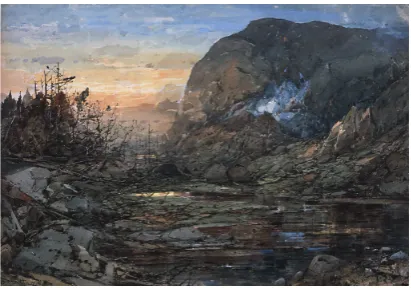
According to the axioms outlined in (13) and (14), then we can appropriately interpret a caption such as the one for the landscape painting in Figure (4) (Smithsonian Cooper-Hewitt, 1880), in which the representational content of the image referred to asskyin the caption (i.e., the representa-tion of a volumetric expanse of light-refracting gases) is not related to any structural region of the image, since it is of the wrong domain. However, the structural, 2D region cor-responding to the asserted complexskyobject does relate to the structural region of the canvas referred to byquarter.9 The annotation for Figure (4) is included in (15).
Figure 4: “An orange, yellow, and blue sky fills the upper left quarter of the sheet.”
(15) . . . [skyl1]cfills the upper left [quarterl2]sof the [sheetl3]s. . .
QSLINK(PO,l1,l2) OLINK(corner of,l2,l3) OLINK(left side,l2,l3) OLINK(top,l2,l3)
5.
Conclusion
In this paper we have presented a formalism and strategy for spatially annotating the captions associated with vi-sual images. We hope to have demonstrated that, by mak-ing a distinction between structure- and content-based rela-tions, properties of the objects in the image can be revealed through compositionally generated inferences. The spec-ification language ISO-Space has been enriched to reflect this distinction. While still preliminary, our initial results suggest that a weak composition table is both sound and informative for deriving new spatial relations.
9The content-to-structure coercion ofl1in theqslink cor-responds to the axiom in (13a).
Acknowledgements
This research was supported by grants from NSF’s IIS-1017765 and NGA’s NURI HM1582-08-1-0018. All errors and mistakes are, of course, the responsibilities of the au-thors.
6.
References
Allen, J. F. (1983). Maintaining knowledge about tempo-ral intervals. Communications of the ACM, 26(11):832– 843.
Asher, N. and Pustejovsky, J. (2006). A type composition logic for generative lexicon. Journal of Cognitive Sci-ence, 6:1–38.
Bennett, B., Isli, A., and Cohn, A. G. (1997). When does a composition table provide a complete and tractable proof procedure for a relational constraint language. In Pro-ceedings of the IJCAI-97 workshop on Spatial and Tem-poral Reasoning, Nagoya, Japan. Citeseer.
Bunt, H. (2010). A methodology for designing semantic annotation languages exploiting syntactic-semantic iso-morphisms. InProceedings of ICGL 2010, Second Inter-national Conference on Global Interoperability for Lan-guage Resources.
Cohn, A. G. and Hazarika, S. M. (2001). Qualitative spa-tial representation and reasoning: An overview. Funda-menta Informaticae, 46(1):1–29.
Edwardes, A., Purves, R., Birche, S., and Matyas, C. (2007). Deliverable 1.4: Concept ontology experimen-tal report. Technical report, TRIPOD Project.
Elliott, D. and Keller, F. (2011). A treebank of visual and linguistic data.
Elliott, D. and Keller, F. (2013). Image description using visual dependency representations. InProceedings of the 2013 Conference on Empirical Methods in Natural Lan-guage Processing, page 12921302. Association for Com-putational Linguistics.
Feng, Y. and Lapata, M. (2008). Automatic image anno-tation using auxiliary text information. In ACL, pages 272–280.
Herskovits, A. (1986). Language and Spatial Cognition: an Interdisci- plinary Study of the Prepositions in En-glish. Cambridge University Press.
Ide, N. and Romary, L. (2004). International standard for a linguistic annotation framework. Natural Language En-gineering, 10(3-4):211–225.
Kiros, R. and Szepesv´ari, C. (2012). Deep representations and codes for image auto-annotation. In Advances in Neural Information Processing Systems 25, pages 917– 925.
Kordjamshidi, P., Moens, M., and van Otterlo, M. (2010). Spatial role labeling: task definition and annotation scheme. InProceedings of LREC 2010 - The sevent in-ternational conference on langauge resources and eval-uation.
M¨uller, H., Clough, P., Deselaers, T., and Caputo, B. (2010).ImageCLEF: Experimental Evaluation in Visual Information Retrieval, volume 32. Springer.
M¨uller, H., Kalpathy-Cramerc, J., Demner-Fushmand, D., and Antanid, S. (2012). Creating a classification of im-age types in the medical literature for visual categoriza-tion. InProc. of SPIE Vol, volume 8319, pages 83190P– 1.
Purves, R., Edwardes, A., and Sanderson, M. (2008). Describing the where–improving image annotation and search through geography.
Pustejovsky, J., Knippen, R., Littman, J., and Saur´ı, R. (2005). Temporal and event information in natu-ral language text. Language Resources and Evaluation, 39:123–164, May.
Pustejovsky, J., Rumshisky, A., Moszkowicz, J., and Batiukova, O. (2009). Glml: Annotating argument se-lection and coercion. submitted to IWCS-8.
Pustejovsky, J., Moszkowicz, J., and Verhagen, M. (2012). A linguistically grounded annotation language for spatial information. TAL, 53(2).
Pustejovsky, J. (1995). The Generative Lexicon. MIT Press, Cambridge, MA.
Pustejovsky, J. (2006). Type theory and lexical decompo-sition.Journal of Cognitive Science, 6:39–76.
Randell, D., Cui, Z., and Cohn, A. (1992). A spatial logic based on regions and connections. In Kaufmann, M., ed-itor, Proceedings of the 3rd Internation Conference on Knowledge Representation and REasoning, pages 165– 176, San Mateo.
Rashtchian, C., Young, P., Hodosh, M., and Hockenmaier, J. (2010). Collecting image annotations using amazon’s mechanical turk. In Proceedings of the NAACL HLT 2010 Workshop on Creating Speech and Language Data with Amazon’s Mechanical Turk, pages 139–147. Asso-ciation for Computational Linguistics.
Renz, J. and Ligozat, G. (2005). Weak composition for qualitative spatial and temporal reasoning. In Princi-ples and Practice of Constraint Programming-CP 2005, pages 534–548. Springer.
Smithsonian Cooper-Hewitt, N. D. M. (1880). Drawing, “carter dome from carter lake, new hampshire”, ca. 1880. Vandeloise, C. (1991). Spatial prepositions: A case study
from French. University of Chicago Press.
von Ahn, L. and Dabbish, L. (2004). Labeling images with a computer game. InProceedings of the SIGCHI con-ference on Human factors in computing systems, pages 319–326. ACM Press New York, NY, USA.
Von Ahn, L. and Dabbish, L. (2008). Designing games with a purpose.Communications of the ACM, 51(8):58– 67.
Wallgr¨un, J. O., Frommberger, L., Wolter, D., Dylla, F., and Freksa, C. (2007). Qualitative spatial representation and reasoning in the sparq-toolbox. InSpatial Cognition V Reasoning, Action, Interaction, pages 39–58. Springer. Wolter, F. and Zakharyaschev, M. (2000).
Spatio-Temporal Representation and Reasoning based on RCC-8. KR 2000: Principles of Knowledge Represen-tation and Reasoning, pages 3–14.