R E S E A R C H
Open Access
P2P net loan default risk based on Spark
and complex network analysis based
on wireless network element
data environment
Zeping Tong
1and Xiaomin Chen
2*Abstract
P2P net loan is the latest financial lending platform business, which is a new way of borrowing under the
background of rapid development of the mobile Internet. Since the beginning of the new century, net loan default has caused P2P companies to break up funds and operate without continuity, which has become an important factor affecting the healthy development of the industry. Therefore, starting from the actual management situation of P2P net loan platform, the default risk of net loan was studied based on Spark technology in wireless network environment. The decision tree data mining algorithm was introduced to construct the early warning model of the net loan default risk, which achieved effective control of risk links. From the fuzzy characteristics that affected the uncertain factors of net loan credit, a hybrid algorithm model of C4.5 decision tree optimization was established. The simulation results show that the hybrid optimization model has good application value.
Keywords:Spark, P2P, Net loan default, Risk research
1 Introduction
Spark is an open source cluster technology to adapt to large data search, which the most important feature is the ability to implement distributed computing and make large data “zero.” The large data sets are divided into separate operations by refining the distributed data-base. Finally, the results of all the data are synthesized and the final results are obtained [1]. Spark technology has greatly improved the situation of wireless network, and data has been geometrically multiplied. The com-puter processing efficiency and speed cannot meet the needs of the use of the situation [2]. In particular, Spark allows the computer to reduce the number of parts of the disk that stores data in the operation process, avoid-ing the repeated storage and extraction of the intermedi-ate data to affect the overall efficiency of the operation. This advantage helps AI machine algorithms become more rapid in distributed and interactive data analysis.
Decision tree algorithm is one of the common mathem-atical models in establishing the credit evaluation model in artificial intelligence data mining technology [3]. The decision tree algorithm can effectively complete the pre-dictability task, which is the rule of summarizing the de-scriptive task summary and classification of the collected data information, and the prediction and evaluation of the data attribute and the future development trend of the event [4]. Decision tree is a classification algorithm, which uses inductive learning for a large number of ac-tual data. Through a supervised learning method, a tree structure classification rule is obtained in these data which are not related to each other and have no distri-bution rules [5]. The implementation method of a deci-sion tree is relatively simple, and its clear logic level makes it easy to understand the final rules. The decision tree is used to compare the attributes of nodes. Accord-ing to the distribution of node properties, the branch direction of the next step of the node is clearly defined. Finally, the corresponding conclusion is obtained on a leaf node, and the path of the tree structure forms the rule of the whole decision tree. The intuitive tree
* Correspondence:[email protected]
2College of Economic and Management, South China Agricultural University, Guangzhou 510642, China
Full list of author information is available at the end of the article
form [7]. In the survey of the development data of a large number of P2P companies in China, it is found that the main factors that cannot effectively control the credit risk of the network directly affect the health busi-ness development of the P2P net loan, which is how to control the risk of the net loan. The risk of net loan de-fault brings serious consequences to the P2P platform, such as slow return of capital, fragmentation of capital chain, bankruptcy, and liquidation of enterprises. These consequences bring about economic losses that P2P companies and investors cannot recover and also cast a shadow on the healthy and sustainable development of the entire P2P industry [8]. In the analysis of P2P net-work credit management, it is seen that the risk nature of the credit risk in the network loan platform and the traditional bank lending is the same, because the bor-rower is unable to achieve the initial repayment agree-ment under various factors, making the interest of the net loan company damaged. Or the net loan company is unable to repay the agreed interest rate. There are differ-ences between investors’actual interests and contractual agreements, and personal economic interests are infringed [9]. The advantage of fast loan in network lending is also a great potential risk. For borrowers, information audit time is too short and information collection is limited, which may bring about credit default such as default and non-repayment [10]. Using a decision tree algorithm to study credit default risk of P2P net loan has a good theor-etical foundation. Mathematical models can be used to analyze the impact of risk more effectively and quantita-tively determined the consequences that may be caused by different factors. In view of different risk factors, this paper puts forward specific control measures to curb de-fault risk from the source.
3 Methodology
3.1 Decision tree algorithm
Since the 1960s of the last century, scholars have pro-posed the basic implementation model system of a deci-sion tree algorithm. Different classification rules are implicit in a decision tree data, so that the small scale and high accuracy of the tree structure is the core of
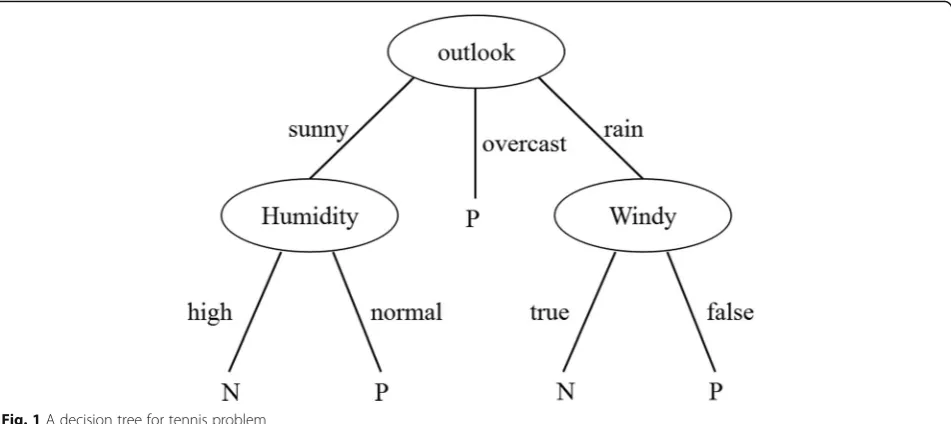
independently and finding out the hidden knowledge is through the tree structure, which can become the rele-vant rules of the decision service through conversion. Decision tree is an algorithm originating from learning system. The main principle is that when walking down an empty trunk, whenever a problem is encountered, it is necessary to propose a different judgment node from the past and use branching decisions to perfect the established decision tree, until a decision point can complete the correct classification of the training instance. Figure 1 is a typical learning decision tree that predicts whether or not to play according to weather data.
Figure 2 is the process of the decision tree generation process.
The mathematical process of the decision tree algo-rithm is to assume thatS is a data set, which containss
samples. The sample contains the m category Ci, i∈{1,
2, 3,Λ m}. When Siis the sample size of category Ci, it
is possible to get the amount of information needed to categorize the set of data set, as shown in Formula 1. Here,Piis the probability that samples belong toCi, and
is calculated bySi/S. Log is a logarithmic function based
on 2. Under the assumption that the attribute A has v
different values {a1,a2,Λ ,av}, theAattribute can divide
the S data set into vsub sets {S1,S2,Λ ,Sv}, so that the
expected information formula can be obtained as shown in Formula (2). |S| is the total number of samples, and |Si| is the sample number of attribute A in the
collec-tion. Information increment is the difference between the amount of information and the amount of
informa-tion that is needed, as shown in Formula 3. The
algo-rithm uses the equation to calculate the information increment under different condition attributes, selects
the maximum gain attribute from the calculation results as the value of the split attribute, and then generates the branch node of the decision tree according to its value.
Infoð Þ ¼S −X m
i¼1
Pi log Pi ð1Þ
InfoðS;AÞ ¼−X m
i¼1 Si
j j
S
j jInfoð ÞSi ð2Þ
GainðS;AÞ ¼Infoð ÞS −InfoðS;AÞ ð3Þ
The comparison between a C4.5 decision tree algo-rithm and the basic decision tree algoalgo-rithm is mainly reflected in the more refined structure and the more in-tuitive realization of the process. The C4.5 decision tree algorithm can be tailored in the decision process or after the construction is completed, and the incomplete data under unknown attributes can be optimized. The algo-rithm of the decision tree can also be used to create pro-duction rules. The most prominent feature here is to use Fig. 1A decision tree for tennis problem
the information gain rate to decide the decision attri-butes. The information gain rate is the value derived from the addition of the gain and entropy, which can overcome the deficiency of using the increment as the evaluation criterion. When T is set as the training data set, the collection underkcategory is expressed as {C1,
C2Λ Ck}, |Cj| that is the example of Cj. |T| is the ex-ample of a data set. Select the Vattribute and set it to havenvalues that do not coincide with each other. The information entropy of the category can be derived from Formula (4), and the result is calculated by Formula (5).
p Cjð Þ ¼j jCjI Tj j
3.2 Optimization strategy of the decision tree algorithm The data used to create decision trees are often collec-tions of outliers such as noise and outliers. Using abnor-mal data to build decision trees, the rules of branching rules based on the process also lead to misjudgment. At this time, pruning can be used to delete abnormal data that does not meet statistical measurement rules, which
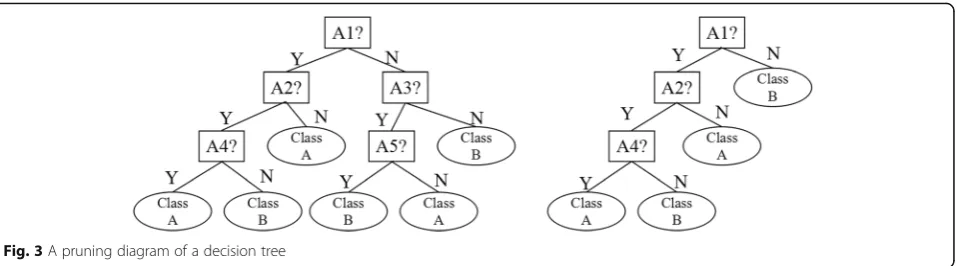
ensure the accuracy of prediction data. Figure 3 is a
comparison diagram of a decision tree without pruning and pruning. As you can see from the graph, the size of the decision tree after pruning is smaller and the complex-ity is reduced, and it is more convenient to understand at the logical level. When the data is classified by pruning operation, the speed is improved and the effect is better.
In order to solve the problem that the data collection of credit information in the P2P net is easily influenced by uncertain factors, the decision tree algorithm of the uncertain data model is optimized. The definition of data for uncertain numerical data is defined as assuming
Table 1Construction process of the uncertain C4.5 decision tree Input: the indefinite set of data D, all the attributes list attribute_list contained in D
Output: uncertain decision tree
Start:
1) create a node N;
2) If indeterminate dataset D all the tuple class labels are C;
3) return to N as a leaf node and mark as a class C;
4) Else if (attribute_list empty) then
5) return to the N node and mark with the majority of the class marks in the remaining tuples;
6) End if;
7) the information gain rate of each attribute is calculated, and the highest information gain rate is selected as the N point.
8) If (attribute is continuous or uncertain) then
9) select a split position Y;
10) For (R per unit of tuple) do
11) If (attribute = y) then
12) the weight of lD is w Rj.
13) Else if (attribute>y) then
14) the weight of rD is w Rj.
15) Else
16) to take the weight of lD from yxjdxxfw R
17) to take the weight of rD from (.Xyjdxxfw R 2)
18) End if;
19) End for;
20) Else For
21) each discrete attribute value NIA),..., 3,2,1 (I from do)
22) a direct downward division of iD branches;
23) End for;
24) End if;
25) For (each iD) do
26) according to the division rules of the decision tree, the nodes continue to be divided.
27) delete the attributes that have been partitioned from attribute_list after each partition.
28) End for;
that the attribute of the uncertain value is Aij, and the
value range is Aij∉[Aij,a,Aij,b],Aijb>Aija. If some data
cannot be clearly defined in a certain interval, the prob-ability PDF can be obtained. The formula for probprob-ability density functionAikf(x) is shown in Formula6.
Z Aij;a
−∞ Aijf xð Þdx¼0
Z þ∞
Aij;b
Aijf xð Þdx¼0
ð6Þ
The main principle of dealing with uncertain data is to calculate the information entropy of uncertain attributes by using probability base. This is a new entropy that plays a decisive role. After guidance, the types of equa-tions of information gain and information gain rate of the basic decision tree algorithm are adopted. The equa-tion of the informaequa-tion gain and the informaequa-tion gain rate of the corresponding uncertain data are calculated, and the final information gain rate is obtained. The con-struction process of the uncertain data decision tree is shown in Table1.
When the actual processing is uncertain, the conven-tional scheme cannot implement fuzzy operation on data. Therefore, a function processing method based on integral principle is introduced. It is assumed here that
the numerical range of x is the indeterminate position
between [a, b]. [a, b] contains n f(x), which contains values that are not equal to zero. The general attribute of uncertain data is the membership degree of a point relative to a function, which is equal to the membership value of the point or the maximum value of the function of the point. In the fuzzy set theory, the membership de-gree is different from the conventional function, and the element x corresponds to the values of multiple f(x). After calculating the information gain value of the un-certain attributes, the composite membership function is used to multiply the membership function of the
uncertain attributes to improve the accuracy of the
pre-diction. Figure 4 shows an example of the membership
function of an uncertain attribute.
4 Result analysis and discussion
In order to verify the performance of the optimized C4.5 decision tree algorithm for parallel large data processing, simulation experiments are carried out. The experimen-tal data come from the P2P network platform in China, a network loan company that has been established for more than 5 years. The basic data for 5 years since the establishment of the company is the original database. There is more than 680 thousand original credit data in-formation of net loan company. In order to make the classification data more targeted, the experiment first is to extract, discretize, and unbalance the collected raw data. The 16 risk factors that affect net loan credit are summed up and extracted, and these factors have 36 characteristic parameters. After calculating the informa-tion gain rate of these indexes, the characteristics of the model are obtained according to the ranking from high to low, which are the credit of the borrowers, the real interest rate of borrowing and lending, the loan cycle, the total income of the borrower, the debt ratio of the borrower, the borrower’s housing, the total amount of loan and the total amount of loan repayment and the way, and so on. In the data modeling phase, WEKA in-telligent analysis software is used. Using this software, the code of optimizing the algorithm of the decision maker is compiled, and the model of the optimal Fig. 4An example diagram of membership function of uncertain attributes
Table 2Model data results of the P2P net loan platform default risk assessment model
Category Optimal decision tree Naive Bayes Logistic
Modeling time (s) 3.21 4.65 6.39
Accuracy rate (%) 78.6 68.2 73.1
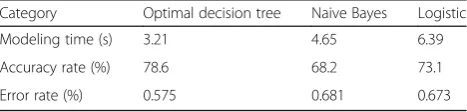
decision algorithm is established. The experiment uses comparative data research. The decision tree optimization algorithm and the logistic, naive Bayes algorithm have been replaced by the data information that has already been processed nine characteristic items, so that the model data results about the default risk assessment model of the P2P net loan platform are obtained as shown in Table 1. The optimization decision tree algorithm has advantages over other algorithms in the modeling time and accuracy of evaluation (Table2).
In order to verify the advanced nature of the proposed optimization scheme, under the same data conditions,
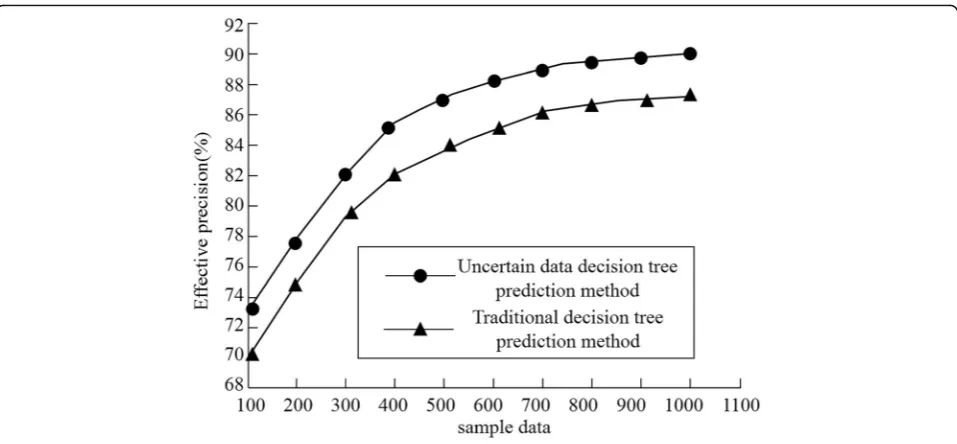
this experiment compares the accuracy of the algorithm with the traditional decision tree algorithm and the deci-sion tree algorithm under the uncertain data. Shown in Fig.5 is the comparison of the effective precision under the two algorithms. After the introduction of uncertain data and the analysis of the attributes of uncertainty, the problems can be effectively solved such as income, debt ratio, housing, and other important attribute values, which can effectively improve the accuracy of the deci-sion tree algorithm.
The training data sample size of the uncertain data de-cision tree algorithm is relatively large, so the rules of Fig. 5Comparison of the effective accuracy of the two decision tree algorithms
the training decision tree are more and the prediction model established by this rule covers all the possible sit-uations. Therefore, when the number of training samples is large, the prediction accuracy of uncertain fuzzy deci-sion tree algorithm is better. As shown in Fig. 6, the total accuracy of the two algorithms is compared.
5 Conclusion
In the application research of classification prediction, the artificial intelligence decision tree algorithm is often used to process the data, and the induction algorithm is used to calculate the corresponding rules. After con-structing the decision tree shape map, the new data is analyzed according to the decision strategy, and the ana-lysis results can provide important basis for future decision-making. In this paper, the P2P net loan default risk based on Spark and complex network analysis in wireless network element data environment are mainly studied. After analyzing the basic principle of the deci-sion tree algorithm, the fuzzy set is used to optimize and update the decision tree algorithm in view of the uncer-tain characteristics of net loan credit data. Starting from the fuzziness of the uncertain data, integral function is used to deal with it. By using the compound member-ship function, the uncertain attribute that affect the lack of credit is fuzzy processing, so the risk of credit risk is predicted by the classification rules of the decision tree. In the simulation experiment, through the analysis of the attributes of the uncertainty, the problems can be ef-fectively solved and the problems are that the important attribute value of the assets, such as the income situation, the debt ratio, the housing, and other assets, cannot be de-termined, which effectively improves the accuracy of the decision tree algorithm. The results of the experiment have proved that the study is successful. However, there are still some improvements in this research. The next step is to further study the pruning method of the opti-mizing decision tree algorithm.
Abbreviations
P2P:Peer to peer Internet borrowing; Spark: Open Source Cluster Technology in big data search
Funding
The study was supported by the National Social Science Foundation of China (Grant No. 16BJY160).
Authors’contributions
ZT has made great contributions to the complex network of wireless network element data environment. XC has done a lot of research and made a lot of contributions to the default risk of P2P online loans. Both authors read and approved the final manuscript.
Author’s information
Zeping Tong, Doctor of Management, Associate professor. Graduated from Wuhan University. Worked in Wuhan University of science and technology. His research interests include P2P online lending.
Xiaomin Chen, Doctor of Financial Management, Lecturer. Graduated from Jinan University in 2011. Worked in South China Agricultural University. Her
research interests include corporate investment and financing & accounting information disclosure.
Competing interests
The authors declare that they have no competing interests.
Publisher’s Note
Springer Nature remains neutral with regard to jurisdictional claims in published maps and institutional affiliations.
Author details 1
School of Management, Wuhan University of Science and Technology, Wuhan 430081, China.2College of Economic and Management, South China Agricultural University, Guangzhou 510642, China.
Received: 7 November 2018 Accepted: 11 January 2019
References
1. S.U. Yong, D. Zhou, Television ratings prediction research based on decision tree algorithm. Comput. Digit. Eng.21, 325–659 (2017)
2. D.C. Wickramarachchi, B.L. Robertson, M. Reale, et al., HHCART: an oblique decision tree. Comput. Stat. Data Anal.96, 12–23 (2016)
3. A. Hamoud, Selection of best decision tree algorithm for prediction and classification of students’action. Soc. Sci. Electron. Publ.3(2), 442–213 (2017) 4. F. Pan, The test results prediction research based on C5.0 decision tree
algorithm. Microcomp. Appl81, 1–12 (2016)
5. F. Ahmed, K.Y. Kim, Data-driven weld nugget width prediction with decision tree algorithm. Procedia Manufact.10, 1009–1019 (2017)
6. H. Hamsa, S. Indiradevi, J.J. Kizhakkethottam, Student academic performance prediction model using decision tree and fuzzy genetic algorithm. Procedia Technol.25, 326–332 (2016)
7. G. Sahoo, S. Kumar, Enhanced decision tree algorithm using genetic algorithm for heart disease prediction. Int. J. Bioinform. Res. Appl.14(1/2), 49 (2017) 8. C.Y. Wu, T.J. Chiou, C.Y. Liu, et al., Decision-tree algorithm for optimized
hematopoietic progenitor cell-based predictions in peripheral blood stem cell mobilization. Transfusion56(8), 2042–2051 (2016)
9. F. Abbasitabar, V. Zare-Shahabadi, In silico prediction of toxicity of phenols to Tetrahymena pyriformis by using genetic algorithm and decision tree-based modeling approach. Chemosphere172, 249–259 (2017) 10. S. Datta, V.A. Dev, M.R. Eden, Hybrid genetic algorithm-decision tree