~
z
z
z
«
..J
a..
en
:E
w
I-~
en
en
U')
w
z
en
::J
'
.
£0
•
•---
-- -- -- --
--
--
-
---- ----
-
---_
.
-Information
Systems
Planning
Guide
CJ
z
z
Z
<C
..J
C.
en
en
w
z
en
::l
m
-~-
-- -- -- --
- - - - -
--
- - .---- ----
-
---- ---- ---- ---- ---- ----
_____ II'_
Information
Systems
Planning
Guide
Business Systems Planning (BSP) is a structured approach to help an organization establish an information systems plan that can satisfy its near- and long-terminforma-tion needs. This guide offers assistance to BSP study teams by explaining the approach and presenting guidelines for conducting a BSP study. It can also be used for general reference on the subject of planning for information systems.
Second Edition (October 1978)
A form for readers' comments has been provided at the back of this publication. If
the form has been removed, address comments to IBM Corporation, Technical Publications, Dept. 824, 1133 Westchester Avenue, White Plains, New York 10604. IBM may use or distribute any of the information you supply in any way it believes appropriate without incurring any obligation whatever.
Preface
Business Systems Planning (BSP) is a structured ap-proach to assist a business in establishing an informa-tion systems plan to satisfy its near- and long-term information needs. The primary purpose of this guide is to assist BSP study team members by explaining the approach and presenting specific guidelines for con-ducting a BSP study. The guide may also be used for general reference on the subject of planning for information systems. The reader does not need a knowledge of computers to understand the concepts and to apply the methodology.
Experience has shown that BSP can be applied to all the public sector and all industries in the private sector, because the requirements for developing information systems are similar regardless of the business served or the products and services provided. F or the sake of simplicity, throughout this manual the term business is used for the organization entity being studied, regardless of its size or purpose, and whether private or public.
Before initiating a BSP study, the personnel involved should consider taking the appropriate BSP-related courses. Information on the educational offerings is available through local IBM branch offices.
Because IBM cannot control the manner in which this methodology is applied, it takes no responsibility for the results. Hundreds of studies have been com-pleted successfully using this approach; this guide represents as much of that experience as it is feasible to include.
This guide is organized so that readers already familiar with BSP can go directly to the material they require, while others may progress serially through
principles, concepts, methodology overview, methodol-ogy details, and finally the alternati~ and the refer-ence material in the appendices. The iIttroduction is for those persons who may have heard of BSP but do not know its purpose or origin. Chapter I presents the concepts that form the basis for the methodology, so that the reader can understand the basic principles without becoming embroiled in the detail of how BSP is done. Even persons with some orientation or training in the subject may wish to read the introduction and Chapter I to strengthen their understanding.
Chapter 2 provides an overview of all the activi-ties in a BSP study so that the reader will be prepared for the details in the following chapters.
Chapter 3 deals with getting the proper executive commitment before starting a BSP study.
Chapter 4 discusses the activities that take place before the BSP team starts its concentrated study. It
also outlines the considerations that must be made in the management of the study.
Chapters 5-15 cover the details of the methodolo-gy, culminating in the writing of the final report and the making of recommendations to the business executives. Since each step of the methodology can prohably be done a number of ways, a single, cohesive methodology is outlined and alternatives, where appropriate, are included at the end of each chapter or in the appendices. For continuity from step to step, all examples are based on the same business, a medium-size manufacturing firm, except those in the appendic-es, which are based on various industries and the public sector.
Contents
Introduction
The Changing Environment
From Operation to Management Control A Justified Approach I
Origin of IBM's Business Systems Planning Function 2 Objectives and Potential Benefits of BSP 2
Objectives 2 Potential Benefits 3
Chapter t. BSP Concepts 4
Chapter 2. Overview of the BSP Study Approach 10 Perspective '10
Major Activities 11 Gaining Commitment 12 Preparing for the Study 12 Conducting the Kickoff Meeting 12 Defining Business Processes 12 Defining Data Classes 12
Analyzing Business/Systems Relationships 13 Determining the Executive Perspective 13 Assessing Business Problems 13
Defining Information Architecture 13 Determining Architectural Priorities 13
Reviewing Information Systems Management (ISM) 13 Developing Recommendations and Action Plan 13 Reporting Results 13
Chapter 3. Gaining the Commitment 15 Establishing the Study Scope 15 Setting Study Objectives 16
Developing Business Reasons for the Study 16 Resourcing the Study Team 16
Characteristics 16
Organization and Responsibilities 16
Considerations for Full-Time or Part-Time Study 17 Manpower Requirements 17
Selection of Team Leader 17 Sponsor's Letter 17
Chapter 4. Preparing for the Study 18 Briefing the Study Team 18
Gathering Data 18 Educating the Team 19
Developing the Study Work Plan 19 Establishing a BSP Study Control File 21 Defining the Structure of the Final Study Report and Ancillary Output 21
Creating Executive Interview List and Schedule 21 Briefing Interviewees 21
Obtaining and Equipping Control Room 22 Arranging for Administrative Support 22 Reviewing with Executive Sponsor 22
Chapter 5. Conducting the Kickoff Meeting 23 Sponsor's Opening 23
Review of Study Work Plan 23 Business Review 23
Information Systems Review 23
Chapter 6. Defining Business Processes 24 Prerequisites to Defining Processes 24 The Product and Resource Life Cycle 24 Basic Steps in Defining Processes 24
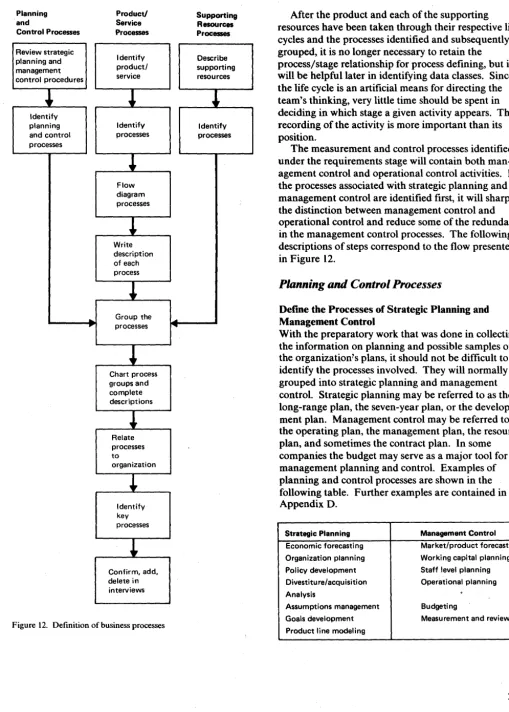
Planning and Control Processes 25 Define the Processes of Strategic Planning and Management Control 25 Product/Service Processes 26
Identify the Product/Service of the Organization 26 Identify the Processes in Each Stage of the
'Life Cycle of the Product/Service 26 Write a Description of Each Process 26 Supporting Resource Processes 28
Describe the Supporting Resources 28 Identify the Processes in Each Stage of
the Life Cycle of Each of the Supporting Resources 28 Consolidation and Analysis 29
Group the Processes 29
Chart the Process Groups and Complete Descriptions 29 Relate the Business Processes to the Organization 29 Identify Processes Key to Business Success 30 Outputs and Their Uses 30
Expansions and Variations in Approach 30 Diversity in Business, Product, or Service 30 Outside Assistance 30
Alternate Methods in Identifying Business Processes 32 Generic Process Model 32
Chapter 7. Defining Data Classes 33 Business Entity Approach 33 Business Process Approach 35 Cross-Referencing and Regrouping 35 Data Class to Process Analysis 36
Chapter 8. Analyzing Business/Systems Relationships 37 Understanding l/S Support of Processes 37
Identifying Usage of Current Data 41 Summary 41
Chapter 9. Determining the Executive Perspective 42 Confirming the List of Executives to be Interviewed 42 Reviewing the Interview Schedule 42
Preparing Questions for Interviews 42 Determining Team Member Interview Roles and Interviewee Characteristics 43
Conducting Interviews 44 Preparing Interview Summaries 44
Chapter
to.
Assessing Business Problems and Benefits 45 Step I: Summarize Interview Data 45Step 2: Classify Interview Data 45 Step 3: Relate Data to Processes 47 Summary 47
Chapter t 1. Defining Information Architecture 49 Developing the Architecture Diagram 49 Data Flow 53
Chapter 12. Determining Architecture Priorities 58 Determine Selection Criteria 58
Apply Criteria and List Systems 58 List Prerequisites 58
Document Recommended System 58 Expansions and Variations 59
Chapter 13. Reviewing Information Systems Management 60 Purpose of ISM in the BSP Study 60
ISM as Part of the BSP Study 60 ISM Inputs 60
Flow of Activities in the ISM Module 60 Compiling the I/S Objectives 60
Ensuring ISM Supports Architectural Priorities 62 Problem Analysis 62
Rearrange I/S Support Problems by Type 62 Extract ISM Problems from I/S Review 62 Consolidating and Prioritizing ISM Changes 62 Developing Recommendations and Action Plan 63 ISM Outputs of a BSP Study 63
Chapter 14. Developing Recommendations and Action Plan 64
Chapter 15. Reporting Results 65 Report Outline 65
Report Preparation 65 Presentation Medium 65 Executive Presentation 65
Chapter 16. Overview of Follow-on Activities 66 Perspective on Follow-on Activities 66
Relation of BSP Study to Follow-on Activities 66 Preparation for Follow-on Activities 66
Orientation of Teams 66
Information Systems Management 67 ISM in Perspective 67
Information Systems as a Business 67 Information Architecture 68
Architecture Refinement 68 Current Systems Examination 69 Data Base 69
Distributed Information Systems 69. Developing the First System 72
Technical Factors 72 Effective Communication 72 Priorities and Conflicts 72
Appendix A. Sample Executive Announcement Letter 74
Appendix B. Sample Interview Confirmation Letter 75
Appendix C. Examples of Process Groups and Processes by Industry 76
Appendix D. Examples of Planning and Control Processes 81
Appendix E. Sample Descriptions of Processes 83
Appendix F. Examples of Business/Systems Relationship Matrices 86
Appendix G. Sample List of Wall Charts for Control Room 89
Appendix H. Risk - Potential Benefit Analysis 90
Appendix I. ISM Processes 92
Appendix J. Potential Topics for BSP Study Report 94
Glossary 96
Figures
I. Translation of business strategy to I/S strategy 4 2. Characteristics of planning and control levels 5 3. Top-down analysis with bottom-up implementation 7 4. General I/S planning approach 8
5. Information architecture example 9
6. Relationship of BSP to I/S projects 10 7. Flow of the BSP study II
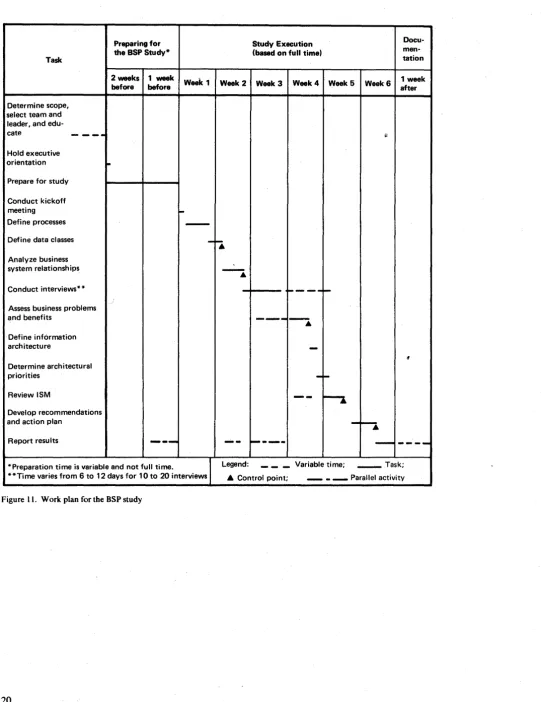
8. BSP organizational business unit options 15 9. Sample study team organization 17 10. BSP study control points 19 II. Work plan for the BSP study 20 12. Definition of business processes 25
13. Example of the flow ofa product/service through a business
14. Sample list of processes by process group 29
15. Organization/process matrix 31 16. Business process network 32
17. Information life-cycle 33
18. 19.
20.
Data class/business entity matrix 34 Input-process-output examples 35
Data class by process, showing data creation and usage 36 21. Organization/process matrix, with current systems support
shown 38
22. System/organization matrix 39
23. System/process matrix 40 24. System/data file matrix 41
25. Data reduction steps 45
26. Interview analysis and data reduction worksheet 46 27. Problem/process matrix, showing the number of times the
problems were stated 48
28. Data class by process, showing data creation and usage 50
29. Data classes arranged by creating process 5 I 30. Process/data class groupings 52
31. Data flow determination 53
32. Data flow 54
33. Information architecture 55
34. Graphic rearrangement of information architecture 56
35. Prerequisite subsystem analysis 57
36. Sample subsystem ranking 59 37. Flow ofISM in a BSP study 61
38. Data base system 70
Introduction
The Changing Environment
The rapidly changing environment and the constant need for businesses to adjust quickly to it make it necessary for executive management to have up-to-date information avaiiable at all times, so that through meaningful analyses and resource allocation tradeoffs they can manage their businesses more effectively. With organization-wide availability of information, strategies can be improved, decisions made more soundly, and operations performed more efficiently.
From Operation to Management Control
Data processing is in transition. Until comparatively recently, most businesses considered it a service function and used it to support single-operation units or locations. In the last two decades applications have been developed independently, with very little regard for the support they could give other functions and for the information they could supply for management control. Functional autonomy has been the rule. This has resulted in fractionalized and redundant data files and in the inaccessibility of data from the many operational applications installed in the various functions.Today, however, businesses are recognizing data more and more as a resource that is as important as personnel, cash, facilities, or materials. They see the need to consolidate the key data files and make information available not just to individual functions or departments but throughout the business, in order , for management to gain a business-wide view and be
able to make multifunctional decisions.
Many companies have recognized the need for company-wide information systems but have been unable to develop them for one or more of the follow-ing reasons:
• Failing to obtain executive commitment and involvement
• Establishing objectives and strategies that were not in line with their overall business objectives • Attempting to implement information systems
without first understanding the business from general management's viewpoint
• Setting out to implement totally new company-wide information systems rather than a comprehensive plan evolving from current systems
• failing to put in place-those information systems management functions required to adequately manage the information systems resources
A Justified Approach
In an article entitled "Blueprint for MIS,"
*
Dr. Wil-liam Zani states, "Traditionally, management informa-tion systems have not really been designed at all. They have been spun off as by-products while improving existing systems within a company. No tool has proved so disappointing in use. I trace this disappointment to the fact that most management information systems have been developed in the "bottom-up" fashion - an effective system, under normal conditions, can only be born of a carefully planned, rational design that looks down from the top, the natural vantage point of the managers who will use it."In most instances the current operational systems have been justified and have been performing effec-tively for their specific intent, even though their maintenance and interfaces may have become unman-ageable. An information system plan should allow a modular approach to implementation, providing confidence that each module will fit and function properly in an integrated network and will interface properly with the present operating systems until they too can be included in that network. The plan should also allow for better decisions concerning the efficient and effective commitment of information systems development resources. With such a plan, the required information can be more readily obtained.
Business Systems Planning (BSP) is geared to help provide such a plan through:
• A top-down approach to (1) getting people commit-ted and involved (starting with top management and working down through the organization) and (2) studying the business (working from the overall to the detail level)
• A bottom-up approach to implementation • Use of a structured methodology proven in
hun-dreds of studies
• The translation of business objectives into informa-tion requirements
The effectiveness of the BSP methodology can be
attributed to two components:
• The fundamental principles and concepts - the unvarying ideas and logic that form the basis for
BSP, including the standards upon which the proce-dures are based
• The sequenced activities, techniques, disciplines, time,outputs, planning, team composition, etc., established to fill a particular organization's need and situation (although consistent with BSP's basic principles and concepts, the pr6cedures are flexible and vary with the particular environment)
Origin of IBM's Business Systems
Planning Function
Learning from its own mistakes and those of other companies that attempted to implement large informa-tion systems in the 1960s, IBM realized that a
disci-plined approach was required, using proven principles and methodologies. In 1966 a business-wide Informa-tion Systems Control and Planning Department was established at IBM'S Data Processing Group headquar-ters. The Data Processing Group was a total business unit comprising the engineering, manufacturing, marketing, and service divisions responsible for all of IBM'S domestic data processing business.
Until the Control and Planning Department was established, IBM had little overall direction in the internal use of computers. In fact, little coordination took place between divisions; most data processing activities were confined to locations and units within divisions. Consequently, each manufacturing plant and marketing region developed and operated its own system. Although the individual systems carried out similar functions, they differed in design and perfor-mance; they could not be used interchangeably and could not communicate with each other. The result was a redundancy of data and excessive use of th~ data processing resources required to develop and maintain such systems. Even with this large expenditure of resources by each division, the systems were mainly satisfying the local department needs of the business, rather than doing an overall data processing job. When steps were taken to improve the data processing within a division (for example, development of a consoli,dated order entry system within the marketing division), little serious attention was given to an effective interface of that system with inputs from engineering and outputs to manufacturing. The business was not getting the return on investment from data processing that it could have because the informa-tion needs of the business, and particularly those of the generalll)anager responsible for the business, were not being accommodated.
The first effort of the Control and Planning Depart-ment was to inventory and profile the systems existing-within the business and the plans for the future. At the same time, recognizing that the data processing effort must be directed toward satisfying business needs and not solely toward individual functions and depart-ments, the Control -and Planning Department
estab-lished a set of information system strategies covering five major areas:
1. Fixed data responsibility
2. Single source and parallel distribution of data 3. Central control and planning of information systems 4. Organizational independence of data
5. Resource sharing of data, equipment, and communications
With the knowledge of what was being done with data processing, and the direction established through the set of strategies, the department defined a network . of information systems and assigned responsibilities for
the development of the systems. These systems ad-dressed the operational, functional, and general management needs for information.
As the definition and design efforts for the business-wide network of information systems got under way in the late 1960s, many of IBM's customers showed interest in learning how they might better manage their information system resources. In an effort to assist these interested customers, IBM established the Busi-ness Systems Planning (BSP) program in 1970.
To conduct the program, the nucleus of the control and planning department that developed the internal information systems plan was transferred to the Data Processing Division headquarters. This group proceed-ed to document proven methodologies and institute a training program to educate regional and branch office personnel and customers in the approach. Executive briefings and seminars were established to show customer executives the potential benefits of the approach and the reasons why their involvement was vital to successful implementation of information systems.
The methods used in developing this information systems plan and the lessons learned have since been used by many IBM customers. Application of BSP methodology has helped them to formulate their information system plans and control mechanisms and to improve their use of information and data process-ing resources. Studies usprocess-ing the BSP methodology and guidelines have been conducted successfully by profit and nonprofit organizations, of varying size, in many industries.
O~ctives
and Potential Benefits of
B
-With a reasonable amount of planning and control, the user of this BSP approach should be able to attain its objectives and realize its potential benefits.
Objectives
is integral with the business plan. There are other objectives that help to justify and clarify the approach:
1. Provide a formal, objective method for management to establish information systems priorities without regard to provincial interests.
2. Provide for the development of systems that have a long life, protecting the systems investment, because these systems are based upon the business processes that are generally unaffected by organizational . changes.
3. Provide that the data processing resources are managed for the most efficient and effective support of the business goals.
4. Increase executive confidence that high-return, major information systems will be produced. 5. Improve relationships between the information
systems department and users by providing for systems that are responsive to user requirements and priorities.
6. Identify data as a corporate resource that should be planned, managed, and controlled in order to be used effectively by everyone.
The illustration below shows the overall flow of BSP
and relates the BSP study to the activities that follow.
This relationship is expanded upon in Chapter 16, with an explanation of the foll()w-on activities.
Step
Evaluation of BSP
Executive commitment
Preparation for BSP study
BSP study
Follow-on projects
Output
Analysis Scope of study
Objectives Team leader Study team
Education Work plan Business facts
Business requirements Information architecture Architectural priorities liS management Action plan
Information architecture First system(s)
lIS management Data management lIS planning
Potential Benefits
Application of the approach and methodology con-tained in this planning guide offers many potential benefits to three management groups:
To executive management:
• An evaluation of the effectiveness of current infor-mation systems
• A defined, logical approach to aid in solving man-agement control problems from a business perspective
• An assessment of future information system needs based on business-related impacts and priorities • A planned approach that will allow an early return
on the company's information systems investment • Information systems that are relatively independent
of organization structure
• Confidence that information system direction and adequate management attention exist to implement the proposed systems
To functional and operational management: • A defined, logical approach to aid in solving
man-agement control and operational control problems • Consistent data to be used and shared by all users • Top management involvement to establish
organiza-tional objectives and direction, as well as agreed-upon system priorities
• Systems that are management and user oriented rather than data processing oriented
To information systems management:
• Top management communication and awareness • . Agreed-upon system priorities
• A better long-range planning base for data process-ing resources and fundprocess-ing
• Personnel better trained and more experienced in I
planning data processing to respond to business needs
Chapter 1. BSP Concepts
Business Systems Planning is most often thought of as a structured approach or methodology. This meth-odology, however, is based upon some fundamental concepts, a good understanding of which can give the
BSP study team members:
I. A better appreciation of the ';;why's" of the methodology
2. Improved confidence in applying variations to meet specific situations
3. A better background with which to communicate the objectives and eventual recommendations to senior management
The premise for conducting a BSP study is that there exists witb.in the organization a need for significantly improved ]computer-based information systems (liS)
and a need for an overall strategy to attain them. BSP is concerned with how these information systems should be structured, integrated, and implemented over the long term. The basic concepts of BSP can be· related to
the long-term objectives for liS in an organization.
An lIS Must Support the Goals and Objectives of the Business
This most basic concept underlies the "top down" philosophy of the methodology as well as several of the specific steps, such as executive interviews·and system priorities.
Since information systems can be an integral part of a business and be critical to its overall effectiveness, and because they will continue to represent major investments of time and money, it is essential that they support the organization's true business needs and directly influence its objectives. BSP, then, can be thought of as a vehicle or process to translate business strategy into liS strategy (see Figure I).
Business Strategy
Mission Goals and
objectives Strategies
BSP
I/S Strategic
...
Planning Process ...
I/S Strategy
I/S Objectives I/S Policies Information
Architecture
Figure 1. Translation of business strategy to liS strategy
Obviously, it is important that an organization be willing and able to express its long-term goals and objectives. For some organizations, this can be done principally through the business plan. For others, where a business plan is not available or current, it can
be done as a part of the BSP methodology. In either event, a recognition of this basic need by senior management is critical, for only with that recognition will their commitment and involvement be great enough to guarantee a meaningful BSP study.
An lIS Strategy Should Address the Needs of All
", .• ' Levels of Management Within the Business
This requirement has several implications relative to
liS structure. First, it is important to recognize the varying characteristics of information as needed by different activities and management levels. Typically, lower levels need considerable detail, volume, and frequency, higher levels need summaries, "exception" reporting, and inquiries, and still higher levels need cross-functional summaries, special requests, "what if' analyses, "external" requirements, etc. It would be impractical to construct a single system to accommo-date all activities or management levels, and it would be erroneous to associate anyone type of information requirement solely with one management level. Clearly, there is need to establish some reasonable framework upon which the liS can be defined.
First, the emphasis in liS should be in support of management decision making. This is in contrast to more traditional bookkeeping or recordkeeping functions. Business decisions are made for various purposes, but most can be associated with either planning or control. Planning, of course, is the
estab-lishment of various missions, objectives, and policies, and it occurs at all levels. Good information is vital to the establishment of good plans. Control decisions, on the other hand, are made in order to guide an activity toward some implicit or defined (by the plan) objec-tive. The liS can provide the measurements of the current or actual condition to the decision maker . We thus complete a planning, measurement and control cycle with liS potentially an integral part. Since planning and control are the keys to decision making, a framework for liS based upon these activities can be utilized. It has been proposed,
*
and well accepted today, that three distinct but concurrent planning and control levels exist in any organization:Strategic planning, the process of deciding on objectives of the organization, on the resources used to attain these objectives, and on the policies that are to govern the acquisition, use, and disposition of resources
Management control, the process by which managers assure that resources are obtained and used effi-ciently in the accomplishment of the organization's objectives
Operational control, the process of assuring that specific tasks are carried out effectively and efficiently
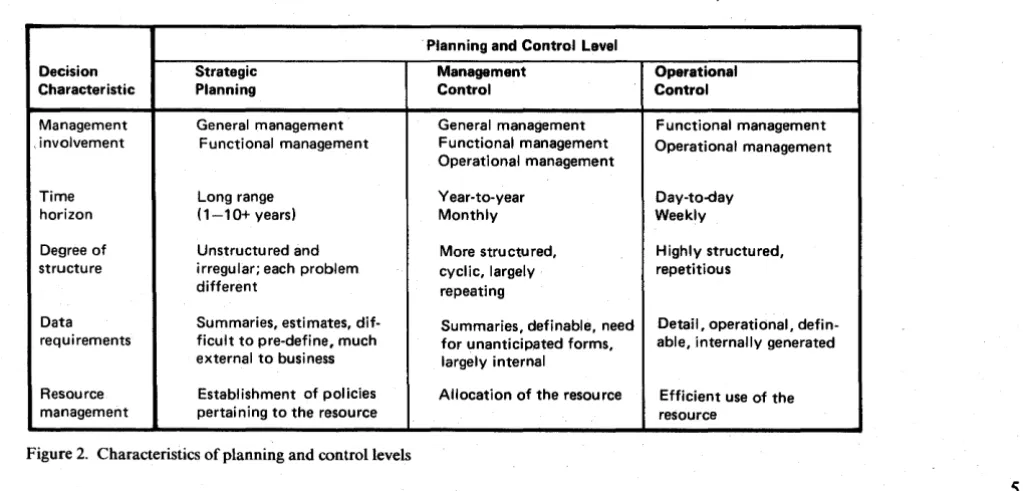
Further characteristics of these areas are outlined in Figure 2. An advantage of this framework is that it does not restrict planning and control activity to any particular industry, function, or management level. A conclusion at this point is that an ljS could
convenient-ly address itself to anyone of the above three planning and control levels.
Resource management is also key to this philosophy and represents a major vehicle for US definition. The specific resources to be managed vary in nature and relative importance from one organization to the next. Examples of traditional resources to be managed are people, facilities, materials and money. Their require-ments are based upon the needs to support the prime mission area of the organization, e.g., its products or services. Because an organization's product or service area has all the attributes of a resource, i.e., a life cycle of activities and decision points, and yet drives the other resources, it is referred to as the "key resource." Each resource, including the key resource, is managed through planning and control decisions of the three levels previously discussed. Resource management has the desired characteristic of cutting across organiza-tional boundaries - vertically across management levels and horizontally across functional lines. Thus a framework based on resources as well as planning and control levels can be established, and an US architec-ture can be applied within this framework.
An liS Should Provide Consistency of Information Throughout the Organization
The keyword in this objective is consistency. The implication is that information derived from more traditional data processing applications is not necessar-ily consistent, particularly when applied to new business problems (decision areas) of broader scope. The problems in data consistency normally arise as a result of a historical evolution of computer usage that traditionally occurs. Isolated and independent applica-tion areas are selected and mechanized, typically to reduce operational costs. The'data files are defined as necessary to support the specific needs of each tion without regard to one another or to future applica-tions. The data itself is converted from manual files located and maintained by the using organization.
As computer applications are added, new data files are usually required since the data requirements for different applications are rarely the same. These are usually created from spinoffs of existing mechanized files plus any additional data that may be required from the using area. Summary-type reports for higher management levels are the result of sorting and merg-ing various existmerg-ing data files together to create new ones. Rarely is any existing data file of the form or content required to provide newly requested informa-tion of any magnitude. Thus new data files are born. Data redundancies and file update requirements multiply. The continual cry from management that "I know the data that I need is somewhere in data proc-essing, but I can't get at it" may be basically true from their point of view. The data may be there, but not necessarily defined as needed, of adequate summary level or sequence, or of proper time period or currency.
Planning and Control Level
Decision Strategic Management Operational Characteristic Planning Control Control
Management General management General management Functional management . involvement Functional management Functional management Operational management
Operational management
Time Long range Vear-to-year Day-to-day horizon (1-10+ years) Monthly Weekly
Degree of Unstructu red and More structured, Highly structured, structure irregular; each problem cyclic, largely· repetitious
different repeating
Data Summaries, estimates, dif- Summaries, definable, need Detail, operational, defin-requirements ficult to pre-define, much for unanticipated forms, able, internally generated
external to business largely internal
Resource Establishment of policies Allocation of the resource Efficient use of the management pertaining to the resource resource
Figure 2. Characteristics of planning and control levels
[image:12.615.61.573.503.749.2]Data, then, exists in most organizations in varying
form, definition, and time. The form may be uncaptured raw data, mechanized data files, detailed DP reports,
summarized DP reports, business documents, or knowledge in someone's head. The definition of any given data can have as many variations, and thus inconsistencies, as there are users of that data. For example, "salary" to the payroll department may mean an employee's actual monthly pay, to the project manager an annual figure plus burden to be charged to a customer, to the department manager a budget line item representing total expense for all reporting employees. In addition, a time inconsistency is very likely to exist between what may otherwise be compa-rable data. Data may be captured by such varying methods as the mail, telephone, data terminals, or satellites. It may be "batched" over varying lengths of time by the user or by OP before processing, or it may be entered "online" as each transactiorl occurs, directly from its source. Data may be processed daily, weekly, or monthly on a predetermined schedule, or it may be incapable of being processed until a series of prior computer runs are completed (e.g., the month-end closing). The output itself may be mailed or it could be immediately available as the result of an online
inquiry. Finally, the report may be up to the second, as when reading from a terminal, or it may have lain in a desk for three weeks after last month's processing. The combinations of time deviations between data capture, data processing activity, and actual data usage are many.
With all these potential data inconsistencies, it is no wonder that reports frequently don't "match" between using departments and managers. This becomes a problem most often during interdepartmental decision-making or at higher reporting levels where consolida-tion of multifuncconsolida-tion activities is important. Attempts to provide better data consistency usually result in "resystematizing" or "consolidating" existing applica-tions into larger ones with broader problem scope and data definitions. This may yield a satisfactory system within the defined scope, but again, as still broader problems are addressed, there will undoubtedly be data inconsistencies between the larger systems. Resystem-atizing at this scope may be extremely expensive and difficult to justify, let alone accomplish. Comments prevail such as "our systems cannot talk to one another."
What has been described is the classical "bottom up" evolution of data processing systems. In. order to begin to address the data consistency problem, a different philosophy must be adopted relative to data management. This is commonly referred to as
managing data as a resource. This concept suggests that data is of considerable overall value to an organization
and should be managed accordingly. It should be potentially available to and shared by the total business unit on a consistent basis. It should not be controlled by a limited organizational segment but by a central coordinator, much like other corporate resources, such as cash and personnel. The management function would include formulating policies and procedures for consistent definition, sourcing, technical implementa-tion, use, and security of the data.
An lIS Should Be Able to Live Through Organization-al and Management Change
Many data processing systems and applications are set up to provide the information needs of a specific department or other organizational entity. Others are built solely on the specific output report requirements of a particular manager. Both types can become immediately obsolete upon a reoganization or manage-ment change. A new manager may have his own ideas as to what information is needed to run the depart-ment. While this kind of change is inevitable, it can be expensive from a data processing standpoint. The data processing system, however, should in no way inhibit management flexibility in a dynamic enterprise. Thus, the liS must anticipate and be capable of living through the long-term organizational and management changes of a business with minimum impact if the expected return on investments is to be realized.
This objective cannot be realized without the proper support vehicle for liS, and this vehicle must be independent of the various components of the organi-zational structure. The BSP vehicle is the business process, that is, a basic activity and decision area irrespective of any reporting hierarchy or specific management responsibility. A logical set of these processes can be defined for any type of business and will undergo minimum change as long as the product or service area of the business remains basically the same.
One example of a business process is purchasing. A particular business might define this as "the process by which raw materials are acquired from vendors." There mayor may not be a separate organizational unit to·' accomplish this process, or indeed there may be several. Inherent within this process are the various activities and decisions necessary to accomplish the process.
upon those processes necessary to manage the key
resource. Each resource of a business can be thought of as having a "life cycle" made up of several stages. A product life cycle, for example, has four stages: re-quirements, ,acquisition, stewardship, and retirement. The time spread of the life cycle can vary greatly with the particular product area but is of no consequence in this approach. Business processes can be identified to describe the major activities performed and decisions made by the business in the course of managing the resource throughout its life cycle. These can normally be organized into a process hierarchy, and this is done without regard to organizational involvement or responsibility.
The above approach results in process definitions that encompass the three planning and control levels previously discussed - namely, strategic planning, management control, and operational control. Using a product resource as the example again, the decision to pursue a particular product area would be "strategic planning," the planning and control decisions relative to product volumes or advertising expenditures would be "management control," and the decisions in areas of engineering control, manufacturing efficiency, etc., would be "operational control." By using this approach for all the resources it is possible to define all the business processes that take place within any organiza-tional segment. This may be tempered by practicality in the actual BSP as there may be little I/S support. interest for some of the resources.
The liS Strategy Should Be Implemented By Subsys-tem Within a Total Information Architecture
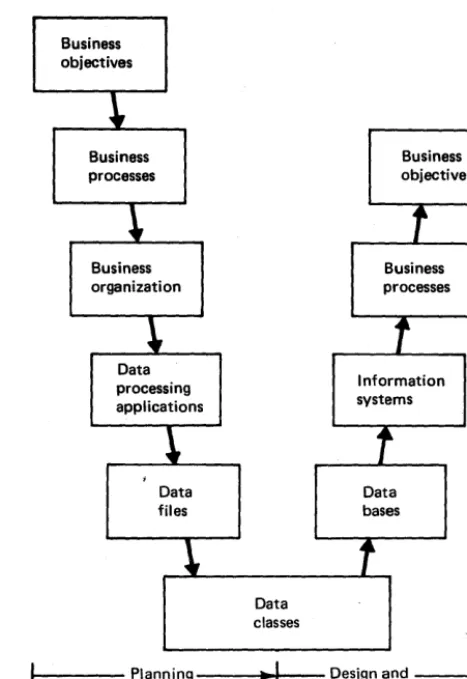
There are several implications and concepts associated with this statement. The first is that a totall/s to support the entire business unit's needs is too big to build in any single project. However, because of the many problems associated with a "bottom up" evolu-tion of systems (data inconsistencies, non-integrated system designs, expensive resystematizing, priority difficulties, etc.), it is very important that long-range goals and objectives for I/S be established. The basic concept, then, is top-down liS planning with bottom-up implementation (Figure 3).
With this concept the long-range I/S goals and objectives are identified through a top-down planning process (the BSP approach). The identified systems
are then implemented in a modular building-block fashion\ over time while remaining consistent with the organization's business priorities, available funds, and other shorter-term considerations. This philosophy can be likened to the detail design and construction of a large office building, which would be unthinkable without an architect's approved drawing of the finished product.
Business objectives
Business processes
Business organization
~
.. Data processing applicationsData files
Data classes
Business objectives
t
Business processes
T
Information systems
t
Data basest
~---Planning ----I~~II---Design and ----t~~1 implementation
Figure 3" Top-down analysis with bottom-up it:nplementation
The BSP methodology, although consisting of considerably more steps and detail than shown in Figure 4, is consistent with this philosophy. St~p I of Figure 4, defining the business objectives, is intended to ensure agreement among all executive levels as to where the business is going, so that the liS strategy can be in direct support. Step 2, defining the business processes, establishes the prime long-term basis for I/S
support in the business. Step 3, defining the data classes, can be done on the basis of the processes to be supported. A data class, as the name implies, is a major category of data needed to support one or more business processes. For example, customer informa-tion is a data class needed in several process areas, such as order entry, billing, and distribution. This step results in a definition of all the data to be managed a&-3"-resource across the business unit. Step 4, defining the information architecture, becomes a statement of the long-term liS objective. This is normally in the form of a group of interrelated liS areas and the associated data to be managed. From the information architecture the individual modules can be identified, prioritized, and built as scheduled by the liS plan ..
[image:14.634.329.563.62.401.2]Step 1 Step 2
Define the Define the
business ...
..
business I-objectives processes
Step 3 Step 4
Define the
~ Define the --.. information
data classes
...
architectureFigure 4. General I/S planning approach
A significant piece of the BSP methodology is the formulation of a recommended information architec-ture. The intent is to develop an implementation strategy that can be built in modules and yet provide justifiable return to the business at each step. These
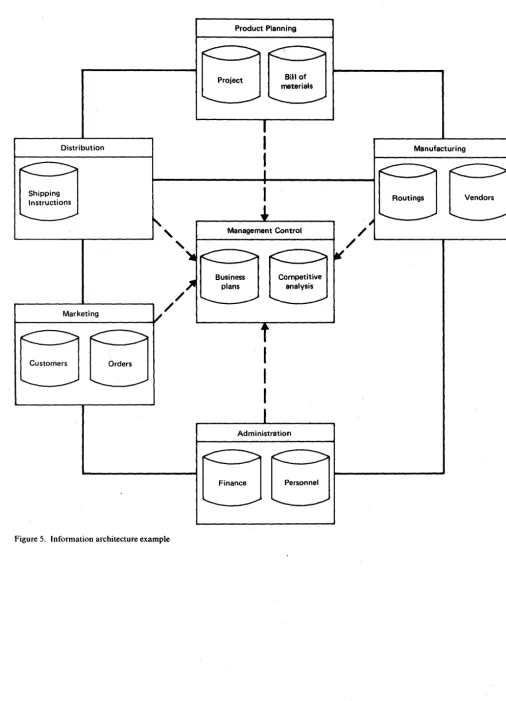
modules or implement able pieces are generally referred to as information systems (I/S). Each could be thought of as the depository or management point'for a particu-lar set of the data classes. As the data classes are implemented (assumed through d~ta base technology), it is possible to provide the information needs for various business processes. Each I/S then normally becomes associated with one or more business process-es and one or more data classprocess-es (see Figure 5). The implementation strategy should obviously be in tune with the business needs. An identified I/S is responsi-ble for the collection and maintenance of its data bases for the entire business. Other, or later implemented,
8
systems can draw on these data bases as well as new ones that they will create and maintain.
Most of the identified I/S areas will normally be in support of processes that are operational in nature. . That is, the decision areas inherent in the processes WIll relate to the "operational control" level of planning and control. Thus these I/S's are sometimes referred to as operational control systems. The ma~aged data is also at an operational level and is typified by much detail and quantity. A management control system, on the other hand (Figure 5), is in support of a
"management control" category of processes. Its managed data would typically b~ summariz~tions of the internally generated operational data (dotted lines in the figure) plus
any
other data (competitive data, for example) as necessary to'support the processes. By having "business plan" data in the data base, the . executive could effect control decisions by companng actual versus plan tor his area of responsibility.Distribution
Marketing
, ,
/
/
Figure 5. Information architecture example
Product Planning
Management Control
Administration
/
/
Manufacturing
[image:16.626.59.566.44.746.2]Chapter 2. Overview of the BSP Study Approach
The keys to success in planning, developing, and implementing an information architecture that effec-tively supports the business goals are:
• Top-down planning with bottom-up implementation • Managing data as a corporate resource
• Orientation around business processes • Use of a proven, comprehensive methodology
Chapter I examined the first three at some length. This chapter gives an overview of a proven methodolo-gy for the BSP study which will be delineated in more detail in the following chapters.
Perspective
Since BSP is part of an overall cycle for providing the
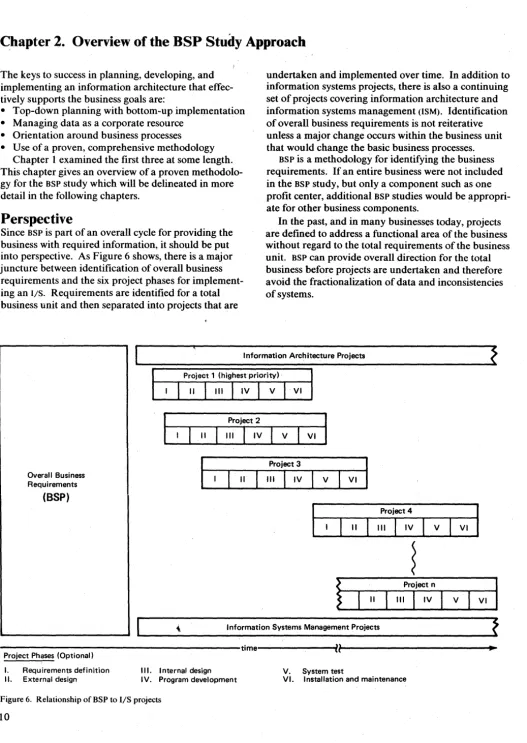
business with required information, it should be put into perspective. As Figure 6 shows, there is a major juncture between identification of overall business
requirements and the six project phases for implement-ing an IjS. Requirements are identified for a total
business unit and then separated into projects that are
undertaken and implemented over time. In addition to information systems projects, there is also a continuing set of projects covering information architecture and information systems management (ISM). Identification
of overall business requirements is not reiterative unless a major change occurs within the business unit that would change the basic business processes.
BSP is a methodology for identifying the business
requirements. If an entire business were not included in the BSP study, but only a component such as one profit center, additional BSP studies would be appropri-ate for other business components.
In the past, and in many businesses today, projects are defined to address a functional area of the business without regard to the total requirements of the business unit. BSP can provide overall direction for the total business before projects are undertaken and therefore avoid the fractionalization of data and inconsistencies of systems.
Information Architecture Projects
Overall Business Requirements
(SSP)
Project 1 (highest priority)
I
III
IIII
IVI
VI
VIProject 2
II III IIV V VI
Project 3
II III IV V VI
Project 4
III IV V
Project n II III
I
IVInformation Systems Management Projects
VI
V VI
---time---~ljl~---~~
Project Phases (Optional)
I. Requirements definition "I. I nternal design V. System test
II. External design IV. Program development VI. Installation and maintenance
Figure 6. Relationship of BSP to liS projects
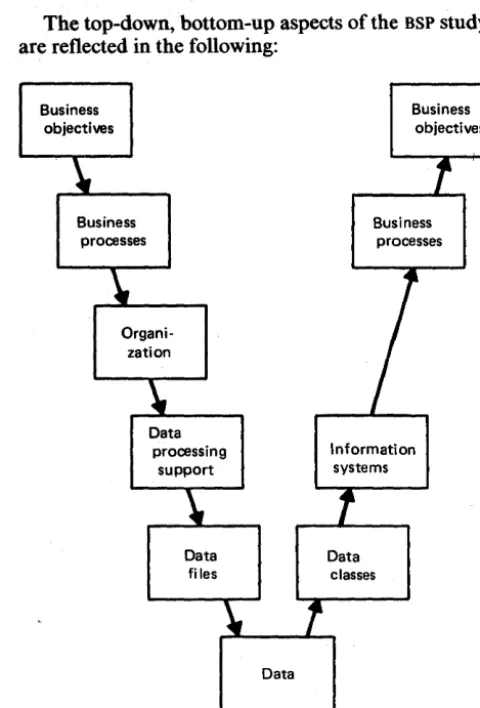
[image:17.623.46.574.28.772.2]The top-down, bottom-up aspects of the BSP study are reflected in the following:
Business objectives
Business processes
Organi-zation
Data processing
support
Data files
Data
Business objectives
Business processes
Information systems
Data classes
The study progresses from the very broad world in which the business exists down to the data required to run the business. The data is categorized into data classes that lead to the definition of information systems to support the business processes and business objectives. The study starts with a collection of facts about the business that are usually available in docu-mented form throughout the organization. These facts are organized, abstracted, and analyzed by the study team and enhanced by the top executive, who explains the business and adds those points usually not docu-mented. The study progresses to an identification of the major activities and decision processes in the business and then each of the executives is asked to validate and enlarge upon the facts that have been gathered and analyzed. The analysis ends with the consolidation and comparison of the facts from all sources. From this understanding the study follows the normal path of findings and conclusions, recommenda-tions, action plan, and executive presentation for concurrence and support.
Major Activities
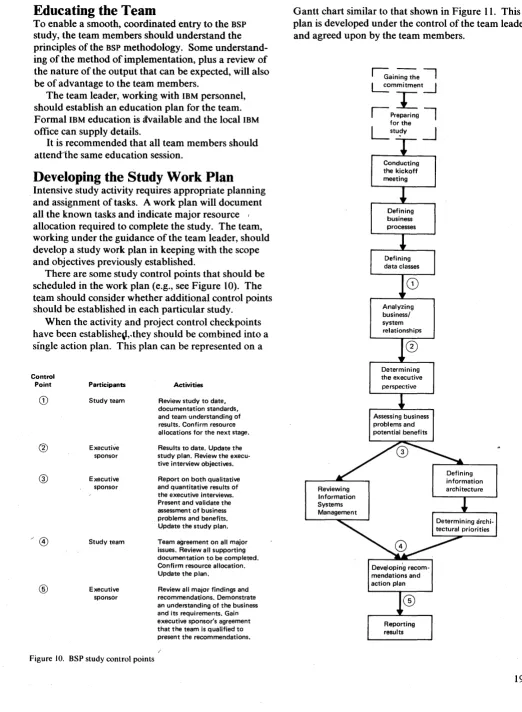
As Figure 7 indicates, there are two major activities that precede a BSP study and eleven in the study itself.
~aining
theI.
~mmitment-.J
r
I
PreparingI
for theLstUdY ~
Conducting the kickoff meeting
Defining business processes
Analyzing businessl system re1ationships
Determining the executive
perspective'
Assessing business problems and benefits
Developing recom-mendations and action plan
Figure 7. Flow of the BSP study
[image:18.627.70.310.56.410.2]While these activities may be carried out in varying degrees, none can be I omitted. Figure 7 shows these
activities and their most logical arrangement. When one becomes fairly familiar with the BSP approach, however, he can, as appropriate, do part of a given activity and delay the balance. The remainder of this chapter is a brief commentary on these major activities.
Gaining Commitment
A BSP study should not be started unless a top execu-tive sponsor and some other execuexecu-tives are committed to being involved in it. The study must reflect their view of the business, and the success of the study depends upon their providing the business understand-ing and information requirements to the team. Most of the input will come ,directly or indirectly from these executives.
Since approval of study recommendations commits
th~ company for several years to a certain direction in the use of its data processing resources, it is important at the outset to get agreement on the scope and objec-tives of the study and on its expected deliverables, so as to minimize future misunderstandings.
The most important action following commitment regards selection of the team leader, an executive who will work full time in the study and direct team activi-ties. He sees that contact with other executives is on the proper level and that input from them is interpreted correctly. A letter from the sponsor to a,ll participating executives sets the tone and signifies commitment.
Preparing for the Study
Considerable saving of time, avoidance of frustation, and higher quality of output can be gained by proper study preparation. All executive participants and the team need to know what will be done, why, and what is expected of them. Proper education and orientation will provide the best input from the executives and the best use of it by the team.
Interviewees are selected as soon as possible so as to allow for their orientation, scheduling of interviews, and the providing of information to the study team. F or maximum efficiency on the part of the team in working together full time during the study, informa-tion on the company and on data processing support is gathered before the study kickoff.
A control room is established so that the team may work together, display relevant material on the walls, and conduct interviews.
The major output should be a study control book containing: a study work plan; a schedule of interviews and a schedule of checkpoint reviews with the sponsor; an outline of the final report from the BSP study; and business and information systems data, analyzed and
12
charted, and ready for the kickoff period. This activity should end with a review by the BSP study sponsor.
Conducting the Kickoff Meeting
The BSP study itself and the full-time participation of the team members starts with the kickoff meeting, which consists of three presentations. First, the executive sponsor reiterates the objectives, expected outputs, and perspective of the study with relation to other company activities and objectives.
The next presentation is concerned with the main purpose of the kickoff, which is to provide that each team member is conversant with the information that has been gathered and to discuss those facts that are not part of the information supplied. To accomplish this the team leader "walks through" the business facts that have been gathered and makes subjective com-ments and additions on facts that cannot be readily documented - politics and sensitive issues, and changes planned and in process~ He should also cover the decision process, how the organization functions, key people, major problems, the user's view of DP support, and the image of the DP department.
The third presentation is made by the information systems director or one of his managers, who gives the team a view of data processing analogous to what was presented for the business. He should also cover project status and project control, history of major data processing projects started in the last two years, major current activities, planned changes, and major
problems.
These three presentations, added to the facts that have been gathered and made readily available to the team, should give the team an overall understanding of the business and the present and planned data process-ing support.
Defining Business Processes
No other activity during the study can be quite as overwhelming or as important as the identifying of the business processes. Since these processes form the basis for executive interviews, the information architec-ture, problem analysis, data class identification, and various follow-on activities, everyone on the team must acquire an understa~ding of all the processes, and they can do so by assisting full time in their identification and in the. writing of their descriptions. The major output from this step will be a list of all the processes, a description of each, and the identification of those that are key to the success of the business.
Defining Data Classes
mbsequent modification during the follow-on projects, helps the business develop data bases over time with a minimum of redundancy and in a manner that allows systems to be added without a major revision to the data bases. Since data must be recognized as a corpo-rate resource, it deserves the attention recommended here.
When the data classes have been identified, they are related to the business processes in orqer to define the information architecture, and they are related to present files to assist in the development of a migration plan.
Analyzing Business/Systems Relationships
The main purpose of this activity is to show how data processing currently supports the business in order to develop recommendations for future action. The currently existing organizations, business processes, information systems (applications), and data files are analyzed to identify voids and redundafiCies, help clarify responsibilities, and further the understanding of the business processes.The main analysis tool is the matrix, and various matrices are developed using combinations of the four elements. The key matrix for the executive interviews is the organization/process matrix, and its intercepts denote the decision makers, major and millor organiza-tional responsibility for a process, and current data processing support.
This activity will not only prepare the team for discussion with executives but will also help them determine requirements for information support.
Determining the Executive Perspective
This activity is an integral part of the top-down approach. Its purpose is to validate the work done by the team, determine the objectives, problems, and information needs (}.nd their value, and gain executive rapport and involvement. The executive interviews provide the business understanding necessary for information systems planning.The major output consists of notes from the inter-views, an update of the control room charts, and a new or improv~d rapport between the executive and the 8SP
study team.
Assessing Business Problems
Some of the business problems were supplied as input ,during the fact-gathering step. These were expanded
upon and complemented by the knowledge of the team and finally validated, explained, and added to in the executive interview. The problems must now be analyzed and related to the business processes so as to give guidance to the setting of project priorities and to
show clearly that better information will help to solve the problems.
One of the last activities in assessing the business problems is to divide them into those which are
information systems support problems and those which are non liS problems. The non liS problems will be delineated and given to the executive sponsor to follow up on while the information systems support problems continue to be addressed in the 8SP study and by the
follow-on activities.
Defining Information
Architecture-This activity represents a major movement from an examination of the present to a synthesis of the future.
It is here that we sketch future information systems and their accompanying data.
Systems may be viewed as the automated portions of processes. Data bases are the computerized part of the total inventory of data in the business. Information architecture brings order and structure to the systems and the data they create and use. Once it is structured, it allows for step-by-step development to migrate from the applications of today to the information systems of the future.
Because this task involves drawing a blueprint for the future, it deserves the attention of the whole team.
Determining Architectural Priorities
Since a total information architecture cannot be developed and implemented at one time, the team must establish priorities for the development of the systems and data bases. By deciding which of the data bases should be designed and implemented first, the team establishes which subsystems will be defined during the follow-on project. This allows an early·implementation for a "pay-as-you-go" foundation and helps establish credibility for the balance of the output from the BSPstudy.
Prioritization is accomplished by developing a list of projects from the subsystems of the information architecture, then establishing a set of criteria and rating the prospective projects against them. The analysis of the business problems is a major contributor to this process.
Reviewing Information Systems Management
(ISM)
The purpose of ISM is to eventually establish a con-trolled environment in which the information architec-ture can be developed, implemented, and operated efficiently and effectively. The information systems functions are examined during the BSP study to identify
( I) any changes that could be made immediately to enhance success in the follow-on projects, (2) changes
that are necessary to properly manage and implement the high-priority information architecture projects, and (3) major activities that will become projects in the follow-on to the BSP study. Fulfillment of this step is vital to the successful support of the business by the data processing function.
The major inputs are the information systems support problems from the executive interviews, the
ISM problems as identified by the liS director, and the technologies and skill requirements of the first system or systems. Additions and/or changes to the present information systems functions that are required for planning, developing, and implementing are then identified and put in priority sequence. This forms the basis for the development of an action plan for ISM
which feeds into the action plan and report from the
BSP study.
Developing Recommendations and Action Plan
The purpose of the action plan is to assist management in its decisions regarding the recommended follow-on projects. The follow-on projects will come from the architectural priorities and from the information systems management recommendations. Each of the projects will have been defined as a result of the activities in those two areas. The action plan brings these together to identify specific resources, schedules, and interactions of the projects.
Another major part of the action plan should be the identification of the steps preparatory to starting each of the follow-on activities. These must be examined
14
and sized before start dates can be put on the follow-on projects, so that management can give the direction necessary to move immediately into those preparatory activities.
Reporting Results
The purpose of the final report and executive presenta-tion is to obtain executive management commitment and involvement for implementing recommendations from the BSP study. The format of the report was agreed upon before the study was started, but may have to be modified slightly now, on the basis of the study results. Various parts of the report should be written during the BSP study and finalized at this time.
The report should be prepared as follows: I. It should include an executive summary.
2. The supporting detail, such as descriptions of the business processes, should be contained in appendices.
3. It should be possible to extract highly confidential or sensitive material easily and still have the balance of the report usable by all people participating in the follow-on activities.
Chapter 3. Gaining the Commitment
The success of a Business Systems Planning study depends heavily upon the commitment of the business to complete all the relevant activities and heed the recommendations of the study team. The steps de-scribed in this chapter should be completed and an assessment made of the commitment of all participants, before the final decision is made to move into the resource dependent activities. Certain situations and environments will be considered unsuitable for a BSP
study at this stage. If such is the case, the team should be prepared to postpone BSP until the situation be-comes more suitable.
In some organizations there may be a problem in obtaining access to executive management to explain the objectives and expected results of a BSP study. If so, the following actions should be considered: • Arrange an executive visit to another business that
has successfully completed a BSP study
• Invite a senior IBM executive to discuss information
systems planning with the appropriate executive in your organization
• Conduct an executive briefing session specifically for yo~r executives
• Conduct an executive planning session - a service offered by IBM
I -
ChiefGeneral management
I
I
executive officer
I
• Invite the executive to an executive information session conducted at an IBM Customer Executive
Education center
The IBM representative can help set up any of these activities.
Establishing the Study Scope
Normally the executive sponsoring the study (called the executive sponsor) will select the scope of the organization to be studied. This business unit must be defined so that all participants can recognize the boundaries within which their activities will be concentrated.
In general, the selected segment sliould extend to the upper levels of the organization, include more than one major function, and be of significant importance to the organization in that it contributes a major portion of the revenues, profits and/or services.
Businesses whose activities are participated in by multiple functional units tend to gain more from a BSP
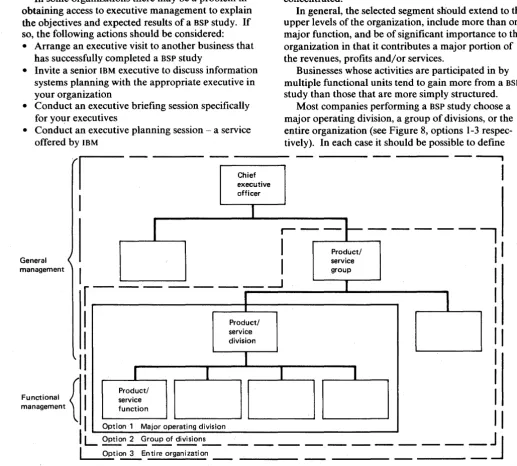
study than those that are more simply structured. Most companies performing a BSP study choose a major operating division, a group of divisions, or the entire organization (see Figure 8, options 1-3 respec-tively). In each case it should be possible to define
--
---,
I
r---I---I
Product/11
I
service groupI
r
I
I
---
_ _ _ _
---1
I
I
I
II
I
I
Product/ service function Functional
{II
management
I
Option·' Major operating divisionI
L
Option~r~
~n_s_
I
OPti~Entire organizationFigure 8. BSP organizational business unit options
_I
Product/ service division
I
I
I
I
II
I
I
I
II
_ _ _ _ _ _ _ _ _ _
JI
[image:22.615.45.562.256.722.2]boundaries for the study scope, including the measure-ments for assessing effectiveness.
Setting Study Objectives
Study objectives should now be defined. Good objec-tives will'be capable of being stated clearly and con-cisely. They will have criteria that can be applied to measure the degree to which they have been met. In addition, they will be applicabl~ to the specific require-ments of the organization to be studied. Finally, they will be capable of being satisfied by the BSP study team working within the defined study scope.
Specifically, a study team's objectives may be to: • Provide a formal, objective method for management
to establish information systems priorities without regard for provincial interests
• Provide for the development of information systems that have a long life, protecting the systems
investment
• Provide that the data processing resources are managed for the most efficient and effective support of the business goals
• Increase executive confidence that high-return information systems will be produced
• Improve relationship between the information systems department and the users by providing systems responsive to the users' requirements and priorities
• Identify data as
a
corporate resource that should be planned, managed, and controlled, in order to be used effectively by everyoneDeveloping Business Reasons fOf the
Study
There are several factors that may make a given business more difficult to do a BSP study for than others:
• Major reorganization or transformation of control taking place
• Geographical diversity, necessitating significant travel time
• Well over 20 executives who must be interviewed • Multiple independent sub-organizations with
autonomous decision making processes and with unique lines of products/services serving diverse markets
These factors should be reflected in a brief report (two or three pages) containing:
• Statement of the study scope • Study objectives
• Positive contributions of a BSP study • Obstacles to successful completion
• Recommendation either to proceed with BSP or postpone it
Current participants should present this report to an
executiv~ of the organization and gain agreement on all issues. Assuming that the report recommends proceed-ing with BSP, the meeting should result in a
commit-ment to:
• Appoint a study team leader
• Resource the study team as appropriate • Have open communication of future plans and
current data among all team members
• W rite a study announcement letter to executives of the organization of the form shown in Appendix A.
Resoufcing the Study Team
Characteristics
Since the study team is responsible for determining the information needs of the entire business and recom-mending the nature of its data processing operations for years to come, the selection of team members is very important.
The people chosen should:
• Have several years' experience within the organiza-tion, a sound knowledge of their own area, and an appreciation of the rest of the business
• Be able to understand and deal analytically with problems
• Be willing to commit to conclusions and recommen-dations that will have a far-reaching effect on the organization
• Be perceived by other management within the organization as competent and responsible business-men whose opinions will carry considerable weight In short, the best people for the study team are those who are already in high demand and difficult to make ayailable.
Organization and Responsibilities
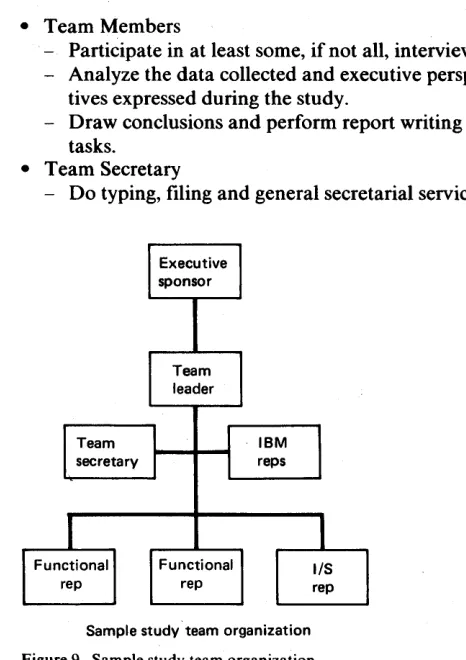
A possible organization structure for the study team is depicted by Figure 9. While minor variations are possible, the following fundamental responsibilities need to be assigned:
• Executive Sponsor
- Visibly endorse and support the study effort. - Review progress and findings during the study. - Receive the final report and make the approval
decision. • TeamLeader
- See that the study is successfully completed. - Provide overall direction, make key business
judgments, and act as liaison with other execu-tives of the organization.
• Team Members
- Participate in at least some, if not all, interviews. - Analyze the data collected and executive
perspec-tives expressed during the study.
- Draw conclusions and perform report writing tasks.
• Team Secretary
- Do typing, filing and general secretarial services.
Sample study· team organization
Figure 9. Sample study team organization
Considerations for Full- Time or Part- Time
Study
To compound the problem of team selection, a BSP
.study is intensive in nature, and is best performed on a full-time basis. While part-time studies may appear to be easier to resource and may be successful, they are often characterized by deadline and continuity prob-lems. Before embarking on a part-time study, assur-ance should be gained that:
• The team will be very well managed. That is, the