Random Walks on Context-Aware Relation Graphs for
Ranking Social Tags
Han Li
∗Zhi yuan Liu
∗M aosong Sun
Department of Computer Science and Technology State Key Lab on Intelligent Technology and Systems National Lab for Information Science and Technology
Tsinghua University, Beijing 100084, China
{lihan.thu,lzy.thu}gmail.om, smstsinghua.edu.n
A
BSTRACTSocial tagging provides an efficient way to manage online resources. In order to collect more social tags, many research efforts aim to automatically suggest tags to help users annotate tags. Many content-based methods assume tags are independent and suggest tags one by one independently. Although it makes suggestion easier, the independence assumption does not confirm to reality, and the suggested tags are usually inconsistent and incoherent with each other. To address this problem, we propose to model context-aware relations of tags for suggestion: (1) By regarding resource content as context of tags, we propose Tag Context Model to identify specific context words in resource content for tags. (2) Given a new resource, we build a context-aware relation graph of candidate tags, and propose a random walk algorithm to rank tags for suggestion. Experiment results demonstrate our method outperforms other state-of-the-art methods.
T
ITLE ANDA
BSTRACT INC
HINESE3
33þþþeee©©©aaa'''XXXää䥥¥ÅÅÅiiirrr???111¬¬¬III\\\üüüSSS
¬I\´«k+n3℄ª"Ǒ¼õ¬I\§NõïÄ
å u g Ä í I \ 5 Ï < I 5 "é õ Äu SN { Ǒ I \ m´ Õ á §Ï d
á / í z I \ " Ǒ , ù 4 í { {ü § ´ Õá 5b ¿Ø ÎÜ ý ¢ ¹§ l
í I \ p m 3 Ø Ú Ø ÆN "Ǒ )û ù ¯ K§ · J Ñé I\
mþe©a'X?1ïµ£1¤·ò℄ SN ǑI \þ e©§ ÏLI \þ
e©.lSN¥uyI\A½þe©"£2¤ ½ # ℄ §· ïáÿ ÀI
\ m þ e © ' X ã § Ï L Å i r { éI \ü S ¿í " ¢ ( Jy ² · {
`u®k{"
K
EYWORDS:
tag ranking, context-aware relation, random walk, social tag suggestion.K
EYWORDS INC
HINESE:
I\üS,þe©a'X,Åir,¬I\í.1 Introduction
Web 2.0 technologies provide a new scheme, social tagging, for users to collect, manage and share online resources (Gupta et al., 2010). In a social tagging system, each user can freely
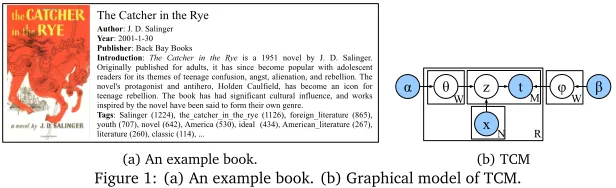
use any words to annotate resources. Figure 1a shows an exemplary book,The Catcher
in the Ryefrom Douban, a review website in China. For the book, many tags have been annotated by thousands of users. For example, the tag “Salinger” is annotated by 1, 224 users, which indicates the author J. D. Salinger. The figure also shows some meta-data such as the title, the author and a brief introduction. In this paper, we refer to the meta-data of a resource ascontentand the user-annotated tags asannotation.
(a) An example book. (b) TCM
Figure 1: (a) An example book. (b) Graphical model of TCM.
Social tagging provides a convenient management scheme compared to strict taxonomy in libraries. In order to attract more users to contribute social annotations, many social tagging systems facilitate users through automatic tag suggestion. There are two main approaches: graph-based and content-based. The former approach (Jaschke et al., 2008; Rendle et al., 2009) suggests tags according to users’ annotation history, while the latter approach (Si et al., 2009, 2010; Liu et al., 2011) according to resource meta-data. Since graph-based methods often suffer from the cold-start problem when they face new users or resources, content-based methods are usually regarded as an important component in social tagging systems especially in the initial stage. In this paper we focus on the content-based approach.
Many social tagging methods are based on independence assumption, which is widely
adopted in computational linguistics (Manning and Schutze, 2000) and information re-trieval (Manning et al., 2008). Under this assumption, tags are regarded independent with each other given the resource. Although this makes methods easier to implement, it does not accord with the real world, in which the annotated tags of a resource are usually se-mantically correlated with each other. Hence, if we can find an effective approach to model tag relations, it may improve the suggestion quality significantly.
It is non-trivial to model tag relations. Given a resource, the tag relations arecontext-aware. Two tags may be more related with each other given a resource but less given another one. Moreover, tag relations are complex for modeling. Since tags are not restricted within a pre-defined vocabulary, their relations cannot be well covered by manually-annotated dictionaries such as WordNet (Miller et al., 1990). Hence, we have to statistically learn the semantic relations of tags from a set of annotated data. This will better guarantee the semantic consistency of suggested tags.
[image:2.420.49.357.169.263.2]graphs to rank social tags. There are two critical challenges for this method: (1) How to statistically model the context-aware relations of tags from a large collection of annotation data? (2) After obtaining the context-aware relations of tags, how to construct a tag graph given a resource for random walks? To address the challenges, we propose a probabilistic model to learn the context-aware relations of tags, and propose a random walk algorithm over context-aware relation graphs to suggest tags. To investigate the efficiency of our method, we carry out experiments using real-world datasets.
Related work. Measuring semantic relations have been studied in many tasks such as measuring term similarities (Lin, 1998; Gabrilovich and Markovitch, 2007) and query simi-larities (Wen et al., 2002; Mei et al., 2008). Meanwhile, context-aware setting is being con-sidered in many applications including recommender systems (Adomavicius and Tuzhilin, 2011) and query suggestion (Brown and Jones, 2001), which is a critical research issue for all applications under real-world complex scene. In social tagging, co-occurrence-based tag relations have been explored to group tags into clusters (Wu et al., 2006b; Brooks and Montanez, 2006; Shepitsen et al., 2008), and have been adopted in personal-ized tag suggestion (Shepitsen et al., 2008) and extending ontology (Mika, 2005; Wu et al., 2006a). Some specific relations of tags such as subsumption are also studied in social tag-ging (Si et al., 2010). These relations are mostly context-free. There has been little work on modeling context-aware tag relations for content-based social tag suggestion.
2 Learning Context-Aware Relations of Tags
A resource is denoted asr ∈R, whereRis the set of all resources in the social tagging system. Each resource is composed of the content (meta-data) and the annotation (a set of tags). The content is represented as a sequence of wordsxr={xi}Ni=r1, whereNris the
number of words inxr. The vocabulary of the words in contents isW, and each word
xi=w∈W. The annotation of resourceris represented asar={ai}Mi=r1, whereMris the
number of annotated tags inar. The vocabulary of annotations isT, and each annotation ai=t∈T. Tag relations can be either context-free or context-aware, and either symmetric or asymmetric. Without loss of generality, we consider symmetric relations all through the paper and introduce context-free and -aware relations in detail.
2.1 Context-Free Relations
Context-free relations of tags leave context information out. There are various methods to statistically measure context-free relations of tags. The basic idea is regarding two tags are correlated with each other if they tend to be assigned to the same resources. For example, the tags “the_catcher_in_the_rye” and “Salinger” can be found correlated since they are usually assigned to the same resources. In this paper, we measure context-free relations of two tagst1andt2using joint probability Pr(t1,t2), estimated according to co-occurrences
of tags as Pr(t1,t2) =Nt1,t2/|R|, whereNt1,t2is the number of resources where botht1and t2appear together, and|R|is the total number of resources.
2.2 Co-Occurrence-based Context-Aware Relations
In this paper, we regard words in resources as the crucial context of tags. The context-aware relation between tagst1andt2given a context wordwcan be represented as the
We first introduce a naive method to measure context-aware tag relations, i.e., co-occurrence-based context-aware relations. In this method, the conditional probability Pr(t1,t2|w)is estimated according to the co-occurrences oft1,t2andwwithin a collection of annotated resources as Pr(t1,t2|w) =Nw,t1,t2/Nw, whereNwis the number of resources wherewappears,Nw,t1,t2is the number of resources wherew,t1andt2appear together. The co-occurrence-based context-aware tag relations are straightforward and easy for im-plementation. However, empirical experiments show that this type of relations usually suf-fers from poor performance. The reason is that, in many cases, given two tags of a resource, not all words in the resource can be regarded as their context. It is obvious that each anno-tated tag usually represents some aspects of a resource, and thus may only correspond to some specific words in the resource.
In order to better model context-aware relations of tags, it is crucial to exactly find corre-sponding context words for tags. Therefore, we propose a probabilistic graphical model, Tag Context Model (TCM), to learn context words for tags.
2.3 TCM and TCM-based Context-Aware Relations
Tag Context Model (TCM). We propose TCM to find context words of tags. TCM can be regarded as a generative process of each resourceras shown in Figure 1b. Essentially, TCM models semantic relations between words and tags, similar to WTM (Liu et al., 2011) and TAM (Si et al., 2010). We denote the context word sequence aszr={zi}M1r, corresponding
to the tag sequencear. The learning goal of TCM is to infer the multinomial distribution
of each tagtgiven wordw(i.e.,φwithφtw=Pr(t|w)) and the multinomial distribution
of each wordwbeing selected as context word in resourcer(i.e.,θwithθwr=Pr(w|r)).α
andβare hyper-parameters ofθandφfollowing Dirichlet distributions.
Given the observed words in resource contentx, the joint distribution ofθ,φ, context words
z, and tagsais Pr(z,θ,φ,a|x,α,β) =Pr(θ|α)QiM=1Pr(ai|zi,x,φ)Pr(φ|β)Pr(zi|x,θ). The key inference problem of TCM learning is computing posterior distribution of the hidden variables given resource content and tags. The hidden variables in TCM arez, i.e., the context words that correspond to the annotated tags of resources. Here we integrate out the parametersθ andφbecause it can be regarded as the statistics of the associations between the observed annotationsaand the correspondingz.
In this paper we select Gibbs Sampling for inference, which has been widely adopted in
graphical models such as LDA (Griffiths and Steyvers, 2004). Since we integrate outθ
andφ, the inference algorithm is also referred to ascollapsedGibbs Sampling. In Gibbs Sampling, we compute the conditional probability as
Pr(zi=w|z¬i,ai=t,a,x,α,β) =
Pr(z,a|x,α,β)
Pr(z¬i,a|x,α,β)∝
N¬i tw+β P
tNtw¬i+|T|β
× N
¬i wr+α P
wNwr¬i+|W|α
, (1)
whereN¬i
∗ indicates the annotationai is excluded,Ntwis the number of times that tagt
takeswas its context word, andNwr is the number of times that wordwis selected as
a context word within resourcer. Note that the probability shown in Equation (1) is un-normalized. The actual probability of assigning a tag to context wordwis computed by
dividing the quantity in Equation (1) for wordwby summing over all unique words in
further estimateφandθasφtw=Pr(t|w) =PNtw+β
tNtw+|T|β andφwr=Pr(w|r) =
Nwr+α
P
wNwr+|W|α.
With the estimatedφ, we can obtain all context words of each tagt, i.e., the words that have higher values ofφtw=Pr(t|w). Based on the estimations, we further measure
context-aware relations of tags.
TCM-based Context-Aware Relations. We define a functionδ(x)asδ(x) =1 ifxis true, otherwiseδ(x) =0. We calculate TCM-based context-aware relations of two tagst1andt2 usingaandzas follows:
Pr(t1,t2|w) =
P
r∈Rδr(zi=w∩zj=w∩ai=t1∩aj=t2)
P
r∈Rδr(zi=w)
. (2)
In this equation, ifδr(zi=w∩zj=w∩ai =t1∩aj =t2) =1, it indicates the resource r∈Rhas two tagst1andt2and both of them are assigned towas their context word; if δr(zi=w) =1, it indicates the resourcer∈Rhaswbeing assigned as context word.
The TCM-based context-aware relations calculated in Equation (2) have a potential size of
|T|2|W|, where|T|is the vocabulary size of tags and|W|is the vocabulary size of words. The
estimation of context-aware relations suffers from more serious problem of sparsity com-pared to context-free relations. To alleviate the sparsity problem, we introduce a remedy so-lution: linear interpolation smoothing. We use the conditional-independent context-aware relations for interpolation. Suppose two tagst1andt2are conditionally independent given w, the context-aware relations will be Pr+(t1,t2|w) =Pr(t1|w)Pr(t2|w), and the interpo-lation smoothing is performed as Pr∗(t
1,t2|w) =λPr(t1,t2|w) + (1−λ)Pr(t1|w)Pr(t2|w),
whereλis the interpolation factor. In this paper, we simply setλ=0.5.
Given a resourcerwith its contentxras context, the context-aware relation of two tagst1
andt2can be calculated according to their context-aware relation given each word in the resource content as context word, Pr(t1,t2|r) =Pr(t1,t2|xr) =
P
w∈xPr(t1,t2|w)Pr(w|x).
3 Random Walks for Ranking Tags
After modeling the context-aware relations of tags, we can build a context-aware relation graph of tags and rank tags by random walks over the graph.
3.1 Context-Aware Relation Graph Building
Here we focus on building undirected graphs which correspond to symmetric context-aware relations. For a resource rwith its contentx, we first rank tags according to the condi-tional probability of each tag estimated by TCM, i.e., Pr(t|r) =Pw∈xPr(t|w)Pr(w|x), where Pr(w|x)is the probability ofwbeing selected as context words within resource contentx, andφtw=Pr(t|w)is the probability ofwworking as context word oft. The measure
as-sumes each tag is conditionally independent given the resource and thus can be calculated separately. With Pr(t|r)we select top-ranked tags as candidate tags, denoted asTc. The number of candidate tags,|Tc|, can be manually pre-defined, which should be much larger than the number of suggested tagsMr, but much smaller than the size of tag vocabulary
|T|.
With candidate tagsTc, we build the context-aware relation graph of tags. We denote the graph asG={V,E}, whereV is the set of nodes with each nodevi =ti ∈Tc, andEis
graph,ei j indicates the edge betweenvi andvj withei j = eji. We set the edge weight
using symmetric context-aware relation probability, i.e.,ei j=Pr(ti,tj|r), which indicates the semantic relatedness betweentiandtjgivenras context. WithG, we represent the
context-aware relations of candidate tags given the resource within a unified graph. The next step is performing random walks over the graph to rank tags.
3.2 Random Walks over Context-Aware Relation Graphs
We conduct random walks over context-aware tag relation graphs to rank and suggest social tags. Random walks have been widely used in many tasks of computational linguistics and information retrieval, which can take the knowledge of the whole graph together for ranking nodes (Liu et al., 2009, 2010).
The basic idea of random walks is that a node is important if there are other important nodes connecting with it. Given a tag graph, we denote the ranking score of a nodevi at iterationkasrk(i). The random walk process is formulated as
rk+1(j) =γ
X
vi∈N(vj) ei j P
jei j
rk(i) + (1−γ)
1
|V|, (3)
wherePjei j is the out-degree of nodevi, γis the damping factor ranging from 0 to 1, and|V|is the number of nodes inG. In this paper, we follow most work and setγ= 0.85 (Langville and Meyer, 2004). The random jump probability in Equation (3) can also be set non-uniformly. Suppose we assign larger scores to some nodes, the final ranking scores will prefer these nodes and their neighbors. The new method is referred to as random walks with restart (RWR) (Tong et al., 2006). RWR takes node preferences into consideration during random walks, which can be written asrk+1(j) =γ
P
vi∈N(vj)
ei j
P
jei jrk(i)+(1−γ)Pr(j), where Pr(j)is the preference of nodevj. In this paper, we set Pr(j) =Pr(tj|r)estimated
by TCM. Note thatPv
i∈VPr(i) = 1. For tag suggestion, we simply use RWR scores to rank candidate tags and select top-ranked ones for suggestion. For this task, we denote the random walk method over context-free relation graphs as CFR; the method over co-occurrence aware relation graphs as CCR; and the method over TCM-based context-aware relation graphs as TCM.
4 Experiments
In the previous sections, we introduced the framework of suggesting social tags based on context-aware relations of tags given the resource. To investigate the efficiency of our method, in this section, we carry out experiments on real-world datasets.
4.1 Datasets and Experiment Setting
In our experiments, we select two real world datasets for evaluation. In Table 1 we show statistics of these datasets, where|R|,|W|, |T|, ˆNr and ˆMr are the number of resources, the vocabulary of contents, the vocabulary of tags, the average number of words in each resource content and the average number of tags in each resource, respectively. The two datasets, denoted as BOOK and MUSIC, contain book and music descriptions as content respectively, together with their annotated tags. Both of them are crawled from Douban
Data |R| |W| |T| Nˆr Mˆr
[image:7.420.120.313.70.100.2]BOOK 26, 807 82, 420 41, 199 368.69 8.95 MUSIC 25, 785 107, 100 31, 288 541.13 8.13
Table 1: Statistical information of two datasets.
We use precision/recall for evaluation. For a resource, we denote gold standard tags asag,
the suggested tags asas, and thus the correctly suggested tags asag∩as. Precision and
recall are defined asP=|ag∩as|/|as|andR=|ag∩as|/|ag|. In experiments, we perform
5-fold cross validation for each method, and the evaluation scores are computed by micro-averaging over resources of test set. We will evaluate the performance when the number of suggested tagsMranges from 1 to 10.
4.2 Evaluation Results
We select Naive Bayes (NB) (Garg and Weber, 2008), kNN (Li et al., 2009), CRM
(Iwata et al., 2009) and TAM (Si et al., 2010) as baseline methods for comparison. NB
andkNN are representative classification-based methods; while CRM and TAM are
repre-sentative topic-based methods. We set the parameters of the baselines as follows, by which
these methods achieve their best performance: the number of topicsT=1, 024 for CRM,
the number of nearest neighborsk=5. We will also compare three types of tag relations for tag suggestion, i.e., CFR (Section 2.1), CCR (Section 2.2) and TCM (Section 2.3).
In Figure 2a and Figure 2b we show the precision-recall curves of NB,kNN, CRM, TAM,
CFR, CCR and TCM on BOOK and MUSIC datasets. Each point of a precision-recall curve
represents suggesting different number of tags ranging fromM =1 (bottom right, with
higher precision and lower recall) toM = 10 (upper left, with higher recall but lower precision), respectively. The closer the curve to the upper right, the better the overall performance of the method.
0.150 0.2 0.25 0.3 0.35 0.4 0.45 0.5 0.55 0.6 0.05 0.1 0.15 0.2 0.25 0.3 0.35 Precision Recall NB kNN CRM TAM CFR CCR TCM (a) BOOK
0.050 0.1 0.15 0.2 0.25 0.3 0.35 0.4 0.45 0.5 0.05 0.1 0.15 0.2 0.25 0.3 0.35 0.4 0.45 Precision Recall NB kNN CRM TAM CFR CCR TCM (b) MUSIC
[image:7.420.68.363.355.470.2]tag suggestion. (3) TCM is superior to CCR. It reveals that measuring context-aware rela-tions simply based on co-occurrences between words and tags may introduce many noises because each tag of a resource mostly reflects only some specific words of the resource in-stead of all of them. This suggests that modeling context-aware tag relations is a non-trivial task, and we have to find corresponding context words for tags so as to build accurate context-aware relations. This is what we do by proposing TCM.
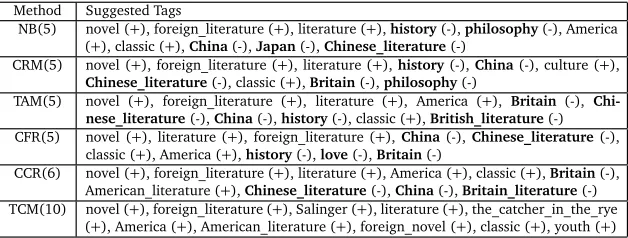
In Table 2, we show top-10 tags suggested by several methods for bookThe Catcher in
the Rye, the example in Figure 1a. Here we do not show the results ofkNN because its performance is too poor to compare with others. The number in the brackets after each method is the count of correctly suggested tags. The correctness of suggested tags are marked with+/−, and the incorrect tags are also highlighted in boldface. From Table 2, we can see that NB, CRM and TAM tend to suggest inconsistent and unrelated tags due to independence assumption, such as “philosophy” and “history”. CFR is context-free and its suggested tags are also inconsistent. CCR and TCM take the given resource as context, and thus achieve better performance especially for several top tags. TCM is obviously better than CCR, and can suggest specific tags such as “Salinger” and “the_catcher_in_the_rye”.
Method Suggested Tags
NB(5) novel (+), foreign_literature (+), literature (+),history(-),philosophy(-), America (+), classic (+),China(-),Japan(-),Chinese_literature(-)
CRM(5) novel (+), foreign_literature (+), literature (+),history(-),China(-), culture (+),
Chinese_literature(-), classic (+),Britain(-),philosophy(-)
TAM(5) novel (+), foreign_literature (+), literature (+), America (+), Britain (-),
Chi-nese_literature(-),China(-),history(-), classic (+),British_literature(-)
CFR(5) novel (+), literature (+), foreign_literature (+),China(-),Chinese_literature(-), classic (+), America (+),history(-),love(-),Britain(-)
CCR(6) novel (+), foreign_literature (+), literature (+), America (+), classic (+),Britain(-), American_literature (+),Chinese_literature(-),China(-),Britain_literature(-) TCM(10) novel (+), foreign_literature (+), Salinger (+), literature (+), the_catcher_in_the_rye
[image:8.420.47.361.236.355.2](+), America (+), American_literature (+), foreign_novel (+), classic (+), youth (+)
Table 2: Suggested tags for bookThe Catcher in the Rye(example in Figure 1a).
Conclusion and Future Work
In this paper, we propose TCM to find context words for tags from resource content. We model TCM-based context-aware tag relations, build a context-aware relation tag graph, and perform random walks over the graph to rank tags. Experiment results show that our method can sufficiently suggest more consistent tags compared to other methods. We have several research plans: (1) Build a unified method to simultaneously find con-text words of tags and model concon-text-aware tag relations. (2) Incorporate more concon-text, such as time-stamps and geographical information of annotation. (3) Model context-aware tag relations for other applications to investigate their effectiveness, such as personalized information retrieval and recommender systems.
Acknowledgments
References
Adomavicius, G. and Tuzhilin, A. (2011). Context-aware recommender systems.
Recom-mender Systems Handbook, pages 217–253.
Brooks, C. and Montanez, N. (2006). Improved annotation of the blogosphere via auto-tagging and hierarchical clustering. InProceedings of WWW, pages 625–632. ACM.
Brown, P. and Jones, G. (2001). Context-aware retrieval: Exploring a new environment for information retrieval and information filtering. Personal and Ubiquitous Computing, 5(4):253–263.
Gabrilovich, E. and Markovitch, S. (2007). Computing semantic relatedness using
wikipedia-based explicit semantic analysis. InProceedings of IJCAI, pages 6–12.
Garg, N. and Weber, I. (2008). Personalized, interactive tag recommendation for flickr. In
Proceedings of RecSys, pages 67–74.
Griffiths, T. and Steyvers, M. (2004). Finding scientific topics.PNAS, 101(Suppl 1):5228.
Gupta, M., Li, R., Yin, Z., and Han, J. (2010). Survey on social tagging techniques.ACM SIGKDD Explorations Newsletter, 12(1):58–72.
Iwata, T., Yamada, T., and Ueda, N. (2009). Modeling social annotation data with content relevance using a topic model. InProceedings of NIPS, pages 835–843.
Jaschke, R., Marinho, L., Hotho, A., Schmidt-Thieme, L., and Stumme, G. (2008). Tag
recommendations in social bookmarking systems.AI Communications, 21(4):231–247.
Langville, A. and Meyer, C. (2004). Deeper inside pagerank. Internet Mathematics,
1(3):335–380.
Li, X., Snoek, C., and Worring, M. (2009). Learning social tag relevance by neighbor voting.IEEE Transactions on Multimedia, 11(7):1310–1322.
Lin, D. (1998). Automatic retrieval and clustering of similar words. InProceedings of COLING, pages 768–774.
Liu, D., Hua, X., Yang, L., Wang, M., and Zhang, H. (2009). Tag ranking. InProceedings of WWW, pages 351–360.
Liu, Z., Chen, X., and Sun, M. (2011). A simple word trigger method for social tag sugges-tion. InProceedings of EMNLP, pages 1577–1588. Association for Computational Linguis-tics.
Liu, Z., Huang, W., Zheng, Y., and Sun, M. (2010). Automatic keyphrase extraction via topic decomposition. InProceedings of EMNLP, pages 366–376.
Manning, C., Raghavan, P., and Schtze, H. (2008). Introduction to information retrieval. Cambridge University Press New York, NY, USA.
Mei, Q., Zhou, D., and Church, K. (2008). Query suggestion using hitting time. In Pro-ceedings of the 17th ACM conference on Information and knowledge management, pages 469–478. ACM.
Mika, P. (2005). Ontologies are us: A unified model of social networks and semantics.
Proceedings of ISWC, pages 522–536.
Miller, G., Beckwith, R., Fellbaum, C., Gross, D., and Miller, K. (1990). WordNet: An on-line lexical database.International Journal of Lexicography, 3:235–244.
Rendle, S., Balby Marinho, L., Nanopoulos, A., and Schmidt-Thieme, L. (2009). Learning optimal ranking with tensor factorization for tag recommendation. InProceedings of KDD, pages 727–736.
Shepitsen, A., Gemmell, J., Mobasher, B., and Burke, R. (2008). Personalized recommen-dation in social tagging systems using hierarchical clustering. InProceedings of RecSys, pages 259–266.
Si, X., Liu, Z., Li, P., Jiang, Q., and Sun, M. (2009). Content-based and graph-based tag suggestion.ECML PKDD Discovery Challenge 2009, page 243.
Si, X., Liu, Z., and Sun, M. (2010). Modeling social annotations via latent reason identifi-cation.IEEE Intelligent Systems, 25(6):42–49.
Tong, H., Faloutsos, C., and Pan, J.-Y. (2006). Fast random walk with restart and its applications. InProceedings of ICDM, pages 613–622.
Wen, J., Nie, J., and Zhang, H. (2002). Query clustering using user logs.ACM Transactions on Information Systems, 20(1):59–81.
Wu, H., Zubair, M., and Maly, K. (2006a). Harvesting social knowledge from folksonomies. InProceedings of the seventeenth conference on Hypertext and hypermedia, pages 111–114. ACM.