34
Performance Evaluation of Bagasse Unit in a Sugar
Industry- A Review
Mr. Tammanna G. Sattigeri
1, Dr. Vinay V. Kuppast
21. M.Tech student, Department of Mechanical Engineering, Basaveshwar Engineering College, Bagalkot-587102. Karnataka
2. Associate Professor, Department of Mechanical Engineering, Basaveshwar Engineering College,
Bagalkot-587102. Karnataka
Abstract-In present paper an overall view of the performance of sugar industries, especially for bagasse
cogeneration plants generating electricity have been presented. The review is based on the survey and research study conducted in sugar industries with cogeneration plant. The review has been carried out taking into account the shortage of raw material (crop) used, availability of machinery to produce power, power consumption, auxiliary power requirements to run the industry and co-generation system. Different case studies have been discussed in this paper. A few feasible recommendations or options for implementation are discussed by the different contributors have been emphasized.
Keywords: Bagasse, Co-generation, Performance, Energy efficiency
1. INTRODUCTION:
Sugarcane is not only agricultural but also energy corp grown in India. Sugar industry is the second large agriculture based industry. This can spread prosperity in rural area. The generated employment has multiple effects and helps in over all development of the nation. Sugar industries in India have big share in agriculture processing industry. There is very strong impact of sugar industries on India's rural development and provides healthy rural economy. The sugarcane is main crop in 21 states of India. Mainly sugarcane mills are operating in areas like Maharashtra, Gujarat, Tamilnadu, Karnataka and Utterpradesh. Bagasse is the stringy substance that leftovers after sugarcane or sorghum stalks are crushed. And a byproduct generated in the method of manufacture of sugar. It can be effectively utilized for generation of steam. It is presently not only used as a biofuel and in the manufacture of pulp but also in paper goods and building materials. The bagasse produced in a sugar factory is however used for generation of steam which in turn is used as a fuel source and the surplus generation is exported to the power grids of state governments. Bagasse burned in quantity produces adequate heat energy to deliver needs of a sugar factory. The following paragraphs have been presented to review the contributions of some researchers who discussed the improvement of the performance of the bagasse cogeneration in sugar plants.
S. C. Kamate and P. B. Gangavati in their paper entitled, 'Exergetic Comparison of Bagasse-based Cogeneration Plants', discussed energy effeciency.
Sugar industry employs different cogeneration schemes to satisfy the plant's process steam demand and generate possible surplus power by upgrading the steam inlet parameters. Though, energy efficiencies are most commonly used up to now, a thermodynamically more accurate evaluation and more fair comparison between different systems can be based on exergetic efficiency. In the light of this, in this article exergetic performance comparison of three actual heat-matched, bagasse-based cogeneration plants working in, three different sugar mills located in, Belgaum district, Karnataka State, India, namely (i) Hira Sugar Works Ltd (HSWL) (ii) Doodhaganga Krishna Sahakari Sakkare Karkhane Ltd (DKSSK), (iii) Ugar Sugar Works Ltd (USWL) is presented. In the analysis, in addition to the more conventional energy analysis, exergy analysis is
employed to evaluate overall and component
efficiencies and to assess the thermodynamic losses. The results indicate that the three-cogeneration plants perform with energy and exergetic efficiency of 0.702, 0.628, 0.648 and 0.187, 0.234, 0.225 respectively for HWSL, DKSSK and USWL. Boiler is the major component contributing most to the overall in-efficiency in all the three plants. [1]
35
source to increase the living standards of people and Bagasse is highly used fuel in Sugar mill and can be used as an alternative to Coal based generation. In this study, we have taken the Data from the mill that is power generation record from the Year 2012-2013, 2013-2014, 2014-2015 when mill was working. Two inputs (Total Quantity of Cane crushed, Total home load) and two outputs (Total power generation and Total power Export) are taken for evaluating the efficiencies in different months and years by using CCR and BCC model in Data Envelopment Analysis. Results have been obtained by Banxia Frontier Analyst Software which reveal the fully efficient DMU’s and the other years are potentially improved by reducing the inputs. For 3 Different years or seasons when plant was running, by using DEA analysis i.e CCR model (minimizing inputs to seek the same outputs) we can reduce the inputs that is Total Quantity of cane crushed(TCC) and Total Home Load(THL) at an average of 8.615 and 5.495% respectively for better efficiency scores or full 100% efficient system and there is no potential improvements by using BCC model.[2] A.Khoodarutha presented in paper, 'Optimisation of a cogenerated energy systems: the cane biomass flexi-factory case study', the scenario of Mauritius. Mauritius has a long tradition of using cogeneration systems for electricity generation. Bagasse, a by-product of sugar cane is burnt in high temperature and pressure boilers to produce superheated steam to be used for combined heat and power generation. Steam is fed in condensing extraction steam turbine coupled with an alternator to produce electricity and the exit low pressure steam of the turbine is used for the processing of sugar with flexibility to be employed also in distillery and refinery activities. Multi-criteria analysis of such bio-refinery inputs and outputs is conducted considering Energy, Engineering, Economic, Environmental and Ethical dimensions like sustainability, equity and
democratization of the energy sector. Due to the reduction of price obtained for the sale of sugar to the European Union, the sugar industry has to re-engineer itself to move towards the flexi-factory concept for its survival. Production of high value-added refined sugar/special sugars, dehydrated ethanol for transport and power use and green electricity are constrained by a host of factors from climatic conditions to the price of sugar on the world market through the grid power costs itself dependent on world oil and coal prices. Environmental standards are also to be considered. The aim of this paper is to optimize the cogenerated energy systems of the cane flexi-factory by a holistic energy systems analysis. Actual parameters of a flexi-factory are used to calculate the energy efficiency of each components parts of the system as well as social, economic and environmental benefits. Policy implications crucial to the future viability of such complex energy systems; these are fully discussed in relation to national and international objectives.
The cane industry is at a cross road. Due to the decreasing prices obtained from the sale of sugar from EU, planters are abandoning their land. To make the industry viable and sustainable, implementation of higher pressure and temperature boilers, use of higher fibre cane, utilization of CTL and optimization of low process steam are promoted. But given the huge investment in implementation of these measures, it is recommended these in short, medium and long term. This would not only increase revenues from the sugar cane crops but also would improve our energy security and decrease the total GHG emissions by 7%. In addition, the share of bagasse-based electricity would increase by 100% from the present share of 14% to expected 28%. Finally, as future works, the study of gasification of bagasse could be undertaken. The flexi factory is shoen in Fig. 1.[3]
36
Palacios-Bereche R et.al. have done a case study on
'ENERGETIC EVALUATION OF
COGENERATION SYSTEMS IN SUGAR CANE PLANTS IN BRAZIL'. The combined production of steam and power has become the norm in the sugar cane industry worldwide. Thus the utilization of cane bagasse as fuel for cogeneration systems allows sugarcane plants to be self sufficient of thermal and electrical energy despite the use of low efficiency systems. The simulation / analysis of this systems would contribute to its improvement. The aim of this work is to evaluate the performance of cogeneration systems of sugarcane plants, in some selected cases in Brazil. The first case, very ussual in Brazilian industry, has got a cogeneration system using bagasse boilers of steam generation at low pressure (21bar) and back-pressure steam turbines. The second case has got a cogeneration system with two types of bagasse boilers, the first works with steam production in low pressure (22bar) to driven turbines of mills, cutters, shredders and pumps. The other one produce steam at higher pressure (42bar) that is used for electricity generation. All the turbines in this case are back-pressure steam turbines. Finally the third case has got a cogeneration system with a boiler of highest pressure (67bar) and condensing-extraction steam turbines. Thus, to evaluate the performance of these systems, some factors and index were calculated such as the Energy Utilization Factor, the Power to Heat Ratio, the Energy Saving Index, Efficiency of Second law, the Efficiency of Power Generation and another parameter derived of the last one called in this work Efficiency of Electricity Generation, which takes into account only the electricity generation without considers the power for direct driving. An exergoeconomic calculation of the plant products was also performed. The results of this work are useful from the point of view of giving a general vision of the energetic efficiency in Brazilian sugarcane plants cogeneration nowadays.
The performance assessment for the cogeneration system of three different sugar cane plants was accomplished. Performance parameters show important differences in these systems due to different levels of technology found in these plants. In this way, it advances in the cogeneration segment can be observed, from the point of view of the improving of these systems, aiming the production of surplus of electricity to sell to the grid. Thus the electricity production for Case C is 2.76 times the electricity production of case B which is 3.02 times the electricity production in case A. In relation to the
37
Table. 1. Performance parameters for the cogeneration systems
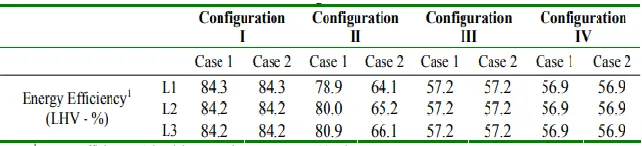
Adriano V. Ensinas et.al., in the paper, 'ANALYSIS OF COGENERATION SYSTEMS IN SUGAR CANE FACTORIES - ALTERNATIVES OF STEAM AND COMBINED CYCLE POWER PLANTS', discussed about the different configurations of energy efficiency. The sugar cane industry represents one of the most important economic sectors in Brazil. It produces sugar and ethanol for the internal and external markets. Also, thermal and electric energy are produced for the own factory consumption, using sugar cane bagasse as fuel in cogeneration plants. Almost all the sugar cane factories in Brazil are self-sufficient in terms of energy supply and in the last few years some of them have been selling their surplus for the grid. The introduction of steam power plants operating at higher pressure and temperature levels or even Biomass Gasification Systems operating in combined cycles are new alternatives for increasing the efficiency of these systems. The purpose of this paper is to analyze different options of cogeneration systems in sugar cane factories in order to evaluate the possibilities of increasing electricity generation. The analysis of the power plant is performed together with the steam demand reduction of sugar production process once the two systems are interlinked.
The analysis of the different configurations of cogeneration systems presented in this paper has shown the importance of the process steam demand when selecting the best option for a sugar factory, considering the bagasse as the sources of energy. The analysis has been focused in the evaluation of the process steam demand reduction and its relation with the possible surplus of electricity that could be produced with the utilization of cane bagasse, an energy resource generated at the process. For the Case 1, that presents a higher steam demand with
38
Table. 2. Configuration efficiencies
Mahesh G. Emmi et.al.,in this paper give an overall view of the performance of sugar industries, especially for bagasse cogeneration plants generating electricity. The compilation of the existing scenario is based on the survey and research study conducted in sugar, mining, paper, power, industries including cogeneration unit. The review has been carried out taking into account the shortage of raw material (crop) used, availability of machinery to produce power, power consumption, auxiliary power requirements to run the industry and co-generation system. The widely used approach to overcome the hindrance faced for higher yield, hazard free and smooth operation of the unit is very much called for at this stage. This aspect has been discussed in this paper. This is followed by few feasible recommendations or options for implementation are provided. The salient points that come out from this review study are given as;
The performance of sugar industry in the present day context has been brought out wherein the per capita consumption of sugar has an edge ever the growth of the population. The gap between demand and supply of power from generating units are required to be bridged to improve the per capita availability of power. The raw materials such as sugarcane and other ingredients required for sugar production as well as the solid waste management have be effectively done and they should not hamper the production of sugar. These have to be implemented with meaningful exercise and logical thinking. The machineries required for the sugar industry have to be made available as well as in good coordinating condition and not causing hindrances to the production of sugar. The overview of power situation study indicate the necessity for co-generation projects so that the shortage of the power may be overcome. The auxiliary power required to run the sugar industry has to be met from the electricity generation through co-generation units.[6]
2. CONCLUSIONS:
The Performance of the bagasse cogeneration plants in sugar industries are being elevated as the major source of energy generation along with the sugar production. It is one of the green energy available to fulfill the energy crisis of India to cope up with the environmental laws laid down by the International accords on ecosystem protection. In this review the researchers emphasized on the improvement of the efficiency of the bagasse plant considering the various parameters which can be controlled the appropriate models.
REFERENCES
[1] S. C. Kamate &P. B. Gangavati, 'Exergetic Comparison of Bagasse-based Cogeneration Plants',
Distributed Generation & Alternative Energy Journal, Volume 26, 2011 - Issue 3 Pages 20-35 | Published online: 10 Nov 2011.
[2] Gagandeep Kaur Gill, Ravinder Kaur, Tarandeep Kaur Gill, ' Efficiency Evaluation of Bagasse Cogeneration Plant by using DEA', International Journal of Electrical, Electronics and Data Communication, ISSN(p): 2320-2084, ISSN(e): 2321-2950 Volume-6, Issue-2, Feb.-2018, http://iraj.in 27
[3] A.Khoodarutha, 'Optimisation of a cogenerated energy systems: the cane biomass flexi-factory case study', 6th International Conference on Sustainability in Energy and Buildings, SEB-14, Energy Procedia 62 ( 2014 ) 656 – 665, www.sciencedirect.com Science Direct 1876-6102 © 2014.
39
August 31 – September 3, 2009, Foz do Iguaçu, Paraná, Brazil.
[5] Adriano V. Ensinas, Silvia A. Nebra, Miguel A. Lozano, Luis Serra, 'Analysis Of Cogeneration Systems In Sugar Cane Factories - Alternatives Of Steam And Combined Cycle Power Plants', Proceedings of ECOS 2006 Aghia Pelagia, Crete, Greece July 12-14, 2006.