A Neural Language Model for Dynamically Representing
the Meanings of Unknown Words and Entities in a Discourse
Sosuke Kobayashi Preferred Networks, Inc., Japan
Naoaki Okazaki
Tokyo Institute of Technology, Japan [email protected]
Kentaro Inui
Tohoku University / RIKEN, Japan [email protected]
Abstract
This study addresses the problem of iden-tifying the meaning of unknown words or entities in a discourse with respect to the word embedding approaches used in neural language models. We proposed a method for on-the-fly construction and exploitation of word embeddings in both the input and output layers of a neural model by tracking contexts. This extends the dynamic entity representation used in
Kobayashi et al.(2016) and incorporates a copy mechanism proposed independently by Gu et al. (2016) and Gulcehre et al.
(2016). In addition, we construct a new task and dataset called Anonymized Lan-guage Modeling for evaluating the abil-ity to capture word meanings while read-ing. Experiments conducted using our novel dataset show that the proposed vari-ant of RNN language model outperformed the baseline model. Furthermore, the ex-periments also demonstrate that dynamic updates of an output layer help a model predict reappearing entities, whereas those of an input layer are effective to predict words following reappearing entities.
1 Introduction
Language models that use probability distribu-tions over sequences of words are found in many natural language processing applications, includ-ing speech recognition, machine translation, text summarization, and dialogue utterance genera-tion. Recent studies have demonstrated that lan-guage models trained using neural network ( Ben-gio et al.,2003;Mikolov et al., 2010) such as re-current neural network (RNN) (Jozefowicz et al.,
2016) and convolutional neural network (Dauphin
... [ 1 ] killed [ 2 ] with bombs … ... police suspects [ 1 ] attacked ...
... police will arrest [ 1 ] …
... will arrest [ 1 ] soon …
d[2],2 d[1],2
! ! !
!
x[1]
x[2] y[2] y[1]
=−−−→RNN(
Figure 1: Dynamic Neural Text Modeling: the embeddings of unknown words, denoted by coref-erence indexes “[ k ]” are dynamically computed and used in both the input and output layers (x[k] and y[k]) of a RNN language model. These are constructed from contextual information (d[k],i)
preceding the current(i+ 1)-th sentence.
et al., 2016) achieve the best performance across a range of corpora (Mikolov et al.,2010;Chelba et al.,2014;Merity et al.,2017;Grave et al.,2017). However, current neural language models have a major drawback: the language model works only when applied to a closed vocabulary of fixed size (usually comprising high-frequency words from the given training corpus). All occurrences of out-of-vocabulary words are replaced with a single dummy token “<unk>”, showing that the word is unknown. For example, the word sequence, Piko-taro sings PPAP on YouTubeis treated as <unk>
sings <unk> on <unk> assuming that the words Pikotaro, PPAP, and YouTube are out of the vo-cabulary. The model therefore assumes that these words have the same meaning, which is clearly in-correct. The derivation ofmeanings of unknown words remains a persistent and nontrivial chal-lenge when using word embeddings.
[image:1.595.308.525.222.333.2]d [4],2 d
[4],1
... [ 1 ] killed [ 2 ] with bombs … ... police suspects [ 1 ] attacked ...
d
[3],1 Merge
Merge
d’
[1],1 d’[2],1
d
[2],1
d[1],1 d
[1],0
d
[2],0 dd[4],0[3],0
d[2],2 d[1],2
d[3],2
Merge
d’
[1],2 =−−−→RNN(
[image:2.595.101.503.61.144.2]=←−−−RNN(
Figure 2: Dynamic Neural Text Modeling: the meaning representation of each unknown word, denoted by a coreference index “[ k ]”, is inferred from the local contexts in which it occurs.
language models also make this assumption and represent all occurrences of a word with a single word vector across all documents. However, the assumption of a universal meaning is also unlikely correct. For example, the nameJohnis likely to re-fer to difre-ferent individuals in difre-ferent documents. In one story,John may be a pianist while another Johndenoted in a second story may be an infant. A model that represents all occurrences ofJohnwith the same vector fails to capture the very different behavior expected fromJohnas a pianist andJohn as an infant.
In this study, we address these issues and pro-pose a novel neural language model that can build and dynamically change distributed representa-tions of words based on the multi-sentential dis-course. The idea of incorporating dynamic mean-ing representations into neural networks is not new. In the context of reading comprehension,
Kobayashi et al.(2016) proposed a model that dy-namically computes the representation of a named entity mention from the local context given by its prior occurrences in the text. In neural ma-chine translation, the copy mechanism was pro-posed as a way of improving the handling of out-of-vocabulary words (e.g., named entities) in a source sentence (Gu et al., 2016;Gulcehre et al.,
2016). We use a variant of recurrent neural lan-guage model (RNLM), that combines dynamic representation and the copy mechanism. The re-sulting novel model,Dynamic Neural Text Model, uses the dynamic word embeddings that are con-structed from the context in the output and input layers of an RNLM, as shown in Figures1and2.
The contributions of this paper are three-fold. First, we propose a novel neural language model, which we named theDynamic Neural Text Model. Second, we introduce a new evaluation task and dataset called Anonymized Language Modeling. This dataset can be used to evaluate the ability of
a language model to capture word meanings from contextual information (Figure 3). This task in-volves a kind of one-shot learning tasks, in which the meanings of entities are inferred from their limited prior occurrences. Third, our experimen-tal results indicate that the proposed model out-performs baseline models that use only global and static word embeddings in the input and/or out-put layers of an RNLM. Dynamic updates of the output layer helps the RNLM predict reappearing entities, whereas those of the input layer are ef-fective to predict words following reappearing en-tities. A more detailed analysis showed that the method was able to successfully capture the mean-ings of words across large contexts, and to accu-mulate multiple context information.
2 Background
2.1 RNN Language Model
Given a sequence of N tokens of a docu-ment D = (w1, w2, ..., wN), an RNN
lan-guage model computes the probability p(D) =
QN
t=1p(wt|w1, ..., wt−1). The computation of
each factorized probabilityp(wt|w1, ..., wt−1)can
also be viewed as the task of predicting a following wordwtfrom the preceding words(w1, ..., wt−1).
Typically, RNNs recurrently compute the proba-bility of the following wordwtby using a hidden
stateht−1 at time stept−1,
p(wt|w1, ..., wt−1) = exp(
~
h|t−1ywt+bwt) P
w∈V exp(~h|t−1yw+bw),
(1) ~
ht=−−−→RNN(xwt, ~ht−1). (2)
Here, xwt and ywt denote the input and output word embeddings of wt respectively, V
repre-sents the set of words in the vocabulary, and bw
LSTM (Hochreiter and Schmidhuber, 1997) or GRU (Cho et al.,2014) to improve performance.
2.2 Dynamic Entity Representation
RNN-based models have been reported to achieve better results on the CNN QA reading compre-hension dataset (Hermann et al.,2015;Kobayashi et al.,2016). In the CNN QA dataset, every named entity in each document is anonymized. This is done to allow the ability to comprehend a docu-ment using neither prior nor external knowledge to be evaluated. To capture the meanings of such anonymized entities,Kobayashi et al.(2016) pro-posed a new model that they nameddynamic entity representation. This encodes the local contexts of an entity and uses the resulting context vector as the word embedding of a subsequent occurrence of that entity in the input layer of the RNN. This model: (1) constructs context vectorsd0
e,ifrom the
local contexts of an entityeat thei-th sentence; (2) merges multiple contexts of the entity ethrough max pooling and produces the dynamic represen-tationde,i; and (3) replaces the embedding of the
entityein the (i+1)-th sentence with the dynamic embeddingxe,i+1 produced fromde,i. More
for-mally,
xe,i+1 =Wdcde,i+be, (3) de,i = maxpooling(d0e,i,de,i−1), (4) d0
e,i = ContextEncoder(e, i). (5)
Here, be denotes a bias vector, maxpooling is a
function that yields the largest value from the el-ementwise inputs, andContextEncoderis an en-coding function. Figure2gives an example of the process of encoding and merging contexts from sentences. An arbitrary encoder can be used for ContextEncoder; Kobayashi et al. (2016) used bidirectional RNNs, encoding the words surround-ing the entityeof a sentence in both directions. If the entityefails to appear in thei-th sentence, the embedding is not updated, i.e.,de,i=de,i−1.
3 Proposed Method: Dynamic Neural Text Modeling
In this section, we introduce the extension of dy-namic entity representation to language modeling. From Equations1and2, RNLM uses a set of word embeddings in the input layer to encode the pre-ceding contextual words, and another set of word embeddings in the output layer to predict a word
from the encoded context. Therefore, we consider incorporating the idea of dynamic representation into the word embeddings in the output layer (yw
in Equation1) as well as in the input layer (xw in
Equation 2; refer to Figure 1). The novel exten-sion of dynamic representation to the output layer affects predictions made for entities that appear repeatedly, whereas that in the input layer is ex-pected to affect the prediction of words that follow the entities.
The procedure for constructing dynamic repre-sentations ofe,de,iis the same as that introduced
in Section2.2. Before reading the (i+ 1)-th sen-tence, the model constructs the context vectors [d0
e,1, ...,d0e,i]from the local contexts ofein every
preceding sentence. Here,d0
e,jdenotes the context
vector ofein thej-th sentence.ContextEncoder in the model produces a context vector d0
e for e
at thet-th position in a sentence, using a bidirec-tional RNN1as follows:
d0e= ReLU(Whd[~ht−1, ~ht+1]+bd), (6)
~
ht=−−−→RNN(xwt, ~ht−1), (7) ~
ht=←−−−RNN(xwt, ~ht+1). (8)
Here, ReLU denotes the ReLU activation func-tion (Nair and Hinton,2010), whileWdcandWhd
correspond to learnable matrices;bdis a bias
vec-tor. As in the RNN language model, ~ht−1 and
~
ht+1 as well as their compositiond0ecan capture
information necessary to predict the features of the targeteat thet-th word.
Following context encoding, the model merges the multiple context vectors, [d0
e,1, ...,d0e,i], into
the dynamic representation de,i using a
merg-ing function. A range of functions are abailable for merging multiple vectors, while Kobayashi et al.(2016) used only max pooling (Equation4). In this study, we explored three further func-tions: GRU, GRU followed by ReLU (de,i =
ReLU(GRU(d0
e,i,de,i−1))) and a function that
se-lects only the latest context, i.e.,de,i =d0e,i. This
comparison clarifies the effect of the accumulation of contexts as the experiments proceeded2.
1Equations2and7are identical but do not share internal
parameters.
2Note that merging functions are not restricted to
con-sidering two arguments (a new context and a merged past context) recurrently but can consider all vectors over the whole history[d0e,1, ...,d0e,i](e.g., by using attention
the hottest gift [ 1 ] could be [ 2 ] , but good luck
finding one . as [ 3 ] reports , many stores have sold out of [ 2 ] even …
Anonymized Version
The hottest gift this Christmas could be Sony’s new PlayStation 2, but good luck finding one. As Greg Lefevre reports, many stores have sold out of the game even …
Original Version
Figure 3: An example document for Anonymized Language Modeling. Token “[ k ]” is an anonymized token that appears k-th in the entities in a document. Language models predict the next word from the preceding words, and calculate probabilities for whole word sequences.
The merging function produces the dynamic representation de,i of e. In language modeling,
to read the (i+ 1)-th sentence, the model uses two dynamic word embeddings of ein the input and output layers. The input embeddingxe, used
to encode contexts (Equation 2), and the output embeddingye, used to predict the occurrence ofe
(Equation1), are replaced with dynamic versions:
xe=Wdxde,i+bxe, (9) ye=Wdyde,i+bye, (10)
where Wdx and Wdy denote learnable matrices,
andbx
e andbye denote learnable vectors tied to e.
We can observe that a conventional RNN language model is a variant that removes the dynamic terms (Wdxde,iandWdyde,i) using only the static terms
(bx
eandbye) to represente. The initial dynamic
rep-resentationde,0 is defined as a zero vector, so that
the initial word embeddings (xeandye) are
iden-tical to the static terms (bx
e andbye) until the point
at which the first context of the target wordeis ob-served. All parameters in the end-to-end model are learned entirely by backpropagation, maximizing the log-likelihood in the same way as a conven-tional RNN language model.
We can view the approach in Kobayashi et al.
(2016) as a variant on the proposed method, but using the dynamic terms only in the input layer (for xe). We can also view the copy
mecha-nism (Gu et al.,2016;Gulcehre et al.,2016) as a variant on the proposed method, in which specific embeddings in the output layer are replaced with special dynamic vectors.
4 Anonymized Language Modeling This study explores methods for on-the-fly cap-ture and exploitation of the meanings of unknown words or entities in a discourse. To do this, we in-troduce a novel evaluation task and dataset that we
calledAnonymized Language Modeling. Figure3
gives an example from the dataset. Briefly, the dataset anonymizes certain noun phrases, treating them as unknown words and retaining their coref-erence relations. This allows a language model to track the context of every noun phrase in the dis-course. Other words are left unchanged, allowing the language model to preserve the context of the anonymized (unknown) words, and to infer their meanings from the known words. The process was inspired byHermann et al.(2015), whose ap-proach has been explored by the research on read-ing comprehension.
More precisely, we used the OntoNotes ( Prad-han et al., 2012) corpus, which includes docu-ments with coreferences and named entity tags manually annotated. We assigned an anonymous identifier to every coreference chain in the cor-pus3 in order of first appearance4, and replaced
mentions of a coreference chain with its identi-fier. In our experiments, each coreference chain was given a dynamic representation. Following
Mikolov et al.(2010), we limited the vocabulary to 10,000 words appearing frequently in the corpus. Finally, we inserted “<bos>” and “<eos>” tokens to mark the beginning and end of each sentence.
An important difference between this dataset and the one presented inHermann et al.(2015) is in the way that coreferences are treated.Hermann et al.(2015) used automatic resolusion of corefer-ences, whereas our study made use of the manual annotations in the OntoNotes. Thus, the process of Hermann et al.(2015) introduced (intentional and unintentional) errors into the dataset. Addi-tionally, the dataset did not assign an entity
iden-3We used documents with no more than 50 clusters, which
covered more than 97% of the corpus.
4Following the study ofLuong et al.(2015), we assigned
Split Train Valid Test
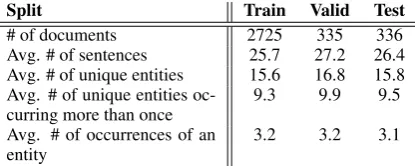
# of documents 2725 335 336
Avg. # of sentences 25.7 27.2 26.4 Avg. # of unique entities 15.6 16.8 15.8 Avg. # of unique entities
oc-curring more than once 9.3 9.9 9.5 Avg. # of occurrences of an
[image:5.595.78.286.59.142.2]entity 3.2 3.2 3.1
Table 1: Statistics of Anonymized Language Modeling dataset.
tifier to a pronoun. In contrast, as our dataset has access to the manual annotations of coreferences, we are able to investigate the ability of the lan-guage model to capture meanings from contexts.
Dynamic updating could be applied to words in all lexical categories, including verbs, adjec-tives, and nouns without requiring additional tensions. However, verbs and adjectives were cluded from targets of dynamic updates in the ex-periments, for two reasons. First, proper nouns and nouns accounted for the majority (70%) of the low-frequency (unknown) words, followed by verbs (10%) and adjectives (9%). Second, we assumed that the meaning of a verb or adjective would shift less over the course of a discourse than that of a noun. When semantic information of un-known verbs and adjectives is required, their em-beddings may be extracted from ad-hoc training on a different larger corpus. This, however, was beyond the scope of this study.
5 Experiments
5.1 Setting
An experiment was conducted to investigate the effect of Dynamic Neural Text Model on the Anonymized Language Modeling dataset. The split of dataset followed that of the original cor-pus (Pradhan et al., 2012). Table 1 summarizes the statistics of the dataset.
The baseline model was a typical LSTM RNN language model with 512 units. We compared three variants of the proposed model, using dif-ferent applications of dynamic embedding: in the input layer only (as in Kobayashi et al. (2016)), in the output layer only, and in both the input and output layers. The context encoders were bidirec-tional LSTMs with 512 units, the parameters of which were not the same as those in the LSTM RNN language models. All models were trained by maximizing the likelihood of correct tokens, to
achieve best perplexity on the validation dataset5.
Most hyper-parameters were tuned and fixed by the baseline model on the validation dataset6.
It is difficult to adequately train the all parts of a model using only the small dataset of Anonymized Language Modeling. We therefore pretrained word embeddings and ContextEncoder (the bi-directional RNNs and matrices in Equations 6–
8) on a sentence completion task in which clozes were predicted from the surrounding words in a large corpus (Melamud et al., 2016)7. We
used the objective function with negative sam-pling (Mikolov et al., 2013): Pe(logσ(ˆx|exe) + P
v∈Neg(logσ(−xˆ|exv))). Here, xˆe is a context
vector predicted byContextEncoder,xedenotes
the word embedding of a target word e appear-ing in the corpus, and Neg represents randomly sampled words. These pretrained parameters of ContextEncoderwere fixed when the whole lan-guage model was trained on the Anonymized Lan-guage Modeling dataset. We implemented models in Python using theChainerneural network li-brary (Tokui et al.,2015). The code and the con-structed dataset are publicly available8.
5.2 Results and Analysis 5.2.1 Perplexity
Table2shows performance of the baseline model and the three variants of the proposed method in terms of perplexity. The table reports the mean and standard error of three perplexity values af-ter training using three different randomly cho-sen initializations (we used the same convention
5We performed a validation at the end of every half epoch
out of five epochs.
6Batchsize was 8. Adam (Kingma and Ba, 2015) with
learning rate10−3. Gradients were normalized so that their norm was smaller than 1. Truncation of backpropagation and updating was performed after every 20 sentences and at the end of document.
7We pretrained a model on the Gigaword Corpus,
exclud-ing sentences with more than 32 tokens. We performed train-ing for 50000 iterations with a batch size of 128 and five negative samples. Only words that occurred no fewer than 500 times are used; other words were treated as unknown tokens. Melamud et al.(2016) used three different sets of word embeddings for the two inputs with respect to the en-coders (−−−→RNNand←−−−RNN) and the output (target). However, we forced the sets of word embeddings to share a single set of word embeddings in pretraining. We initialized the word embeddings in both the input layer (xw) and the output layer (yw) of the novel models, including the baseline model, with this single set. The word embeddings of all anonymized to-kens were initialized as unknown words with the word em-bedding of “<unk>”.
Models (1) All (2) Reappearingentities (3) Followingentities (4) Non-entities LSTM LM (Baseline) (A) 64.8±0.6 48.0±2.6 128.6±2.0 68.5±0.2 With only dynamic input (B) 62.8±0.3 42.4±1.1 109.5±1.4 66.4±0.3 With only dynamic output (C) 62.5±0.3 35.9±3.7 129.0±0.7 69.5±0.3 With dynamic input & output (D) 60.7±0.2 34.0±1.3 106.8±0.6 67.6±0.04 Table 2: Perplexities for each token group of models on the test set of Anonymized Language Modeling dataset. All values are averages with standard errors, calculated respectively by three models (trained with different random numbers). Dynamic models used GRU followed by ReLU as the merging function.
throughout this paper). Here, we discuss the pro-posed method using GRU followed by ReLU as the merging function, as this achieved the best perplexity (see Section5.2.2for a comparison of functions). We also show perplexitiy values when evaluating words of specific categories: (1) all words; (2) reappearing entity words; (3) words fol-lowing entities; and (4) non-entity words.
All variants of the proposed method outper-formed the baseline model. Focusing on the cat-egories (2) and (3) highlights the roles of dynamic updates of the input and output layers. Dynamic updates of the input layer (B) had a larger im-provement for predicting words following entities (3) than those of the output layer (C). In con-trast, dynamic updates of the output layer (C) were quite effective for predicting reappearing entities (2) whereas those of the input layer (B) were not. These facts confirm that: dynamic updates of the input layer help a model predict words following entities by supplying on-the-fly context informa-tion; and those of the output layer are effective to predict entity words appearing multiple times.
In addition, dynamic updates of both the input and output layers (D) further improved the perfor-mance from those of either the output (C) or input (B) layer. Thus, the proposed dynamic output was shown to be compatible with dynamic input, and vice versa. These results demonstrated the posi-tive effect of capturing and exploiting the context-sensitive meanings of entities.
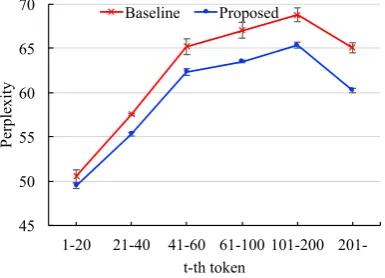
In order to examine whether dynamic updates of the input and output embeddings capture context-sensitive meanings of entities, we present Fig-ures 4, 5 and6. Figure 4 depicts the perplexity of words with different positions in a document9.
The figure confirms that the advantage of the pro-posed method over the baseline is more evident
9It is more difficult to predict tokens appearing latter in
a document because the number of new (unknown) tokens increases as a model reads the document.
45 50 55 60 65 70
1-20 21-40 41-60 61-100 101-200
201-P
er
pl
exi
ty
t-th token Baseline Proposed
Figure 4: Perplexity of all tokens relative to the time at which they appear in the document.
especially in the latter part of documents, where repeated words are more likely to occur.
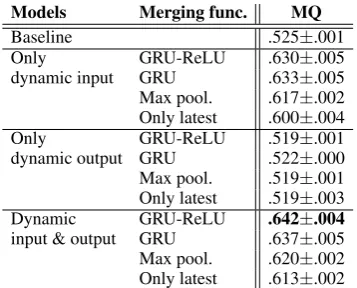
Figure 5 shows the perplexity with respect to the frequency of wordstwithin documents. Note that the word embedding at the first occurrence of an entity is static. This figure indicates that en-tities appearing many times enjoy the benefit of the dynamic language model. Figure6visualizes the perplexity of entities with respect to the num-bers of their antecedent candidates. It is clear from this figure that the proposed method is better at memorizing the semantic information of entities appearing repeatedly in documents than the base-line. These results also demonstrated the contribu-tion of dynamic updates of word embeddings. 5.2.2 Comparison of Merging functions Table 3compares models with different merging functions; GRU-ReLU, GRU, max pooling, and the use of the latest context. The use of the lat-est context had the worst performance for all vari-ants of the proposed method. Thus, a proper accu-mulation of multiple contexts is indispensable for dynamic updates of word embeddings. Although
[image:6.595.321.514.210.349.2]Models Merging function (to be finetuned)# of parameters (1) All (2) Reappearingentities (3) Followingentities (4) Non-entities Only GRU-ReLU 18.9M (14.2M) 62.8±0.3 42.4±1.1 109.5±1.4 66.4±0.3 dynamic input GRU 18.9M (14.2M) 63.2±0.4 43.3±2.7 111.2±0.7 66.8±0.4 Max pool. 17.3M (12.6M) 63.6±0.4 45.0±2.6 116.0±1.0 67.0±0.2 Only latest 17.3M (12.6M) 64.0±0.4 44.1±1.6 127.6±0.7 67.5±0.2 Only GRU-ReLU 18.9M (14.2M) 62.5±0.3 35.9±3.7 129.0±0.7 69.5±0.3 dynamic output GRU 18.9M (14.2M) 62.6±0.2 39.0±2.0 121.1±8.3 69.1±0.2 Max pool. 17.3M (12.6M) 62.2±0.4 41.1±1.9 126.9±1.5 68.4±0.6 Only latest 17.3M (12.6M) 64.9±0.1 49.8±1.8 129.1±1.6 70.6±0.2 Dynamic GRU-ReLU 19.2M (14.4M) 60.7±0.2 34.0±1.3 106.8±0.6 67.6±0.04 input & output GRU 19.2M (14.4M) 60.9±0.3 37.5±0.3 108.9±0.8 67.2±0.4
[image:7.595.75.530.59.212.2]Max pool. 17.6M (12.9M) 60.7±0.3 39.5±3.4 107.5±1.3 66.8±0.8 Only latest 17.6M (12.9M) 63.4±0.2 47.9±4.2 116.4±0.4 68.9±0.1 Baseline 12.3M (12.3M) 64.8±0.6 48.0±2.6 128.6±2.0 68.5±0.2 Table 3: Results for models with different merging functions on the test set of the Anonymized Language Modeling dataset, as same as in Table 2.
60 70 80 90 100 110 120 130 140 150 160
1 2 3-6 7-10
11-P
er
pl
exi
ty of
t
oke
ns
fol
low
ing e
nt
it
ie
s
t-th occurrence of entities Baseline Proposed
Figure 5: Perplexity of tokens following the enti-ties relative to the time at which the entity occurs.
shown to be comparable in performance and supe-rior to max pooling when predicting tokens related to entities (2) and (3).
5.2.3 Predicting Entities by Likelihood of a Sentence
In order to examine contribution of the dynamic language models on a downstream task, we con-ducted cloze tests for comprehension of a sentence with reappearing entities in a discourse. Given multiple preceding entities E = {e+, e1, e2, ...}
followed by a cloze sentence, the models were re-quired to predict the true antecedente+ which
al-lowed the cloze to be correctly filled, among the other alternativesE−={e1, e2, ...}.
Language models solve this task by comparing the likelihoods of sentences filled with antecedent candidates inE and returning the entity with the highest likelihood of the sentence. In this experi-ment, the performance of a model was represented by the Mean Quantile (MQ) (Guu et al., 2015).
0 10 20 30 40 50 60 70 80 90 100
0 1 2 3 4-6 7-10 11-20
21-P
er
pl
exi
ty of
e
nt
it
ie
s
[image:7.595.321.514.268.406.2]# of antecedent entities Baseline Proposed
Figure 6: Perplexity of entities relative to the num-ber of antecedent entities.
The MQ computes the mean ratio at which the model predicts a correct antecedente+more likely
than negative antecedents inE−,
MQ = |{e−∈E−:|pE(−e−|)< p(e+)}|. (11)
Here, p(e) denotes the likelihood of a sentence whose cloze is filled with e. If the correct an-tecedente+yields highest likelihood, MQ gets 1.
[image:7.595.85.279.269.407.2]Models Merging func. MQ
Baseline .525±.001
[image:8.595.92.271.58.202.2]Only GRU-ReLU .630±.005 dynamic input GRU .633±.005 Max pool. .617±.002 Only latest .600±.004 Only GRU-ReLU .519±.001 dynamic output GRU .522±.000 Max pool. .519±.001 Only latest .519±.003 Dynamic GRU-ReLU .642±.004 input & output GRU .637±.005 Max pool. .620±.002 Only latest .613±.002 Table 4: Mean Quantile of a true coreferent entity among antecedent entities.
6 Related Work
An approach to addressing the unknown word problem used in recent studies (Kim et al.,2016;
Sennrich et al.,2016;Luong and Manning,2016;
Schuster and Nakajima,2012) comprises the beddings of unknown words from character em-beddings or subword emem-beddings. Li and Juraf-sky (2015) applied word disambiguation and use a sense embedding to the target word. Choi et al.
(2017) captured the context-sensitive meanings of common words using word embeddings, applied through a gating function controlled by history words, in the context of machine translation. In fu-ture work, we will explore a wider range of mod-els, to integrate our dynamic text modeling with methods that estimate the meaning of unknown words or entities from their constituents. When addressing well-known entities such as Obama andTrump, it makes sense to learn their embed-dings from external resources, as well as dynam-ically from the preceding context in a given dis-course (as in our Dynamic Neural Text Model). The integration of these two sources of informa-tion is an intriguing challenge in language model-ing.
A key aspect of our model is its incorporation of the copy mechanism (Gu et al., 2016; Gul-cehre et al., 2016), using dynamic word embed-dings in the output layer. Independently of this study, several research groups have explored the use of variants of the copy mechanisms in lan-guage modeling (Merity et al.,2017;Grave et al.,
2017;Peng and Roth,2016). These studies, how-ever, did not incorporate dynamic representations in the input layer. In contrast, our proposal in-corporates the copy mechanism through the use
of dynamic representations in the output layer, in-tegrating them with dynamic mechanisms in both the input and output layers by applying dynamic entity-wise representation. Our experiments have demonstrated the benefits of such integration.
Another related trend in recent studies is the use of neural network to capture the informa-tion flow of a discourse. One approach has been to link RNNs across sentences (Wang and Cho,
2016; Serban et al., 2016), while a second ap-proach has expolited a type of memory space to store contextual information (Sukhbaatar et al.,
2015; Tran et al., 2016; Merity et al., 2017). Research on reading comprehension (Kobayashi et al., 2016;Henaff et al.,2017) and coreference resolution (Wiseman et al.,2016;Clark and Man-ning, 2016b,a) has shown the salience of entity-wise context information. Our model could be lo-cated within such approaches, but is distinct in be-ing the first model to make use of entity-wise con-text information in both the input and output layers for sentence generation.
We summarize and compare works for entity-centric neural networks that read a document.
Kobayashi et al. (2016) pioneered entity-centric neural models tracking states in a discourse. They proposed Dynamic Entity Representation, which encodes contexts of entities and updates the states using entity-wise memories. Wiseman et al.
(2016) also proposed a method for managing sim-ilar entity-wise features on neural networks and improved a coreference resolution model. Clark and Manning(2016b,a) incorporated such entity-wise representations in mention-ranking corefer-ence models. Our paper followsKobayashi et al.
(2016) and exploits dynamic entity reprensetions in a neural language model, where dynamic re-poresentations are used not only in the neural en-coder but also in the deen-coder, applicable to various sequence generation tasks, e.g., machine transla-tion and dialog response generatransla-tion. Simultane-ously with our paper,Ji et al.(2017) use dynamic entity representation in a neural language model for reranking outputs of a coreference resolution system. Yang et al. (2017) experiment language modeling with referring to internal contexts or ex-ternal data. Henaff et al. (2017) focus on neural networks tracking contexts of entities, achieving the state-of-the-art result in bAbI (Weston et al.,
attention-like gated RNN instead of using coreference links directly. Dhingra et al.(2017) also try to improve a reading comprehension model using coreference links. Similarly to our dynamic entity representa-tion, Bahdanau et al. (2017) construct on-the-fly word embeddings of rare words from dictionary definitions.
The fisrt key component of dynamic entity representation is a function to merge more than one contexts about an entity into a consistent representation of the entity. Various choices for the function exist, e.g., max or average-pooling (Kobayashi et al.,2016;Clark and Man-ning, 2016b), RNN (GRU, LSTM (Wiseman et al., 2016; Yang et al., 2017) or other gated RNNs (Henaff et al., 2017; Ji et al., 2017)), or using the latest context only (without any merg-ing) (Yang et al., 2017). This paper is the first work comparing the effects of those choices (see Section5.2.2).
The second component is a function to encode local contexts from a given text, e.g., bidirec-tional RNN encoding (Kobayashi et al., 2016), unidirectional RNN used in a language model (Ji et al.,2017;Yang et al., 2017), feedforward neu-ral network with a sentence vector and an entity’s word vector (Henaff et al.,2017) or hand-crafted features with word embeddings (Wiseman et al.,
2016; Clark and Manning, 2016b). This study employs bi-RNN analogously toKobayashi et al.
(2016), which can access full context with power-ful learnable units.
In the task setting proposed in this study, a model must capture the meaning of a given spe-cific word from a small number of its contexts in a given discourse. The task could also be seen as novel one-shot learning (Fei-Fei et al., 2006) of word meanings. One-shot learning for NLP like this has been little studied, with the excep-tion of the study byVinyals et al. (2016), which used a task in which the context of a target word is matched with a different context of the same word.
7 Conclusion
This study addressed the problem of identifying the meaning of unknown words or entities in a discourse with respect to the word embedding ap-proaches used in neural language models. We pro-posed a method for on-the-fly construction and exploitation of word embeddings in both the in-put layer and outin-put layer of a neural model by
tracking contexts. This extended the dynamic en-tity representation presented in Kobayashi et al.
(2016), and incorporated a copy mechanism pro-posed independently byGu et al.(2016) and Gul-cehre et al. (2016). In the course of the study, we also constructed a new task and dataset, called Anonymized Language Modeling, for evaluating the ability of a model to capture word mean-ings while reading. Experiments conducted using our novel dataset demonstrated that the RNN lan-guage model variants proposed in this study out-performed the baseline model. More detailed anal-ysis indicated that the proposed method was par-ticularly successful in capturing the meaning of an unknown words from texts containing few in-stances.
Acknowledgments
This work was supported by JSPS KAKENHI Grant Number 15H01702 and JSPS KAKENHI Grant Number 15H05318. We thank members of Preferred Networks, Inc., Makoto Miwa and Daichi Mochihashi for suggestive discussions.
References
Dzmitry Bahdanau, Tom Bosc, Stanisław Jastrz˛ebski, Edward Grefenstette, Pascal Vincent, and Yoshua Bengio. 2017. Learning to compute word embed-dings on the fly. arXiv preprint arXiv:1706.00286. Dzmitry Bahdanau, Kyunghyun Cho, and Yoshua
Ben-gio. 2015. Neural machine translation by jointly learning to align and translate. In Proceedings of ICLR.
Yoshua Bengio, Réjean Ducharme, Pascal Vincent, and Christian Jauvin. 2003. A neural probabilistic lan-guage model. JOURNAL OF MACHINE LEARN-ING RESEARCH, 3:1137–1155.
Ciprian Chelba, Tomas Mikolov, Mike Schuster, Qi Ge, Thorsten Brants, Phillipp Koehn, and Tony Robin-son. 2014. One billion word benchmark for mea-suring progress in statistical language modeling. In
Proceedings of INTERSPEECH, pages 2635–2639. Kyunghyun Cho, Bart van Merrienboer, Çaglar
Gülçehre, Dzmitry Bahdanau, Fethi Bougares, Hol-ger Schwenk, and Yoshua Bengio. 2014. Learning phrase representations using RNN encoder-decoder for statistical machine translation. InProceedings of EMNLP.
Kevin Clark and Christopher D. Manning. 2016a. Deep reinforcement learning for mention-ranking coreference models. In Proceedings of EMNLP, pages 2256–2262.
Kevin Clark and Christopher D. Manning. 2016b. Im-proving coreference resolution by learning entity-level distributed representations. InProceedings of ACL, pages 643–653.
Yann N. Dauphin, Angela Fan, Michael Auli, and David Grangier. 2016. Language Modeling with
Gated Convolutional Networks. arXiv preprint
arXiv:1612.08083.
Bhuwan Dhingra, Zhilin Yang, William W Cohen, and Ruslan Salakhutdinov. 2017. Linguistic knowledge as memory for recurrent neural networks. arXiv preprint arXiv:1703.02620.
Li Fei-Fei, Rob Fergus, and Pietro Perona. 2006. One-shot learning of object categories. IEEE transac-tions on TPAMI, 28(4):594–611.
Edouard Grave, Armand Joulin, and Nicolas Usunier. 2017. Improving neural language models with a continuous cache. InProceedings of ICLR.
Jiatao Gu, Zhengdong Lu, Hang Li, and O.K. Vic-tor Li. 2016. Incorporating copying mechanism in sequence-to-sequence learning. In Proceedings of ACL, pages 1631–1640.
Caglar Gulcehre, Sungjin Ahn, Ramesh Nallapati, Bowen Zhou, and Yoshua Bengio. 2016. Pointing the unknown words. InProceedings of ACL, pages 140–149.
Kelvin Guu, John Miller, and Percy Liang. 2015. Traversing knowledge graphs in vector space. In
Proceedings of EMNLP, pages 318–327.
Mikael Henaff, Jason Weston, Arthur Szlam, Antoine Bordes, and Yann LeCun. 2017. Tracking the world state with recurrent entity networks. InProceedings of ICLR.
Karl Moritz Hermann, Tomas Kocisky, Edward Grefenstette, Lasse Espeholt, Will Kay, Mustafa Su-leyman, and Phil Blunsom. 2015. Teaching ma-chines to read and comprehend. InProceedings of NIPS, pages 1684–1692.
Sepp Hochreiter and Jürgen Schmidhuber. 1997. Long short-term memory. Neural computation, 9(8):1735–1780.
Yangfeng Ji, Chenhao Tan, Sebastian Martschat, Yejin Choi, and Noah A. Smith. 2017. Dynamic entity representations in neural language models. In Pro-ceedings of EMNLP.
Rafal Jozefowicz, Oriol Vinyals, Mike Schuster, Noam Shazeer, and Yonghui Wu. 2016. Exploring the limits of language modeling. arXiv preprint arXiv:1602.02410.
Yoon Kim, Yacine Jernite, David Sontag, and Alexan-der M. Rush. 2016. Character-aware neural lan-guage models. InProceedings of AAAI, pages 2741– 2749.
Diederik Kingma and Jimmy Ba. 2015. Adam: A method for stochastic optimization. InProceedings of ICLR.
Sosuke Kobayashi, Ran Tian, Naoaki Okazaki, and Kentaro Inui. 2016. Dynamic entity representation with max-pooling improves machine reading. In
Proceedings of NAACL-HLT, pages 850–855.
Jiwei Li and Dan Jurafsky. 2015. Do multi-sense em-beddings improve natural language understanding? InProceedings of EMNLP, pages 1722–1732. Minh-Thang Luong and D. Christopher Manning.
2016. Achieving open vocabulary neural machine translation with hybrid word-character models. In
Proceedings of ACL, pages 1054–1063.
Thang Luong, Ilya Sutskever, Quoc Le, Oriol Vinyals, and Wojciech Zaremba. 2015. Addressing the rare word problem in neural machine translation. In Pro-ceedings of ACL, pages 11–19.
Oren Melamud, Jacob Goldberger, and Ido Dagan. 2016. context2vec: Learning generic context em-bedding with bidirectional lstm. InProceedings of CoNLL, pages 51–61.
Stephen Merity, Caiming Xiong, James Bradbury, and Richard Socher. 2017. Pointer sentinel mixture models. InProceedings of ICLR.
Tomáš Mikolov, Martin Karafiát, Lukáš Burget, Jan ˇCernocký, and Sanjeev Khudanpur. 2010. Recurrent neural network based language model. In Proceed-ings of INTERSPEECH, pages 1045–1048.
Tomas Mikolov, Ilya Sutskever, Kai Chen, Gregory S. Corrado, and Jeffrey Dean. 2013. Distributed repre-sentations of words and phrases and their composi-tionality. InProceedings of NIPS, pages 3111–3119. Vinod Nair and Geoffrey E. Hinton. 2010. Recti-fied linear units improve restricted boltzmann ma-chines. In Proceedings of ICML, pages 807–814. Omnipress.
Haoruo Peng and Dan Roth. 2016. Two discourse driven language models for semantics. In Proceed-ings of ACL, pages 290–300.
Sameer Pradhan, Alessandro Moschitti, Nianwen Xue, Olga Uryupina, and Yuchen Zhang. 2012. CoNLL-2012 shared task: Modeling multilingual unre-stricted coreference in OntoNotes. InProceedings of CoNLL.
Rico Sennrich, Barry Haddow, and Alexandra Birch. 2016. Neural machine translation of rare words with subword units. InProceedings of ACL, pages 1715– 1725.
Iulian V. Serban, Alessandro Sordoni, Yoshua Bengio, Aaron Courville, and Joelle Pineau. 2016. Building end-to-end dialogue systems using generative hier-archical neural network models. InProceedings of AAAI, pages 3776–3783.
Sainbayar Sukhbaatar, Arthur Szlam, Jason Weston, and Rob Fergus. 2015. End-to-end memory net-works. InProceedings of NIPS, pages 2440–2448. Seiya Tokui, Kenta Oono, Shohei Hido, and Justin
Clayton. 2015. Chainer: a next-generation open source framework for deep learning. InProceedings of Workshop on LearningSys in NIPS 28.
Ke Tran, Arianna Bisazza, and Christof Monz. 2016. Recurrent memory networks for language modeling. InProceedings of NAACL-HLT, pages 321–331. Oriol Vinyals, Charles Blundell, Tim Lillicrap, koray
kavukcuoglu, and Daan Wierstra. 2016. Matching networks for one shot learning. InProceedings of NIPS, pages 3630–3638.
Tian Wang and Kyunghyun Cho. 2016. Larger-context language modelling with recurrent neural network. InProceedings of ACL, pages 1319–1329.
Jason Weston, Antoine Bordes, Sumit Chopra, and Tomas Mikolov. 2015. Towards ai-complete ques-tion answering: A set of prerequisite toy tasks.
arXiv preprint arXiv:1502.05698.
Sam Wiseman, Alexander M. Rush, and Stuart M. Shieber. 2016. Learning global features for coref-erence resolution. InProceedings of NAACL-HLT, pages 994–1004.
Zichao Yang, Phil Blunsom, Chris Dyer, and Wang Ling. 2017. Reference-aware language models. In
![Figure 1:Dynamic Neural Text Modeling: theembeddings of unknown words, denoted by coref-erence indexes “[ k ]” are dynamically computedand used in both the input and output layers (x [] kand y [] k ) of a RNN language model](https://thumb-us.123doks.com/thumbv2/123dok_us/799542.1094058/1.595.308.525.222.333/figure-dynamic-modeling-theembeddings-indexes-dynamically-computedand-language.webp)
![Figure 2: Dynamic Neural Text Modeling: the meaning representation of each unknown word, denotedby a coreference index “[ k ]”, is inferred from the local contexts in which it occurs.](https://thumb-us.123doks.com/thumbv2/123dok_us/799542.1094058/2.595.101.503.61.144/figure-dynamic-modeling-representation-denotedby-coreference-inferred-contexts.webp)