Chinese Short Text Classification Based on Domain Knowledge
Xiao Feng
Institute of Automation
Chinese Academy of Science
[email protected]
Yang Shen
State Administration for
In-dustry & Commerce of the
People's Republic of China
[email protected]
Chengyong Liu
Information Center of
Gen-eral Administration of Press
and Publication of PR China
[email protected]
Wei Liang
Institute of Automation
Chinese Academy of Science
[email protected]
Shuwu Zhang
Institute of Automation
Chinese Academy of Science
[email protected]
Abstract
People are generating more and more short texts. There is an urgent demand to classify short texts into different domains. Due to the shortness and sparseness of short texts, con-ventional methods based on Vector Space Model (VSM) have limitations. To tackle the data scarcity problem, we propose a new mod-el to directly measure the corrmod-elation between a short text instance and a domain instead of representing short texts as vectors of weights. We firstly draw domain knowledge for each user-defined domain using an external corpus of longer documents. Secondly, the correlation is calculated by measuring the proportion of the overlapping part of the instance and the domain knowledge. Finally, if the correlation is greater than a threshold, the instance will be classified into the domain. Experimental re-sults show that the classifier based on the pro-posed model outperforms the state-of-the-art baselines based on VSM.
1
Introduction
In recent years, web services are generating more and more short texts including micro-blogs, cus-tomer reviews, chat messages and so on. Howev-er, a user is often only interested in very small part of these data. There is an urgent demand to classify incoming short texts into different do-mains, so that users are not overwhelmed by the raw data. As short texts do not provide sufficient word occurrences (i.e., the length of a micro-blog is limited to 140 characters), conventional text classifiers often cannot achieve high accuracy,
especially when the number of training examples is small.
Vector Space Model (VSM) is a very popular document representation model, where each doc-ument is represented as a vector of weights. Text classification methods based on VSM perform well when processing documents in regular length (Berry and Michael, 2004). But, the sparsity of VSM will reduce the classification accuracy when processing short texts.
There have been several studies that attempted to solve the problem of data sparseness in VSM. One way is to select more useful features using additional semantics from Wikipedia (Banerjee
et al. ,2007), WordNet (Hu et al , 2009) or HowNet (Liu et al. , 2010). Another way is to expand the coverage of classifier by using back-ground knowledge drawn from much longer ex-ternal data sources. Zelikovitz and Hirsh (2000) utilized a corpus of unlabeled longer documents as a “bridge”, to connect the test example with training examples. Phan et al. (2008) and Chen et al. (2011) integrated the original short text with hidden topics discovered from external large-scale data collections to add more meta-information. These researches have shown posi-tive improvement by enriching the representation of feature vectors, but a disadvantage is the high computational complexity.
In this paper, we try to solve the sparse prob-lem from another direction with lower computa-tional complexity. We propose a new model to directly measure the correlation between a short text instance and a domain, using domain knowledge drawn from a labeled external corpus of related longer documents. We performed a careful evaluation for our model on micro-blog
classification task, and achieved consistent im-provements over two baselines.
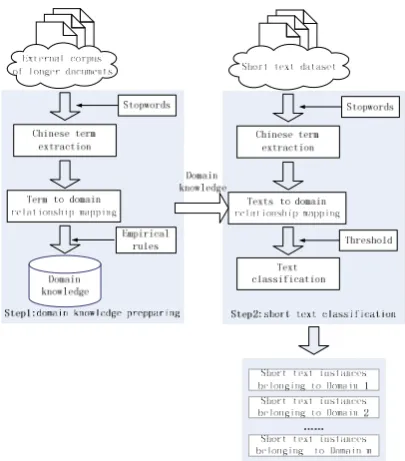
The overall framework of our approach is shown in Figure 1. We firstly draw domain knowledge for each user-defined domain using the external corpus. Secondly, the correlation between a short text instance and a domain is calculated by measuring the proportion of the overlapping part of this instance and the domain knowledge of this domain. Finally, if the correla-tion is greater than a threshold, the instance will be classified into the domain. The main ad-vantages of our approach include the following points:
• Good generalization performance: do-main knowledge learned from longer doc-uments can cover lots of terms that do not exist in a small labeled training set.
• Easy to implement: No need to construct VSM to train classifiers. All we need to prepare is the domain knowledge.
Figure 1. The framework of our approach
2
Our Approach
2.1 Domain knowledge preparing
To expand the coverage of our model, we utilize a labeled external corpus of longer documents to draw domain knowledge. Text documents in this corpus have been classified into user-defined domains. There are two main conditions that should be followed to choose an appropriate ex-ternal corpus. First, the coverage of vocabulary should be sufficient. Second, the user-defined
domains should be consistent with the classifica-tion problem. In fact, the second condiclassifica-tion will not be a problem, because a large number of web documents belonging to different domains can be crawled from portal sites such as Sina1 and Sohu2.
After Chinese term extraction and removing stop words, we obtain an initial term list appear-ing in the corpus, denoted by T={ , ,t t1 2L, }tn .
The aim of term-to-domain relationship map-ping is to select K-number of most related terms for each domain from T . The set of selected terms is regarded as the domain knowledge of a domain. How terms are related to each domain is measured by applying Chi-square statistical term-to-domain independency measurement. The measurement is based on the co-occurrence fre-quencies of a term and a domain. We firstly as-sume that the term and the domain are statistical-ly independent, and then compare the observed frequency and the expected frequency.
Let t ii( =1, 2,L, )n be a term in the initial term list T, and dj(j=1, 2,L, )m be a domain in the user-defined domain list D={ ,d d1 2,L,dm}. The expected frequency is defined as:
{0,1} {0,1}
the observed frequency of documents which con-tain
t
i and belong to dj, O01 denotes theob-served frequency of documents which do not contain
t
i but belong to dj, O10 denotes theob-served frequency of documents which contain
t
i but not belong to dj, and O00 denotes theob-served frequency of documents that neither con-tain
t
i nor belong to dj.Note that the greater the Chi value is, the clos-er the relationship between
t
i andd
j is.Let DK={dk dk1, 2, ,dkm} uuur
L be the domain knowledge vector, dkj be the domain knowledge
main dj. The algorithm of term-to-domain rela-tionship mapping includes three main steps:
Step1: For each term ti, construct its Chi val-in dkj are arranged in descending order under its Chi value. measuring the proportion of the overlapping part of g and the domain knowledge dkj(Liu et al, 2012), see Figure 2.
Figure 2. The overlapping part of a short text instance and the domain knowledge
To measure the proportion of the overlapping part, we need to compute the score of domain knowledge dkj and the score of the overlapping part of g and dkj, and then normalize the latter by the former. Moreover, we introduce a weight, denoted by wjk, to indicate the importance of a term in dkj, when calculating the scores. As the Chi values of terms in different domain knowledge vary greatly, we define the weight of a term based on its ordering position in the do-main knowledge. The weight is defined as:
1 calculated based on scores as:
1 of δ can be obtained by cross-validation.
3
Experiments and results
3.1 Data Sets
We collect short texts from Sina micro-blog 3, and use an open corpus 4 collected by Sogou Lab from the Internet as the external corpus.
External Corpus Documents belong to 8
do-mains: Finance, IT, Health, Sports, Tour, Educa-tion, Film&TV, and Military. Each domain con-tains 600 documents. The vocabulary is 69909 terms. The average length of documents is 403 terms.
Micro-blog Dataset We manually choose
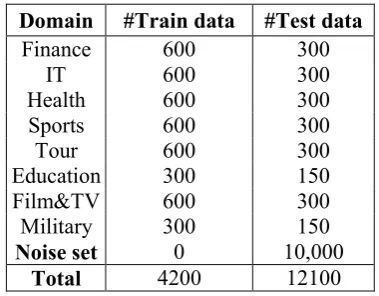
training samples and test samples for each user-defined domain. Samples in the training set and the test set are totally exclusive. The average length of micro-blogs is 31 terms. There is a noise set in the test set containing micro-blogs which do not belong to any user-defined domain, see Table 1.
Table 1. Description of the micro-blog dataset
3 http://t.sina.com.cn
4
3.2 Measurement
We adopt the F1-measure as our performance criterion to balance the influence between preci-sion and recall.
TP precision
TP FP
=
+ (7)
TP recall
TP FN
=
+ (8) 2
1 precision recall F measure
precision recall
× ×
− =
+ (9)
where TP denotes the numbers of relevant samples classified as relevant, FN denotes the numbers of relevant samples classified as irrele-vant, and FP denotes the number of irrelevant samples classified as relevant.
3.3 Experiment results and analysis
In order to obtain the optimized value of δ, we randomly divided the training set into five equal partitions and performed 5-fold cross-validation. In Table 2, we can find that our classifier achieves the highest F1-measure when δ =0.2 and K=500. Thus in all following experiments, we employ δ =0.2.
δ
K 0.1 0.2 0.3 0.4 0.5
100 0.8201 0.8847 0.9110 0.9189 0.9125
200 0.8635 0.9274 0.9476 0.9421 0.8821
300 0.8934 0.9506 0.9447 0.9235 0.7203
400 0.9187 0.9519 0.9417 0.7286 0.4537
500 0.9388 0.9554 0.8494 0.5463 0.2293
600 0.9453 0.9523 0.7545 0.4372 0.1120
700 0.9482 0.8938 0.6842 0.3213 0.0503
Table 2. 5-fold cross-validation on training set
The next experiment is to compare our method with two baselines based on VSM of TFIDF weights on the test set. Both the baselines are composed of 8 SVM (Support Vector Machine) classifiers (one for each domain to decide wheth-er a test sample belongs to this domain). One of them uses terms in domain knowledge drawn from the external corpus as features to enrich the representation of VSM (“VSM with E” for short). The other one only uses terms in domain knowledge drawn from the training set as fea-tures to construct VSM (“VSM without E” for short). We use RBF kernel and optimized param-eters which are chosen by grid-search in LIBSVM5 to train SVM classifiers.
5
http://www.csie.ntu.edu.tw/~cjlin/libsvm/
VSM without E
VSM with E
Our Method
Optimized K 700 500 500
Optimized
F1-measure 0.8965 0.9285 0.9520
Table 3. The overall optimized results of our method and VSM-based methods
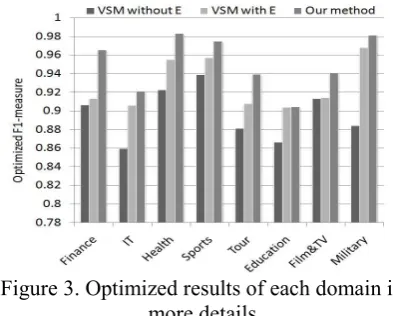
Table 3 shows the overall optimized result of each method with its optimized K on the test set, and Figure 3 shows the optimized result of each domain in more details. We can find that our method achieves the highest overall F1-measure, and achieves 5.7%, 1.7%, 3.0%, 1.9%, 3.5%, 0.06%, 2.9% and 1.4% improvements over VSM with E for Finance, IT, Health, Sports, Tour, Ed-ucation, Film&TV, and Military respectively. This means our method could improve the per-formance of short text classification by solving data sparsity problem effectively.
Figure 3. Optimized results of each domain in more details
4
Conclusion
In this paper, we propose a new model based on domain knowledge to solve the data sparsity problem in short text classification. We validate through experiments that classifier based on our model outperforms classifiers based on VSM. In the future work, we will try to combine the ex-ternal knowledge and the training set to further improve the performance of short text classifica-tion.
Acknowledgments
References
Banerjee S, Ramanathan K, and Gupta A. 2007. Clus-tering Short Texts Using Wikipedia. Proceed-ings of the 30th annual international ACM SIGIR conference on Research and development in infor-mation retrieval. ACM, 2007: 787-788.
Hu X, Sun N, Zhang C, and Chua T. 2009. Exploit-ing internal and external semantics for the clustering of short texts using world knowledge. Proceedings of the 18th ACM confer-ence on Information and knowledge management. ACM, 2009: 919-928.
Zelikovitz S and Hirsh H. 2000. Improving short text classification using unlabeled background knowledge to assess document similarity. Pro-ceedings of the Seventeenth International Confer-ence on Machine Learning. 2000: 1183-1190.
Phan X, Nguyen L, and Horiguchi S. 2008. Learning to classify short and sparse text & web with hidden topics from large-scale data collec-tions. Proceedings of the 17th international confer-ence on World Wide Web. ACM, 2008: 91-100.
Chen M, Jin X, and Shen D. 2011. Short text classi-fication improved by learning multi-granularity topics. Proceedings of the Twenty-Second international joint conference on Artificial Intelligence-Volume Volume Three. AAAI Press, 2011: 1776-1781.
Liu Z, Yu W, Chen W, et al. 2010. Short text feature selection for micro-blog mining. Computational Intelligence and Software Engineering (CiSE), 2010 International Conference. IEEE, 2010: 1-4.
Berry, and Michael. 2004. Survey of Text Mining I: Clustering, Classification, and Retrieval. vol-ume 1. Springer-Verlag New York Incorporated, 2004.