Implementation of Multiple Wireless Sensor Networks by Using Cloud
Computing
N. Chandra Shekhar, Assoc.Prof. KITS,Khammam
Dr. Y.V. Narayana, Principal, Tirumala Engineering College
Dr. M.Asharani, Professor, JNTU College of Engineering
A BSTRACT:
Wireless sensor Networks (WSN) has been focus for analysis for many years. WSN permits novel and attractive solutions for information getting across the spectrum of Endeavour together with business, transportation, industrial automation, health-care and environmental watching. Despite these advances, the exponentially increasing data extracted fro m WSN isn't obtaining adequate use attributable to the dearth of experience, time and cash with that the data may well be better explored and keep for future use. This transformation of data derived fro m device networks into a valuable resource for information hungry applications can have the benefit of techniques being developed for the rising Cloud Co mputing Technologies. ensuing generation of WSN can profit once device data is additional to blogs, virtual communities, and social network applications. ancient High Performance Co mputing approaches is also replaced or realize an area in data manipulation before the data being rapt into the Cloud. during this paper, a unique infrastructure is proposed to integrate the Cloud Computing model with WSN.
KEY WORDS: W ireless device Networks, FPGAs, Cloud Computing.
INTRODUCTION:
Recent advances in micro-electro-mechanical systems (MEM S) technology, wireless data network, and digital physical science have enabled the event of lopower, lo w-cost, multifunctional device nodes that square measure little in
size and commun icate unbound briefly d is tances[1-5]. These little device nodes, that accommodates sensing, processing, and communication parts, leverage the concept of device networks based on cooperative effort of an oversized range of nodes. device networks represent a major improvement over ancient sensors, that square measure deployed within the following 2 ways in which [6=8].
• Sensors may be positioned off fro m the particu lar phenomenon, i.e., one thing best-known by sense perception. during this approach, giant sensors that use some advanced techniques to differentiate the targets from environmental noise are required[9-10].
• Several sensors that perform solely sensing may be deployed. The positions of the sensors and communications topology are rigorously designed.
They transmit statistic of the detected [11]
data regarding their surroundings. for instance, sensors is utilized in a field of battle to collect data regarding enemy troops, find events like exp losions, and track and localize targets. Upon readying during a field, they form associate adhoc network and commun icate with one another and with
processing centers[12-14].
Sensor networks are typically supposed to last for long periods of your time (months/years). However, because of the restricted energy obtainable on board, if a detector remains active endlessly, its energy are depleted quickly resulting in its death. To prolong the network period, sensors alternate between being active and sleeping. There are many detector choice algorith ms to attain this whereas still ach ieving the goal
of deployment.
PROBLEM S WITH SENSOR SELECTION:
The sensing element choice problem will be outlined as follows: Given a group of sensors S = , we want to determine the "best subset" S of X sensing device to satisfy the necessities of 1 or multiple missions. The "best subset" is one that achieves the desired accuracy of data with respect to a task whereas meeting the energy constraints of the sensors. So, we've two conflicting goals: 1. lo wer the price of operation & 2. collect data of h igh accuracy . This trade-off is sometimes sculptured using the notions of utility and price • Utility: ccuracy of the gathered data and its utility to a mission. • Cost: this consist in the main of energy spent activating and in operation the sensors that is directly proportional to variety of chosen sensors k. Another price issue that may be considered here is that the risk of sleuthing a device wh ich can increase for active sensors particularly if wireless communication is used. The goal of a device choice theme is to pick out a set S of k sensors specified the whole utility is maximized whereas the price is a smaller amount than a definite budget. for several utility models, this problem is at least as hard1 because the backpack problem that is (weakly) NP-co mplete.2 this
implies there's no polynomial-time algorith mic ru le, though there's a pseudo-polynomial algorith mic rule (poly in nu mber of devices and sensor costs). this is often clearly not fascinating, particularly if we tend to contemplate a network with a large vary of attainable device prices. Hence, realistic restrictions of the problem have received attention. as an example, Isler and Bajcsy1 assume that utilities have geometric structure which total price is either zero or eternity,
based on whether or not |S| ≤ k holds[15-18].
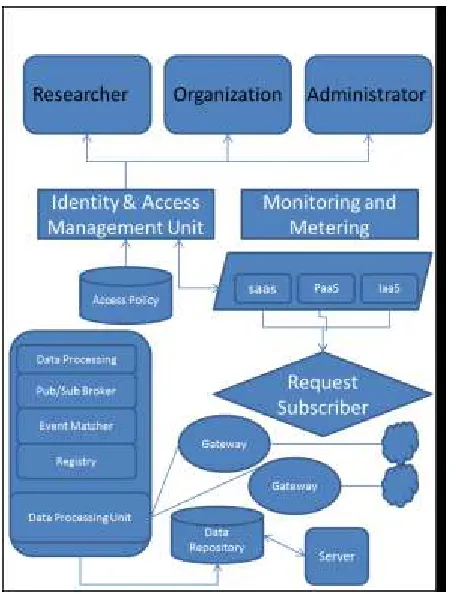
Fig. 1 shows the WSN andCloud Co mputing integration framework. The framework elements include: processing Unit (DPU), Pub/Sub Bro ker, Request Subscriber (RS), Identity and Access Management Unit (IAM U), and information Repository (DR). info rmation collected fro m the WSN moves through a entranceway to the DPU. The DPU can method the information into a storage format so send the information to the DR. we've thought-about sixteen temperature sensors for
Fig. 1. Sensor-Cloud Integration Framework
Users will connect to the Cloud through the secured IAMU and will be given access on the basis of the policy stored against their user account. After access has been granted users can put forward data access requests. The requests will be forwarded to the RS and the RS will create a subscription on the basis of this request and forward this subscription to the Pub/Sub Broker. Data received in the cloud will be identified by the DPU wh ich will create a published data event and send the event to an event queue at the Pub/Sub Broker. When a new event is published, each subscription is evaluated by the event matcher. Once the event matching process finds a match the published data is made availab le to the user after further
processing is carried out if required [19-20].
The proposed system maintains the whole of sixteen
temperature sensors without any collisions in between them.
RESULTS:
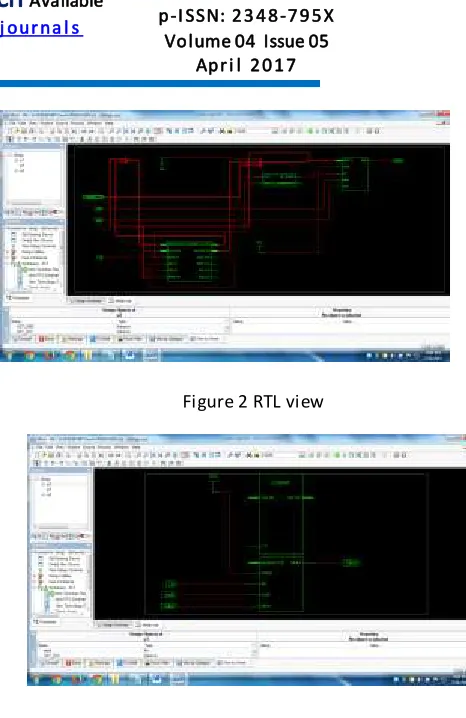
The implementation is completed with the verilog language by mistreatment the Xilinx package. Figure 4,2,3 shows the RTL views of the projected systems. Figure five shows the temporal order results of the system.
Figure 4 RTL view
Figure 2 RTL view
Figure 3 RTL view
Figure 5 timing diagram CONCLUSION:
distributed data. Future work can emb race additional development of the data process, storage and retrieval methodology. There square measure parallels to the on-demand video Cloud solutions presently being imp lemented. Another side of future analysis are to spot an optimu m approach to allow data manipulation before publication.
REFERENCES
[1] V.Rajesh, J.M.Gnanasekar, R.S.Pon magal, P.Anbalagan, “Integration of Wireless Sensor Network with Cloud”,
International Conference on Recent Trends in Information, Telecommunication and Computing, Kochi, Kerala,
12-13 Mar 2010, pp 321-323, Print ISBN: 978-1-4244-5956-8, DOI: 10.1109/ITC.2010.88
[2] Wen-Yaw Chung, Pei-Shan Yu, Chao-Jen Huang, “Cloud Computing System Based on Wireless Sensor Network”, Federated Conference on Co mputer Science and Information Systems, 8-11 Sept 2013, pp 877-880, INSPEC
Accession Number: 13884725.
[3] Rajeev Piyare, Sun Park, Se YeongMaeng, Seung Chan Oh, Sang Gil Choi, Ho Su Choi, Seong Ro Lee,
“Integrating Wireless Sensor Network into Cloud Serv ices for Real-time Data Collection, International conference
on ICT Convergence [ICTC], 14-16 Oct 2013, Jeju, pp752-756, DOI : 10.1109/ICTC.2013.6675470.
[4] Carlos OberdanRolim, Fernando Luiz Koch, Carlos Becker Westphall, Jorge Werner, Armando Fracalossi,
Giovanni Sch mitt Savador, “A Cloud Co mputing Solution for Patient’s Data Collection in Health Care
Institutions”, 2nd International Conference on eHealth, Telemedicine and Social Medicine, St. Maarten, 10-16 Feb 2010, pp 95-99, DOI: 10.1109/eTELEM ED.2010.19.
[5] Peter Langendoerfer, Krzysztof Piotro wski, Manuel Diaz, Bartolome Rubio, “Distributed Shared Memory as an
Approach for Integrating WSNs and Cloud Co mputing”, 5th International Conference on New Technologies,
Mobility and Security, Istanbul, 7-10 May 2012, pp 1-6, DOI: 10.1109/NTMS.2012.6208723.
[6] Srimathi C, Soo-Hyun Park, Rajesh N, “Proposed framework for underwater sensor Cloud for environmental Monitoring”, 5th International Conference on Ubiquitous and Future Networks, Da Nang, 2-5 July 2013, pp 104-
109, DOI: 10.1109/ICUFN.2013.6614788.
[7] John Tooker, Xin Dong, Mehmet C. Vu ran, Suat Irmak, “Connecting Soil to the Cloud: A Wireless Underground Sensor Network Test bed”, 9th Annual IEEE Co mmunications Society Conference on Sensor, Mesh and Ad Hoc
Co mmunications and Networks, Seoul, 18-21 June 2012, pp 79-81, Print ISBN: 978-1-4673-1904-1, DOI:
10.1109/SECON.2012.6275848.
[8] Tongrang Fan, Xuan Zhang, Feng Gao, “Cloud Storage Solution for WSN Based on Internet Innovation Union”, International Journal o f Database Theory and Application, Vo l 6, No. 3, June 2013, pp 49-58.
[9] Perumal.B, PallikondaRajasekaran.M, Ramalingam.H.M, “WSN Integrated Cloud for Automated Telemedicine
[ATM] Based E-Healthcare Applications”, 4th International Conference on Bioinformatics and Biomedical
Technology, Singapore, Vol 29, Feb 2012, pp 166-170. [10] Geoffrey C Fo x, A lex Ho, Eddy Chan Anabas, “Measured Characteristics of FutureGrid Clouds for Scalable Collaborative Sensor-Centric Grid Applications”, International Conference on collaboration Technologies and
systems, Philadelphia, 23-27 May 2011, pp 151-160, DOI: 10.1109/CTS.2011.5928677.
[11] SajjadHussain Shah, FazleKabeer Khan, Wajid Ali, Jamshed Khan, “A New Framework to Integrate Wireless Sensor Networks with Cloud Co mputing”, IEEE Aerospace Conference, Big Sky, MT, USA, 2-9 Mar 2013, pp 1-6,
Print ISBN: 978-1-4673-1812-9, DOI:
10.1109/AERO.2013.6497359.
[12] Peng Zhang, Zheng Yan, Hamlin Sun, “A Novel Architecture Based on Cloud Computing for Wireless Sensor Network”, 2nd International Conference on Co mputer Science and Electronics Engineering [ICCSEE], pp 472-475,
2013.
[13] JunyaTerazono, Hideyuki Fu kuhara, Takuto Yamada, Toshiaki Nihei, Kazunori Suzuki, Isamu Koseda, Ryutaro Fujita, Toshiaki M iyazaki, Senroh Saito, Atsushi Kara, Takafumi Hayashi, “A Sensor Network using Content- Aware Messaging Network Architecture”, ICROS-SICE International Joint Conference, Fukuoka, 18-21 Aug
2009, pp 5055-5058, Print ISBN: 978-4-907764-34-0.
[14] David Tracey, Cormac Sreenan, “A Ho listic Architecture for the Internet of Things, Sensing Services and Big
Data”, 13th IEEE/A CM International Sy mposiu m on Cluster, Cloud, and Grid Computing, Delft, 13-16 May 2013,
pp 546-553, Print ISBN: 978-1-4673-6465-2, DOI: 10.1109/CCGrid.2013.100.
[15] RazviDoo mun, ThaierHayajneh, Prashant Krishnamurthy, David Tipper, “SECLOUD: Source and Destination
Seclusion Using Clouds for Wireless Ad hoc Networks”, IEEE Symposium on Computers and Communications,
Sousse, 5-8 July 2009, pp 361-367, Print ISBN: 978-1-4244-4672-8, DOI: 10.1109/ISCC.2009.5202367.
[16] SudarsanRaoVemu ri, Dr. N Satyanarayana, V Lakshmi Prasanna, “Generic Integrated Secured WSN-Cloud
Co mputing For U-Life Care”, International Journal of Engineering Science and Advanced Technology, Vol 2, Issue 4, pp 897-907, Aug 2012, ISSN: 2250-3676.
[17] Ahmed Lounis, AbdelkrimHad jid j, Abdelmadjid Bouabdallah, YacineChallal, “Secure and Scalable Cloud-based
and Networks (ICCCN), Munich, 30 July-2 Aug 2012, pp 1-7, Print ISBN: 978-1-4673-1543-2, DOI:
10.1109/ICCCN.2012.6289252.
[18] KhandakarEntenamUnayes Ahmed, Mark A Gregory, “Integrating Wireless Sensor Networks with Cloud
Co mputing”, 7th International Conference on Mobile Ad-hoc and Sensor Networks (MSN), Beijing, 16-18 Dec
2011, pp 364-366, Print ISBN: 978-1-4577-2178-6, DOI: 10.1109/MSN.2011.86.
[19] Mohamed Firdhous, Osman Ghazali, Suhaidi Hassan, “Trust Management in Cloud Computing: A Critical
Review”, International Journal on Advances in ICT for Emerging Regions, Sept 2011, Vol. 2, No. 4, pp 24-36, DOI: http://arxiv.org/abs/1211.3979.
[20] Rosangela de Fátima Pereira, Marcelo Risse de Andrade, ArturCarvalhoZucchi, Karen Langona, Walter Akio
Goya, Nelson Mimura Gon zalez, Tereza Cristina Melo Brito de Carvalho, Jan-Erik Mangs, AzimehSe
“Distributed processing from large scale sensor network using Hadoop”, IEEE International Congress on Big Data,
Santa Clara, CA, 27 June-2 Ju ly 2013, pp 417-418, Print ISBN: 978-0-7695-5006-0, DOI:
10.1109/BigData.Congress.2013.64.
[21] Wei Wang, Kevin Lee, Dav id Murray, “Integrating Sensors with the cloud using dynamic proxies”, IEEE 23rd International symposium on Personal Indoor and Mobile Radio communications, Sydney, 9-12 Sept. 2012, pp
1466-1471, DOI: 10.1109/PIM RC.2012.6362579.
[22] Rajesh V, O Pandithurai, S Mageshkumar, “Wireless sensor data on cloud”, IEEE International Conference on Co mmunication, Control and Co mputing Technologies, Ramanathapuram, 7-10 Oct 2010, pp 476-481, DOI:
10.1109/ICCCCT.2010.5670599.
[23] Wen Qiang Wang, Xiao ming Zhang, Jiangwei Zhang, Hock Beng Lim, “Smart Traffic Cloud: An Infrastructure for Traffic Applications”, IEEE 18th International Conference on Parallel and Distributed Systems, Singapore, 17-
19 Dec 2012, pp 822-827, DOI: http://doi. ieeecomputersociety.org/10.1109/ICPA DS.2012.134.
[24] Giancarlo Fortino, MukaddimPathan, Giuseppe Di Fatta, “Body Cloud: Integration of Cloud Co mputing and BodySensor Networks”, IEEE 4th International Conference on Cloud computing Technology and Science, Taipei, 3-6 Dec 2012, pp 851-856, DOI: 10.1109/CloudCo m.2012.6427537. [25] B. B. P. Rao, P. Salu ja, N. Sharma, A. Mittal, S. V. Sharma,“Cloud computing for internet of things and sensing based applications”, 6th International Conference on Sensing Technology, Kolkata, India, 18-20 Dec 2012, pp 374–380, DOI: 10.1109/ICSensT.2012.6461705.
N.ChandraShekhar completed his M.Sc, M.tech with electronics and communication engineering. He has published more than five international journals. Currently he is a research Scholar in JNTU, Hyd and working as Associate Professor cum Head of the department for ECE in Khammam Institute of Technology and Science.
Dr. Y. VenkataNarayana, was born in a tiny village, west Godavari dist, A.P.,India, way back in 1968. His brilliant academic record won him a seat in B.Tech, ECE,JNTU college of Engineering, Ananthapur and passed out it in flying colours in 1991. He pursued his ME in electronic instrumentation from college of engineering, Andhra university during 1997 -1999 and secured second rank. He followed it up with research in the same university, which finally cultimated in the award of P.hD in the area of communications on “investigations on Beam Conversions using arrays by phase only control. He has put up a total of twenty years of service -16 years in teaching and four years as senior engineer, instrumentation in power plant rain claiming limited, Visakhapatnam. He was actively associated with erection and commissioning of 53.5MW co-generation plant. Presently, he is the principal cum professor in Tirumala Engineering College, Jonnalagadda, Narsaraopet. Prior to it he had worked in various capacities at different engineering colleges across A.P. To his credit, he has presented twenty six international journals. He is the fellow member of IETE.