www.euacademic.org DRJI Value: 5.9 (B+)
Effects of TCP Window Size and Transmission
Range on the Throughput of Mobile Adhoc Data
Network
ELEJE SAMSON EJIOFOR ABDULLAH AUWAL GABARI NDUBUEZE HERBERT OTUOSOROCHI Electrical and Electronic Engineering Technology Federal Polytechnic of Oil and Gas, Bonny, Nigeria
Abstract
the transmission range is kept below 10m as in our case depending on the transmitting power.
Keywords: MADNET, TCP, throughput, Iperf, transmission range, Window size
1. INTRODUCTION
its congestion control mechanisms to reduce congestion whenever any packet loss is detected.
2. RELATED WORKS
TCP over mobile adhoc data networks is a popular topic in the literature. Several studies have been carried out to investigate the cause of degradation of TCP throughput in wireless networks. Such factors include: TCP misinterpretation of packet loss or delay as congestion [16], network congestion [17], node mobility, position error and link distance [18], wireless link-layer contention for wired internet [19], etc.
The study in [2] investigated the multi-rate throughput characteristics of IEEE802.11g wireless LANs using real terminals. The results show that in simulation model based on the Rayleigh fading model, throughputs resemble a step function of the distance between a sender and receiver in all transmission rates. However, in real terminals, the throughput does not have steps but continuously decreases over the distance because there is radio interference. The result in the work shows the real terminals suffered from busy carrier effects due to radio interferences from other systems. The percentage of busy carriers was estimated to be 10% indoor and 121% outdoors.
versus the distance between them for different transmission modes with and without media-oriented mechanism was compared. Since no payload FEC was used in the media-oriented protocol, the mean goodput is increased significantly compared to the standard transmission modes. Moreover, it was observed that the media-oriented mechanism achieved a 4Mbps mean goodput improvement at the highest rate mode with a reduction in coverage range.
Some TCP related problems over wireless links are the focus in [4]. The work is based upon simulations in ns-2 which demonstrated that TCP connections are unstable over wireless links. The study shows also that the TCP maximum window size has effects on the instability problem. The conclusion was drawn on the bases that the current version of the IEEE 802.11 MAC protocol does not function well in multi-hop ad hoc networks.
In [5], the performance of the practical network topology of RipEX units wireless communication module, based on Narrowband RF Networks for remote wireless communications is analyzed. A scenario with direct wireless transmission round- trip from the source S1 to the destination S5 and come back from source S1 with the presence of (RipEX units) Radio modem & Routers for relaying messages is considered. For multi-hop transmission with RipEX units, the results show that as the distance between the radio router nodes in round trip delay path increases with the round trip time (RTT). It was also observed that the RTT network decreases as throughput increases. In addition to these observations, the introduction of Forward Error Correction (FEC 3/4) can also promote a slight increase in RTT. Therefore, the study recommends that minimizing the number of transmitting nodes will improve system performance.
FEC to avoid the high error rate of the wireless link should have a detrimental effect on the system performance but the use of FEC does improve the system performance [6]. Another observation is that the use of RTS/CTS results in a decrease in system performance.
3. BASIC FUNCTIONALITIES OF TCP
Various literatures have established the TCP/IP protocol suite as the de facto standard for network communications today because it guarantees a reliable communication channel over an unreliable network. As a connection-oriented transport protocol that guarantees end-to-end reliable and ordered delivery of data packets over wired networks, it’s widely used. Its design has some essential fundamental functionalities such as flow control, error control, and congestion control. In practice, these functionalities work with one another even though they have independent definitions of their own [8].
3.1 Flow Control
Modern data networks are designed to support a diverse range of hosts and communication mediums [10]. The crucial requirement for transmission of data from a sender to a receiver is that, regardless of the processing capability of the sender and the receiver and the available bit rate at the communication link, the buffers at the receiver side must not overflow [12]. This adaptation and a corresponding regulation concerning the amount of data sent are often referred to as Flow Control [9]. Data Link Control (DLC) achieves this through the flow control mechanism based on two approaches: Stop-and-Wait flow control and Sliding-Window flow control
3.2 Error control
3.3 Congestion Control
Network congestion occurs when the network is over flooded with too many packets by the sender. When this happens, the network fails to handle the traffic properly, leading to poor quality of service (QoS). The typical symptoms of congestion are excessive packet delay, packet loss and retransmission [13]. TCP Congestion Control is a technique that prevents congestion or helps mitigate congestion after it occurs. Unlike flow control mechanism that employs sliding window (rwnd) at the receiver, the Congestion control mechanism uses congestion window (cwnd) at the sender. TCP implements four congestion control algorithms: slow start, congestion avoidance, fast retransmit, and fast recovery [14].
4. METHODOLOGY
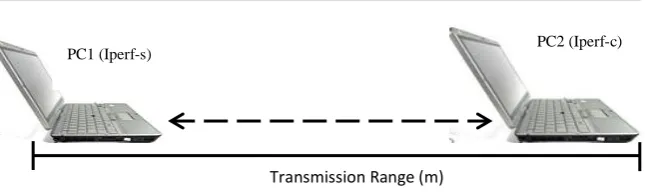
In this study, we setup two mobile adhoc data networks (MADNET) A and B one at a time which differs only on the TCP window sizes. The two networks A and B have TCP window sizes of 64kb and 256kb respectively. In this study, the throughput of the networks were measured and recorded at the transmission ranges of 5m, 10m, 15m, 20m, and 25m. Hence, the impact of increasing transmission range and TCP window size on the performance of the MADNET was observed and analysed. The measurements were taken indoors to maintain a line-of-sight between the server at the same ground level as the client as shown in fig. 1.
4.1 Experimental Requirements
Figure 1. Experimental Setup
Table 1. Experimental Specification
Specifications Value
Wireless Standard IEEE 802.11g
Data Rate 54mbps
Frequency 1.2GHz
Radio Channel 6
Modulation OFDM
RF Power 20dbm (maximum)
Operating System Win 7
RAM 2GB
Subnet mask 255.255.255.0
Gateway Disabled
5. RESULT
In each of the measurements, we kept the server (Iperf-s) stationary and the position of the client (Iperf-c) was been changed according to the transmission ranges above. In this study, each TCP connection was carried out for 10secs at 2secs interval. The total data transferred at the respective transmission range was got and recorded in the table below.
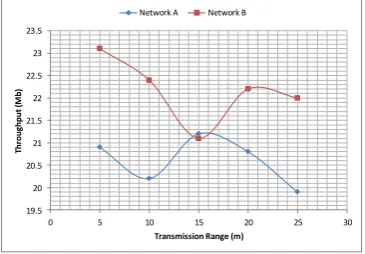
Table 2. Throughput of various Transmission Ranges at different TCP window sizes
Transmission Range (m)
Throughput of Network A Throughput of Network B
5 20.9 23.1
10 20.2 22.4
15 21.2 21.1
20 20.8 22.2
25 19.9 22.0
PC2 (Iperf-c) PC1 (Iperf-s)
Figure 2.Bar Chart of Throughput as a function of Transmission Range for different TCP window sizes
Figure 3. Throughput as a function of Transmission Range (m) at different TCP window sizes
6. DISCUSSION
Here, we describe the relationship between the transmission range and the amount of data transferred in both networks. In Figure 3, networks A and B gave similar response at the initial range of 0 to10m, showing a reduction in throughput in both networks. However, from 10m, their responses differed inversely with the transmission range till at 15m. Network A continued to upgrade in performance and recorded the maximum throughput (minimum packet loss) and the performance of network B continued to degrade until it recorded the minimum throughput (maximum packet loss). Moreover, the sizes of the TCP window as seen in table 2 is one of the dominant factors that determine the amount of data transmitted between the client and
19.5 20 20.5 21 21.5 22 22.5 23 23.5
0 5 10 15 20 25 30
Th ro u gh p u t (M b )
Transmission Range (m) Network A Network B 18 19 20 21 22 23 24
5 10 15 20 25
Th ro u gh p u t (M b )
Transmission Range (m)
the server in our network setups. In figure 2, there was an increment in the TCP throughput as the TCP window size is increased at the same transmission range. Unlike [15], that showed that an increase in TCP window size led to increase in errors and decrease in TCP throughput because of the loss of TCP data and TCP ACK-segments. Moreover, there was a significant decrease in the data transferred as the transmission range increases in both networks A and B. On a general note, our result depicts that increase in transmission range has a reductive effect on throughput unlike the TCP window size, which improves the throughput when increased. We, therefore, conclude that a higher window size guarantees a better throughput characterized by little or no loss while keeping the transmission range as low as possible depending on the transmission power. The impact of the window size on the bandwidth with increasing transmission range could be verified in the future work. Subsequently, the relationship between the window size and bandwidth will be studied.
REFERENCES
[1] S.E. Eleje, R.I. Hart and M.T. Pepple. 2020. "Impact of Node Velocity on the TCP Throughput of Mobile Ad-Hoc Data Network (MADNET)” European Journal of Engineering and Technology Vol. 8 No. 1, pg 48-55, 2056-5860. [2] S. IWAKI, T. MURASE, M. OGUCHI. 2012. “Throughput Analysis and Measurement on Real Terminal in Multi-rate Wireless LAN” ICUIMC’12, Feb 20–22, Kuala Lumpur, Malaysia.
[3] M.H Manshaei, T. Turletti, and T. Guionnet. 2005. “An Evaluation of Media-Oriented Rate Selection Algorithm for Multimedia Transmission in MANETs” EURASIP Journal on Wireless Communications and Networking:
757–773.
[4] S. Xu and T. Saadawi. 2001. "Does IEEE 802.11 MAC Protocol Work Well in Multihop Wireless AdHoc Networks?” in IEEE Communications Magazine 39(6):130 – 137.
[5] E. Ar reyouchi, K. Ghoumid, K. Ameziane, and O. El Mrabet. 2013.
“Performance Analysis of Round Trip Time in Narrowband RF Networks For Remote Wireless Communications” International Journal of Computer Science & Information Technology (IJCSIT) Vol 5, No 5,
[6] M. Petrovic and M. Aboelaze. 2003. “The Performance TCP/IP over
wireless IEEE802.11 Link”
[7] X. Chen, H. Zhai, J. Wang and Y. Fang. 2005. ”A Survey on Improving TCP Performance over Wireless Networks” Resource Management in Wireless Networking pp 657-695.
[8] Andrei Gurtov. 2001. “Effect of Delays on TCP Performance” IFIP
Personal Wireless Communications (PWC'01)
https://www.researchgate.net/publication/258763344.
[9] A. Badach. 2017. “Data Flow Control with TCP”
https://www.researchgate.net/publication/320383565.
[10] National Programme on Technology Enhanced Learning, Version 2 CSE IIT, Kharagpur “Module 3 Data Link Control”,
[11] Error Control in TCP, http://www.myreadingroom.co.in/notes-and-studymaterial/68-dcn/853-error-control-in-tcp.html
[12] D. Constantinescu, D. Erman, D. Ilie, and A. Popescu. 2007. “Congestion and Error Control in Overlay Networks” Research Report No:01.
[13] “TCP (Transmission Control Protocol) Congestion Control”
https://www.noction.com/blog/tcp-transmission-control-protocol-congestion-control.
[14] K. Mohamed, S. Hussein and A.A.A El Seddiq. 2019. “studying TCP flow and Congestion Control Mechanism Impact on Internet Environment”
International Journal of Computer Science and Information Security.
[15] R. HAMAMOT, C. TAKANO, H. OBATA, and K. ISHIDA. 2016.
“Improvement of Throughput Prediction Scheme Considering Terminal Distribution in Multi-Rate WLAN Considering Both CSMA/CA and Frame Collision” J-STAGE” Published in IEICE Transactions,Volume E99.Issue 12.
[16] F. Ahmed, S.K. Pradhan , N. Islam, and S.K. Debnath. 2010. “Performance Evaluation of TCP over Mobile Ad-hoc Networks” (IJCSIS) International Journal of Computer Science and Information Security, Vol. 7, No. 1.
[17] B.C Sreenivasa, G.C. Bhanu Prakash, and K.V. Ramakrishnan. 2012.
“Comparative analysis of ADTCP and M-ADTCP: Congestion Control Techniques for improving TCP performance over Ad-hoc Networks”
International Journal of Mobile Network Communications & Telematics (IJMNCT) Vol.2, No.4.
[18] G. Ding, X. Wu, and B. Bhargava “Performance Evaluation of Multiple-Rate Mobile Ad Hoc Networks” School of Electrical and Computer Engineering, Purdue University, W. Lafayette, Department of Computer Sciences, Purdue University, W. Lafayette, IN 47907.