Available online: https://edupediapublications.org/journals/index.php/IJR/ P a g e | 1
Few Aspects in Hard Turning Process
B.Purna Chandra Sekhar
1*, K.Srinivas
2, S.Radhika
31Dept. of ME, ANU College of Engineering & Technology, Guntur, AP, India. 2,3Dept. of ME, RVR&JC College of Engineering, Guntur, AP, India.
3Third Company, Affiliation, Address etc.
*Corresponding author- [email protected]
Abstract
Hard turning is the process of machining hardened steels that are above 45HRC. In manufacturing, hard turning has emerged as a potential area because of its many advantages over grinding as a finishing operation. Besides many advantages of hard turning operation, one has to implement to achieve close tolerances in terms of surface finish, high product quality, reduced machining time, low operating cost and environmental friendly characteristics. Taguchi method is a powerful tool to design optimization for quality. It is used to find the optimal cutting parameters such as cutting speed, feed rate, depth of cut and nose radius as the overall cost can be reduced. The present study predominantly focuses on the usage of Taguchi’s method in hard turning.
Keywords: Machining Materials, Mechanical alloying, response surface method, Taguchi method, hard turning
Introduction
Manufacturing sector is still hesitant to implement fast and economically hard turning technology compared to slow and costly grinding. The process of turning hardened steels within a range of 45–68 HRC with a variety of tipped tools is called hard turning. Machining is quiet popular manufacturing process in manufacturing sector of high precision distinct metal parts. Figure 1 describes the difference between hard turning and conventional machining. With advent of new kind of tools such as Cubic Boron Nitride (CBN), Polycrystalline Cubic Boron Nitride (PCBN), poly-crystalline diamond (PCD), coated, Chemical Vapor Deposition (CVD), Physical Vapor Deposition (PVD) and ceramic tools, better surface finish will be accessible without any finishing and complementary operation such as grinding.
Fig1. Comparison of conventional machining and hard turning[13]
Available online: https://edupediapublications.org/journals/index.php/IJR/ P a g e | 2
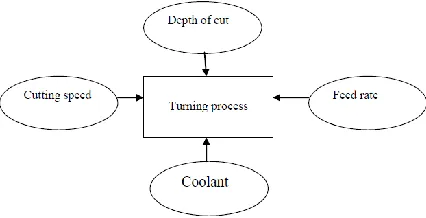
substitute to cylindrical grinding. However, surface quality and process reliability is still considered not on par with grinding processes, due to issues related to different geometrically defined cutting tools [2]. Figure 2 depicts the factors that influence hard turning process. To optimize the tooling cost, ceramic cutting tools are right candidates for light and continuous cutting. Geometry of the insert also has major influence upon the surface integrity, single point cutting tool gives uniform micro structural changes compared to grinding as this will increase functional performance of the product. Hence correct tool geometry must be selected for a given application or may produce subsurface damage and high tensile residual stresses on the surface of the machined work piece [2, 3, 4 and 5]. Generation of heat during hard turning and heat dissipation along the insert corner is also affected by geometry due to change in work material flow around the cutting edge [3].
Fig 2. Factors affecting the turning process
Few works related to Taguchi method
Dr. Genichi Taguchi, a Japanese engineer, developed a new method that is known as
Orthogonal array design, which adds a new dimension to conventional experimental design.
Taguchi method is a broadly accepted method of DOE which has proven to produce high quality
products at subsequently low cost. Although similar to DOE, the Taguchi design only conducts
the balanced (orthogonal) experimental combinations, which makes the Taguchi design even more
effective than a fractional factorial design. Taguchi proposed that engineering optimization of a
process or product should be carried out in a three-step approach namely system design, parameter
design and tolerance design. In system design, the engineer applies scientific and engineering
knowledge to produce a basic functional prototype design. According to the Ross et al. [6] the
objective of the parameter design is to optimize the settings of the process parameter values for
improving performance characteristics and to identify the product parameter values under the
optimal process parameter values. The steps included in the Taguchi parameter design are:
Available online: https://edupediapublications.org/journals/index.php/IJR/ P a g e | 3
(parameters); running experiments based on the OA; analyzing data; identifying the optimum
condition; and conducting confirmation runs with the optimal levels of all the parameters [7]. The
main effects indicate the general trend of influence of each parameter.
Knowledge of the contribution of individual parameters is the key to decide the nature of
the control to be established on a production process. ANOVA is the statistical treatment most
commonly applied to the results of the experiments to determine the percentage contribution of
each parameter against a stated level of confidence [6]. According to Roy et al. [8] Taguchi
suggests two different routes for carrying out the complete analysis. In the standard approach, the
results of a single run or the average of repetitive runs are processed through the main effect and
ANOVA (raw data analysis). The second approach, which Taguchi strongly recommends for
multiple runs is to use the Signal-to-Noise (S/N) ratio for the same steps in the analysis. The Grey
system theory proposed by Deng et al. [9] has been proven to be useful for dealing with poor,
incomplete and uncertain information. An advantage of the Taguchi method is that it emphasizes
a mean performance characteristic value close to the target value rather than a value within certain
specific limits, thus improving the product quality. Additionally, Taguchi’s method can be used to
quickly narrow the scope of project or to identify problems in a manufacturing process from data
already in existence Fraley et al. [10]. There have been many research contributions and several
books explaining and reviewing Taguchi’s ideas [11, 12]. Most of these, however, have not
adequately captured the diverse views on the topic. In particular, the Taguchi methodology has not
been well represented in statistical journals.
In the work of Dureja and Bhatti [13] Taguchi L9 orthogonal array has been applied for
experimental design. S/N ratio and ANNOVA analysis were performed on D3 steel to identify
significant parameters influencing tool wear and surface roughness. Results signify the cutting
speed to be the most significant factor influencing flank wear. In [14] the influence of cutting
parameters on cutting force and surface finish in turning operations. The authors used work
material of 1050 steel (hardness of 484 HV) with tool made of ceramic with an Al203 + Tic matrix
(KY1615) . Feed rate was found to be the most significant parameter for surface roughness in the
work of [15] in which evaluation of dry turning of inconel718 using carbide inserts was done using
Available online: https://edupediapublications.org/journals/index.php/IJR/ P a g e | 4
Mahamani used Taguchi method to optimize the machining parameters. The influence of
process parameters on cutting force and surface roughness during turning of AA2219-TiB2/ZrB2
In situ metal matrix composites was done. L27 orthogonal layout was used for experimentation
[16]. The response graph and analysis of variance shows that feed rate has strongest effect on
surface roughness and cutting force. Shreemoy et al in their work [17] have done multi objective
optimization of machining parameters during dry turning of IASI 304 Austenite stainless steel.
Three imp characteristics MRR, cutting force and surface roughness were measured. Same time in
[18] Design of experiment was done to optimize the turning parameters like cutting speed, depth
of cut and feed of duplex steel. Duplex steels during machining are generally prone to mechanical
strengthening Feed rate and cutting speed have statistically significant effect on surface roughness
parameters Ra, Rz where increase of factors effect increase surface roughness but then feed rate is
set to level 0.1 mm/rev factor cutting speed has smaller effect.
The work of Chandrasekaran [19] used Taguchi method for studying the macinability of
AISI 410 on CNC lathe for surface roughness.L27 orthogonal array , analysis of variance are used
in this investigation. Aditya Kulkarni et al. [20] investigated the optimum value of power
consumption with considering various parameters. In this optimization method used is taguchi
method and ANOVA result shows that increase in cutting fluid consideration level from 3% to 9%
resulted significantly decrease in power consumption.
Ilhan Asilturk et al. [21] have studied cutting parameter for machining of co28cr6mo
medical material. In this method used is taguchi and RSM. It is found that ANNOVA can be
reliably used in RSM and taguchi orthogonal array design model and theoretical studies that will
be conducted in future. D. Manivel et al.[22] have studied optimization of surface roughness and
tool wear in hard turning of austempered ductile iron (grade 3). The method used is taguchi
method. In this work, it was found that the taguchi method was successfully used in reduction of
production cost and production time in turning of ADI. In future other could be considered like
different coating material, lubricant and cutting tool geometry, all these factors would effect on
the surface roughness and tool wear. Sujit Kumar Jha et al. [23] investigated that various
Available online: https://edupediapublications.org/journals/index.php/IJR/ P a g e | 5
found that the material removal rate is mainly affected by cutting speed, depth of cut and feed rate,
by increasing any one the material removal rate is increased. Milan kumar das et al. [24] have
studied that optimization for response variables like MRR and surface roughness of EN 31 steel in
plasma arc cutting. Method used is weighted principal component analysis. The test insures the
improvement of S/N ratio from initial to optimal condition and improvement is 54%. From the
study it can be concluded that the proposed methodology can be treated as a very effective and
powerful approach to tackle multiple response problem in industrial experiments.
Conclusions
Currently, hard turning is of high interest for academicians and researchers and it is the
best option for replacement of grinding process in many cases as the hard turning process is more
economical than grinding. The hard turning process is essentially a high speed, low feed and low
depth of cut finishing process. The cutting speeds, as reported in various works, range between
100 and 250 m/min [25–31]. In order to establish the correct combination of input parameters, trial
experiments are to be performed which consume lots of time and manufacturing cost. Multiple
hard turning operations may be performed in a single setup rather than multiple grinding setups
thus reduces the production cost. The tool life shortens with increasing cutting speed and feed.
Different combinations of workpiece and tool material have to be investigated to find the optimal
feed and speed ranges for machining.
Same time, Taguchi method is one of the most effective systems of offline quality control
system. Taguchi method is used where the quality is improved at the design stage instead of
controlling it at the manufacturing stage. A customer usually considers several correlated quality
characteristics of a product. The main disadvantage of the Taguchi method is that the results
obtained are only relative and do not exactly indicate what parameter has the highest effect on the
performance characteristic value. Also, since orthogonal arrays do not test all parameter
combinations, this method should not be used with all relationships between all parameters.
Taguchi method has been criticized in the literature for its difficulty in accounting for interactions
between parameters. Another limitation is that the Taguchi methods are offline, and therefore
Available online: https://edupediapublications.org/journals/index.php/IJR/ P a g e | 6
REFERENCES
[1] Byrne, G., Dornfeld, D., Denkena, B., 2003.Advanced cutting technology. Annals of the CIRP 52 (2), 483–507.
[2] Klocke, F., Brinksmeier, E., Weinert, K., 2005. Capability profile of hard cutting and grinding processes. Annals of the CIRP 54 (2), 557–580.
[3] Klocke, F., Kratz, H., 2005. Advanced tool edge geometry for high precision hard turning. Annals of the CIRP 54 (1), 47–50.
[4] Bauer, W.K., Parnell, S.G. and Meyers, A.D., 1999, “Response surface methodology as a sensitivity analysis tool in decision analysis”, Journal of Multi-Criteria Decision Analysis, vol. 8, pp. 162–168.
[5] Siva Prasad, K., Srinivasa Rao, Ch., Nageswara Rao, D., 2012, “Application of design of experiments to plasma arc welding process: a review”, J. of the Braz. Soc. of Mech. Sci. & Eng., January–March 2012, vol. XXXIV, pp. 75–81.
[6] Ross, P.J., 1988, Taguchi Technique for Quality Engineering, McGraw-Hill, New York. [7] Zhang, J.Z., Chen, J.C. and Kirby, E.D. 2007, “Surface roughness optimization in an end-milling operation using the Taguchi design method”, Journal of Materials Processing Technology, vol. 184, pp. 233–239.
[8] Roy, R.K., 1990, A Primer on the Taguchi Method, Van Nostrand Reinhold, New York. [9] Deng, J., 1989, “Introduction to grey system”, J. Grey System, vol. 1, pp. 1–24.
[10] Fraley, S., Oom, M., Terrien, B. and Date, J.Z., 2006, Design of Experiments via Taguchi Methods: Orthogonal Arrays, The Michigan Chemical Process Dynamic and Controls Open Text Book, USA.
[11] Nair, V.N., 1992, “Taguchi’s parameter design: a panel discussion”, Technometrices, vol. 34, pp. 127–161.
[12] Parks, J.M., 2001, “On stochastic optimization: Taguchi methods demystified, its limitations and fallacy clarified”, Proab. Engg. Mech., vol. 16, pp. 87–101.
[13]. J.S.Dureja, Rupinder Singh & Manpreet Bhatti “Optimizing flank wear and surface roughness during hard turning of AISI D3 steel by Taguchi and RSM methods” Production and Manufacturing Research Vol 2.1 pg 767-783 (2014).
[14]. Dr. C. J. Rao, Dr Nageswara rao, P.srihari “Influence of cutting parameters on cutting force and surface finish in turning operation” International Conference on design and manufacturing Vol 64 pg 1405-1415 (2013).
[15]. R Ramanujan, K venketesan “Modeling and optimization of cutting parameters in dry turning of Inconel 718 using Coated Carbide Inserts” International conference on advances in materials science & engineering Vol 5 pg 2550-2559(2014)
[16]. A Mahamani “Influence of Process Parameters on Cutting Force and Surface Roughness During Turning of AA2219-TiB2/ZrB2” 3rd International Conference on Materials Processing and Characterization Vol 6 pg 1178-1186 (2014)
Available online: https://edupediapublications.org/journals/index.php/IJR/ P a g e | 7
[18]. Libor Beraneka, Kamil Kolarikb “Surface integrity analysis of duplex steel by design of experiment Approach” International Symposium on Intelligent Manufacturing and Automation Vol 69 pg 630-637 (2013).
[19]. Chandrasekaran, K., Marimuthu,P., Raja, K and Manimaran k, ”Machinability study on AISI 410 with different layered inserts in CNC turning during dry condition.” International Journal of Engineering& Material Science, Vol. 20, pp.398-404, 2013.
[20] Aditya kulkarni, Hemant Mandave, Vajay Sabnis, “Optimization of Power Consumption for CNC Turning of AISI 1040 Steel Using Taguchi Approach,” International Journal of Innovative Research in Science, Engineering and technology, vol.3, Issue 8, August 2014.
[21] Ilhan Asilturk, Suleyman neseli, Mehmet Alper Ince, “Optimization of Parameters Affecting Surface Roughness of Co28cr6mo Medical Material during CNC Lathe Machining by Using the Taguchi and RSM methods,” Measurement 78(2016) 120-128.
[22] D. Manivel, R. Gandhinathan, “ Optimization of surface roughness and tool wear in hard turning of austempered ductile iron (grade 3) using taguchi method”, 2016.
[23] Sujit Kumar Jha, Pramod K Shahabadkar, “Experimental Investigation of CNC Turning of Aluinium Using Taguchi Method,” International Research journal of Engineering and Technology, vol. 02 issue: 03 june- 2015.
[24] Mlan Kumar Das, Kaushik Kumar, tapan Kr Barman and prasantha Sahoo, “ Optimization of MRR and Surface Roughness in PAC of EN-31 Steels Using Weighted Principals Component Analysis,” 2nd international Conference on Innovations in Automation and mechatronics Engineering, ICIAME 2014, Procedia engineering 14 (2014) 211-214
[25] Dessoly, V., Melkote, S.N. and Lescalier, C., 2004, “Modeling and verification of cutting tool temperature in rotary tool turning of hardened steels”, International Journal of Machine Tools and Manufacture, vol. 44, pp. 1463–1470.
[26] Diniz, A.E., and Oliveira, A.J.D., 2008, “Hard turning of interrupted surfaces using CBN tool”, Journal of Materials Processing Technology, vol. 195, pp. 275–281.
[27] Rech, J. and Moisan, A., 2003, “Surface integrity in finish hard turning of case-hardened steels”, International Journal of Machine Tools and Manufacture, vol. 43, pp. 543–550.
[28] Grezesik, W., 2008, “Influence of tool wear on surface roughness in HT using differently shaped ceramic tools”, Wear, vol. 265, pp. 327–335.
[29] Ebrahimi, A. and Moshksar, M.M., 2009, “Evaluation of machinability in turning of micro-alloyed and quenched tempered steels: tool wear, statistical analysis, chip morphology”, Journal of Material Processing Technology, vol. 209, pp. 910–921.
[30] Zhou, J.M., Andersson, M. and Stahl, J.E., 2003, “The monitoring of flank wear on the CBN tool in the hard turning process”, International Journal of Advanced Manufacturing Technology, vol. 22, pp. 697–702.