c e-ISSN: 2348-6848, p- ISSN: 2348-795X Volume 3, Issue 05, March 2016
International Journal of Research (IJR)
Available at http://internationaljournalofresearch.org
A Novel Permutation Spreading for MIMO-CDMA Based
on STBC
P.Dhanababu
1& P. A. Nageswar Rao
21, 2 Department of Electronics and Communication Engineering Dadi Institute of Engineering and Technology, Anakapalli, Visakhapatnam (A.P.)
ABSTRACT:-
CDMA is one of the channelization protocols that support more number of users simultaneously and asynchronously. It uses spreading technique that spreads information bearing signals, so that only intended receiver can able to receive it thus provides security. Here proposed a novel method is for designing the spreading permutations based on STBC (space time block code) matrices for MIMO-CDMA systems. The performance of the two techniques for MIMO-CDMA systems operating
on frequency-flat slowly Rayleigh fading
channels are compared and it was proved and achieved to obtain less BER compared with MIMO-CDMA with less system complexity.
1. INTRODUCTION :
Application of parity bits in selecting the spreading codes in direct-sequence spread spectrum (DS-SS) systems is first introduced in [2]. In spread spectrum systems employing parity bits selected spreading codes (SS-PB), instead of appending the parity bits generated from a linear block encoder, they are used to select a spreading code from a set of mutually orthogonal spreading sequences [2]. Wireless communication systems in the next generation technologies are required to have high voice quality and also need to provide higher data rates. At the same time they
need to operate in different types of
environments also. In [1] the author has proposed
c e-ISSN: 2348-6848, p- ISSN: 2348-795X Volume 3, Issue 05, March 2016
International Journal of Research (IJR)
Available at http://internationaljournalofresearch.org
to transmit antennas[3]. The impressive
performance of turbo (iterative) processing techniques that soon followed the discovery of turbo codes [4] has inspired many researchers to utilize the turbo principle in a variety of ways in the architecture of the receiver. The application of turbo processing in MIMO systems has been discussed in the literature, and turbo processing techniques have been shown to attain a channel capacity close to the Shannon limit [5,6]. More recent works such as [7] have investigated the iterative joint channel estimation and data detection for MIMO-CDMA systems. In this paper, we introduce a new turbo receiver for MIMO-CDMA systems that employ parity bit selected and permutation spreading. To be able to use turbo processing in the receiver, a serially concatenated convolutional encoder is used in the transmitter. In this system, the parity bit selected or permutation spreading techniques act as an inner code without allocating any transmit energy to the additional redundancy provided by these techniques [5]. The receiver implements a
turbo processing by iteratively exchange soft information on coded bits between a soft-input soft-output (SISO) detector and a SISO decoder. In this system, detection is performed by
incorporating the extrinsic information provided
by the decoder in the last iteration into the received signal to calculate the likelihood of each detected bits in terms of log likelihood ratios (LLR) which are used as the input for a SISO decoder. In the case of multiple user systems, a turbo multiuser receiver is presented in which multiple access interference (MAI) affecting
each user is estimated based on the extrinsic
information of all other user in the system. Simulation results presented in this paper show a significant improvement in the performance of MIMO-CDMA systems of both parity bit selected and permutation spreading when a turbo receiver is implemented. Similar iterative detection strategies have been studied for a single carrier as well as multicarrier SS-PB systems in [8] and [9], respectively.
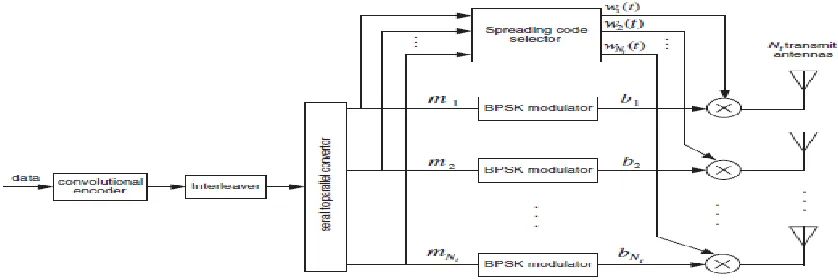
Figure 1: Transmitter of a coded MIMO-CDMA system employing parity bit selected and permutation spreading.
2. T-DESIGNS for MIMO – CDMA
MIMO-CDMA with Parity bit selected
spreading is discussed in [2]. In parity bit selected spreading sequence technique, based on the calculated parity bits the spreading
waveform is selected for each antenna. In this approach, for each user 2(n-k) spreading
sequences will be assigned. Where n-k is the
number of parity bits of the code. The system
c e-ISSN: 2348-6848, p- ISSN: 2348-795X Volume 3, Issue 05, March 2016
International Journal of Research (IJR)
Available at http://internationaljournalofresearch.org
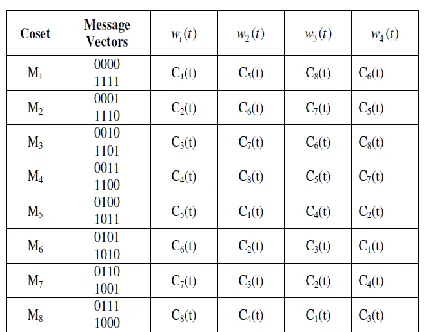
spreading is similar to parity bit selected spreading. In this technique, all possible message vectors are divided in to cosets and depending on which coset that messages comes then the corresponding permutation of spreading waveforms are assigned for each antenna in to groups. Now M is a set of all possible message vectors, contains 16 elements. M is divided into 8 possible cosets. The MIMO-CDMA system is designed with Nt=Nr=4 antennas, and N=8. On signaling interval, the message to be transmitted is {m1, m2,…mNt}.
The cosets are M1={0000 1111},M2={0001 1110}, M3={0010 1101}, M4={0011 1100}
M5={0100 1011}, M6={0101 1010},
M7={0110 1001}, M8={0111 1000}.
And the spreading sequences are assigned to the antennas as shown in TABLE I. for example, if the message comes from M1, then spreading waveforms for four antennas are c1,c3,c5 and c7 correspondingly.
Table 1: T-DESIGNS PERMUTATION SPREADING TABLE FOR 4 TRANSMIT
ANTENNAS
3. SPACE-TIME BLOCK CODE
APPROACH
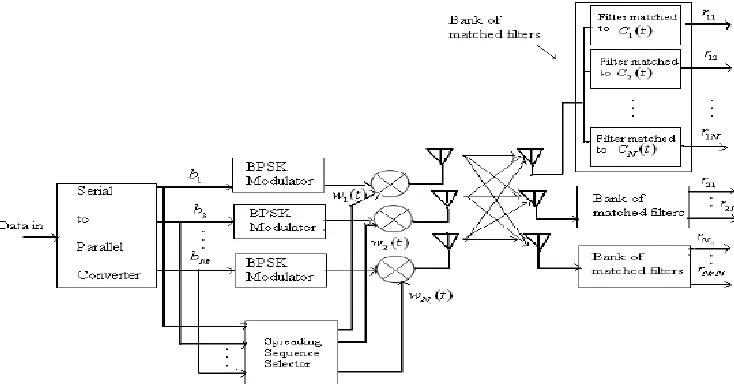
The MIMO-CDMA system employing STBC permutation spreading [5] is shown in Fig 1. The input bit stream is converted into Nt parallel data streams. And these bits are given to spreading sequence selector that selects Nt spreading waveforms, then these data bits are modulated with BPSK modulation, then each bit is spread by using spreading waveform. On a
given signaling interval Nt spreading
waveforms will be selected from N orthogonal spreading waveforms. And at the receiver side, the output of each antenna is given to a bank of matched filters, and according to matched filter decision, the transmitted data is estimated.
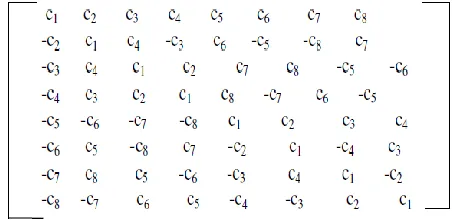
The spreading assignment is done based on 8x8 STBC matrixes.
Here the columns of 1,5,8, and 6 of above matrix shown are assigned to columns 1,2,3,4 The received vector r = ub+n ,
Where r = [ r11 r12 ,..., r 18,..., r21 ….r 41 ,..., r48 ,..., ] and
n= [n11,n12,..., n18,..., n21,..., n41,..., n48]
Where ub is the received data vector that
c e-ISSN: 2348-6848, p- ISSN: 2348-795X Volume 3, Issue 05, March 2016
International Journal of Research (IJR)
Available at http://internationaljournalofresearch.org
And b = [b1,b2,b3,b4] in case of 4x4 antenna system. For example if m = [0,0,0,1] then b=[-1,-1,-1, 1].
Maximum likely hood detection is performed to detect the data. And squared Euclidean distance is found between the received vector and all other possible received vectors and the value which is minimum will be taken as the transmitted message
b=min
b// r-u
b//
2
The above expression finds the squared Euclidean distance between the received vector and all possible remaining vectors and the vector which gives the smallest distance that is the transmitted message.
Table 2: STBC PERMUTATION SPREADING TABLE FOR 4 TRANSMIT ANTENNAS
3. EXPERIMENTAL APPROACH
A MIMO-CDMA system using
c e-ISSN: 2348-6848, p- ISSN: 2348-795X Volume 3, Issue 05, March 2016
International Journal of Research (IJR)
Available at http://internationaljournalofresearch.org
Figure 2: MIMO-CDMA system with STBC spreading permutation for 3 transmit and 3 receive
antennas.
At the receiver, the system first determines which spreading sequence in the set was most likely employed by the transmitter by observing the magnitudes of the matched filter outputs over the duration of the block. Then, assuming the first step is correct; it determines the most likely transmitted message block by comparing the matched filters outputs to the subset of Messages that correspond to the selection of that spreading sequence. Since the parity bits are not appended at the end of information message bits, this technique can improve the system performance in the additive white Gaussian noise (AWGN) channel with no transmission rate loss. The transmitter model for the CDMA system using parity bit selected spreading, given in [11], When the receiving antenna is moved relative to the transmitter there will be temporary local minimum in the amplitude of the incoming electromagnetic wave. This is called fading. This will of course happened twice every wavelength in the standing wave scenario. This effect can be reduced by using two receiving antennas at a
distance of quarter of a wavelength apart from each other. The receiver then checks from which antenna it gets the strongest signal and uses that one. This is called space diversity. Suppose a receiver has one antenna at point A in the Figure 1.1 below and one antenna at point B, it is obvious that the amplitude in the received signal from antenna B is much greater than the received signal from antenna A. It is also evident that there is a great advantage to be able to choose between these two antennas.
SIMULATION RESULTS
c e-ISSN: 2348-6848, p- ISSN: 2348-795X Volume 3, Issue 05, March 2016
International Journal of Research (IJR)
Available at http://internationaljournalofresearch.org
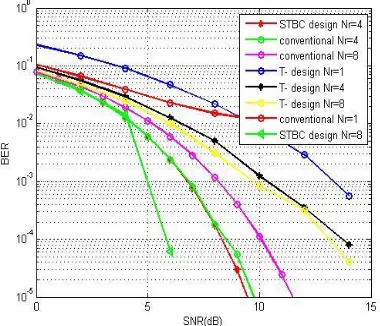
technique outperforms the conventional and t-designs.
Figure 3:BER for STBC Permutation vs.
T-Design Permutation
From TABLE I, we can see that in t-design permutation spreading table, there is no code symmetry between different co-sets, that leads to some degrees of freedom are lost, when MLD (maximum likelihood detection) is performed at the receiver. So that cause to slight increment of BER. But the system with STBC spreading, the permutation spreading table provides code symmetry between different co-sets, so that gives better BER performance.
CONCLUSIONS
Code division multiple access
technology, has been widely used in mobile communications, because of its high spectrum efficiency, low transmit power. The T-designs Permutation Spreading method does not provide code symmetry so some sorts of degrees of freedom are lost in the squared Euclidean distance between different messages. The lack of code symmetry increases the BER. The STBC technique create dependency between the
data streams and provide performance
improvement compared to conventional
spreading. All code symmetry also provides by using space-time block codes. Space–time block coding is a simple method for transmission using multiple transmit antennas in a wireless communication systems. STBC codes have a very simple maximum-likelihood decoding algorithm which is only based on linear processing. They provide full diversity given by transmit and receive antennas. Bit error rate performance also improves compared to the
conventional and t-designs permutation
spreading techniques.
REFERENCES
[1] M. Nakagami, ”The m-distribution, a general formula of intensity distribution of rapid fading,” in Statistical Methods in Radio Wave Propagation, W.G Hooffman, Ed. Oxford, England: Pergamon, 1960.
[2] H. Suzuki, “A statistical model for urban radio channel model,” IEEE Trans. Common., vol. 25, pp.673-680, July 1977.
[3] H. Bölcskei, A. Paulraj ”Multiple-Input Multiple-Output (MIMO) Wireless Systems”, The Communications Handbook, 2nd ed., J. Gibson, Ed.
[4] C. Julian, B. Norman “Maximum-Likelihood
Based Estimation of the Nakagami m
Parameter”, Fellow IEEE, Commun letters, vol. 5 No 3 March 2001.
[5] F. Boixadera Espax, J.Boutros ”Capacity
c e-ISSN: 2348-6848, p- ISSN: 2348-795X Volume 3, Issue 05, March 2016
International Journal of Research (IJR)
Available at http://internationaljournalofresearch.org
channels,”http://www.com.enst.fr/publications/p ubli/MMT99_boixadera.ps. 2002-01-08.
[6] M.Wennström, M. Helin, T.Öberg”On the Optimality and Performance of Transmit and Receive Space Diversity in Rayleigh Fading Channels,” IEE Seminar on MIMO Systems, London Dec. 12, 2001.
[7] T.Svantesson, A. Ranheim ”Mutual coupling effects on the capacity of multielement antenna systems,” Acoustics, Speech, and Signal Processing, 2001. Proceedings. 2001 IEEE InternationalConference on , Volume: 4 , 2001. Page(s): 2485 -2488
[8] Arash Mirbagheri, K.N. Plataniotis, S. Pasupathy, `An enhanced widely linear CDMA receiver with OQPSK modulation' , IEEE Trans. on Communications, vol. 54, no. 2, pp. 261- 272, February 2006.
[9] S.W.L. Poon, K.N. Plataniotis, S. Pasupathy, `Superimposed asymmetric modulation in narrow-band fading channels with orthogonal
codes' , IEEE Trans. on Wireless
Communications, vol. 5, no. 6, pp. 1260-1265, May 2006.
[10] A.C.C.C. Lam, A. Elkhazin, S. Pasupathy, K.N. Plataniotis, `Pulse shaping for differential
offset-QPSK' , IEEE Trans. on
Communications, vol. 54, no. 10, pp. 1731-1734, October 2006.
[11] S. Lam, K.N. Plataniotis, S. Pasupathy, `Self-matching space-time block codes for matrix Kalman estimator based ML detector in MIMO fading channels' , IEEE Trans. on Vehicular Technology, vol.56, no 4 II, pp. 2130-2142, July 2007.
[12] A. Elkhazin, K.N. Plataniotis, S.
Pasupathy, `Reduced dimension MAP
turbo-BLAST detection' , IEEE Trans. on
Communications, vol. 54, no. 1, pp. 108-118, January 2006.
[13] Alamouti, Siavash M, “A Simple Transmit
Diversity Technique for Wireless
Communications:, IEEE JOURNAL ON