ISSN (Print) : 2320 – 3765 ISSN (Online): 2278 – 8875
I
nternational
J
ournal of
A
dvanced
R
esearch in
E
lectrical,
E
lectronics and
I
nstrumentation
E
ngineering
(An ISO 3297: 2007 Certified Organization)
Vol. 3, Issue 8, August 2014
An Integration STATCOM PWM Improved
Approach to Control Stability in Wind Power
System
Tanisha1, Shilpi2
PG Student (power System), Dept. of Electrical, Hindu College of Engineering, Sonipat, Haryana, India
Assistant Professor, Dept. of Electrical, Hindu College of Engineering, Sonipat, Haryana, India
ABSTRACT: In this paper a PWM based wind turbine model is been presented with three wind turbines. The presented system is able to provide the system stability in case of varying voltage generation because of varying speed of wind turbine as well as capable to handle the fault over the system. To provide the stability over the system, the statcom based model is been presented in this work. The presented model is been developed in Simulink environment. The analysis of the work is been in terms of voltage analysis in statcom based and statcom less wind turbine model. The obtained results show that the presented system is effective enough to provide the stability over the system.
KEYWORDS: PMSG, STATCOM, PWM based Wind Turbine, synchronization
I INTRODUCTION
Non renewable energy sources are exhausting in near future. So for the sustainable growth and social progress of an country, it is necessary that energy demand is meet by utility of renewable energy sources like wind, biomass, sun etc. the renewable sources are inexhaustible and therefore we can readily access to have the supply of energy from the renewable sources. The various advantages of renewable energy sources are as follows:
The sun, wind, geothermal, ocean energy are available in the abundant quantity and free to use. The non-renewable sources of energy that we are using are limited and are bound to expire one day.
Renewable sources have low carbon emissions, therefore they are considered as green & environment friendly. Renewable helps in stimulating the economy and creating job opportunities. The money that is used to build these
plants can provide jobs to thousands to lakhs of people.
You don't have to rely on any third country for the supply of renewable sources as in case of non-renewable sources.
ISSN (Print) : 2320 – 3765 ISSN (Online): 2278 – 8875
I
nternational
J
ournal of
A
dvanced
R
esearch in
E
lectrical,
E
lectronics and
I
nstrumentation
E
ngineering
(An ISO 3297: 2007 Certified Organization)
Vol. 3, Issue 8, August 2014
due to rotating mechanical parts. The reliability of the variable speed wind turbine can be improved significantly byusing direct drive permanent magnet synchronous generator (PMSG). Because of self-excitation property, PMSG provides high power factor and high efficiency.
This paper investigates the application of STATCOM with PMSG based variable speed wind turbine for uninterrupted operation during grid disturbances. Also grid synchronization of wind turbine is achieved using a rapid synchronizer by controlling the phase angle of wind energy system output.
(A) STATCOM
The wind is variable in nature, which produces a continuous variable output power. Intermittent nature of wind introduces voltage sags, swells, flickers and harmonics. Integrating large amount of wind power into existing power system presents technical challenges, which requires consideration of voltage and frequency regulation, stability, power quality problems. Shunt Flexible AC Transmission System (FACTS) devices such as synchronous static compensators (STATCOMs) have the ability to improve the voltage quality with its fast response capability, accurate reactive power compensation and voltage control. Recent development in power electronic devices and application specific ICs and DSP system enables the introduction of low cost and faster STATCOMs. Variable speed wind turbine with power electronic converters injects harmonic currents in the grid. Intermittent nature of wind produces variable power and feeding this variable power to the grid introduces voltage variation to the grid in the form of voltage sag, voltage swell and voltage flickers. These problems have impact on system stability and quality and introduce trip to the wind turbine or damage of sensitive electronic devices connected to the grid. STATCOM connected to the point of common coupling either supply reactive power or absorbed reactive power, so it removes reactive power part of the grid. STATCOM injects current to the point of common coupling in such a way that cancels out the harmonic currents.
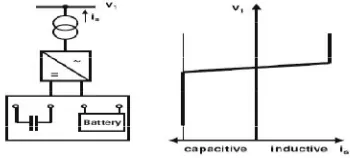
Figure 1 Statcom structure and voltage / current characteristic
(B)PMSG MODEL
The voltage equation of PMSG are expressed in d- and q- axis reference frame are given by
sq i s L r ω dt sd di s L s R sd i sd
V (1)
And f ψ r ω sd i s ωrL dt sq di s L s R sq i sq
V
(2)
Where Vsd, Isd, Vsq and Isq are d- axis and q- axis component of stator voltages and currents, Rs is the stator resistance, ωr is
ISSN (Print) : 2320 – 3765 ISSN (Online): 2278 – 8875
I
nternational
J
ournal of
A
dvanced
R
esearch in
E
lectrical,
E
lectronics and
I
nstrumentation
E
ngineering
(An ISO 3297: 2007 Certified Organization)
Vol. 3, Issue 8, August 2014
The electromagnetic torque is given by
e
2
p
ψ
fi
sq3
T
(3)(C) Wind Turbine Location in Power System
The way of connecting the wind generating system into the power system highly influences the power quality. Thus the operation and its influence on power system depend on the structure of the adjoining power network.
(D) Self Excitation of Wind Turbine Generating System
The self excitation of wind turbine generating system (WTGS) with an asynchronous generator takes place after
disconnection of wind turbine generating system (WTGS) with local load. The risk of self excitation arises especially when WTGS is equipped with compensating capacitor. The capacitor connected to induction generator provides reactive power compensation. However the voltage and frequency are determined by the balancing of the system. The disadvantages of self excitation are the safety aspect and balance between real and reactive power.
(E) Consequences of the Issues
The voltage variation, flicker, harmonics causes the malfunction of equipments namely microprocessor based control system, programmable logic controller; adjustable speed drives, flickering of light and screen. It may leads to tripping of contractors, tripping of protection devices, stoppage of sensitive equipments like personal computer, programmable logic control system and may stop the process and even can damage of sensitive equipments. Thus it degrades the power quality in the grid.
II LITERATURE REVIEW
Zhonghui Zhang [1] et al. proposed Matlab based permanent magnet synchronous machine vector control simulation. Experiment and validate id = 0 is a good control algorithm. It provides an effective means and tools for analysis and design of PMSM control system provides. It also provides a guideline of designing and debugging for practical PMSM system.
Malgorzata Bobrowska [2] et al. has presented improved voltage oriented control for converter. They proposed an algorithm for independent control of positive and negative current sequences, which contains different controlling blocks. They applied different voltage feed forward together with converter and proved the significance of VOC algorithm against unbalance voltage dips.
Marek Stulrajter [3] et al. has proposed two techniques of PMSM control in 2007. A brief description of properties of both methods Scalar control and vector control were presented as a control of synchronous machines. This paper shows that scalar control is an advantage of sensor less control. A comparative study between scalar control and vector control is also discussed. Scalar control method has some demerits such as the scalar control in an open loop does not provide a possibility to control the currents causes different behaviors of PMSM during various operation cycles like the start-up and loading. Vector control method gives better performance and overcome all the demerits of scalar method. It provides proper regulation against oversaturation of the magnetic circuit and reduces the magnetizing current.
ISSN (Print) : 2320 – 3765 ISSN (Online): 2278 – 8875
I
nternational
J
ournal of
A
dvanced
R
esearch in
E
lectrical,
E
lectronics and
I
nstrumentation
E
ngineering
(An ISO 3297: 2007 Certified Organization)
Vol. 3, Issue 8, August 2014
described using four layer neural networks. Set of wind-rotor aerodynamic data is calculated with the help of combining blade element momentum-modified theory and taken as sample data. The Levenberg–Marquardt algorithm is used for neural network. Then, the coupling dynamic models of the wind-rotor and PMSG, and AC–DC–AC converter model are established.
III PROPOSED MODEL
PMSM model, vector controller and converter which are simulated in MATLAB Simulink. The controller of machine gives voltage reference to PWM converter to develop the same voltage. The controller provides the reference voltage to converter from rotor field oriented vector control which is oriented in a synchronously rotating frame. The STATCOM is commonly used for voltage sags mitigation and harmonic elimination at the point of connection. The STATCOM employs the same blocks as the DVR, but in this application the coupling transformer is connected in shunt with the ac system, as illustrated in Fig 5.1. The VSC generates a three-phase ac output current which is controllable in phase and magnitude. These currents are injected into the ac distribution system in order to maintain the load voltage at the desired voltage reference. Active and reactive power exchanges between the the VSC connected in shunt with the ac system provides a multifunctional topology which can be used for up to three quite distinct purposes:
1) Voltage regulation and compensation of reactive power; 2) Correction of power factor;
3) Elimination of current harmonics.
IV SYSTEM OVERVIEW
Figure 2 shows the proposed structure of the direct drive, grid connected PMSG base variable speed wind turbine with statcom.
Figure 2 Grid Connected Wind Energy System with Statcom
ISSN (Print) : 2320 – 3765 ISSN (Online): 2278 – 8875
I
nternational
J
ournal of
A
dvanced
R
esearch in
E
lectrical,
E
lectronics and
I
nstrumentation
E
ngineering
(An ISO 3297: 2007 Certified Organization)
Vol. 3, Issue 8, August 2014
V. BASIC WIND TURBINE MODEL
Following figure shows the basic wnd turbine model
Figure 3 Basic Wind Turbine Model
In figure 3 is showing the basic wind turbine model. As we can see, the system is connected with the wave generator as the primary source to the wind power system. To manage the voltage distribution, a controlled current source is attached. An analyzer is attached with the system to monitor the voltage and to control the flow.
VI. GRID SYNCHRONIZATION OF WIND TURBINE
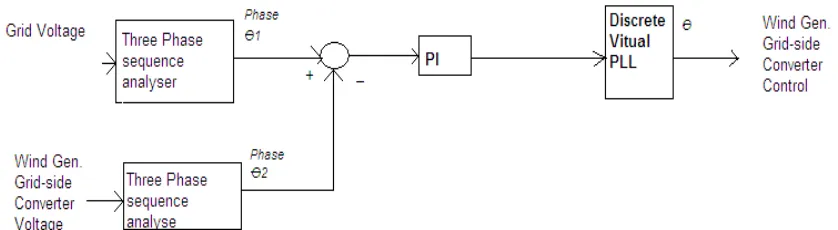
In order to synchronize wind turbine with the grid, three measures have to be considered: the amplitude, the frequency, and the phase angle. While the synchronisation of the voltage amplitudes and frequencies can be realised by the machine side converter control. The phase angles between the wind energy system and grid voltage has to be addressed independently. A rapid synchronization scheme based on controlling the phase angle of the PWM signal of the machine side converter is used in this paper. Grid voltage and Wind turbine converter voltage were fed to the discrete three phase sequence analyzer to produce phase angles as shown in Fig. 4. Error between these two phase angles was passed through the PI controller and a discrete virtual PLL to produce actual phase angle θ for the PWM signal that controls the Wind turbine grid side converter.
ISSN (Print) : 2320 – 3765 ISSN (Online): 2278 – 8875
I
nternational
J
ournal of
A
dvanced
R
esearch in
E
lectrical,
E
lectronics and
I
nstrumentation
E
ngineering
(An ISO 3297: 2007 Certified Organization)
Vol. 3, Issue 8, August 2014
VII. RESULTS AND DISCUSSION
Using matlab, we develop a model of wind turbine connected to grid system with statcom, which provide protection to the system against underload and overload problems. It reveals that, this model gives solution for removing problems and improves power quality.
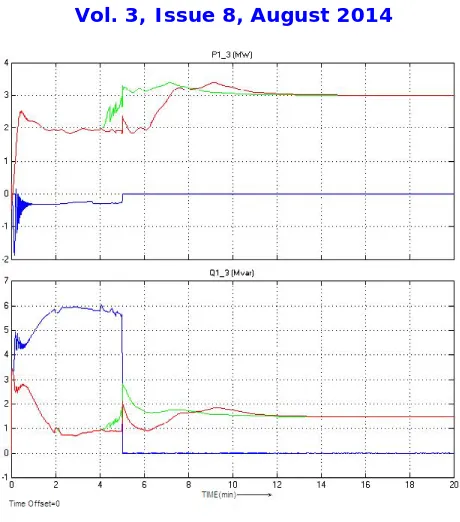
Figure 5 Result of Bus System
Here figure 5 is showing the result of bus system in case of statcom based implementation. As we can see the presented system has provided the stability in terms of voltage and current flow over the system.
Figure 6 rotor Speed
ISSN (Print) : 2320 – 3765 ISSN (Online): 2278 – 8875
I
nternational
J
ournal of
A
dvanced
R
esearch in
E
lectrical,
E
lectronics and
I
nstrumentation
E
ngineering
(An ISO 3297: 2007 Certified Organization)
Vol. 3, Issue 8, August 2014
Figure 7 Final Result
Here figure 7 is showing the final result driven in terms of voltage and current over the system. The figure is showing the up and down in initial stage. But the statcom provided the stability over the system.
VIII. CONCLUSION
The results are found to be encouraging. In this work, a wind power system is designed using statcom based controller. The presented system is effective enough to control the voltage and current over the system. The complete power drive train contains generator, inverter, and statcom based controller. The system is verified under the overload and underload conditions. The system is defined to provide the voltage and current stability over the system. The system is simulated in MATLAB Simulink. The direct driven wind power extraction can give maximum possible efficiency because machine is run at optimum speed. Vector control method shows better performance since lower current distortion is obtained. The implemented control technique is suitable to drive for wind power applications.
IX.FUTURE SCOPE
In this present paper, the wind power system is defined with statcom based controller. The work can be extended in different directions in future.
In this paper, the stability of the system is achieved in case of underload and overload conditions. In future, the system can also be implemented for different kind of faults over the system.
ISSN (Print) : 2320 – 3765 ISSN (Online): 2278 – 8875
I
nternational
J
ournal of
A
dvanced
R
esearch in
E
lectrical,
E
lectronics and
I
nstrumentation
E
ngineering
(An ISO 3297: 2007 Certified Organization)
Vol. 3, Issue 8, August 2014
REFERENCES
[1] M.E. Haque, M. Negnevitsky, K.M. Muttaqi, "A novel control strategy for a variable speed wind turbine with a permanent magnet synchronous generator," IEEE Trans. On Industry Applications, vol. 46, no. 1, January/February 2010.
[2] M. Chinchilla, S. Arnaltes, and J. C. Burgos, “Control of permanent magnet generators applied to variable-speed wind-energy systems connected to the grid,” IEEE Trans. Energy Convers., vol. 21, no. 1, pp. 130–135, Mar. 2006.
[3] Q. Wei, Q. Liyan, H. G. Roland "Control of IPM synchronous generator for maximum wind power generation considering magnetic saturation," IEEE Trans. On Industry Applications, vol. 45, no 3, May/June 2009.
[4] J.M. Carrasco, , L.G. Franquelo, J.T. Bialasiewicz, E. Galvan, R.C.P. Guisado, Ma. A. M. Prats, J.I. Leon, N. Moreno-Alfonso, “power electronic systems for the grid integration of renewable energy sources: a survey,” IEEE Trans. On Industry Applications, vol. 53, no. 4,August 2006. [5] T. F. Chan and L. L. Lai, “Permanent-magnet machines for distributed generation: A review,” in Proc. IEEE Power Eng. Annu. Meeting, 2007, pp.
1–6.
[6] Sharad W. Mohod, Mohan V. Aware "A STATCOM-Control Scheme for Grid Connected Wind Energy System for Power Quality Improvement," IEEE Trans. On Energy Conversions.vol. 4, no 3, pp. 346 – 352, Mar. 2010.
[7] A. Kehrli and M. Ross, “Understanding grid integration issues at wind farms and solutions using voltage source converter FACTS technology,” in Proc. IEEE PES Gen. Meeting, vol. 3, pp. 1822–1827, Jul. 2003.
[8] PinakiMitra, Ganesh Kumar Venayagamoorthy, Keith A. Corzine,"SmartPark as a Virtual STATCOM," IEEE Trans. On Smart Grid, vol. 2, no. 3, Sep. 2011.
[9] Wei Qiao, Ronald G. Harley, Ganesh Kumar Venayagamoorthy, “Coordinated Reactive Power Control of a Large Wind Farm and a STATCOM Using Heuristic Dynamic Programming,” IEEE Trans.Energy Conversions., vol. 24, no. 2, pp. 493–505, Jun. 2009.
[10] T K. J. Astrom and T. Hagglund, PID Controllers: Theory, Design and Tuning. Research Triangle Park, NC: ISA, 1995.
[11] Wei Qiao, Ganesh Kumar Venayagamoorthy, “Real Time Implementation of a STATCOM on a firm equipped with with Doubly Fed Induction Generators” IEEE Trans. On Industry Applications, vol. 45, no.1,pp. 98–107, Jan. 2009.
[12] M. Östman, J. M. Carrasco, L. G. Franquelo, J. T. Bialasiewicz, E. Galván, “Dynamics of the low voltage ride through capabilities of generators” Wartsila Technical Journal, pp. 13-16, Jan., 2010.