Volume 3, No. 3, May-June 2012
International Journal of Advanced Research in Computer Science
RESEARCH PAPER
Available Online at www.ijarcs.info
ISSN No. 0976-5697
Operational Risk Evaluating and Modeling for E-Banking
M. Salahi
Associate Professor, Faculty of Mathematical Sciences University of Guilan, Rasht, Iran
[email protected], [email protected]
M. Mahdavi
Assistant Professor, Dept. of Computer Engineering University of Guilan, Rasht, Iran
M. Pirouz*
Master of Information Technology University of Guilan, Rasht, Iran
R. Ebrahimi Atani
Assistant Professor, Dept. of Computer Engineering University of Guilan, Rasht, Iran
Abstract: This paper focuses on modeling operational risk which is one of the most important risks in E-banking. It can affect the institution’s ability to deliver products or services and lead to large losses at financial institutions. In our paper, we are presenting a new approach to compute the capital charge for an E-bank to cover the losses of operational risk, based on Loss Distribution Approach (LDA), which refers to statistical methods for modeling the loss distribution. In this framework, we begin our model with performing the descriptive statistic analysis of internal loss data at bank, and finish it using Value-at-Risk measure, to obtain the capital charge of an E-bank for operational risk. We have tested our model for some operational loss data samples, and have estimated operational risk capital charge. Our results indicate that the new model can be used at least as an initial part against the dangers of operational risk losses in E- banking.
Keywords:E-banking, operational risk, capital charge, risk management, Basel committee
I. INTRODAUCTION
Basel Committee on Banking Supervision (BCBS), which is the most important center of banking supervision and risk management, have studied traditional banking risk and realized that although e-banking wouldn’t produce risk inherently, but have changed or increased some traditional risks. Their research showed that impact is more on strategic, operational, legal and reputational risks, because of the form of financial institutions [1].
Strategic risks are mainly associated with board and management decisions. At the E-banking context, using technology when management does not adequately planed to manage and monitor the performance of technology-related products, can lead to strategic risk. Legal risk is the risk to earnings or capital arising from violations of, or nonconformance with laws, rules, regulations, or ethical standards. Although when legal lawful and liability of two sides for one transaction would not establish well, this risk would create. Reputational risk arises from negative public opinion. E-banking services that poorly execute or customers and the public can lead damaged to a licensee’s reputation [2].
There are many definition of operational risk, but Basel Committee offers a more accurate definition of operational risk as “The risk of loss resulting from inadequate or failed internal processes, people and systems or from external events failures” [3]. This definition includes legal risk, but excludes strategic and reputational risk. Some analysts call it a transaction risk, security risk, or IT risk. Examples of operational risk can include internal and external fraud, technological inadequacies,
human factors such as lack of training, negligence by customers and employees, product and service liability, misuse
of confidential information, damage to physical assets, business disruption and system failures, failed or erroneous transaction processing, failed outsourced processes. Complexity and structure of bank’s processing environment, type of services offered, and the complexity of supporting technology also affect the level of operational risk. The risk is heightened when the institution offers innovative services that have not been standardized.
At recent years, operational risk has transformed to the most important financial industry risk topics both at academic and practical area. The reasons of this attention can be related to large investment on information technology and communication systems, increasing financial institution merge and growing banking industry communication. In addition, accords of Basel Committee have determined capital requirement for operational risk, and financial institutions are required to perform it [3]. Until now literature on operational risk almost focused on two topics: first, the estimation of operational risk losses [4-8] and second, application of this estimate to determine capital charge [9-13]. Estimation of capital charge for operational risk should be based on Basel Committee accords.
potential losses. The regulatory capital is meant to assure bank's ability to cover major potential losses without causing a banking crisis. Consequently, regulatory capital management should ensure the stability of the banking sector and protect depositors. Best value of capital charge should be extracted from suitable model for each bank [2].
III. MODELING OPERATIONAL RISK
Basel Committee in its accords, have introduced the loss distribution approach (LDA) and gave enough freedom to banks to demonstrate their statistical models based on LDA. But for calculating operational risk capital charge, banks should display their presented model and evaluate measure of operational risk for one year period with 99.9% confidence level.
Under (LDA), bank’s activity arranged into a 56 cell matrix included 8 Business Line (BL) × 7 Event Type (ET). For each pair, key task is estimating frequently and severity losses. Based on these two distributions estimation, bank would calculate aggregated losses probability distribution function.
Operational capital charge is calculated as sum of VaR value (with 99.9% confidence level) in one year period for each pair BL/EV. 99.9th percentile means that capital charge totally is enough for covering losses, but with 0.1% defeat, in other words there is 0.1% probability that banks can’t cover inconsistent operational losses.
Our model has the following steps to get operational risk capital charge:
a. Calculating statistical characteristics of loss data, (we have calculated, mean, median, Skewness, Kurtosis). b. Performing descriptive statistic analysis for loss data
using different statistical plots of data, (we have used histogram of loss data).
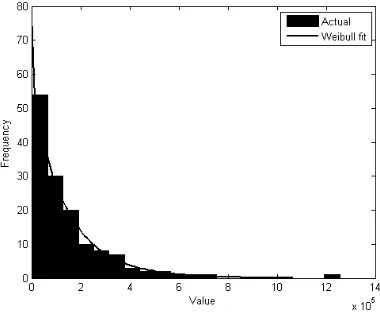
c. Choosing appropriate statistical distributions for fitting frequency and severity of loss data.
d. Checking the fitted distribution with goodness of fit tests, (we have used Q-Q plot).
e. Computing aggregate loss distribution from combination frequency and severity distribution. To
algorithm for operational loss data. First, we have modeled operational loss severity data. Frequently of this data followed from Poisson distribution, that we connivance from its details. Then with implementing Monte Carlo algorithm, we would have aggregated loss distribution of combination of two distributions and finally we determine the value of VaR and CVaR as the value of capital that should be reserved for covering operational risk.
A. Modeling Severity of one Sample of Operational Risk:
Table 1 presents the statistical characteristics of some operational loss severity data, and Fig. 1. illustrates the corresponding histogram.
Table 1: Statistical characteristic for operational losses data
140
Number of Losses
150520 Mean 102810 Median 2.8443 Skewness 15.5301 Kurtosis 170420 Std. Deviation
Several important points are evident:
a. First, the mean of sample is considerably larger than the median, which is reflected in a coefficient of skew equal to 2.84.
b. Second, the losses are very fat tailed, with a kurtosis in excess of 15.
et al
Figure. 1. Severity loss distribution data histogram
B. Aggreating loss distribution modeling and computing VaR using Monte Carlo simulation approach:
We perform aggregated loss distribution for 100,000 simulated data getting from Monte Carlo simulation with characteristic as Table 2.
Figure. 2. Normal Q-Q plot (up) and Weibull Q-Q plot (down) for severity losses data.
Figure. 3.Weibull distribution fitting for severity losses data.
[image:3.612.355.545.60.216.2]By running our algorithm, we get aggregated loss distribution with characteristics as Table 3. In addition, you can see value of Var, CVaR and the algorithm’s running time in Table 3. Aggregated loss distribution getting from loss data is presented at Fig. 4.
Table 2: Input data for our algorithm
Poisson Lambda=200 Loss Frequency
Weibull Alpha= 0.75
Beta=0.25
Loss severity
100,000
Iterative number of Simulation
99.9% Confidence level
25 Iterative number
[image:3.612.63.263.293.615.2]of algorithm
Table 3: Results of our algorithm
59.5260 Average loss
7.0802 Standard
deviation
0.2046 Skew
3.0604 Kurtosis
83.5640 VaR
86.0607 CVaR
0.0440 error_VaR
0.0540 error_CVaR
[image:3.612.373.527.312.577.2]Figure.4. Aggregated loss distribution histogram getting from operational losses data.
V. CONCLUSIONS
In this paper, we have provided a statistical model for operational risk that is one of the most important banking risks, especially for e-banking. This model which is based on LDA, lets banks to estimate their operational risk capital charge for one year’s period with 99.9% confidence level and can cover the loss caused from appearing operational risk with high confidence level. Results of our implementation show the benefits of our model for covering losses of operational risk in banking.
VI. REFERENCES
[1]. Basel Committee on Banking Supervision, risk management principles for Electronic banking, 2003.
[2]. J. Kondabaghil, Risk Management in Electronic Banking, John Wiley & Sons (Asia) Pte Ltd., 2007, pp. 11-13.
[3]. Basel Committee on Banking Supervision, International Convergence ofCapital Measurement and Capital Standards -A Revised Framework Comprehensive Version, 2006.
Implications of alternative operational risk modeling techniques. Working paper, Federal Reserve Bank of Boston, 2004.
[8]. P. de Fontnouvelle, J. Jordan, V. DeJesus-Ureff, and E. Rosengren, Capital and risk: New evidence onimplications of large operational losses. Working paper, Federal Reserve Bank of Boston, 2005.
[9]. H. Dahen, and G. Dionne, Scaling Models for the Severity and Frequency of External Operational Loss Data, Journal of Banking & Finance, 2010, 46, pp. 3545-3568.
[10]. S. Ebnother, P. Vanini, A. McNeil, and P. Antolinez-Fehr, Modeling operational risk. Working paper, ETH Zurich, 2001.
[11]. P. Embrechts, and G.Puccetti, Aggregation operational risk across matrix structured loss data. Journal of Operational Risk, 2004, 3(2), pp. 29-44.
[12]. F. Lindskog, and A. McNeil, Common Poisson shock models: Applications to insurance and credit risk modeling. ASTIN Bulletin, 2003, 33 (2), pp. 209–238.