Volume 8, No. 5, May – June 2017
International Journal of Advanced Research in Computer Science RESEARCH PAPER
Available Online at www.ijarcs.info
Vehicle Routing Problem using Swarm Optimization Techniques
Jyoti Gupta
Department of Computer Engineering U.I.E.T., Kurukshetra University Kurukshetra
Kurukshetra, INDIA
Chander Diwaker
Department of Computer Engineering U.I.E.T., Kurukshetra University Kurukshetra
Kurukshetra, INDIA
Abstract: Vehicle Routing Problem (VRP) is a major research domain in optimization research area. In VRP produced goods are supplied to customers on their demand from one or more depot. Goal of VRP is to attain a group of delivery path satisfying several necessities or constraints and give out minimal overall cost. After introducing a basic description in relevance of VRP, how the applications are applied in real-life is represented. Numerous variations of VRP exist there such as: time windows, pickup and delivery, stochastic VRP, periodic deliveries and heterogeneous fleet etc. Review contains the paper published in between 2008 to 2016, which shows how heuristic techniques are used in solving different variants of VRP.
Keywords: Vehicle Routing Problem; Ant Colony Optimization; Artificial Bee Colony; Particle Swarm Optimization; time windows.
IINTRODUCTION
VRP is a leading combinatorial optimization crisis. It plays a vital role within logistics and delivering chain management because of its wider applications in shipping, product supplying, and services [1]. VRP comes under the category of problems within which requirements of customers are satisfied through the products originate from storage area and transported via utilizing a vehicle fleet in such a manner that overall cost of traveling of every one vehicle is diminished. The VRP was initially proposed as a generalized model of well-known Traveling Salesman Problem (TSP) contrive by Dantzig and Ramser. Idea of VRP comes from the real time problem of finding the shortest way for delivering the fuel from chief depot to gas stations via utilizing gasoline delivery trucks [2].
Since 50 years VRP has rigorous research area and broad range of real applications as well that lead to numerous VRP variants [3]. Since numerous variants of typical VRP has been deliberated in support to encompass more constraints just as time windows, multi-depot, stochastic or dynamic demands. [4].
Fig.1. Diagrammatical illustration of VRP
VRP exist as NP hard problem, which imply that one might never discovered a computational procedure that will assure optimal solutions toward more instances of such problems [5].
Despite the complexity of problem, several methods have designed for resolving the VRP [1]. Solution methods are divided in two classes i.e. exact methods and heuristic methods. The exact algorithms perpetually assured to produce optimal solution. Though, it may possibly necessitate intolerable computation time, particularly when problem scale is very large. Heuristics provide suitable suboptimal solutions within satisfactory computing time, whereas could not hypothetically guarantee that achieved solutions are globally best possible ones [3]. Exact algorithm comprises of branch and bound, branch and-cut and branch and price algorithm for solving the VRP [6]. Most eminent heuristic technique is Clarke and Wright (C & W) saving algorithm. Concept of algorithm is to stick together two routes in one route while there exists cost saving for such combination [1].
II APPLICATIONS OF VRP
Latest advancement in technology has permitted the growing of extensive new variety of applications for vehicle routing. Applications of VRP able to be classify in three categories:
(i)Services: (a)Maintenance operations:
Maintenance companies providing services to their customers periodically or on demand for performing preventive and corrective maintenance.
(b)Non-profit organization SOS Medicines: This organization works out with a team of physicians, who provide emergency servicing to patients via a call.
(ii) Transport of goods: (a) Courier service:
Couriers are sending out to customer locations either for delivering them to destination or to a unique depot.
(c) Grocery delivery services: An application within which customer requests have to be answered by short delays able to be discovered in corporation through a service model.
(iii) Transport of persons: (a) Taxis: Taxis are possibly the most ordinary on-demand separate transport systems. (b) School bus routing: school bus provides services like pick the students as well as carrying them to schools possess a finite capacity.
(c) Hospitals: an application related to transportation of persons can be observed in hospitals. Disabled people or patients are transported from their work place to medical centers.
(d)Dial-a-ride systems: This offers transportation avail for the people between specified origin and destination pairs.[7]
III VRP Variants
[image:2.595.43.277.292.577.2]Basically variation in VRP means extra features in VRP. Many variants will appear in VRPs. Several most fundamental types of VRPs are expressed below.
Fig 2. Variants of VRP [8]
(i)Capacitated VRP (CVRP): CVRP, can formally be described as ‘n’ total customers that needs services from a warehouse and each one customer ‘i’ holds a demand ‘di’ that are serviced through vehicle ‘k’ possesses a capacity ‘c’. Customer visits via a vehicle just the once, capacity of vehicle doesn’t go beyond maximum capacity, also the model deserves to discover least distance for vehicle route or least possible time for serving services to the customers. Within this case, the high-pitched capacity utilization able to be attained and further reduces total distance covered [9].
(ii)VRP with Time Window (VRPTW): In VRPTW, services are served to every single customer i within a definite time window [ai , bi]. A vehicle arrival is allowed
before ai and waits until the customer become available.
Arrivals afterward biare disallow. The goal of VRPTW is
just to create shortest path for reducing the traveling costs,
total vehicles and waiting time beside customer locations devoid of interrupting constraints of time windows or loading capacity of vehicle [10].
(iii)Distance Constrained VRP (DCVRP): In DCVRP constraint on distance is present on every route where the target is to lower the total vehicles used. A bound on the distance covered by some vehicle occurs commonly, as, in scheduling daily basis routes supporting courier carriers or milk runs from manufacturing services. Distance bound transforms to a guarantee of service quality for all customers that are to be serve up on the day as they arescheduled [11].
(iv)VRP with Pick-Up and Delivery (VRPPD) :
In VRPPD goods not just have to be transport from depot to customers, however have to be gathered from numerous customers and carry back to depot. [12]
(v)VRP with Backhauls (VRPB): In the VRPPD, there is division of customers among two subsets. One subset having the line-haul customers, these customers requires a given amount of product have to supply. Another subset has the backhaul customers, from where given amounts of product have to picked up. In VRPB every single line-haul customers necessitate to be visited prior to the backhaul customers during a route [13].
(vi) Multi Depot VRP (MDVRP): Single-Depot VRP (SDVRP) has the generalization named as Multi-Depot VRP (MDVRP). In MDVRP multiple vehicles begins from numerous depots and report to their initialized depots by the ending of their allocated tours. The goal of problem is destined at dropping the overall cost of collective routes for vehicles fleet [14].
(vii)Periodic VRP (PVRP): Usually planning period is of single day, in classical VRPs. But in the PVRP, this model can be generalized by extending planning period to the M-days. [13]
(viii) Dynamic VRP (DVRP): In DVRP, a few requests are known before the starting of delivering the products as the products are delivered new requests come and system has to assimilate them into emergent schedule [6].
(ix) VRP with Simultaneous Pick-up and Delievery (VRPSPD): In VRPSPD vehicles concurrently distribute and pick-up merchandise. In this goal and constraints are similar like in VRPB excluding servicing sequence of customers [15].
IV RELATED WORK
Venkatesan et al. [9] introduced a meta-heuristic technique for solving CVRP. A comparison is described among results achieved by the sweep method with Particle Swarm Optimization (PSO) and C&W with PSO for making the cluster. The result of sweep with PSO method is 664 units and C&W with PSO is 709 and this shows that traveling distance covered by sweep with PSO is reduced by 45 units i.e., 6.35% than the C&W result.
Kuo et.al [1] presented a hybrid method HPSOGA which is a combination of hybrid PSO and genetic algorithm (GA) to get the solution of CVRP with fuzzy demand (CVRPFD). The proposed method use the conception of the particle’s best solution and global best solution of a PSO algorithm, after that combining it along with crossover and mutation operations of GA. The outcome reveals that HPSOGA obtain an improved performance to get the solution of CVRP and CVRPFD and also have an stable and faster convergence as that of DPSO and GA.
Gong et.al [17] deliberate a set-based PSO for solving the VRPTW (S-PSO-VRPTW). S-PSO-VRPTW considers the discrete search place like arc set from complete graph which is defined through nodes in VRPTW. In the formation of particle’s position, a time-oriented Nearest Neighbor Heuristic has to be applied. Experimental outcome shows that proposed technique is really effective and efficient than others. Furthermore, S-PSOVRPTW attains promising outcome on nearly all tested instances, which display robustness of algorithm
Chun-Ying Liu [18] developed an adaptive GA which is lying on the artificial bee colony (ABC) algorithm for finding the efficient solution of multi-depot VRP (MDVRP). GA provides high global search capability along with high local search capability. On other side the acceptance operators are handled through the simulated annealing. The experimental outcome reveals that the adaptive GA is excellent than other algorithms and enhances the speed and global convergence.
Dhawan et al. [19] used ACO meta-heuristic for solving VRP. ACO is feasible approach for dynamic scenarios and therefore is best for discovering optimal route in CVRP at least cost. Proposed method is proficient of attaining high-quality outcomes on real-time problem. Outcome shows that less amount of memory is utilize for allotment and computation. And also the considered goal, optimal outcome was located at lowest cost with minimum of vehicles requisite.
Norouzi et al. [20] introduced a pioneering category of PVRP i.e termed as periodic VRP with competitive time windows (PVRPCTW). This category of PVRP considers some new parameters like as competition among distributors and best time for visiting to each customer to gets optimum cost. Improved PSO is applied on problem for measuring efficiency of problem. Computational result specifies that among improved PSO and original PSO, improved PSO performs perfectly in context of efficiency.
Nahum et al. [10] proposed an optimization algorithm i.e vector evaluated technique with ABC (VEABC) for solving
the multi-objective VRPTW. Proposed heuristic work in two stages, during first stage optimization of minimizing number of vehicles is done and in the next stage optimization of the total route length is done. Deliberated heuristic optimizes both objectives simultaneously. Proposed method was coded into C# and .Net 4.0.
Gomez and Salhi [21] deliberate a new ABC algorithm to solve CVRP. Novel aspects are introduced in ABC algorithm named as diversification and intensification. Diversification is controlled by employed and scout bees and the intensification is controlled by onlooker bees. Proposed approach needs five parameters that are employed bee numbers, iterations numbers, the scout limit, number of onlookers and the permutation parameter. In the ABCLS coding done in .NET and c#.
Abdulkader et al. [2] proposed a Hybridized Ant Colony (HAC) algorithm for work out on the Multi Compartment VRP (MCVRP). HAC is a grouping of the local search approach with Ant Colony (AC) algorithm. Computational results shows that HAC gave better results consuming less computational time. It also maintains its high performance in bigger problems as well. This also demonstrates the advantage of utilizing multi-compartment vehicles.
Kaiwartya et al. [22] identified a new variation of DVRP named as multi-objective dynamic VRP (M-DVRP) which includes multiple objectives namely geographical and customer ranking, expected reach-ability time, service time and satisfaction level. Time seed PSO (TS-PSO) is proposed for solving M-DVRP. The comparison proves that optimization done by TS-PSO of identified problem produce better results than GA in respect to vehicle count, reach-ability, time expected, profit and satisfaction level.
Wu et al. [23] solved a heterogeneous vehicle routing with mixed backhaul and time windows (VRPHBMTW) by using a label based AC system (LACS) algorithm. LACS algorithm operates in two stages for minimizing the overall travelling cost. In first stage optimization of vehicle type and vehicle quantity is performed and in second stage optimization of travel routes depending on the previous stage decision is done. Parameters of ACS consist of swarm intelligence and searching robustness.
Lingxin et al.[24] investigated a model that had multiple customers and minimizes path length plus vehicle’s waiting time. Proposed method is a grouping of ACO and insert heuristic algorithm for determining VRPTW. Parameters, on which comparison is performed, are average rate of entire path length, average rate of complete waiting time and average rate of entire time of algorithm. Comparison outcome shows that considered algorithm can resolve VRPTW troubles effectively.
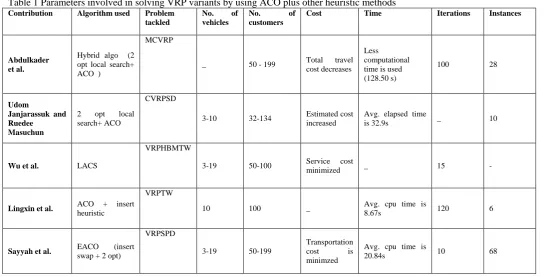
resolving VRPSPD problems. Matlab 11 programming language is utilized for coding of EACO.
Table 1 Parameters involved in solving VRP variants by using ACO plus other heuristic methods
Contribution Algorithm used Problem tackled
No. of vehicles
No. of customers
Cost Time Iterations Instances
Abdulkader et al.
Hybrid algo (2 opt local search+ ACO )
MCVRP
_ 50 - 199 Total travel
cost decreases Less computational time is used (128.50 s)
100 28
Udom
Janjarassuk and Ruedee
Masuchun
2 opt local search+ ACO
CVRPSD
3-10 32-134 Estimated cost
increased
Avg. elapsed time
is 32.9s _ 10
Wu et al. LACS
VRPHBMTW
3-19 50-100 Service cost minimized _ 15 -
Lingxin et al. ACO + insert
heuristic
VRPTW
10 100 _ Avg. cpu time is
8.67s 120 6
Sayyah et al. EACO (insert
swap + 2 opt)
VRPSPD
3-19 50-199
Transportation cost is minimzed
Avg. cpu time is
20.84s 10 68
CONCLUSION
The VRP lies at core of distribution organization. Exploration regarding VRP has done from many years but still an active area for research. VRPs are used in many regions such as in providing services, transportation of merchandise and persons. Numerous basic variants related to VRP have been explored in this survey. Parameters involved in solving VRP variants by using ACO plus other heuristic methods are shown in tabular form. From Recent years several researchers were shown more improvement in optimization, uncertainty and dynamic problems. Numerous objectives were achieved but still there exist some problems which needs to be attained. An improvement can be done in case of distribution of massive goods within a bounded period to customer. To deal through uncertainty plus dynamics within VRP is major task to attain. More exploration required in VRP that have to focus on more effective, straightforward and faster resolution methods which is proficient of doing an intelligent and extensive routing.
REFERENCES
[1] Udom Janjarassuk and Ruedee Masuchun, “An Ant Colony Optimization Method for the Capacitated Vehicle Routing Problem with Stochastic Demands”, Computer Science and Engineering Conference (ICSEC), 2016, pp 1-5.
[2] M.M.S. Abdulkader, Yuvraj Gajpal and Tarek Y. ElMekkawy, “Hybridized ant colony algorithm for the Multi Compartment Vehicle Routing Problem”, Applied Soft Computing, Vol 37(C), 2015, pp 196-203.
[3] Xinyu Wang, Tsan-Ming Choi, Haikuo Liu, and Xiaohang Yue, “Novel Ant Colony Optimization Methods for Simplifying Solution Construction in Vehicle Routing Problems”, IEEE Transactions on Intelligent Transportation Systems, Vol 17(11),2016, pp 3132-3141.
[4] Yannis Marinakis, Georgia - Roumbini Iordanidou and Magdalene Marinaki “ Particle Swarm Optimization for the VRP with Stochastic Demands”, Applied Soft Computing, Vol 13(4), Jan. 2013, pp 1693–1704.
[5] Xiaoxiang Liu, Weigang Jiang and Jianwen Xie “VRP with Time Windows: A Hybrid Particle Swarm Optimization Approach” Fifth International Conference on Natural Computation , 2009, pp 502-506.
[6] Suresh Nanda Kumar and Ramasamy Panneerselvam, “A Survey on the VRP and Its Variants”, Intelligent Information Management, Vol. 4(3), May 2012, pp. 66-74.
[7] Victor Pillac , Michel Gendreau, Christelle Gueret_ and Andr_es L. Medaglia, “ A Review of Dynamic VRPs”, European Journal of operational research, Vol 225(1), Sept. 2012, pp 1- 36.
[8] Jairo R. Montoya-Torres, Julián López Franco, Santiago Nieto Isaza , Heriberto Felizzola Jiménez and Nilson Herazo-Padilla “A literature review on the vehicle routing problem with multiple depots”, Computers & Industrial Engineering, Vol 79, Nov. 2014, pp 115–129.
[9]S.R. Venkatesan, D.Logendran and D.Chandramohan “ Optimization of Capacitated VRP Using PSO” International Journal of Engineering Science and Technology (IJEST), Vol 3(10), Oct. 2011, pp 7469- 7477.
[10] Oren E. Nahum, Yuval Hadas and Uriel Spiegel, “Multi- Objective VRPs with Time Windows: a Vector Evaluated Artificial Bee Colony Approach” ,International Journal of Computer and Information Technology, Vol-3(1), Jan. 2014, pp 41-47.
[11] Viswanath Nagarajan and R. Ravi, “Approximation Algorithms for Distance Constrained VRPs”, Wiley Online Library, Vol 59(2), 2011, pp 209-214.
[12] Liong Choong Yeun, Wan Rosmanira Ismail, Khairuddin Omar and Mourad Zirour, “VRP: MODELS AND SOLUTIONS” , Journal of Quality Measurement and Analysis, Vol 4(1),2008, pp 205-218.
[13] Jose Caceres - cruz, Daniel Riera and Angel A. Juan, “ Rich VRP: Survey” ACM Computing Surveys, Vol 47(2), 2015 pp 1-29.
[15] Bulent Catay, “Ant Colony Optimization and Its Application to the Vehicle Routing Problem with Pickups and Deliveries”, Springer Berlin Heidelberg, Vol 250,2009, pp 219- 244.
[16] R.J. Kuo, Ferani E. Zulvia and Kadarsah Suryadi “Hybrid particle swarm optimization with genetic algorithm for solving capacitated VRP with fuzzy demand – A case study on garbage collection system”, Applied Mathematics and Computation ,Vol 219(5),2012, pp 2574 – 2588.
[17] Yue-Jiao Gong, Jun Zhang, Ou Liu, Rui-Zhang Huang, Henry Shu-Hung Chung and Yu-Hui Shi “ Optimizing the VRP With Time Windows : A Discrete Particle Swarm Optimization Approach” IEEE Transactions on systems, man and cybernetics, Vol 42( 2),2012, pp 254-267.
[18]Chun-Ying Liu “An Improved Adaptive Genetic Algorithm for the Multi-depot VRP with Time Window”, Journal of Networks, Vol. 8(5), 2013,pp 1035-1042.
[19] Charul Dhawan, Maneela Bhugra and Parul Dhawan, “ ACO for Capacitated VRP”, International Journal of Advanced Research in Computer Science and Software Engineering, Vol 4(4) ,2014, pp 664-668.
[20] N. Norouzi, M. Sadegh-Amalnick and M. Alinaghian “Measuring and evaluating of the particle swarm optimization in a periodic VRP”, Elsevier Science, Vol 62,2014, pp 161-169.
[21] Alberto Gomez and Said Salhi , “ Solving capacitated VRP by artificial bee colony algorithm”, IEEE Symposium on Computational Intelligence in Production and Logistics Systems (CIPLS), 2014, pp 48-52.
[22] Omprakash Kaiwartya, Sushil Kumar, D. K. Lobiyal, Pawan Kumar Tiwari, Abdul Hanan Abdullah, and Ahmed Nazar Hassan , “Multiobjective Dynamic VRP and Time Seed Based Solution Using Particle Swarm Optimization”, Journal of Sensors, Vol 2015, pp 1-14, 2015[17] Weiqin Wu, Yu Tian and Tongdan Jin, “A label based ant colony algorithm for heterogeneous vehicle routing with mixed backhaul”, Applied Soft Computing, Vol 47(C),2016, pp 224-234.
[23] Weiqin Wu, Yu Tian, Tongdan Jin “A label based ant colony algorithm for heterogeneous vehicle routing with mixed backhaul”, Applied Soft Computing, Vol 47(C), 2016, pp 224-234.
[24] Meng Lingxin, Lin Cong, Huang Huadong and CAI Xiushan, “Vehicle Routing Plan Based on Ant Colony and Insert Heuristic Algorithm”, Proceedings of the 35th Chinese Control Conference, 2016, pp 2658- 2662.
![Fig 2. Variants of VRP [8]](https://thumb-us.123doks.com/thumbv2/123dok_us/688959.1076303/2.595.43.277.292.577/fig-variants-of-vrp.webp)