International Journal of Advanced Research in Computer Science
RESEARCH PAPER
Available Online at www.ijarcs.info
Evaluation of the Impact of Interference on Mobile Ad Hoc Network Performance
Phu Hung Le
Banking Academy of Vietnam, Hanoi,Vietnam
Abstract: In Mobile Ad hoc Networks (MANETs), interference plays an important role in research in network perfomance. In this paper, we propose a new Hibrid Interference-Aware Multi-path Routing Protocol (HIA-MPOLSR)based on our definition of interference for mobile ad hoc networks. To evaluate the influence of interference in network performance, we compare our protocol to typical protocol OLSR [1] in terms of packet delivery fraction, end-to-end delay, and routing overhead when the RTS/CTS mechanism is alternatively enabled and disabled. From the observation of the simulation results, we see that interference significantly decreases the network performance.
Keywords: Mobile Ad Hoc Networks; Routing Protocol; OLSR; Interference
I. INTRODUCTION
Mobile ad hoc networks consist of a collection of wireless mobile nodes that move freely and self-configure without a preexisting communication infrastructure.
In a MANET, when a node transmits data, all nodes within the carrier sensing range are interfered. The level of the interference of a node depends on the distance from the transmitting node to received node.
Interference in MANETs has been widely studied by the scientific community. Interference can be generated by many different factors, such as the transmission of multiple nodes on a common channel. Interference level can also be affected by number of nodes or the position of nodes in the network. Hence, many interference models have been proposed to consider interference problem in MANETs.
Gobriel et al[23] have proposed a grid model to compete interference. In [24],Gupta and Kumar indicated that the throughput of a fixed wireless network reduces when the number of nodes increases.
In [25], Pascal von Rickenbach et al built a Robust Interference Model that is suitable for Manets.
Another approach to consider interference influence is based on analizing protocol performance.
In [14], the interference level is specified by two- hop interference region. The authors of [2] consider link's interference degree is an average interference degree of two nodes forming the link. The paper [20] estimated the residual bandwidth in transmission range. The protocols [15], [16], and [17] evaluate the link quality based on the Expected Transmission Count (ETX) metric [12] but they did not consider the influence of the outside nodes and the interference level by the geographic distance between nodes.
To reduce the impact of interference, a few interference-aware multi-path protocols were proposed for mobile ad hoc networks. Ying-Hong Wang et al.[19] propose IMRP but it is not high efficient. The protocol of W. Wei et al. [21] is a
heuristic protocol that is only suitable for static or slow moving nodes. Kamal Jain et al. [18] used the conflict graph to find paths. However, the computational complexity of this solution is NP-hard.
In this paper, we propose a new Interference-aware path Routing protocol called HibridInterference-Aware Multi-path Routingprotocol (HIA-MPOLSR). HIA-MPOLSR is built on our definion of interference in part B and it can minimize the impact of interference.
This paper includes four sections. In Section II, we introduce the detail structure of the protocol HIA-MPOLSR. Section III compares the protocols HIA-MPOLSR and OLSR. Our results are summarized in Section IV.
II. PROPOSEDHIBRIDINTERFERENCE-AWARE MULTI-PATHROUTINGPROTOCOL
A. Topology information
In HIA-MPOLSR, all components in HELLO and Topology Control (TC) messages of OLSR are used. Each node inserts its carrier sensing range and position to HELLO message. Nodes also add the information in the HELLO message.
Each node that creates TC messages adds the carrier sensing range, the neighbor information and the position of it, the carrier sensing range, the neighbor information and the position of nodes in MPR selector set to TC messages. When the nodes in the network receive a TC message, they save the information in the message to calculate the interference level of links.
Like OLSR, HELLO messages are periodically sent to its neighbors while TC messages are sent to the entire network.
B. Interference and interference evaluation
The definition of interference and interference evaluation are introduced in my previous papers [26,27,2829].
1) Specifying n1, n2, n3, and n4
According to the formula (3), the interference of a node u in MANET is
I (u) = n1+ 0.25n2 + 0.11n3 + 0.06n4
Each node of MANET has a co-ordinate (x,y). Supposed that the co-ordinate of u, v is (x1,y1), (x2,y2), respectively. The distance between u and v is
(5) The formula (5) is used to calculate the distances between u and all other nodes in MANET. The number of nodes in zone1, zone2, zone3, and zone4 of node u is specified by comparing distances between nodes and u to R1, R2, R3, and R4.
In HIA-MPOLSR, topology information is maintained and updated by each node. When any node changes its status, information and position of the node are updated. The distances between it and other nodes are recalculated. Therefore, interference of nodes and links is recomputed too.
2)Modelling MANET as a weighted graph
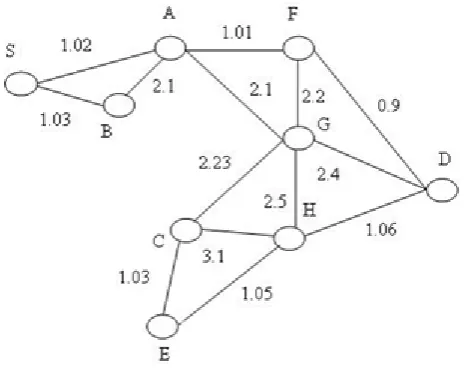
MANET can be considered as a weighted graph (Figure 2) where nodes of MANET are vertices of the graph and the edges of the graph are any two neighbor nodes. The weight of each edge is the interference level of the corresponding link.
This graph is dynamic. The edges and the weight of them are changed when any node changes its status.
Fig 2.HIA-MPOLSR
3)Algorithm of hibrid multi-path
Hybrid multi-path: the paths may be some common links
the destination along the path found in the step 1. We then get the second minimum interference path from the source to the destination.
Step 3: Dijkstra’s algorithm is repeated for a number of times k (k=3,..., n) and while avoiding at least one node or one link between the source and the destination along the paths found in the previous steps to find k-minimum interference path.
Figure 2 is an illustration of an example for a MANET that is considered as a weighted graph. The weight of each edge is set on the edge.
When Dijsktra's algorithm is used at the first time for this weighted graph with the source S and the destination D, we get the minimum interference path S-A-F-D that has the value of 3.02.
The second minimum interference path S-B-A-F-D is found by employing Dijsktra's algorithm once again. This path has the value of 5.04. Dijsktra's algorithm is repeated at the third time, we find the path S-A-G-D that has the third minimum interference value of 5.52.
III.PERFORMANCEEVALUATION
A. Simulation environment
We implement protocol in NS-2 with 11Mbps 802.11 channels. The traffic source is Constant Bit Rate (CBR). The distributed coordination function (DCF) of IEEE 802.11 for wireless LANs is used as the MAC layer. The Random Waypoint and Two-Ray Ground models have been used as propagation model and mobility model, respectively. 35 nodes are used and they move within an area of 550m x550m.
B. Simulation results
In the simulations, we compare the performance between HIA-MPOLSR and OLSR when RTS/CTS is enabled and disabled for:
1-Packet delivery fraction (PDF) 2-Delay
3- Routing overhead
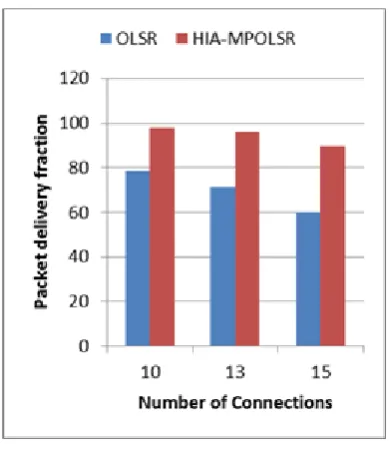
Figure 3. Packet delivery fraction with RTS/CTS
Figure 4. Packet delivery fraction without RTS/CTS
Without using RTS/CTS, the delay of each protocol is lower than it's delay with using RTS/CTS. With 10 source-destination pairs, the delay of HIA-MPOLSR reduces around 2.2 times compared to the delays of OLSR as seen in Figure 5. Also in terms of delay, when turning off RTS/CTS, with 10 connections, HIA-MPOLSR is less than about 5,9 times compared to OLSR(Figure 6). This is because HIA-MPOLSR has low contention.
Figure 5.Average delay with RTS/CTS
Figure 6. Average delay without RTS/CTS
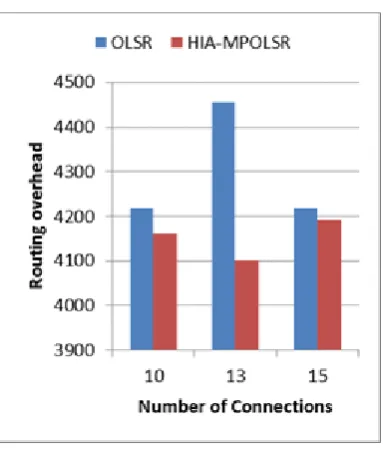
In Figure 7, when RTS/CTS is used, routing overhead of OLSR is 5% more than HIA-MPOLSR at 10 connections. That is becauseOLSR must retransmit the lost packets more
than HIA-MPOLSR.When RTS/CTS is not used, at 13
connections, routing overhead of OLSR outperforms
Figure 7. Routing overhead with RTS/CTS
Figure 8. Routing overhead without RTS/CTS
IV.CONCLUSION
A challenge to improve the network performance for mobile ad hoc networks is interference.
This paper proposed a new Hibrid Interference-Aware Multi-path Routingprotocol (HIA-MPOLSR) for mobile ad
V.REFERENCE
[1] T. Clausen, P. Jacquet, IETF Request for Comments: 3626, Optimized Link State Routing Protocol OLSR, October 2003. [2] Xinming Zhang, Qiong Liu, Dong Shi, Yongzhen Liu, Xiang Yu
An Average Link Interference-aware Routing Protocol for Mobile Ad hoc Networks, proc of ICWMC'07.
[3] Perkins CE, Royer EM. Ad-Hoc on demand distance vector routing. In: IEEE Work-Shop on Mobile Computing Systems and Applications (WMCSA). New Orleans, 1999. 90 100. [4] David B. Johnson, David A. Maltz, Josh Broch, “DSR: The
Dynamic Source Routing Protocol for Multi-Hop Wireless Ad Hoc Networks,” Ad Hoc Networking, Addison-Wesley, 2001:139~172.
[5] http://masimum.inf.um.es/fjrm/
[6] M. Burkhart, P. Rickenbach, R. Wattenhofer, and A. Zollinger, “Does topology control reduce interference?” Proc. of MobiHoc, 2004.
[7] K. Xu, M. Gerla, and S. Bae, “Effectiveness of RTS/CTS handshake in IEEE 802.11 based ad hoc networks”, Journal of Ad Hoc Networks, 2003,1(1):107-123.
[8] Marina, M. K. and Das, S. R., “On-demand Multipath Distance Vector Routing forAd Hoc Networks,” Wireless communications and mobile computing, 6, 969–988 .
[9] X. Zhou, Y. Lu, B. Xi, A novel routing protocol for ad hoc sensor networks using multiple disjoint paths, proc of broadnet 2005.
[10]S J Lee, M Gerla, “Split Multi-Path Routing with Maximally Disjoint Paths in Ad Hoc Networks”, IEEE ICC 2001, 2001, pp. 3201-3205.
[11]Jiazi Yi, Eddy Cizeron, Salima Hamma, Benoît Parrein and Pascal Lesage Implementation of Multipath and Multiple Description Coding in OLSR, 4thIntrop/Workshop,Ottawa, Canada.
[12]D. D. Couto, D. Aguayo, J. Bicket, and R. Morris. A High-Throughput Path Metric for Multi-hop Wireless Routing. In Proc. of MobiCom, San Diego, CA, October 2003.
[13]Dang-Quan Nguyen, Pascal Minet, “Interference-Aware QoS OLSR for Mobile Ad-Hoc Network Routing”, Proc. of SNPD-SAWN '05.
[14]R. Draves, J. Padhye, and B. Zill, "Comparison of routing metrics for static multi-hop wireless networks," SIGCOMM '04. [15]R. Draves, J. Padhye, and B. Zill, "Routing in multi-radio, multi-hop wireless mesh networks," in Int'l Conf. On Mobile Computing and Networking, Philadelphia, PA, USA, 2004, pp. 114 – 128.
[16]I. Sheriff and E. Belding-Royer, "Multipath Selection in Multi-radio Mesh Networks," in 3rd Int'l Conf. on Broad-Multi-Multi-radio Mesh Networks," in 3rd Broadnets 06, San Jose, 2006.
[17]Rami Langar, Nizar Bouabdallah , Raouf Boutaba , and Guy Pujolle,
“Interferer Link-Aware Routing in Wireless Mesh Networks”, Proc. of IEEE ICC, 2010.
[18]Kamal Jain, Jitendra Padhye, Venkat Padmanabhan, and Lili Qiu, “Impact of interference on multi-hop wireless network
performance”, Proceedings of the 9th MobiCom. .
[23]Gobriel S., Melhem R, Mossé D. “A unified interference/collisionanalysis for power-aware ad hoc networks”, Proc. of IEEE Infocom, Hong Kong, 2004.
[24]Gupta, P. & Kumar, P. R “ The capacity of wireless networks”, IEEE Transactions on Information Theory, vol. 46, no. 2, pp. 388–404.
[25]Pascal von Rickenbach, Stefan Schmid, Roger Wattenhofer, Aaron Zollinger, “An interference model for wireless ad-hoc networks”, Proc. of IEEE WMAN, Denver, CO.
[26]Phu Hung Le, “A Source Routing Interference-Aware Multi-Path Routing Protocol for Mobile Ad Hoc Networks” , JJFCC, 2014
[27]Phu Hung Le, Guy Pujolle, Thi-Mai-Trang Nguyen, "An Interference-aware multi-path routing protocol for Mobile Ad hoc Network", proc of ICNSC 2011, Delft, the Netherlands, April 2011,
[28]Phu Hung Le, Guy Pujolle, "A Link-disjoint interference-aware multi-path routing protocol for Mobile Ad hoc Network", proc of The International Conference on Digital Information and Communication Technology and its Applications(DICTAP
2011), Dijon, France, June 2011, Springer LNCS, pages 649-661.
[29]Phu Hung Le, “A Performance Evaluation of Multi-Path Routing Protocols for Mobile Ad Hoc Network”, the 10th IEEE/IFIP International Conference on Embedded and Ubiquitous Computing, Paphos, Cyprus, December 2012.
BIOGRAPHIES