Web-based Annotation of Anaphoric Relations and Lexical Chains
Maik Stührenberg and Daniela Goecke and Nils Diewald and Alexander Mehler Bielefeld University
Germany
{maik.stuehrenberg|daniela.goecke|nils.diewald|alexander.mehler}@uni-bielefeld.de
Irene Cramer Dortmund University
Germany
Abstract
Annotating large text corpora is a time-consuming effort. Although single-user notation tools are available, web-based an-notation applications allow for distributed annotation and file access from different lo-cations. In this paper we present the web-based annotation application Serengeti for annotating anaphoric relations which will be extended for the annotation of lexical chains.
1 Introduction
The relevance of corpus work for different tasks in the fields of linguistics is widely accepted. This holds especially for the area of (semi-)automatic text and discourse analysis which demands reference corpora in which instances of various levels of dis-course structure have been annotated. Such anno-tation tasks are typically carried out by a combina-tion of automatic and manual techniques. Manual annotation of large text corpora is a time consum-ing effort. Therefore, annotation tools are an indis-pensable means to overcome the limits of manual annotations. In spite of their limited level of au-tomatization, such tools nevertheless help to semi-automatically support the annotation process and to secure consistency of manual annotations. This pa-per describes such an annotation tool which focuses on a certain type of discourse structures. More specifically, we deal with anaphoric relations and lexical cohesion. Our starting point is the obser-vation that these two resources of textual cohesion (Halliday and Hasan, 1976) homogeneously induce
chain-likediscourse structures: one the one hand we have reference chains started by some antecedence and continued by some anaphora linked to the same antecedence. On the other hand, lexical cohesion generates so called lexical chains of semantically related tokens. Based on this observation we de-scribe the annotation tool Serengeti which reflects this structural homogeneity on the level of its struc-tural representation model as well as by its proce-dural annotation model. Serengeti includes an an-notation scheme which is extended in order to sup-port the annotation of reference chains and lexical chains. The paper is organized as follows: Section 2.1 describes the application scenario of anaphoric relations and the scheme we use to annotate them. Section 2.2 deals with the second application sce-nario: lexical chains. As our starting point was the former scenario, its extension to the latter one will be motivated by a separate case study of lexical chain-ing. Section 3 refers to related work, while Section 4 describes our annotation tool in detail. Finally, the application ofSerengetito annotating lexical chains is described in Section 5.
2 Annotating Large Text Corpora
The main focus of the joint work presented in this paper1 is text technological information modelling and analysis of various types of discourse. Within our research group we deal with the integration of
1
The work presented in this paper is a joint ef-fort of the projects A2, A4 and B1 of the Research Group Text-technological modelling of information funded by the German Research Foundation. See http://www. text-technology.defor further details.
heterogeneous linguistic resources. This applies es-pecially to theSekimo project (A2) which focusses on the application domain of anaphora resolution. We use the term ’heterogeneity’ to refer to resources that differ either in terms of form (text, audio, video) or in terms of function (e. g. lexicons, annotated texts). Connection between these resources can be established with the means of XML, cf. Si-mons (2004). Integrating resources via an abstract interface is necessary due to different reasons: The resources used have often been developed indepen-dently from each other and a cascaded application of one resource to the output of another resource is not always possible. Furthermore, the output of dif-ferent resources often cannot be encoded in a single structure without driving into incompatibilites (i. e. XML overlap). Therefore an architecture was devel-oped which allows for the combination of the out-put structures of several linguistic resources into a single XML annotated document and which is de-scribed in detail in Witt et al. (2005) and Stühren-berg et al. (2006) .
2.1 Anaphoric Relations
Motivation and Background Resolving anapho-ric relations needs a variety of different informa-tion (e. g. POS, distance information, grammati-cal function, semantic knowledge, see, for exam-ple, Mitkov (2002) for an overview). Several re-sources are applied to a corpus of 47 texts and the output structures are combined into a single XML document using the architecture mentioned above. In order not only to integrate but also evaluate re-sources for a given linguistic task formally in terms of precision and recall, it should be possible to ei-ther switch on or switch off a given resource. In the application domain of anaphora resolution eval-uation is done as follows. Each discourse entity
or referent (cf. Karttunen (1976)) is annotated as an XML element which holds a variety of attribute information. Each XML element is reinterpreted as a feature vector; pairs of discourse entities be-tween which an anaphoric relation holds form a sin-gle feature vector with additional information rele-vant for anaphora resolution (e. g. distance informa-tion, identity of grammatical form, semantic relat-edness of underlying lemmata and the like). In or-der to evaluate different resource settings, decision
trees with varying sets of feature vectors are used for the process of anaphora resolution. Xiaofeng et al. (2004) or Strube and Müller (2003) have shown the feasibility of decision trees for the domain of anaphora resolution; we have chosen this approach as it makes it possible to easily switch the informa-tion set for training and evaluainforma-tion as opposed to e. g. rewriting rule sets. Both, training and evaluation as well as empirically based analysis of anaphora need an annotated reference corpus (Poesio et al., 2002). Scheme and annotation process are described in the following section.
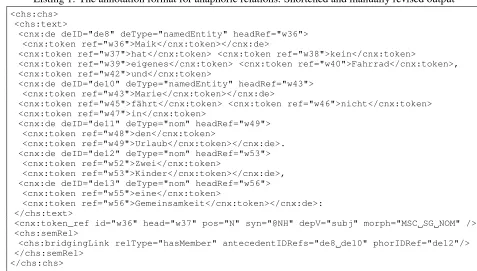
Listing 1: The annotation format for anaphoric relations. Shortened and manually revised output
1 <chs:chs> 2 <chs:text>
3 <cnx:de deID="de8" deType="namedEntity" headRef="w36"> 4 <cnx:token ref="w36">Maik</cnx:token></cnx:de>
5 <cnx:token ref="w37">hat</cnx:token> <cnx:token ref="w38">kein</cnx:token>
6 <cnx:token ref="w39">eigenes</cnx:token> <cnx:token ref="w40">Fahrrad</cnx:token>, 7 <cnx:token ref="w42">und</cnx:token>
8 <cnx:de deID="de10" deType="namedEntity" headRef="w43"> 9 <cnx:token ref="w43">Marie</cnx:token></cnx:de>
10 <cnx:token ref="w45">fährt</cnx:token> <cnx:token ref="w46">nicht</cnx:token> 11 <cnx:token ref="w47">in</cnx:token>
12 <cnx:de deID="de11" deType="nom" headRef="w49"> 13 <cnx:token ref="w48">den</cnx:token>
14 <cnx:token ref="w49">Urlaub</cnx:token></cnx:de>. 15 <cnx:de deID="de12" deType="nom" headRef="w53"> 16 <cnx:token ref="w52">Zwei</cnx:token>
17 <cnx:token ref="w53">Kinder</cnx:token></cnx:de>, 18 <cnx:de deID="de13" deType="nom" headRef="w56"> 19 <cnx:token ref="w55">eine</cnx:token>
20 <cnx:token ref="w56">Gemeinsamkeit</cnx:token></cnx:de>: 21 </chs:text>
22 <cnx:token_ref id="w36" head="w37" pos="N" syn="@NH" depV="subj" morph="MSC SG NOM" /> 23 <chs:semRel>
24 <chs:bridgingLink relType="hasMember" antecedentIDRefs="de8 de10" phorIDRef="de12"/> 25 </chs:semRel>
26 </chs:chs>
types that specify the subtype of the relation, e. g.
identorhypernymas secondary types of cospecLink or meronym or setMember as secondary types of bridgingLink. An example annotation of an indirect anaphoric relation (elementbridgingLink, line 30) between the discourse entitiesde12(lines 18 to 21) andde8(lines 3 to 5) andde10(lines 9 to 11) can be seen in Listing 1.
2.2 Lexical Chaining
[image:3.612.62.539.72.343.2]Motivation and Background Based on the con-cept of lexical cohesion (Halliday and Hasan, 1976), computational linguists (inter alia Morris and Hirst (1991)) developed a method to compute a par-tial text representation: lexical chains. These span over passages or even the complete text linking lex-ical items. The exemplary annotation in Figure 1 illustrates that lexical chaining is achieved by the selection of vocabulary and significantly accounts for the cohesive structure of a text passage. Items in a lexical chain are connected via semantic re-lations. Accordingly, lexical chains are computed on the basis of a lexical semantic resource such as WordNet (Fellbaum, 1998). Figure 1 also depicts
Figure 1: Chaining Example (adapted from Halliday et al. (1976))
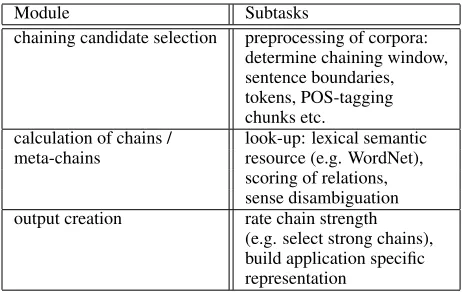
several unsystematic relations, which should in prin-ciple be considered. Unfortunately, common lexical resources do not incorporate them sufficiently. Most systems consist of the fundamental modules shown in Table 1.
Module Subtasks
chaining candidate selection preprocessing of corpora: determine chaining window, sentence boundaries, tokens, POS-tagging chunks etc.
calculation of chains / look-up: lexical semantic meta-chains resource (e.g. WordNet),
scoring of relations, sense disambiguation output creation rate chain strength
[image:4.612.71.302.57.203.2](e.g. select strong chains), build application specific representation
Table 1: Overview of Chainer Modules
nor for German. We therefore plan to develop an evaluation corpus (gold standard), which on the one hand includes the annotation of lexical chains and on the other hand reveals the rich interaction be-tween various principles to achieve a cohesive text structure. In order to systematically construct sound guidelines for the annotation of this gold standard, we conducted a case study.
Case Study Six subjects were asked to annotate lexical chains in three short texts and in doing so record all challenges and uncertainties they experi-enced. The subjects were asked to read three texts
– a wikipedia entry (137 words), a newspaper
article (233 words), and an interview (306 words). They were then given a list of all nouns occurring in the articles (almost all chainers exclusively con-sider nouns as chaining candidates), which they had to rate with respect to their ’importance’ in under-standing the text. On this basis they were asked to determine the semantic relations of every pos-sible chaining candidate pair, thus chain the nouns and annotate the three texts. Just like previously re-ported case studies (Beigman Klebanov, 2005; Mor-ris and Hirst, 2004; MorMor-ris and Hirst, 2005) aim-ing at the annotation of lexical chains, we found that the inter-annotator agreement was in general relatively low. Only the annotation of very promi-nent items in the three texts, which accounted for approximately one fifth of the chaining candidates, resulted in a satisfying agreement (that is: the ma-jority of the subjects produced an identical or very similar annotation). However, all subjects com-plained about the task. They found it rather
diffi-cult to construct linearized or quasi-linearized struc-tures, in short, chains. Instead, most of the subjects built clusters and drew very complex graphs to illus-trate the cohesive relations they found. They also pointed out that only a small fraction of the can-didate list contributed to their text understanding. This clearly supports our observation that most of the subjects first skimmed through the text to find the most prominent items, established chains for this selection andthenworked the text over to distribute the remaining items to these chains. We therefore as-sume that lexical chains do not directly reflect read-ing and understandread-ing processes. Nevertheless, they do in some way contribute to them. Many subjects additionally noted that a reasonable candidate list should also include multi-word units (e.g. techni-cal terms) or even phrases. Furthermore, as already reported in previous work (Morris and Hirst, 2004), the semantic relations usually considered seem not to suffice. Accordingly, some subjects proposed new relations to characterize the links connecting can-didate pairs. Given our own findings and the re-sults reported in previous work, it is obviously de-manding to find a clear-cut border between the con-cepts of lexical chaining, semantic fields, and co-reference/anaphora resolution. Definitely, the anno-tation of co-reference/anaphora and lexical chains is inherently analogous. In both cases an annotation layer consisting of labelled edges between pairs of annotation candidates is constructed. However, we assume that the lexical chaining layer might contain more edges between annotation candidates. As a consequence, its structure presumably is more com-plex and its connectivity higher. We thus plan to conduct an extended follow-up study in order to ex-plore these differences between the annotation of lexical chains and co-reference/anaphora. We also intend to take advantage of – amongst other aspects – the inter-annotator comparison functionality pro-vided bySerengeti(see Section 4 for a detailed de-scription) in order to implement a formally correct inter-annotator agreement test.
3 Available Tools for Annotating Linguistic Corpora
easy-to-use annotation tool. Although a wide range of annotation tools is available, one has to separate tools for annotating multimodal corpora from tools for annotating unimodal (i. e. text) corpora. Dip-per et al. (2004) evaluated some of the most com-monly used tools of both categories (TASX Anno-tator, EXMARaLDA, MMAX, PALinkA and Sys-tematic Coder). Besides, other tools such as ELAN2 or Anvil3are available as well, as are tool kits such as the Annotation Graph Toolkit (AGTK)4 or the NITE XML Toolkit.5 While multimodal annotation demands a framework supporting the time-aligned handling of video and audio streams and, therefore, much effort has been spent on the design and devel-opment of tools, unimodal annotation has often been fulfilled by using ordinary XML editors which can be error-prone. Nevertheless, specialized annota-tion frameworks are available as well, e. g. MMAX can be used for multi-level annotation projects (cf. Müller and Strube (2001; 2003)). However, as an-notation projects grow in size and complexity (often multiple annotation layers are generated), collabo-rative annotation and the use of annotation tools is vital.
• Ma et al. (2002), for example, describe collab-orative annotation in the context of the AGTK. But since most of the aforementioned applica-tions have to be installed locally on a PC, work-ing on a corpus and managwork-ing annotations ex-ternally can be difficult.
• Another problem worth to be mentioned is data management. Having several annotators work-ing on one text, unification and comparison of the markup produced is quite difficult.
• Furthermore, annotation tools help to increase both the quality and quantity of the annotation process.
Recent web technologies allow the design of web-based applications that resemble locally installed desktop programs on the one hand and provide cen-tral data management on the other hand. Therefore
2
http://www.lat-mpi.eu/tools/elan/ 3
http://www.dfki.de/~kipp/anvil/ 4http://agtk.sourceforge.net/ 5http://www.ltg.ed.ac.uk/NITE/
distributed annotation is possible regardless of loca-tion, provided that an internet connection is avail-able. In this paper we propose the web-based anno-tation applicationSerengeti.
4 A new Approach: Serengeti
As the Sekimo project is part of a research group with interrelated application domains, annotation layers from different projects have been evaluated for their interrelationship (e. g. Bayerl et al. (2003; 2006)). This led directly to the open design of
Serengeti – an annotation tool with the fundamen-tal idea in mind: making possible the annotation of a single layer (or resource) and the use of the best annotation possible and the best available re-sources. Serengetiallows for several experts to an-notate a single text at the same time as well as to compare the different annotations (inter-annotator-agreement) and merge them afterwards. Access to the documents is available from everywhere (an in-ternet connection and a browser is required).
4.1 Technical Overview
Serengetiis a web application developed for Mozilla Firefox,6 thus its architecture is separated into a client and a server side, following the principles and tools of AJAX (Asynchronous JavaScript and XML, cf. Garrett (2005)). While groups, documents and annotations are managed centrally on the server side, all user interactions are rendered locally on the client side.7
4.2 Graphical User Interface
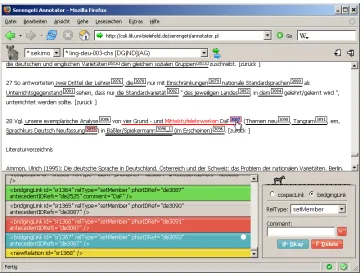
The Graphical User Interface (GUI) ofSerengetiis subdivided into several areas (cf. Figure 2). The main area renders the text to be annotated, roughly laid out in terms of paragraphs, lists, tables and non-text sections according to the input XML data. Ad-ditionally, predefined markables are underlined and followed by boxes containing the markables’ unique identifiers. These boxes serve as clickable buttons to choose markables during the annotation. At this
6
Serengetiis targeted at platform independence, so we’ve chosen Firefox, which is freely available for several operating systems. Future versions will support other browsers as well.
7
time, adding markables, i. e. changing the input data, is not allowed.8 This ensures that all annota-tors use the same base layer. A section at the bottom of the interface represents the annotation panel with a list of all annotated relations on the left and all editing tools on the right side. An application bar at the top of the GUI provides functions for choosing and managing groups, documents and annotations.
4.3 Annotation Process
After logging in and choosing a document to anno-tate, new relations between markables can be cre-ated. The markables that take part in the relation are chosen by left-clicking the boxes attached to the underlined markables in the text and, if necessary, unchecked by clicking them once again. To encode the type of a relation between chosen markables, an input form at the bottom right of the page provides various options for specifying the relation accord-ing to the annotation scheme. The OKAYcommand
adds created relations to the list, which can subse-quently be edited or deleted. In regard to their state, relation bars in the list can be highlighted differ-ently to simplify the post-editing (i. e. new relations, old/saved relations, commented relations or incom-plete relations).9 The user can save his work to the server at any time. After the annotation process is completed, the COMMIT command (located in the document menu) declares the annotation as finished.
4.4 Comparing Annotations and Reaching a Consensus
In order to achieve the best annotation results it is necessary to provide an opportunity for the evalua-tion of single annotaevalua-tions or comparing of multiple annotations on one single document (either by dif-ferent annotators or identical annotators at difdif-ferent points in time). This allows for verification of the quality of the annotation scheme and for valid train-ing data for automated natural language processtrain-ing tools. For this purpose, a special user access, the
Consensus User (CU), has been developed as part of
Serengeti’s concept. Loading a document as a CU, it
8
The definition of XML elements as markables and the lay-out and relation type specification is driven via an external con-figuration script, adjustable for each group.
9
It is possible to hide relations according to their state as well.
[image:6.612.313.540.153.228.2]is possible to choose a single annotation done by any other annotator (either work in progress or commit-ted) as the basis for the final annotation. This is done with the same tools as those for the annotation pro-cess. If satisfied, the CU can declare the annotation as ultimately closed via the COMMITcommand.
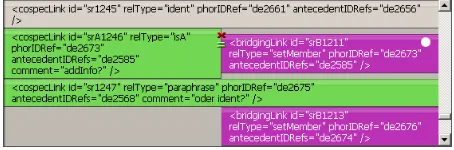
Figure 3: Serengeti’s comparison window in the lower left part of the GUI.
Furthermore, the CU can compare two annota-tions with each other. The relaannota-tions annotated by both users are then displayed in the relation list and juxtaposed in case they differ in at least one aspect (e. g. different relation types as in Figure 3).10 On this basis the CU can decide which relation to accept and which one to reject. Again, all editing options are at the user’s disposal.
While editing single or multiple user annotations, the CU can save the current state of his work at any time. Afterwards these annotations will appear in the ANNOTATIONS MENU as well and can be se-lected for further evaluation and comparison.11
5 Extending Serengeti
Although one might doubt thatSerengetiis directly applicable to annotating lexical chains, this can nev-ertheless be done straightforwardly using the anno-tation described in Section 2.1. Our starting point is as follows: As markables we refer to entities of the parser output (i. e. tokens) where a user can mark a token as the initial vertex of a chain. In order to reflect the findings of our case study on lexical chaining we distinguish two cases: Either the an-notator decides that a newly entered token enlarges
10
At this point the assignment of relations is important. Anaphoric relations, for example, are assigned to each other if their anaphoric element is the same. If there is more than one relation with identical anaphoric elements, the relations are sorted by their relation types and their antecedent(s).
11
Figure 2:Serengeti’s User Interface. Screenshots ofSerengetiVersion 0.7.1
an already marked-up chain by explicitly relating it to one of its links or he implicitly assigns the to-ken to that chain as a whole which is visually rep-resented as part ofSerengeti’s interface. In the first case we just face another use case of our annota-tion scheme, that is, a link between two tokens or spans of a text where this link may be typed accord-ing to some laccord-inguistic relation that holds between the spans, e. g. hyponymy. In the second case of an im-plicit chain assignment we proceed as follows: We link the newly processed token to the last vertex of the lexical chain to which the token is attached and type this relation non-specifically asassociation. As a result, we reduce this use case to the one already mapped by our general annotation scheme. In or-der to make this a workable solution, we will in-tegrate a representation of lexical chains by means oftag cloudswhere each chain is represented by a subset of those lexical units which because of their frequency are most important in representing that chain. Following this line of extendingSerengeti, we manage to use it as an annotation tool which handles anaphoric relationsas well aslexical chains.
6 Discussion and Outlook
Serengeti can be used to create corpus data for training and evaluation purposes. An installation of Serengeti is available online.12 Currently, the tool is being generalized to allow the annotation of lexical chains and several other annotation tasks. More specifically, we plan to incorporate any kind of chain-like structuring of text segments and to make the chains an object of annotation so that they can be interrelated. This will allow to incorporate con-stituency relations into the annotation process. Be-yond that we will incorporate metadata handling to document all steps of the annotation process.
References
P. S. Bayerl, H. Lüngen, D. Goecke, A. Witt, and D. Naber. 2003. Methods for the Semantic Analy-sis of Document Markup. In C. Roisin, E. Muson, and C. Vanoirbeek, editors, Proceedings of the 2003 ACM symposium on Document engineering (DocEng), pages 161–170, Grenoble. ACM Press.
B. Beigman Klebanov. 2005. Using readers to identify lexical cohesive structures in texts. InProceedings of ACL Student Research Workshop.
S. Dipper, M. Götze, and M. Stede. 2004. Simple Anno-tation Tools for Complex AnnoAnno-tation Tasks: an Evalu-ation. InProceedings of the LREC Workshop on XML-based Richly Annotated Corpora, pages 54–62, Lis-bon, Portugal.
C. Fellbaum, editor. 1998.WordNet. An Electronic Lexi-cal Database. The MIT Press.
S. Fligelstone. 1992. Developing a Scheme for Annotat-ing Text to Show Anaphoric Relations. In G. Leitner, editor,New Directions in English Language Corpora: Methodology, Results, Software Developments, pages 153–170. Mouton de Gruyter, Berlin.
J. J. Garrett, 2005. AJAX: A New Approach to Web Applications. Adaptive Path LLC, February, 18. Online: http://www.adaptivepath.com/ publications/essays/archives/000385. php.
R. Garside, S. Fligelstone, and S. Botley. 1997. Dis-course Annotation: Anaphoric Relations in Corpora. In R. Garside, G. Leech, and A. McEnery, editors,
Corpus Annotation: Linguistic Information from Com-puter Text Corpora, pages 66–84. Addison-Wesley Longman, London.
D. Goecke and A. Witt. 2006. Exploiting Logical Docu-ment Structure for Anaphora Resolution. In Proceed-ings of the 5th International Conference., Genoa, Italy.
Michael A. K. Halliday and Ruqaiya Hasan. 1976. Co-hesion in English. Longman, London.
L. Hirschmann. 1997. MUC-7 Coreference Task Defini-tion (version 3.0). In L. Hirschman and N. Chinchor, editors,Proceedings of Message Understanding Con-ference (MUC-7).
A. Holler, J.-F. Maas, and A. Storrer. 2004. Exploiting Coreference Annotations for Text-to-Hypertext Con-version. In Proceeding of LREC, volume II, pages 651–654, Lisbon, Portugal.
L. Karttunen. 1976. Discourse Referents. Syntax and Semantics: Notes from the Linguistic Underground, 7:363–385.
X. Ma, L. Haejoong, S. Bird, and K. Maeda. 2002. Models and Tools for Collaborative Annotation. In
Proceedings of the Third International Conference on Language Resources and Evaluation, Paris. European Language Resources Association.
R. Mitkov. 2002. Anaphora Resolution. Longman, Lon-don.
J. Morris and G. Hirst. 1991. Lexical cohesion computed by thesaural relations as an indicator of the structure of text.Computational linguistics, 17(1):21–48, March.
J. Morris and G. Hirst. 2004. Non-classical lexical semantic relations. In Proceedings of HLT-NAACL Workshop on Computational Lexical Semantics.
J. Morris and G. Hirst. 2005. The subjectivity of lexi-cal cohesion in text. In J. C. Chanahan, C. Qu, and J. Wiebe, editors,Computing attitude and affect in text. Springer.
C. Müller and M.l Strube. 2001. Annotating Anaphoric and Bridging Relations with MMAX. InProceedings of the 2nd SIGdial Workshop on Discourse and Dia-logue, pages 90–95, Aalborg, Denmark.
C. Müller and M. Strube. 2003. Multi-Level Annotation in MMAX. InProceedings of the 4th SIGdial Work-shop on Discourse and Dialogue, pages 198–207, Sap-poro, Japan.
M. Poesio, T. Ishikawa, S. Schulte im Walde, and R. Viera. 2002. Acquiring lexical knowledge for anaphora resolution. InProc. of the 3rd Conference on Language Resources and Evaluation (LREC).
M. Poesio. 2004. The MATE/GNOME Scheme for Anaphoric Annotation, Revisited. InProceedings of SIGDIAL, Boston, April.
G. Simons, W. Lewis, S. Farrar, T. Langendoen, B. Fitzsi-mons, and H. Gonzalez. 2004. The semantics of markup. In Proceedings of the ACL 2004 Workshop on RDF/RDFS and OWL in Language Technology (NLPXML-2004), Barcelona.
M. Strube and C. Müller. 2003. A Machine Learning Approach to Pronoun Resolution in Spoken Dialogue. InProceedings of the 41st Annual Meeting on Associ-ation for ComputAssoci-ational Linguistics, volume 1, pages 168–175. ACL 03.
M. Stührenberg, A. Witt, D. Goecke, D. Metzing, and O. Schonefeld. 2006. Multidimensional Markup and Heterogeneous Linguistic Resources. In D. Ahn, E. T. K. Sang, and G. Wilcock, editors,Proceedings of the 5th Workshop on NLP and XML (NLPXML-2006): Multi-Dimensional Markup in Natural Language Pro-cessing, pages 85–88.
A. Witt, D. Goecke, F. Sasaki, and H. Lüngen. 2005. Unification of XML Documents with Con-current Markup. Literary and Lingustic Computing, 20(1):103–116.