Application to Si-dielectric interfaces
J.-F. T. Wang, G. D. Powell, R. S. Johnson, G. Lucovsky, and D. E. Aspnesa) Department of Physics, North Carolina State University, Raleigh, North Carolina 27695-8202
共Received 12 February 2002; accepted 22 April 2002兲
We show that the anisotropies of second-harmonic-generation 共SHG兲 intensities of singular and vicinal 共111兲 and 共001兲Si–dielectric interfaces can be described accurately as dipole radiation originating from the anharmonic motion of bond charges parallel to the bond directions. This simplified bond-hyperpolarizability model not only provides a simpler and mathematically more efficient representation of SHG, but also allows a direct physical interpretation at the bond level, which was lacking in previous approaches. Application to oxidized and nitrided Si–SiO2interfaces provides new insight into bonding that occurs at these interfaces as well as the origin of SHG. © 2002 American Vacuum Society. 关DOI: 10.1116/1.1493783兴
I. INTRODUCTION
The development of the femtosecond laser has generated a significant resurgence of interest in the use of nonlinear-optical共NLO兲phenomena as a means of studying bulk ma-terials, thin films, interfaces, and surfaces.1,2NLO phenom-ena possess richer selection rules than their linear-optic equivalent, and are therefore intrinsically more powerful as diagnostic tools.1–3In addition, the microscopic symmetry of surfaces and interfaces is lower than that of bulk material, which can provide an additional means of isolating contribu-tions from these regions. For example, with the exception of the bulk quadrupole contribution, which is relatively small in materials such as Si that possess inversion symmetry, second-harmonic generation共SHG兲is forbidden in the bulk and also in amorphous materials such as SiO2 overlayers where the bonds are oriented in essentially random direc-tions. Thus SHG of oxidized or nitrided Si wafers originates almost entirely from an interface region no more than several atomic layers thick, where there is a regular repeating geom-etry of asymmetric bonds. As a result SHG has become a widely used probe for studying the interfaces of this techno-logically important materials system.1,2,4 –12
However, NLO spectra are difficult to acquire, so with few exceptions12 SHG data have been limited to relatively narrow spectral ranges and are typically obtained as anisotro-pies ISHG() of the second-harmonic intensity ISHG as a
function of the sample azimuth angle. Since the associated nonlinear susceptibility SHG⫽2 is a third-rank tensor,
anisotropies up to and including 3may be analyzed by this approach. To organize these data the results are typically expressed either as the coefficients of the Fourier expansion of ISHG() or as tensor coefficients, taking account of
group-theoretical constraints13–15to eliminate all those that are not allowed by crystal symmetry. Neither approach is satisfac-tory, since there is no obvious connection between the Fou-rier or tensor coefficients and the properties of the individual bonds. Moreover, the absolute-squaring operation that
con-verts fields to intensities generates additional Fourier coeffi-cients and obscures phases, further complicating analysis. In-terpretation on the basis of available first-principles expressions involves lengthy calculations16and a significant loss of physical insight. This situation has created a barrier to the more widespread use of SHG.
To gain the information about the interface chemistry and bonding on a microscopic scale that we needed, a better ap-proach was necessary. Because the region from which SHG originates in the Si-dielectric system is localized, it seemed that a much more sensible method of analysis was to formu-late SHG in terms of its basic physics, starting at the bond rather than the band level and representing observed SHG intensities as far-field radiation from dipoles driven anhar-monically by the incident electric field. This approach em-ploys the nonlinear-optical equivalent of techniques that were used by Ewald17and Oseen18in their derivations of the extinction theorem of linear optics. Using physically reason-able approximations we found that we could indeed develop a simple approach that not only replaces the cataloging of phenomenological quantities but also allows SHG data to be represented by a minimum number of parameters, each of which has a direct physical interpretation at the bond level.19 For example, we show below that we not only can recognize SHG absorption from the anisotropy of ISHG() but also
identify the responsible bonds. Because these parameters can also be calculated from first principles, our framework also provides a convenient interface between experiment and theory. We anticipate that our approach will stimulate a re-surgence of interest in SHG.
Specifically, we assume that the system consists of charges localized in bonds, then follow a three-step proce-dure. First, we recognize that the applied field causes a dis-placement of charge共dipole兲at each bond site, which varies anharmonically with time under the action of the applied field and appropriate restoring and dissipation forces. We summarize the linear and nonlinear parts of this motion in terms of complex polarizabilities and hyperpolarizabilities, respectively, which can be obtained in principle by solving the standard equation of motion as discussed by Shen.3Next,
a兲Author to whom correspondence should be addressed; electronic mail:
we make the simplifying assumption that for any bond the only relevant anharmonic motion is that along the bond axis. In the SHG context this is equivalent to assuming that the bonds are cylindrically symmetric. Finally, we calculate the far-field intensity as the square of the superposition of fields radiated by these charges in the dipole approximation, as-suming that the relevant bond directions are those of the underlying bulk crystalline material. This simplified bond-hyperpolarizability model 共SBHM兲leads to an excellent de-scription of SHG signals from 共111兲and共001兲Si–dielectric interfaces, and in addition provides new physical insight at the microscopic level not only about these interfaces but also about the physics of SHG itself.
The new aspect with respect to Ewald17 and Oseen18 be-yond the application to a nonlinear process, and with respect to early NLO bond calculations of the dc susceptibility,20–22 is our assumption that for SHG purposes we need to consider bond polarization only along bond directions. This also dis-tinguishes the present approach from more recent bond-orbital treatments of SHG in covalent materials,23,24 includ-ing that of Wijers et al. where SHG was also formulated in terms of radiating bonds. Cluster calculations for As-terminated Si and Ge surfaces showed that the assumption of cylindrical symmetry for individual bonds is not necessarily a good approximation,25 but we justify its use because we find that our model accurately represents SHG data with an absolute minimum number of parameters, thereby implying either simplifications or outright cancellations in what is ba-sically an effective-bond representation. A bond-hyperpolarizability model similar to ours, including the as-sumption of cylindrical symmetry for the individual bonds, was recently presented by Mendoza and co-workers.26,27 However, Mendoza et al. represented SHG as a product of linear polarizabilities for which the transverse polarizability cannot be ignored, and hence overlooked the essential sim-plification that results from the assumption of cylindrical symmetry. Since this assumption cannot be made for linear optics, we conclude that in at least some aspects SHG is simpler than linear optics.
II. THEORY
A. Formulation
We outline only basic aspects since a more complete de-scription has been published elsewhere.19 Consistent with our assumption that only motion along the bond axis need be considered, we examine a one-dimensional force model as discussed by Shen.3Let the direction of the j th bond in a unit cell or other appropriate set of bonds be defined by the unit vector bˆj. We suppose an applied field Ee⫺it, noting that
the field Ej at the jth bond site may be different from E
owing to contributions from other induced dipoles in the area
共local-field effect兲. However, for simplicity we assume that Ej⫽E. Then the motion of the charge qjcan be described by
the equation of motion:
F⫽qjE•bˆje⫺it⫺1共x⫺xo兲⫺2共x⫺xo兲2⫺␥dx/dt
⫽md2x/dt2, 共1兲
where x is the position of the charge in a local coordinate system that lies along the bˆj direction, xo is the equilibrium
position, 1 and 2 are the harmonic 共Hooke’s law兲 and
anharmonic spring constants, respectively, and ␥ is a fric-tional coefficient representing losses. Assuming that x can be written
x⫽xo⫹⌬x1e⫺it⫹⌬x2e⫺i2t, 共2兲
it follows that to lowest order the linear p1 j and first-order
nonlinear p2 j parts of the induced dipole pj⫽qj⌬xj
corre-sponding to the jth charge are given in a general coordinate system by
p1 j⫽qj⌬x1bˆj⫽
q2jE•bˆj
1⫺m2⫺i␥bˆj⫽␣1 jbˆj共bˆj•E兲, 共3a兲
p2 j⫽qj⌬x2bˆj⫽ qj2⌬x1
2
1⫺4m2⫺2i␥bˆj⫽␣2 jbˆj共bˆj•E兲
2, 共3b兲 where ␣1 j and ␣2 j are the microscopic first-order 共linear兲 polarizability and second-order共first-order nonlinear兲 hyper-polarizability, respectively, of the jth bond.
Thus, to within a scaling factor, the total polarization can be written
P⫽1
V
兺
jpj⫽
1
V
兺
j 共␣1 jbˆjbˆj兲•E
⫹V1
兺
j 共␣2 j
bˆjbˆjbˆj兲••EE 共4a兲
⫽1•E⫹2••EE, 共4b兲
where V is the volume and 1 and 2 are the first- and second-order susceptibility tensors, respectively, of the sys-tem. Using the assumption that the bond charges radiate as dipoles, we can now express the far-field radiation field Ef f
as
Ef f⫽k2e
ikr
r
冉
兺
jpj⫺kˆ
冋
kˆ•兺
j
pj
册冊
共5a兲⫽k2e
ikr
r 共IÀkˆkˆ兲•
兺
jpj, 共5b兲
where I is the unit tensor and k⫽kkˆ is the wave vector
pointing in the direction of the observer. By combining Eqs.
共4兲and共5b兲it is clear that in this model the different orders of susceptibilities can be defined in intrinsic terms as sums of dyadic, triadic, etc. products of the bonds, with the descrip-tion of the observed radiadescrip-tion and the acdescrip-tion of the applied fields both represented as external operators. Extensions to higher orders are obvious.
equivalent ‘‘back’’ bonds, although for vicinal surfaces one of the three back bonds becomes an inequivalent step bond. Choosing a coordinate system where one axis is perpendicu-lar to the interface and another parallel to the step, these bonds can be written: up: bˆ1⫽zˆ; step: bˆ2⫽(
冑
8)/3xˆ⫺(1/3)zˆ; back: bˆ3,4⫽⫺(&)/3xˆ⫾(
冑
6)/3yˆ⫺(1/3)zˆ.We suppose that all bonds point away from the Si atom in the outermost plane. If the incoming angle of incidence is
i, the incoming s- and p-polarized beams are Es⫽Esyˆ and
Ep⫽Ep(⫺xˆ cosi⫹zˆ sini), respectively. If the observation
angle is o, the k vector of the outgoing wave is kˆ ⫽⫺xˆ sino⫹zˆ coso. In this case the far fields Ef f observed in the four possible combinations of polarization are given for the p- p case:
Ef f⫽关xˆ coso⫹zˆ sino兴关␣usin2isino ⫹␣d共cos3sin2isino
⫹3
4sinsin 2共cos
2
isino⫺sin 2icoso兲
⫹3
4sin
3cos2
icosocos 3兲兴, 共6a兲
for the p-s case:
Ef f⫽yˆ
3
4␣dsin3cos2isin 3, 共6b兲
for the s-p case:
Ef f⫽关xˆ coso⫹zˆ sino兴共3
4␣d共⫺sin3cosocos 3 ⫹sinsin 2sino兲兲, 共6c兲 for the s-s case:
Ef f⫽⫺yˆ
3
4␣dsin3sin 3, 共6d兲
where⫽109.47° is the angle between bonds and is the azimuth angle measured from the xz plane. To calculate the intensity we take the absolute square of these fields.
For 共001兲 interfaces the situation is complicated by the fact that real on-axis interfaces are not singular but consist of statistically equal areas of two inequivalent domains that are rotated by 90° with respect to each other. Thus except for the dc component the terrace contributions vanish, leaving that from the steps. In a full least-squares analysis for either ori-entation we do not rely on analytic expressions but rather evaluate Eqs.共4a兲and共5b兲numerically, with all bonds tilted appropriately in the case of vicinal surfaces.
B. Validation: Analysis of oxidized vicinal„111… and„001…Si
We assess the validity of the model by applying it to the data of Lu¨pke, Bottomley, and van Driel on an oxidized vici-nal 共111兲Si wafer reported in Ref. 8. These data are appro-priate because all four combinations of polarizations are given. However, the amplitudes of the measured SHG anisotropies are normalized to the 3 Fourier component, which means that the information that in principle is avail-able from the relative amplitudes of the four configurations is lost, and that comparisons must be done on the basis of line
shapes alone. The wavelength was 765 nm, the nominal miscut angle 5° toward the关112¯兴direction, and the nominal angles of incidence and observation 45°. Setting aside the normalization coefficients, the data are presented as a table of seven real and two complex Fourier coefficients共Table VI of Ref. 8兲, which are also given apart from normalization as seven complex coefficients of 2 共Table VII兲. Using their
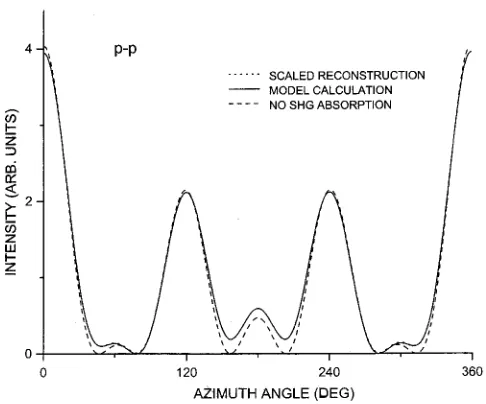
Fourier coefficients we have reconstructed their data as in-tensities, normalizing them in our case to the 6coefficients. We determine the共complex兲bond hyperpolarizabilities by least-squares fitting the azimuthal variation of the SHG in-tensity for the p-p configuration. The result, shown in Fig. 1, is an essentially exact representation of the reconstructed data. The least-squares values obtained are 29.5° for the angles of incidence and observation, 1.12° for the vicinal angle, and 1.78⫹i0.17, 2.76⫹i1.43, 2.19⫹i0.00, and 2.19
for the hyperpolarizabilities of the up, step, and two back bonds, respectively. The imaginary part of the hyperpolariz-ability of the last back bond is arbitrarily set equal to zero, since the absolute phase cannot be determined in an intensity measurement. The values for the back bonds are equivalent, as expected. We find therefore that, again apart from normal-ization, we can essentially represent the p-p line shape with three parameters, one less than the number of Fourier coef-ficients needed to describe the same data in Ref. 8. Thus the SBHM not only has the mathematical breadth necessary to represent SHG anisotropies, but also does it in a more effi-cient and physically more meaningful manner.
The existence of SHG absorption can be demonstrated unequivocally by repeating the least-squares fit with the imaginary parts of the hyperpolarizabilities of the first two bonds set equal to zero. The result is the dashed line in Fig. 1, which is obtained with the least-squares values 1.743, 3.158, 2.230, and 2.230. More to the point, in the absence of FIG. 1. Comparison between the reconstructed p-p SHG data of Lu¨pke et al. for a 5° vicinal (111)Si–SiO2interface共points, Ref. 8兲and the variation
SHG absorption the SHG intensity reaches zero at the local minima near 80°, 155°, 205°, and 280°. Thus, SHG absorp-tion is relatively easy to recognize from these data.
Taking the best-fit p-p parameters we now calculate the expected intensity anisotropies for the p-s, s-p, and s-s con-figurations. The reconstructed data and least-squares fits are shown in Fig. 2. As can be seen, the SBHM provides a very good representation of these data, provided that the predicted line shapes are scaled by the least-squares-determined values 1.40, 1.93, and 2.26, respectively. The need for, and physical meaning of, these scaling factors can be understood by not-ing that the data shown in Fig. 2 were scaled to the 6 Fourier component. From Eqs.共6兲we see that if the angle of incidence i equals the angle of observation o, the 6
anisotropies of the four configurations differ only in that the
p-s, s-p, and s-s coefficients are multiplied by 1/cos2, 1/cos4(), and 1/cos6(), respectively, where ⫽i⫽o.
From the scaling factors determined above we findvalues of 32.5°, 32.0°, and 29.2° for the p-s, s-p, and s-s configura-tions, respectively, essentially equal to expected values. We also note that the least-squares-determined value of 29.5° for
⫽i⫽o is in excellent agreement with the values of 29.1°
and 28.7° calculated for refraction at the air–SiO2 interface
using the refractive indices of 1.454 and 1.472 for SiO2 at
765 and 382.5 nm, respectively. From this we can also con-clude that for this oxidized共111兲Si interface the SHG signal originates essentially from the SiO2 side of the interface.
Since we can account for the scaling parameters, the SBHM reconstructs the p-s, s-p, and s-s anisotropies with the same
three parameters determined for the p-p configuration, in contrast to the seven additional Fourier coefficients and 14 overall tensor coefficients needed in Ref. 8.
For the oxidized vicinal 共001兲 Si interface similar good agreement is obtained, as shown by our data in Fig. 3. This sample was prepared by thermally growing a 10 nm sacrifi-cial oxide at 900 °C, stripping the oxide with HF, then ther-mally regrowing a 3 nm oxide at 750 °C by annealing at 900 °C. The angles of incidence and observation were 45° and the wavelength was 830 nm. The p-s data were multi-plied by a factor of 4 to compensate for reflectance effects and different pulse durations and intensities that resulted as a consequence from the need to use different experimental conditions with respect to the p-incident configuration. The least-squares fitting parameters were determined to be 12° for the angles of incidence and observation, 7.28° for the vicinal angle, and 105⫹i30, 197⫹i55, 133⫹i0, and 131 for
the hyperpolarizabilities of the four bonds, again in arbitrary units and with the phase of the hyperpolarizability of the last bond arbitrarily set equal to zero. The ‘‘step’’ bond again shows the highest polarizability and absorption, although the essentially threefold pattern of Fig. 2 shows that most of the signal is coming from the vicinity of the steps. The p-s an-isotropy is found to be particularly sensitive to the angles of incidence and observation, and we estimate that the 12° value is determined to within 3°. This angle is consistent with Snell’s Law for a refractive index of 3.4, which indi-cates that the SHG signal here is originating predominantly from the Si side of the interface.
III. APPLICATION TO PLASMA-DEPOSITED AND RAPID-THERMAL-ANNEALED INTERFACES
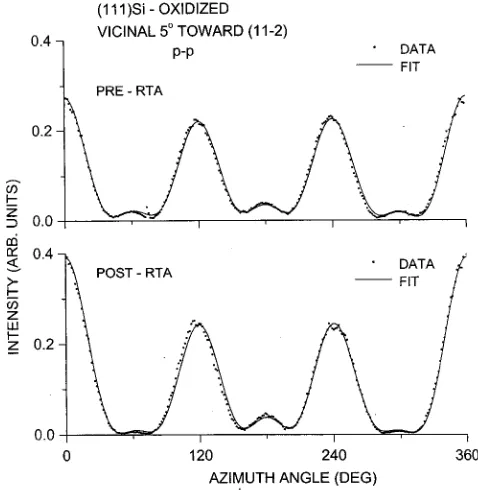
We have performed a number of measurements on inter-faces formed on 共111兲Si surfaces by plasma oxidation and nitridation followed by rapid thermal annealing共RTA兲. The data shown in Fig. 4 are for an oxidized surface cut 5° off
共111兲toward (112¯ ). The incident wavelength was 830 nm, and measurements were made in situ, that is, without expos-ing the sample to air. Data for (112) and nitrided samples are similar. The anisotropy follows the typical pattern shown in Fig. 1, with a basic threefold waveform superimposed on a dc background, which when squared gives rise in a Fourier expansion primarily to dc, 3, and 6components. Qualita-tively RTA processing reduces SHG absorption and increases the magnitude of the hyperpolarizability of the up bond rela-tive to the other three.
The complex hyperpolarizabilities obtained from a least-squares fit of the SBHM to these data, and those obtained for related surfaces, are summarized in Table I. We show these data in polar共amplitude, angle兲rather than rectangular共real, imaginary兲 form because the polar format better illustrates the fact that the amplitudes of the hyperpolarizabilities ap-pear to be generally unaffected by RTA while the absorption decreases. The phases are defined according to our previous convention, i.e., that the phase of one of the back bonds is arbitrarily set equal to zero. The fact that some of the step-bond phases are now slightly negative indicates that this as-sumption is not strictly valid in all cases. The hyperpolariz-abilities of the oxidized (112¯ ) sample are seen to support the
qualitative interpretation given above, in that the SHG ab-sorption, here associated primarily with the up bond, is de-creased significantly by RTA. This is consistent with the con-version of the interface suboxide to Si and SiO2, a known
consequence of rapid thermal annealing. The hyperpolariz-ability of the step bond has also increased, further indicating improved bonding. The hyperpolarizabilities of the two back bonds, which as expected are essentially identical, are basi-cally unchanged by RTA.
The response of the nitrided (112¯ ) interface is very simi-lar. The dominant hyperpolarizability is again seen to occur for the up bond, and the major fraction of SHG absorption occurs for this bond as well. As with the oxidized interface, RTA reduces the SHG absorption for the up bonds and in-creases the hyperpolarizability for the step bonds. Both indi-cate improved bonding as a result of RTA.
FIG. 3. Result of least-squares fitting for a 9° vicinal Si–SiO2interface.
FIG. 4. Comparison of SHG anisotropies before and after an oxidized (112¯ ) sample has undergone rapid thermal annealing. The corresponding hyperpo-larizabilities for this and other Si-dielectric interfaces are listed in Table I.
TABLEI. Hyperpolarizabilities obtained for plasma-processed vicinal共111兲 Si samples before and after rapid thermal annealing.
Orientation and procedure Up Step Back
The situation is different for the sample cut 5° off 共111兲 toward (112). While the SHG absorption decreases with RTA for both oxidized and nitrided samples, the real part of the hyperpolarizability increases dramatically with RTA for the nitrided sample. The hyperpolarizability for this orienta-tion is substantially less for the step bond, and the values move in opposite directions following RTA for the oxidized and nitrided interfaces, decreasing, and increasing, respec-tively. While we believe that RTA is increasing the perfection of the step in both cases, it is clear that the detailed bonding geometry must be taken into account before an increase is automatically considered to be the sign of improved bonding. As with the other orientation, the hyperpolarizabilities of the back bonds remain constant for the oxidized surface while those for the nitrided surface increase.
We conclude with an indication of the type of information that may be available when spectral SHG data become avail-able. Figure 5 shows SHG anisotropies of the up and back bonds for three different singular共111兲samples measured in
situ after plasma processing. We chose this orientation
be-cause the three back bonds are equivalent, which means that only two classes of parameters need be considered. Data were obtained every 15 nm from 800 to 890 nm for two different oxidations and one nitridation run. The two oxida-tion runs are nominal duplicates of each other, allowing us to investigate reproducibility. It is clear from the heavy traces that the real parts of the hyperpolarizabilities ␣1 and ␣2 ⫽␣3⫽␣4 of the two oxidation experiments are nearly equal. However, the SHG absorption for the up bond ␣1 shows a significant difference between the two oxidation runs, indi-cating that this feature is apparently rather sensitive to the details of specific plasma-processing runs.
Regarding nitridation, the real parts of all hyperpolariz-abilities are consistently larger for the nitrided sample than for the oxidized samples. This is in contrast to the data given in Table I for the vicinal samples, but is an effect clearly
outside experimental uncertainty. The absorption associated with the up bond appears to be generally less than that ob-served in oxidation.
The wavelength dependencies of the real parts of the non-zero contributions all follow essentially the same trend, de-creasing monotonically with inde-creasing wavelength. We con-sider first the back bonds, for which analysis is in principle easier. The decrease in the real part indicates the existence of absorption at wavelengths shorter than those accessible with our current apparatus. On the other hand, and given our phase reference, the imaginary part of the hyperpolarizability of the up bond appears to be approximately constant or even increasing slightly with decreasing wavelength as the real part crosses zero, indicating that its absorption may be reach-ing a maximum near or within the present spectral region. Given the limited wavelength range of these data these re-marks are essentially speculation, but these data do indicate that considerable information should be available when SHG anisotropy measurements such as these are made and inter-preted in the SBHM over an extended spectral range. Con-sidering in addition that we can identify the hyperpolarizabil-ity of step bonds when dealing with vicinal surfaces, we should be able to form a rather complete picture of the ab-sorption processes of these bonds at these interfaces. Similar investigation of dielectrics other than silicon oxides and ni-trides should also be fruitful.
IV. CONCLUSION
absorption and allowing us to determine the effective angles of incidence and observation. This in turn allows us to iden-tify the side of the interface at which the observed SHG response originates. Connection between Fourier coefficients describing the different anisotropies and the properties of the bonds could now be made, if desired, thereby providing a more microscopic basis for previous work.
With the exception of Fig. 5, we have considered only data that have been obtained at single wavelengths. The data shown in Fig. 5 indicate that extension of this approach to SHG anisotropies measured over a wide wavelength range will provide spectral information that will be useful for more detailed analyses. This would be extremely interesting not only as a means of obtaining greater insight concerning the energy dependence and therefore the origin of the observed SHG absorption, but also for additionally critically assessing the SBHM model. In particular, an assessment of the effec-tive angles of incidence and observation as a function of wavelength would provide additional insight into the specific interface region responsible for the SHG signal.
ACKNOWLEDGMENTS
It is a pleasure to acknowledge the Office of Naval Re-search for the original grant under which our SHG equip-ment was purchased and for continuing support. We would also like to acknowledge further support by the Army Re-search Office and the Max-Planck-Gesellschaft via an Award for International Cooperation.
1J. F. McGilp, Prog. Surf. Sci. 49, 1共1995兲. 2
G. Lu¨pke, Surf. Sci. Rep. 35, 75共1999兲.
3Y. R. Shen, The Principles of Nonlinear Optics共Wiley, New York, 1984兲. 4W. Daum, H.-G. Krause, U. Reichel, and H. Ibach, Phys. Rev. Lett. 71,
1234共1993兲.
5
C. H. Bjorkman, C. E. Shearon, Jr., Y. Ma, T. Yasuda, G. Lucovsky, U. Emmerichs, C. Meyer, K. Leo, and H. Kurz, J. Vac. Sci. Technol. A 11, 964共1993兲.
6
C. H. Bjorkman, T. Yasuda, C. E. Shearon, Jr., Y. Ma, G. Lucovsky, U. Emmerichs, C. Meyer, K. Leo, and H. Kurz, J. Vac. Sci. Technol. B 11, 1521共1993兲.
7G. Lu¨pke, D. J. Bottomley, and H. M. van Driel, Phys. Rev. B 47, 10389
共1993兲.
8
G. Lu¨pke, D. J. Bottomley, and H. M. van Driel, J. Opt. Soc. Am. B 11, 33共1994兲.
9J. I. Dadap, X. F. Hu, M. H. Anderson, M. C. Downer, J. K. Lowell, and
O. A. Aksipetrov, Phys. Rev. B 53, R7607共1996兲.
10C. Meyer, G. Lu¨pke, Z. G. Lu˜, A. Go¨tz, H. Kurz, and G. Lucovsky, J. Vac.
Sci. Technol. B 14, 3107共1996兲.
11S. T. Cundiff, W. H. Knox, F. H. Baumann, K. W. Evans-Lutterodt, and
M. L. Green, J. Vac. Sci. Technol. A 16, 1730共1998兲.
12G. Erley and W. Daum, Phys. Rev. B 58, R1734共1998兲. 13
J. E. Sipe, D. J. Moss, and H. M. van Driel, Phys. Rev. B 35, 1129共1987兲.
14
V. Mizrahi and J. E. Sipe, J. Opt. Soc. Am. B 5, 660共1988兲.
15J. E. Sipe and A. I. Shkrebtii, Phys. Rev. B 61, 5337共2000兲. 16See, e.g., M. Cini, Phys. Rev. B 43, 4792共1991兲.
17P. P. Ewald, Dissertation, Munich, 1912; Ann. Phys.共Paris兲49, 1共1916兲. 18
C. W. Oseen, Ann. Phys.共Paris兲48, 1共1915兲.
19G. D. Powell, J.-F. T. Wang, and D. E. Aspnes, Phys. Rev. B 65, 205320
共2002兲.
20N. Bloembergen and P. S. Pershan, Phys. Rev. 128, 606共1962兲. 21
N. Bloembergen, R. K. Chang, S. S. Jha, and C. H. Lee, Phys. Rev. 174, 813共1968兲.
22B. F. Levine, Phys. Rev. B 7, 2600共1973兲.
23W. L. Schaich and B. S. Mendoza, Phys. Rev. B 45, 14279共1992兲. 24C. M. J. Wijers, P. L. de Boeij, C. W. van Hasselt, and Th. Rasing, Solid
State Commun. 93, 17共1995兲.
25C. H. Patterson, D. Weaire, and J. F. McGilp, J. Phys.: Condens. Matter 4,
4017共1992兲.
26B. S. Mendoza and W. L. Mocha´n, Phys. Rev. 55, 2489共1997兲. 27