Composite Searchable Encryption (CSE) For Group Data Allocation
through Cloud Storage
Shelly Sinha & N. Sujata Gupta
1
M.tech Student,
2Associate Professor, Departmentof CSE, Sridevi Women’s Engineering College,
Vatinagullapally(v), Rajendranagar(m), Ranga Reddy(d), Telangana state, India.
Abstract: The capacity of specifically sharing secure information with various clients by means of open distributed storage (e.g Public cloud) may significantly ease security worries over coincidental information spills in the cloud. A key test to planning such encryption plans lies in the effective administration of encryption keys. The coveted adaptability of imparting any gathering of chose reports to any gathering of clients requests diverse encryption keys to be utilized for various archives. In any case, this additionally suggests the need of safely conveying to clients countless for both encryption and seek, and those clients should safely store the got keys, and introduce a comparably extensive number of watchword trapdoors to the cloud with a particular ultimate objective to perform investigate the common data. The proposed prerequisite for secure correspondence, accumulating, and multifaceted nature doubtlessly renders the approach farfetched. In this paper, we address this viable issue, which is to a great extent ignored in the writing, by proposing the novel idea of composite accessible encryption (CSE) also, instantiating the thoroughly considered a solid CSE plot, in which an information proprietor just needs to stream a solitary key to a client for sharing a critical number of chronicles, and the customer simply needs to display a lone trapdoor to the cloud for scrutinizing the regular records. The security examination and execution assessment both declare that our proposed plans are provably secure and all around that truly matters convincing.
Keywords: Encryption, group data allocation, cloud sharing platform, data security
I. INTRODUCTION
What is cloud computing?
Computing is the usage of enlisting resources (gear and programming) that are passed on as an organization over a system (ordinarily the Internet). The name begins from the fundamental use of a cloud-shaped picture as a consideration for the psyche boggling structure it contains in system diagrams. Distributed computing endows remote administrations with a client's information, programming and calculation. Circled handling includes rigging and programming assets made open on the Internet as administered outsider associations. These administrations commonly give access to cutting edge programming applications and top of the line systems of server PCs.
Data Sharing Over Cloud
Cloud data sharing, also called cloud-based data sharing or online data sharing, is a system in which a user is allotted storage space on a server and reads and writes are carried out over the Internet. Cloud information sharing can show security dangers and consistence concerns if information is put away on outsider suppliers without the IT division's learning.
Secure data Sharing
Fig 1. Cloud Computing
II. RELATED WORK
There is a rich written work on open encryption, including SSE designs and PEKS designs. Rather than those current work, with regards to distributed storage, watchword seek under the multi-occupancy setting is a more typical situation. In such a circumstance, the information proprietor might want to impart a record to a gathering of approved clients, and every client who has the get to right can give a trapdoor to play out the catchphrase look for over the common record, specifically, the "multi-customer available encryption" (MUSE) circumstance. Some current work center to such a MUSE situation, despite the fact that they all receive single-key joined with get to control to accomplish the objective. In MUSE plans are built by allotment the report's accessible encryption key with all clients who can get to it, and communicate encryption is utilized to accomplish coarse-grained get the opportunity to control. In attribute, based encryption (ABE) is associated with achieve fine-grained get the opportunity to control careful catchphrase look for. Therefore, in MUSE, the fundamental issue is the means by which to control which clients can get to which archives, while how to diminish the quantity of shared keys furthermore, trapdoors is not considered.
i) Unexpected benefit acceleration will uncover all.
ii) It is not proficient.
iii) Shared information won't be secure.
In this paper, we address this test by proposing the clever thought of key-composite available encryption (), and instantiating the thought through a strong plan. The proposed scheme applies to any cloud storage that supports the searchable group data allocation functionality, which means any user may selectively share a group of selected files with a group of selected users, while allowing the latter to perform keyword search over the former. To help accessible gathering information distribution the fundamental necessities for productive key administration are twofold. First, a data owner only needs to distribute a single composite key (instead of a group of keys) to a user for allocation any number of files. Second, the customer simply needs to introduce a single composite trapdoor (as opposed to a social occasion of trapdoors) to the cloud for performing watchword look for over any number of shared files. We initially characterize a general system of key composite accessible encryption made out of seven polynomial calculations for security parameter setup, key era, encryption, key extraction, trapdoor period, trapdoor modification, and trapdoor testing. We at that point depict both practical and security necessities for planning a substantial plan. We at that point instantiate the system by planning a solid plan. After providing detailed constructions for the seven algorithms, we analyze the efficiency of the scheme, and establish its security through detailed analysis. We discuss various practical issues in building an actual group data allocation system based on the proposed scheme, and evaluate its performance. The evaluation confirms our system can meet the performance requirements of practical applications.
i) It is more secure.
ii) Unscrambling key ought to be sent by means of a protected channel and kept mystery.
iii) It is a powerful open key encryption plot which supports versatile arrangement..
iv) To the best of our insight, the plan proposed in this paper is the main known plan that can fulfill necessities.
III. THE COMPOSITESEARCHABLE ENCRYPTION (CSE) FRAMEWORK
we use encryption to secure our data and ensure only valid receiver will able to access this data. In this part, we are going to discuss how we can use composite searchable Encryption framework to secure our data.
3.1 Problem
Consider a scenario where manager John wants to share some confidential business researchdocuments using a public cloud storage service (e.g. One Drive or Google Drive).For example, John wants to upload a large collection of confidential business research documents to the cloud storage, which are meant to use by different analysts of different departments. Suppose those documents contain highly sensitive information that should only be accessed by authorized users, and Mark is one of the analysts and is thus authorized to see archives identified with his area of expertise. In light of stresses of information security in the cloud, John scrambles these documents with different keys, and makes catchphrase figure messages in light of office names. John then uploads and shares to the cloud, those documents with the analysts using the sharing functionality of the cloud storage. For getting the right file in secure manner, John must pass to Mark the rights both for keyword search over those documents and for decryption of documents related to Mark’s department.
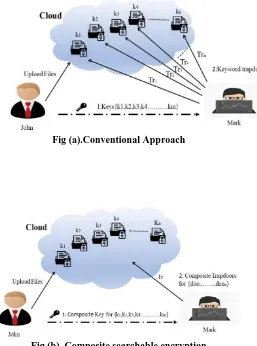
With a conventional way, John must securely provide all the searchable encryption keys to Mark. After receiving keys, he must store them securely and then to perform a keyword search, he must generate all the keyword trapdoors using these keys. As shown in Fig.(a), John is assumed to have a confidential document set {doci}ni=1, and for each document doci, a searchable encryption key ki is used. Without loss of generality, we suppose John wants to share m documents {doci}mi=1 with Mark. In this case, John must send all the searchable encryption keys {ki}mi=1 to Mark. Then, when Mark wants to get documents containing a keyword w, he must generate keyword trapdoor Tri for each document doci with key ki and submit all the trapdoors {Tri}mi=1 to the cloud computing server. At the point when m is adequately substantial, the key dissemination and capacity and the trapdoor era may turn out to be excessively costly for Mark's customer side gadget.
In this paper, we offer the innovative approach of composite searchable encryption (CSE), as depicted in Fig.(b), in CSE, John just needs to convey a solitary composite key, rather than {ki}mi=1 for sharing m archives with Mark, and Mark just needs to present a solitary composite trapdoor, instead of {Tri}mi=1,to the cloud server.
Fig (a).Conventional Approach
Fig (b). Composite searchable encryption
Fig 2. Keyword search in group data allocation
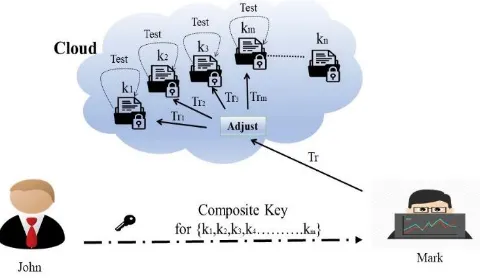
In this framework, we are going to use seven algorithms to achieve the aim. In this plan, distributed storage supplier will produce open parameters of the framework through the Setup calculation, and these open parameters will have the capacity to reused by various information proprietors to share their files. Utilizing this Keygen calculation every information proprietor will have the capacity to make an open/ace mystery key match. Watchwords of each report can be mixed by methods for the Encrypt estimation with the phenomenal available encryption key. At that point, the information proprietor should utilize the ace mystery key to produce a composite accessible encryption key for a gathering of chose records utilizing the Extract calculation. These composite keys ought to be conveyed safely (e.g., through secure messages or secure gadgets) to approved clients. Beginning now and into the not so distant, as appeared in Fig.3,an affirmed customer will have the ability to make a watchword trapdoor by methods for the Trapdoor calculation using this composite key, and present the trapdoor to the computing. After receiving the trapdoor, to perform the keyword search over the specified set of documents, the cloud server will run the Adjust algorithm to generate the right trapdoor for each record, and a short time later run the Test figuring to test whether the file contains the watchword.
Fig 3. Framework of composite searchable encryption
This structure is condensed in the accompanying.
Setup(1λ, n): Cloud specialist organization will execute this calculation to set up the plan. On contribution of a security parameter 1λ furthermore, the greatest conceivable number n of records which has a place with an information proprietor, it yields the general population
framework parameter params.
Keygen: Information proprietor will executed this calculation to produce an irregular key match (pk,msk).
Encrypt(pk, i): This algorithm is execute by the information proprietor to scramble the ith archive and create its catchphrases' figure writings. For each report, this computation will make a delta ∆i for its accessible encryption key ki. On commitment of the proprietor's open key pk and the record document i, this computation yields data ciphertext and watchword ciphertexts Ci.
Extract(msk, S): This algorithm is execute by the data owner to generate an composite searchable encryption key for delegating the keyword search right for a certain set of records to different clients. It takes as input the owner’s master-secret key msk and a set S which contains the indices of documents, then outputs the composite key
k
cmpst Trapdoor(
k
cmpst, w): This algorithm is execute bythe user who has the composite key to perform a search. It takes as input the composite searchable encryption key
k
cmpstand a keyword w, then out-puts only one trapdoor Tr.
Adjust(params, i, S, Tr): This algorithm is execute by cloud server to adjust the composite trapdoor to generate the right trapdoor for each different document. It takes as info the framework open dad parameters params, the set S of reports' files, the list i of target record and the composite trapdoor Tr, at that point yields each trapdoor Trifor the ith target document in S.
Test(Tri, i): This algorithm is execute by the cloud server to perform keyword search over an en crypted document. It takes as input the trapdoor Tri and the document index i, then outputs true or false to denote whether the document doci contains the keyword w.
IV. MODULES AND ITS DESCRIPTION
In this project,Composite Searchable Encryption For Group Data Allocation Through Cloud Storage have following modules.
A. Data Owner
C. Encrypted Composite Key and Searchable Encryption Key Transfer
D. Trapdoor Generation
E. File User
A. Data Owner
In this module, we executed by the data owner to setup an account on an untrusted server. On input a security level parameter 1λ and the number of ciphertext classes n (i.e., class list ought to be a whole number limited by 1 and n), it yields the general population framework parameter param, which is precluded from the contribution of alternate calculations for quickness.
B. Network Storage(Dropbox or OneDrive)
With our solution, John can simply send Mark a single composite key via a secure e-mail. Check can download the encoded photographs from John's Dropbox or OneDrive space and after that utilization this composite key to unscramble these scrambled photographs. In this Network Storage is untrusted third party server or dropbox or OneDrive.
C. Encrypted Composite Key and Searchable Encryption Key Transfer
The information proprietor builds up the general population framework parameter by means of Setup and creates an open/ace mystery key match through KeyGen. Messages can be encoded by means of Encrypt by any individual who additionally chooses what ciphertext class is asso-ciated with the plain instant message to be scrambled. The information proprietor can utilize the ace mystery to produce composite decoding key for an arrangement of ciphertext classes by means of Extract. The made keys can be passed to delegates securely (by methods for secure messages or secure devices) finally; any customer with composite key can unscramble any ciphertext if the ciphertext's class is contained in the composite key through Decrypt.
D. Trapdoor Generation
Trapdoor era calculation is controlled by the client who has the composite key to play out a pursuit. It takes as
information the composite accessible encryption key
k
cmpst what's more, a watchword w, at that point yields just a single trapdoor Tr.E. File User
The created keys can be passed to delegates safely (by means of secure messages or secure gadgets) at last; any client with the Trapdoor catchphrase era process can decrypt any cyphertextif the cyphertext’s class is contained in the Encrypted composite key and Searchable Encrypted key via Decrypt.
4.1 ALGORITHMS
The proposed CSE system algorithm follows as below:
i) Setup (1λ, n):The cloud server will use this algorithminitialize system parameters as follows:
Generate a bilinear map group system B=(p,G,G1,e(·,·)),
where p is the order of Gand2λ ≤p≥ 2λ+1
Set n as the maximum possible number ofdocuments which belong to a data owner. Pick a random generator gϵG and a random α ϵ
Zp,and computes gi=g(αi)ϵG for i= {1,2, ···,n,n+2,···,2n}.
Select a one-way hash function
H:{0,1}*→
G
.
At long last, cloud server distributes the framework parameters params = (B,PubK,H), where PubK=(g
1,g
2,
···,g
n,g
n+2,···,g
2n)ϵG
2n+1ii)Keygen: Information proprietor utilizes this calculation to produce his/her key combine. It picks an irregular γϵZp, and outputs:
pk=v=gϒ ,msk=ϒ .
iii) Encrypt (pk, i): Information proprietor utilizes this algorithmto encode information and create its catchphrase ciphertexts while transferring the ith archive. To create the catchphrase ciphertexts, this algorithmtakes as info the document record i ϵ {1,…., n}, and:
randomly picks atϵZ
pas the accessible encryption keyki of this document.
c
1= g
t, c2 = (v · g
i)
t
for a keywordw
,
outputs its ciphertextsc
was:c
w=e(g,H(w))
t/e(g
1,g
n)
t·Note that c1,c2 are public and can be stored in the cloud server.
iv) Extract (msk, S): Data owner uses this algorithmto generate composite searchable encryptionkey. For any subset,S⸦{1,2….,n}which contains the indices ofdocuments, this algorithm takesas input the owner’s master-secret key mskand outputs the composite key
k
cmpstby computing:k
cmpst=
∏jϵsgγn+1-j·To delegate the keyword search right to a user,data owner will send
k
cmpstand the set Sto theuser.v)Trapdoor (
k
cmpst, w): The client utilizes this calculation tocreate the trapdoor to perform catchphrase look. For all documents, which are relevant tothe composite key
k
cmpst,this algorithm generatesthe only one trapdoor Trfor the keyword w bycomputing:
Tr=
k
cmpst·H(w)Then, the user sends (Tr, S) to the cloud server.
vi) Adjust (params, i, S, Tr): The cloud server utilizes this calculation to deliver the privilege trapdoor. For each document in the set S, this estimation takes as data the structure open parameters params,the record list i ϵ S and the composite trapdoor Tr, yields the privilege trapdoor Tri by registering:
Tri
=
Tr·
∏jϵs,≠i gn+1 -j+iThen, the cloud server will use Test algorithmto finish the keyword search.
vii) Test (Tri, i): The cloud server utilizes this calculation to
perform catchphrase look over the ith report. For the ith document, this algorithm takes as input the adjusted trapdoor Tri the
Δ
i=(
c
1, c
2)
relevant to its searchableencryptionkiand the subset S, outputs true or false
byjudging:
Cw=
?=e(Tr
i,c
1)/e(pub,c
2)
Where pub=∏jϵsj≠ign+1. Note that for efficiencyconsi-deration, the pubfor the set S can becomputed only once.
Remark. If there is only one element in the subsetS, the above scheme will be a concrete public keyencryption with keyword search scheme, in which theAdjust algorithm will not work.
V. CONCLUSION
Considering the functional issue of protection safeguarding information sharing framework in view of open distributed storage which requires an information proprietor to appropriate an extensive number of keys to clients to empower them to get to his/her archives,we are proposing concept of composite key Encryption also, reason a total CSE plot.Our research and analysis produces satisfactory results and proper solution to create sensitive real time data sharing into the groups on open distributed storage (e.g. cloud storage).
In this scheme, user will face only s single trapdoor when he wants to query all documents shared by owner of documents. In any case, if a client needs to question over records shared by various proprietors, he should create numerous trapdoors to the cloud. Reducing number of trapdoors is still under futuristic research work. In addition, unified mists have pulled in a great deal of consideration these days, yet our CSE can't be connected for this situation specifically. It is likewise a future work to give the answer for CSE an account of combined mists.
VI. REFERENCES
[1] S. Yu, C. Wang, K. Ren, and W. Lou, “Achieving Secure, Scalable, and Fine-Grained Data Access Control in Cloud Computing”, Proc. IEEE INFOCOM, pp. 534-542, 2010.
[2] R. Lu, X. Lin, X. Liang, and X. Shen, “Secure Provenance: The Essential of Bread and Butter of Data Forensics in Cloud Computing”, Proc. ACM Symp. Information, Computer and Comm. Security, pp. 282-292, 2010.
IEEE Transactions on Parallel and Distributed Systems, 2013, 24(6): 1182- 1191.
[4] J. Li, Q. Wang, C. Wang. “Fuzzy keyword search over encrypted data in cloud computing”, Proc. IEEE INFOCOM, pp. 1-5, 2010.
[5] C. Bosch, R. Brinkma, P. Hartel. “Conjunctive wildcard search over encrypted data”, Secure Data Management. LNCS, pp. 114127, 2011.
[6] C. Dong, G. Russello, N. Dulay. “Shared and searchable encrypteddataforuntrustedservers”,JournalofComputerSecur ity, pp. 367-397, 2011.
[7] F. Zhao, T. Nishide, K. Sakurai. Multi-User Keyword Search Scheme for Secure Data Sharing with Fine-Grained Access Control. Information Security and Cryptology, LNCS, pp. 406-418, 2012.
[8] J. W. Li, J. Li, X. F. Chen, et al. “Efficient Keyword Search over Encrypted Data with Fine-Grained Access Control in Hybrid Cloud”, In: Network and System Security 2012, LNCS, pp. 490502, 2012.
[9] J. Li, K. Kim. “Hidden attribute-based signatures without anonymity revocation”, Information Sciences, 180(9): 1681-1689, Elsevier, 2010.
[10] X.F. Chen, J. Li, X.Y. Huang, J.W. Li, Y. Xiang. “Secure Outsourced Attribute-based Signatures”, IEEE Trans. on Parallel and Distributed Systems, DOI.ieeecomputersociety.org/10.1109/TPDS.2013.180, 2013.
Shelly Sinha received B.Tech in Computer Science Engineering from Teerthankar Mahaveer University, Moradabad(Uttar Pradesh), in 2012 and M.Tech in Computer Science Engineering from Sridevi Women’s Engineering College, JNTU, Hyderabad in 2017. Her current research interests include applied cryptography, cloud computing and networking.
E-mail [email protected]
N. Sujata Gupta is an Associate Professor in Sridevi Women’s Engineering College(SWEC) at JNTU University, Hyderabad. She received her M.tech degree in Computer Science Engineering from Vardhaman Engineering College, JNTU, Hyderabad in 2011 and B.Tech in Computer Science Engineering from Jyothshmathi Engineering College& Technology, JNTU, Hyderabad in 2004. She is an associateprofessor in Computer Science & Engineering at Sridevi Women’s Engineering College, JNTU University. Her research area are data security, networking and cryptography, network security.