Communication within Sensor Networks by Using
Key Distributor
Ch. Demudu Naidu Prof.S. Pallam Setty M.V.Kishore V.Annapoorna D.Sailaja
Sr. Asst. Professor Department of CS & SE Asst. Professor, Asst. Professor, Asst. Professor, Dept of I.T, ANITS Andhra University Dept of I.T, ANITS Dept of I.T, ANITS Dept of I.T, NITS
Abstract: A sensor in order to communicate with another sensor within the sensor network needs to find out the sensor which is adjacent to it. So within the network, a sensor needs to find out its adjacent sensor and communicate with it. In order to commu-nicate it needs to maintain some authentication information. If the sensors are mobile then it is difficult to expect the adjacent sensors. So each sensor has to maintain the information of all other sensors. This increases the non-data overhead. So, if there are ‘n’ sensors within the network then each sensor has to maintain the keys of the remaining ‘n-1’ sensors (which is ‘n*(n-1)’) for the network. So through our project we reduce the keys information from ‘n-1’ to a maximum of ‘(n+1)/2’. This could be achieved with the help of a new concept called ‘Key Sender’.
Keywords: sensor, key sender, encryption, decryption, sensor networks, MWSN, plain-text, cipher-text, grid, probabilistic, keying protocol
1. INTRODUCTION
When a pair of devices wants to communicate with each other, there has to be a secure connection that needs to be established between them. The same is the case with the sensor nodes. When two sensor nodes tend to communicate with each other the data that is being communicated has to be protected from external attacks.
Sensor nodes are very small devices with small size, small computation power and transmission range. Moreover, the positions of sensors need not be static; they may be dynamically displaced with respect to time. So, it is imperative that the data that needs to be communicated is kept accurate and secure. In early days when sensors were first introduced there were many problems related to security. Either the data that was being communicated was too large or the secure transmission aspect was neglected. Therefore the concept of Cryptography was introduced. Cryptography ensured that the data that is being communicated is secure and also the data size is also small. Sensors: Sensors are defined as devices that measure a physical quantity and convert it into an electric signal which can be read and understood by an observer or an instrument [2]. It is generally used to communicate secretive information securely without the attack from external world. Examples: SONAR (Battle fields), Heat Sensors, Security Alarm Systems.
Sensor Networks: A sensor network is a group of specialized sensors with a communication infrastructure intended to monitor and record conditions at diverse locations. A sensor network consists of multiple detection stations called sensor nodes, each of which is small, lightweight and portable. Every sensor node is equipped with a transducer, and power source. The transducer
generates electrical signals based on sensed physical effects and phenomena [3]. The microcomputer processes and stores the sensor output. The power for each sensor node is derived from the electric utility or from a battery.
Mobile wireless sensor networks (MWSNs):
MWSNs can simply be defined as a wireless sensor network (WSN) in which the sensor nodes are mobile [10]. MWSNs are a smaller, emerging field of research in contrast to their well-established predecessor. Many of their applications are similar, such as environment monitoring or surveillance [4] .
Key distribution within Sensor Networks:
It is an important issue in wireless sensor network (WSN) design. Due to memory and power constraints, the keys need to be well arranged to build a fully functional network.
Key distribution [12] is the method of distribution of keys to nodes before deployment. Initially sensors detect their adjacent sensors in the network and send that information to the key sender. The Key Sender then generates secret keys and sends them to respective sensors for secure transmission [5].
Encryption and Decryption of data:
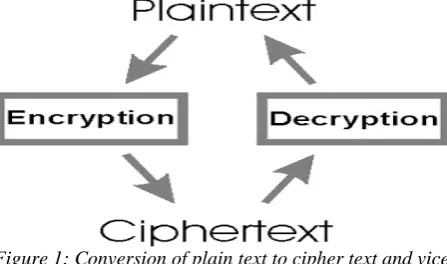
In cryptography, Encryption is the process of encoding messages or information in such a way that only authorized parties can read it. In an encryption scheme, the message or information, referred to as plain-text, is encrypted using an
encryption algorithm [11], turning it into an
unreadable cipher text [6].
Decryption: It is the process of decoding the data which has been encrypted into a secret format. An authorized user can only decrypt data because decryption requires a secret key or password. In simple terms it is the conversion of cipher text into plain text [6].
Figure 1: Conversion of plain text to cipher text and vice versa
network. We refer to these two protocols as the Probabilistic Keying Protocol and the Grid Keying Protocol. In the Probabilistic Keying Protocol [1], each sensor in the network stores a number of keys that are selected at random from a large set of keys. When two adjacent sensors need to exchange data messages, the two sensors identify which keys they have in common then use a combination of their common keys as a symmetric key to encrypt and decrypt their exchanged data messages. Since a particular sensor doesn’t have its own universal key and only has a set of shared keys it is prone to impersonation attack. In the Grid Keying Protocol, each sensor is allocated a unique number (called identifier) which is the coordinates of a distinct node in a two-dimensional space and each symmetric key is also assigned an identifier. Then a sensor x stores a symmetric key K if and only if the identifiers of x and K satisfy certain given relation. When two adjacent sensors need to communicate, the two sensors identify which keys they have in common then use a combination of those common keys as a symmetric key to encrypt and decrypt data messages. The grid keying protocol has two advantages). First, this protocol can defend against impersonation (unlike the probabilistic protocol) and can defend against eavesdropping (like the probabilistic protocol). Second, each sensor in this protocol needs to store only O(log n) symmetric keys, where n is the number of sensors in the network. But the main problem with grid keying protocol is it cannot defend itself from collusion attack.
In our proposed paper we show that there can be a system with a keying protocol which reduces the number of keys maintained within the sensor to (n+1)/2 keys. The additional and a very important feature that has been introduced is that of a Key Sender. Each and every Sensor Network has a Key Sender associated with it. Every sensor node needs to get registered within the Key Sender. The Key Sender then distributes the keys to the sensors within the network. With the help of the keys distributed by the Key Sender the sensors communicate with the other sensors.
We use ix and Iy to denote the identifiers of sensors ‘x’ and
‘y’, respectively, in this network. Each two sensors, say sensors ‘x’ and ‘y’, share a symmetric key denoted K(x, y) or
K(y, x). Only the two sensors ‘x’ and ‘y’ know their shared
key K(y, x) [7]. And if sensors ‘x’ and ‘y’ ever become
neighbors in the network, then they can use their shared symmetric key K(y, x) to perform two functions:
1) Mutual Authentication: Sensor ‘x’ authenticates sensor ‘y’, and sensor y authenticates sensor ‘x’.
2) Confidential Data Exchange: Encrypt and later decrypt all the exchanged data messages between ‘x’ and ‘y’. In the remainder of this section, we show that if the shared symmetric keys are designed to have a “special structure”, then each sensor needs to store only (n+1)/2 shared symmetric keys. But before we present the special structure of the shared keys, we need to introduce two new concepts: “Universal Keys” and “a circular relation, named below, over the sensor identifiers”. Each sensor ‘x’ in the network stores a symmetric key, called the universal key of sensor ‘x’. The universal key of sensor ‘x’, denoted ‘ux’, is known
only to sensor ‘x’. Let Ix and iy be two distinct sensor
identifiers. Identifier ix is said to be below identifier Iy if
exactly one of the following two conditions holds: 1) Ix < Iy and (Iy - Ix) < n/2
2) Ix > Iy and (Ix - Iy) > n/2
The below relation is better explained by an example. Consider the case where n / 3. In this case, the sensor identifiers are 0, 1, 2
We have:
• Identifier 0 is below identifiers 1 and 2. • Identifier 1 is below identifiers 2 and 0. • Identifier 2 is below identifiers 1 and 0.
2. METHODOLOGY
Theorem 1:If there exists a pair of distinct but adjacent sensors ‘x’ and ‘y’ with unique identifiers ‘Ix’ and ‘Iy’
respectively then the Below condition holds true as follows • ‘Ix’ is below ‘Iy’
• ‘Iy’ is below ‘Ix’
Theorem 2: Since there exists ‘n sensors, each sensor ‘x’ with identifier ix has (n-1)/2 sensor identifiers Iy below it.
Theorem 3: In accordance with Theorem 1,the number of sensors with identifiers ix below the sensor ‘y’ with identifier Iy is (n-1)/2.
Theorem 4: If a sensor identifier ix for sensor ‘Ix’ is below
a sensor identifier ‘Iy’ then the sensor ‘x’ needs to store the
Symmetric Key ‘ky, x’/ H (‘Ix’|uy) within it. Then the sensor
‘y’ needs to compute the Symmetric Key to verify the sensor ‘x’. The Symmetric Key ‘k(y, x)’ is stored only in ‘x’.
Theorem 5: As discussed earlier, each sensor ‘x’ needs to store single Universal Key and (n-1)/2 Symmetric Keys ‘k(y, x)’ in order to communicate with sensor ‘y’ (NOTE: the
sensor identifier ix should be below ‘Iy’).
3. AMUTUAL AUTHENTICATION PROTOCOL : Each and every sensor ‘x’ is provided with the following information before the sensors are deployed within the network :-
1) One distinct identifier ix in the range 0-(n-1) 2) One universal key ux
3) (n-1)/2 symmetric keys K(y, x) / H (‘Ix’|uy) each of which
is shared between sensor ‘x’ and another sensor ‘y’ (where ix is below Iy). If the sensors ‘x’ and ‘y’ are adjacent and
want to communicate with each other, then they must implement the Mutual Authentication protocol which has the following steps :-
Step 1: Sensor ‘x’ selects a random nonce nx and sends a
hello message that is received by sensor ‘y’. x ->y: hello(‘Ix’|nx)
Step 2: Sensor ‘y’ selects a random nonce ny and sends a
hello message that is received by sensor ‘x’. x ->y: hello (‘Iy’|ny)
Step 3: Sensor ‘x’ determines whether ix is below iy. Then it either fetches K(y, x) from its memory or
message to sensor ‘y’. x->y: verify (‘Ix’; ‘Iy’; H
(Ix | Iy |ny|K(y, x)))
Step 4: Sensor ‘y’ determines whether iy is below ix. Then it either fetches Ky,x from its memory or computes
it. Finally, sensor ‘y’ sends a verify message to sensor ‘x’. x->y: verify (Iy| Ix |H ((Iy| Ix |nx|Ky,x))
Step 5: Sensor ‘x’ computes H (Iy| Ix |nx|K(y, x)) and
compares it with the received H(Iy|Ix|nx|K(y, x)). If
they are equal, then sensor ‘x’ concludes that the sensor claiming to be sensor ‘y’ is indeed sensor ‘y’. Otherwise, no conclusion can be reached. Step 6: Sensor ‘y’ computes H(Ix | Iy |ny|K(y, x)) and
compares it with the received H(Ix | Iy |ny|K(y, x)). If
they are equal, then ‘y’ concludes that the sensor claiming to be sensor ‘x’ is indeed sensor ‘x’. Otherwise, no conclusion can be reached.
4. ADATA EXCHANGE PROTOCOL:
Sensors ‘x’ and ‘y’ can now start exchanging data according to the following data exchange protocol:-
Step 1: Sensor ‘x’ combines the nonce ny with the data to
be sent, encrypts the combined data using the symmetric key K(y, x), and sends the result in a data message to sensor
‘y’.
x ->y: data(Ix | Iy |K(y, x)(ny|text))
Step 2: Sensor ‘y’ combines the nonce nx with the data to
be sent, encrypts the combined data using the symmetric key Ky,x, and sends the result in a data message to sensor
‘x’.
x ->y: data(Iy | Ix |K(y, x)(nx|text))
5. OPTIMALITY OF KEYING PROTOCOL:
According to our keying protocol, described in Section III, each sensor in the network is required to store only (n+1)/2 keys. Thus, the total number of keys that need to be stored within the network is n(n+1)/2.
Theorem 6: There should be a minimum of n(n-1)/2 keys that are to be stored within the sensor network.
Theorem 7: According to any keying protocol (which is uniform) has to store at least (n-1)/2 keys within it to communicate with its adjacent sensors.
6. ADVANCED ENCRYPTION STANDARD ALGORITHM (AES):
The Advanced Encryption Standard (AES) is a
specification for the encryptionof electronic data established by the U.S.National Institute of Standards and Technology (NIST) in 2001[8]
AES is a block cipher, but it does not use a Feistel structure. The block size of AES is 128-bit, but the key size may differ as 128, 192, or 256 bits [9].
Substitution: This method substitutes each byte of the
block in the order of S-box. It provides an invertible transformation of blocks during encryption, with the reverse during decryption.
Shifting Rows: This operation performs left circular shifts
of rows 1, 2, and 3 by 1, 2 and 3,
Mix Columns: This method multiplies each column of the input block with a matrix. The multiplication operation is just like matrix multiplication, except that it uses a Finite Field to multiply two elements and performs an XOR operation instead of addition.
Add Rounded Keys: This operation just applies an XOR operation to each byte of the input block and the current weight (key) matrix.
Figure2: the Sub-Bytes step, one of four stages in a round of AES
7. DATA ANALYSIS
Key Sender: It detects the sensors present in its region and updates their details in its table. Here we used java simulation to create an interface to key-sender. Symbolically it may look like(before sensors detection and after detection)
Figure3:KeySender table before detection
ID is the unique number given to each sensor, IP address is the logical address and universal is the symmetric key used for encryption and decryption
Key Sender Table after sensor detection:
Figure4: Key-sender table after clients/sensors are detected
Figure5:Receiver0
Figure6:Receiver1
After the key sender sends the symmetric keys to both the receivers the clients now look like
Figure7:Reciever0 with keys updated
Figure8:Receiver1 with keys updated
After the keys are updated both the nodes need to authenticate each other for that they send verification messages and confirm the authentication. After authentication is done message transfer is done using encryption and decryption.
Message transfer done by Receiver0-original message is hello, it is encrypted and sent. The encrypted message from Receiver1 is decrypted
Figure9: Receiver0 sending and receiving messages
Figure10: Receiver1 sending and receiving messages
Whenever a receiver0 wants to communicate with receiver2 , it cannot communicate directly, first of all the receiver0 must communicate with receiver1 and then the receiver1 communicates that message with receiver2
Figure9:nodes communication
REFERENCES
1. Taehwan Choi, H. B. Acharya and Mohamed D. Gouda, “ The Best
Keying Protocol “, December 2011 IEEE 2. http://en.wikipedia.org/wiki/Sensor -Sensors
3. Sensor Networks by Margaret Rouse.
4. http://en.wikipedia.org/wiki/Mobilewirelesssensornetwork- MWSN’s
5. “Key Distribution Mechanisms for Wireless Sensor Networks” by
Seyit A., C¸Amtepe and Bulent Yener
6. “Cryptography and Network Security”, Fourth Edition by William
Stallings
7. L. Gong and D. J. Wheeler, “A matrix key-distribution scheme,”
Journal of Cryptology, vol. 2, pp. 51–59, January 1990. 8. “Advanced Encryption Standard” by Douglas Selent
9. http://en.wikipedia.org/wiki/Advanced_Encryption_Standard#cite_n ote-fips-197-4.
10. “Comparative Study of Energy Aware QoS for Proactive and
Reactive Routing Protocols for Mobile Ad-hoc Networks”. International Journal of Computer Applications (0975 – 8887) Volume 31– No.5, October 2011.
11. Steganography Detection using Functional Link Artificial Neural Networks, International Journal of Computer Applications (0975 - 888), Volume 47 No.5 June 2012.
12. Secure Group Communication using Multicast Key Distribution