VOLUME 4
January 1951
Number 1
In this Issue
Editorial-The Western Range and Changing Human
Economy... Walter P. Cottam
1
Summer Range management Course on Wheels for
County Agricultural Agents in Texas
Vernon A. Young
4
Control of Orange Sneezeweed with 2,4-D
Clyde W. Doran
11
New Grasses for Old Ranges... Jack R. Harlan
16
A Symposium on Rotation Grazing in North America
Arthur W. Sampson
19
Rotational Grazing Studies in Western Canada
William A. Hubbard
25
Rotation-Deferred Grazing as Compared to Season-Long
Grazing on Sagebrush-Bunchgrass Ranges in Oregon
Donald N. Hyder and W.A. Sawyer
30
A Twenty-Five Year Comparison of Continuous and
Rotational Grazing in the Northern Plains
George A. Rogler
35
Eight-year Comparisons of Continuous and Rotational
Grazingon the Southern Plains Experimental Range
E.H. McIlvain and D.A. Savage
42
Continuous and Rotation Grazing on Buffalo and Tobosa
Grassland.... ... C.E. Fisher and P.T. Marion
48
Studies in Rotation Grazing in the Southeast
H.H. Biswell
52
Book Reviews:
Monograph of the Genus Digitaria (Henrard)
Alan A. Beetle
56
Of Men and Mountains (Douglas)
Lincoln Ellison
56
Financing the Farm Business (Duggan and Battles)
H.R. Hochmuth
57
Water in the Physiology of Plants (Crafts et al.)
H.H. Biswell
58
Current Literature... ... ... Grant A. Harris
60
News and Notes . ... ... ... ... 66
With the Sections... ... ... ... 69
Society Business ... ... ... ... 75
Published Quarterly by
JOURNAL OF
RANGE
MANAGEMENT
EDITOR R. S. Campbell
Southern Forest Experiment Station 1008 Federal Office Building
New Orleans 12, Louisiana
EDITORIAL ROARD
TERMS EXPIRE 1950
F. W. Albertson Walter P. Cot<tam Department of Botany Botany Department Fort Hays Kansas State College University of Utah
Hays, Kansas Salt Lake City, Utah
TERMS EXPIRE 1951
B. W. Allred David F. Costello
U. S. Soil Conservation Service Rocky Mountain Forest and Range
P. 0. Box 1898 Experiment Station
Fort Worth 1, Texas Fort Collins, Colorado
TERMS EXPIRE 1952
Kenneth B. Platt
Bureau of Land Management Swan Island
Portland 18, Oregon
E. W. Tisdale School of Forestry University of Idaho Moscow, Idaho
The Journal of Range Management is published bimonthly by the American Society of Range Management at Mount Royal and Guilford Avenues, Balti- more 2, Mafyland. Subscription, $5.00 per year; for students $3.00. Single copies $1.50. Changes of address and communications on business matters should be addressed to the Treasurer, H. R. Hochmuth, Bureau of Agricultural Economics, Utah State Agricultural College, Logan, Utah; or to the Secretary, E. H. McIlvain, U. S. Southern Great Plains Field Station, Woodward, Okla- homa.
Advertising Agent, Bell Publications, 1447 Stout Street, Denver 2, Colorado.
Address communications on editorial matters to the Editor.
Entered as second-class matter ai the Post Office at Baltimore, Maryland.
ADVERTISE
in the
Journal
ofRANGE
MANAGEMENT
Agent:
BELL PUBLICATIONS
1447 stout St. Denver 2, Colo.
The
Ross
seed
Company
Wichita, Kansas
+k
Buyers and Sellers
of
Western
RANGE
Grasses
Since 1884
AMERICAN SOCIETY OF RANGE MANAGEMENT
Application for Membership
Name Title
Business Address
__~
Home Address
indicate to whichaddress Journal should be mailed
Employer or Business
Remarks _--
Calendar year dues are to apply
Date of Application Annual Dues $5.00; Students $3.00.
RANGE
MANAGEMENT
Editorial
The Western Range and Changing
Human Economv
I.
T IS an i&rrdible thought that one short rentwy ago t,he vast western terrain that romprises the major urea of Amwira’s Yang? lands was Indian coun- try scnrwly scratchrd hy the t,railri of mi- grating pionmrs. Today hundreds of pros- perous cities dot the tandsoap~, and pavrd highways, railroatls and airlines have oh- litrrabd every vestigr of those geogrsphir fmntiws known to our fathers. There re- mflnx no srgment of 0111‘ lnnd to h? PS- plowd or wnquered, and few sieahle acr~agrs have escaped the exploitation of their mineral and agricultural resources. For us and for generations of Americans yrt unborn, the front&s of mv wealth must forever lie in the more efficient and prudent use of the natural rc~ources already known.That the range resource was a major factor in t,he prosperous settlement of the \Vcst, History gives ample evidence. That the grazing industry must continue to serve a major role in our future cconomg, few would deny. The great, question of the moment is “can this hc done and horn?” “Tis one and the same Satwe that rolls on her cowse,” and whoever ventures to anticipate t,hr future in range manage- ment must orcasionally retrace the past and consider well the present, in rnngr conditions and trends.
The history of the Western Range over
2 EDITORIAL
ated a boom in the grazing industry that was as spectacular in magnitude as it was short in duration.
The second period (1900-1950), a logi- cal sequel to the first, began with a crash in the grazing economy that was wide- spread in extent, tragic in its consequences and shameful in its basic underlying causes. An attempt to assess blame would entail great injustices, for society as a whole was guilty. Young America liber- ated from Old World austerity was drunk with the idea of New World abundance. The science of ecology was in its infancy, and there were no yardsticks by which it was possible to measure or predict the consequences of overstocking. Worst of all, there were no sympathet)ic ears to list!en even if all this had been known, for the settlers of the semiarid West were but newly transplanted from the humid cul- tures of New England and western Europe, where space was the chief limit- ing factor to copious agricultural produc- tion. A series of misguided land acts by Congress during the period of grazing expansion provided little incentive or possibility for livestock operators to acquire ownership of the lands they grazed; yet there was total lack of a national policy to provide Federal man- agement) of these pioneer grazing areas. All these factors were as certainly bound to incite war for forage as they proved to irrvite speedy disaster.
The past half century, so far as the grazing industry is concerned, has been a period of adjustment, investigation, and attempted rehabilitation of the range. We have learned much. The basic causes and effects of range deterioration have been experimentally verified, and . the necessary practices leading to range re- covery have been demonstrated. Today hundreds of competent scientists in the various services of the Federal Govern- ment and in private and state institutions
are contributing valuable information to the many facets of the complex problems of land management. A partial list of these includes research in range manage- ment, range animal husbandry, forage utilization, range wild life and forest entomology; in range botany and range plant physiology; in natural revegetation and artificial reseeding; in watersheds, range economics, range weather and range soils.
This list of diversified research activi- ties serves well to emphasize the fact that most of the problems confronting range management reach far beyond the limits of any one discipline of the natural and social sciences and point to the present and future needs for cooperative group investigations.
The practical results of our research programs over the past five decades would be more heartening if range recov- ery were at all commensurate with t,he scientific information at hand. But the fact remains that we know much more about what needs to be done in range management than we know how to ac- complish it,.
Among the several causes for this di- lemma should be mentioned the practical difficulties of reducing stock numbers to range capacity, the recent phenomenal increase of big game over much of the mountain ranges, the tenacity with which many stockmen attribute reduction of forage to acts of God rather than to their own transgressions, and the reluctance of the public in general to realize their re- lationship to the land or to accept the practical values of range investigations.
EbITORIAL 3
range research, urbanites as well as rural folk must come to realize that as papula- t,ions increase and the complexities of civilization expand, the multiple use as- pect of our wild lands assumes greater public importance and raises issues that strike at the root of personal and social liberties. The public must become acutely aware of the fact that no community can expand or survive without an adequate water supply and that well regulated streams or underground wat,er sources are dependent on a properly managed soil mantle. The common man must realize t,hat in order to protect) watershed areas and at the same time to maintain grazing populations, the revegetation of poten- tially productive aseas elsewhere is an urgent necessity. Great)er recreational use of restricted lands is a recognized human need. And superimposed on all these problems is the issue of private vs. public control and ownership of the Pub- lic Domain.
There are some of us who, perhaps, honestly contend that the business of the scientist is to search for truth and not necessarily to publicly proclaim it. But surely if men who created the atom bomb consider it their moral duty to warn soci- ety against its use, can the ecologist or range manager logically shun his responsi- bility in warning society against the evil exploitation of the soil resource? There is in my opinion no more justification for a “public be damned” attitude for those of us who could well dedicate our efforts to conserve a resource, than there is for those who would selfishly despoil it. In the field of public education we should find opportunities to attain more quickly the goal of our research and certainly to attain new horizons in the service of mankind.
Walter P. Cottam, Department of Bot- any, University of IJtah,
Salt Lake City, Utah
GRAZING INTENSITY AFFECTS RUN-OFF
Knowledge of the effect of grazing intensity upon run-off and soil erosion is of vital importance in grazing management, especially on mountain watersheds. E. G. Dunford, at the Rocky Mountain Forest atid Range Experiment Station, has recently reported results from studies on this problem in Colorado. The studies were made on Arizona fescue-mountain muhly range with a 17 percent slope at the Manitou Experimental Forest. Cattle were allowed to remove an average of 57 and 33 percent of the herbage on duplicated plots (0.01 acre in size) for heavy and moderate grazing, In addition, t’wo plots were completely protected.
Summer Range Management Course on Wheels for
County Agricultural
Agents in Texas
VERSOS A. YOUNG
Head, Dept. of Range and Forestry, A. & M. College of Texas, College Station, Texas
T
HE fourth annual summer range management course for Texas county agricultural agents closed on July 10, 1950. The class of 29 students t’old the instructors their college course was one of the best they had ever taken. They had just finished a course which required of them many hours of study, preparation of field notes, herbarium development, 1600 miles of travel, and the inspection of 22 ranches over a period of approxi- mately three weeks.Why did this field course, like the three previous ones, appeal to these ex- perienced men although several of the group had taken no class work for a num- ber of years?
The answer may in part be found in the following: First, the county agents had a real look at range problems both from the distance and close-up. They were convinced that something concrete must be done to save one of the largest and most important crops of Texas, namely the native grasses and forbs. Second, they recognized that text book information and field application can be correlated. Third, that the principles and practices of range management taught could in a large measure apply to most of the counties of the state although these are highly diversified in climate and native forage. Fourth, the agents also realized they did not have the answers for the many questions that ranchmen asked . them concerning range management.
Fifth, these men discovered that it was real fun to study and learn in an atmos- phere of challenge. The challenge came
not only from the members of the class but each challenged himself to increase his efficiency and knowledge from day to day.
The latter point was of considerable interest to the instructors because a number of the members of each course were in their forties and a few in their early fifties. This proved that age is no barrier to technical learning.
At the request of Vice-Director J. D. Prewit of the Extension Service, arrange- ments to teach the summer field range course were made with the Agricultural and Mechanical College of Texas, College Station, Texas during the spring semester of 1947. The Extension Service appointed a committee composed of district agri- cultural agents to work out with mem- bers of the Range and Forestry staff the overall program for the field course. As a result, the district agents were held re- sponsible for transportation, registration and camp facilities, while the instruction was made the responsibility of the Department of Range and Forestry.
Dr. 0. E. Sperry and the writer pre- pared a syllabus of the course. It was approved by the College Administration and the first range management course for county agricultural agents began on June 22, 1947 at Agricultural Substation No. 14 near Sonora, Texas. This Substa- tion is located in the approximate center of the Edwards Plateau region.
Twenty-six agents representing coun- ties rather widely distributed over the State reported for class. During the first meeting, the county agents, under
SUMMER RANGE COURSE IN TEXAS 5
the supervision of a district agent, or- ganized their camp program. The problem of food was solved by employing a cow- boy cook and hiring a truck equipped for outdoor cooking. Each man brought his cot and bedroll and slept in the open.
The lecture room (for six days) was a machine shed. A semi-portable black- board, a small teacher’s table, three long rough board tables and board benches for seats comprised the class room fur- nishings.
The topics included in the course were with certain exceptions those that would apply to any group of agriculturally t)rained men without a technical back- ground in range management. The lec- tures included both fundamental and applied knowledge relative to range management. The principal topics treated were *
1.
2.
3.
4.
5.
6.
7.
8. 9.
The identification and classification of the important range plants of Texas.
Range types in relation to the cli- mate, topography and soil of the State.
Proper utilization of forage plants in relation to regional composition. Proper forage utilization as a guide
to stocking rates on the basis of “key” species and “key” areas. Management of ranges in relation to kinds of livestock, proper dis- tribution, proper season of use, and indicators of both range abuse and range recovery.
Poisonous plants, their distribution and methods of control.
Control or eradication of noxious species of brush and the introduc- tion of proper grazing practices’ on brush lands.
Range reseeding.
Pastures and their management as forage supplement for ranges.
10. Technical problems in relation to range management.
11. Range condition classes. 12. Range developments.
13. Applied range economics.
The periods &nd sequence of inst’ruction at the Sonora Substation included from one to four hours of formal lecture daily, with field exercises on nearby ranches taking up the remainder of the day. The field exercises not only parallelled the lecture material but actually introduced new subject material for later lectures. This was made possible by the different methods of management found in t,he region where stocking combinations of cattle, sheep and goats are a common practice.
Forage plants were studied in relation to their environment as well as a means of determining their identification and classification. The county agents were taught how to prepare a field herbarium and how to mount and preserve plant specimens for educational purposes. Sev- eral of the agents later prepared a grass exhibit for display use in their offices. These were used to familiarize ranchmen with the species common to their ranges. They also added interest to the 4-H grass judging contests that have proved so popular over much of the State.
G VERNON
grasses and forbs through the “common use” grazing of cattle, sheep and goats over a fifty year period.
Chemical and mechanical methods of controlling live and shinnery oaks, juniper (cedar) and other woody species were observed. It became apparent that the brush problem on native ranges was one that would require the best) talents of all concerned. In addition, several of the major problems associated with range abuse throughout the State, were avail- able for st,udy within a radius of 60 miles of the Substation.
This crowded week of lectures and field exercises gave the students the back- ground essential to move on to other areas in order to study range management practices under different environments.
July 2nd, 1947, the class left the Sonora Substation in private cars accompanied by the cook, a chuck wagon, a blackboard, and the instructors. The first major study was made at the Clark Hereford Ranch near San Angelo. Here were observed outstanding results obtained by fitting tobosa grass into a rotation system of grazing with other grasses.
The class next moved westward to the vicinity of Fort Stockton. The general region was experiencing a three-year period of drought. Here irrigated pas- tures and alfalfa fields were studied not only as to management but as a source of supplemental forage and hay for the ranges during drought periods. A study of the Puckett Rancli, ,, in this general locality, revealed the imp6rtance of proper rates of stocking to maintain a profitable unit during a prolonged drought period.
A hurried trip was made through the 290 section E-L Ranch near Fort Stock- ton. In a small native pasture located in z corner of this great ranch, the highly palat,able bush-muhly grass once fairly abundani ; but now almost extinct over
. YOUNG
western and sout,hwestern Texas, was seen making a satisfactory comeback under proper grazing practices.
Sixty miles to t)he west, in the Davis mountains, the class visit,ed the little college city of Alpine. The vegetation in this vicinity revealed for the first time on the tour zonal differences associated with altitude. Here different kinds of range management) were associated with the zonation-something unusual for
Texas. In t)his area and on the famous Kokernot Ranch, a dual management program of cattle, deer and antelope furnished valuable information on the role that native pastures play in balanced land use for the hunter and livestock producer.
Moving deeper into southwest,ern Texas, the class stopped at the Mitchell Ranch located near Marfa and in an area that is noted for Highland Hereford cattle. Here a practical engineering method of water distribution was stud- ied. Seven windmills, within an area of less than five acres, are used to lift water from a canyon from where it is distributed to various points in this 17,000 acre ranch. Range economics was strongly stressed in this particular region. During the three-day stop at Marfa, first hand information was ob- tained relative to the effect of the drought and overutilization gn the ranges of that) area. The determination of sange condi- tion claiges was quite stimulating to the class. The value of leaving sufficient plant stubble and residue on the range lands to protect the soil from the forces of erosion was: evident from comparisons made in the region. In addition, these studies left ‘a deep impression with the county agents as to the close correlation of the physiological and ecological rela- tionships of the plants to their environ- ment.
ous plants in this general region was also a major consideration. Such poisonous plants as rayless goldenrod, woolly and Riddell senecio, woolly and narrow leaf locos, garboncilla, peavine, and others were causing considerable livestock losses on several ranches. Again an opportunity was presented for the class to correlate range abuse and the kind of vegetation
with the practices used in areas studied elsewhere. They questioned each other as to the soundness of given management practices. Whenever the instructors felt it was desirable to st,op for a lecture or to outline on the blackboard certain phases of the instruction, they did so. Lectures were held in such places as open native pastures (Fig. l), under trees, or on the
,, ./ ,.... I( _,_, ~,._..
that might increase or invade its a result. A hurried inspection of the poisonous plants laboratory brought to light the need for technical assistance and funds to combat the poisonous plant problem in Texas.
During the period of travel the county agents became more conscious of the importance of the overall range program and likewise became more inquisitive each day. They obtained valuable in- formation first hand from livestock opera- tors. Qualified personnel from the Soil Conservation Service and Extension Serv- ice willingly gave their experiences on the methods and programs necessary to make range conservation work.
The agents made comparisons of the several range management practices ob- served in a given area and attempted to show whether the results mere correlated
shady side of barns and once in a high school lecture room.
At the close of each lecture or discus- sion the instructor would leave a chal- lenge that called for additional thinking on the part of the class. There was never an idle moment on the part of the student if he wished to follow all leads.
One might logically ask what t,he course accomplished that could be passed on by the county agents in their respective counties to promote better range manage- ment and stimulate rural people to be- come more range conservation minded. These are a fev that stand out:
1.
2.
3.
4.
The introduction of a range manage- ment program for specific localities in a county t,hat would assist ranch- men in initint,ing range conservation practices needed to obtain a sus- tained forage yield.
Range and pasture field day demon- strations have been organized and guest speakers invited to attend. Ranohmen have been visited and encouraged to set up reduced stock- ing rates on over-utilized ranges. Forage displays of outstanding na- tive range plants have been placed in a strategic place in the county court house or in the office of the county agricultural agent.
have preached t,he gospel of range consrrvntion to their neighboring county agents and advised them to attend the next summer range management co”rsA.
contests are also becoming popular at field day programs.
The county agents who completed the course the third year were equally a6
enthwiastic as the former two groups
and were determined not only to carry
on what had been introduced in the
past, but to introduce additional phases of range management and conservation. Two members of this class soon after
retrrning to their respective counties
counties and vocational agriculture
Classes.
The summary of t,hn major contribu- tions in range management obtained in the Extension Service in 1949 is included in a paper published hy Extension Serv. ice Range Specialist A. H. Walker, en- titled “Extension Range Work in Texas”
(Journal of Range Management 3: I%.- 189, 1950; Table 1). Sixteen major ax- tivities are reported and each was xell
successfully conducted range manage-
ment courses for ranehme” and others
interested in land conservation. Two
other members began range manage- ment field contests among their 4-H clubs which will no doubt be greatly expanded in the future.
The members of the fourth class which comprised 23 county agents and 6 voca- tional agricultural teachers although less than a month out of the field range school are at this time reporting the or- ganisat,ion of range programs for their
supported hy 18 to 159 counties. How ever, all t,hr activities listed and reported should not be attributed entirely to the influence of the sunmwr range manage- ment field courses. The energetic action by those who did attend started the
general program rolling, however. Ar.
Walker who was appointed range n-orker September, 1947 was especially active in
promoting the range program and his
services were made available to any
agent desiring assistance.
10 VERNON
writer in the field of range management now definitely indicate that ranchmen, farmers, business men and others are profoundly interested in the welfare of our native range lands. Much has been accomplished in range management re- search, but the results, published prin- cipally in technical bulletins, have been slow in arousing the ranchmen and far- mers to action.
It is now too late to depend largely-on literature to stimulate an interest in proper range management practices. Therefore, real action is necessary whereby the information must be brought to the landowner by representatives of the various agencies interested in range
A. YOUNG
conservation by means of personal visits, organized meetings, field demonstrations and club work for boys (Fig. 3).
There should be at least one Extension Range Specialist in each of the 17 West- ern range states to assist the county agricultural agents with their range man- agement programs. These specialists would help to keep the landowners in touch with results being obtained in range research. Not until every county agent, every Vocational Agricultural teacher, and every conservationist is ? spreading the gospel of proper range management practices 1 will our native range lands be safe from exploitation.
n
PLANT GRASS AND SAVE SOIL
We must conserve our remaining natural resources. This applies particularly to our topsoil. It is not too late to save, and even improve, our soil. We can prevent the runoff of eroding rain water by adopting such practices as contour and strip farming and by putting greater emphasis on grass crops. Fortunately, increased demands for livestock products require more grass culture.
Only a small fraction of our farmers are as yet using the scientific knowledge now available. If that knowledge were universally applied, our food supply could be raised 50 percent.
Dr. Harold G. Moulton, in The American Magazine
Control of Orange Sneezeweed with 2,4-D
CLYDE W. DORAN
R.
ECEKT tests by the Rocky Moun- by offshoots developed fuxn adventitious tam Forest and Range Experiment buds on the taproots. Following over- Station in western Colorado show that grazing, sneezewend spreads rapidly, and orang? sneeaenwd (Helenium hoopesii) bwxnes n constant source of tlimger to may be killed with 2,4-D at lower costs range sherp. When sheep cat sneezerneed than by grubbing or by the application in quantity, they develop “speving siek- of soil sterilants such as borax or sodium ness” (Xllarsh, IO@), causing severechlorate. death losses and reduced lamb and wool
Sneezeweed (Fig. 1) is poisonous to sheep and unpalatable to cattle. Light to heavy infestations occupy more than two million acres of summer rangeland in the central Rocky Mountains. The plant reproduces prolifically by seed and
‘Maintained by the U. S. Department of Agriculture, Forest Service, in eooperatior. with Colorado A Q M College, Fort Collins, Colorsdo.
include: (1) use of one-night bedgrounds and their location in uninfested areas,
(2) light use of the range and uvoidancr of the most dense stands of this poisonous weed, (3) non-UBC of infested ranges in early spring or in late fall when desirable forage plants begin to dry, (4) “pen quiet herding, (5) uniform we of the range with 11s little trailing and “twice over” herding as possible, (6) never salting on bedgrounds until just before dark so sheep do not concentrate and
but costs vary from $15 to $30 per acre. Such costs are generally prohibitive on lowvalue rangelands and followup trcat- men& are often required for complete control.
Good kills of sneezeweed have now been made with only one application of 2,4-D at a cost of approximately $8 per acre (Fig. 2). The development of cheaper or m”re effective herbicides and better methods of application may decrease costs in the future.
graze I\-ith little chance of plant selection, and (7) careful culling of the flock at marketing time to dispose of all poisoned animals.
Although careful management of the flock will reduce poison losses, sneezeweed remains a problem on both sheep and cattle ranges because it produces little or no forage and occupies productive land that, could and should be producing grass.
Many different methods of eradicating sneezeweed have been tried (Doran k Cassady, 1944). Grubbing and application of soil sterilants such as borax and sodium chlorate have proved effective,
CONTROL OF ORANGE SNEEZEWEED 13
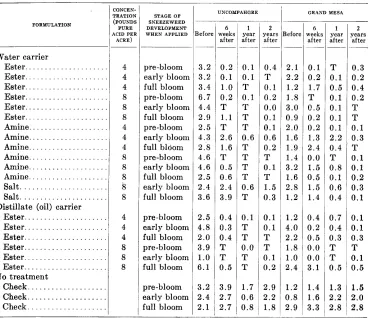
caused the weed to wilt and discolor, but Table 1 indicates the average density of the old roots produced new offshoots sneezeweed before treatment, and six that quickly replaced the original stand.
1 In 1947 additional small plots were
weeks, one year, and two years following treatments. These tests were made only treated at three different dates during on the Uncompahgre and Grand Mesa the” midsummer period, conforming to Forests.
different stages of sneezeweed develop- All the 2,4-D formulations tested pro-
TABLE 1
Average percent density of sneezeweed before and after spraying with 2,4-D
FOBhf.UI.4TION
Water carrier Ester ... Ester ... Ester ... Ester ... Ester ... Ester ... Amine. ...
Amine. ...
Amine. ...
Amine. ...
Amine. ...
Amine. ...
Salt. ...
Salt. ...
Distillate (oil) carrier Ester ... Ester ... Ester. ...
Ester ... Ester ... Ester ... No treatment
Check. ...
Check ... Check ...
T = trace.
-
CONCEN- TRATION (POUNDS PURE ACID PE6
ACRE)
4 pre-bloom 3.2
4 early bloom 3.2
4 full bloom 3.4
8 pre-bloom 6.7
8 early bloom 4.4
8 full bloom 2.9
4 pre-bloom 2.5
4 early bloom 4.3
4 full bldom 2.8
8 pre-bloom 4.6
8 early bloom 4.6
8 full bloom 2.5
s early bloom 2.4
8 full bloom 3.6
4 pre-bloom 2.5
4 early bloom 4.8
4 full bloom 2.0
8 pre-bloom 3.9
8 early bloom 1.0
8 full bloom 6.1
-
STAGE OF SNEEZEWEED DEVELOPMENT WHEN APPLIED leforf
pre-bloom 3.2
early bloom 2.4
full bloom 2.1
ment : (1) pre-bloom (2) early bloom, duced good sneezeweed kills when ap- (3) full bloom. These stages occurred plied during this midsummer period, about two weeks apart. Three differ.ent from the pre-bloom to full-bloom stage commercial 2,4-D formulations (ester, of sneezeweed development. The esters amine, and salt) were tested in water appeared to give the most consistently solutions or carriers, and in addition the good kills throughout the different periods ester formulation was applied in a distil- of application, while the amines and salts late or fuel oil carrier instead of water. appeared to be slightly more effective
UNCOMPAHGRE GRAND MESA
_ 6 week! after 1 year after 2 years after Ieforr
6 weeks after 1 year after
0.2 0.1 0.4 2.1 0.1 T
0.1 0.1 T 2.2 0.2 0.1
1.0 T 0.1 1.2 1.7 0.5
0.2 0.1 0.2 1.8 T 0.1
T T 0.0 3.0 0.5 0.1
1.1 T 0.1 0.9 0.2 0.1
T T 0.1 2.0 0.2 0.1
2.6 0.6 0.6 1.6 1.3 2.2
1.6 T 0.2 1.9 2.4 0.4
T T T 1.4 0.0 T
0.5 T 0.1 3.2 1.5 0.8
0.6 T T 1.6 0.5 0.1
2.4 0.6 1.5 2.8 1.5 0.6
3.9 T 0.3 1.2 1.4 0.4
0.4 0.1 0.1 1.2 0.4 0.7
0.3 T 0.1 4.0 0.2 0.4
0.4 T T 2.2 0.5 0.3
T 0.0 T 1.8 0.0 T
T T 0.1 1.0 0.0 T
0.5 T 0.2 2.4 3.1 0.5
3.9 1.7 2.9 1.2 1.4 1.3
2.7 0.6 2.2 0.8 1.6 2.2
2.7 0.8 1.8 2.9 3.3 2.8
-
2 vears ’
14 CLYDE W. DORAN
when applied during the pre-bloom stage. A water carrier was just as effective as a distillate or oil carrier.
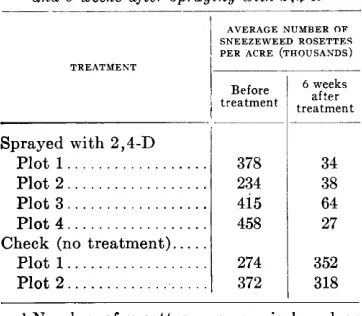
Later tests on a larger scale have shown that the jeep ground-spraying equipment (Fig. 2) may be effectively used for spray- ing sneezeweed?infested ranges. Good plant coverage can be obtained using 50 gallons of water per acre as the 2,4-D carrier. In experimental tests the jeep, equipped with 20-foot booms and ap- propriate nozzles, traveled about 4 miles per hour and required 15 minutes to spray an acre. Table 2 shows the number
TABLE 2
Number of sneezeweed rosettes per acre before and 6 weeks after spraying ,with .2.4-D
AVERAGE NUMBER OF SNEEZEWEED ROSETTES I PER ACRE (THOUSANDS) TREATMEKT
I
Before treatmentSprayed with 2,4-D
Plot 1.. . . . . . 378
Plot 2.. . . 234
Plot 3.. . . . . . . 4i5
Plot 4.. . . . . . . 458
Check (no treatment). . . Plot l... 274
Plot 2.. . . . 372
1 Number of rosettes per acre is
I
_
6 weeks after treatment
34 38 64 27
352 318
based on counts of 20 random sample plots within each treated plot. Sample plots were l/20,000 acre in size. One sneezeweed plant may consist of 1 to 20 rosettes.
of sneezeweed rosettes before and after spraying four +-acre plots on the Un- compahgre Plateau with the jeep ground- spraying equipment. These plots were sprayed in early July during the pre- bloom stage of sneezeweed development. 2,4-D was applied at the rate of 4 pounds pure acid per acre in an ester formulation with a water carrier.
Spraying should be confined to the period just before the sneezeweed plants
begin to bloom, when flower buds are formed and the plants are growing rapidly. At a 9,000-foot elevation in western Colorado, this period usually occurs in early July. 2,4-D should be applied on calm, warm, sunny days. If rain falls within a few hours after spray- ing, it is liable to wash away the 2,4-D before it is fully effective.
Killing sneezeweed with 2,4-D has some disadvantages and may create new problems. For example, most of the broadleaf plants that grow with sneeze- weed are also susceptible to 2,4-D. Commonly occurring species that are killed or severely damaged by 4 pounds of pure acid per acre are as follows:
Western yarrow Achilles lanulosa Dandelion agoseris Agoseris taraxacifolia Painted cup . Castilleja spp. Hairy goldaster Chrysopsis villosa Menzies larkspur Delphinium menzeisi Trailing fleabane Erigeron flagellaris
Aspen fleabane Erigeron macranthus
Richardson geranium Geranium richardsoni
Aspen peavine Lathyrus leucanthus
Mountain bluebell Mertensia ciliata Shrubby cinquefoil Potentilla fruticosa Cinquefoils Potentilla filipes, P. an-
serina, P. glauco- phylla
Buttercup Ranunculus spp.
Niggerhead Rudbeckia occidentalis
Groundsel Senecio spp.
Decumbent goldenrod Solidago decumbens Common dandelion Taraxacum officinale Edible valerian Valeriana edulis
American vetch Vicia americana
When these plants are killed the forage crop is reduced and the soil may erode more rapidly.
CONTROL OF ORANGE SNEEZEWEED 15
In spite of obvious disadvantages, 2,4-D sprays offer a promising method of controlling sneezeweed. Because of the aggressive nature of the weed, per- manent control cannot be expected from a single application of 2,4-D. A good cover of perennial vegetation that will keep sneezeweed from re-invading must be established and maintained.
Studies have been initiated to deter- mine how such a vegetation cover can be obtained and maintained most ef- fectively and economically. Getting rid ,of sneezeweed is a difficult goal to attain; yet the benefits in increased forage pro- duction and reduced poison losses make the effort woyth while.
SUMMARY
Tests made by the Rocky Mountain Forest and Range Experiment Station in western Colorado show that sneezeweed can be killed with 2,4-D sprays. Sneeze- weed is poisonous to sheep and unpalat- able to cattle. When abundant, this noxious weed is a problem’ on summer ranges in the central Rocky Mountains.
A low-pressure weed sprayer with 20- foot booms mounted on a jeep, proved satisfactory for applying 2,4-D in moun- tain parks. Ninety percent kills were <obtained at costs of approximately $8 per acre.
To be effective in controlling sneeze- .weed 2,4-D should be applied :
1. At the rate of 4 pounds pure acid per acre.
2. On calm sunny days, with no rain for several hours following applica- tion.
3. At the pre-bloom stage of sneeze- weed development, when flower buds are formed and the plants are grow- ing rapidly.
4. With a sufficient amount of carrier, water or distillate, to give good plant coverage.
2,4-D does not damage native grasses, but does kill most broadleaved plants commonly associated with sneezeweed. Sneezeweed rapidly re-invades treated areas, and control should be attempted only when provisions are made to restore a good cover of grass in a short time.
The author wishes to acknowledge the cooperation of Bruce J. Thornton, Seed Laboratory, Colorado Agriculture Experi- ment Station, Fort Collins, Colorado.
LITERATURE CITED
DORAN, C. W., AND J. T. CASSADY. 1944.
Management of sheep on range infested
with orange sneezeweed. U. S. Dept. Agr. Circular 691.
MARSH, C. D. 1924. Stock poisoning plants
of the range. U. S. Dept. Agr. Bulletin 1245.
UNITED STATES FOREST SERVICE. 1937.
. Range Plant Handbook. U. S. Dept. Agr.
New Grasses for Old Ranges
J.lCI< R. HARLAN
Geneticist, Bureau of Plant Industry, U. S. Southern Great Plains Station, Woodward, Oklahoma
T
HE organization of the American Society of Range Management is but one expression of the concern ex- perienced by those interested in our national agricultural resources for the present condition of our grasslands. The millions of acres of abandoned farmland throughout the West added to the still more mil,lions of acres of brush infested and badly depleted range land attest to an immense deterioration of our range resources. The problems presented are of staggering magnitude and can be solved only through diligent cooperation of all people interested in range management. One of the keys to the whole situation is the discovery, selection, or production of grasses suitable for range reseeding. Lack of research on the problem and little understanding of the fundamentals in- volved have led us to many blind alleys and misconceptions. Range management specialists are not yet generally aware of the great differences which may be found between varieties of a species of grass. Many instances of unsatisfactory at- tempts at reseeding can be ascribed to a failure to recognize varietal differences in both introduced and native grasses.There is no question that some species of grasses are better suited to reseeding our rangelands than others. A few seem to be especially suited to broadcast seed- ing which means they can be used in airplane seedings on a large scale. The splendid results so far obtained from King Ranch bluestem (a strain of Andro- pogon ischaemum) in parts of Texas and
the similar performance of Caucasian bluestem (A. &termed&s caucasicus) in Kansas and other states indicate that we may have found grasses suitable for our southern ranges which can be used as readily as crested wheatgrass in the northern ranges.
King Ranch bluestem was introduced to this country by accideqt and was not discovered nor exploited for many years after its chance establishment in southern Texas. If such grasses can be found acci- dentally, “what could we do on purpose?” It would be coincidence indeed if this strain should be the very best of all the great number of forms and types of the Eurasian complex to which it belongs. It seems absurd to suppose that of all the thousands of strains in this complex we have already come upon the types best suited to our purposes. If we are not so lucky, then strains and varieties of even greater value await us somewhere on t,he continent of Asia.
SYSTEMATIC FORAGE INTROWTCTTON NEEDED
Introductions, particularly of forage plants, have been brought to this country in a haphazard, unsystematic way. Most of the introductions consist of one small packet of seed which cannot even repre- sent the local variation of the species. This would be equivalent to sending a small packet of side-oats grama seed to Australia to represent that species. Side- oats grama is native from Maine to Southern California and the number of
NEW GRASSES FOR OLD RANGES
17
variant forms is legion. The difference in adaptation between strains of side- oats grama greatly exceeds the difference in adaptation between many species of lesser distribution. Thus a single packet introduction-or even a dozen packets- is a pitifully inadequate sampling of a species. The Eurasian bluestems are native from Hungary to China. The handful1 of accessions so far grown in this country cannot represent a reasonable sampling of the material.
Other introductions of value have reached us in the same way. Weeping lovegrass (Bragrostis curvuZa) has at least a limited place in some portions of the southern plains. The standard strain now being used is low in palatability and re- turns low gains per head. This does not mean that other and superior strains might not be found were we to search for them. A number of strains of the species have been tested, most of which are not nearly so resistant to cold as the standard strain and have winterkilled at Wood- ward, Oklahoma. Two other species of lovegrass have shown much promise in the Southwest. Lehmann’s lovegrass (E.
Zehmannianu) and Boer lovegrass (E.
chloromuelus) are both very cold sensitive. Many accessions have winterkilled regu- larly at Woodward, yet a lot was received in 1948 which overwintered under severe conditions without injury. Of several ac- cessions of Andropogon &termed&s tested, only the var. cuucusicus type has proved winterhardy.
Among these occasional and chance introductions we have found, and may find in the future, material of immense value. But such introductions are a poor substitute indeed for a thorough and systematic survey of the world’s grass resources. As the writer can testify from personal experience, an adequate sam- pling of the genetic material of a geo-
graphic region is not easily obtained.
A
systematic collection program for forage plants over the world would need to be well organized and adequately financed. The results would certainly justify the effort.
SUPERIOR NATIVE STRAINS Many of our native species offer the same challenge and opportunity. The difference between strains is sometimes extraordinary. This seems particularly true of the warm season grasses. The striking differences in behavior and per- formance between northern and southern sources of native species have long been recognized by range management spe- cialists. More recent, detailed inquiry into the problem has shown that dif- ferences nearly as great may be found between varieties from similar latitudes. One example of special interest here can be cited of the behavior of a complex of blue-grama strains in the Capitan moun- tains of New Mexico. Here we find types indicating mediocre performance inter- mingled with types showing excellent vigor and marked superiority. Collections made only one half mile apart show striking differences although the blue grama stand is nearly pure and con- tinuous between the sources. A similar behavior is ’ demonstrable in side-oats grama and further study will no doubt reveal an analogous situation in other native grass species.
It is evident, therefore, that even to obtain an adequate sampling of some of our own native species we must go through some areas with a fine toothed comb. How much more difficult it would be to obtain a good sampling of foreign species about which we know even less!
18 JACK R. HARLAN
ferences. How can we determine which species is the best for our conditions? The comparison of two species by ac- cepted research techniques becomes a virtual impossibility. We can compare one strain of one species with one strain of another species. We may compare the best known strain of one species with the best known strain of another, but we have not the physical resources to compare one species with another. The diference in
performance between strains of one species is in many cases a jar greater variable than the diference between species.
Grass breeding, although much neg- lected in our national forage crop picture can play a vital and important role in our range reseeding problems. Byfthe discovery or production of new and su- perior strains, the grass breeding pro- gram is a key to the utilization of a number of species in range reseeding.
DOES THE HORSE HAVE AN I. Q.?
A Symposium on Rotation Grazing in
North America
ARTHUR W. SAMPSON
Professor of Forestry, University of California, Berkeley, California
R
OTATION grazing composed one of the panel periods at the third an- nual meeting of the Range Society held in San Antonio, Texas, in January, 1950.Several papers on the subject were read and lively discussions followed.
It soon became apparent that much diversity of opinion exists among both research workers and operators regarding the merits of rotation grazing. Some of these differences seem to stem back to confusion in terminology, as between rotation and deferred grazing; others to the more broadly accepted objectives of these grazing systems, still others to a combination of the two.
The importance of this subject prompted Editor Dr. R. S. ,Campbell to request the authors to prepare their papers for publication in the Journal, preferably in a single issue. He also pro- posed that the writer edit the series, prepare a brief review on the subject of rotation grazing, list the most pertinent references, and perhaps draw some con- clusions on the merits and application of rotation grazing. All agreed to carry out these proposals.
HIGHLIGHTS ON ROTATION GRAZING
Rotation Grazing Defined
Rotation grazing consists in shifting the livestock systematically at desirable intervals to different subunits of a range area or fenced subdivisions, and back to the first subdivision, without speci$c pro- vision for seed production.
The objectives are essentially: 1) to avoid grazing the same subunit first in
the spring of each year; 2) to maintain the plant cover over the entire range area in a high state of vigor with little or no decrease in animal production.
Strictly speaking, any prescribed de- layed date for placing the animals on a range subunit may be regarded as de- ferred grazing; to avoid confusion the term as commonly used in this country, is restricted to imply deferment of cropping until after seed maturity. The acreage reserved must be large enough to carry all the animals from the ripening of the seed crop of the primary forage species to the end of the normal grazing season.
“Deferred-rotation” is a somewhat common combination term and seems to have a useful place in American range practices. The term is justified for any rotation system which envisages delaying grazing on some small portion of the range until after seed maturity for purposes of revegetation.
Where a range area or fenced pasture is merely divided into two subdivisions to improve the vigor of the vegetation or “condition” of the range, the system is properly referred to as alternate grazing. As a rule ranges which have been revege- tated through deferred grazing are main- tained in good condition by rotation or alternate grazing under proper stocking. Most rotation grazing systems as prac- ticed on the western range are, in effect, deferred-rotation systems in which the primary forage plants have good condi- tions for setting seed and of getting the seed crop trampled into the mineral soil on one subunit each season. On cattle
20 ARTHUR W. SAMPSON
range rotation grazing-is carried out by appropriately dividing the area into sub- units by fencing or taking advantage of natural boundaries; on open sheep range by herding so as to rotate the grazing at appropriate intervals from one subunit to another.
Resum& of Literature
Numerous studies have been under- taken throughout the world to learn the relative merits of continuous and of rota- tion or alternate grazing, with or without a planned deferment. These tests have been conducted on native as well as tame pastures, with either cattle or sheep, and under various degrees of stocking. Sev- eral plant physiological experiments have also been made to corroborate the results of the rotation grazing trials. The present review is limited to the native range lands of North America, but the bibliog- raphy on the subject is more inclusive. In general, the foreign workers have been primarily concerned with intensive man- agement on tame pastures grazed by dairy stock or sheep. Some of these trials gave results favoring a rotation grazing sys- tem; in others continuous grazing proved the more practical. Much of the work in the United States has been with dairy cattle, but a limited number of studies have been conducted with beef cattle or sheep on native ranges.
As early as 1895, Smith (40) advocated improvement of natural ranges by divid- ing them into separate pastures to be grazed in rotation, thereby providing for the spread of forage plants by means of ripened seed. In 1913, Sampson (35) re- ported preliminary results of a system of deferred and rotation grazing based. on the growth requirements of vegetation that would naturally reseed overgrazed portions of sheep range. This proposal was derived from a study in the Wallowa
mountains of Oregon initiated in 1909 and described more fully by this worker
(36) in 1914. Jardine (21, 22) in 1915 and 1919 discussed this proposed plan and recommended a system of deferred and rotation grazing where feasible.
About 1915 a study was initiated at Manhattan, Kansas to compare continu- ous and deferred grazing on native blue- stem pastures. The primary objective was to increase the carrying capacity of the pastures. Anderson (3) reported on this study in 1940. The original deferment to September 1 did not give the desired re- sults. But a deferment to July 1 improved the vegetation, gave greater livestock gains, and increased the carrying capac- ity over that of the continuously grazed pastures.
In 1919 a study of rotation grazing was begun at ilandan, North Dakota. It compared a three field seasonal rotation system with continuous grazing. In 1941 Sarvis (38) reported that the vegetation in the rotation pastures improved over that in the continuously grazed pasture, but that the cattle made greater gains on the properly stocked (7 acres/head) continuously grazed pasture. Clarke and associates (9) reported in 1943 essentially the same results from a 5 year study at Manyberries, Alberta, except that the weaning weights of the calves were greater in the continuously grazed pas- ture, and the cow weights were essentially the same for both the rotationally and continuously grazed pastures. Both Sarvis and Clarke suggested that the beneficial effects of deferred and rotational grazing appear to be most evident in the restora- tion of overgrazed pastures rather than in the utilization of ranges in a highly productive condition.
SYMPOSIUM ON ROTATION GRAZING 21
tinuous grazing. As the rates of stocking were not consistent throughout the study, the results were somewhat confounded. In 1937 Black and associates (7) reported that during the last 3 years of the study when the pastures were stocked at about the same moderate rate, greater gains were made on the alternately grazed pas- tures. These workers recognized that when pastures of different grazing inten- sities are compared livestock gains alone are not the only measure of forage pro- duction or the success of the system. In 1942, a four year study, also at Ardmore, was reported by Black and Clarke (8), in which the alternate pastures were grazed for a 28 day period (28 days on-28 days off). Under moderate stocking the vege- tation in the continuously and alter- nately grazed pastures appeared to be essentially the same, and there was no significant difference in the weights of the cattle.
Another study initiated in the early 20’s near Fort Collins, Colorado, was reported by Hanson and associates (16) in 1931. The deferred-rotation system consisted of 3 pastures, two of which were opened to grazing May 1 and the third was deferred until August 15. This system was compared with continuous year long grazing. At the close of the study the vegetation on the deferred pastures was much superior to that on the continu- ously grazed pasture. Trampling effect was pronounced on the continuously grazed unit.
Frandsen (12) of the Soil Conservation Service has made a practical study of the application of various grazing systems as used in the Pacific Northwest. He points out the difficulty of obtaining uniform forage utilization under continuous sea- son-long grazing without seriously injur- ing the more accessible areas of the range. The easy way to improve the forage
cover, he points out, is by a properly applied system of deferred-rotation graz- ing, the hard way by a properly applied moderate continuous grazing system.
Several clipping studies have indicated what effect the time of use has on produc- tivity of various range grasses. McCarty (27), working with mountain brome, concluded that some form of deferred and rotation system should be employed to insure sufficient carbohydrate storage in the perennial range grasses. In a later study McCarty and Price (28) found that the quantity of carbohydrate re- serves in the plants at the end of the growing season was less influenced by frequency of clipping than by time and degree of defoliation. Sampson and Mc- Carty (37) found that moderate grazing or clipping once or twice early in the growth cycle had little influence on the total herbage yield of Stipa pulchra. But herbage removal was harmful during the summer when the growth rate was most rapid-a period when carbohydrate re- serves were lowest.
General Conclusions
The above incomplete resume of the literature brings out two fairly distinct viewpoints among range conservationists and operators regarding the merits of rotation or deferred-rotation grazing. It becomes clear that regional and local conditions have much to do with the re- sults achieved. Such factors as growth form (bunchgrass, sodgrass, stoloniferous, or rhizomatous), stocking rates, seasonal distribution of the rainfall, soil type, topography and the time factor between deferment periods, may greatly influence the outcome of the practice. However, most workers and operators seem to agree on the following points:
*
22 ARTHUR W. SAMPSON
highly beneficial to the vegetation. The grass tufts are enlarged measurably; roots penetrate more widely and deeply through the soil; the volume of forage is greater, and the larger seed crop has a higher viability; the added food reserves protect the plants against winter killing and in- duce earlier and more vigorous spring growth.
2. On predominantly bunchgrass ranges, especially mountain lands with abbreviated growing season, some form of rotation grazing is essential. On sod- grass range, especially at the lower eleva- tions, moderate season-long cropping produces somewhat heavier livestock weights without apparent injury to the vegetation.
3. Natural revegetation of depleted mountain bunchgrass range of rugged topography is generally unsuccessful be- cause of spotty over-grazing of the more accessible portions and too light cropping . of the steeper slopes. Improvement of
soil and cover, if any, is slow and costly. 4. Any system of rotation grazing should provide for shifting the animals so that no given portion of the range will be grazed at the same time every year-a point too frequently overlooked. This principle applies especially to early spring grazing.
5. The benefits of rotation grazing must take into account the economic re- turns in beef, mutton, and wool, including such costs as fencing, water development, and handling of the stock. These expenses are particularly justified on mountain bunchgrass ranges and other equally critical areas.
BIBLIOGRAPHY
1. AHLGREN, H. L., I. W. RUPEL, G. BOH- STEDT, AND E. J. GRAUL. 1944. Eight years’ results on the effectiveness of fer- tilization and management in increasing the production of permanent pastures. Jour. Am. Sot. Agron. 36(4): 301-315.
2. 3. 4. 5. 6. 7. 8. 9. 10. 11. 12. 13. 14. 15.
ALDOUS, A. E. 1935. Management of Kan- sas permanent pastures. Kansas Agr. Exp. Sta. Bul. 272: l-44.
ANDERSON; K. L. 1940. Deferred graz- ing of bluestem pastures. Kansas Agr. Exp. Sta. Bul. 291: l-27.
BARNES, W. C. 1924. The problem of systems of grazing. Jour. Am. Sot. Agron. 16 : 202-205.
BISWELL, H. H., AND J. E. WEAVER. 1933. Effect of frequent clipping on the devel- opment of roots and tops of grasses in prairie sod. Ecology 14: 368-390.
BISWELL, H. H., AND J. E. FOSTER. 1947. Is rotation grazing on native pasture practical? No. Caro. Agr. Exp. Sta. Bul. 360: 1-17.
BLACK, W. H., A. L. BAKER, V. I. CLARK, 0. R. MATHEWS. 1937. Effect of differ- ent methods of grazing on native vegeta- tion and gains of steers in northern Great Plains. U. S. Dept. Agr. Tech. Bul. 547: 1-19.
BLACK, W. H. AND V. I. CLARK. 1942. Yearlong grazing of steers in the northern Great Plains. U. S. Dept. Agr. Cir. 642: 1-16.
CLARKE, S. E., E. W. TISDALE, AND N. A. SKOGLUND. 1943. The effects of climate and grazing practices on short-grass prai- rie vegetation. Canada Dept. Agr. Tech. Bul. 46: l-53.
CLARKE, S. E., AND E. W. TISDALE. 1945. The chemical compostion of native for- age plants of southern Alberta and Sas- katchewan in relation to grazing prac- tices. Canada Dept of Agr. Tech. Bul. 54 : l-59.
EVANS, T. W. 1931. The chemical com- position of pasture grass under different systems of management. Welsh Jour. Agr. 7: 255-267.
FRANDSEN, W. R. 1950. Management of reseeded ranges. Jour. Range Mgt. 3: 125-129.
FRICKE, E. F. 1940. The influence of grazing management on the carrying capacity of a newly sown pasture. Tas- manian Jour. of Agr. 11: 181-186. GRABER, L. F. 1929. Penalties of low
food reserves in pasture grasses. Jour. Am. Sot. Agron. 21: 29-34.