On Securing Communication From Profilers
Sandra D´ıaz-Santiago, Debrup Chakraborty
Department of Computer Science, CINVESTAV IPN Av. Instituto Polit´ecnico Nacional No. 2508 Col. San Pedro Zacatenco. M´exico, D.F., 07360
[email protected], [email protected]
Abstract. A profiling adversary is an adversary which aims to classify messages into pdefined profiles and thus gain useful information re-garding the sender or receiver of such messages. Usual chosen-plaintext secure encryption schemes are capable of securing information from pro-filers, but these schemes provide more security than required for this purpose. In this paper we study the requirements for an encryption algo-rithm to be secure only against profilers and finally give a precise notion of security for such schemes. We also present a full protocol for secure (against profiling adversaries) communication, which neither requires a key exchange nor a public key infrastructure. Our protocol guarantees se-curity against non-human profilers and is constructed using CAPTCHAs and secret sharing schemes.
1
Introduction
Informally a spam email is an email which is not of interest to the receiver. Everyday almost every one of us finds hundreds of such spam emails waiting in our in-boxes. A spammer (who sends spam emails) generally has a business motive and most spam emails try to advertise a product, a web-page or a service. If the spam emails can be sent in a directed manner, i.e., if a spammer can send a specific advertisement to a user who would be interested in it, then the motive of the spammer would be successful to a large extent. Thus, one of the important objectives of a spammer would be to know the preferences or interests of the users to whom it is sending the un-solicited messages.
In today’s connected world we do a lot of communication through emails and it is not un-realistic to assume that a collection of email messages which originate from a specific userU carries information about the preferences and interests ofU. Based on this assumption a spammer can collect email information originating from different users and based on these emails try to make a profile of each user (based on their preferences or interests), and later use this profile for directed spamming.
of a given user. Thus, in the scenario of our interest we consider an adversary that classifies messages into pre-defined classes. Such an adversary would be further called as a profiler.
Other than directed spamming, there may be other motives for user profiling. Currently there has been a paradigm shift in the way products are advertised in the internet. In one of the popular new paradigm ofonline behavioral advertising (OBA) [14], internet advertising companies display advertisements specific to user preferences. This requires profiling the users. To support this big business of internet advertising, innovative techniques for user profiling have also developed. It is known that some internet service providers perform a procedure calleddeep packet inspection on all traffic to detect malware etc., but this technique has been used to generate user profiles from the information contents of the packets received or sent by an user, and this information is later sold to advertising companies [14]. This currently has led to many policy related debates, and it has been asked whether such practices should be legally allowed [11].
In the context of emails, a solution to the problem of profiling attacks would be encrypting the communications so that the contents of the emails are not available to the profiler. Or to make the communications anonymous so that given a message it would not be possible for a profiler to trace the origin of the message. In this paper we ask the following question: What would be the exact security requirements for an encryption scheme which can protect the commu-nication from profilers? Intuitively a cipher obtained from a secure encryption algorithm should not reveal any information regarding the plaintext which was used to produce the cipher. Hence, a secure encryption algorithm should surely resist attacks by profilers. But, as the goal of a profiler is only to classify the messages, it is possible that an encryption algorithm which provides security in a weaker sense would be enough to resist profilers. We explore in this direction and try to fix the appropriate security definition of an encryption scheme which would provide security against profilers.
Using any encryption scheme involves the complicated machinery of key ex-change (for symmetric encryption) or a public key infrastructure (for asymmetric encryption). When the goal is just to protect information against profilers the heavy machinery of key exchange or public key infrastructure may be unnec-essary. Keeping in mind security against profilers we propose a new protocol which does not require explicit key exchange. To do this we use the notion of CAPTCHAs, which are programs that can distinguish between humans and ma-chines by automated Turing tests which are easy for humans to pass but difficult for any machine. The use of CAPTCHAs makes our protocol secure from non-human profilers, but the protocol is still vulnerable to non-human adversaries. In the context that we see the activity of profiling, it would be only profitable if a large number of users can be profiled and this goal is infeasible if human profilers are employed for the task.
encryption algorithms, and thus using a normal encryption algorithm can be an overkill. The solution in [5] hides the semantic of the plaintext by converting an English text into another English text with the help of a key. In their protocol also they do not need explicit key exchange or a public key infrastructure. The key is derived from the email header by using a hash function with a specific property. The hash function they use is a ”slow one-way hash function”, which was first proposed in [3]. Such hash functions are difficult to compute, i.e., may take a few seconds to get computed and are hard to invert. This high computa-tional cost for the hash function prevents a profiler to derive the key for a large number of messages. Our method is fundamentally different from [5] in its use of CAPTCHAs. Slow hash functions which were proposed long ago have not seen much use, and its suitability is not well tested. But CAPTCHAs are ubiquitous in today’s world and had been used successfully in diverse applications. Also, our work presents a theoretical analysis of the problem, and provides the security definitions which to our knowledge is new to the literature.
2
Preliminaries
2.1 Notations
The set of alln bit strings would be denoted by{0,1}n. For a stringx, |x| will
denote the length ofxand for a finite setA,|A|would denote the cardinality of A. For a finite setS,x← S$ will denotexto be an element selected uniformly at random fromS. In what follows, by an adversary we shall mean a probabilistic algorithm which outputs an integer or a bit. A(x, y)⇒b, will denote the fact that an adversaryAgiven inputsx, y outputsb. In general an adversary would have other sorts of interactions, maybe with other adversaries and/or algorithms before it outputs, these would be clear from the context. In what follows by E :K × M → C would denote an encryption scheme with K, M, C as the key space, message space and cipher space respectively. Form ∈ M andk∈ K we shall usually write Ek(m) instead ofE(k, m).
2.2 Indistinguishability in the Presence of an Eavesdropper
ExperimentExp-IND-EAVA
1. The challenger selectsKuniformly at random fromK. 2. The adversaryAselects two messagesm0, m1∈ M,
such that|m0|=|m1|.
3. The challenger selects a bitb uniformly at random from{0,1}, and returnsc←EK(mb) toA.
4. The adversaryAoutputs a bitb′ . 5. Ifb=b′
output 1 else output 0.
Definition 1. Let E : K × M → C be an encryption scheme. The IND-EAV advantage of an adversary Ain breaking E is defined as
Advind-eavE (A) = Pr[Exp-IND-EAV
A
⇒1]−1
2.
Moreover, E is(ǫ, t) IND-EAV secure if for all adversariesA running for time
at mostt,Advind-eavE (A)≤ǫ. ♦
The IND-EAV security as defined above is used only for one time encryption and it is different from the most used security notion for symmetric encryption which is indistinguishability under chosen plaintext attack (IND-CPA). In an IND-CPA attack the adversary is given access to the encryption oracle and thus can consult this oracle before it chooses the messages, and has the option of asking encryption of multiple pairs of messages before it outputs. IND-EAV notion is strictly weaker than the IND-CPA notion of security. All IND-CPA secure encryption schemes are also IND-EAV secure.
A related notion of security is that of semantic security. Informally a sym-metric encryption scheme is called semantically secure if an adversary is unable to compute any function on the plaintext given a ciphertext.
Definition 2. Let E :K × M → C be an encryption scheme. E is called (ǫ, t) SEM-EAVsecure, if for all functions f and for all adversaries running for time at mostt
|Pr[A(EK(x))⇒f(x)]−max
A′ Pr[A ′
(.)⇒f(x)]| ≤ǫ (1)
where the running time ofA′
is polynomially related to t, and xis chosen
uni-formly at random from M. ♦
Note, in the above definition, byA′
(.) we mean that the adversary is given no input, i.e.,A′ is trying to predictf(x) without seeingE
K(x). And in the second
term of Equation (1) the maximum is taken over all adversariesA′ which runs for time at most poly(t), for some polynomial poly(). Thus, if E is EAV-SEM secure then no adversary can do better in predictingf(x) fromEK(x) than an
adversary who does so without seeing EK(x). It is well known that IND-EAV
2.3 Captcha
A CAPTCHA is a computer program designed to differentiate a human being from a computer. The fundamental ideas for such a program were first proposed in an unpublished paper [10] and then these ideas were formalized in [15], where the name CAPTCHA was first proposed. CAPTCHA stands for Completely Automated Public Turing test to tell Computers and Humans Apart. In fact, a CAPTCHA is a test which is easy to pass by a human user but hard to pass by a machine. One of the most common CAPTCHAs are distorted images of short strings. For a human it is generally very easy to recover the original string from the distorted image, but it is difficult for state of the art character recognition algorithms to recover the original string from the distorted image. Other types of CAPTCHAs which depend on problems of speech recognition, object detection, classification etc. have also been developed.
Recently CAPTCHAs have been used in many different scenarios for identi-fication of humans, like in chat rooms, online polls etc. Also they can be used to prevent dictionary attacks on the password based systems [12], and more recently for key establishment [4].
A CAPTCHA is a randomized algorithmG, which given a input string from a set of stringsSTR produces the CAPTCHA G(x). A CAPTCHAGis called
(α, β) secure, if for any human or legitimate solverS
Pr[x←$ STR:S(G(x))⇒x]≥α,
and for any efficient machineC
Pr[x←$ STR:C(G(x))⇒x]≤β,
For a CAPTCHA to be secure it is required that there is a large gap between α and β. In section 4, we will propose an alternative security definition for CAPTCHAs.
2.4 Secret Sharing Schemes
A secret sharing scheme is a method designed to share a secret between a group of participants. These schemes were first proposed by Shamir in 1979 [13]. Although there have been improvements to these kind of schemes, here we will use the basic construction due to Shamir. In a (u, w) threshold secret sharing scheme a secretK is divided intow pieces called shares. These w shares are given to w participants. To recover the secret, at leastu≤wof thewshares are required. And it is not possible to recover the secret with less thanushares.
SHAREu,w(K)p
1. Choosewdistinct, non-zero elements ofZp, denote them asxi, 1≤i≤w.
2. Chooseu−1 elements ofZp independently at random. Denote them asa1, . . . , au−1.
3. Let,a(x) =K+
u−1
X
j=1
ajxj modp, andyi=a(xi), 1≤i≤w.
4. OutputS={(x1, y1), . . . ,(xw, yw)}as the set of wshares.
The secretKcan be easily recovered using anyB⊂ Ssuch that|B| ≥u, but if|B|< uthenKcannot be recovered. To see this, observe that the polynomial used in step 3 to compute the yis is a u−1 degree polynomial. Thus using u
pairs of the type (xi, yi) one can generateulinear equations, each of the type
yi = K+a1xi+· · ·au−1xu
−1
i . Using these equations the value of K can be
found. It can be shown that this set ofuequations would always have a unique solution.
3
Profiling Adversaries
LetMbe a message space andP ={1,2, . . . , k} be a set of labels for different possible profiles. We assume that each message x in M can be labeled by a uniquej ∈ P. Thus, there exists a function f :M → P, which assigns a label to each message in the message space. In other words, we can assume that the message space can be partitioned into disjoint subsets asM=M1∪M2∪· · ·∪Mk
and for everyx∈ M,f(x) =iif and only ifx∈Mi.
We callf as the profiling function or a classifier. Thus, in this setting we are assuming that each message in the message space M represents some profile, and messages in Mi(1 ≤i ≤k) correspond to the profilei. The function f is
a classifier which given a message can classify it into one of the profiles. We also assume that the function f is efficiently computable for every x ∈ M, in particular, we assume that for any x ∈ M, f(x) can be computed in time at mostµ, whereµis a constant.
The function f is public, thus given x ∈ M any adversary can efficiently compute f(x). We want to define security for an encryption scheme which is secure against profiling adversaries, i.e., we want that when a message fromM
is encrypted using the encryption algorithm no efficient adversary would be able to profile it.
3.1 PROF-EAV Security
Definition 3. [PROF-EAV security] Let M be a message space and f :
M → P be a profiling function. LetE:M × K → Cbe an encryption algorithm. We define the advantage of an adversary A in the PROF-EAV (read profiling under eavesdropping) sense in breaking E as
Advprof-eavE,f (A)
= Pr[A(EK(x))⇒f(x)]−max
A′ Pr[A ′
(.)⇒f(x)], (2)
whereK← K$ ,x← M$ andA′
is an adversary whose running time is a polyno-mial of the running time ofA. An encryption algorithmE:M × K → C is called (ǫ, t) PROF-EAVsecure for a given profiling functionf, if for all adversaries A
running in time at most t,Advprof-eavE,f (A)≤ǫ. ♦
In the definition above, we want to capture the notion that for a PROF-EAV secure encryption scheme, an adversaryAtrying to find the profile of a message seeing its cipher cannot do much better than the best adversaryA′
, who tries to guess the profile without seeing the ciphertext.
This definition is in accordance with the definition of semantic security as discussed in Section 2.2. Recall that an encryption scheme is called semantically secure if no adversary can efficiently computeanyfunction of the plaintext given its ciphertext. But in the PROF-EAV definition we are interested only with a specific functionf. Thus, PROF-EAV security is strictly weaker than semantic security. Semantic security trivially implies EAV security but PROF-EAV security does not imply IND-PROF-EAV security, we give a concrete example to illustrate this.
Example 1. LetM={0,1}n=M
1∪M2 be a message space, where
M1={x∈ M: first bit ofxis 0},
andM2=M \M1, andf be the profiling function such thatf(x) =iiffx∈Mi.
LetEonebe an encryption scheme which uses a one bit keyk(chosen uniformly from{0,1}) and given a messagex∈ Mit xorskwith the first bit ofx. It is easy to see that an adversary trying to guess the profile of a messagexgivenEkone(x) cannot do better than with probability half, and this success probability can be achieved even without seeing the ciphertext, as here |M1| =|M2|. HenceEone
is PROF-EAV secure, but trivially not secure in the IND-EAV sense.
4
Encryption Protocol Secure Against Profiling
Adversaries
getting profiled in large scale mechanically. The protocol is not secure from hu-man adversaries, and we do not care much about that as we hope that it would be economically and otherwise infeasible to employ a human for large scale pro-filing.
The protocolPconsists of the following entities:
– The message spaceM, the cipher spaceC.
– The set of profilesP and the profiling functionf associated withM. – A setSTRwhich consists of short strings over a specified alphabet.
– An encryption schemeE :K × M → C. – A hash functionH :STR→ K.
– A CAPTCHA generatorGwhich takes inputs fromSTR.
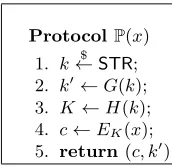
Given a message x∈ M,P produces a ciphertext as shown in Figure 1. In the
ProtocolP(x) 1. k←$ STR; 2. k′←G(k);
3. K←H(k); 4. c←EK(x); 5. return(c, k′)
Fig. 1.The protocolP.
protocol as described in Figure 1,k, an element ofSTRis hashed to form the key
Kandkis also converted into a CAPTCHA and transmitted along with the ci-phertext. The only input toPis the message and the key generation is embedded in the protocol. It resembles the scenario of hybrid encryption [1], which consists of two mechanisms called key encapsulation and data encapsulation where an encrypted version of the key is also transmitted along with the cipher. For a human decryption is easy, as given a ciphertext (c, k′
) a human user can recover kfrom k′
by solving the CAPTCHA and thus compute EH(k)−1 (c) to decipher.
4.1 Security of P
The security of a protocol P against profilers is defined in the same way as in Definition 3.
Definition 4. The advantage of an adversary attacking protocolP is defined as
AdvprofP,f (A)
= Pr[A(P(x))⇒f(x)]−max A′ Pr[A
′
where x ← M$ andA′ is an adversary whose running time is a polynomial of the running time of A. Additionally Pis called (ǫ, t)secure in the PROF sense if for all adversaries running in time at most t,AdvprofP (A)< ǫ. ♦
The above definition is different from Definition 3 by the fact that it does not mention the key explicitly, as key generation is embedded in the protocol itself. To prove that Pis secure in the PROF sense we need an assumption regarding the CAPTCHAGand the hash functionH. We state this next.
Definition 5. [The Hash-Captcha assumption]LetGbe a CAPTCHA gen-erator, let ℓ be a number, let H :STR → {0,1}ℓ be a hash function, and let A
be an adversary. We define the advantage of A in violating the Hash-Captcha assumption as
AdvhcG,H(A) = Pr[x $
←STR:A(G(x), H(x))⇒1]
−Pr[x←$ STR, z← {$ 0,1}ℓ:A(G(x), z)⇒1].
Moreover, (G, H) is called (ǫ, t) HC secure if for all adversaries A running in
time at mostt,AdvhcG,H(A)≤ǫ. ♦
This definition says that the pair formed by a CAPTCHA generatorGand a hash functionH is secure, if an adversaryAis unable to distinguish between a (G(x), H(x)), wherexis some string, and (G(x), z), wherezis a random string. This security notion of a CAPTCHA inspired by the notion ofindistinguishability is quite different from the (α, β) security notion as described in Section 2.3. Here the adversary has some more information regardingxthrough the valueH(x). If the adversary can efficiently solve the CAPTCHAGthen it can break (G, H) in the HC sense irrespective of the hash function. Given the CAPTCHA is secure, i.e., no efficient adversary can findxfrom G(x) still an adversary may be able to distinguishH(x) from a string randomly selected from the range ofH.
If we consider a keyed family of hash functionsH={Hℓ}ℓ∈L, such that for
everyℓ ∈ L, Hℓ : D → R for some sets D andR. Then His called a entropy
smoothing family if for any efficient adversary it is difficult to distinguish between (ℓ, Hℓ(x)) and (ℓ, z), whereℓ,x, z are selected uniformly at random fromL, D
andRrespectively. An entropy smoothing hash along with a secure captcha can resist HC attacks. Entropy smoothing hashes can be constructed from universal hash functions using the left over hash lemma [7], but the parameter sizes which would be required for such provable guarantees can be prohibitive. We believe that using ad-hoc cryptographic hashes like the ones from the SHA family can provide the same security. In our definition we do not use a keyed family of hash functions, but such a family can be easily used in the protocol P, and in that case the hash key will also be a part of the ciphertext.
Theorem 1. LetPbe a protocol as in Figure 1 andAis an adversary attacking P in thePROFsense. Then there exist adversaries Band B′ such that
AdvprofP,f (A)≤AdvhcG,H(B) +Advprof-eavE,f (B
′ ).
And, ifA runs for timet, both BandB′
runs for timeO(t).
Proof. LetAbe an adversary attacking the protocolPin Figure 1. We construct an adversaryBattacking the hash-captcha, usingAas follows.
AdversaryB(G(k), z) 1. x← M$ ;
2. Send (Ez(x), G(k)) toA;
3. Areturnsj; 4. iff(x) =j; 5. return1; 6. else return0;
AsBis an adversary attacking the hash-captcha assumption, hence there are two possibilities regarding the input (G(k), z) ofB, z can either be H(k) or a uniform random element inK, and the goal ofBis to distinguish between these two possibilities.
Considering the first possibility thatz isH(k), the way the adversaryB is defined,Agets a valid encryption of the messagex(which is a random element in the message space) according to the protocolP. Hence we have
Pr[k← K$ :B(G(k), H(k))⇒1]
= Pr[k← K$ , x← M$ :A(EH(k)(x), G(k))⇒f(x)]
= Pr[x← M$ :A(P(x))⇒f(x)]. (3)
Similarly, for the second possibility, i.e., when the input z to B is an element chosen uniformly at random from K, we have
Pr[k, K← K$ :B(G(k), K)⇒1]
= Pr[x← M$ :A(EK(x), G(k))⇒f(x)]. (4)
In Equation (4),kandKare chosen independently uniformly at random from K. Thus, the adversaryAhas as inputEK(x) andG(k), wherekis independent
ofK, thusG(k) carries no information aboutK. HenceAcannot do better than some PROF-EAV adversaryB′
who has only EK(x) as its input, and runs for
same time as that ofA. Thus
Pr[x← M$ :A(EK(x), G(k))⇒f(x)]
≤Pr[x← M$ :B′
From definition of PROF-EAV advantage ofB′ we have
Pr[x← M$ :B′(EK(x)) =f(x)]
=Advprof-eavE,f (B′
) + max A′ Pr[A
′
(.)⇒f(x)] (6)
Thus, using Equations (4), (5) and (6) we have
Pr[k, K← K$ :B(G(k), K)⇒1]
≤Advprof-eavE,f (B′
) + max A′ Pr[A
′
(.)⇒f(x)] (7)
Finally, from Equations (3) and (7) and Definitions 5 and 4 we have
AdvprofP,f (A)≤AdvhcG,H(B) +Adv
prof-eav
E,f (B
′ ),
as desired. ⊓⊔
Some remarks about security ofP:We defined the security of the protocol Pfor only a fixed profiling functionf, but note that we can modify the definition for any arbitrary functionf which would give us a security definition equivalent to SEM-EAV (discussed in Section 2.2). If the encryption algorithm E used within the protocol is SEM-EAV secure then using the same proof we can obtain SEM-EAV security forP.
5
A Practical Instantiation
A very common problem using CAPTCHAs is that sometimes even humans may fail to solve them. As in the protocol P if a human user fails to solve the CAPTCHA then (s)he will not be able to decipher and there is no way to repeat the test (as is done in normal CAPTCHA usage), hence this stands as a serious weakness of the proposed protocol P. A solution to this problem can be attempted by providing some redundancy in the CAPTCHAs so that a valid user can have more chance in solving the CAPTCHA. As a solution we propose that the initial stringkchosen by the protocol be broken intowshares such that withtor more of the shares would be enough to generatek. Thesew shares are converted into CAPTCHAs and sent along with the ciphertext. To incorporate this idea we changed the initial protocolPtoP′. The protocolP′ is a specific instantiation, thus before we describe the protocol we fix some details of its components, in particular forP′we would require an encoding mechanism
ENCDwhich we discuss first.
LetAL ={A, B, . . . , Z} ∪ {a, b, . . . , z} ∪ {0,1, . . . ,9} ∪ {+, /}, thus making
|AL|= 64. We define an arbitrary (but fixed) bijection ρ:AL→ {0,1, . . . ,63},
and for anyσ∈ALandn≥6,binn(σ) will denote thenbit binary representation
ofρ(σ). Note that for allσ∈AL, at most 6 bits are required to representρ(σ).
toψ, similarly for a positive integerv <2n, toBin
n(v) denotes the nbit binary
representation of v. We fix a positive integer m and let STR be the set of all
m character strings over the alphabet AL. Letpbe the smallest prime greater
than 26m and letd=p−26m. Let ENCD:STR× {0,1, ..., d} →Z
p be defined
as follows
ENCD(s, λ)
1. Parsesas σ0||σ1||. . .||σm, where eachσi∈AL;
2.ψ←bin6(σ0)||. . .||bin6(σm);
3.v←toInt(ψ);
4.returnv+λ;
And letENCD−1:Zp→STR× {0,1, . . . , d}be defined as
ENCD−1(y)
1.ify≥26m,
2. λ←y−26m+ 1;
3. y←26m−1;
4.elseλ←0; 5.z←toBin6m(y);
6. Parsez asz0||z1||. . .||zm, where|zi|= 6;
7.s←ρ−1(toInt(z
0))||. . .||ρ−1(toInt(zm));
8.return(s, λ);
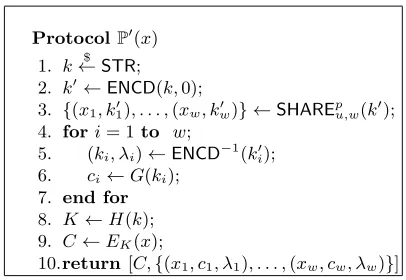
The modified protocolP′ is shown in Figure 2. It uses the encoding function
ENCDand the secret sharing scheme as depicted in Section 2.4. ForP′we assume that STR contains all m character strings over the alphabet AL, and p is the
smallest prime greater than 26m, these can be considered the fixed and public
parameters forP′. The encoding mechanism is specifically designed to convert a string inSTRto an element inZpso that Shamir’s secret sharing can be suitably used.
To decrypt a cipher produced byP′ a human user must solve at least someu ofwCAPTCHAs. Using theseusolutions together withxi,kcan be recovered.
A specific recommendation for SHARE can be Shamir (2,5)-threshold scheme.
Thus the user would have much flexibility on solving the CAPTCHAs.
5.1 Security of P′
The security ofP′can be easily proved in the sense of Definition 4 in a similar way as we prove Theorem 1 if we make a new assumption regarding the CAPTCHA as follows :
Definition 6. [The Hash-MultiCaptcha assumption]LetGbe a CAPTCHA generator, let ℓ be a number, letH :STR→ {0,1}ℓ be a hash function, and let
ProtocolP′(x)
1. k←$ STR; 2. k′←ENCD(k,0);
3. {(x1, k1′), . . . ,(xw, kw′)} ←SHAREpu,w(k′); 4. fori= 1 to w;
5. (ki, λi)←ENCD−1
(k′
i); 6. ci←G(ki);
7. end for 8. K←H(k); 9. C←EK(x);
10.return[C,{(x1, c1, λ1), . . . ,(xw, cw, λw)}]
Fig. 2.The protocolP′which uses a secret-sharing scheme.
of x1, . . . , xw are known thenxcan be recovered. We define the advantage of A
in violating the Hash-MultiCaptcha assumption as
AdvmhcG,H(A) = Pr[A(G(x1), . . . G(xw), H(x))⇒1]
−Pr[z← {$ 0,1}ℓ:A(G(x1), . . . G(xw), z)⇒1].
where x←$ STR. Moreover, (G, H) is called (ǫ, t) HMC secure if for all
adver-saries Arunning in time at most t,AdvmhcG,H(A)≤ǫ. ♦
As in the definition of Hash-Captcha assumption, in this definition if the adver-sary can efficiently solve at leastuofwCAPTCHAs, then it can break (G, H) in the HMC sense irrespective of the hash function. If this assumption is true, then we can show the security of protocolP′ just as we did for protocolP.
A CAPTCHA is an example of a weakly-verifiable puzzle [2], since a legiti-mate solverS may not be able to verify the correctness of its answer. For this kind of puzzles, it has been proved [6] that if it is difficult for an attacker to solve a weakly-verifiable puzzle P, then trying to solve multiple instances of a puzzle in parallel is harder. Most recently, Jutla found a better bound to show how hard it is for an attacker to solve multiple instances of weakly-verifiable puzzles [8]. The next theorem is based on the main theorem proposed by Jutla, but it has been adapted to CAPTCHAS, which are of our interest in this work.
Theorem 2. LetGbe a CAPTCHA generator which is(α, β)secure. Letk∈N, δ= 1−βandγ (0< γ <1) be arbitrary. LetAbe an arbitrary polynomial time adversary, which is given as inputkCAPTCHAs(G(x1), . . . , G(xk))and outputs
a set X of solutions of thek CAPTCHAs. If InCorr(X)denotes the number of
incorrect solutions in X, then
This theorem establishes that for any adversary if the probability of failure in solving a CAPTCHA is at least δ, then the probability of failing on less than (1−γ)δk out ofkpuzzles, is at moste−(1−γ)γ2δk/2
.
Based on this fact, it may be possible to show that for any arbitrary adversary
A attacking the HMC assumption, there exists a HC adversary B such that AdvmhcG,H(A)<AdvhcG,H(B). This would imply that the HC assumption implies
the HMC assumption. But, for now we are not sure whether such a result holds.
5.2 Discussions
– About the encryption scheme: In this work we have not said anything about the encryption scheme to be used in the protocol. We only said that we require our encryption scheme to be PROF-EAV secure and any IND-EAV secure encryption scheme can provide such security. Thus most symmetric encryption schemes which are usually in use like CBC mode, counter mode etc. ( which provide security in the IND-CPA sense) can be used for the encryption functionEinP′. A more efficient scheme which provides security only in the PROF-EAV sense would be much interesting, we would like to explore in this direction.
– Key sizes: Another important thing to consider is that the effective size of a key for the protocol is dictated by the parameterm, i.e., the size of each string inSTR. This value cannot be made arbitrarily large as solving
big CAPTCHAs for human beings may be tiresome, a usual CAPTCHA length is five to eight characters. If we use eight character strings from the alphabetALthen the effective size of the key space would be 248. Increasing
the alphabet size is also not feasible as we need un-ambiguous printable characters to make CAPTCHAs. Thus, the key space is not sufficiently large for a modern cryptographic application, but for the application which we have in mind this may be sufficient, as we do not expect that a profiler would be ready to use so much computational resource for profiling a single message.
6
Final Remarks
In this paper we did a theoretical analysis of profiling adversaries and ultimately described a protocol which is secure against profiling adversaries. Our proto-col does not require any key exchange or public key infrastructure and uses CAPTCHAs and secret sharing schemes in a novel way.
possible due to online advertisements, so putting a total end to user profiling may not be desirable. So there have been current attempts to develop systems which would allow targeted advertisements without compromising user security [14]. These issues are not covered in our current work.
References
1. M. Abdalla, M. Bellare, and P. Rogaway. The oracle diffie-hellman assumptions and an analysis of DHIES. In D. Naccache, editor,CT-RSA, volume 2020 ofLecture Notes in Computer Science, pages 143–158. Springer, 2001.
2. R. Canetti, S. Halevi, and M. Steiner. Hardness amplification of weakly verifiable puzzles. In J. Kilian, editor, TCC, volume 3378 of Lecture Notes in Computer Science, pages 17–33. Springer, 2005.
3. C. Dwork and M. Naor. Pricing via processing or combatting junk mail. In E. F. Brickell, editor,CRYPTO, volume 740 ofLecture Notes in Computer Science, pages 139–147. Springer, 1992.
4. S. Dziembowski. How to pair with a human. In J. A. Garay and R. D. Prisco, editors,SCN, volume 6280 ofLecture Notes in Computer Science, pages 200–218. Springer, 2010.
5. P. Golle and A. Farahat. Defending email communication against profiling attacks. In V. Atluri, P. F. Syverson, and S. D. C. di Vimercati, editors,WPES, pages 39– 40. ACM, 2004.
6. R. Impagliazzo, R. Jaiswal, and V. Kabanets. Chernoff-type direct product theo-rems. J. Cryptology, 22(1):75–92, 2009.
7. R. Impagliazzo and D. Zuckerman. How to recycle random bits. InFOCS, pages 248–253. IEEE, 1989.
8. C. S. Jutla. Almost optimal bounds for direct product threshold theorem. In D. Micciancio, editor, TCC, volume 5978 ofLecture Notes in Computer Science, pages 37–51. Springer, 2010.
9. J. Katz and Y. Lindell. Introduction to Modern Cryptography. Chapman & Hall/ CRC, 2008.
10. M. Naor. Verification of a human in the loop or identification via the turing test, 1997. http://www.wisdom.weizmann.ac.il/~naor/PAPERS/human.pdf.
11. NYT. Congress begins deep packet inspection of internet providers, 2009. http://bits.blogs.nytimes.com/2009/04/24/ congress-begins-deep-packet-inspection-of-internet-providers/.
12. B. Pinkas and T. Sander. Securing passwords against dictionary attacks. In V. Atluri, editor, ACM Conference on Computer and Communications Security, pages 161–170. ACM, 2002.
13. A. Shamir. How to share a secret. Commun. ACM, 22(11):612–613, 1979. 14. V. Toubiana, A. Narayanan, D. Boneh, H. Nissenbaum, and S. Barocas. Privacy
preserving targeted advertising. InProceedings of annual network and distributed
systems security symposium, 2010. http://www.isoc.org/isoc/conferences/
ndss/10/pdf/05.pdf.