Sketch Based Image Retrieval System for the Web
- A Survey
Neetesh Prajapati1, G.S.Prajapti2
1
M-Tech Research Scholar, 2Research Guide & HOD, VNS Group Of Institutions Faculty Of Engineering,
Bhopal, India.
Abstract- A proposal for a queried-by-sketch image retrieval system is introduced as an alternative to a text-based image search on the Web. This paper reviews the enlargement of content based image retrieval system and sketch based image retrieval system. We present in this paper the difficult task concerned with the design and creation of CBIR is based on a free hand sketching. The use of the occur a possible result, how to design and implementation a task specific descriptor which can handle the information about a sketch a colored image to make an opportunity for the well organized search. The CBIR system first evaluates the similarity between query and images stored in the database.
This paper outlines a description of primitive features of images like textures, colors and shapes as parameters. In these tools, images are manually annotated with retrieved using image-based search methods. This paper aim to introduce the problems and challenges concerned with the design and implementation of CBIR systems, which is based on a free hand sketch (Sketch based image retrieval – SBIR). With the help of the existing methods revealed that the proposed algorithm is better than the be living algorithm. In this paper, we create the mosaic of the images and compared the methods of matching sketches descriptor.
Keywords: - CBIR, SBIR, EHD, HOG.
I. INTRODUCTION
The fastest growth of multimedia applications proceeds with the emergence of large-scale image collections has brought about the need for efficient methods for storage, browsing, indexing and retrieval of images.
Content Based Image Retrieval (CBIR) is an automatic process to search relevant images based user input. The input could be specified, sketches or example images. A typical CBIR process first extracts the image features and store them efficiently. Then it compares with images from the database and returns the results. Feature extraction and similarity measure are very dependent on the features used. With each feature, there would be more than one representation. Among these
Representations, the histogram is the most commonly used technique to describe features.
In computer technology, Database and Internet are the most basic part of the searching information. These are mostly based upon the text search. Although there are
Many advanced machines to handle queries and storing the vast amount of information. The efficiency of search cannot be same. The methods of searching using text based content are not efficient because most of the visual
Information cannot be expressed textually. This situation can be avoided by using CBIR technology [1].
The CBIR technology is necessary for the image; the image search is made efficient and dependable. CBIR is allowed to extract information which itself represent the image. Content-based image retrieval (CBIR) is also known as query by image content (QBIC) and content-based visual information retrieval (CBVIR). Application of computer vision to the image retrieval problem that is the problem to search for digital images in the large databases [2]. The term ‗content-based means that the search can be analyzing the actual content of the image. Content must be relayed on metadata to examine the image content, searches without the facility like keywords. This type of metadata must be generated by a human and stored alongside each image in the database. The rise of interest in techniques for retrieving
Images on the basis of automatically-derived features such as color, texture and shape. This technology generally referred to as Content-Based Image Retrieval (CBIR) [2]. The aim of this paper is to review the current state of the art in content-based image retrieval. The word content in CBIR refers to features of images like color, shape, texture, edges, etc. which can be extracted from that image itself. Thus a system which uses features of the image will give better indexing and give valid results. The work is done on developing an easier and smarter system called Sketch-Based Image Retrieval (SBIR). It is a system that basically operates to show the user‘s query by line-based hand drawing. The query picture can be well expressed by SBIR through shape only while it needs more than that to be demonstrated by CBIR. The SBIR system includes a new variety of hand drawing style and even more flexibility to the query users.
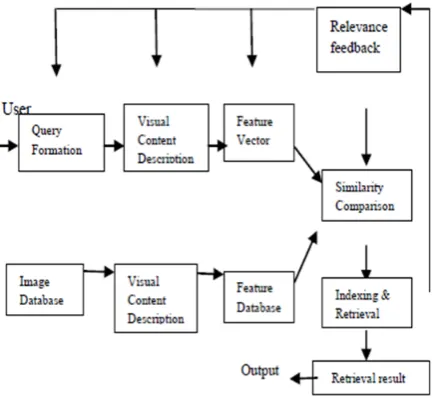
The above figure shows the flow diagram of content based image retrieval system [3].
Sketch-based image retrieval (SBIR) is a relevant means of querying large image databases. All of researches focus on how to solve the gap between sketch and image matching problem. A lot of ways are discussed or discovered about this gap. Recently, we have reviewed bellow a method that deal with the main three points of sketch based image retrieval.
images. Most research efforts still focus on the study of sketch-to-image matching on a small-scale dataset. But in practice, a large-scale image database is highly desired to ensure the system can always find good matches for any sketch query. The necessity of an efficient index solution further makes sketch-based image search more challenging. To build a large-scale sketch-based image search engine, we need to overcome the following two challenges, i.e. matching and indexing. However, the two challenges are intimately coupled with each other, making it inappropriate to just study one of them. The complexity of a matching algorithm determines whether a proper index structure can be designed to speed up the retrieval process. Meanwhile, the growing desire of searching in larger databases poses a more rigid requirement on the machine precision, for a larger database increases the possibility of returning false positives in top results.
Fig. 1 Diagram for content-based image retrieval system
This paper aims to introduce the problems and challenges competently with the CBIR systems in general and especially SBIR, to describe the methods of solutions, applications, and to display the existing research in this area. Then it`s introduce the overview of the basic concepts of the CBIR in the presents the SBIR and the main challenge of retrieval, image that depends on descriptor of features extractions, matching based on features and the recall image based on indexing, while contains the conclusions and unsolved problems of this area.
II. HISTORY
The term "content-based image retrieval system (CBIR)" appears to have originated in 1992 when it was used by T. The Kato to describe the investigation into the automatic retrieval of images from a database, based on the colors,shapes and texture present. Since then the term has been used to explain the technique of retrieving desired images from a large collection on the basis of syntactical image quality. The techniques, tools and algorithms that are used spring form fields such as pattern recognition, signal processing and computer vision.
The earliest commercial content-based image retrieval system was developed by IBM and was called QBIC (Query by Image Content).
III. LITERATURE REVIEW
Reviews the suitable background literature and describes the concept of an image retrieval system. Scientific publications included in the literature survey have been chosen in order to build a sufficient background that would help out in solving the research sub-difficulties difficulties. 1. Miguelena Bada, A.M.; de Jesus Hoyos Rivera,
G.; Marin Hernandez, A.[1] presented A proposal for a queried-by-sketch image retrieval system is introduced as an alternative to text-based image search on the Web. The user will create a sketch as a query that will be matched with the edges extracted from natural images. The main challenge regarding edge detection for Content-based Image Retrieval consists in finding edges for larger regions and avoiding the ones corresponding to textures. For this purpose, a combination of selective smoothing and color segmentation is applied prior edge extraction. An evolutionary algorithm is deployed to optimize the image-processing parameters. Similarity between the user´s sketch and the image’s edges will be measuredregarding two local aspects: spatial proximity and edge orientation. A full architecture for image search on the Web is proposed and preliminary results are reported using a trial database.
2. Eitz, M.; Hildebrand, K.; Boubekeur, T.; Alexa, M.[2]
introduce a benchmark for evaluating the performance of large-scale sketch-based image retrieval systems. The necessary data are acquired in a controlled user study where subjects rate how well given sketch/image pairs match. We suggest how to use the data for evaluating performance of sketch based image retrieval systems The benchmark data as well as the large image database are made publicly available for further studies of this type. Furthermore, we develop new descriptors based on the bag-of-features approach and use the benchmark to demonstrate that they significantly outperform other descriptors in the literature.
information, photo sharing sites and remote sensing systems.
4. Annam S., Kavitha M., Ravi Kumar K.C.[4] Image processing is the popular research area is based on the content image retrieval system, image search tools such as Webopedia, Google Images and Yahoo, image search based on textual annotation of images. Images are manually annotated with keywords and then retrieved using text-based searching methods. Our analysis introduces the content based on a free hand sketch with the help of the existing methods which describes sketch colored image search is efficient, sequence of preprocessing steps that the transformed full color image and the sketch. Sketch based image retrieval system can be used as digital libraries, crime prevention etc, we compare this with previous technology and also analyzed the algorithm such a system has great data on suspects and identifying victims in forensic sketch to the shot which demands wide spectrum on the image processing.
5. Fendarkar J. D Gulve K. A. [5] System (CBIR) and sketch based image retrieval system (SBIR). In this paper, we present the problems and challenges concerned with the design and the creation of CBIR systems, which is based on a free hand sketch (i.e. SBIR). The use of the existing methods, describe a possible result, how to design and implement a task specific descriptor, which can handle the informational gap between a sketch a colored image to make an opportunity for the efficient search. The CBIR system first computes the similarity between the query and the images stored in the database.The development of content based image retrieval.
6. Khobragade S., Nikose S., Shaikh M.[6] Content-based image retrieval (CBIR) is a digital image processing system . Available image search tools are based on a literal interpretation of the images . In these devices , the images manually annotated with keywords and then using text- based search tool has been . This method will not promising results . The goal of the visual features of CBIR is to extract and display the required image . Using SBIR this paper , issues and challenges concerned with the design and construction of CBIR systems is to apply . Results sketch - based system for users to use a clever device allows search queries. The technique of digital libraries , crime prevention , and photo sharing sites can be used in many applications . One possible application for a gallery of mug shot images matching a forensic sketch . In the field of image processing on a wide spectrum of functionality demanded the return of the query image based on the picture to view the content of this paper focus.
7. Dalal,N.; Triggs,B.[7] In this paper We study the question of feature sets for robust visual object recognition, adopting linear SVM based human detection as a test case. After reviewing existing edge and gradient based descriptors, we show experimentally that grids of Histograms of Oriented Gradient (HOG) descriptors significantly outperform
existing feature sets for human detection. We study the influence of each stage of the computation on performance, concluding that fine-scale gradients, fine orientation binning, relatively coarse spatial binning, and high-quality local contrast normalization in overlapping descriptor blocks are all important for good results. The new approach gives near-perfect separation on the original MIT pedestrian database, so we introduce a more challenging dataset containing over 1800 annotated human images with a large range of pose variations and backgrounds.
8. Konishi, S., Yuille, A.L., Coughlan, J.M., Song Chun Zhu[8] Weformulate edge detection as statistical inference. This statistical edge detection is data driven, unlike standard methods for edge detection which are model based. For any set of edge detection filters (implementing local edge cues), we use presegmented images to learn the probability distributions of filter responses conditioned on whether they are evaluated on or off an edge. Edge detection is formulated as a discrimination task specified by a likelihood ratio test on the filter responses. This approach emphasizes the necessity of modeling the image background (the off-edges). We represent the conditional probability distributions nonparametrically. Multiple edges cues, including chrominance and multiple scale, are combined by using their joint distributions. Hence, this cue combination is optimal in the statistical sense. We evaluate the effectiveness of different visual cues using the Chernoff information and Receiver Operator Characteristic (ROC) curves. This shows that our approach gives quantitatively better results than the Canny edge detector when the image background contains significant clutter. In addition, it enables us to determine the effectiveness of different edge cues and gives quantitative measures for the advantages of multilevel processing, for the use of chrominance, and for the relative effectiveness of different detectors. Furthermore, we show that we can learn these conditional distributions on one data set and adapt them to the other with only slight degradation of performance without knowing the ground truth on the second data set. This shows that our results are not purely domain specific.We apply the same approach to the spatial grouping of edge cases and obtain analogies to nonmaximal suppression and hysteresis.
IV. ABOUT IMAGE RETRIEVAL SYSTEM
In earlier days, image retrieving from a large image database can be done by subsequent techniques. We determine some method regarding the picture salvage. 4.1 Content Based Image Retrieval system
similar to the query image according to predefined criteria. Choosing good indexes is thus a very important matter. The Yet another Content Based Image Retrieval system combines three characteristics like color, texture and points of interest of an image to compute a weighted similarity measure [1]. Color and texture characteristics are global while points of interest are shaping local characteristics. The color characteristic is widely used in generalist CBIR systems. The indexer module quantifies colors and creates a histogram specific to each image. The similarity measure will be made on histograms and then color similarity SC is calculated. If the value of SC is 1 that means the two images has the same color. For the texture characteristic four descriptors like contrast, entropy, energy and inverse differential moment are used. In this they have used Euclidian distance to find out the similarity of texture ST. The value ST = 1 means that the two images have the same texture. The points of interest analyzer are based on the Harris detector. The number of correct matching points between the two images will quantify the similarity measure SS. If this value is low, we have a bad similarity. If this value is high relative to the total number of interest points, we have a good similarity. The similarity measure used in YACBIR is a sum of weighted color, texture and points of interest (shape) similarity measures. This similarity measure is given by:
S = α.SC + β.ST + γ.SS with (α+ β+γ) =1
CBIR systems are various and diverse. There are a variety of physical characteristics used to index images. A system can use the region histogram while another uses color coherence vector. For some systems there are no available details. The collection of images used in the tests can influence the results. With a given CBIR system, searching for example for a cat image in a database containing only dogs always yields images of dogs. To have a more powerful and efficient retrieval system for image and compact disk record, contented stand question must be shared with wording and keyword predicates.
4.2 Gradient Field Descriptor for Sketch Based image Retrieval system
This system accepts monochrome free-hand sketched queries describing a shape, and returns images that contain similar shapes. This requires a matching process robust to defective inaccuracy (e.g. On location, scale, or shape deformation) and photometric variation. The approach is to transform database images into canny edge maps, and capture local structure in the map using a novel descriptor. We recommend setting an appropriate scale and hysteresis threshold for the canny operator by searching the parameter space for a binary edge map in which a small, fixed percent of the pixels are confidential edging. These easy heuristics remove central boundaries and discourages response at the scale of finer texture. This paper introduces the Gradient Field HoG (GF-HOG) descriptor; an adaptation of HoG that mitigates the lack of relative spatial information within BoW by capturing structure from surrounding regions. We are inspired by work on image completion (in-painting) capable of propagating image structure into voids, and use a similar ―Poisson fillingǁ approach to improve the
richness of information in the gradient field prior to sampling with the HoG descriptor [3]. This simple technique yields significant improvements in performance when matching sketches to photos, compared to three leading descriptors: Self-Similarity Descriptor (SSIM); SIFT; and HoG. Furthermore, we show how the descriptor can be applied to localize sketched objects within the retrieved images, and demonstrate this functionality through a sketch driven photo montage application. The success of the descriptor is dependent on the correct selection of scale during edge extraction, and use of image salience measures may benefit this process. The system could be enhanced by exploring colored sketches, or incorporate more flexible models for object localization.
4.3 Computational Perceptual Features for Texture Representation and Retrieval system
A perception-based approach to content-based image representation and retrieval is proposed in this method. We consider textured images and propose to model their textual content by a set of features having a perceptual meaning and their application to content-based picture recovery. We present an innovative technique to calculate approximately a set of perceptual textural features that is roughness, directionality, distinction, and business. The planned computational actions can be based upon two illustrations: the original image representation and the autocorrelation function (associated with original images) illustration. The set of computational actions planned is useful to content-based image retrieval on a big image data set, the famous Brodatz record. Investigational fallout and benchmarking illustrate attractive presentation of our approach. Primarily, the association of the planned computational events to person conclusion is shown using a psychometric method based upon the Spearman rank-correlation coefficient. Next, the function of the projected computational events in texture retrieval shows the exciting outcome, particularly when by means of outcome combination come back from each of the two illustrations. Judgment is also given with associated works and show excellent performance of our approach compared to related approaches on both sides: correspondence of the proposed computational measures with human judgments as well as the retrieval effectiveness [4].
experimentations taking into account human judgments. The psychometric method used is based on the sum of rank values and the Spearman coefficient of rank-correlation. Investigational outcome show a substantial communication between the proposed computational measures and human judgments. Compared to related works, our results are better. In order to validate the proposed set of computational measures, we applied them in a content-based image retrieval experimentation using a large image database, the well-known Brodatz catalog, which include 112 programs of 9 metaphors every class for a total of 1008 images. Experimental results show very good results and benchmarking based on precision and recall measures shows a significant improvement in retrieval performance, especially when fusing results returned by each of the two considered representations. Further research related to this work concerns mainly possible derivation of semantically- meaningful features based on the perceptual features used in this work as well as the use of supplementary features, such as arbitrariness, in organizing finally to further improve representation and retrieval effectiveness.
4.4 User Oriented Image Retrieval System Based on Interactive Genetic Algorithm
In this method, a user-oriented mechanism for CBIR method based on an interactive genetic algorithm (IGA) is anticipated. Color characteristic like the signify rate, the ordinary departure, and the figure bitmap of a color image are used as the features for recovery. In county, the entropy support on the older point co-occurrence matrix and the edge histogram of an image is also considered as the surface features. In addition, to decrease the break between the recovery outcome and the users’ hope, the IGA is working to assist the users recognize the images that are most satisfied with the users’ want. Untried outcome and judgment show the feasibility of the proposed approach. This paper has presented a user-oriented framework in interactive CBIR structure. In distinction to straight come close to that are based on diagram features, our scheme give an interactive machine to bridge the gap between the visual features and the person awareness. The color allocation, the signify charge, the average departure, and icon bitmap are used as color in turn of a representation. In adding, the entropy stand on the GLCM and edge histogram is considered as texture descriptors to help distinguish the descriptions. In exacting, the IGA can be measured and used as a semiautomatic exploration tool with the help of a user that can navigate a complex universe of images [5]. Experimental results of the proposed approach have shown the significant improvement in recovery presentation. Most employment allowing for extra low-level image descriptors or high-level semantics in the proposed approach is in progress.
4.5 Categories Based Image Retrieval system
This work presents a novel approach to content-based image retrieval in the categorical compact disk record. The metaphors are indexed by means of a mixture of text and pleased descriptors. The groupings are outlook as a semantic group of metaphors and are used to confine the
look for gaps. Keywords are used to recognize applicant grouping. Content-based retrieval is carried out in this grouping using multiple icon features. Importance reaction is used to learn the user’s intent—query specification and feature weighting with minimal user-interface concept. The technique applies to a huge amount of images collected from a popular categorical structure on the World Wide Web. Results show that efficient and accurate performance is achievable by exploiting the semantic classification represented by the groups. The significance reaction loop permits the substance descriptor weightings to be determined without exposing the calculations toward the user. Indexing varied compilations of compact disk facts remains a challenging problem. Even though significant progress has been made toward developing effective content descriptors, evidenced by the forthcoming MPEG-7 standard, it is still difficult to bridge the gap between low-level image analysis and image understanding at the semantic level. This gap limits access solutions since users usually interact at the semantic level. The images found on the World Wide Web (WWW) is a prime example of a multimedia collection that is difficult to index. Low-level features, such as color and texture, can be extracted and used for similarity searches. The results might be visually suitable excluding it is unreasonable to expect them to be conceptually relevant. For this, the content based searches must be constrained to semantically relevant sets of images. Due to the size of the dataset, manual classification is not feasible. This work investigates how existing semantic structure can be exploited by a multimedia access system even if this structure is not perfect. Our approach recognizes that the WWW is not just a large collection of images with loosely associated manuscript excluding there is existent structure which can be exploited. The work also demonstrates how relevance feedback can refine query intent using a simple and intuitive interface.
4.6 Sketch Based Image Retrieval System
Still, even if the compute of research in sketch-based image Retrieval increases, there is no widely old SBIR scheme. Our aim is to enlarge a content-based associative investigate engine, which records are accessible for anybody looking back to unguided sketch. The client has a diagram area, where he preserves all outline and instant, which are predictable to take place in the given place and with a given size. The retrieval results are grouped by color for superior clearness. Our mainly vital task is to overpass the information gap between the drawing and the image, which is assisting with the own preprocessing alteration process. In our organization the iteration of the consumption process is probable, by the existing outcome looking again, thus increasing the precision. The system building blocks include a preprocessing subsystem, which remove the troubles caused by the multiplicity of metaphors. Using the attribute vector generating subsystem our image can be represented by numbers considering a given property.
collected in the present form of feature vectors – this is the off-line part of the plan. This part holds out the computation demanding tasks, which has to be finished prior to the program real use. The other phase is the retrieval method, which is the online part of the plan [6]. Examine the data flow model of the system from the user’s point of observation. Initially the user draws a sketch or fill an image. When the illustration has been ended or the suitable representative has been loaded, the retrieval process is ongoing. The recovered image first is preprocessed. Later than the feature vector is produced, then by means of the retrieval subsystem investigation is executed in the previously indexed record. As an effect of searching a result set is prominent, these come into sight in the user interface of an organized form. Based on the outcome set we can once more retrieve using another descriptor with different nature. This represents using the loop.
V. PROPOSED METHODOLOGY
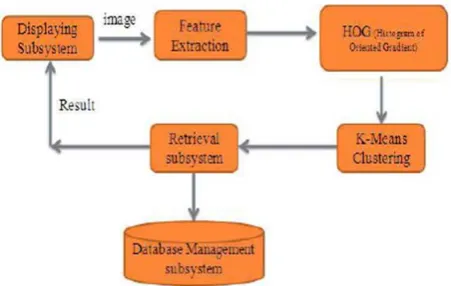
We studied various descriptors and algorithm for Sketch based image retrieval system to retrieve the better image from the database. But above studied Algorithm has some disadvantages; to overcome these disadvantages, here we present some work which is useful to retrieve the better image from the database than the previous system. In our proposed system, we can combine the HOG (Histogram of Oriented Gradient) Descriptor and the K-mean algorithm together. Fig. 2 shows the block diagram of a proposed system. This system saves large images compared to the previous system.
Fig 2. Block DIA. Of Proposed system
By using the HOG and K-mean together, it overcomes The problems arise in an individual that is k-mean is not used for large database but HOG used for large database. These retrieve the image from the database more efficiently than EHD & HOG. This system takes the image based on the user drawn sketches, match with the gallery of images from the database and display the retrieval of an image on the screen. HOG saves large images and k-means for better retrieval of image, so this system gives better performance than other system.
VI. PRESENTED SCHEMEOLOGY
We can evaluate the effectiveness of the system forming methods, and comparing different applied methods. This compression can be done easily through Metrics.
To evaluate effectiveness & accuracy of the system, precession & recall rate to be calculated.
Where the Precision provides information related to the effectiveness of the system.
Precision = Q / P. . .
Q = No. of images displayed with similar shape.
P= No. of images displayed.
Where the Recall provides the information regarding the exact accuracy of the system.
Recall = Q / Z . . .
Q = No. of images displayed with similar shape. Z = No. of images with similar shape in the whole database.
VII. CONCLUSION
According to the manuscript explain above is executed to idea, appeal and exploration of a sketch-based image retrieval system. Two main features were considered into the report. The recovery procedure has to be very unusual and interactive. The toughness of the process is necessary in some quantity of clank which force also is in case of straightforward images.
The drawn picture with no changes cannot be compared with color image or its edge revelation. On the other hand a distance transform step was initiated. The simple appearance and edge finding based method was enhanced which had a similar meaning as the preceding step.
This paper presents the dissimilar techniques used to execute implement, plan & examination a sketch based image retrieval system. From the previous system, the two aspects are taken, one is system is very interactive and another is system is toughness. HOG is more effective than the EHD.
Proposed organisms correspond to the grouping, which retrieve the images more efficiently than the previous system.
ACKNOWLEDGEMENT
REFERENCES
[1]. Miguelena Bada, A.M.; de Jesus Hoyos Rivera, G.; Marin Hernandez, A. “ Garabato: A proposal of a sketch-based Image
Retrieval system for the Web” Electronics, Communications and
Computers (CONIELECOMP), International Conference. PAGES:183-188 DATE-26-28 FEB 2014.
[2]. Eitz, M.; Hildebrand, K.; Boubekeur, T.; Alexa, M. “Sketch Based Image Retrieval: Benchmark and
Bag-of-FeaturesDescriptors’’Visualization and Computer Graphics, IEEE
Volume: 17, Issue: 11 Pages: 1624 – 1636. 2011.
[3]. Desai Asmita A., Shinde Aparna S., Malathi P. “Sketch Based
Image Retrieval System’’ International Journal of Advanced
Research in Computer Engineering & Technology Volume: 3, Issue: 9, pages:3016-3020,September 2014.
[4]. Annam S., Kavitha M., Ravi Kumar K.C. “Analysis of Web
Information Gathering Based on Sketch Image Retrieval System’’ International Journal of Emerging Trends & Technology in Computer Science Volume: 1, Issue: 2,pages:285-288, July – August 2012.
[5]. Fendarkar J. D., Gulve K. A. “Utilizing Effective Way of Sketches
for Content-based Image Retrieval System” International Journal of
Computer Applications Volume: 116 – No.: 15, pages: 23-28,April 2015.
[6]. Khobragade S., Nikose S., Shaikh M., “Content Based Image
Retrieval System Use forSimilarity Analysis of Images” International
Journal of Computer Science and Information Technologies Vol.: 5 (2) pages: 1701-1704,2014.
[7].Dalal,N.; Triggs,B.“Histograms of oriented gradients for human detect ion” Computer Vision and Pattern Recognition, 2005. CVPR 2005. Computer Society Conference on IEEE Volume: 1, Pages: 886 – 893, 2005.
[8]. Konishi, S., Yuille, A.L., Coughlan, J.M., Song Chun Zhu
“Statistical edge detection: learning and evaluating edge cues”