Pretty Understandable Democracy 2.0
Stephan Neumann, Christian Feier, Perihan Sahin, and Sebastian Fach
Security, Usability, and Society
Technische Universit¨
at Darmstadt
Hochschulstraße 10
64289 Darmstadt, Germany
[email protected]
[email protected]
[email protected]
[email protected]
September 1, 2014
Abstract
Technology is advancing in almost all aspects of our everyday life. One interesting aspect is the possibility to conduct elections over the Internet. However, many proposed Internet voting schemes and systems build on unrealistic assumptions about the trustworthiness of the voting environment and other voter-side assumptions. Code voting – first introduced by Chaum [Cha01] – is one approach that minimizes the voter-side assumptions. The voting scheme Pretty Understandable Democracy [BNOV13] builds on the idea of code voting while it ensures on the server-side an arguably practical security model based on a strict separation of duty, i.e. all security requirements are ensured if any two components do not collaborate in order to violate the corresponding requirement. As code voting and strict separation of duty realizations come along with some challenges (e.g. pre-auditing phase, usability issues, clear APIs), the goal of our research was to implement Pretty Understandable Democracy and run a trial election. This paper reports on necessary refinements of the original scheme, the implementation, and a trial election among the different development teams.
1
Introduction
The advance of technology, more and more, impacts our everyday life. Shopping, banking, or chatting with friends no longer depends on physical presence but may be easily done independent of time and location by digital means. In recent years, even fundamental processes of democracy have come into the focus of technological advance. Amongst the most attractive options is the possibility to conduct elections over the Internet. Since the seminal work by Chaum [Cha81], many works addressed the challenge of voting over the Internet addressing a broad set of security requirements, see for instance [LSBV10]. It turns out, however, that most of the present schemes rely on unrealistic assumptions to ensure security: for instance, the JCJ [JCJ05] scheme relies on the voter’s platform being trustworthy and the Helios voting system [Adi08] relies on the voter conducting a complex verification procedure several times. The number of infected computers1
shows that it is not realistic to rely on voters to ensure that their platforms are trustworthy. It has also been shown (e.g. in [KOKV11]) that in particular with the Helios voting system, verifiability
1According to [Pan14], in 2013 31.53% of all computers were infected by malware
is not accessible to voters. Furthermore, Olembo et. al [OBV13] have shown that voters do not even see the need to verify their vote due to their trust mental models.
Code voting – first introduced by Chaum [Cha01] – is one approach that minimizes the voter-side assumptions. Since its invention several code voting schemes with different advantages and disad-vantages have been proposed [HS07, JRF09, RT09]. Recently, Budurushi et al. [BNOV13] proposed a new code voting based Internet voting scheme, Pretty Understandable Democracy (PUD). It en-sures on the server-side an arguably practical security model based on a strict separation of duty, i.e. all security requirements are ensured if any two components do not collaborate in order to violate a corresponding requirement. Furthermore, the authors’ goal was to keep the scheme as simple as possible. To date, PUD has not been implemented and therefore has only been considered from a purely theoretical perspective.
Contribution. As code voting and strict separation of duty realizations come along with some challenges for the implementation process, the election preparation and the vote casting (e.g. pre-auditing phase, usability issues, clear APIs), the goal of our research was to implement Pretty Understandable Democracy and run a trial election. In order to implement components by a rigorous separation of duties, we decided to implement components by group-wise student projects within a computer science class at the Technische Universit¨at Darmstadt, Germany. In this paper, we present several improvements and refinements made to the original scheme. Thereafter, we report on our experience about the implementation of the revised scheme and running a trial election among the different development teams (each team being responsible for one component).
Structure. The remainder of this work is structured as follows: Section 2 reviews related work in the area of code voting. Section 3 summarizes the original PUD scheme. In Section 4, we outline the settings provided to the class. In Section 5, we present several improvements of the original PUD scheme. Section 6 is dedicated to the implementation process. Section 7 reports on our lessons learned from conducting the trial election. Section 8 concludes this work and provides guidance for future research.
2
Related Work
Chaum’s seminal work on code voting [Cha01] has motivated many researchers to build their schemes upon the same idea [JFR13, JRF09, JR07a, JR07b, JRF10, Hel09, HS07, HSS08]. None of these schemes follows the distribution of trust as rigorously as Pretty Understandable Democracy (PUD) does. While some of the proposed schemes do not provide receipt-freeness (hence, a malicious voter can violate secrecy of the vote) [Cha01, JFR13, JRF09], other schemes build upon dedicated trustworthy hardware [JR07a, JR07b, JRF10] or single voting servers [Hel09, HS07, HSS08] to en-sure secrecy and/or integrity of the vote. The Norwegian Internet voting system [iEGT12] also uses some kind of code voting. While their verification code approach prevents single components from undetectably violating integrity, secrecy builds upon the assumption of a trustworthy voter platform [SVK12, KLH13] . The only scheme we are aware of following the distribution of trust principle as precisely as PUD is Pretty Good Democracy (PGD) [RT09]2. As opposed to PGD, PUD is tailored towards understandability and therefore real-world applicability.
3
Pretty Understandable Democracy
This section provides a brief overview of Pretty Understandable Democracy (PUD) [BNOV13], its code sheets, the different entities, and the different phases (setup phase including auditing, voting phase, and tallying phase).
2It should be emphasized that PGD’s adversary model is stronger because stored-as-cast integrity can be increased
3.1
Code Sheets
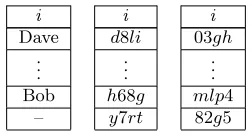
Similar to other code voting schemes, code sheets are distributed using an out-of-band channel such as the postal service. Furthermore, voters get different code sheets. Different from the code sheets in other schemes, the PUD code sheet is divided into three parts: The first part consists of a permuted list of candidates3. The permutation differs from code sheet to code sheet. The
second and third parts consist of codes which are concatenated and used to cast a vote for a specific candidate. The respective code sheets parts are associated by a shared index. A typical PUD code sheet is depicted in Figure 1. Note, different from the original code voting approach from Chaum [Cha01], the code sheet contains one additional code which is used throughout the voting phase to acknowledge the reception of a valid voting code4.
i i i
Dave d8li 03gh
. .
. ... ...
Bob h68g mlp4
– y7rt 82g5
Figure 1: Code sheet in PUD
3.2
Entities
The voting system consists of five different entities and a variable number of trustees. Their roles and duties are:
• Trustees (T)generate the election key pair in a distributed manner, i.e. they agree on a public key and each trustee knows one share of the corresponding key. The underlying cryptosystem must provide additive homomorphism, hence exponential ElGamal is used. Furthermore, the key generation process is tailored towards providing a trade-off between secrecy and robustness [Ped91]. They are involved in the auditing and tallying phase as in both phases information needs to be decrypted (while this is done in a distributed manner).
• Registration Authority (RA) generates, in the setup phase, the first part of the code sheets, i.e. the permuted candidate list. During the voting phase, RA is responsible for the election website.
• Voting Authority 1 (VA1) and Voting Authority 2 (VA2) generate, in the setup phase, the second and third part of the code sheets. They are also involved in the voting phase.
• Bulletin Board (BB)All data necessary to verify (or audit) is published on the BB. Therefore all entities except DA have write access and everyone (including voters and the public) have read access.
• Distribution Authority (DA) has a key role in the setup phase: It receives the different code sheet parts, put them in an envelope, provides those that should be audited, and distributes the remaining envelopes to the voters.
There are two further entities involved in the election processes, namely thevoter, who is a person eligible to vote, and thevoter’s platform which is used by the voter to cast his/her vote.
3Note, according to [DHR+11] permutations of candidates are in general legally compliant and in particular for
simple ballots such asnout ofm candidates.
4In [Cha01], there is one acknowledge code per candidate which might serve to prove an individual vote. Therefore,
3.3
Setup Phase
The setup phase consists of the following sub-phases: key generation, code sheet generation, com-mitting on these code sheets, auditing, anonymizing and distributing them to eligible voters. These are explained in the following paragraphs.
3.3.1 Key generation.
Trustees generate the election key pair. All authorities generate RSA key pairs for TLS, which will be signed by a valid CA afterwards.
3.3.2 Code sheet generation.
The generation of the three code sheet parts is done distributively and secretly. Each code sheet part is assigned to an index to enableDA to put the proper parts in one envelope. For each index,RA
generates a permutation and re-orders the canonical candidate list according to that permutation. For each index, VA1 and VA2 independently generate random codes for all candidates and the acknowledge code. All codes generated by one entity have to be unique which is to ensure integrity and differ for the two entities to avoid confusion. After an authority generated code sheet parts for all indices, the respective code sheet parts are put in envelopes and their index is printed on these envelopes. RA,VA1, andVA2 forward their indexed envelopes to theDA. In order to allow code sheet auditing, more code sheets than needed are generated throughout the code sheet generation.
3.3.3 Committing on code sheets.
Afterwards,RA,VA1, andVA2 commit on the respective code sheet parts by publishing encryptions (using the election key) of the permuted candidate list (each candidate is encrypted separately) and the generated codes (all codes per index are encrypted together).
3.3.4 Auditing code sheets.
During the auditing process, indices are randomly chosen by the Trustees. For each announced index the three code sheet parts stored atDAare opened. Furthermore, the encrypted data for the specific index is downloaded from theBB and decrypted by theTrustees. The public can verify that the committed code sheet data and the printed code sheets part match. Audited code sheets are discarded.
3.3.5 Anonymizing and distributing code sheets.
All remaining code sheets sharing the same index are put into neutral envelopes. These are put in a box and then shuffled. After this anonymization step, the neutral envelopes are distributed to the eligible voters.
3.3.6 Setting-up the servers.
AsRA,VA1, andVA2 are also involved in the voting phase as well as theBB, corresponding servers are set up. Furthermore, the election register is loaded onRA’s server component and VA1 and
VA2 download the information posted byRA.
3.4
Voting Phase
these codes into the two respective parts and sends the first part to VA1 and the second one to
VA2 (d8li to VA1 and 03gh to VA2 in the example). Both entities generated their respective code sheet parts of all voters. Consequently, both authorities are able to deduce for which code sheet indexi at which position pthe code part was generated. Both components check whether the code was used before and whether it is a valid code. If all checks are successfully passed,VA1
andVA2 independently re-encrypt the encrypted candidate for the corresponding code sheetiand position p(without knowing the plaintext candidate); the encrypted candidate corresponding to code sheet i and p has been published throughout committing on code sheets step. They both sign their respective re-encrypted candidate and send this information to theBB. After receiving this data,BB publishes it and sends eachVA1 andVA2 a confirmation back. After receiving the confirmation, bothVA1 and VA2 forward their part of the acknowledgement code to RA, which concatenates the acknowledgement codes and sends it to the voter. The voter checks whether the acknowledgement code matches the one on his/her code sheet.
3.5
Tallying Phase
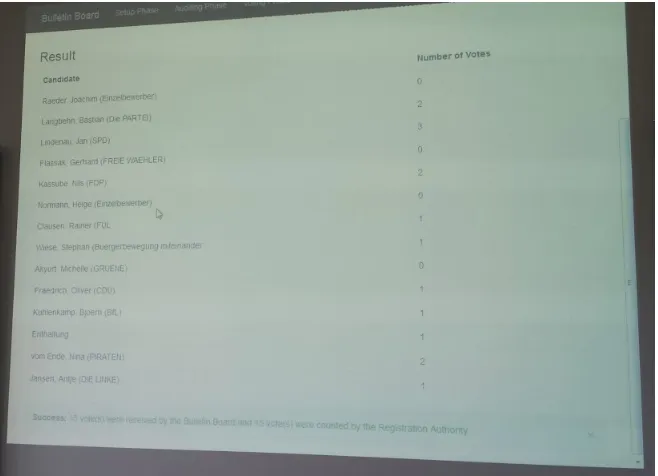
To tally the votes,RAsigns the total number of authenticated voters, which have participated in the election and sends this information toBB and the Trustees. TheTrustees request the signed re-encrypted candidates from theBB.BB returns both list (one fromVA1 and one fromVA2 with the voting phase. After this, theTrustees check whether the number of entries in the list matches the number of authenticated voters. Then they sum up the entries in each list homomorphically and decrypt both resulting sums in a distributed manner (including correctness proofs for the decryption). For each decrypted sum, theTrustees solve the discrete logarithm and compare if the both resulting values match. If so, this value is declared to be the election result. The result is published on theBB along with the zero knowledge proofs of the correct decryption.
3.6
Security Model
PUD ensures secrecy and integrity (encoded-as-intended, cast-as-encoded, stored-as-cast, and tallied-as-stored) under the assumption that coercion does not take place, cryptographic primitives cannot be broken, voters do not forward authentication material due to the strong authentication in place, and do not fall for phishing. In addition, it is assume that the adversary cannot corrupt more than one entity from the set of authorities, voters, or voter’s platforms. Given that adversary model, PUD defends the security requirements against a corrupted voter, a corrupted platform, and a corrupted authority. A more thorough review of the related work can be found in [BNOV13].
4
Settings
Pretty Understandable Democracy (PUD) has been implemented within a student project as part of the lecture Electronic Voting in the winter term 2013/14 at the Technische Universit¨at Darm-stadt, Germany. Students participating in this course had a background in computer security and cryptography.
4.1
Pre-considerations
In PUD, any communication between two components is secured by applying TLS. In contrast to a real-world system, the project management team signed the public key for each component and acted as a Certificate Authority.
In addition, it was decided that the servers did not have to be protected against hackers etc.. In a real-world scenario protection against several threats, like denial of service attacks (DoS), would be necessary but was out of scope for the implementation task. However, for the course, this enabled the students to use their own laptops.
Motivated by a newspaper report5we decided to tailor our trial election towards the State Election
(German: ”B¨urgerschaftswahl”) of the Hanseatic City of L¨ubeck and implemented the respective ballot from the last state election. Furthermore, it was decided that 35−40 voters (i.e. all students and supervisors) should be eligible to vote in the trial election at the end of the semester.
The software development teams were free to choose any programming language, as long as they are able to provide communication interfaces for the other components. This has several advan-tages: First, due to the different programming skills within specific languages, students could build upon their preferred languages. Second, relying on one single programming language could result in system vulnerabilities due to the compiler. An adversary could corrupt the whole system by just corrupting the used compiler. By using different programming languages also different com-pilers/interpreters are used. Assuming an adversary can corrupt one compiler/interpreter just one component would be corrupted but not the whole system.
For distributed key generation and tallying (see Section 3) we extended an already existing android app [NKMV13] which was already able to perform distributed ElGamal key generation. For the Trustees’ secret sharing, we defined a threshold of two out of three.
4.2
Organization
There were several software development teams (each one consisted of 2 to 3 students) while each team was assigned to one component and one phase. There were the following software development teams: VA1-setup, VA1-voting, VA2-setup, VA2-voting, Trustees-audit, Trustees-tallying, RA -setup, RA-voting. In addition, there were the project management team, the BB team, and the
DA team. Students in the software development team were explicitly told to not copy any code from other groups to ensure the required separation of duty (SoD).
4.3
Schedule
The lecture started on October 18, 2013. There were two sessions to discuss the PUD scheme. The group assignment was done afterwards. Correspondingly, the software development part started on November 5th, 2013 and the trial election was scheduled for February 7th, 2014. Thus, the teams had about three months time to implement and test their components.
4.4
Project management
The software development teams were asked to send the project management team their component design, their interfaces and their project schedule until November 15th, 2013. This was done in order to detect and correct design flaws in an early stage of the development process. As target date for the first integration test, the project management team proposed January 15th, 2014. During the development process the software development teams were rather free to organize themselves, but they were repeatedly asked to report their current status to the project management.
5http://www.segeberger-zeitung.de/Schleswig-Holstein/Landespolitik/Kommunalwahl-2013/
5
Protocol Refinements
After foundational concepts of electronic voting has been introduced to the students, there were two lectures on Pretty Understandable Democracy in which the scheme was introduced and discussed with the students. During these discussions, a couple of improvements have been identified. These are proposed and discussed in this section.
5.1
Candidate encoding
The original proposal was to encode candidates within one single ciphertext. Due to the fact that throughout the tallying process, all encryptions are summed up, each individual encryption of a candidate must also encode null encodings of all other candidates. As a consequence, computing the discrete logarithm for such a complex encoding results in a computationally-intensive task even for small-scale elections. Following the multi-candidate punch-hole vector-ballot by Kiayias and Yung [KY04], our revised scheme encodes each candidate into a separate encryption indicating whether the candidate is selected or not. Therefore, the revised scheme encodes each candidate into a separate encryption indicating whether the candidate is selected or not. ThereforeC encrypted blocks are sent whereC is the number of candidates. Each block has the form{gx}r
pkT where r
is a random number andxis the number of votes for this candidate. If the voter has exactly one vote this is either 1 or 0. For example there are 3 candidates and the voter votes for candidate 1 and 3. The corresponding encodings are (g1, g0, g1) and the respective encryptions are given
as ({g1}r1
pkT,{g
0}r2
pkT,{g
3}r3
pkT). Due to this improvement the necessary number of re-encryptions
is increased to C for each voter. Furthermore during the tallying process 2·C homomorphic sums are calculated. To overcome these drawbacks compared to the encoding in [BNOV13] the tallying performance is improved. The encrypted homomorphic sums for each candidate are given asgc1, gc2, ..., gcn wherec
i describes the number of votes for candidatei. To solvegci the discrete
logarithm problem has to be solved but the number of necessary modular exponentiations to find all
ciis limited toP C
i=1ci≤V modular exponentiations whereV is the number of eligible voters. This
is solvable by using bruteforce. Compared to up toV ·10(C−1)·dlog10(V)e modular exponentiations
which are necessary to tally as described in [BNOV13] this is a significant improvement.
5.2
Cross-checking indices and positions
Originally, PUD prescribed the following procedure: After RA split the voting code apart and forwarded the respective parts to VA1 and VA2, VA1 and VA2 independently re-encrypt the ciphertext related to the specific voting code (over index and position of the voting code). It turns out that a malicious voter might however prevent the computation of an election result by submitting code parts that represent different candidates, e.g. on the middle code sheet part, the voter would chose the code at position 3 and at the right code sheet part, the voter chooses the code at position 4. In such a case,VA1 andVA2 would re-encrypt different candidates and the computed homomorphic sum of both authorities would differ. Therefore, in addition to validity checks,VA1
andVA2 cross-check that they obtained codes of the same index and the same position. In case the code is invalid or a mismatch is detected,VA1 andVA2 log the corresponding request and inform
RAthat informs the voter.
5.3
Code length
VA. Furthermore, the codes generated by VA1 andVA2 are disjoint which results in a factor 2 of generated codes6. Therefore 2·λ·(C+ 1)·V codes are needed for both VAs. This means that log2(2·λ·(C+ 1)·V) bits are necessary for each code to ensure that all codes are different. For
the trial election, we set λ= 2. The number of candidate was according to the proposed ballot
C = 14 and the number of voters V = 50 (because of the number of participants). This takes
dlog2(2·2·(14 + 1)·50)e = 12 bits. With Base32 encoding, each code consists of 3 characters.
In order to prevent guessing attacks launched byRA, there must be more characters within each code. We propose to extend each code by one further character. Note, as 50 voters is a rather small number, we were interested to study the practicability of PUD for larger amount of voters (while keepingλ= 2): For 500.000 voters, 25 bits (5 characters) are needed; for 1.000.000, 26 bits (6 characters) are needed. Even for 5.000.000 just 29 bits (6 characters) are needed. From this we are able to conclude that code lengths scale well with the number of voters.
6
Implementation
In this section, we explain the programming interface, the different languages in place, the user interfaces, and the way the prototype was tested.
6.1
Programming Interfaces
In order to ensure a smooth communication between the involved entities, the students agreed on a REST API to receive and send data. To publish the specific syntax for each command an internal Wiki was used in which each team documented all available commands for their API. Some students did never work with a REST API and had to start learning it first.
6.2
Used Programming Languages
As programming languages Python, Java and Scala are used. Both parts ofRAandBB are written in Python, both parts ofVA1 andVA2 are written in Java and theDAis written in Scala.
6.3
Election Material and User Interfaces
The election materials as well as the user interfaces were developed in an iterative process, i.e. members of different teams provided feedback as well as friends not being involved in the process.
6.3.1 Election material
The election material was developed by the DA team in close collaboration with the RA-voting team. The invitation letter is the same as the interface shown in Figure 5 and an example code sheet fromVA1 is shown in Figure 2.
6.3.2 Vote casting interfaces
There are in total five relevant interfaces. Note, we translated the interfaces for this paper from German to English. Once visited the election website, information about the Internet voting pro-cess is displayed (see Figure 3). In order to proceed, the voter needs to click on ’Authenticate now’. The voter, then, authenticates himself/herself using the interface provided in Figure 4. As outlined in section 4, the voter only has to write his/her name, rather than authenticate by strong authentication means.
6To realize this,VA1 could generate only those codes that start with 0 andVA2respectively generates only codes
Figure 2: Code sheet of our trial election.
Figure 3: Welcome interface. Figure 4: Interface to authenticate.
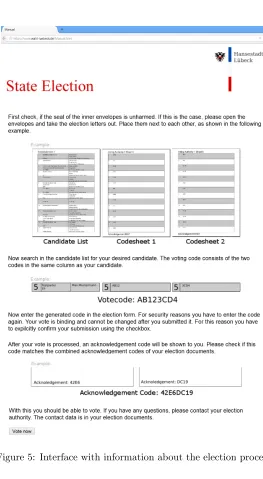
After being authenticated, the next interface displays the election manual (similar to the election material received together with the code sheets)(see Figure 5). The students decided to provide this information here again as the vote casting process differs from what voters might expect and, thus, to ensure that voters who did not carefully read the election material are provided with a short summary. The voter continues by clicking on ’Vote now’.
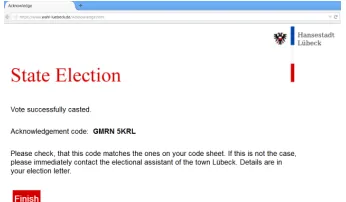
The system re-directs the voter to the next interface on which he/she casts his/her vote (Figure 6). Both codes of his/her preferred candidate need to be provided in the field next to ’Vote’. Spaces will be deleted by the interface. The vote casting can either be completed by clicking on ’cast’ or canceled. If the voter enters an invalid concatenated code, e.g. code 1 corresponds to candidate A and code 2 corresponds to candidate 2, an error message will be returned by the RA. Once cast, the interface displays the information that the vote has been successfully cast and the respective acknowledgement code as shown in Figure 7.
Figure 5: Interface with information about the election process.
6.3.3 Bulletin Board interfaces
Figure 8: Committed and encrypted parts of the code sheets.
6.4
Tests
To test their components the teams wrote their own test cases and some of them set up test servers which respond static messages depending on the request with the syntax described in the internal Wiki. With such servers the teams could also test the communication with other components. Unfortunately, some teams did not stick to the plan on the first test, which was as announced on January 15th. Therefore, the final complete test took place at February 6th, 2014, only one day before the trial election. At the final test some problems occurred, which had to be fixed: The communication from any component toVA1 did not work because of a TLS error. Furthermore the tallying module did not work properly because the group did not implement homomorphic tallying properly. To fix the communication and tallying problems, the students worked until late night and the whole morning before the trial election.
This experience shows that time schedules are even more important if (voting) systems are developed in such a distributed manner.
7
Lessons Learned from Running the Trial Election
The trial election was conducted on February 7th, 2014. Assembling all the needed papers (three code sheets and the election manual) took about 20 minutes (with one printer) for the small trial election with 50 voters, where ten persons in parallel took care of preparing the voting papers. This process could possibly be improved by special machines. Even without machines, the process could be organized in a way that is acceptable as in many German cities the postal voting material is also prepared manually.
Auditing only five code sheets took us more than 10 minutes. It just takes time to open the envelopes and read aloud all the candidates, then all the codes from VA1 and then all the codes from VA2 for each audited code sheet. It even takes more time, if this is done in a transparent manner, i.e. the present observers can follow the process.
When entering the codes, we noticed that some participants were confused by entering both parts of the code in the same text field. It might be worth providing two different fields in future and clearly indicating which code to enter in which field. The different views of the bulletin board were clear to the participants. However, it was also discussed that in case - due to transparency requirements - it is assumed that also voters should understand the content of the bulletin board, further information needs to be provided.
8
Conclusion
The present work reports about the experience of refining and implementing Pretty Understandable Democracy (PUD) and running a trial election with that scheme as part of a computer science course. Overall, the implementation and the election have been a success. The insights gained throughout the implementation and the trial election process are manifold and serve as guidelines for future research.
For the future, we see space for improvements both from the conceptual and from the implementa-tion perspective. Throughout the trial elecimplementa-tion, individual code sheet parts had to be combined into one envelope and sent out to voters. This results in significant organizational and time-intensive effort. We consider revising the code sheet distribution process, thereby lowering the organizational effort. Discussions among the students and the staff show that from a usability perspective the scheme is going into the right direction. In order to evaluate the scheme’s usability in an unbiased manner, user studies will be conducted in the near future. PUD has been tailored towards a trade-off between security and transparency. Nevertheless, the scheme builds upon several cryptographic primitives. We plan to investigate the scheme’s understandability by preparing information and education material and evaluating it in user-studies.
Acknowledgment
This work has been developed within the project ComVote, which is funded by CASED.
References
[Adi08] Ben Adida. Helios: Web-based open-audit voting. In Paul C. van Oorschot, editor,
USENIX Security Symposium, pages 335–348. USENIX Association, 2008.
[BNOV13] Jurlind Budurushi, Stephan Neumann, Maina Olembo, and Melanie Volkamer. Pretty Understandable Democracy - A Secure and Understandable Internet Voting Scheme. In
8th International Conference on Availability, Reliability and Security, pages 198–207. IEEE, 2013.
[Cha81] David L. Chaum. Untraceable electronic mail, return addresses, and digital pseudonyms. Communications of the ACM, 24(2):84–90, 1981.
[Cha01] David Chaum. Sure vote: Technical overview. In Proceedings of the Workshop on Trustworthy Elections (WOTE 01), 2001.
[DHR+11] Denise Demirel, Maria Henning, Peter Y. A. Ryan, Steve Schneider, and Melanie
Volka-mer. Feasibility analysis of prˆet `a voter for german federal elections. InVOTE-ID, pages 158–173, 2011.
[Hel09] J¨org Helbach. Code Voting mit pr¨ufbaren Code Sheets. In GI Jahrestagung, pages 1856–1862, 2009.
[HS07] J¨org Helbach and J¨org Schwenk. Secure Internet Voting with Code Sheets. In VOTE-ID, pages 166–177, 2007.
[HSS08] J¨org Helbach, J¨org Schwenk, and Sven Sch¨age. Code Voting with Linkable Group Signatures. InElectronic Voting, pages 209–208, 2008.
[iEGT12] Jordi Barrat i Esteve, Ben Goldsmith, and John Turner. International experience with e-voting. 2012.
[JCJ05] Ari Juels, Dario Catalano, and Markus Jakobsson. Coercion-resistant electronic elec-tions. In ACM Workshop on Privacy in the Electronic Society, pages 61–70. ACM, 2005.
[JFR13] Rui Joaquim, Paulo Ferreira, and Carlos Ribeiro. EVIV: An End-to-end Verifiable Internet Voting System. Computers & Security, 32:170–191, 2013.
[JR07b] Rui Joaquim and Carlos Ribeiro. CodeVoting Protection Against Automatic Vote Manipulation in an Uncontrolled Environment. InVOTE-ID, pages 178–188, 2007.
[JRF09] Rui Joaquim, Carlos Ribeiro, and Paulo Ferreira. VeryVote: A Voter Verifiable Code Voting System. In Proceedings of the 2nd International Conference on E-Voting and Identity, VOTE-ID ’09, pages 106–121. Springer-Verlag, 2009.
[JRF10] Rui Joaquim, Carlos Ribeiro, and Paulo Ferreira. Improving Remote Voting Security with CodeVoting. InTowards Trustworthy Elections, pages 310–329, 2010.
[KLH13] Reto E Koenig, Philipp Locher, and Rolf Haenni. Attacking the verification code mechanism in the norwegian internet voting system. In E-Voting and Identify, pages 76–92. Springer, 2013.
[KOKV11] Fatih Karayumak, Maina Olembo, Michaela Kauer, and Melanie Volkamer. Usabil-ity analysis of helios - an open source verifiable remote electronic voting system. In
Electronic Voting Technology Workshop / Workshop on Trustworthy Elections, 2011.
[KY04] Aggelos Kiayias and Moti Yung. The vector-ballot e-voting approach. In Financial Cryptography, pages 72–89. Springer, 2004.
[LSBV10] Lucie Langer, Axel Schmidt, Johannes Buchmann, and Melanie Volkamer. A taxonomy refining the security requirements for electronic voting: analyzing helios as a proof of concept. In5th International Conference on Availability, Reliability and Security, pages 475–480. IEEE, 2010.
[NFSV14] Stephan Neumann, Christian Feier, Perihan Sahin, and Melanie Volkamer. Pretty understandable democracy 2.0. In Melanie Volkamer Robert Krimmer, editor, 6th International Conference on Electronic Voting (EVOTE). TUT Press, October 2014.
[NKMV13] Stephan Neumann, Oksana Kulyk, Lulzim Murati, and Melanie Volkamer. Towards a practical mobile application for election authorities (demo). In 4th International Conference on e-Voting and Identity (VoteID13), 2013.
[OBV13] Maina M. Olembo, Steffen Bartsch, and Melanie Volkamer. Mental models of verifia-bility in voting. In Proceedings of the 4th International Conference on E-Voting and Identity, Vote-ID’13, pages 142–155, Berlin, 2013. Springer-Verlag.
[Pan14] Panda Security. Annual Report Pandalabs 2013 summary. http://press. pandasecurity.com/wp-content/uploads/2010/05/PandaLabs-Annual-Report_ 2013.pdf, 2014. Online; accessed 30 May, 2014.
[Ped91] Torben Pryds Pedersen. A threshold cryptosystem without a trusted party. InAdvances in Cryptology—EUROCRYPT’91, pages 522–526. Springer, 1991.
[RT09] Peter Y. A. Ryan and Vanessa Teague. Pretty Good Democracy. In Bruce Christian-son, James A. Malcolm, Vashek Matyas, and Michael Roe, editors, Security Protocols Workshop, pages 111–130. Springer, 2009.