Parallelizable Rate-1 Authenticated Encryption
from Pseudorandom Functions
⋆Kazuhiko Minematsu
NEC Corporation, Japan [email protected]
Abstract. This paper proposes a new scheme for authenticated encryption (AE) which is typically realized as a blockcipher mode of operation. The proposed scheme has attractive features for fast and compact operation. When it is realized with a blockcipher, it requires one blockcipher call to process one input block (i.e. rate-1), and uses the encryption function of the blockcipher for both encryption and decryption. Moreover, the scheme enables one-pass, parallel operation under two-block partition. The proposed scheme thus attains similar characteristics as the seminal OCB mode, without using the inverse blockcipher. The key idea of our proposal is a novel usage of two-round Feistel permutation, where the round functions are derived from the theory of tweakable blockcipher. We also provide basic software results, and describe some ideas on using a non-invertible primitive, such as a keyed hash function.
Keywords: Authenticated Encryption, Blockcipher Mode, Pseudorandom Function, OCB.
1
Introduction
Authenticated encryption.Authenticated encryption, AE for short, is a method to simultaneously provide message confidentiality and integrity (authentication) using a symmetric-key cryptographic function. Although a secure AE function can be basically obtained by an adequate composition of secure encryption and message authentication [14, 32], this requires at least two independent keys, and the composition methods in practice (say, AES + HMAC in TLS) frequently deviate from what proved to be secure [42]. Considering this situation, there have been numerous efforts devoted to efficient, one-key constructions. Among many approaches to AE, blockcipher mode of operation is one of the most popular ones. We have CCM [3], GCM [5], EAX [16], OCB [33, 44, 47] and the predecessors [26, 31], and CCFB [36], to name a few. We have some standards, such as NIST SP 800-38C (CCM) and 38D (GCM), and ISO/IEC 19772 [6].
This paper presents a new AE mode using a blockcipher, or more generally, a pseudorandom function (PRF). Our proposal has a number of desirable features for fast and compact operations. Specifically, when the underlyingn-bit blockcipher isEK(whereKdenotes the key), the properties of our proposal can be summarized as follows.
– The key is one blockcipher key,K.
– Encryption and decryption can be done by the encryption function of EK.
– For s-bit input, the number of EK calls is ⌈s/n⌉+ 2, i.e., rate-1 processing, for both encryption and decryption.
– On-line, one-pass, and parallel encryption and decryption, under two-block partition. – Provable security up to about 2n/2 input blocks, based on the assumption that E
K is a pseudorandom function (PRF) or a pseudorandom permutation (PRP).
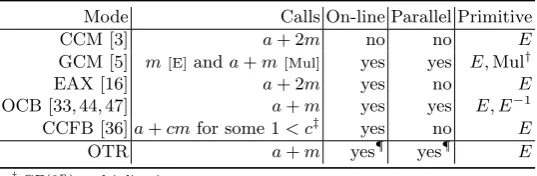
These features are realized with a novel usage of two-round Feistel permutation, where internal round functions are PRFs with input masking. From this we call our proposal OTR, for Offset Two-round. Table 1 provides a summary of properties of popular AE modes and ours, which shows that OTR attains similar characteristics as the seminal OCB mode, without using the inverse blockcipher. The proposed scheme generates
⋆
input masks toEK using GF(2n) constant multiplications. This technique is called GF doubling [44], which is a quite popular tool for mode design. However, our core idea is rather generic and thus allows other masking methods. We also remark that Liting et al.’s iFeed mode [51] has similar properties to ours, without introducing 2-block partition. However, its decryption is inherently serial. In return for these attractive features, one potential drawback of OTR is that it inherently needs two-block partition (though the message itself can be of any length in bits), which implies more state memories required than that of OCB. The parallelizability of our scheme is up to the half of the message blocks, while OCB has full parallelizability, up to the number of message blocks. On-line processing capability is restrictive as it needs buffering of consecutive two input blocks.
We also warn that the security is proved for the standard nonce-respecting adversary [45], i.e. the encryption never processes duplicate nonces (or initial vectors), see Section 2.2. Some recent proposals have a provable se-curity under nonce-reusing adversary, or even sese-curity without nonce (called on-line encryption) [9,25]. However we do not claim any security guarantee for such adversaries.
Table 1.A comparison of AE modes. Calls denotes the number of calls form-block message anda-block header and one-block nonce, without constants.
Mode Calls On-line Parallel Primitive
CCM [3] a+ 2m no no E
GCM [5] m[E]anda+m[Mul] yes yes E,Mul†
EAX [16] a+ 2m yes no E
OCB [33, 44, 47] a+m yes yes E, E−1 CCFB [36]a+cmfor some 1< c‡ yes no E
OTR a+m yes¶ yes¶ E
†GF(2n) multiplication
‡Security degrades ascapproaches 1 ¶two-block partition
Benefits of inverse-freeness. The use of blockcipher inversion, as in OCB, has mainly two drawbacks, as discussed by Iwata and Yasuda [30]. The first is efficiency. The integration of encryption and decryption functions increases size, e.g. footprint of hardware, or memory of software (See Section 6). Moreover, some ciphers have unequal speed for enc/dec. For AES, decryption is slower than encryption on some, typically constrained, platforms. For example, an AES implementation on Atmel AVR by Osvik et al. [41] has about 45% slower decryption than encryption. This property is the initial design choice [23], in preference of encryption-only mode, e.g., CTR, OFB, and CFB. IDEA is another example, where decryption is exceptionally slower than encryption on microcontrollers [43]. The uneven performance figures of blockcipher enc/dec functions is undesirable in practice, when the mode uses both functions.
The second is security. Usually the security of a mode using both enc/dec functions of a blockcipher, denoted byE andE−1, needs (E, E−1) to be a strong pseudorandom permutation (Strong PRP or SPRP). This holds
true for the original security proofs of all versions of OCB [33, 44, 47], though a recent work of Aoki and Yasuda [11] showed a relaxation on the security condition for OCB. In contrast, when the mode uses only E, the security assumption is relaxed to PRP or PRF.
In addition, the inverse-freeness allows instantiations using non-blockcipher primitives, such as a hash func-tion. Some basic ideas on this direction are explained in Section 7.4.
Hardware assistance. We remark that some software platforms have hardware-assisted blockcipher, most notably AES instructions called AESNI in Intel CPUs. AMD CPUs also have an equivalent set. AESNI enables the same performance for AES encryption and decryption. Therefore, when our proposal uses AESNI, the performance would be roughly similar to that of OCB-AES with AESNI, though the increased number of states may degrade the result. We have other SW platforms where hardware AES is available but decryption is slower (e.g., [27]). Basically, the value of our proposal isnot to provide the fastest operation on modern CPUs, instead, to increase the availability of OCB-like performance for various platforms, using single algorithm.
2
Preliminaries
2.1 Basic Notations
LetN={1,2, . . . ,}, and let{0,1}∗ be the set of all finite-length binary strings, including the empty string ε. The bit length of a binary string X is denoted by |X|, and let |X|a
def
= max{⌈|X|/a⌉,1}. Here, ifX = ε we have |X|a = 1 for anya≥1 and|X|= 0. A concatenation of X, Y ∈ {0,1}∗ is written asX∥Y or simplyXY. A sequence of a zeros is denoted by 0a. For k ≥ 1, we denote ∪ki=1{0,1}i by {0,1}≤k. For X ∈ {0,1}∗, let (X[1], . . . , X[x])←n X denote then-bit block partitioning ofX, i.e.,X[1]∥X[2]∥. . .∥X[x] =X wherex=|X|n, and |X[i]| =n for i < xand |X[x]| ≤ n. If X = εthe parsing with any n ≥1 makes x= 1, X[1] =ε. The sequence of firstcbits ofX ∈ {0,1}∗ is denoted bymsbc(X). We havemsb0(X) =εfor anyX.
For a finite set X, ifX is uniformly chosen fromX we writeX← X$ . We assumeX⊕Y isεifX orY isε. For a binary stringX with 0≤ |X| ≤n, X denotes the padding written asX∥1∥0n−|X|−1. When|X|=n,X
denotesX.
For keyed function F : K × X → Y with key K ∈ K, we may simply write FK : X → Y if key space is obvious, or even write as F if being keyed with K is obvious. If EK : X → X is a keyed permutation, or a blockcipher, EK is a permutation over X for every K ∈ K. Its inverse is denoted by EK−1. A keyed function may have an additional parameter called tweak, in the sense of Liskov, Rivest and Wagner [34]. It is called a tweakable keyed function and written as Fe : K × T × X → Y or FeK : T × X → Y, where T denotes the space of tweaks. Instead of writingFeK(T, X), we may write asFe⟨
T⟩
K (X). A tweakable keyed permutation, or a tweakable blockcipher (TBC), is defined analogously by requiring that every combination of (T, K) produces a permutation overX.
Galois field. Ann-bit string X may be viewed as an element of GF(2n) by takingX as a coefficient vector of a polynomial in GF(2n). Following Rogaway [44], we write 2X to denote the multiplication of 2 andX over GF(2n), where 2 denotes the generator of the field GF(2n), by seeing 2 as
xin the polynomial representation. This operation is calleddoubling. Similarly we write 3X (where the corresponding polynomial isx+1) and 22X
to denote 2X⊕X and 2(2X), and 7X to denote 2(2X)⊕2X ⊕X. We may write 4X to denote 22X. The
doubling can be efficiently computed by one-bit shift with conditional XOR of a constant, and other constant multiplications can be done by combining doubling and XOR, as shown above. There operations are frequently used as a tool to build efficient blockcipher modes, e.g. [16, 28, 44].
Throughout the paper we assumen= 128 and the corresponding field GF(2n) is defined over the polynomial
x128+x7+x2+x1+1, which is lexicographically-first primitive (thus irreducible) polynomial and is quite popular for doubling-based tweaks. The scheme itself is general and is easily extended to other block sizes, however care must be taken since masking coefficients are specific to the choice ofnand the polynomial defining the field.
2.2 Random Function and Pseudorandom Function
Let Func(n, m) be the set of all functions {0,1}n → {0,1}m. In addition, let Perm(n) be the set of all per-mutations over {0,1}n. A uniform random function (URF) having n-bit input and m-bit output is uniformly distributed over Func(n, m). It is denoted by R←$ Func(n, m). Ann-bit uniform random permutation (URP), denoted byP, is similarly defined asP←$ Perm(n).
We also define tweakable URF and URP. Let T be a set of tweak and FuncT(n, m) be a set of functions
T × {0,1}n → {0,1}m. A tweakable URF with tweak T ∈ T, and n-bit input, m-bit output is written as
e
R←$ FuncT(n, m). Note that ifT ={0,1}t, FuncT(n, m) has the same cardinality as Func(n+t, m), henceeRis simply realized with URF of (n+t)-bit input. In addition, let PermT(n) be a set of functionsT ×{0,1}n→ {0,1}n such that, for any f ∈ PermT(n) and t ∈ T, f(t,∗) is a permutation. A tweakable n-bit URP with tweak T ∈ T is defined as eP ←$ PermT(n). We also define a URF having variable input length (VIL), denoted by
R∞:{0,1}∗→ {0,1}n. This can be realized by stateful lazy sampling.
PRF.Forcoracles,O1, O2, . . . , Oc, we writeAO1,O2,...,Octo represent the adversaryAaccessing thesecoracles in an arbitrarily order. If O and O′ are oracles having the same input and output domains, we say they are compatible. LetFK :{0,1}n → {0,1}m andGK′ :{0,1}n→ {0,1}mbe two compatible keyed functions, with K∈ Kand K′ ∈ K′ (key spaces are not necessarily the same). Let Abe an adversary trying distinguish them using chosen-plaintext queries. Then the advantage ofAis defined as
AdvcpaF
K,GK′(A)
def
The above definition can be naturally extended to the case whenGK′ is a URF,R $
←Func(n, m). We have
AdvprfF K(A)
def =AdvcpaF
K,R(A).
If FK is a VIL function we define AdvprfFK(A) as Adv cpa
FK,R∞(A). Similarly, for tweakable keyed function FeK : T × {0,1}n→ {0,1}mandRe $
←FuncT(n, m), we have
Advprfe
FK
(A)def=Advcpae
FK,eR
(A).
We stress that A in the above is allowed to choose tweaks, arbitrarily and adaptively. By convention we say FK is a pseudorandom function (PRF) if AdvprfFK(A) is small (though the formal definition requires FK to be
a function family). Similarly we say FK is a pseudorandom permutation (PRP) ifAdvprpFK(A) = Adv cpa
FK,P(A) is
small andFK is invertible. A VIL-PRF is defined in a similar way.
2.3 Definition of Authenticated Encryption
Following [16, 45], we define nonce-based AE, or more formally, AE with associated data, called AEAD. We then introduce two security notions, privacy and authenticity, to model AE security.
Definition. LetAE[τ] be an AE havingτ-bit tag, where the encryption and decryption algorithms are AE-Eτ and AE-Dτ. They are keyed functions. Besides the key, the input to AE-Eτ consists of a nonce N ∈ Nae, an associated data (AD, or a header)A∈ Aae, and a plaintextM ∈ Mae. The output consists ofC ∈ Mae and T ∈ {0,1}τ, where|C| =|M|. The tuple (N, A, C, T) will be sent to the receiver. The decryption function is denoted byAE-Dτ. It takes (N, A, C, T)∈ Nae×Aae×Mae×{0,1}τ, and outputs a plaintextM with|M|=|C| if input is determined as valid, or error symbol⊥if determined as invalid.
Security.A PRIV-adversaryAagainstAE[τ] accessesAE-Eτ, where thei-th query consists of nonceNi, header Ai, and plaintext Mi. We define A’s parameter list to be (q, σA, σM), whereqdenotes the number of queries, andσA
def
=∑qi=1|Ai|nandσM def
=∑qi=1|Mi|n. We assumeAis nonce-respecting, i.e., allNis are distinct. We also define random-bit oracle, $, which takes (N, A, M)∈ Nae×Aae×Maeand returns (C, T)
$
← {0,1}|M|×{0,1}τ. The privacy notion forAis defined as
AdvprivAE[τ](A)def= Pr[K← K$ :AAE-Eτ ⇒1]−Pr[A$⇒1]. (1)
An AUTH-adversaryAagainstAE[τ] accessesAE-Eτ andAE-Dτ, usingqencryption queries andqv decryption queries. Let (N1, A1, M1), . . . ,(Nq, Aq, Mq) and (N1′, A′1, C1′, T1′), . . . ,(Nq′v, A
′
qv, C
′
qv, T
′
qv) be all the encryption
and decryption queries made byA. We define A’s parameter list to be (q, qv, σA, σM, σA′, σC′), where σA′ def =
∑qv
i=1|A′i|n andσC′ def =∑qv
i=1|Ci′|n, in addition toσA andσM. The authenticity notion for the AUTH-adversary
Ais defined as
AdvauthAE[τ](A)def= Pr[K← K$ :AAE-Eτ,AE-Dτ forges ], (2)
where A forges if AE-Dτ returns a bit string (other than⊥) for a decryption query (Ni′, A′i, Ci′, Ti′) for some 1 ≤ i ≤ qv such that (Ni′, A′i, Ci′, Ti′) ̸= (Nj, Aj, Cj, Tj) for all 1 ≤ j ≤q. We assume AUTH-adversary A is always nonce-respecting with respect to encryption queries; using the same N for encryption and decryption queries is allowed, and the same N can be repeated within decryption queries, i.e.Ni is different fromNj for anyj̸=ibut N′i may be equal toNj or Ni′′ for somej andi′̸=i.
Moreover, whenFKandGK′ are compatible withAE-Eτ, letAdvcpa-nrF,G (A) be the same function asAdv
cpa
F,G(A) butAis restricted to be nonce-respecting. Note thatAdvprivAE[τ](A) =Advcpa-nrAE-E
τ,$(A) holds for any nonce-respecting A. In addition whenFK andGK′ are the pairs of encryption and decryption functions written asFK = (FKe, FKd) andGK′ = (GeK′, G
d
K′) and they are compatible with (AE-Eτ,AE-Dτ), we define
Advcca-nrF,G (A)def= Pr[K← K$ :AFKe,FKd ⇒1]−Pr[K′← K$ ′:AGeK′,GdK′ ⇒1], (3)
whereAis assumed to be nonce-respecting for encryption queries. Then we have
AdvauthAE[τ](A)≤Advcca-nrAE[τ],AE′[τ](A) +AdvAEauth′[τ](A) (4)
3
Specification of OTR
We present an AE scheme based on an EK : {0,1}n → {0,1}n, which is denoted by OTR[E, τ], whereτ ∈
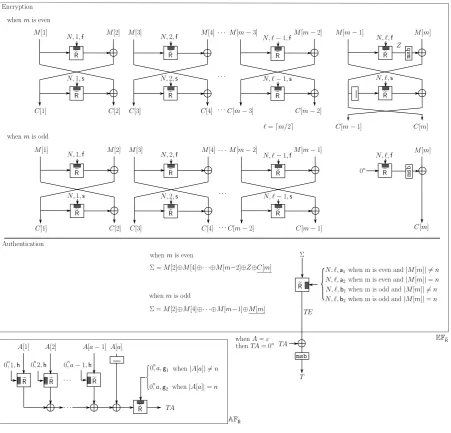
{1, . . . , n}denotes the length of tag. The encryption function and decryption function of OTR[E, τ] are denoted by OTR-EE,τ and OTR-DE,τ. Here OTR-EE,τ (OTR-DE,τ) has the same interface asAE-Eτ (AE-Dτ) of Section 2.3, with nonce spaceNae={0,1}≤n−1 (which excludesεby definition), header spaceAae ={0,1}∗, message spaceMae ={0,1}∗, and tag space{0,1}τ. The functions OTR-EE,τ and OTR-DE,τ are further decomposed into the encryption and decryption cores, EFE, DFE, and the authentication core, AFE. Figs. 1 and 2 show the scheme. As shown by Fig. 2, OTR consists of two-round Feistel permutations using a blockcipher taking a distinct input mask in each round. To authenticate the plaintext a check sum is computed for the right part of two-round Feistel (namely the even plaintext blocks), and the tag is derived from encrypting the check sum with an input mask. The overall structure has a similarity to OCB, and the function AFE is a variant of PMAC [44]. We also show Fig. 6 as an alternative representation of Fig. 1 to make explicit the used constants over GF(2n) for masking.
4
Security Bounds
We provide the security bounds of OTR. Here we assume the underlying blockcipher is an n-bit URP, P. The bounds when the underlying blockcipher is a PRP are easily derived from our bounds, using a standard technique, thus omitted.
Theorem 1. Fixτ ∈ {1, . . . , n}. For any PRIV-adversaryA with parameter(q, σA, σM),
AdvprivOTR[P,τ](A)≤6σ
2 priv
2n holds forσpriv=q+σA+σM.
Theorem 2. Fixτ ∈ {1, . . . , n}. For any AUTH-adversaryAwith parameter (q, qv, σA, σM, σA′, σC′),
AdvauthOTR[P,τ](A)≤ 6σ
2 auth
2n + qv 2τ holds forσauth=q+qv+σA+σM +σA′+σC′.
5
Proofs of Theorems 1 and 2
Overview. The proofs of Theorems 1 and 2 consist of two steps, where in the first step we interpret OTR as a mode of TBC and in the second step we prove the indistinguishability between the tweakable URF and the TBC used in OTR. This structure is essentially the same as original OCB proofs, say by Rogaway [44], as well as many other schemes based on TBC.
First step: TBC-based design. In the first step, we define an AEAD scheme denoted by OTR[τ], which we may abbreviate OTR if τ is obvious. It is compatible with OTR[E, τ] and uses a tweakable n-bit URF,
e
R:T × {0,1}n→ {0,1}n. Here, tweakT∈ T is written asT = (x, i, ω)∈ N′
ae×N×Ω, whereNae′ =Nae∪{0n} and Ω def= {f,s,a1,a2,b1,b2,h,g1,g2}. The encryption and decryption functions of OTR[τ] are OTR-Eτ and OTR-Dτ, and they consist of encryption coreEFeR, decryption coreDFeR, and authentication coreAFeR, as shown by Fig. 4. For referenceOTRis also illustrated in Fig. 5. They can be seen as counterparts of EFE, DFE, and AFE of OTR[E, τ]. Fig. 4 also defines OTR′[τ], which uses an independent VIL-URF,R∞ :{0,1}∗→ {0,1}n, instead ofAFeR. We first derive the security bounds ofOTR′[τ] in the following theorem. The proof of Theorem 3 is given in Appendix A.
Theorem 3. Fixτ ∈ {1, . . . , n}. For any PRIV-adversaryA,
AdvprivOTR′[τ](A) = 0.
Moreover, for any AUTH-adversary Ausingq encryption queries andqv decryption queries,
AdvauthOTR′[τ](A)≤
2qv 2n +
AlgorithmOTR-EE,τ(N, A, M)
1. (C, TE)←EFE(N, M)
2. ifA̸=ε thenTA←AFE(A)
3. elseTA←0n 4. T←msbτ(TE⊕TA)
5. return(C, T)
AlgorithmOTR-DE,τ(N, A, C, T)
1. (M, TE)←DFE(N, C)
2. if A̸=εthen TA←AFE(A)
3. else TA←0n 4. Tb←msbτ(TE⊕TA)
5. if Tb=T returnM 6. else return⊥
AlgorithmEFE(N, M)
1. Σ←0n
2. U←E(N),L←U,L♯←3U 3. (M[1], . . . , M[m])←n M 4. fori= 1 to⌈m/2⌉ −1do
5. C[2i−1]←E(L⊕M[2i−1])⊕M[2i] 6. C[2i]←E(L♯⊕C[2i−1])⊕M[2i−1] 7. Σ←Σ⊕M[2i]
8. L←L⊕L♯,L♯←2L♯ //L= 2iU,L♯= 2i3U 9. ifm is even
10. Z ←E(L⊕M[m−1]) 11. C[m]←msb|M[m]|(Z)⊕M[m]
12. C[m−1]←E(L♯⊕C[m])⊕M[m−1]
13. Σ←Σ⊕Z⊕C[m] 14. L∗←L♯
15. ifm is odd
16. C[m]←msb|M[m]|(E(L))⊕M[m]
17. Σ←Σ⊕M[m] 18. L∗←L
19. if|M[m]| ̸=n thenTE←E(32L∗⊕Σ) 20. elseTE←E(7L∗⊕Σ)
21. C←(C[1], . . . , C[m]) 22. return(C, TE)
AlgorithmDFE(N, C)
1. Σ←0n
2. U ←E(N),L←U,L♯←3U 3. (C[1], . . . , C[m])←n C 4. for i= 1 to ⌈m/2⌉ −1do
5. M[2i−1]←E(L♯⊕C[2i−1])⊕C[2i]
6. M[2i]←E(L⊕M[2i−1])⊕C[2i−1] 7. Σ←Σ⊕M[2i]
8. L←L⊕L♯,L♯←2L♯ //L= 2iU,L♯= 2i3U 9. if mis even
10. M[m−1]←E(L♯⊕C[m])⊕C[m−1]
11. Z←E(L⊕M[m−1]) 12. M[m]←msb|C[m]|(Z)⊕C[m]
13. Σ←Σ⊕Z⊕C[m] 14. L∗←L♯
15. if mis odd
16. M[m]←msb|C[m]|(E(L))⊕C[m]
17. Σ←Σ⊕M[m] 18. L∗←L
19. if |C[m]| ̸=nthen TE←E(32L∗⊕Σ) 20. else TE←E(7L∗⊕Σ)
21. M ←(M[1], . . . , M[m]) 22. return(M, TE)
AlgorithmAFE(A)
1. Ξ←0n 2. Q←E(0n)
3. (A[1], . . . , A[a])←n A 4. fori= 1 toa−1do
5. Ξ←Ξ⊕E(Q⊕A[i]) 6. Q←2Q
7. Ξ←Ξ⊕A[a]
8. if|A[a]| ̸=nthen TA←E(3Q⊕Ξ) 9. elseTA←E(32Q⊕Ξ)
10. returnTA
Fig. 2.Encryption of OTR. Box with underline andX denote the 10∗padding of inputX.
Proof intuition of Theorem 3. To understand Theorem 3, there are two important properties of a two-round Feistel permutation, denoted byϕf1,f2 :{0,1}
2n→ {0,1}2n. Hereϕ
f1,f2(X[1], X[2]) = (Y[1], Y[2]) where Y[1] =f1(X[1])⊕X[2] and Y[2] =f2(Y[1])⊕X[1] andf1 andf2 are independentn-bit URFs. Then we have
the followings.
Property 1. For any (X[1], X[2])∈ {0,1}2n,ϕ
f1,f2(X[1], X[2]) is uniformly random.
Property 2. Let (Y[1], Y[2]) =ϕf1,f2(X[1], X[2]), and let (Y′[1], Y′[2]) be a function of (X[1], X[2], Y[1], Y[2]) satisfying (Y′[1], Y′[2]) ̸= (Y[1], Y[2]). Then X′[2], where (X′[1], X′[2]) = ϕ−f1
1,f2(Y
′[1], Y′[2]), is uniform
unless the event Bad1:X[1] =X′[1] occurs, which has the probability at most 1/2n.
Property 1 is simple becausef1andf2are independent and the output ofϕconsists of those off1andf2.
Prop-erty 2 needs some cares. It holds because ifX[1]̸=X′[1] =f2(Y′[1])⊕Y′[2],f1(X′[1]) is distributed uniformly
random, independent of all other variables, and this makes X′[2] =f1(X′[1])⊕Y′[1] completely random. The
Bad1event has probability 1/2n whenY′[1]̸=Y′[1], and otherwise 0. Note that (X[1], X[2], Y[1], Y[2]) reveals
corresponding I/O pairs off1andf2, however this does not help gain the probability ofBad1.
Property 1, this makes all output blocks perfectly random, hence the privacy bound is 0. For the authenticity bound, suppose adversaryAperforms an encryption query (N, A, M) and obtains (C, T), and then performs a decryption query (N′, A′, C′, T′) for someC̸=C′with|C|=|C′|, with (N′, A′) = (N, A). This implies that there exists at least one chunk (2n-bit block) ofC′ different from the corresponding chunk inC, and from Property 2, the right half of the corresponding decrypted plaintext chunk is completely random, unlessBad1occurs. There
is another chance for the adversary to win, i.e. the checksum collision Bad2 :Σ′ =Σ, which has probability
1/2n providedBad1 did not happen. Hence we have Pr[Bad1∪Bad2]≤Pr[Bad1] + Pr[Bad2|Bad1]≤2/2n. When
both events did not happen (i.e. given Bad1∪Bad2), the final chance is to successfully guess the tag, where
the probability is clearly bounded by 1/2τ because different checksums yield independent tags. Hence the authenticity bound is 2/2n+ 1/2τ for anyA using qv = 1 decryption query (of course we need to consider the existence of other encryption queries and many other cases for (N′, A′, C′, T′) as well, however the above bound holds for all cases). Finally we use a well-known result of Bellare, Goldreich and Mityagin [13] to obtain 2qv/2n+qv/2τ for anyqv≥1.
AlgorithmG[eP]⟨N,i,ω⟩(X)
1. Preprocessing: Q←P(0n) 2. if N̸= 0n thenL←P(N)
3. switchω
4. Casef: ∆←2i−1L
5. Cases: ∆←2i−13L 6. Casea1 :∆←2i−133L
7. Casea2 :∆←2i−1317L
8. Caseb1 :∆←2i−132L
9. Caseb2 :∆←2i−17L
10. else switch ω
11. Caseh: ∆←2i−1Q
12. Caseg1 :∆←2i−13Q 13. Caseg2 :∆←2i−132Q
14. Y ←P(∆⊕X) 15. returnY
Fig. 3.Tweakable permutation of OTR[P, τ], denoted byG[eP].
Second step: analysis of TBC.In Fig. 3 we define a TBC,G[eP]⟨N,i,ω⟩(X), where (N, i, ω) is a tweak. It uses ann-bit URP, P. We remark that G[eP] slightly abuse N as it allows N = 0n, making N to be an element of
N′
ae. For tweaks that do not appear in Fig. 3, we let them as undefined. We observe that G[eP] is compatible with eR, the tweakable URF used by (components of) OTR[τ] andOTR′[τ], and in addition G[eP] is implicitly used by OTR[P, τ], where the usage is the same as the wayOTR[τ] useseR. More formally, we have the following proposition.
Proposition 1. If EFeR andDFeR useG[eP] instead of Re, we obtainEFP andDFP. Similarly if AFeR uses G[eP]
instead ofRe we obtain AFP.
Note thatG[eP] does not perform GF doublings in a sequential manner, instead a full multiplications for every input. This is inefficient in practice, however does not cause a problem for simulation purpose. We then prove thatG[eP] is a secure tweakable URF, shown by the following lemma.
Lemma 1. For any adversaryA accessingG[eP] withq queries, we haveAdvcpae
G[P],eR(A)≤5q
2/2n.
We also provide the indistinguishability bound between AFReandR∞, which is as follows.
Lemma 2. For anyA withσ input blocks, we haveAdvprfAF
e
R(A)≤σ 2/2n+1.
Third step: deriving bounds.For privacy notion, there exist adversariesBagainstAFeRwithσAinput blocks, andC againstG[eP] withσprivqueries, satisfying
AdvprivOTR[P,τ](A)≤Advcpa-nrOTR[P,τ],OTR[τ](A) +Advcpa-nrOTR[τ],OTR′[τ](A) +Adv cpa-nr
OTR′[τ],$(A) (5) ≤Advcpa-nrOTR[P,τ],OTR[τ](A) +AdvcpaAF
e
R,R∞(B) +Adv cpa-nr
OTR′[τ],$(A) (6) ≤Advcpae
G[P],eR(C) +
σ2
A
2n+1 (7)
≤5σ 2 priv
2n + σ2
A
2n+1 (8)
≤6σ 2 priv
2n . (9)
where the third inequality follows from Proposition 1, Lemma 2, and Theorem 3, and the fourth inequality follows from Lemma 1. Similarly, for authenticity notion, there existBagainstAFeRwithσA+σA′ input blocks, andC againstG[eP] withσauthqueries, satisfying
AdvauthOTR[P,τ](A)≤Advcca-nrOTR[P,τ],OTR′[τ](A) +AdvOTRauth′[τ](A) (10) ≤Advcca-nrOTR[P,τ],OTR[τ](A) +Advcca-nrOTR[τ],OTR′[τ](A) +AdvauthOTR′[τ](A) (11) ≤Advcca-nrOTR[P,τ],OTR[τ](A) +Adv
cpa AFeR,R∞
(B) +AdvauthOTR′[τ](A) (12)
≤Advcpae
G[P],eR(C) +
(σA+σA′)2 2n+1 +
2qv 2n +
qv
2τ (13)
≤5σauth2
2n +
(σA+σA′)2 2n+1 +
2σA′ 2n +
qv
2τ (14)
≤6σauth2
2n + qv
2τ, (15)
where the fourth inequality follows from Proposition 1, Lemma 2, and Theorem 3, and the fifth inequality follows from Lemma 1. This concludes the proof.
6
Experimental Results on Software
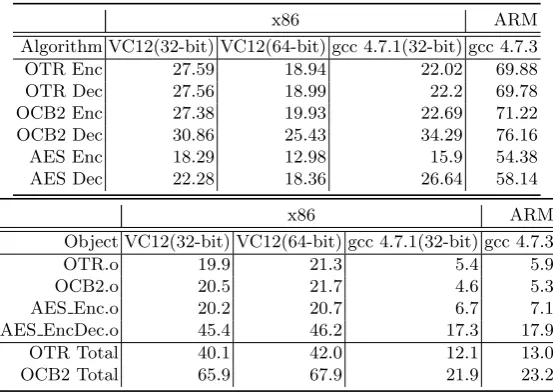
We implemented OTR on software. The purpose of this implementation is not to provide a fast code, but to see the effect of inverse-freeness in an experimental environment. We wrote a reference-like AES C code that takes byte arrays and uses 4Kbyte tables for combined S-box and Mixcolumn lookup, so-called T-tables. AES decryption of our code is slightly slower than encryption (see Table 2). We then wrote pure C code of OTR using the above AES code. All components, e.g. XOR of blocks and GF doubling, are byte-wise codes. For comparison we also wrote a C code of OCB2 [44] in the same manner, which is similar to a reference code by Krovetz [2].
We ran both codes on an x86 PC (Core i7 3770, Ivy bridge, 3.4GHz) with 64-bit Windows 7. We used Visual C++ 2012 (VC12) to obtain 32-bit and 64-bit executables and used GCC 4.7.1 for 32-bit executables, with option-O2. We measured speed for 4Kbyte messages and one-block header. We also tested the same code on an ARM board (Cortex-A8 1GHz) using GCC 4.7.3 with-O2option. Their speed figures in cycles per byte1 are shown in the upper part of Table 2. For both OTR and OCB2, we can observe a noticeable slowdown from raw AES, however, OTR still receives the benefit of faster AES encryption. Another metric is the size, which is shown in the lower part of Table 2. For OTR we can remove the inverse T-tables and inverse S-box from AES code, as they are not needed for AES encryption, resulting in smaller AES objects.
We also measured the performance of these codes when AES is implemented using AESNI (on the Core i7 machine, using VC12). We simply substituted T-table AES with single-block AES routine using AESNI. In addition, two common functions to OCB2 and OTR, namely XOR of two 16-byte blocks and GF doubling, are substituted with SIMD intrinsic codes. Other byte-wise functions are unchanged. On our machine single-block AES ran at around 4.5 to 5.5 cycles per byte, for both encryption and decryption. Table 3 shows the results. It looks interesting, in that, although we did not write a parallel AESNI routine, we could observe the obvious
1
Table 2.Reference implementation results of OTR and OCB2. (Upper) Speed in cycles per byte. (Lower) Object size in Kbyte.
x86 ARM
Algorithm VC12(32-bit) VC12(64-bit) gcc 4.7.1(32-bit) gcc 4.7.3 OTR Enc 27.59 18.94 22.02 69.88 OTR Dec 27.56 18.99 22.2 69.78 OCB2 Enc 27.38 19.93 22.69 71.22 OCB2 Dec 30.86 25.43 34.29 76.16 AES Enc 18.29 12.98 15.9 54.38 AES Dec 22.28 18.36 26.64 58.14
x86 ARM
Object VC12(32-bit) VC12(64-bit) gcc 4.7.1(32-bit) gcc 4.7.3
OTR.o 19.9 21.3 5.4 5.9
OCB2.o 20.5 21.7 4.6 5.3
AES Enc.o 20.2 20.7 6.7 7.1
AES EncDec.o 45.4 46.2 17.3 17.9
OTR Total 40.1 42.0 12.1 13.0
OCB2 Total 65.9 67.9 21.9 23.2
effect of AESNI parallelism via compiler. Notably, both OTR and OCB2 achieved about 2 cycles per byte for 4K data, and OCB2 is slightly faster as expected. We think further optimization of OTR would be possible by using parallel AES routine with full utilization of SIMD instructions and a careful register handling in a similar manner to OCB, e.g. see a recent report by Bogdanov et al. [20].
These experiments, though quite naive, imply OTR’s good performance under multiple platforms with a simple code. Of course, optimized implementations for various platforms are interesting future topics.
Table 3. Performance of codes with single-block AES routine using AES-NI. Data xdenotes the plaintext length in bytes, anda/bdenotesa(b) cycles per byte in 32-bit (64-bit) VC12 compilation.
Data (byte) 128 512 1024 2048 4096 OTR Enc 6.01/5.43 3.32/3.16 2.85/2.74 2.66/2.51 2.49/2.40 OTR Dec 7.22/5.60 3.81/3.15 3.06/2.72 2.79/2.51 2.59/2.39 OCB2 Enc 6.39/5.60 3.26/2.76 2.81/2.26 2.53/2.02 2.37/1.90 OCB2 Dec 6.36/5.86 3.04/2.80 2.59/2.26 2.28/2.03 2.11/1.91
7
Remarks
7.1 Remove Inverse from OCB
The abstract structure of OTR has a similarity to OCB, however, removing inverse is not a trivial task. Roughly, in OCB, each plaintext block is given to the ECB mode of an n-bit TBCEeK [34], namelyC[i] = Ee⟨
unpredictable value in the decryption, rather than 2nbits. Two-round Feistel fulfills these requirements, which makes OTR provably secure.
7.2 Design Rationale for Masking
We remark that using the same mask for the two round functions, i.e. using 2iL for the first and second rounds of a two-round Feistel, does not work. This is because Property 2 of Section 5 does not hold anymore since the two-round Feistel becomes an involution. Once you query (X[1], X[2]) and receive (Y[1], Y[2]) = ϕf1,f2(X[1], X[2]), you know X′[2] = Y[2] always holds (where (X′[1], X′[2]) = ϕ−
1
f1,f2(Y
′[1], Y′[2])), when
(Y′[1], Y′[2]) = (X[1], X[2]). This implies that the adversary can control the checksum value in the decryp-tion, hence breaks authenticity.
We also remark that the masks for EFE depend onN, hence do not allow precomputation. In contrast the latest OCB3 allows mask precomputation by using EK(0n) [33]. The reason is that we want our scheme not to generate EK(0n) for header-less usage (i.e. whenA is always empty). As a result our scheme has a rather similar structure as OCB2 and an AEAD mode based on OCB2, called AEM [44]. Recent studies reported that the doubling is not too slow [10], hence we employ on-the-fly doubling as a practical masking option.
7.3 Comparison with Other Inverse-free Modes
Section 6 only considers a comparison with OCB. Here we provide a basic comparison with other modes, in particular those not using the blockcipher inverse. Table 1 shows examples of such inverse-free modes. Among them, CCM, GCM, and EAX are rate-2, assuming the speed of field multiplication in GCM is comparable with blockcipher encryption. At least in theory, OTR is faster for sufficiently long messages for its rate-1 computation. For CCFB, the ratec is a variable satisfying 1< cand c≈1 is impractical for weak security guarantee2. For memory consumption, all inverse-free modes including OTR have a similar profile, as long as the blockcipher encryption is the dominant factor. An exception is GCM since field multiplication usually needs large memories. At the same time, a potential disadvantage of OTR is the complexity introduced by the two-round Feistel, such as a limited on-line/parallel capability, and a slight complex design compared with simple designs reusing existing modes like CTR, CFB, and CMAC.
7.4 Other Instantiations
As the core idea of our proposal is general, it allows various instantiations, by seeing OTR or OTR′ as a prototype. What we need is just to instantiateRe acceptingn-bit input and tweak (N, i, ω), and producingn-bit output. While we employ GF doubling, one can use a different masking scheme, such as Gray code [33, 47], or word-oriented LFSR [22,33,50], or bit-rotation of a special prime length [39]. Moreover, we can use non-invertible cryptographic primitives, typically a Hash-based PRF such as HMAC, or a permutation of Keccak [17] with Even-Mansour conversion [24] for implementing a component of OTR. In the latter case the resulting scheme does not need an inversion of the permutation, which is different from the permutation-based OCB described at [40], and there is no output loss like “capacity” bits of SpongeWrap [18]. In these settings, it is possible that the underlying primitive accepts longer input than output. Then a simple tweaking method by tweak prepending can be an option. For example we take SipHash [12], which is a VIL-PRF with 64-bit output. A SipHash-based scheme would be obtained by replacingeR⟨N,i,ω⟩(X) ofOTR′(Fig. 4) with SipHashK(N∥i∥ω∥X), and replacingR∞(X) with SipHashK(0n∥0∥
h∥X), accompanied with an appropriate input encoding. As SipHash has an iterative structure, a caching of an internal value allows efficient computation of SipHashK(N∥i∥ω∥X) from SipHashK(N∥i′∥ω′∥X′). We remark that this scheme has roughly 64-bit security. The proof is trivial from Theorem 3, combined with the assumption that SipHash is a VIL-PRF.
8
Conclusion
This paper has presented an authenticated encryption scheme using a PRF. This scheme enables rate-1, on-line, and parallel processing for both encryption and decryption. The core idea of our proposal is to use two-round
2
Feistel permutation with input masking, combined with a message check sum. As a concrete instantiation we provide a blockcipher mode, called OTR, entirely based on a blockcipher encryption function, which may be seen as an “inverse-free” version of OCB. Our proposal has a higher complexity than OCB outside the blockcipher, hence it will not outperform OCB when the blockcipher enc/dec functions are natively supported and equally fast (say CPU with AESNI), despite the relaxed security assumption. Still, our proposal would be useful for various other environments where the use of blockcipher inverse imposes a non-negligible cost, or when the available crypto function is simply not invertible.
Acknowledgments. The author would like to thank anonymous reviewers at Eurocrypt 2014 for careful reading and invaluable suggestions, which greatly improved the presentation of the paper. The author also would like to thank Tetsu Iwata for fruitful discussions, and Sumio Morioka and Tomoyasu Suzaki for useful comments on implementation aspects, and Martin M. Lauridsen for feedback on the initial ePrint report, and Raphael Bost and Olivier Sanders for their report and the subseqent paper on the tweak of initial specification.
References
1. CAESAR (Competition for Authenticated Encryption: Security, Applicability, and Robustness), http:// competitions.cr.yp.to/index.html/
2. Reference C code of OCB2,http://www.cs.ucdavis.edu/~rogaway/ocb/code-2.0.htm/
3. Recommendation for Block Cipher Modes of Operation: The CCM Mode for Authentication and Confidentiality . NIST Special Publication 800-38C (2004), national Institute of Standards and Technology.
4. Recommendation for Block Cipher Modes of Operation: The CMAC Mode for Authentication. NIST Special Publi-cation 800-38B (2005), national Institute of Standards and Technology.
5. Recommendation for Block Cipher Modes of Operation: Galois/Counter Mode (GCM) and GMAC. NIST Special Publication 800-38D (2007), national Institute of Standards and Technology.
6. Information Technology - Security techniques - Authenticated encryption, ISO/IEC 19772:2009. International Stan-dard ISO/IEC 19772 (2009)
7. Anderson, E., Beaver, C.L., Draelos, T., Schroeppel, R., Torgerson, M.: ManTiCore: Encryption with Joint Cipher-State Authentication. In: Wang, H., Pieprzyk, J., Varadharajan, V. (eds.) ACISP. Lecture Notes in Computer Science, vol. 3108, pp. 440–453. Springer (2004)
8. Anderson, E., Beaver, C.L., Draelos, T., Schroeppel, R., Torgerson, M.: Manticore and CS mode: parallelizable encryption with joint Cipher-State authentication (2014)
9. Andreeva, E., Bogdanov, A., Luykx, A., Mennink, B., Tischhauser, E., Yasuda, K.: Parallelizable and Authenticated Online Ciphers. In: Sako, K., Sarkar, P. (eds.) ASIACRYPT (1). Lecture Notes in Computer Science, vol. 8269, pp. 424–443. Springer (2013)
10. Aoki, K., Iwata, T., Yasuda, K.: How Fast Can a Two-Pass Mode Go? A Parallel Deterministic Authenticated Encryption Mode for AES-NI. DIAC 2012: Directions in Authenticated Ciphers (2012), available from http:// hyperelliptic.org/DIAC/
11. Aoki, K., Yasuda, K.: The Security of the OCB Mode of Operation without the SPRP Assumption. In: Susilo and Reyhanitabar [49], pp. 202–220
12. Aumasson, J.P., Bernstein, D.J.: SipHash: A Fast Short-Input PRF. In: Galbraith, S.D., Nandi, M. (eds.) IN-DOCRYPT. Lecture Notes in Computer Science, vol. 7668, pp. 489–508. Springer (2012)
13. Bellare, M., Goldreich, O., Mityagin, A.: The Power of Verification Queries in Message Authentication and Authen-ticated Encryption. Cryptology ePrint Archive, Report 2004/309 (2004),http://eprint.iacr.org/
14. Bellare, M., Namprempre, C.: Authenticated Encryption: Relations among Notions and Analysis of the Generic Composition Paradigm. In: Okamoto, T. (ed.) ASIACRYPT. Lecture Notes in Computer Science, vol. 1976, pp. 531–545. Springer (2000)
15. Bellare, M., Rogaway, P.: The Security of Triple Encryption and a Framework for Code-Based Game-Playing Proofs. In: Vaudenay, S. (ed.) EUROCRYPT. Lecture Notes in Computer Science, vol. 4004, pp. 409–426. Springer (2006) 16. Bellare, M., Rogaway, P., Wagner, D.: The EAX Mode of Operation. In: Roy and Meier [48], pp. 389–407
17. Bertoni, G., Daemen, J., Peeters, M., Assche, G.V.: The Keccak SHA-3 submission (January 2011),http://keccak. noekeon.org/
18. Bertoni, G., Daemen, J., Peeters, M., Assche, G.V.: Duplexing the Sponge: Single-Pass Authenticated Encryption and Other Applications. In: Miri, A., Vaudenay, S. (eds.) Selected Areas in Cryptography. Lecture Notes in Computer Science, vol. 7118, pp. 320–337. Springer (2011)
19. Black, J., Rogaway, P.: CBC MACs for Arbitrary-Length Messages: The Three-Key Constructions. In: Bellare, M. (ed.) CRYPTO. Lecture Notes in Computer Science, vol. 1880, pp. 197–215. Springer (2000)
21. Bost, R., Sanders, O.: Trick or Tweak: On the (In)security of OTR’s Tweaks. Cryptology ePrint Archive, Report 2016/234 (2016),http://eprint.iacr.org/
22. Chakraborty, D., Sarkar, P.: A General Construction of Tweakable Block Ciphers and Different Modes of Operations. IEEE Transactions on Information Theory 54(5), 1991–2006 (2008)
23. Daemen, J., Rijmen, V.: AES Proposal: Rijndael (1999)
24. Even, S., Mansour, Y.: A Construction of a Cipher From a Single Pseudorandom Permutation. In: Imai, H., Rivest, R.L., Matsumoto, T. (eds.) ASIACRYPT. Lecture Notes in Computer Science, vol. 739, pp. 210–224. Springer (1991) 25. Fleischmann, E., Forler, C., Lucks, S.: McOE: A Family of Almost Foolproof On-Line Authenticated Encryption Schemes. In: Canteaut, A. (ed.) FSE. Lecture Notes in Computer Science, vol. 7549, pp. 196–215. Springer (2012) 26. Gligor, V.D., Donescu, P.: Fast Encryption and Authentication: XCBC Encryption and XECB Authentication Modes.
In: Matsui, M. (ed.) FSE. Lecture Notes in Computer Science, vol. 2355, pp. 92–108. Springer (2001)
27. Gouvˆea, C.P.L., L´opez, J.: High Speed Implementation of Authenticated Encryption for the MSP430X Microcon-troller. In: Hevia, A., Neven, G. (eds.) LATINCRYPT. Lecture Notes in Computer Science, vol. 7533, pp. 288–304. Springer (2012)
28. Iwata, T., Kurosawa, K.: OMAC: One-Key CBC MAC. In: Johansson, T. (ed.) FSE. Lecture Notes in Computer Science, vol. 2887, pp. 129–153. Springer (2003)
29. Iwata, T., Minematsu, K., Guo, J., Morioka, S.: CLOC: Authenticated Encryption for Short Input. In: FSE. Lecture Notes in Computer Science, vol. 8540, pp. 149–167. Springer (2014)
30. Iwata, T., Yasuda, K.: BTM: A Single-Key, Inverse-Cipher-Free Mode for Deterministic Authenticated Encryption. In: Jr., M.J.J., Rijmen, V., Safavi-Naini, R. (eds.) Selected Areas in Cryptography. Lecture Notes in Computer Science, vol. 5867, pp. 313–330. Springer (2009)
31. Jutla, C.S.: Encryption Modes with Almost Free Message Integrity. In: Pfitzmann, B. (ed.) EUROCRYPT. Lecture Notes in Computer Science, vol. 2045, pp. 529–544. Springer (2001)
32. Krawczyk, H.: The Order of Encryption and Authentication for Protecting Communications (or: How Secure Is SSL?). In: Kilian, J. (ed.) CRYPTO. Lecture Notes in Computer Science, vol. 2139, pp. 310–331. Springer (2001) 33. Krovetz, T., Rogaway, P.: The Software Performance of Authenticated-Encryption Modes. In: Joux, A. (ed.) FSE.
Lecture Notes in Computer Science, vol. 6733, pp. 306–327. Springer (2011)
34. Liskov, M., Rivest, R.L., Wagner, D.: Tweakable Block Ciphers. In: Yung, M. (ed.) CRYPTO. Lecture Notes in Computer Science, vol. 2442, pp. 31–46. Springer (2002)
35. Luby, M., Rackoff, C.: How to Construct Pseudorandom Permutations from Pseudorandom Functions. SIAM J. Comput. 17(2), 373–386 (1988)
36. Lucks, S.: Two-Pass Authenticated Encryption Faster Than Generic Composition. In: Gilbert, H., Handschuh, H. (eds.) FSE. Lecture Notes in Computer Science, vol. 3557, pp. 284–298. Springer (2005)
37. Maurer, U.M.: Indistinguishability of Random Systems. In: Knudsen, L.R. (ed.) EUROCRYPT. Lecture Notes in Computer Science, vol. 2332, pp. 110–132. Springer (2002)
38. Minematsu, K.: AES-OTR (A submission to CAESAR),http://competitions.cr.yp.to/round1/aesotrv1.pdf/ 39. Minematsu, K.: A Short Universal Hash Function from Bit Rotation, and Applications to Blockcipher Modes. In:
Susilo and Reyhanitabar [49], pp. 221–238
40. Namprempre, C., Rogaway, P., Shrimpton, T.: Reconsidering Generic Composition. DIAC 2013: Directions in Au-thenticated Ciphers (2013), available fromhttp://2013.diac.cr.yp.to/
41. Osvik, D.A., Bos, J.W., Stefan, D., Canright, D.: Fast Software AES Encryption. In: Hong, S., Iwata, T. (eds.) FSE. Lecture Notes in Computer Science, vol. 6147, pp. 75–93. Springer (2010)
42. Paterson, K.: Authenticated Encryption in TLS. DIAC 2013: Directions in Authenticated Ciphers (2013), available fromhttp://2013.diac.cr.yp.to/
43. Rinne, S.: Performance Analysis of Contemporary Light-Weight Cryptographic Algorithms on a Smart Card Mi-crocontroller. SPEED – Software Performance Enhancement for Encryption and Decryption (2007), available from http://www.hyperelliptic.org/SPEED/start07.html
44. Rogaway, P.: Efficient Instantiations of Tweakable Blockciphers and Refinements to Modes OCB and PMAC. In: Lee, P.J. (ed.) ASIACRYPT. Lecture Notes in Computer Science, vol. 3329, pp. 16–31. Springer (2004)
45. Rogaway, P.: Nonce-Based Symmetric Encryption. In: Roy and Meier [48], pp. 348–359
46. Rogaway, P.: Efficient Instantiations of Tweakable Blockciphers and Refinements to Modes OCB and PMAC. Full version (2013), available fromhttp://www.cs.ucdavis.edu/~rogaway/papers/
47. Rogaway, P., Bellare, M., Black, J.: OCB: A block-cipher mode of operation for efficient authenticated encryption. ACM Trans. Inf. Syst. Secur. 6(3), 365–403 (2003)
48. Roy, B.K., Meier, W. (eds.): Fast Software Encryption, 11th International Workshop, FSE 2004, Delhi, India, Febru-ary 5-7, 2004, Revised Papers, Lecture Notes in Computer Science, vol. 3017. Springer (2004)
49. Susilo, W., Reyhanitabar, R. (eds.): Provable Security - 7th International Conference, ProvSec 2013, Melaka, Malaysia, October 23-25, 2013. Proceedings, Lecture Notes in Computer Science, vol. 8209. Springer (2013) 50. Zeng, G., Han, W., He, K.: High Efficiency Feedback Shift Register:σ-LFSR. Cryptology ePrint Archive, Report
2007/114 (2007),http://eprint.iacr.org/
A
Proof of Theorem 3
PRIV bound.We observe that the any output block of encryption oracleOTR′-Eτcontains an output block of
e
R⟨N,i,ω⟩, where the tweak (N, i, ω) is uniquely used throughout the attack by PRIV-adversaryA. For example any odd ciphertext block contains an output of Re⟨N,i,f⟩ for odd i and any even ciphertext block contains an output ofRe⟨N,i,s⟩for eveni, and a tagT containsTE, which is an output ofeR⟨N,i,ω⟩for someω∈ {a1,a2,b1,b2}
and thus random. TagT is an XOR ofTE andTAand the latter isR∞(A) ifA̸=εand 0n ifA=ε, therefore, T is also independent and random. This implies that the output blocks in (C, T) is completely random and independent of the adversary’s choice (except the length), thus indistinguishable from those of $ oracle. PRIV bound is naturally derived from this observation.
AUTH bound.We first consider the caseqv = 1. LetAbe AUTH-adversary againstOTR′ withqencryption queries and a decryption query. Without loss of generality we can assumeAfirst performs all encryption queries before the decryption query, which is the best strategy for maximizing the probability of successful forgery.
Following Section 2.2, we denote thei-th encryption query and the answer as (Ni, Ai, Mi) and (Ci, Ti). Here
|Mi| =|Ci| and Ni ̸= Nj for any 1 ≤ i < j ≤ q from the assumption. Let (Mi[1], Mi[2], . . . , Mi[mi])
n ← Mi and (MMi[1], MMi[2], . . . , MMi[ℓi])
2n
← Mi, where Mi[j] is called a j-th block and MMi[j] is called a j-th chunk for Mi. Note that mi = |Mi|n and ℓi = |Mi|2n (which equals to ⌈mi/2⌉). For ciphertext we similarly define Ci[j] and CCi[j]. The decryption query (or forgery attempt) is denoted by (N′, A′, C′, T′). We require (N′, A′, C′)= (N̸ i, Ai, Ci) for alli= 1, . . . , q, since forgery attempt with (N′, A′, C′) = (Ni, Ai, Ci) andT′̸=Ti for someiis always rejected.
Let T∗ be the true tag value for the forgery attempt. Similarly we define TE∗, TA∗ and Σ∗ for the corre-sponding values produced in the decryption of the forgery attempt, which uses (N′, A′, C′). The forgery attempt is accepted as valid iffT∗=T′, where
T∗=msbτ(TE∗⊕TA∗), andTE∗=lsbn(DFeR(N′, C′)), andTA∗=R∞(A′), (16)
wherelsbn(X) denotes the last (rightmost)nbits ofX. Letm′=|C′|n andℓ′ =|C′|2n. We consider parsings, (C′[1], . . . , C′[m′])←n C′ and (CC′[1], . . . , CC′[ℓ′])←2nC′. Note thatTE∗ is equal toRe⟨N
′,ℓ′,ω′⟩
(Σ∗), whereΣ∗ is generated as an internal variable ofDFRe(N′, C′) for someω′∈ {a1,a2,b1,b2}uniquely determined by the length
ofC′. Application of functionRe⟨N ′,ℓ′,ω′⟩
is called a finalization and the tweak (N′, ℓ′, ω′) is called a finalization tweak.
LetZ={(Ni, Ai, Mi, Ci, Ti)}i=1,...,q be the transcript obtained by encryption queries. SeeingZas a random variable, the forgery probability is written as
AdvauthOTR′(A) = Pr
A,OTR′[T
′=T∗] =∑
z
Pr
A,OTR′[T
′=T∗|Z=z]· Pr
A,OTR′[Z=z], (17) where the probability space is defined by the interactive game involving A and OTR′ (also applies to all probabilities hereafter). In deriving the authenticity bound, we fix adversaryAand define FPzas Pr[T′=T∗|Z=
z], and bound a maximum of FPzfor all possiblezwithA. This provides the upper bound ofAdvauthOTR′(A). Here
we can assume thatAproduces a decryption query (N′, A′, C′, T′) deterministically fromzso that it maximizes FPz. Note that, the transcript reveals all the input-output pairs forRe invoked at all encryption queries, except
the residual bits ofZ in the check sum for the case of even plaintext blocks (the security proof does not rely on this fact though). Hence (N′, A′, C′, T′) can be any function of these input/output pairs of Re. We perform a case analysis for (N′, A′, C′).
Case 1:N′̸=Ni for all1≤i≤q.
The finalization tweak is new, hence theTE∗ is independent and uniformly random. Thus FPz≤1/2τ.
Case 2:(N′, C′) = (Nα, Cα) for some 1≤α≤q, and A′̸=Aα.
We have T∗ = msbτ(TEα ⊕TA∗). First we observe that, throughout the attack the adversary obtains no knowledge aboutTAα for all non-empty Aα, since TAα is xored with TEα, andTE1, . . . , TEq, includingTEα, are independent and uniform. Note that for anyi≤q with Ai =εwe always have TAi= 0n, and for Aα̸=ε we have TAα = R∞(Aα), which is random. If we have Aα = Aβ ̸= ε the adversary only knows that TAα is uniformly random over{0,1}n, thus completely unpredictable, and the equationTA
Case 2-1: A′̸=Ai for alli= 1, . . . , q, and A′̸=ε.
We observe thatTA∗=R∞(A′) is uniformly random, thus FPz≤1/2τ.
Case 2-2: A′̸=Ai for alli= 1, . . . , q, and A′=ε. We observe thatTA∗= 0nandT∗=msb
τ(TEα) =msbτ(TAα⊕Tα) for non-emptyAα. ThenTAαis completely unpredictable to the adversary. ThusT∗ is also completely unpredictable, and we have FPz≤1/2τ.
Case 2-3: A′=Aβ ̸=ε for some β̸=α.
We observe thatTA∗=TAβandT∗=msbτ(TAβ⊕TEα). AsTAβfor non-emptyAβis completely unpredictable, we have FPz≤1/2τ.
Case 2-4: A′=Aβ =ε for some β̸=α.
We observe thatTA∗=TAβ= 0n andT∗=msbτ(TEα) =msbτ(Tα⊕TAα). AsAα̸=εholdsTAαis completely unpredictable, and we have FPz≤1/2τ.
Therefore, for all cases we have FPz≤1/2τ. We then consider cases withN′ =Nαfor someαandC′ ̸=Cα. Case 3:N′=Nα,|C′|=|Cα|and C′ ̸=Cα for some 1≤α≤q.
Let (Cα[1], . . . , Cα[mα])
n
← Cα and (CCα[1], . . . , CCα[ℓα]) 2n
← Cα. Similarly, let (C′[1], . . . , C′[m′])
n
← C′, and (CC′[1], . . . , CC′[ℓ′])←2n C′. Here we have m′ =mα and ℓ′ =ℓα as |C′| =|Cα| holds. Note that we made no assumption onA′.
Case 3-1: |CC′[ℓ′]|= 2n.
We observe that the finalization tweaks forα-th query and the forgery attempt are the same, i.e. (Nα, ℓα,a2).
This means that, there exists at least one chunk different, i.e., we must haveCC′[i]̸=CCα[i], for some 1≤i≤ℓ′. We first consider the casei < ℓα. Then we obtain
M∗[2i−1] =Re⟨N ′,i,s⟩
(C′[2i−1])⊕C′[2i], and (18)
M∗[2i] =Re⟨N ′,i,f⟩
(M∗[2i−1])⊕C′[2i−1] (19)
in the decryption process of the forgery attempt. Lete1denote the eventM∗[2i−1] =Mα[2i−1]. IfC′[2i−1]̸= Cα[2i−1],e1occurs with probability 1/2n, and ifC′[2i−1] =Cα[2i−1] andC′[2i]̸=Cα[2i], the probability is zero. The evente1, i.e.M∗[2i−1]̸=Mα[2i−1], implies that the input toRe
⟨N′,i,f⟩
is new, thusM∗[2i] is uniformly random and independent of any other variables in the transcript. This makes the computed check sum in the decryption of forgery attempt, written asΣ∗, independent and uniformly random under the evente1. Lete2 be
the event thatΣ∗=Σα, whereΣα equals toMα[2]⊕Mα[4]⊕ · · · ⊕Mα[mα]. The above analysis implies that Pr(e1|Z=z) = 1/2n and Pr(e2|e1,Z=z) = 1/2n hold for anyz. In addition, givene2,TE∗ =eR
⟨Nα,ℓα,a2⟩ (Σ∗) is uniformly random and independent of all previously generated values, sinceRe⟨Nα,ℓα,a2⟩ is only invoked once with inputΣαin the encryption queries. Hence we have
FPz= Pr(msbτ(TE∗⊕TA∗) =T′|Z=z) (20)
≤Pr(msbτ(Re
⟨Nα,ℓα,a2⟩
(Σ∗)⊕TA∗) =T′|e1∨e2,Z=z)·Pr(e1∨e2|Z=z) + Pr(e1∨e2|Z=z) (21)
≤ max
x∈{0,1}τPr(msbτ( e
R⟨Nα,ℓα,a2⟩(Σ∗)) =x|e1∧e2,Z=z) + Pr(e2|e1,Z=z) + Pr(e1|Z=z) (22)
≤ 1
2τ + 2
2n, (23)
where the third inequality is obtained by taking the maximum for all possible values ofTA∗. We then consider the casei=ℓα, i.e. the difference is in the last chunks. For this case the same analysis holds when we exchange C′[2i−1] andC′[2i]. Thus FPz is bounded by 21τ +
2
2n as well.
Case 3-2: n <|CC′[ℓ′]|<2n.
The finalization tweak is (Nα, ℓα,a1), for bothα-th encryption query and the forgery attempt. We haveCC′[i]̸=
CCα[i] for some 1≤i≤ℓ′. Ifi < ℓ′ (=ℓα) the case is the same as Case 3-1. Otherwise we haveCC′[j] =CCα[j] for all j = 1, . . . , ℓ′ −1 and CC′[ℓ′] ̸= CCα[ℓ′]. If we haveC′[m′] ̸= Cα[m′] (i.e. the difference is in the last partial blocks), the eventM∗[m′−1] =Mα[m′−1], which we denote by evente1, has probability 1/2n. This
is because M∗[m′−1] = Re⟨Nα,ℓα,s⟩(C′[m′])⊕C′[m′ −1] and C′[m′] is a new input to eR⟨Nα,ℓα,s⟩. If we have C′[m′] =Cα[m′] and C′[m′−1]̸=Cα[m′−1] (i.e. the difference is in the last-but-one blocks), we always have M∗[m′ −1] ̸= Mα[m′ −1], hence e1 never occurs. When e1 occurs, M∗[m′−1] is a new input to produce


![Fig. 3. Tweakable permutation of OTR[P, τ], denoted by G�[P].](https://thumb-us.123doks.com/thumbv2/123dok_us/7900673.1311513/8.595.178.422.267.458/fig-tweakable-permutation-otr-p-t-denoted-g.webp)
![Fig. 4. The components of OTR′[τ] and OTR[τ].](https://thumb-us.123doks.com/thumbv2/123dok_us/7900673.1311513/18.595.67.542.92.722/fig-the-components-of-otr-t-and-otr.webp)