Jung Hee Cheon1, Miran Kim1, and Myungsun Kim2
1 Department of Mathematical Sciences, Seoul National University {jhcheon,alfks500}@snu.ac.kr
2
Department of Information Security, The University of Suwon
Abstract. Private query processing on encrypted databases allows users to obtain data from encrypted databases in such a way that the user’s sensitive data will be protected from exposure. Given an encrypted database, the users typically submit queries similar to the following examples:
– How many employees in an organization make over $100,000?
– What is the average age of factory workers suffering from leukemia?
Answering the above questions requires one tosearch and thencompute over the encrypted databases in sequence. In the case of privately processing queries with only one of these operations, many efficient solutions have been developed using a special-purpose encryption scheme (e.g., searchable encryption). In this paper, we are interested in efficiently processing queries that need to perform both operations onfully encrypted databases. One immediate solution is to use several special-purpose encryption schemes at the same time, but this approach is associated with a high computational cost for maintaining multiple encryp-tion contexts. The other soluencryp-tion is to use a privacy homomorphism (or fully homomorphic encrypencryp-tion) scheme. However, no secure solutions have been developed that meet the efficiency requirements.
In this work, we construct a unified framework so as to efficiently and privately process queries with “search” and “compute” operations. To this end, the first part of our work involves devising some underlying circuits as primitives for queries on encrypted data. Second, we apply two optimization techniques to improve the efficiency of the circuit primitives. One technique is to exploit SIMD techniques to accelerate their basic operations. In contrast to general SIMD approaches, our SIMD implementation can be applied even when one basic operation is executed. The other technique is to take a large integer ring (e.g.,Z2t) as a message
space instead of a binary field. Even for an integer of k bits with k ą t, addition can be performed with degree 1 circuits with lazy carry operations. As a result, search queries including a conjunctive or disjunctive query on encrypted databases ofNtuples withµ-bit attributes requireOpNlogµqhomomorphic operations with depth Oplogµq circuits. Search-and-compute queries, such as a conjunctive query with aggregate functions in the same conditions, are processed using OpµNq homomorphic operations with at most depth OplogµlogNq circuits. Further, we can process search-and-compute queries using only OpNlogµq homomorphic operations with depthOplogµqcircuits, even in the large domain. Finally, we present various experiments by varying the parameters, such as the query type and the number of tuples.
Keywords:encrypted databases, private query processing, homomorphic encryption.
1 Introduction
Roughly speaking, Gentry’s scheme allows anyone to computeEpfpx1, . . . , xNqqfrom a collection
of encrypted data Epx1q, . . . ,EpxNq for any computable function f without knowing the actual data.
He called this technique a fully homomorphic encryption (FHE) scheme.
While the use of Gentry’s scheme and other FHE schemes (e.g., [35,8,7]) allows us to securely evaluate any function in a theoretical sense, the evaluation cost is still far from being practical for many functions. Moreover, the complexity for several important functions has not been determined. Among the important functions, we restrict our interest to a set of functions for databases, which raises the following question: Given a set of fully encrypted databases, can we construct a set of efficient functions to process queries over the encrypted databases? If so, what is the computational cost of the functions?
Although this question is the starting point of this work, to facilitate a better understanding of the approach, we describe the motivation for our work from a different perspective. Ultimately, the two perspectives share a common outcome, i.e., fully homomorphic encryption. Currently, perhaps the simplest way to search for records satisfying a particular condition over encrypted databases is via searchable encryption (e.g., [34,4,3]). However, privately processing sum and avgaggregation queries in the same condition is performed using homomorphic encryption (e.g., [15,27] and [6]). Thus, the private processing of a query that includes both matching conditions and aggregate operations requires the use of two distinct encryption techniques in parallel,i.e., searchable encryption and homomorphic encryption. We should note that simultaneously maintaining multiple cryptosystems is fairly expensive. This observation leads to the natural question: Can we construct a solution to efficiently address such a database query without maintaining multiple contexts of encryption?
At first glance, FHE schemes seem to perfectly fit the problem of processing queries on encrypted databases with a single encryption context. However, further research on this topic reveals that there exists no solutions for expressing and processing various queries on fully encrypted databases in an
efficient way.
1.1 Our Results
Our main results are as follows:
op-erations of circuit primitives. Furthermore, we find that all circuit primitives have Oplogµq depth forµ-bit data.
We then express more complicated queries by a composition of the optimized circuit primitives. The resulting query functions are conceptually simpler than other representations of database queries and are compact in the sense that retrieval queries require at mostOplogµlogNq depth. Here,N
means the number of tuples ofµ-bit attributes in a table.
– Further improvements in the performance of query processing: FHE schemes usually use
Z2 as a message space so that their encryption algorithm encodes an input message into a bit
string and then encrypts each bit into a ciphertext. While our circuit primitives efficiently work on bit encryptions, we can achieve further improvements by adopting a large integer ring (e.g.,
Z2t), especially in the case ofcomputing on encrypted numeric-data. Even for an integer ofkbits
withkąt, addition can be performed with degree 1 circuits by processing lazy carry operations. Although this rectification requires us to amend our circuit primitives, we can again preserve their optimality by SIMD operations. In other words, search-and-compute queries can be processed with only Oplogµq-depth circuits.
– Comprehensive experiments: We conduct comprehensive experiments for evaluating the per-formance of various queries expressed by our techniques from a theoretical as well as practical perspective. We first analyze the computational complexity of each type of query. For example, a function representing a conjunctive search query with τ matching conditions over N-block en-crypted databases has Opτ Nlogµq computation complexity. Then, we implement these queries using Halevi-Shoup’s library and Shoup’s NTL library to verify the correctness and performance of the query.
1.2 A High-level Overview of Our Approach
Figure 1 graphically illustrates the high-level architecture of our approach.
queryQ PSnC Pre/post-Processor
SWHE pk, sk
PSnC Processor SWHE ¯
Q˚
pk transformed
retrieve/modify query ¯Q
Encrypted DB table ¨ ¨ ¨
. . .
Fig. 1: Our PSnC Framework
Assuming a database consisting ofN blocks,i.e.,R1 kR2 k¨ ¨ ¨kRN, to encrypt the recordRi, a
key to a DB server. The DB users store their encrypted records ¯Ri “ EpkpRiq for 1 ďi ďN in the
same way as normal write queries (e.g., using theinsert-intostatement). We use an efficient variant of an FHE scheme: a somewhat homomorphic encryption (SWHE) scheme (we will discuss the SWHE scheme later).
Suppose that the user wants to submit a retrieval queryQto the DB server. Before being submitted, the query Q needs to be properly pre-processed so that all clear messages, such as constant values, are encrypted under the public key pk. We denote this transformed query by ¯Q.
Upon receiving ¯Q, the DB server compiles it into ¯Q˚ by applying our techniques. The readers
can consider a dedicated module for performing this task.3 Hereafter, we call the module a Private Search-and-compute (PSnC) processor. Next, the DB server homomorphically evaluates ¯Q˚ over the
fully encrypted databases and returns the resulting ciphertexts to the user.
The DB user can decrypt the output using his private key sk while learning no additional data except for the records satisfying thewhere conditions.
For example, consider the following typical retrieval queryQu:
selectAj1, Aj2, Aj3
fromR
whereAj0 “α;
(Qu)
The PSnC preprocessor outputs ¯Qu with ¯α“Epkpαq in place ofα. The DB server transforms ¯Qu into
¯
Q˚
u by invoking its PSnC processor, where ¯Q˚u is written in the following form:
equal
´ ¯
Apj0iq,α¯ ¯
¨
´ ¯
Aj1piq,A¯j2piq,A¯pj3iq
¯
( ¯Q˚
u)
whereequalpx,¯ y¯qis one of our circuit primitives that outputs an encryption of 1 ifx“y; otherwise, an encryption of 0; “¨” means homomorphic multiplication of ciphertexts, and ¯Apjiqdenotes an encryption of the j-th attribute value of thei-th tuple in the table. In this way, the DB server can process other involved queries without knowing the data.
1.3 Closely Related Work
A few results closely related to our work can be found in the literature. First, Lauter et al. in [24] showed how to privately compute avgand varfunctions using a variant of Brakerski et al.’s SWHE scheme [9]. They encode an integer as a polynomial with binary coefficients over ZtrXs{xXn`1yfor sufficiently larget. Rather than directly computing the variables of the encrypted data, they compute the sum and the sum of squares of the ciphertexts and obtain the result with one division operation after decryption. However, their work only focused on applying homomorphic encryption to compute aggregate functions in query statements. Thus, it is not clear how to address their whereclauses in a private manner.
Recently, Boneh et al. [5] proposed a way to privately process the where clause in a select
statement and produce a set of matching indices. Their solution allows the where clause to involve conjunctive and disjunctive conditions. Their technique uses private set intersection together with
3 Alternatively, one may imagine that ¯Q˚ transformed by the DB user directly is sent to the DB server. However,
homomorphic encryption. Their basic idea is as follows. Suppose that a DB server holds a database consisting of N tuples with d attributes, i.e.,
!
Ap11q, . . . , ApdNq
)
. Let us denote vij as the attribute
value of Apjiq in the i-th tuple. The DB server considers the DB as a multivariate polynomial Dpx, yq
satisfying Dpi, jq “ vij for each i, j. For a where clause having Aj “αj, a DB user prepares a query
polynomial Qpyq such that Qpjq “ αj for all 1 ď j ď s, where αj is a constant value. When the
DB user submits its encrypted polynomial ¯Qpyq, the DB server computes Rpx, yq “Dpx, yq ´Q¯pyq, obtains Rjpxq “Rpx, jq for each 1ďjďsby evaluatingRpx, yqat j, and sends all Rjpxqto the DB
user after randomizing the polynomial. Upon receivingtR1pxq, . . . , Rspxqu, the DB user decrypts and
evaluates each polynomial Rjpxq at each tuple. If Rjpiq “ 0 for allj, the tuple index iimplies that
thei-th tuple is what the user wants.
However, their scheme has the following drawbacks: (1) their scheme only allows conjunctive and disjunctive conditions. Namely, the DB user cannot make a query that contains general comparison operators, such as ă,ď,ą, and ě; (2) the equality test is restricted to comparisons with a constant value; and (3) the DB users must revisit the DB server to obtain a list of real tuples because they only know the indices of those tuples. In conclusion, the query type supposed by their scheme is fairly constrained.
Our work differs in several ways from prior efforts. First, our solution can privately process the
selectclause and the where clause all at once. Second, our solution supports a wide range of query types–from simple search queries to join queries. In particular, our solution allows the DB users to express rich conditions, including ă,ď,ą,ě, and ăą. More detailed survey results are provided in Section 7.
The remainder of the paper is structured as follows. In Section 2, we briefly review the BGV-type homomorphic encryption scheme. In Section 3, we construct the optimized circuits for expressing queries. Then, in Section 4, we show how to construct database queries having search and/or compute operations using our circuit primitives. Section 5 presents our optimization techniques for further improvements in performance, and Section 6 shows the experimental evaluations of our constructions.
2 Preliminaries
In this section, we recall the concept of homomorphic encryption and focus on describing the BGV-type cryptosystem [7,20], which is our underlying encryption scheme. In what follows, we give a description of the security model that our constructions assume.
2.1 Homomorphic Encryption (HE)
A homomorphic encryption (HE) schemeHE“ pKg,E,D,Evqis a quadruple of probabilistic polynomial-time algorithms that proceeds as follows:
– ppk, ek, skq ÐKgp1κq: The algorithm takes as input the security parameterκand outputs a public encryption key pk, a public evaluation key ek and a secret decryption key sk.
– c Ð Epkpx;γq: The algorithm takes the public key pk, a single-bit message x P t0,1u and a
randomizerγ and outputs a ciphertextc. When no confusion may arise, we occasionally omit the randomizerγ.
– x Ð Dskpcq: The algorithm takes the secret key sk and a ciphertext c and outputs a message
– cf ÐEvekpf;c1, . . . , ckq: The algorithm takes the evaluation keyek, a functionf :t0,1uk Ñ t0,1u
and a set ofk ciphertextsc1, . . . , ck and outputs a ciphertextcf.
We assume that f will be represented by an arithmetic circuit overZ2, with the addition and
multi-plication gates.
We say that an HE schemeHE“ pKg,E,D,Evqishomomorphicif for any set of inputspx1, . . . , xkq,
for every positive polynomial pand for all sufficiently large κ, it holds that
PrrDskpEvekpf;c1, . . . , ckqq ‰fpx1, . . . , xkqs “
1
ppκq
where ci“Epkpxiq for 1ďiďk.
Although homomorphic cryptosystems (e.g., [18,35,9,7,25]) allow us to homomorphically evaluate any arithmetic circuit without decryption, the noise of the resulting ciphertext grows during homo-morphic evaluation, slightly with addition but substantially with multiplication. Two techniques are used for noise management: One is bootstrapping, which makes the ciphertext noise free by evaluating the decryption circuit homomorphically by the decryption key. The other is modulus switching, which scales down a ciphertext during every multiplication operation and reduces the noise by its scaling fac-tor. The bootstrapping technique allows us to utilize an FHE scheme [19,10] at the cost of a significant degradation in performance. By contrast, Although a modulus-switching technique supports limited operations, this is more efficient for supporting low-degree homomorphic computations on encrypted data. This is called somewhat homomorphic encryption (SWHE).
The BGV SWHE Scheme Our solutions are implemented with an efficient variant of the Brakerski-Gentry-Vaikuntanathan (BGV) cryptosystem using a modulus-switching technique. We first review an SWHE version of a BGV FHE scheme [7] based on ring learning with errors (RLWE) problems [20].
Let us denote the reduction of the integer x modulo q into the interval p´q{2, q{2s XZ by rxsq.
For a security parameterκ, we choose anmPZ that defines them-th cyclotomic polynomial ΦmpXq.
For a polynomial ring A “ ZrXs{xΦmpXqy, we set the message space to At :“ A{tA for some fixed
tě 2 and the ciphertext space to Aq :“A{qA for an integer q. Then, all the ciphertexts are treated
as vectors of elements in Aq.
In this scheme, homomorphic addition is performed by simple component-wise addition of the ciphertexts, and homomorphic multiplication is performed using a tensor product over Aq. One could
use a key-switching technique to convert the product ciphertext into the refreshed ciphertext. Moreover, one chooses a chain of moduli q0 ă q1 ă ¨ ¨ ¨ ă qL “ q whereby the SWHE scheme can evaluate a
depth-L arithmetic circuit. Modulus switching down during homomorphic computation implies that when we reach the smallest modulus q0, we can no longer compute on ciphertexts. Here, the depth
of an arithmetic circuit under an SWHE scheme means the number of reduced moduli in the circuit being evaluated homomorphically.
To formally describe their scheme, we need to introduce extra notation for denoting distributions as follows:
– Uq: This is the uniform distribution overpZ{qZqφpmq.
– dGqpσ2q: This is the discrete Gaussian that draws a real φpmq-vector according to the normal
– Tpρq: For a real valueρ P r0,1s, this distribution outputs a vector int0,˘1uφpmq with probability
ρ{2 for each `1 and ´1 and probability 1´ρ for each 0.
– Hphq: For an integer h ď φpmq, this distribution uniformly outputs a vector at random from
t0,˘1uφpmq such that the number of non-zero entries ish.
Finally, we denote by a D, choosing a P A according to the distribution D. Considering these
notations, we describe an RLWE-based SWHE scheme of the BGV cryptosystem. – pa, b;sq Ð Kgp1κ, h, σ, q
Lq: The algorithm Kg chooses s Hphq, a UqL and e dGqLpσ
2q. It
then calculates b“ ra¨s`2esqL and sets the secret keysk “s and the public keypk“ pa, bq.
– c Ð Epkpxq: To encrypt a message x P t0,1u, the algorithm chooses v Tp1{2q and pe0, e1q
dGqLpσ
2
q and outputs the ciphertext c“ pc0, c1q by computing
pc0, c1q “ px,0q ` pbv`2e0, av`2e1qmodqL.
In practice, we usec“ ppc0, c1q, t, ηqto represent a normal ciphertext with its leveltand the noise
magnitude η. Note that the initial ciphertext for a message is in level L.
– x Ð Dskpcq: Given a ciphertext c “ ppc0, c1q, t, ηq, the algorithm outputs x “ rc0 ´s¨c1sqt as a
corresponding plaintext.
– cf Ð Evekpf;c,c1q. The algorithm first determines whether c and c1 have the same level. If not,
it brings both ciphertexts to the same level by reducing the larger one modulo the smaller of the two moduli, e.g., ˜t.
Specifically, assume c “ ppc0, c1q, t, ηq and c1 “ ppc10, c11q, t1, η1q are the two ciphertexts of the
messagesxandx1, respectively. Then, if the functionf is an addition over ciphertexts, the algorithm
outputs
c`“ pprc0`c10sq˜t,rc1`c
1
1sq˜tq,˜t, η`η
1
q,
which is considered to be an encryption ofx`x1. Iff is a multiplication over ciphertexts, it outputs
cˆ“ prc0c10sq˜t,rc0c
1
1`c1c10,sq˜t,rc1c
1
1sq˜tq,˜t, η¨η
1
q.
Another very useful homomorphic operation allowed in the BGV-typed cryptosystem is the auto-morphism X ÞÑXg for somegP
Z˚m because we can perform a cyclic rotation on the plaintext slots,
in particular, without increasing the noise of the ciphertexts.
SIMD Technique In general, FHE (and SWHE) schemes encrypt small plaintexts (e.g., Z2) into
large ciphertexts (e.g., Zq for q " 2). Thus, provided that a ciphertext is able to contain a number of independent plaintexts, we can use memory space far more efficiently. Smart and Vercauteren [32] first mentioned that choosing appropriate parameters in some FHE schemes enables the FHE schemes to support SIMD operations on finite fields of characteristic two. Their key observation was that the plaintext space A2 can be considered as a vector of plaintext slots by the polynomial CRT (Chinese
remainder theorem). Then, addition and multiplication in A2 are performed in the same way as
component-wise addition and multiplication of the vector of slots. In particular, because there is no need for the values in the slots to be only bits, we can use them to represent elements in Z2r. We
2.2 Security Model
We will consider the following threat model. First, we assume that an SQL server is semi-honest. Thus, it should follow all specifications of our scheme. However, an adversary is allowed to access all databases maintained by a corrupted SQL server. Moreover, a corrupted DBA may become such an attacker. It is fairly plausible for an attacker to legally login to the SQL server, to make an illegal copy of interesting data, and to hand it over to any malicious buyer. Therefore, the DB server should learn nothing about a query beyond what is explicitly revealed (e.g., the number of tuples).
Second, we assume that a DB user is also semi-honest but is not allowed to collude with an SQL server. Some corrupted DB users can create an illegal copy of sensitive data; however, the volume of illegally copied data leaked at any given time is assumed to be negligible. The DB user should not be given access to data that are not part of the query result.
To formulate our security model, we follow Boneh et al.’s security definition [5]. Specifically, the dishonest DB server should not be able to distinguish between ¯Q0 and ¯Q1, where two transformed
queries ¯Q0 and ¯Q1 have the same syntactical form. Moreover, the adversarial DB user should not be
able to distinguish two encrypted DBs DBĎ0 and DBĎ1 for every fixed queryQ and for all pairs of DBs
pDB0,DB1q such that QpDBĎ0q “QpDBĎ1q.
3 Circuit Primitives
We devise three primitives, equality, comparison, and integer addition circuits, by which queries are represented compactly. We focus on a method of optimizing these circuits with respect to the depth and required homomorphic operations. To do this, we make use of SIMD operations along with an automorphism operation.
As mentioned before, computing on two encrypted data may appear both at the where clauses and at the select clauses. Hence, we should prepare an equality-test circuit and a greater-than comparison circuit for the former and an addition circuit for the latter. When input messages are decomposed and encrypted in a bitwise manner, the encryption ¯x of a message x “ xµ´1¨ ¨ ¨x1x0
meanstx¯0,x¯1, . . . ,x¯µ´1u, where xi P t0,1u.
We use “+” to denote homomorphic addition andAto denote the number of homomorphic addi-tions. Similarly, for homomorphic multiplication, we use “¨” and M. For two integers aď b, we use
ra, bsto denote the setta, a`1, . . . , bu.
3.1 Equality Circuit
For twoµ-bit integers x andy, we define an arithmetic circuit for the equality test as follows:
equalpx,¯ y¯q “ µ´1
ź
i“0
p1`x¯i`y¯iq. (1)
The output of equalp¨,¨q is ¯1 in the case of equality and ¯0 otherwise.
In the bit-sliced implementation, we assume that one ciphertext is used per bit; therefore, we have 2µ ciphertexts in total for evaluating the equality test. Instead of regular multiplication, if we multiply each term after forming a binary-tree structure, the depth of theequalcircuit becomes logµ. Specifically, the algorithm requires two homomorphic additions for computing 1`x¯i`y¯i and that µ
Optimizations Our optimizations are focused on minimizing the number of homomorphic operations, especially for homomorphic multiplication. We apply the optimization technique below to the other two circuits.
As mentioned above, as shown by Smart and Vercauteren [32], we can pack each bitxi into a single
ciphertext. Rather than ¯x“ tx¯0, . . . ,x¯µ´1u, we consider the ciphertext ¯x as follows:
¯
x“ x¯0 x¯1 ¨ ¨ ¨ x¯µ´1
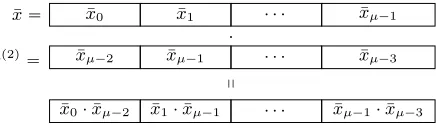
Next, we expand the right-hand side of Equation (1) and rearrange each term so as to fit in well with the SIMD executions. Then, we repeatedly apply SIMD operations to a vector of SIMD words. This is the key to reducing the number of homomorphic multiplications from µ´1 to logµ. For example, one SIMD homomorphic multiplication can be depicted as in Fig. 2, denoting by ¯xpiq the
vector obtained by applying the rotation-by-i to each element in ¯x. Namely, we implement a single automorphismXÞÑXgi for some elementgPZ˚mof orderµin the original groupZ˚m and the quotient
group Z˚m{x2y.
¯
x“ ¯x0 x¯1 ¨ ¨ ¨ x¯µ´1 ¨
¯
xp2q“ x¯µ´2 x¯µ´1 ¨ ¨ ¨ x¯µ´3
q
¯
x0¨x¯µ´2 x¯1¨x¯µ´1 ¨ ¨ ¨ x¯µ´1¨x¯µ´3
Fig. 2: A Sample Step Illustrating SIMD Execution
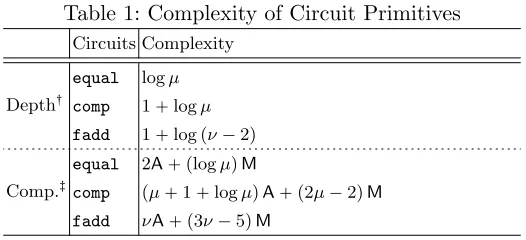
Due to space limitations, we have omitted a detailed description of an application of the SIMD operations. We provide a better description of the complexity in Table 1.
3.2 Greater-than Comparison Circuit
For two unsigned µ-bit integers, the circuit comppx,¯ y¯q outputs ¯0 if x ě y and ¯1 otherwise. This operation can be recursively defined as follows:
comppx,¯ y¯q “¯cµ´1, (2)
where ¯ci“ p1`x¯iq ¨y¯i` p1`x¯i`y¯iq ¨¯ci´1 foriě1 with an initial value ¯c0“ p1`x¯0q ¨y¯0.
Optimizations As the first step of optimization, we express Equation (2) in the following closed form
¯
cµ´1 “ p1`x¯µ´1q ¨y¯µ´1` µ´2
ÿ
i“0
p1`x¯iq ¨y¯i¨di`1di`2¨ ¨ ¨dµ´1,
where dj “ p1`x¯j`y¯jq. Because it has degree µ`1, we can deduce that the depth of the circuit is
The key observation is that the closed form is expressed by a sum of products of p1`x¯iq ¨y¯i
and p1`x¯i`y¯iq terms for i P r0, µ´1s. We are able to compute p1`x¯iq ¨y¯i for all i using only 1
homomorphic multiplication due to the use of the SIMD technique. Now, we have to computeśµ´1 k“i dk
for each iP r1, µ´1s. As mentioned above, a naive method incursOpµ2q, but using SIMD operations
requires one to perform only 2µ´4 homomorphic multiplications, consuming logµ depth. Finally, we need to multiply p1`x¯iq ¨y¯i by the result of the above computation, which also incurs only 1
homomorphic multiplication. Thus, the total number of homomorphic multiplications equals 2µ´2.
Remark 1 We can address the signed numbers by slightly modifying the circuit. Assume that we place a sign bit in the leftmost position of a value (e.g., 0 for a positive number and 1 for a negative number) and use the two’s complement system. Then, for two µ-bit values x and y, comppx,¯ y¯q “
¯
cµ´1`x¯µ´1`y¯µ´1. It is clear that the case of two positive numbers corresponds to x¯µ´1 “y¯µ´1“¯0.
3.3 Integer Addition Circuit
Suppose that for two µ-bit integers x andy and for an integer ν ąµ, we construct two ν-bit integers by padding zeros on the left. Then, a size-ν full-adderfaddν is recursively defined as follows:
faddνpx,¯ y¯q “ p¯s0,¯s1,¨ ¨ ¨,s¯ν´1q
where a sum ¯si“x¯i`y¯i`c¯i´1 and a carry-out ¯ci “ px¯i¨y¯iq ` ppx¯i`y¯iq ¨¯ci´1q foriP r1, ν´1swith
initial values ¯s0 “x¯0`y¯0 and ¯c0 “x¯0¨y¯0. The main reason for considering such a large full-adder is
to cover SQL aggregate functions with many additions.
Optimizations Our strategy for optimization is the same as above. Namely, we express each sum and carry in the closed form and find a way to minimize the number of homomorphic operations using SIMD and automorphism operations. As a result, ¯si’s are written as follows:
¯
si“x¯i`y¯i` i´1
ÿ
j“0
tij
where tij “ px¯j¨y¯jq
ś
j`1ďkďi´1px¯k`y¯kq for j ăi´1 and ti,i´1 “x¯i´1¨y¯i´1. When i“ν´1 and
j“0, becauseν´2 homomorphic multiplications are required, we see that the circuit has logpν´2q
depth. However, we need to perform an additional multiplication by ¯xj ¨y¯j. Thus, the total depth
amounts to logpν´2q `1. As before, the use of SIMD and parallelism by automorphism allows us to evaluate the integer addition circuit with only 3ν´5 homomorphic multiplications, while a naive method requires pν
3
´3ν2`8νq
6 homomorphic multiplications. Due to space limitations, we omit the details of the calculation of the counts.
4 Search-and-compute on Encrypted Data
Table 1: Complexity of Circuit Primitives
Circuits Complexity
Depth:
equal logµ
comp 1`logµ
fadd 1`logpν´2q
Comp.;
equal 2A` plogµqM
comp pµ`1`logµqA` p2µ´2qM
fadd νA` p3ν´5qM
:Depth: The number of levels for homomorphic evaluations
;Comp.: Computational complexity during homomorphic evaluations
4.1 General-Purpose Search-and-Compute
We begin by describing our basic idea for performing a search operation over encrypted data. We assume that a collection of data is partitioned into N µ-bit items denoted byx1 k¨ ¨ ¨kxN and that
the data have been encrypted and stored in the form of ¯x1 k ¨ ¨ ¨ k x¯N. In addition, for an SWHE
schemepKg,E,D,Evq, the key pairppk, skq ÐKgp1κq determines its ciphertext space denoted byCpk. For a predicateϕonCpk, a search on encrypted data outputs ¯xi ifϕpx¯iq “¯1 and ¯0 otherwise. More
formally, let ϕ:CpkÑ t¯0,¯1u be a predicate on encrypted data. Then, we say thatSϕ :CpkN ÑCpkN is a
search on the encrypted data and define Sϕpx¯1, . . . ,x¯Nq:“ pϕpx¯1q ¨x¯1, . . . , ϕpx¯Nq ¨x¯Nq.
We then extend this operation to a more general operation on encrypted data, i.e., search-and-compute on encrypted data, as follows. Let F :CN
pk ÑCpk be an arithmetic function on encryptions.
Then, for restricted searchSϕ :CpkN ÑCpkN, we say thatpF˝Sϕqpx¯1, . . . ,x¯Nqis search-and-compute on
encryptions.
Further, we measure the efficiency of the search-and-compute operations on encrypted data in Theorem 1. The theorem states that if we can perform a search on encrypted data restricted byϕ, which specifies only the equality operator, then the search queries on encrypted data requireNp2A`logµMq
homomorphic operations in total. In general, it is not difficult to construct an involved search on encrypted data by composing two circuit primitives–equal and comp. If a predicate ϕ allows one to specify all the comparison operators in the set tă,ď,ą,ě,‰u, then we can perform Sϕpx¯1, . . . ,x¯Nq
withOpµNq homomorphic multiplications.
Theorem 1 Let ϕ,Cpk, and x¯1, . . . ,x¯N be defined as above. Let Mpϕq and MpFq be the total number
of homomorphic multiplications for ϕand F, respectively. Then, we can perform pF˝Sϕqpx¯1, . . . ,x¯Nq
withOpNpMpϕqq `MpFqqhomomorphic operations. Specifically, we can perform a search on encrypted data restricted by ϕ using at mostOpNpMpϕqqq homomorphic operations.
Proof. Because homomorphic multiplication dominates the performance of the operation, we might only count it. Because a predicateϕrequiresOpMpϕqqhomomorphic operations, we see thatSϕrequires OpNpMpϕqqq homomorphic operations to compute the predicate N times. Then, the operation uses
OpMpFqqhomomorphic operations to evaluate an arithmetic functionF on encrypted data. Therefore, we can conclude that the total computation complexity of search-and-compute on encryptions is
to be the identity map. Therefore, we can perform a search on encrypted data restricted by ϕusing at mostOpNpMpϕqqqhomomorphic operations.
Security Secrecy against a semi-honest DB server is ensured because encrypted data cannot be leaked due to the semantic security of our underlying SWHE scheme. Secrecy against a semi-honest DB user follows because the result of queries expressed by our circuit primitives is equivalent to ¯0 if specified conditions do not hold; therefore, the resulting ciphertext is equal to ¯0. This implies that the evaluated ciphertexts do not leak anything else except for the number of unsatisfied tuples.
4.2 Applications to Encrypted Databases
We denote RpA1, . . . , Adq as a relation schemaR of degreedconsisting of attributes A1, . . . , Ad, and
we denote by ¯Aj the corresponding encrypted attribute. As mentioned above, we use Apjiq to denote
the j-th attribute value of the i-th tuple, and for convenience, we assume that each attribute value has a length of µbits.
Search Queries
Simple Selection Queries Consider a simple retrieval query as follows:
selectAj1, . . . , Ajs fromR
whereAj0 “α;
(Q.1)
where α is a constant value andsďd, j0P r1, ds.
An efficient construction of (Q.1) using ourequal circuit is as follows:
equal
´ ¯
Apj0iq,α¯ ¯
¨
´ ¯
Apj1iq, . . . ,A¯pjiq s
¯
( ¯Q˚.1)
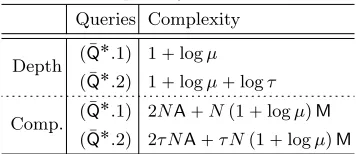
for eachiP r1, Ns. It follows from Theorem 1 that the construction ( ¯Q˚.1) has the complexity
evalu-ation given in Table 2.
Conjunctive & Disjunctive Queries The query (Q.1) is extended by adding one or more conjunctive or disjunctive conditions to the whereclause. Consider a conjunctive query as follows:
selectAj1, . . . , Ajs fromR
whereAj1
1 “α1 and ¨ ¨ ¨ andAjτ1 “ατ;
(Q.2)
The query (Q.2) is expressed as the following: For eachiP r1, Ns,
τ
ź
k“1
equal
´ ¯
Apji1q
k ,α¯k
¯
¨
´ ¯
Apj1iq, . . . ,A¯pjisq
¯
. ( ¯Q˚.2)
A disjunctive query whose logical connectives are allors is also efficiently evaluated by the following expression: For each iP r1, Ns,
˜
1` τ
ź
k“1
´
equal
´ ¯
Apji1q
k,α¯k
¯ `1 ¯ ¸ ¨ ´ ¯
Apj1iq, . . . ,A¯pjisq
¯
Denoting by τ the number of connectives, ( ¯Q˚.2) additionally requires logτ in depth to compute the
multiplications among the τ equality tests in comparison with ( ¯Q˚.1). Note that in general, τ
!N. Table 2 reports the complexity analysis.
Table 2: Complexity of Search Queries
Queries Complexity
Depth ( ¯Q
˚.1) 1
`logµ
( ¯Q˚.2) 1`logµ`logτ
Comp. ( ¯Q
˚
.1) 2NA`Np1`logµqM
( ¯Q˚.2) 2τ NA`τ Np1`logµqM
Search-and-compute Queries We continue presenting important real constructions as an extension of Theorem 1, in whichF is one of the built-in SQL aggregate functions–sum,avg,countand max. We begin with the caseF “sum.
Note that in contrast to Lauter et al.’s approach [24], because our plaintext space isZ2, we should
be careful when addressing search-and-compute queries.
Search-and-sum Query Consider the followingsumquery:
select sumpAj1q
fromR
whereAj0 “α;
(Q.3)
As mentioned above, due to our plaintext space beingZ2, repeatedly applying simple homomorphic
additions does not ensure correctness. This is the motivation for our integer addition circuit (See Section 3.3). Now, we can efficiently perform (Q.3), expressed as follows:
faddµ`logN
´
equal
´ ¯
Apj0iq,α¯ ¯
¨A¯pj1iq
¯
. ( ¯Q˚.3)
Because the result of the search-and-sum query is less than 2µN, it suffices to use a full adder of size ν “µ`logN for adding all the values. Using our optimized equality circuit, ( ¯Q˚.3) requires
N equality tests in total and N homomorphic multiplications for each result of the test. Thus, the total computation cost is p2N `νpN ´1qqA` pNp1`logµq ` pN ´1q p3ν´5qM with the depth 1`logµ`logNp1`logpν´2qqbased on Theorem 2 below.
Theorem 2 Let |R| denote the cardinality of a set of tuples from a relation schema R. Suppose that all the keyword attributes in the where clause and the numeric attributes in the select clause have
}kwd}bits and}num}bits, respectively. Then, a search-and-sum query can be processed with the depth
1`rlogp}kwd}qs`rlog|R|s¨ p1`rlogp}num} `rlog|R|s´2qsq.
Proof. The query ( ¯Q˚.3) consumes 1`rlogp}kwd}qslevels to compute all the equality tests. Then, it
Thus, if|R| “ 103,}kwd} “10, and }num} “30, the number of levels consumed by this query is
approximately 75.
Search-and-Count Query We observe that search-and-count queries can be processed in a similar manner.
For example, assume a search-and-count query withcountp˚q in place of sumpAj1q in (Q.3). The
query can also be efficiently processed by
faddlogN
´
equal
´ ¯
Apj0iq,α¯ ¯¯
.
Note that the output of search-and-count queries is less than N.
Search-and-Avg Query To process a search-and-compute query with the avg aggregate function, it suffices to compute search-and-sum queries because an average can be obtained using one division after decryption.
Search-and-Max(Min) Query It is clear that one can obtain the max (or min) aggregate function by repeatedly applying thecomp circuit primitive.
5 Performance Improvements
Due to the benefits of combining SIMD and automorphism operations, we can achieve the three opti-mized circuit primitives in Section 3. However, there is still room to further improve the performance of the circuit primitives. Our strategies are composed of three interrelated parts: Switch the message space Z2 intoZt, adapt the circuit primitives (in Section 3) to Zt, and fine-tune the circuit primitives
using SIMD operations again.
5.1 Larger Message Spaces with Lazy Carry Processing
Lauter et al. [24] presented a comparison of two message-encoding techniques: bit-wise encoding and
integer encoding. The former method (i.e., the message space is Z2) encrypts messages in a
bit-by-bit manner, whereas the latter encrypts them as elements of Zt for sufficiently large t. The primary
advantage of usingZ2is that two comparison operations are very cheap. In contrast, running an integer
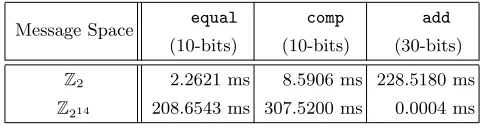
addition circuit on encrypted data is expensive (see Table 3) with respect to the running time. One of the important motivations of using such a large message space is that the bit length of keyword attributes (e.g.,ď20 bits) in thewhereclause is generally smaller than that of numeric-type attributes (e.g.,ě30 bits) in theselectclause. Therefore, it would be of substantial benefit to take the message domain as an integer ring if one can quite efficiently evaluate the addition circuit with much lesser depth.
Specifically, if we represent a numeric-type attributeA in the radix 2ω, then we have
ÿ
i
Apiq“
ÿ
k
ÿ
i
rApiqsk¨ p2ωqk;
therefore, it suffices to compute řirApiqs
k over the integers. Assuming that the plaintext modulus t
is sufficiently large, we are able to perform addition without overflow in Zt. We should note that we
To verify the performance gained by integer encoding, we report the running time of each circuit primitive in Table 3: equality, great-than comparison, and integer addition. We conducted experiments over 102 ciphertexts, and we measured the average running times of equality circuits and comparison circuits for 10-bit keywords. In addition, we performed homomorphic addition over 30-bit integers. Consequently, we observed the drastic performance improvement in the operation. We suspect that integer encoding yields more benefits in performing search-and-compute queries because aggregate functions extensively rely on addition.
Table 3: Running-time Comparisons inZ2 and Z214 Message Space equal comp add
(10-bits) (10-bits) (30-bits)
Z2 2.2621 ms 8.5906 ms 228.5180 ms
Z214 208.6543 ms 307.5200 ms 0.0004 ms
5.2 Calibrating Circuit Primitives
It is clear that the use of a different message space results in modifications of our circuit primitives. Before discussing our modifications in detail, we need to determine some lower bounds of depth for homomorphic multiplication as a function of t. We have two types of homomorphic multiplications: multiplying a ciphertext either by another ciphertext or by a known constant. We formally state this in Theorem 3.
Theorem 3 Suppose that the native message space of the BGV cryptosystem is a large integer ring
Zt and that a chain of moduli is defined by a set of primes of roughly the same size, p0,¨ ¨ ¨, pL, that
is, the i-th modulus qi is defined as qi “śki“0pk. For simplicity, assume that p is the size of thepks.
Let us denote byσ the standard deviation in our RLWE instance and by H the Hamming weight of the secret key. For iďj, letc andc1 be normal ciphertexts at leveliand j, respectively. Then, the depth,
denoted by ˜d, for multiplying c and c1 is the smallest nonnegative integer that satisfies the following
inequality:
t2¨φpmq ¨ p1`Hq ¨ prqi´1stq2 ă6p2¨ ˜ d.
In addition, the depth, denoted by˜dc, for multiplyingcby a constant is the smallest nonnegative integer
for which the following inequality holds:
φpmq ¨ pt{2q2 ăp2¨˜dc.
Proof. Before multiplying two ciphertexts, we set their noise magnitude to be smaller than the pre-set constantB “t2φpmqp1`Hq{12 by modulus switching. That is, while the noise is larger than B, it is scaled down by the next prime. Therefore, c becomes a ciphertext with a prime set tp0, . . . , piu and
has the dominant noise term B. Similarly, c1 also becomes a ciphertext with a prime set
tp0, . . . , pju,
i as c. Subsequently, we obtain a tensor product of the ciphertexts, and the result has the following noise magnitude:
2¨B¨B¨ prqi´1stq2
Next, the scale-down is performed by removing small primespk’s from the current prime-set of the
ten-sored ciphertext; we say that∆is the product of the removed primes. We then have 2B2prqi´1stq2{∆2 ă
B. By assumption, it may be considered that ∆“p˜d, which means that ˜dis the smallest nonnegative
integer that the following inequality satisfies
2Bprq´i 1stq2 ăp2¨˜d.
We now consider the case in whichcis multiplied by a constant. As above, we may assume that it initially has small noise magnitudeB by modulus-switching. Then the size of the constant is multiplied by its noise, i.e., the result has approximately the same noise estimate asB¨φpmq ¨ pt{2q2. Thus, we see that ˜dc is the smallest nonnegative integer that satisfies the inequality φpmq ¨ pt{2q2 ăp2¨˜dc.This
completes the proof.
As a concrete example, we have ˜d “ 2 and ˜dc “ 1 in Z214 with the assumption that σ “ 3.2,
H “64, andm“13981.
We now describe a basic idea that underlies our modifications. It is well known that forx, yP t0,1u, the following properties hold:
x‘y“x`y´2¨x¨y and x^y“x¨y,
where`,´, and¨are arithmetic operations over integers. Based on this observation, our equality test can be rewritten as follows:
equalpx,¯ y¯q “ µ´1
ź
i“0
p1´x¯i´y¯i`2¨x¯i¨y¯iq.
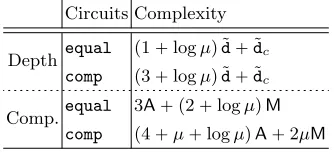
We then see that with only a small extra cost, we can construct a new arithmetic circuit for an equality test working on Zt. We report the additional cost in Table 4.
Next, consider thecomp circuit onZt. Recall that the closed form of ¯cµ´1 is (with slight
modifica-tion)
¯
cµ´1 “ p1´x¯µ´1q ¨y¯µ´1` µ´2
ÿ
i“0
p1´x¯iq ¨y¯i¨ pdi`1di`2¨ ¨ ¨dµ´1q.
Rather than dj “ p1`x¯j `y¯jq, we set dj “ p1`2¨x¯j ¨y¯j ´y¯j ´x¯jq ¨ p1`2¨x¯j¨y¯j´2¯yjq.Table 4
shows the new complexity introduced by this modification.
5.3 SIMD-based Fine Tuning
Table 4: Complexity of Circuit Primitives overZt Circuits Complexity
Depth equal p1`logµq˜d`˜dc
comp p3`logµq˜d`˜dc
Comp.equal 3A` p2`logµqM
comp p4`µ`logµqA`2µM
In our implementation, plaintexts are elements of A2r obtained by setting t “ 2r for a small
positive integer r. The polynomial ΦmpXq mod 2r factors into ` irreducible factors, each of degree
δ, e.g.,ΦmpXq “
ś`
j“1FjpXq. Then, each factor corresponds to a plaintext slot. In other words, we
consider the `-copies of the space Z2r as the plaintext slots. This enables us to directly embed our
messages as elements ofZ2r into each slot. As a result, we can process` messages a single ciphertext
at a time.
As in Section 3, we again apply this technique to the devised circuit primitives to reduce the required depth of each circuit and the number of homomorphic operations. Compared with the result of [24], a sum of encryptions of 100 numeric data (all 128-bit data) only requires approximately 0.227 milliseconds, which is 100 times faster.
5.4 Efficiency Results
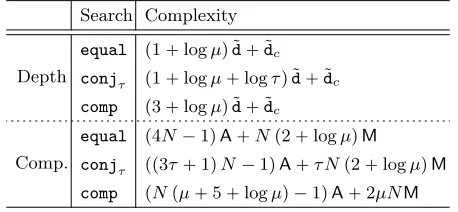
The remainder of this section reports on the new complexity results from using the new message spaceZt. We measured the complexities of only search-and-sum and -count queries. Table 5 shows the
complexity of a search-and-sum query, and Table 6 shows that of a search-and-count query.
Table 5: Complexity of Search-and-sum Queries
Search Complexity
Depth
equal p2`logµq˜d`˜dc
conjτ p2`logµ`logτq˜d`˜dc
comp p4`logµq˜d`˜dc
Comp.
equal p4N´1qA`Np3`logµqM
conjτ pp3τ`1qN´1qA`τ Np3`logµqM
comp pNpµ`5`logµq ´1qA`Np2µ`1qM
6 Experimental Results
Table 6: Complexity of Search-and-count Queries
Search Complexity
Depth
equal p1`logµq˜d`˜dc
conjτ p1`logµ`logτq˜d`d˜c
comp p3`logµq˜d`˜dc
Comp.
equal p4N´1qA`Np2`logµqM
conjτ pp3τ`1qN´1qA`τ Np2`logµqM
comp pNpµ`5`logµq ´1qA`2µNM
somewhat fair comparison with the prior related works in [24,5], although each work is fairly different from its underlying SWHE scheme and experimental settings.
All experiments reported in our paper were performed on a machine with an Intel Xeon 2.3 GHz processor with 192 GB of main memory running a Linux 3.2.0 operating system. All methods were implemented using the GCC compiler version 4.2.1. In our experiments, we used a variant of a BGV-type SWHE scheme [20] with Shoup’s NTL library [30] and Shoup-Halevi’s HE library [31]. Throughout this section, when we measured the average running times, we excluded computing times used in data encryption and decryption.
6.1 Adjusting the Parameters
Without a loss of generality, we assume that the bit length of keyword attributes in the whereclause is 10-bit and that of numeric-type attributes in the select clause is 30-bit. The keyword attributes are expressed in a bit-by-bit manner, and each bit is an element of Z2r. In addition, numeric-type
attributes are expressed by the radix 2ω but are still in the same space Z2r.
We begin by observing the following relation among the parameters. At this point, we consider the
selectivity of a selection condition, which means the fraction of tuples that satisfies the condition, and we denote it by ε.
Theorem 4 Let A be a numeric-type attribute. For a positive integer ω ě 1, suppose that each at-tribute is written asA“řkrAsk¨ p2ωqk with0ď rAskă2ω. Then, to process a search-and-sum query,
one can take a plaintext modulus with
r“Θpω`logpε¨Nqq.
Similarly, for a search-and-count query, it suffices to choose the parameterr so thatr “Θplogpε¨Nqq.
Proof. The goal of the theorem is to provide a bound for the size of a plaintext modulus; therefore, we simply omit an overhead bar for all variables. Let us denote by ϕ a predicate on encrypted data and by A˚ a keyword attribute. Then, a search-and-sum query can be written as
ÿ
i
SϕpA˚, αq ¨Apiq“
ÿ
k
˜ ÿ
i
SϕpA˚, αq ¨ rApiqsk
¸
We then have that
ÿ
i
SϕpA˚, αq ¨ rApiqskă2ω
ÿ
i
SϕpA˚, αq “2ω¨ pεNq.
Thus, for a database withN records, it is sufficient to chooser such that 2ω¨ pεNq ď2r.
Note, the larger we make the plaintext modulus 2r, the more noise there is in the ciphertexts and thus the faster we consume the ciphertext level. Therefore, it appears thatω`logpεNq is the tight bound for the parameter r.
Because a search-and-count query does not need to consider a specific attribute, we immediately know thatřiSϕpA˚, αq “εN ă2r.
One may wonder whySϕp¨, . . .qdoes not take multiple keyword attributes in the proof. Because we
consider the selectivity ratio, it does not need to do so. In our experiments, we varied the selectivity ratio from 5 to 40% and plotted the average running time of queries over a database withN “102,103, and 104 tuples.
6.2 Experiments for Search
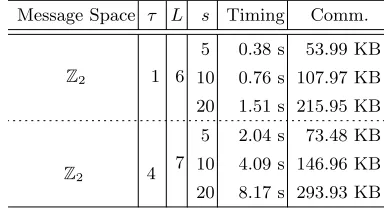
We measured the running time per query while varying the number of numeric-type attributes. We take the ring modulus m “8191, and each of the ciphertexts has 630 plaintext slots. ForN “1, the experiment of ( ¯Q˚.1) query is given in the top three rows of Table 7 and that of ( ¯Q˚.2) is in the bottom
three rows in Table 7, wheresis the number of attributes,L is the number of ciphertext moduli, and Comm. means the communication cost.
Table 7: Performance of ( ¯Q˚.1) and ( ¯Q˚.2)
Message Space τ L s Timing Comm.
Z2 1 6
5 0.38 s 53.99 KB
10 0.76 s 107.97 KB
20 1.51 s 215.95 KB
Z2 4
7
5 2.04 s 73.48 KB
10 4.09 s 146.96 KB
20 8.17 s 293.93 KB
6.3 Experiments for Search-and-compute
We conducted a series of additional experiments to measure performance of search-and-compute queries. Because each of the ciphertexts can hold ` plaintext slots of elements in Z2r and because
a numeric-type attribute with a length of 30 bits is encoded into ˜ω (“r30{logp2ωqs“r30{ωs) slots, we can process ˜` (“t`{ω˜u) attributes per ciphertext.
Experiments for Search-and-sum We divided our experiment into four cases: (1) Single equality, (2) Multiple equality, (3) Single comparison, and (4) Multiple comparison.
Case I: Single equality This case contains one equality test in thewhere clause. We chose a plaintext space so that the number of plaintext slots is divisible by 10. Then, the entire keyword attribute is packed in only one ciphertext. Further, we take the ring modulusm whereby there existsgPZ˚m that
has order 10 in the original group Z˚m and in the quotient group Z˚m{x2y. Then, there is a Frobenius
automorphism of cyclic right shift over those 10 plaintext bits. We used m “ 13981 so that each of the ciphertexts holds 600 plaintext slots. We report this experimental result in Table 8.
Table 8: Experiments for Case I ( ¯Q˚.3)
N ε Message Space Radix L Timing Comm.
102 ă16% Z214 210 14 3.69s 3.47KB ă32% Z215 15 3.89s 3.75KB
103 ď6%
Z216
210
15 38.78s 3.75KB
ď25% 28 51.64s 5.01KB
104
ď10%
Z216
26 15
681.05s 6.25KB
ď20% 25 817.26s 7.50KB
ď40% 24 1089.68s 10.03KB
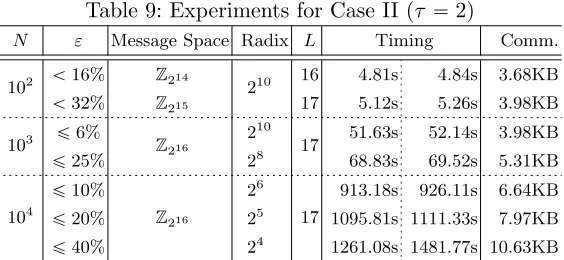
Case II: Multiple equality This case contains two or more equality tests in the where clause (i.e.,
τ ě2). We performed experiments for τ “2 and τ “4. Whenτ “2, we used m “13981 as before. For the τ “4 case, we chose m “20485 to support more multiplications than before. Similarly, each ciphertext holds 640 plaintext slots. Compared with queries in the conjunctive form, disjunctive-formed queries require more addition operations. However, both of them require the same depth; therefore, their running times are not significantly different from each other.
Each result is presented in Table 9 and Table 10 (the 6th column of each table consists of two parts: The left part is for conjunctive-formed queries, and the right part is for disjunctive-formed ones.)
Table 9: Experiments for Case II (τ “2)
N ε Message Space Radix L Timing Comm.
102 ă16% Z214
210 16 4.81s 4.84s 3.68KB ă32% Z215 17 5.12s 5.26s 3.98KB
103 ď6% Z216
210
17 51.63s 52.14s 3.98KB
ď25% 28 68.83s 69.52s 5.31KB
104
ď10%
Z216
26
17
913.18s 926.11s 6.64KB
ď20% 25 1095.81s 1111.33s 7.97KB
Table 10: Experiments for Case II (τ “4)
N ε Message Space Radix L Timing Comm.
102 ă16% Z214
210 18 9.79s 9.86s 5.09KB ă32% Z215 19 10.24s 10.28s 5.44KB
103 ď6%
Z216
210
19 101.86s 105.15s 5.44KB ď25% 28 135.59s 139.97s 7.24KB
104
ď10% Z216 26 19 1788.19s 1800.84s 9.05KB
ď20% Z217 26 20 1850.70s 1864.36s 9.05KB
ď40% Z217 25 20 2234.81s 2251.30s 10.93KB
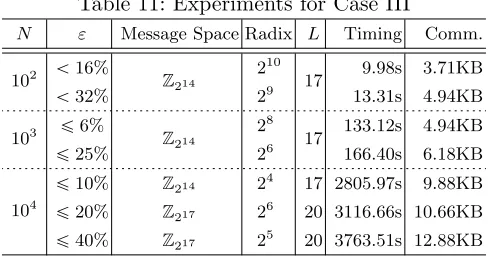
Case III: Single comparison This case contains one greater-than comparison in thewhereclause. For the experiments, we used m “ 20485 in the case of L “ 20, but in all other experiments, we used
m“13981. We report the experimental results in Table 11.
Table 11: Experiments for Case III
N ε Message Space Radix L Timing Comm.
102 ă16%
Z214
210
17 9.98s 3.71KB
ă32% 29 13.31s 4.94KB
103 ď6% Z214
28
17 133.12s 4.94KB
ď25% 26 166.40s 6.18KB
104
ď10% Z214 24 17 2805.97s 9.88KB
ď20% Z217 26 20 3116.66s 10.66KB
ď40% Z217 25 20 3763.51s 12.88KB
We observed that the results for Case IV are very similar to those for Case II. Thus, due to space limitations, we omitted the Case IV experimental results.
For a better comparison, in Figure 3, we graphically depict the experimental results described above, while the selectivity ratio εis fixed at 10%.
Experiments for Search-and-count The experiments for search-and-count can also be divided into four cases as performed above. In these experiment, the plaintext modulusm“13981 was used; therefore, each of the ciphertexts holds 600 plaintext slots. Table 12 shows the case with a single equality condition, Table 13 shows that withτ “4, and Table 14 shows that with a single comparison condition.
0 0.2 0.4 0.6 0.8 1 ¨104 0
1,000 2,000 3,000
Number of tuples (N)
Query
R
unning
Time
(seconds)
Case I Case II (τ “2) Case II (τ “4)
Case III
Fig. 3: Experimental Results for Search-and-sum
Table 12: Experiments using Single Equality N ε Message Space L Timing Comm.
102 ă8% Z23 7 5.66s 0.73KB ă32% Z25 8 7.34s 1.00KB
103 ď6% Z26 10 84.59s 0.93KB ď25% Z28 11 90.89s 1.03KB
104 ď40% Z212 12 961.84s 1.12KB
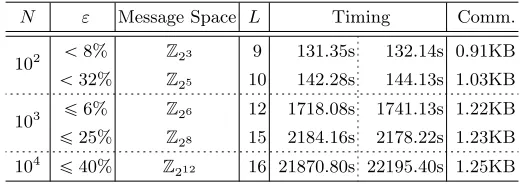
Table 13: Experiments for Multiple Equality (τ “4) N ε Message Space L Timing Comm.
102 ă8% Z23 9 131.35s 132.14s 0.91KB
ă32% Z25 10 142.28s 144.13s 1.03KB
103 ď6% Z26 12 1718.08s 1741.13s 1.22KB ď25% Z28 15 2184.16s 2178.22s 1.23KB
104
ď40% Z212 16 21870.80s 22195.40s 1.25KB
6.4 Handling Join Query
In this section,we design the join queries within the search-and-compute paradigm. For this purpose, suppose that we have the other relationSpB1, . . . , Beqconsisting ofM tuples. For simplicity, we assume
Table 14: Experiments using Single Comparison N ε Message Space L Timing Comm.
102 ă8% Z23 8 17.10s 0.82KB
ă32% Z25 9 19.24s 0.91KB
103 ď6% Z26 11 224.04s 0.93KB
ď25% Z28 15 311.84s 1.25KB
104
ď40% Z212 15 3029.05s 1.25KB
0 0.2 0.4 0.6 0.8 1 ¨104 0
0.5 1 1.5 2
¨104
Number of tuples (N)
Query
R
unning
Time
(seconds)
Singe equality Multiple equality (τ “2) Multiple equality (τ “4)
Single comparison
Fig. 4: Experimental Results for Search-and-count
First, we consider a simple join query as follows:
selectr.Aj1, . . . ,r.Ajs,s.Bj1
1, . . . ,s.Bjs11
fromRas r,Sas s
wherer.Ajk “s.Bj1k1;
(Q.4)
This type of query is expressed and efficiently processed using only the equality circuit. Specifically, for each iP r1, Ns, i1 P r1, Ms, the query (Q.4) is expressed as
equal
´ r.A¯pjiq
k,s.
¯
Bjpi11q
k1
¯
¨
´
r.A¯pj1iq,s.B¯jpi11q
1 , . . .
¯
( ¯Q˚.4)
For fixed iand i1, we suppose that each numeric-type attribute is packed in only one ciphertext.
Then, the only difference from ( ¯Q˚.1) is that ( ¯Q˚.4) requires two homomorphic multiplications by
the result of search operations; thus, we need to perform N M equality tests in total. Hence, the depth of circuit needed to process ( ¯Q˚.4) is 1`logµ, and the computation complexity isp2N MqA`
N Mp2`logµqM. In addition, a join query with τ conjunctive conditions needs to perform τ N M
Next, we consider an advanced join query demanding search-and-compute operations. For the sake of readability, we consider a join query with two aggregate functions and a simple condition as follows.
select sumpr.Ajq,countp˚q
fromRas r,S ass
wherer.Ajk “s.Bj1 k1;
(Q.5)
We can express the query (Q.5) in a manner similar to that used in Section 4.2. Assuming
sumpr.Ajq ă 2µN M, we use a full adder of size ν “ µ` logpN Mq. By contrast, the result of
countp˚q ă N M, and it suffices to use a full adder of size logpN Mq. Thus, one candidate of cir-cuit construction for (Q.5) is as follows:
faddµ`logN M
´
equal
´ r.A¯pjiq
k,s.
¯
Bjpi11q
k1 ¯
¨r.A¯pjiq
¯
,
faddlogN M
´
equal
´ r.A¯pjiq
k,s.
¯
Bjpi11q
k1 ¯¯
.
( ¯Q˚.5)
With respect to sumpr.Ajq, this is the same as ( ¯Q˚.3), except for the number of operands for
additions. Therefore, the depth for evaluation amounts to
1`logµ`logpN Mq p1`logpν´2qq,
and the computation complexity is
p2N M`νpN M´1qqA` pN Mp1`logµq ` pN M´1q p3ν´5qqM.
We remark that it is straightforward to extend this approach to a join query with two or more aggregate functions in the selectclause.
Finally, we performed some experiments for join queries. We measured the average running time for processing a single equality test while varying N, M from 10 to 102 and fixings“s1 “5. Table 15
reports the experimental results for ( ¯Q˚.4). As N and M increase, the running time of the algorithm
grows linearly. Table 16 shows the experimental results for ( ¯Q˚.5), assuming the selectivity ratio is
fixed at 10%. Because the experiments of ( ¯Q˚.4) are implemented for more numeric-type attributes
than those for ( ¯Q˚.5), the query takes longer to perform.
Table 15: Experiments for ( ¯Q˚.4)
τ“1 ands“s1
“5
N“M“10N“102, M “10N “M “102
42.75 s 423.86 s 4210.53 s
Table 16: Experiments for ( ¯Q˚.5)
τ “s“1
N“M“10N“102, M “10N “M “102
7 Literature Review
There have been a number of studies with similar goals, as mentioned in Section 1.3. In this section, we present a brief overview of these studies.
We begin with a study on private information retrieval (PIR) primitives. PIR enables a DB user to retrieve a tuple from a DB [11] without revealing which tuple the DB user is retrieving, and with the communication complexity lower thanOpNq. However, because the DB user may learn additional bits of information in addition to the originally requested tuples, PIR does not ensure the privacy of the DB server. This issue has been resolved in [21], but in turn, a DB user is required to provide an index of tuples that they would like to obtain. Sometimes, the DB user may not have any information on the index.
The next important research topic is searchable encryption (SE) [34,13,14]. These techniques allow a DB user to encrypt and store their data on a DB server in combination with block ciphers and stream ciphers. Later, the DB user can search for a specific keyword by submitting a trapdoor without revealing keywords and original data. Boneh et al. in [4] generalized this into the public-key setting. Using SE as a primitive, Yang et al. [36] proposed a scheme to privately process a conjunctive query. There are different research areas focused on realizing private query processing. Hacig¨um¨us et al.[22] tried to support general DB queries in a private manner. Horeet al.[23] claimed their schemes can support range queries that maintain privacy. However, they later were found to reveal the under-lying data distributions. Olumofin and Goldbeg [26] extended PIR into SQL-enabled PIR to privately process general DB queries. They focused on ensuring query privacy but did not consider the pri-vacy of databases. Other works, such as [28,12], assumed that there is a set of mutually trusted and host participants. Ge and Zdonik considered the same security model [17]. Their scheme is, however, restricted to aggregate queries. Ada Popa et al.’s CryptDB [1] processed general types of database queries using layers of different encryption schemes: deterministic encryption for equality condition queries, order-preserving encryption for range queries, and homomorphic encryption for aggregate queries. The disadvantage of their work is that in the long run, it downgrades to the lowest level of data privacy provided by the weakest encryption scheme. For example, it may enable one to determine the data order. Recently, TrustedDB [2] achieved the goal by placing the DB engine and all sensitive data processing inside a secure co-processor.
References
1. R. Ada Popa, C. Redfield, N. Zeldovich, and H. Balakrishnan. CryptDB: protecting confidentiality with encrypted query processing. In T. Wobber and P. Druschel, editors,SOSP, pages 85–100, 2011.
2. S. Bajaj and R. Sion. TrustedDB: a trusted hardware based database with privacy and data confidentiality. In T. Sellis, R. Miller, A. Kementsietsidis, and Y. Velegrakis, editors,SIGMOD, pages 205–216, 2011.
3. M. Bellare, A. Boldyreva, and A. O’Neill. Deterministic and efficiently searchable encryption. In A. Menezes, editor, Advances in Cryptology-Crypto, LNCS 4622, pages 535–552, 2007.
4. D. Boneh, G. Di Crescenzo, R. Ostrovsky, and G. Persiano. Public key encryption with keyword search. In C. Cachin and J. Camenisch, editors,Advances in Cryptology-Eurocrypt, LNCS 3027, pages 506–522, 2004.
5. D. Boneh, C. Gentry, S. Halevi, F. Wang, and D. Wu. Private database queries using somewhat homomorphic encryption. In M. Jacobson Jr., M. Locasto, P. Mohassel, and eihaneh Safavi-Naini, editors, ACNS, LNCS 7954, pages 102–118, 2013.
6. D. Boneh, E.-J. Goh, and K. Nissim. Evaluating 2-DNF formulas on ciphertexts. In J. Kilian, editor,TCC, LNCS 3378, pages 325–341, 2005.
8. Z. Brakerski and V. Vaikuntanathan. Efficient fully homomorphic encryption from (standard) LWE. In R. Ostrovsky, editor,FOCS, pages 97–106, 2011.
9. Z. Brakerski and V. Vaikuntanathan. Fully homomorphic encryption from ring-LWE and security for key dependent messages. In P. Rogaway, editor,Advances in Cryptology-Crypto, LNCS 6841, pages 505–524, 2011.
10. J. H. Cheon, J.-S. Coron, J. Kim, M. S. Lee, T. Lepoint, M. Tibouchi, and A. Yun. Batch fully homomorphic encryption over the integers. In T. Johansson and P. Q. Nguyen, editors,Advances in Cryptology-Eurocrypt, LNCS 7881, pages 315–335, 2013.
11. B. Chor, E. Kushilevitz, O. Goldreich, and M. Sudan. Private information retrieval. Journal of the ACM, 45(6):965– 981, 1998.
12. S. Chow, J. Lee, and L. Subramanian. Two-party computation model for privacy-preserving queries over distributed databases. InNDSS, 2009.
13. R. Curtmola, J. Garay, S. Kamara, and R. Ostrovsky. Searchable symmetric encryption: improved definitions and efficient constructions. In A. Juels, R. Wright, and S. De Capitani di Vimercati, editors, ACM Conference on Computer and Communications Security, pages 79–88, 2006.
14. R. Curtmola, J. Garay, S. Kamara, and R. Ostrovsky. Searchable symmetric encryption: Improved definitions and efficient constructions. Journal of Computer Security, 19(5):895–934, 2011.
15. T. El Gamal. A public key cryptosystem and a signature scheme based on discrete logarithms. In G. R. Blakley and D. Chaum, editors,Advances in Cryptology-Crypto, LNCS 196, pages 10–18, 1984.
16. J. Feigenbaum and M. Merritt. Open questions, talk abstracts, and summary of discussions. DIMACS Series in Discrete Mathematics and Theoretical Computer Science, 2:1–45, 1991.
17. T. Ge and S. Zdonik. Answering aggregation queries in a secure system model. In C. Koch, J. Gehrke, M. Garofalakis, D. Srivastava, K. Aberer, A. Deshpande, D. Florescu, C. Y. Chan, V. Ganti, C.-C. Kanne, W. Klas, and E. Neuhold, editors,VLDB, pages 519–530, 2007.
18. C. Gentry. Fully homomorphic encryption using ideal lattices. In M. Mitzenmacher, editor,STOC, pages 169–178, 2009.
19. C. Gentry and S. Halevi. Implementing Gentry’s fully-homomorphic encryption scheme. In K. Paterson, editor, Advances in Cryptology-Eurocrypt, LNCS 6632, pages 129–148, 2011.
20. C. Gentry, S. Halevi, and N. Smart. Homomorphic evaluation of the AES circuit. In R. Safavi-Naini and R. Canetti, editors,Advances in Cryptology-Crypto, LNCS 7417, pages 850–867, 2012.
21. Y. Gertner, Y. Ishai, E. Kushilevitz, and T. Malkin. Protecting data privacy in private information retrieval schemes. In J. Vitter, editor,STOC, pages 151–160, 1998.
22. B. I. Hakan Hacig¨um¨us, C. Li, and S. Mehrotra. Executing sql over encrypted data in the database-service-provider model. In M. Franklin, B. Moon, and A. Ailamaki, editors,SIGMOD, pages 216–227, 2002.
23. B. Hore, S. Mehrotra, and G. Tsudik. A privacy-preserving index for range queries. InVLDB, pages 720–731, 2004. 24. K. Lauter, M. Naehrig, and V. Vaikuntanathan. Can homomorphic encryption be practical? In C. Cachin and
T. Ristenpart, editors,CCSW, pages 113–124, 2011.
25. A. Lopez-Alt, E. Tromer, and V. Vaikuntanathan. On-the-fly multiparty computation on the cloud via multikey fully homomorphic encryption. In H. Karloff and T. Pitassi, editors,STOC, pages 1219–1234, 2012.
26. F. Olumofin and I. Goldberg. Privacy-preserving queries over relational databases. In M. Atallah and N. Hopper, editors,Privacy Enhancing Technologies, LNCS 6205, pages 75–92, 2010.
27. P. Paillier. Public-key cryptosystems based on composite degree residuosity classes. In J. Stern, editor,Advances in Cryptology-Eurocrypt, LNCS 1592, pages 223–238, 1999.
28. M. Raykova, B. Vo, S. Bellovin, and T. Malkin. Secure anonymous database search. In R. Sion and D. Song, editors, CCSW, pages 115–126, 2009.
29. R. Rivest, L. Adleman, and M. Dertouzos. On data banks and privacy homomorphisms. Foundations of Secure Computation, pages 165–179, 1978.
30. V. Shoup. NTL: A library for doing number theory. Inhttp://www.shoup.net/ntl/, 2009.
31. V. Shoup and S. Halevi. Design and implementation of a homomorphic-encryption library. Technical report, IBM Technical Report, 2013.
32. N. Smart and F. Vercauteren. Fully homomorphic SIMD operations. IACR Cryptology ePrint Archive, 2011(133), 2011.
33. N. Smart and F. Vercauteren. Fully homomorphic SIMD operations. Des. Codes Cryptography, 71(1):57–81, 2014. 34. D. Song, D. Wagner, and A. Perrig. Practical techniques for searching on encrypted data. InIEEE Symposium on
Security and Privacy, pages 44–55, 2000.