Wireless Power Transmission Using
Microwaves
Jayshree Sonawane 1, Sonal Benare2
Assistant Professor, Dept. of Electronics, Dr. D. Y. Patil ACS College, Pune, India1
Assistant Professor, Dept. of Electronics, Dr. D. Y. Patil ACS College, Pune, India2
ABSTRACT: In this paper, we present the concept of transmitting power without using wires. Wireless power transfer (WPT) has been made feasible in recent years due to advances in technology and better implementations of transfer techniques, such as Microwave Power Transfer (MPT).In order to reduce the transmission and distribution losses. The MPT system works by converting microwave into power by using special devices called as rectenna The applications of MPT are numerous, not only to change the way existing technologies work, but also as theoretical constructs for future constructs. While the benefits are great, there are many limitations and drawbacks of MPT. We also discussed the technological developments in Wireless Power Transmission (WPT). The advantages, disadvantages, biological impacts and applications of WPT are also presented.
KEYWORDS: Wireless Power Transfer, Microwave Power Transfer, Rectenna, Wireless sensor network
I. INTRODUCTION
Transfer of energy like electricity, involves physical connection between source and receiver. One of the major issue in power system is the losses occurs during the transmission and distribution of electrical power. The percentage of loss of power during transmission and distribution is approximated as 26%. The main reason for power loss during transmission and distribution is the resistance of wires used for grid. Microwave Power Transmission is one of the promising technologies and may be the righteous alternative for efficient power transmission. Wireless transmission is useful to power electrical devices in case where interconnecting wires are inconvenient, hazardous, or are not possible. For example the life of WSN is its node which consists of several device controllers, memory, sensors, actuators, transceivers and battery and battery. The transceiver can operate in four states, 1) Transmit 2) Receive 3) Idle and 4) Sleep. The major energy problem of a transmitter of a node is its receiving in idle state, as in this state it is always being ready to receive, consuming great amount of power. However, the batter has a very short lifetime and moreover in some developments owing to both practically and economically infeasible or may involve significant resists to human life. That is why energy harvesting for WSN in replacement of battery is the only and unique solution. In wireless power transfer, a transmitter device source, such as the mains power line, transmits power by electromagnetic fields across an intervening space to one or more receiver devices, where it is converted back to electric power and utilized. In communication the goal is the transmission of information, so the amount of power reaching the receiver is unimportant as long as it is enough that signal to noise ratio is high enough that the information can be received intelligibly. In wireless communication technologies, generally, only tiny amounts of power reach the receiver. By contrast, in wireless power, the amount of power received is the important thing, so the efficiency (fraction of transmitted power that is received) is the more significant parameter.
A. Field Regions
be used to power a load. The oscillating electric and magnetic fields surrounding moving electric charges in an antenna device can be divided into two regions, depending on distance. Range from the antenna[10]. Different technologies are used for transmitting power.
Near-field or non-radiative region- This means the area within about wavelength (λ) of the antenna.
Far-field or radiative region: Beyond about 1 wavelength(λ) of antenna, the electric and magnetic fields perpendicular
to each other and propagate as an electromagnetic wave; example are radio waves,microwave,or light waves.
Figure I.1: Schematic view of the WPT system
B. Classification of WPT
1. Non- radiative (Near –field techniques) In near-field or non-radiative techniques, power is transferred over short distance by magnetic fields using inductive coupling between coils of wire or in a few devices by electric fields using capacitive coupling between electrode [5][8]. A current focus is to develop wireless systems to charge mobile and handheld computing devices such as cell phones, digital music players and portable computers without being tethered to a wall plug. Application of this type are electric toothbrush chargers, RFID tags, smartcards and chargers for implantable medical devices like artificial cardiac pacemaker, and inductive powering or charging of electric vehicles like trains or buses. Fig .1.2 shows the classification of WPT.
2. Radiative (Far-field techniques) In radiative or Far-field techniques, also called power beaming, power is transmitted by beams of electromagnetic radiation, like microwaves or laser beams. These techniques can transport energy longer distances but must be aimed at the receiver. Proposed application for this type is solar power satellites, and wireless powered drone aircraft.
II. BACKGROUND
computers and other portable electronics capable of charging themselves without ever being plugged in, freeing us from that final, ubiquitous power wire. Some of these devices might not even need their bulky batteries to operate.
Sony Corporation in 2009 announced the development of a highly efficient wireless power transfer system that eliminates the use of power cables from electronic products such as television sets. Using this system, up to 60 Watts of electrical energy can be transferred over a distance of 50cm (at an efficiency of approximately 80%, approximately 60% including rectifier). This new wireless power transfer system incorporates a form of contactless electrical energy transmission technology based on magnetic resonance. With magnetic resonance, electromagnetic energy is only transferred to recipient devices that share the identical resonant frequencies as the energy source, so energy transfer efficiency is maintained, even when misalignment occurs. Furthermore, even if there are metal objects located between the transmitter and receiver, no heat induction occurs. With the growth in networked products, the number of cables used to connect these products has also increased. While data cables are rapidly being replaced with wireless communication systems such as Wi-Fi, the demand for wireless power transfer systems is also continuing to grow. Sony will proceed with its efforts to develop further technologies that meet customer needs for the wireless transfer of power across a wide range of products, distances and energy levels.
III. PROPOSED METHODOLOGY AND DISCUSSION
William C. Brown, the pioneer in wireless power transmission technology, has designed, developed a unit and demonstrated to show how power can be transferred through free space by microwaves. The concept of Wireless Power Transmission System is explained with functional block diagram shown in Figure 2. In the transmission side, the microwave power source generates microwave power and the output power transmitted by antenna. The transmitting antenna radiates the power uniformly through free space to the rectenna. In the receiving side, a rectenna receives the transmitted power and converts the microwave power into DC power. The impedance matching circuit and filter is provided to setting the output impedance of a signal source equal to the rectifying circuit. The rectifying circuit consists of Schottky barrier diodes converts the received microwave power into DC power.
A. COMPONENTS OF WPT SYSTEM
The Primary components of Wireless Power Transmission are Microwave Generator, Transmitting antenna and Receiving antenna (Rectenna).
A.1 Microwave Generator: It may be a transmitter which emits microwave for mobile phone communication. Or a
converter which converts electrical energy into microwave.
A.2. Transmitting Antenna: The slotted wave guide antenna, micro strip patch antenna, and parabolic dish antenna are
the most popular type of transmitting antenna. The slotted waveguide antenna is ideal for power transmission because of its high aperture efficiency (> 95%) and high power handling capability.
3. Rectenna & Filter: The rectenna is used to harvest electric energy from the RF signals that have been radiated
and GaAs) are usually used in the rectifying circuit due to the faster reverse recovery time and much lower forward voltage drop and good RF characteristics. The rectenna efficiency for various diodes at different frequency.
Following table shows practical results of conversion of microwave to D.C. signal.
B. Energy Harvesting Circuit
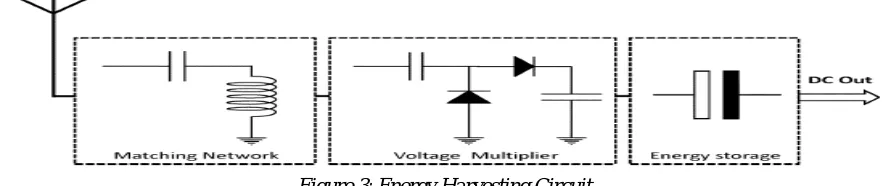
In the context of wireless power, energy harvesting, also called power harvesting or energy scavenging, is the conversion of ambient energy from the environment to electric power, mainly to power small autonomous wireless electronic devices. The ambient energy may come from stray electric power, mainly to power small autonomous wireless electronic devices. The ambient energy may come from stray electric or magnetic fields or radio waves from nearby electrical equipment, light, thermal energy (heat),or kinetic energy such as vibration or motion of the device. Although the efficiency of conversion is usually low and the power gathered often minuscule (mill watts or microwatts),it can be adequate to run or recharge small micro power wireless devices such as remote sensors, which are proliferating in many fields. This new technology is being developed to eliminate the need for battery replacement or
charging of such wireless devices, allowing them to operate completely autonomously.
Figure 3: Energy Harvesting Circuit
IV. RESULTS
Table 1. Performance of Energy Harvesting Circuit
Value of capacitor Value of diode Output voltage (D.C.)
100uF 1N4001 120mV
100uF Schottky Diode(GaAs-W) 200mV
Description: In our work we involved voltage multiplier which is one of the part of rectenna. In this circuit antenna receives A.C. signals and feeds it to voltage multiplier. This multiplies the input voltage and converts it into D.C. voltage. This circuit involve capacitor and diode network. Above table indicates the value of D.C. output which obtained by using different value of diodes and capacitors.
Table 2. Performance of printed Rectenna
Type of Rectenna Operating Frequency(GHz) Measured Peak Conversion Efficiency (%)
Printed diploma[9] 2.45 85
Description: In our work we involved direct rectenna for comparative study with antenna with voltage multiplier. This gives directly D.C. converted output after receiving antenna signals. Above table shows maximum operating frequency of rectenna and efficiency of rectenna according their type.
V. APPLICATIONS OF WPT
Moving targets such as fuel free airplanes, fuel free electric vehicles, moving robots and fuel free rackets.
Automatic wireless charging for mobile robots, cordless tools and instrument which eliminates complex
mechanisms, and labour intensive manual recharging and battery replacement.
Another application of WPT are solar power satellites, energy to remote areas, broadcast energy globally.
WPT are used for Ubiquitous power source, RF power Adaptive Rectifying Circuits (PARC).
VI. ADVANTAGES AND DISADVANTAGES
Advantages- Wireless Power Transmission system would completely eliminates the existing high-tension power transmission line cables, towers and sub stations between the generating station and consumers and facilitates the interconnection of electrical generation plants on a global scale. It has more freedom of choice of both receiver and transmitters. Even mobile transmitters and receiver s can be chosen for the WPT system. The cost of transmission and distribution become less and the cost of electrical energy for the consumer also would be reduced. The power could be transmitted to the places where the wired transmission is not possible. Loss of transmission is negligible level in the Wireless Power Transmission; therefore, the efficiency of this method is very much higher than the wired transmission. Power is available at the rectenna as long as the WPT is operating. The power failure due to short circuit and fault on cables would never exist in the transmission and power theft would be not possible at all.
Disadvantages- The Capital Cost for practical implementation of WPT seems to be very high and the other disadvantage of the concept is interference of microwave with present communication systems.
Biological Impacts- Common beliefs fear the effect of microwave radiation. But the studies proven that the microwave radiation level would be never higher than the dose received while opening the microwave oven door, meaning it slightly higher.
VII. CONCLUSION
The concept of Microwave Power transmission (MPT) and Wireless Power Transmission system is presented. The technological developments in Wireless Power Transmission (WPT), the advantages, disadvantages, biological impacts and applications of WPT are also discussed. For the long range power transmission power can be sent from source to receivers instantaneously without wires, reducing the cost. Batteries need to be recharge or changed eventually, hence the need for this kind of work.
REFERENCES
[1] Nikola Tesla, My Inventions, Ben Johnston, Ed., Austin, Hart Brothers, p. 91,1982. [2] Nikola Tesla, “The Transmission of Electrical Energy Without Wires as a Means for Furthering Peace,” Electrical World and Engineer. Jan. 7, p. 21, 1905.
[3] HISTORY OF WIRELESS Tapan K. Sarkar Robert J. Mailloux Arthur A. Oliner Magdalena Salazar-Palma Dipak L. Sengupta. [4] J.J. Schelesak, A. Alden and T. Ohno, A microwave powered high altitude platform, IEEE MTT-S Int. Symp. Digest, pp - 283- 286, 1988. [5] Farouk Balouchi and Bob Gohn, “Wireless Power: Mobile Devices, Consumer Electronics, Industrial Devices, Wireless Power Infrastructure, and Wireless Charging of Electric Vehicles: Technology Analysis, Environmental Impact, and Market Forecasts,” Pike Research Report, Published 2Q 2012.
[6] Gopinath, Ashwin (August 2013).”All about Transferring Power Wirelessly” (PDF).Electronics For You E-zine (EFY Enterprises Pvt.Ltd) Retrieved January 16, 2015
[7] Tomar, Anuradha; Gupta,Sunil(July2012). “Wireless Power Transmission: Application and Components” International Journal of Engineering Research &Technology
[9]J.J. Schelesak, A. Alden and T. Ohno, A microwave powered high altitude platform, IEEE MTT -S Int. Symp. Digest, pp -283-286, 1988.[10]"CES Best of 2007"[11] "Goodbye wires...MIT News. 2007-06-07.
[10] The Witricity website[online].Available: http://www.witri city.com/pages/company html [11]
https://en.m.wikipedia.org/wiki/wireless_power_transfe
12]F. Mishriki, “Power Solutions A New Approach to WirelessPower Transfer January 1, 2010,Sensors [13]Wireless writicity new post, USA.
[14] TWYoo and K. Chang, “Theoretical and experimental development of 10 and 35 GHz Rectennas,” IEEE Trans. Microwave Theory Tech., vol. 40, pp. 1259-1266, 1992.