COMPUTERIZED WELDING PROCESS SELECTION AND PARAMETER DETERMINATION
TAREK ABDELHADI A. AREGIA
“I hereby declare that I have read this project report and in my opinion this project
report is sufficient in terms of scope and quality for the award of the degree of Master of
Engineering (Mechanical – Advanced Manufacturing Technology)”
Signature : ………
Name of Supervisor : PROF. DR. ASHRAF HAFIZ RADWAN
iii
COMPUTERIZED WELDING PROCESS SELECTION AND PARAMETER
DETERMINATION
TAREK ABDELHADI A. AREGIA
A project report submitted in partial fulfillment of the requirements for the award of the degree of
Master of Engineering (Mechanical – Advanced Manufacturing Technology)
Faculty of Mechanical Engineering
Universiti Teknologi Malaysia
I declare that this project report entitled “Computerized Welding Process Selection and
Parameter Determination” is the result of my own research except as cited in the
references. The project report has not been accepted for any degree and is not
concurrently submitted in candidature of any other degree.
Signature : ...
Name : TAREK ABDELHADI A. AREGIA
iii
To my beloved Family and Friends
ACKNOWLEDGEMENT
First and foremost, I wish to express my sincere appreciation to my thesis
supervisor Prof. Dr. Ashraf Hafiz Radwan for his precious guidance, encouragement,
constructive criticisms, advice, knowledge, and motivation. Without his continual
support and interest, this thesis would not have been the same as presented here.
Besides that, I would also like to express my thank you to all my fellow
postgraduate course mates for their support. My sincere appreciation also extends to all
my colleagues, friends and others who have provided assistance at various occasions.
Their views and tips are useful indeed. Unfortunately, it is not possible to list all of them
in this limited space. A very special appreciation goes to all my family members and my
v
ABSTRACT
Welding is a materials joining process in which two or more parts are coalesced at
their contacting surfaces by a suitable application of heat and/or pressure. In
today technology, welding is an important process in manufacture and assembly
project. There is a need for welding expertise to get the best welding qualities. For
small and medium industry, employing a welding expert is quite costly. The purpose
of this study is to design and develop an expert system to select suitable welding
process and determining the optimum welding parameters. While conducting this
project, the important question that the project focused on was how an effective
and efficient computerized system can help in selecting the welding process and
determine process selection parameters. Also an exclusive research was done to collect
data about the arc and other welding processes parameters, designing database for the
welding processes, welding parameters, and work-pieces characteristics related to the
parameters of welding process, and also an algorithms was developed to find out the
most suitable welding process and its parameters related to a specific work-piece. So
having an expert system that helps in selecting the suitable welding process and
determine process parameters can help industries and welders to set the welding
process time, less expensive and extensive clerical work, and provide reliable and
consistent welding processes. However, the required methodology for this project
development began from initial planning, an analysis, design, development of a
implementation and application testing of the system was executed. Farther more,
evolutionary prototype is chosen as the system development methodology for this
project. On the other hand, a prototype of the proposed system was developed and
deployed by using Oracle Application Express version 3.2 as a web page developer tool
and Oracle Database 11g as data storage application. Finally, this project is developed to
achieve the objective of improving the welding processes selections by using expert
system, which is a computer program with reasoning capabilities to solve a particular
vii
ABSTRAK
Penaterian merupakan satu proses pencantuman bahan di mana satu atou lebih
bahagian disatukan pada permukaan sentuhan setiaprya, dengan mengaplikasikan haba
dan atau tekanan. Dalam teknologi hari ini, pematesian merupalcan proses yang penting
dalam projek pemosangon dan pembuatan. Wujudanya satu keperivan terhadap pakar
pematerion bagi mendapatkan kualiti pematerian yang terbaik. Bagi industri kecil dan
sederhana, mengambil seorang pakar pematerian adalah agak mohal. Tujvan kajian ini
adalah untuk merekabentuk dan membangunkan sebuah sistem pakar untuk memilib
proses pematesian yang sesuai dan menentvkan parameter pematerian yang optimum.
Semasa mengendalikan projek ini, persoalan penting yang difokuskan adalah bagaimana
sebuah sistem berkomputer yang berkesan dan cekap ( efektif dan efisyen) dapat
membontu dalam memilih proses pematesian dan menetukan pemilihan parameter
proses. Satu kajian ekslusif juga telah telah dilaksanakan untuk mengumpul data tentag
lengkok dan parameter proses pematerian yang lain, merekapentuk rujukan data untuk
proses pematerian , juga sebuah algorithm telah dibongunkan untuk menentukon proses
pematerian yang paling sesuai peserta parameternya yang berkenaan dengan hasil keja
tertentu. Maka, mempunyai sebuah sistem pakar yang mambantu memilib proses
pematerian yang sesuai dan menentukan parameter proses dapat membantu industri dan
juga pemateri untuk menentukan masa proses pematerian, kerja-kerja perkeranian yang
lebih murah dan singkat, dan menyediakan satu proses pematerian yang boleh dipercayai
dan konsisten. Walaubgaimanapon, kaedah yang diperlukan bagi pembangunan projek
akhirnya pelkasanaan dan pengaplikasian ujian terhodop sistem yang telah dibina.
Tambahan lagi, evolvsi prototaip telah dipilih sebagai kaedah pembangunan sistem
projek ini. Dengan kata lain, prototaip sistem yang dicadangkan telah dibargunkan dan
dilaks anakan dengar menggunakon Oracle Application Express version 3.2 sebagai
pembangun muka web, dan Oracle database 11g sebagai aplikasi peroyimpan data.
Akhir sekah, projek ini telah dijayakan untuk mencapai objektifnya meperbaiki
pemilihan proses pematerian dengan meggunakan sistem pakar yang merupokan sebuah
program berkomputer yang perkebolehan 'reasoning' untuk menyelesaikan masalah
ix
TABLE OF CONTENTS
CHAPTER NO. TITLE PAGE
DECLARATION
DEDICATION
ACKNOWLEDGEMENTS
ABSTRACT ABSTRAK
TABLE OF CONTENTS LIST OF TABLES LIST OF FIGURES
LIST OF ABBREVIATIONS LIST OF APPENDICES
ii iii iv v vii ix xiii xv xvii xix
1 Project Overview 1.1. Introduction
1.2. Problem Background
1.3. Statement of the Problem
1.4. Project Objectives
1.5. Scope
1.6. Importance of the Project
1.7. Chapter Summary
1 1 2 2 3 3 3 4
2 LITERATURE REVIEW
2.1. Introduction
2.2. General Welding
2.3. Arc Welding
2.3.1. Shielded Metal-Arc Welding (SMAW)
2.3.2. Gas Tungsten Arc (TIG) Welding (GTAW)
2.3.3. Plasma Arc Welding (PAW)
2.3.4. Gas Metal-Arc Welding (GMAW)
2.3.5. Flux-Cored Arc Welding (FCAW)
2.3.6. Submerged Arc Welding (SAW)
2.4. Resistance Welding (RW)
2.4.1. Advantage and Disadvantages of RW
2.4.2. Resistance Spot Welding (RSW)
2.4.3. Resistance Seam Spot Welding (RSEW)
2.4.4. Resistance Projection Welding (RPW)
2.4.5. Flash Welding (FW)
2.4.6. Upset Welding (UW)
2.4.7. Percussion Welding (PEW)
2.5. Oxyfuel Gas Welding (OFW)
2.5.1. Advantages and Disadvantages of Oxyfuel
Gas Welding
2.5.2. Oxyacetylene Welding (OAW)
2.5.3. Oxyhydrogen Welding (OHW)
2.5.4. Pressure Gas Welding (PGW)
2.6. Expert System
2.6.1. Definition
2.6.2. Current Expert Systems
2.6.3. Advantage of Expert System
2.7. Welding Process Selection
2.7.1. Introduction
2.7.2. Selection Criteria
2.7.3. Technical Consideration
2.7.4. Cost Consideration
xi
2.8. Parameter Selection
2.9. Chapter Summary
40
43
3 METHODOLOGY
3.1. Introduction
3.2. Project Methodology
3.2.1. Phase 1: Initial Planning Phase
3.2.2. Phase 2: Analysis
3.2.2.1. Literature Review
3.2.2.2. Study Current Expert Systems in
Welding Process Selection
3.2.3. Phase 3: Develop Prototype
3.3. System Development Methodology
3.3.1. Evolutionary Prototype
3.3.2. Justification of Chosen Methodology
3.4. System Requirements Analysis
3.4.1. Hardware Requirements
3.4.2. Software Requirements
3.5. Project Schedule
3.6. Chapter Summary
44 44 45 47 47 47 48 48 50 51 52 53 53 54 55 55
4 SYSTEM DESIGN IMPLEMENTATION AND
TESTING
4.1. Introduction
4.2. Database Design
4.3. Welding Process Algorithm/Model
4.3.1. Arc and Other Welding Processes
4.3.2. Resistance Welding Processes
4.3.3. Oxyfuel Welding Process
4.4. Program Chart
4.5. Interface Chart
4.6. System Architecture
4.7. Coding Approach
4.8. System Evaluation
4.8.1. User Interface Testing
4.8.2. System Testing
4.8.2.1. Requirement Testing
4.8.2.2. Usability Testing
4.8.2.2.1. Usability Requirement
4.9. Organizational Strategy
4.9.1. Business Continuity Plan (BCP)
4.9.2. Expected Organizational Benefit
4.10. Chapter Summary
75 75 77 77 78 78 78 79 81 81 81 82
5 DISCUSSION AND CONCLUSION
5.1. Achievement
5.2. Constraints and Challenges
5.3. Aspirations
5.4. Chapter Summary
83 83 84 84 85 REFERENCES APPENDIX A – B
xiii
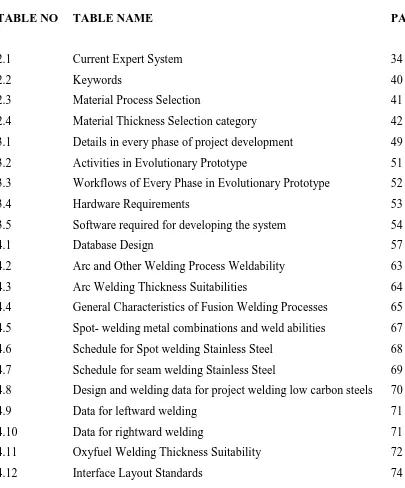
LIST OF TABLES
TABLE NO TABLE NAME PAGE
2.1 Current Expert System 34
2.2 Keywords 40
2.3 Material Process Selection 41
2.4 Material Thickness Selection category 42
3.1 Details in every phase of project development 49
3.2 Activities in Evolutionary Prototype 51
3.3 Workflows of Every Phase in Evolutionary Prototype 52
3.4 Hardware Requirements 53
3.5 Software required for developing the system 54
4.1 Database Design 57
4.2 Arc and Other Welding Process Weldability 63
4.3 Arc Welding Thickness Suitabilities 64
4.4 General Characteristics of Fusion Welding Processes 65
4.5 Spot- welding metal combinations and weld abilities 67
4.6 Schedule for Spot welding Stainless Steel 68
4.7 Schedule for seam welding Stainless Steel 69
4.8 Design and welding data for project welding low carbon steels 70
4.9 Data for leftward welding 71
4.10 Data for rightward welding 71
4.11 Oxyfuel Welding Thickness Suitability 72
xv
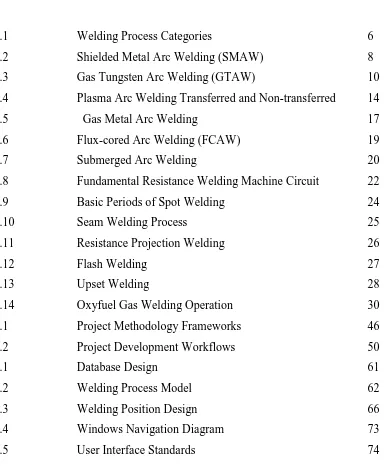
LIST OF FIGURES
FIGURE NO FIGURE NAME PAGE
2.1 Welding Process Categories 6
2.2 Shielded Metal Arc Welding (SMAW) 8
2.3 Gas Tungsten Arc Welding (GTAW) 10
2.4 Plasma Arc Welding Transferred and Non-transferred 14
2.5 Gas Metal Arc Welding 17
2.6 Flux-cored Arc Welding (FCAW) 19
2.7 Submerged Arc Welding 20
2.8 Fundamental Resistance Welding Machine Circuit 22
2.9 Basic Periods of Spot Welding 24
2.10 Seam Welding Process 25
2.11 Resistance Projection Welding 26
2.12 Flash Welding 27
2.13 Upset Welding 28
2.14 Oxyfuel Gas Welding Operation 30
3.1 Project Methodology Frameworks 46
3.2 Project Development Workflows 50
4.1 Database Design 61
4.2 Welding Process Model 62
4.3 Welding Position Design 66
4.4 Windows Navigation Diagram 73
xvii
LIST OF ABBREVIATIONS
A - Excellent,
AW - Arc Welding
B - Good
BCP - Business Continuity Plan
C - Fair
CL - Cost of Labor and overheads P.M.O.W
CM - Cost of consumable Material P.M.O.W
CR - Cost Rate of labor and overheads
CW - Cost of Welding P.M.O.W
D - Poor
E - Excellent
E - Very poor
ER - Cost of Rate of Electrode
F - Impractical
FCAW - Flux-Cored Arc Welding
FR - Cost Rate of Flux
FW - Flash Welding
G - Good
GMAW - Gas Metal-Arc Welding
GR - cost Rate of Shielding Gas
GTAW - Gas Tungsten Arc Welding
I - Intermediate
OAW - Oxyacetylene Welding
OF - Operating Factor of the welding process (arc time/total time)
OFW - Oxyfuel Gas Welding
OHW - Oxyhydrogen Welding
P - Poor
PAW - Plasma Arc Welding
PEW - Percussion Welding
PGW - Pressure Gas Welding
RPW - Resistance Projection Welding
RSEW - Resistance Seam Spot Welding
RW - Resistance Welding
S - Sheet
SAW - Submerged Arc Welding
SMAW - Shielded Metal-Arc Welding
T - Thick
T - Time required P.M.O.W
UW - Upset Welding
VG - Volume of shielding Gas consumed P.M.O.W
WE - Weight of Electrode consumed P.M.O.W
WF - Weight of Flux consumed P.M.O.W
xix
LIST OF APPENDICES
APPENDIX NO APPENDIX NAME PAGE
A Gant Chart 88
CHAPTER 1
PROJECT OVERVIEW
1.1. Introduction
Welding is a fabrication or sculptural process that joins materials, usually metals
or thermoplastics, by causing coalescence. This is often done by melting the workpieces
and adding a filler material to form a pool of molten material (the weld pool) that cools
to become a strong joint, with pressure sometimes used in conjunction with heat, or by
itself, to produce the weld. This is in contrabmnbmnst with soldering and brazing, which
involve melting a lower-melting-point material between the workpieces to form a bond
between them, without melting the workpieces.
Many different energy sources can be used for welding, including a gas flame, an
electric arc, a laser, an electron beam, friction, and ultrasound. While often an industrial
process, welding can be done in many different environments, including open air, under
2
and precautions must be taken to avoid burns, electric shock, eye damage,
poisonous fumes, and overexposure to ultraviolet light.
Besides that, Arc welding uses a welding power supply to create an electric arc
between an electrode and the base material to melt the metals at the welding point.
Welding in general can be considered as a multi-input multi-output process. Finally, the
process of arc welding is widely used because of its low capital and running costs.
1.2. Problem Background
In today technology, welding is an important process in manufacture and
assembly project. Welding expertise is required to generate a good welding procedure.
For small and medium industry, employing a welding expert is quite costly. Therefore, it
would be indeed an asset to the industry if the expertise on the particular domain could
be pooled and configured into an expert system, which is a computer program with
reasoning capabilities to solve a particular problem.
The existing computerized welding expert systems have same drawbacks
1.3. Statement of the Problem
While conducting this study, the main question to be focused on is how an
effective and efficient computerized system can help in selecting the welding process
and determine process selection parameters.
1.4. Project Objectives
The main objective of this project is to design and develop an expert system to
select suitable welding process and determining the optimum welding parameters
1.5. Scope
The scopes of this project are:
1. Collecting data about the welding processes parameters.
2. Designing database for The welding processes, welding parameters, and
work-pieces characteristics related to the parameters of welding processes
3. Developing algorithms to find out the most suitable welding process and its
4
1.6. Importance of the project
The selection of a suitable welding process and determining the optimum
parameters is not an easy task. This requires experience and involves a substantial
amount of the time, expensive and extensive clerical work. The availability of expertise
to generate a set of welding procedure is either expensive, scarce, or situations for which
specialists do not have time.
So, with using the expert system, the welder just need to specify the workpiece
materials, dimensions. Then the system will provide the suitable welding process and the
optimum welding parameters.
The advantages of this computerized welding process selection system are:
1. Provides reliable, and consistent welding processes
2. Available 24/7
3. Saving the expertise salaries and their benefits
1.7. Chapter Summary
This chapter contains brief introduction of arc welding, background of the
problem, statement of the problem, objectives of the project, scope, importance of the