Quantitative Analysis of Manual and
Automation Testing and Comparative
Study of Selenium and Load Runner
Automated Testing Tools
Krutika Kamble, Jyoti Kharade
Student, Dept. of MCA, Bharati Vidyapeeth’s Institute of Management and Information Technology, Navi
Mumbai, India
Professor, Dept. of MCA, Bharati Vidyapeeth’s Institute of Management and Information Technology, Navi
Mumbai, India
ABSTRACT: Automated software testing is a mechanism in which automation tools executes the script tests on a software and with the use of automated software testing tool comparison is done between the expected result with the actual result. The main objective of automation testing is to minimize the testing effort as possible with a minimum set of scripts. Automated software testing is becoming very much important for many software projects in order to automatically validate and verify various functionalities of the projects, for regression testing and it also help teams to run a huge number of test cases in a short period of time.
The main objective of this research paper is to estimate and compare automated software testing tools such as selenium automation testing framework and Load Runner to find out their versatility, usability, benefits and effectiveness. There are various tools available in the market for automation testing that help people to build test cases and execute them automatically. But the key part is to select the most efficient and persuasive tool among various categories of tools.
KEYWORDS: Selenium, Load Runner, Automation Testing Tools, Software Testing, Automated software Testing.
I. INTRODUCTION
Software testing is a process of executing a program which is used to find the correctness, completeness and the quality of software or the application. Software testing is the procedure of executing the application under positive and negative condition by manually or automatically. Software testing is done with the intent of locating and finding the software bugs. Software Testing is a very crucial in software development life cycle (SDLC).The main aim of software testing is to uncover as many errors or bugs as possible. It is use to see that the software product is matching the requirements or not. It is also use to validate the quality of software. Testing is the process of making certain secret that a program does what it is took as probable to do.
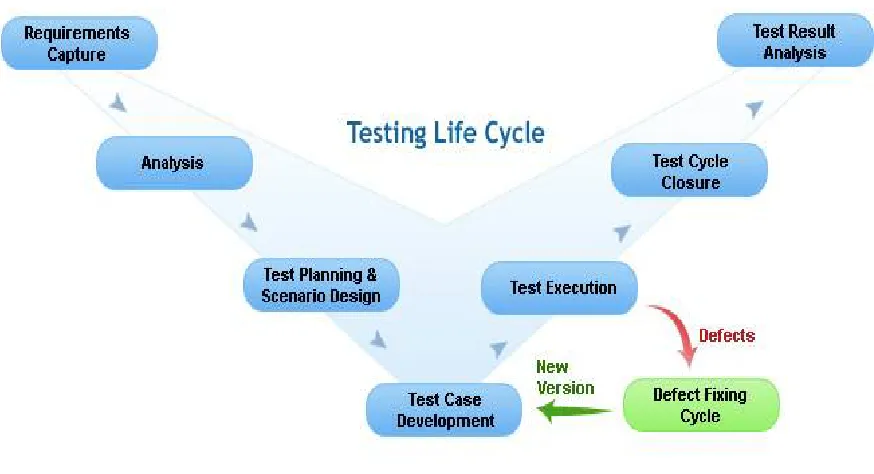
Fig. 1. Testing Life Cycle
II. MAIN STRATEGIES OF SOFTWARE TESTING
A. Manual Testing
Manual Testing is a process in which the software or application is tested manually i.e. without using the software automation tools or test scripts. Manual testing is a process of testing the software or application manually to find out the defects and see to it that the software is fulfilling the requirement specifications. It needs a tester to play the role of associate user and use most of all options of the applying to make sure correct behavior. Any new application should be manually tested before it is automatically tested. Manual testing needs additional efforts however is critical to examine automation practicable. Manual Testing doesn’t need information of any testing tool. One in every of the computer code Testing elementary is Full-fledged Automation testing is not possible which makes Manual Testing imperious and essential.
Manual testing needs longer and a lot of resources, a while each.
Performance testing is unworkable in manual testing, Per-forming same tasks again and again is time consuming and tedious.
GUI objects Size distinction and color combos etc are difficult to seek out in Manual Testing.
Batch testing isn’t potential, for each and every check execution Human User interaction is obligatory.
Actual load and performance isn’t potential to hide in manual testing for big variety of users.
B. Automation Testing
Automated testing is a method during which software tools execute pre-scripted tests on a package application before it’s free into production. In software testing, take a look at automation is that the use of special software system (separate from the software system being tested) to manage the execution of tests and also the comparison of actual outcomes with foretold outcomes. Test automation will modify some repetitive however necessary tasks in an exceedingly formalized testing method already in place.
Test automation is crucial for continuous delivery and testing. Automation Testing covers the majority the issues of manual testing. The objective of automated testing is to alter the maximum amount of the testing effort as attainable with a minimum set of scripts.
Automated testing tools are able to execute tests, reportage outcomes and scrutiny results with earlier test runs. Automation is not a complete alternative to manual testing but it is a continuation of manual testing which aims to provide accuracy and speed to the testing efforts.
III. AUTOMATED SOFTWARE TESTING TOOLS
Automated software testing is changing into more and more necessary for several software come so as to mechanically verify key practicality, test for regressions and facilitate groups run an outsized range of tests in a very short amount of your time. There are numerous tools within the market that facilitate software groups build and execute machine-controlled tests. The tools are mainly classified into different categories as follows:
Functional Testing Tools
Load Testing Tools
Test Management Tools
The purpose of this research paper highlights comparison between Selenium and Load Runner testing tools and their contribution to software project scenario.
A. Selenium
Selenium Framework is an open-source tool that is used for automation testing. Selenium is a set of various software system tools every with a unique approach to supporting test automation.
It has capabilities to manage across operational systems and completely different browsers. It supports various programming languages, which incorporates most, however not restricted to solely, Groovy, Ruby, Perl, Python, Java, C and PhP. Selenium consists of numerous components which content three major tools. Everyone has a selected role in aiding the event of test automation for a web application.
1. Selenium IDE: Integrated Development Environment is associated with Firefox plugin that lets testers to record their actions as they follow the progress that they have to test.
2. Selenium RC: Selenium device (RC) was the flagship testing framework that allowed quite easy browser actions and linear execution. It makes use of the complete power of programming languages like Java, C, PHP, Groovy, Python, Ruby and PERL to create more complex tests.
3. Selenium Web Driver: Selenium Web Driver is that the successor to Selenium RC that sends commands on to the browser and retrieves results.
4. Selenium Grid: Selenium Grid is a tool use to run parallel tests across totally different machines and different browsers at the same time which ends in decreased execution time.
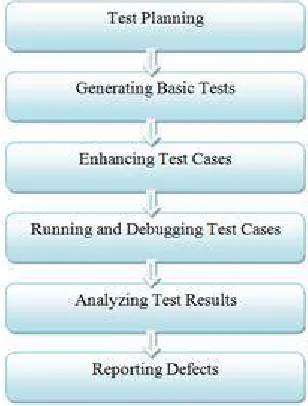
Fig. 2. Selenium Testing Process
B. Load Runner
Load Runner is the automation testing tool which is use for testing the application or software. It is developed by Hewlett Packard Enterprise in year 2000. It is used for testing applications and it is also use to measure the behavior of the system. Load Runner analyzes the performance of the applications under load.
Hewlett Packard Enterprise Load Runner can imitate legion users simultaneously or synchronously using software application. By using load runner we can record and analyze the performance of main ingredients or inner parts of the applications. Load Runner is an automation tool use for load testing and performance testing of applications. It supports two operating systems Microsoft Windows and Linux (Load Generator only).
Load Runner consists of various components which are as follows:
1.Load Generator: Load Generator generates the load against the appliance or application by following scripts. 2.VuGen: VuGen (Virtual User Generator) for generating and redacting or modifying the scripts.
3.Controller: Controller launches, controls and sequences instances of Load Generator specifying that which script to use and for how long. During runs the Controller receives real time observational information and displays status.
4. Agent method: Agent method manages affiliation between Controller and Load Generator instances.
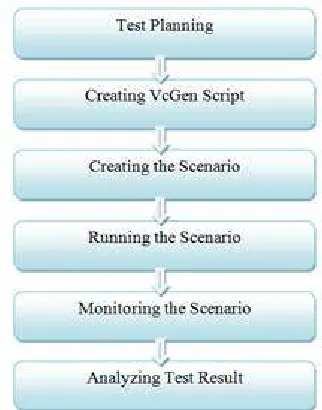
Load Runner Testing Process consists of following phases:
Fig. 3. Load Runner Testing Process
IV. EVALUATION STUDY
Comparisons between Selenium and Load Runner are made on the basis of following parameters:
A. License Cost
Load Runner: Variety of Protocol bundles and Virtual users.
Selenium: The Selenium is free of cost.
B. About the Software
Load Runner: Around 2.5 GB software systems that have separate applications for recording, take a look at execution and analysis.
Additionally has cloud support.
Selenium: Need to have Java and collection of various Selenium libraries which will be executed using any language that support HTTP protocol library (Java/PhP/Groovy/.Net/Python/Ruby etc).
C. Script Recorder
Load Runner: Ajax (Click & Script) rules is appropriate for WEB2.0 applications, this protocol has HP QTP technology with restricted object properties. User clicks were recorded as C functions. The similar functions run during the replay in Load Runner Browser.
D. Script Replay
Load Runner: It replays the script in Load Runner proprietary browser thus there’s page rendering. Lots of problems were face when page contain alternative objects.
Selenium: It replay the script in real browser thus there’s page rendering.
E. Load Generator
Load Runner: Deployed within the premises or on the cloud. Load obtaining generated from few places only.
Selenium: There is no thought of Load Generators in Selenium, by using GRID we are able to run multiple browsers on completely different systems.
F. WAN Emulator
Wan emulation defines a technique use for performance of real time testing on virtual network.
Load Runner: It is integrated with SHUNRA Virtual Enterprise Suite to get network effects.
Selenium: There is no facility to feature network effects.
G. Multi-Browser support
Load Runner: It does not support various browsers, it execute in Load runner Propriety or deportment browser.
Selenium: Selenium supports various browsers, you would like to possess own software package and hardware.
H. Test Execution Length
Load Runner: We can schedule our test but cannot run for longer time span. If we run the test for three to four days the system will get stuck while processing.
Selenium: We can schedule our test using Hudson-CI.
I. Response time
Load Runner: It is record at transaction level.
Selenium: There is no inbuilt facility to calculate time interval, have to be compelled to contemplate different ways and methods.
J. Functional Testing
Load Runner: It doesn’t support Functional testing.
Selenium: It is a functional checking tool with parallel test execution capability and cross-browser support.
K. Performance Testing
Selenium: We cannot use selenium for performance testing.
L. Mobile Platform Support
Load Runner: It doesn’t support Mobile platform.
Selenium: It support Mobile platform but it has to be integrated with some other tools like Appium.
M. Monitoring Resources
Load Runner: Load Runner monitors server resources and output.
Selenium: It doesn’t have the resource monitoring capability.
N. Flex Support
Load Runner: It supports, but the problems are faced distinguishing the objects.
Selenium: It supports, but to show the objects, we have to recompile the flex with some third party libraries. The Selenium Flex libraries are flex-pilot, flexmonkium and flash-selenium.
V. CONCLUSION
Selenium and Load Runner are both effective tools for automation testing. But Selenium is open source tool whereas Load Runner is not open source. Selenium simulates user interaction with the interface whereas Load Runner simulates significant usage.
Selenium simulates a user by recording its actions on the interface whereas Load Runner doesn’t hassle concerning the interface and records the commands through a proxy. Selenium is mainly use for functional testing whereas Load Runner is use mainly for performance testing.
REFERENCES
1. Mohammad Imran, Dr. Mohamed A.Hebaishy, Dr. Abdullah Shawan Alotaibi, A Comparative Study of QTP and Load Runner Automated Testing Tools and their Contributions to Software Project Scenario, Vol. 4, Issue 1, January 2016
2. Rasneet Kaur Chauhan and Iqbal Singh, Latest Research and Development on Software Testing Techniques and Tools, Accepted 05 July 2014, Available online 01 Aug 2014, Vol.4, No.4 (Aug 2014).
3. IEEE (1990), IEEE Standard Glossary of Software Engineering Terminology, Los Alamitos, CA: IEEE Computer Society Press.
4. Hitesh Tahbildar1 and Bichitra Kalita2 AUTOMATED SOFTWARE TEST DATA GENERATION: DIRECTION OF RESEARCH, International Journal of Computer Science Engineering Survey (IJCSES) Vol.2, No.1, Feb 2011.
5. Niranjanamurthy M, Arun Kumar R , Sahana Srinivas, Manoj RK, Research Study on Web ApplicationTesting using Selenium Testing Framework, IJCSMC, Vol. 3,Issue. 10, October 2014.
6. Harpreet Kaur, Dr.Gagan Gupta, Comparative Study of Automated Testing Tools: Selenium, Quick Test Professional and Testcomplete, ISSN: 2248-9622, Vol. 3, Issue 5, Sep-Oct 2013.
7. Kaner, Cem. (November 17, 2006). ”Exploratory Testing” (PDF).Florida Institute of Technology, Quality Assurance Institute Worldwide Annual Software Testing Conference, Orlando, FL.