ABSTRACT
REDDY, VIMAL KODANDARAMA. Exploiting Microarchitecture Insights for Efficient Fault Tolerance. (Under the direction of Dr. Eric Rotenberg).
Technology scaling makes transistors more susceptible to transient faults. As a result, it is becoming increasingly important to incorporate transient fault tolerance in future processors. Traditional transient fault tolerance approaches duplicate in time or space for robust fault tolerance, but are expensive in terms of performance, area, and power, counteracting the very benefits of technology scaling. To make fault tolerance viable for commodity processors, unconventional techniques are needed that provide significant fault protection in an efficient manner. In this spirit, this thesis presents two low-overhead approaches to fault tolerance based on microarchitecture insights.
Exploiting Microarchitecture Insights for
Efficient Fault Tolerance
by
VIMAL KODANDARAMA REDDY
A dissertation submitted to the Graduate Faculty of North Carolina State University
in partial fulfillment of the requirements for the Degree of
Doctor of Philosophy
Computer Engineering
Raleigh, North Carolina
2007
APPROVED BY:
Dr. Eric Rotenberg, Chair of Advisory Committee
Dr. Thomas M. Conte Dr. Suleyman Sair
DEDICATION
BIOGRAPHY
ACKNOWLEDGMENTS
The pursuit of my doctoral degree has been a fun and rewarding journey. Here, I want to thank everyone who helped me reach my destination.
First and foremost, I want to thank my parents, Prof. Kodandarama Reddy and Mrs. Vijiram. I could not have succeeded without their unconditional love, support, and prayers.
I am indebted to my advisor Prof. Eric Rotenberg for inspiring me to do computer architecture research and training me to become a good researcher. Eric has been a great mentor and friend. I thank him for giving me the freedom to work on many projects, while always making sure I was on the right track. His high standards, work ethics, attention to quality and emphasis on novelty and individuality, and most importantly, his sense of humor, have influenced my thinking and personality to a great degree. I feel privileged and proud to have been advised by him.
I wish to thank my committee members Prof. Tom Conte, Prof. Suleyman Sair, and Prof. Warren Jasper. Their guidance and expertise improved the quality of this dissertation.
I would like to express my deepest gratitude to my wife Lakshmi for her love, compassion and support. Her companionship and cheerfulness were my solace during many uncertain periods that graduate school brought with it. I really thank her for the many selfless sacrifices she made for my cause, and the patience and trust she has shown in me.
I feel privileged to have crossed paths with several wonderful people in the CESR lab. Thanks to Ahmed Al-Zawawi for being a great friend, mentor and an excellent sounding board to my ideas, regardless of their merit. I benefited immensely from Ahmed’s wisdom and experience. Many problems related to my research were resolved after brainstorming with him. I learnt several valuable lessons from him: asking good questions, how to not get ripped off, bargaining, winning an argument (by actually losing many to him), and finally, finding great deals, that saved me lots of dough :) I really wish him good luck in his endeavors. Thanks to Balaji, Chad, Hashem, Mark, Muawya, Paul, Salil, and Sandeep, for grilling me during my practice talks, and more importantly, keeping the lab humored. I wish them the very best in their doctoral pursuit. Thanks to Muawya for all the rides to the airport. I sincerely thank my former lab mates Ali, Aravindh, Ravi, Sailashri, Saurabh and Shobhit, for their friendship and support as a fellow grad student.
I owe a big thanks to Sandy Bronson for taking care of all my paperwork and conference reimbursements. I also want to thank Patrick Murphy for his condor support, and Aaron for his VCL support, which helped me meet various conference deadlines.
TABLE OF CONTENTS
List of Tables ……….... viii
List of Figures ………...ix
Chapter 1 : Introduction ... 1
1.1 Prediction-based Partial Redundant Threading (PRT) on Slipstream ... 4
1.2 A Canonical Fault-Tolerant Superscalar Processor ... 6
1.2.1 Canonical Fault Checks for a Superscalar Processor ... 8
1.2.2 Putting it All Together ... 11
Chapter 2 : Prediction-based Partial Redundant Threading ... 14
2.1 Fault Detection in Various PRT Models ... 17
2.2 Prediction-based PRT on Slipstream ... 23
2.2.1 Confident Branch Prediction ... 24
2.2.2 Confident Silent Write Prediction ... 24
2.2.3 Confident Dead Write Prediction ... 26
2.2.4 Confident Silent Store Prediction ... 28
2.2.5 Result: % Undetectable Faulty Instructions ... 28
2.3 Fault Recovery ... 28
2.3.1 Previous Recovery Implementation ... 29
2.3.2 Recovery Alterations ... 29
2.3.3 Direct Checks of Silent Writes and Stores ... 31
2.4 Novel Coverage Analysis ... 34
2.5 Simulation Environment ... 37
2.6 Results ... 39
2.6.1 Instruction Breakdown ... 39
2.6.2 Slipstream with Base Recovery ... 40
2.6.3 Slipstream with New Recovery ... 42
2.6.4 Performance ... 43
2.7 Using Only Branch Predictions ... 45
2.8 Summary ... 48
Chapter 3 : Inherent Time Redundancy ... 50
3.1 Characterizing Program Repetition in SPEC2K Benchmarks ... 51
3.2 ITR Cache ... 55
3.3 Microarchitecture Support for ITR ... 55
3.3.1 ITR Signature Generation ... 56
3.3.2 ITR ROB and ITR cache ... 57
3.3.3 Fault Detection and Recovery Coverage ... 59
3.3.4 Faults on ITR Components ... 60
3.3.5 Faults on the Program Counter (PC) ... 61
3.7 Summary ... 73
Chapter 4 : Register Name Authentication ... 75
4.1 RNA Previous Mapping Check ... 76
4.2 RNA Writeback State Check... 79
4.3 Source Register Renaming Faults ... 82
4.4 Fault Injection ... 82
4.4.1 Experimental Setup ... 82
4.4.2 Results ... 84
4.5 Summary ... 89
Chapter 5 : Timestamp-based Assertion Checking ... 90
5.1 TAC Mechanism ... 91
5.2 Handling Wraparound of Timestamp Counter ... 94
5.3 Fault Injection ... 95
5.3.1 Experimental Setup ... 95
5.3.2 Results ... 97
5.4 Summary ... 98
Chapter 6 : A Canonical Fault-Tolerant Superscalar Processor ... 100
6.1 Fault Injection Strategy ... 100
6.2 Fault Analysis of a Superscalar Pipeline ... 103
6.2.1 Fetch and Decode Stages ... 105
6.2.2 Register Rename Stage ... 110
6.2.3 Dispatch Stage ... 111
6.2.4 Backend Stages ... 113
6.3 Fault-Checking Regimen... 119
6.4 Experimental Methodology ... 121
6.5 Results ... 124
Chapter 7 : Related Work ... 137
7.1 Space Redundancy Based Approaches ... 137
7.2 Time Redundancy Based Approaches ... 140
7.3 Information Redundancy Based Approaches ... 144
7.4 Logic-Circuit-Level Approaches ... 146
Chapter 8 : Summary ... 147
LIST OF TABLES
Table 2-1. SMT microarchitecture for all three modes. ... 38
Table 3-1. Number of static traces for SPEC. ... 64
Table 3-2. Microarchitecture configuration ... 66
Table 3-3. List of decode signals. ... 67
Table 4-1. Microarchitecture configuration ... 83
Table 5-1. Microarchitecture configuration ... 96
LIST OF FIGURES
Figure 2-1. Partial Redundant Threading (PRT) spectrum. ... 15
Figure 2-2. Full redundant execution. ... 18
Figure 2-3. Conventional PRT. ... 19
Figure 2-4. Prediction-based PRT... 20
Figure 2-5 (a) and (b). Relaxing the checking constraints in prediction-based PRT. ... 21
Figure 2-6. Prediction-based PRT with indirect checking through confident predictions. .... 22
Figure 2-7. Confidently predicted branch removed from partial thread. ... 24
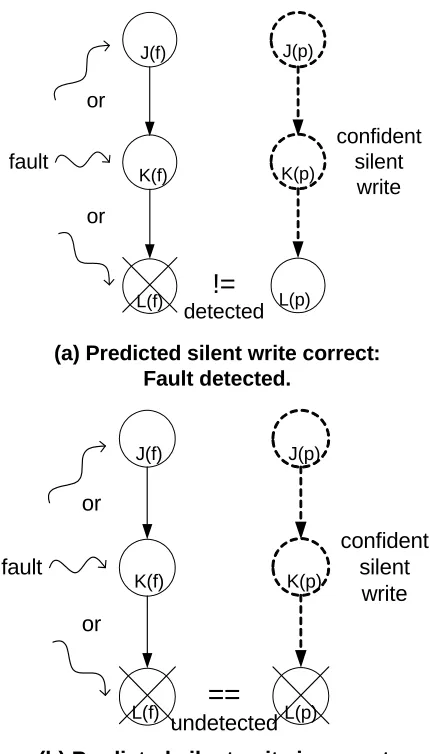
Figure 2-8. Confidently predicted silent write removed from partial thread. ... 26
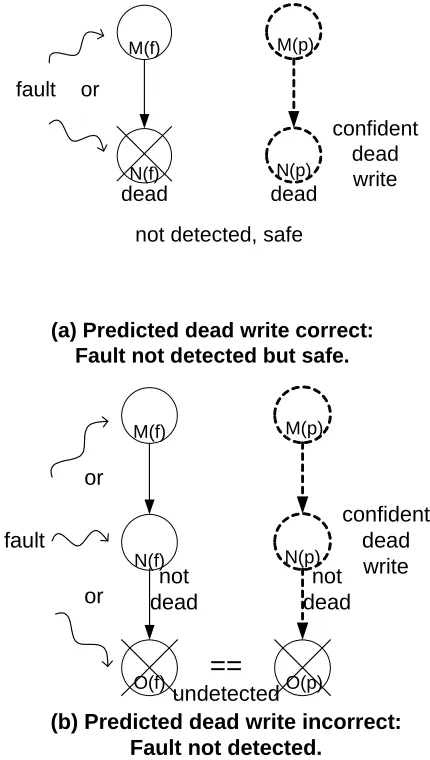
Figure 2-9. Confidently predicted dead write removed from partial thread. ... 27
Figure 2-10. Forward slice example. ... 37
Figure 2-11. Breakdown of retired instructions. ... 39
Figure 2-12. Coverages of Slipstream with base recovery. ... 40
Figure 2-13. Coverage of Slip+SS+SW_ORT_ret for various recovery approaches.. ... 43
Figure 2-14. Performance comparisons. ... 44
Figure 2-15. Coverage for Single+B(+b). ... 46
Figure 2-16. Optimistic coverage for Single+B(+b). ... 47
Figure 2-17. Performance of Single+B(+b). ... 48
Figure 3-1. Dynamic instructions per 100 static traces (integer benchmarks). ... 53
Figure 3-2. Dynamic instructions per 50 static traces (floating point benchmarks). ... 53
Figure 3-3. Distance between trace repetitions (integer benchmarks). ... 54
Figure 3-4. Distance between trace repetitions (floating point benchmarks). ... 54
Figure 3-5. Superscalar processor augmented with ITR support. ... 58
Figure 3-6. Loss in fault detection coverage. ... 66
Figure 3-7. Loss in fault recovery coverage. ... 66
Figure 3-8. Fault injection results. ... 69
Figure 3-9. Die photo of the IBM S/390 G5 processor (Source: [51]). ... 71
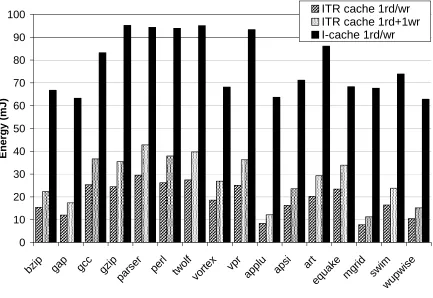
Figure 3-10. Energy of ITR cache vs. I-cache. ... 73
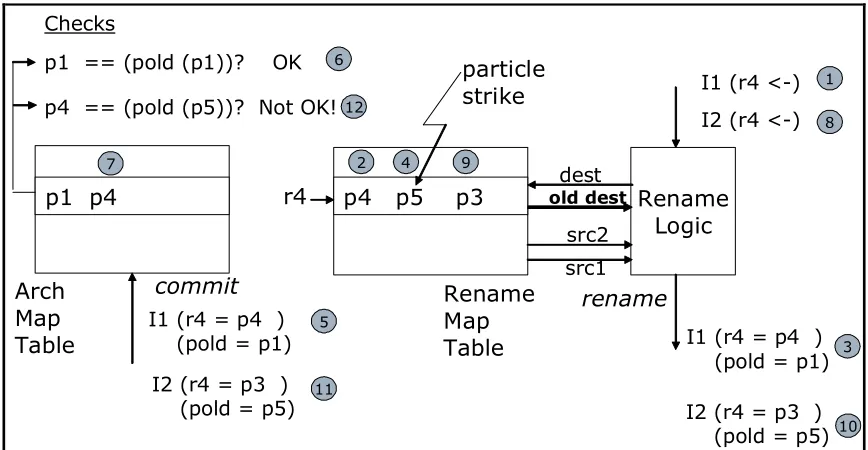
Figure 4-1. Fault detection using RNA’s “previous mapping check”. ... 78
Figure 4-2. Fault detection using RNA-writeback. ... 81
Figure 4-3. Breakdown of outcomes of RNA fault injection campaign. ... 85
Figure 4-4. Relation of faults to outcomes... 86
Figure 4-5. Relation of faults to assertion checks. ... 88
Figure 5-1. Example data-flow graph with latencies. ... 91
Figure 5-2. Illustration of TAC checks. ... 93
Figure 5-3. Breakdown of outcomes of TAC fault injection campaign. ... 98
Figure 6-1. Superscalar processor pipeline for (a) non-memory and (b) memory instructions. ... 104
Figure 6-2. Fault analysis of the fetch and decode stages of the pipeline. ... 109
Figure 6-3. Fault analysis of the register rename stage of the pipeline. ... 111
Figure 6-5. Fault analysis of the backend of the pipeline (Issue, Reg Read, Execute/Agen,
Writeback, Cache Access, and Retire). ... 118
Figure 6-6. Classification chart for fault injection outcomes. ... 124
Figure 6-7. Distribution of faults injected across different pipeline stages. ... 125
Figure 6-8. Fault outcome distribution. ... 126
Figure 6-9. Fault outcome distribution per pipeline stage. ... 127
Figure 6-10. Fault outcome distribution for each fault type injected in the fetch stage. ... 132
Figure 6-11. Fault check distribution for fetch stage. ... 132
Figure 6-12. Fault outcome distribution for each fault type injected in the decode stage. ... 133
Figure 6-13. Fault check distribution for decode stage. ... 133
Figure 6-14. Fault outcome distribution for each fault type injected in the rename stage. .. 134
Figure 6-15. Fault check distribution for rename stage. ... 134
Figure 6-16. Fault outcome distribution for each fault type injected in the dispatch stage. . 135
Figure 6-17. Fault check distribution for dispatch stage. ... 135
Chapter 1: Introduction
Processor performance has increased significantly over the years, fueled by deep technology scaling. Unfortunately, deep scaling also increases vulnerability to soft errors caused by cosmic rays in the atmosphere, most notably neutron particles. Several research studies [34][45][46][87][88][89][90] and practical reports [47][48][49][50] have shown that neutron particles striking silicon chips at sea level can induce sufficient charge to flip the logical state of memory elements (logic state bits or SRAM cells), or cause transient changes to outputs of combinational logic, which might get erroneously latched. Process technology scaling leads to scaling down of many important parameters that increase the vulnerability of a node from neutron strikes. Most importantly, when a process technology is scaled, the critical charge needed to change the logical state of a node (known as Qcrit) experiences a quadratic decrease [46], making it easier to flip a bit. In contrast, a quadratic decrease is observed in the charge collection area of a node [46], reducing vulnerability to soft errors. However, as each new process leads to more nodes on a chip (Moore’s law), the net impact is expected to be a rise in overall chip soft error rates. Studies indicate that the soft error rate (SER) of logic state bits will rise 8% for each new generation [46], and that of combinational logic will increase several orders of magnitude across generations [34]. One study expects the overall chip SER at 16 nm to be 100 times that at 180 nm [45].
performance) is equally important because heavy-weight solutions will offset the benefits of high-performance processors, and hence slow down growth that the processor industry has seen over the years.
Conventional fault tolerance solutions confirm correctness by either duplicating explicitly in time or space, or adding information redundancy like parity, ECC, etc. Such traditional techniques incur high overheads that are unsuitable for commodity high-performance processors. For example, redundant multithreading [19][20][23][27][29] is a time-redundant execution model where all instructions of a program are duplicated, and their outcomes compared, to confirm correctness. Redundant multithreading has high performance and power overheads due to full-program duplication. Space redundancy also incurs high power and area overheads. A classic example of space redundancy is the IBM S/390 mainframe processor [51][52], in which the fetch, decode and execution units are duplicated, and signals from duplicated units are compared to detect transient faults. Information redundancy techniques like parity and ECC require checking circuitry that can impact cycle time if the protected elements lie on critical paths of the processor. Moreover, they have limited applicability in protecting combinational logic elements.
level fault checks are an effective middle-ground between architecture-level checks like redundant multithreading, which have high overheads due to duplication, and logic-circuit-level checks like parity, robust flip-flop designs [100][103][104], self-checking state machines [106][105][107] etc., which are fine-grain and lead to high overheads when applied to all logic.
In this dissertation, two fault-tolerant architectures are presented that use microarchitecture insights for fault tolerance.
The first architecture improvises an existing leader-follower multithreading architecture called Slipstream [16][27] to make it robust, using the insight that a correct prediction of an instruction’s outcome is the same as the outcome produced by fault-free execution of the instruction. So, an instruction with a predictable outcome is not duplicated, rather, its outcome is compared to a prediction, with a misprediction being a strong indicator of a transient fault. An incorrect prediction can mask a faulty outcome, if they match. The vulnerability due to mispredictions can be reduced using confidence counters to guide the selection of predictions that are reliable proxies for redundant execution of instructions. The idea of using confident predictions as effective proxies for redundant execution forms the basis of my first thesis about prediction-based partial redundant threading (PRT). My
first thesis is that near-100% fault coverage can be achieved without full duplication, by using highly-confident predictions to replace redundant execution of instructions.
design. This forms the basis for my second thesis about using canonical fault checks for a fault-tolerant superscalar processor. My second thesis is that, by exploiting
microarchitecture insights, there is potential to replace conventional time or space redundancy approaches with an inexpensive regimen of canonical fault checks that provide substantial fault coverage of the processor, leading to a canonical fault-tolerant superscalar processor.
The two architectures are discussed in further detail in Sections 1.1 and 1.2.
1.1 Prediction-based Partial Redundant Threading (PRT) on
Slipstream
The main idea behind prediction-based PRT is to leverage predictions as a source of redundancy, and use them as proxies for redundant execution of instructions. The very same notion is also exploited by Slipstream processors for high-performance reasons, and hence, Slipstream provides an ideal platform to test my first thesis about the efficient fault tolerance of prediction-based PRT.
A-stream outcomes as near-ideal predictions. The net result is faster execution compared to conventional non-redundant execution.
An additional benefit of Slipstream is transient fault tolerance due to some amount of duplication of the program. Previous studies of Slipstream [27][16] concluded that “the system transparently recovers from transient faults affecting redundantly-executed instructions”. By building upon the insight that confident predictions are as effective as actual outcomes, it will be shown in this dissertation that Slipstream processors inherently possess higher levels of fault tolerance than suggested in previous studies, and minor improvisations to the microarchitecture can boost Slipstream’s fault tolerance to nearly 100%. An improvised Slipstream processor on a SMT substrate that has close-to single-thread performance and close-to 100% fault coverage will be demonstrated as proof of my first thesis.
estimate the fault recovery coverage for various recovery implementations. The forward-slice algorithm is then applied to estimate fault recovery coverage for a superscalar architecture that rolls back to the head of the reorder buffer on branch mispredictions.
1.2 A Canonical Fault-Tolerant Superscalar Processor
Traditional transient fault tolerance approaches that use time or space redundancy provide robust fault tolerance, but have significant overheads. The following drawbacks associated with these approaches lead to consideration of alternative fault-tolerant architectures:
1. Power: Power consumption has become a major consideration for high-performance processors. Time or space redundancy based implementations that protect the entire processor pipeline have substantial power overheads, making them unattractive for high-performance processors [74][75].
3. Performance: Time redundant execution incurs performance overheads because instructions compete for resources on a single processor core. For example, redundant multithreading [20][23] incurs high performance overheads that may make it unsuitable for high-performance processors.
4. Area: Straightforward duplication of resources could lead to significant area overheads. For example, in the IBM S/390 G5, the fetch, decode and execution units were duplicated, with a 20% to 30% area overhead [51].
Prediction-based PRT, which forms the first part of this dissertation, reduces the performance overhead of redundant multithreading architectures by reducing the number of duplicated instructions. However, not all programs are predictable, hence, opportunities for reducing duplication might be limited in these programs. Moreover, time redundancy models that exploit prediction-based PRT still have power and complexity drawbacks indicated above.
A more fundamental approach to make fault tolerance viable for commodity high-performance processors is to develop fault checks that can be incorporated into the processor microarchitecture without significant overheads. In this spirit, my dissertation proposes some unconventional fault checks based on microarchitecture insights, that provide significant fault protection in an efficient manner. An important characteristic of all the fault checks is that they are “canonical,” i.e., they are generic enough to be applied to any out-of-order superscalar processor design.
check would protect a distinct part of the processor pipeline, thus, the regimen as a whole would provide comprehensive protection to the processor.
1.2.1 Canonical Fault Checks for a Superscalar Processor
Towards the goal of achieving a canonical fault-tolerant superscalar processor, my dissertation develops three important microarchitecture-level fault checks for out-of-order superscalar processors: Inherent Time Redundancy (ITR) for protecting decode signals, Register Name Authentication (RNA) for protecting register-dependency information, and Timestamp-based Assertion Checking (TAC) for ensuring correct issue ordering among instructions. The following subsections discuss the three checks.
1.2.1.1 Inherent Time Redundancy (ITR)
Inherent Time Redundancy (ITR) is based on the insight that many programs repeatedly execute the same instructions within close time periods. This program repetition can be exploited for fault tolerance by recording input-independent signals in the processor (like decode signals) and checking correctness upon program repetition by comparing the new instance of a signal with the recorded instance. An ITR cache is proposed for recording the decode signals and it is shown that a relatively small ITR cache can provide fault coverage on the decode signals for a significant fraction of instructions. By checking decode signals for correctness, ITR can potentially detect faults in the fetch unit, faults in the decode unit, and faults in all pipeline latches that store decode signals of instructions.
end of 16 instructions) emerging from the decode stage are combined into a signature and stored in the ITR cache. Subsequently, newly formed decode signatures are checked against cached decode signatures to check for transient faults. Chapter 3 evaluates the fault tolerance capabilities of ITR using targeted fault injection on decode signals of a processor, and also compares the ITR cache’s area and power overheads against conventional approaches that are based on space or time redundancy, highlighting the efficiency of ITR-based approaches.
1.2.1.2 Register Name Authentication (RNA)
logic will cause an erroneous mapping very early in the pipeline, and all the renaming structures are updated consistently (rename map, architectural map, shadow maps, and ROB).
The RNA writeback state check aims to detect such faults using the insight that they cause register conflicts between the instructions. Basically, an erroneously mapped physical register might already be in use by another active instruction, committed to architectural state, or still available in the free list. Asserting the state of a physical register (whether it is in the free list, whether it is not ready, etc.) at key points in the processor pipeline (e.g., the register writeback stage) exposes this conflict, hence, detects the fault.
Chapter 4 discusses RNA in depth, illustrating the various faults involving destination physical register mappings, and discussing how the two RNA checks offer protection against such faults. Chapter 4 also evaluates the fault tolerance capabilities of RNA using targeted fault injection on structures associated with register renaming in an out-of-order superscalar processor.
1.2.1.3 Timestamp-based Assertion Checking (TAC)
instructions for issuing. A transient fault in the scheduler structures or any associated logic involved can cause instructions to misfire. TAC detects all of these faults with one simple assertion check.
Chapter 5 discusses TAC in detail. Microarchitecture alterations required to incorporate timestamp counters and the TAC checks are explained. Timestamp counter overflow is a problem, since it can cause false alarms. An elegant solution is proposed to handle overflows without compromising on fault detection. Finally, the fault tolerance capabilities of TAC are evaluated using targeted fault injection.
1.2.2 Putting it All Together
The culmination of this work is a fault-tolerant superscalar processor that incorporates all the fault checks developed in this dissertation. The goal is to make the case for a fault-tolerant processor based on a regimen of low-overhead fault checks, where each check targets a different part of the pipeline, and the regimen as a whole provides comprehensive coverage of the pipeline.
Chapter 6 builds a checking regimen that includes all the fault checks developed in this dissertation: ITR, RNA, TAC and mispredictions of confident branches. Some fault checks are improvised from their original description in earlier chapters and new fault checks are introduced for broader coverage of the processor pipeline.
element. A straightforward approach to inject faults would be to consider all pipeline latches as candidates for fault injection, and flip a bit of a randomly selected latch. However, this direct approach is not feasible because a timing simulator does not model all the pipeline latches.
My dissertation presents a practical fault injection approach for a timing simulator of a superscalar processor. The idea is to aggregate faults at several locations in a pipeline stage into visible fault manifestations that have a greater chance of causing a failure. In reality, faults in many pipeline latches get masked away and do not become errors. Aggregating several faults into visible fault locations increases the likelihood of an error due to a fault, and to a certain degree, reduces masking due to dormant faults from the experiments. Modeling dormant faults would only highlight the presence of fault masking in the processor. Hence, the approach of aggregating faults into visible fault locations by inspection provides a rigorous evaluation of processor fault-detection capabilities, while not sacrificing pipeline coverage in the fault injection experiments.
Chapter 2: Prediction-based Partial Redundant Threading
The microarchitecture insight behind prediction-based PRT is that highly confident predictions are effective proxies for redundant execution. The reasoning is that a correct prediction for an instruction is as good as the actual outcome achieved by executing the instruction. On the other hand, a misprediction of an instruction outcome can mask a fault if the mispredicted outcome matches the faulty outcome. Since highly confident predictions are rarely incorrect, confident predictions can be used as effective proxies for redundant execution of instructions.
In redundant multithreading architectures [19][20][23][27][29], all instructions are fetched and executed twice, via two redundant threads on a simultaneous multithreading (SMT) pipeline. The results of the duplicated instructions are compared to detect transient faults. The performance overhead of dual redundant threads on an SMT pipeline can be significant due to resource contention (fetch, issue, and retire bandwidth, physical registers, etc.) and checking bandwidth. Lighter weight approaches have been proposed [5][27][30], that duplicate only a subset of the dynamic instruction stream. These approaches are referred to as Partial Redundant Threading (PRT) and will be discussed in the context of the PRT spectrum shown in Figure 2-1.
• Partial duplication. In this approach, instructions are arbitrarily duplicated for fault
low instruction-level parallelism). This approach only achieves partial fault tolerance depending on the amount of duplication.
PARTIAL REDUNDANT THREADING (PRT) SPECTRUM
Confident Predictions Partial
Duplication
Partial Duplication
& Confident Predictions
EX: Opportunistic
EX: Slipstream
EX: ReStore
Figure 2-1. Partial Redundant Threading (PRT) spectrum.
• Confident predictions. This approach is an extreme case of prediction-based PRT
where only confident predictions provide redundancy to detect faults. Since highly confident predictions are rarely incorrect, a misprediction most likely indicates that a fault afflicted the instruction outcome, and not that the prediction is wrong. For example, ReStore [30] does not explicitly duplicate instructions. Instead, highly confident branch predictions are used to detect faults. Whether due to a fault or a misprediction, the processor rolls back to a prior register/memory checkpoint. If there was a fault, rolling back masks the fault if the original faulty instruction is logically after the checkpoint (i.e., not yet retired) and therefore the checkpoint is not corrupted. Since the number of confident predictions in a program is limited, only partial fault tolerance is achieved by this prediction-based PRT approach.
• Partial duplication and confident predictions. This approach is a more complete case
duplication and confident predictions. A second reduced thread is created by (i) removing predictable branches and their backward slices, replacing them with highly confident branch predictions, (ii) removing predictable dynamically-dead instructions and their backward slices, and (iii) removing predictable silent writes (they do not change the value in a location) and their backward slices, implicitly replacing them with highly confident value predictions. This form of prediction-based PRT holds promise for near complete fault tolerance as regions not protected by highly confident predictions are protected through duplication.
To reiterate from Chapter 1, my first thesis is that if a very small sacrifice in fault coverage is acceptable (in the order of 0.01% of instructions), then, near-100% fault coverage can be achieved without full duplication by using highly confident predictions to replace redundant execution of instructions. Such prediction-based partial redundant threading (PRT) will pave path to achieving close-to single-thread performance with fault coverage close to that of full duplication, a highly desirable goal for reliable high-performance processors. In this chapter, Slipstream will be used as a platform to study and prove my thesis.
The rest of this chapter is organized as follows. Section 2.1 generically discusses fault detection and recovery in various PRT models. Section 2.2 discusses prediction-based PRT in Slipstream and thoroughly dissects the four prediction scenarios in Slipstream, illuminating cases in which faulty instructions are detectable vs. undetectable. It is shown for the first time, that Slipstream is able to detect faults in nearly 100% of dynamic instructions. Section 2.3 discusses fault recovery in Slipstream, highlighting existing weaknesses that cause it to fall far short of 100% instruction coverage despite excellent detection capability. Several recovery alterations are suggested in Section 2.3.2 to increase Slipstream’s fault recovery coverage. Section 2.4 discusses a novel analysis framework to measure fault coverage of various recovery implementations. Section 2.5 discusses the simulation environment. Section 2.6 discusses fault coverage and performance results of Slipstream with various recovery alterations. Section 2.7 discusses fault coverage results for a prediction-based PRT approach that only uses confident branch predictions to detect faults. Finally, Section 2.8 summarizes and concludes the chapter.
2.1 Fault Detection in Various PRT Models
the instruction that detected the fault, and fault recovery coverage is also 100%. However, the main drawback of full redundant multithreading is the significant performance degradation due to heavy resource contention between instructions of the fully duplicated redundant threads.
Figure 2-2. Full redundant execution.
during L2 misses or low-ILP phases, and only an average 2% performance degradation was reported to be incurred across several SPEC2000 benchmarks [5]. The average redundancy obtained across SPEC2000 benchmarks was 60% [5], well short of complete fault coverage.
Figure 2-3. Conventional PRT.
100% provided sufficiently high confidence is used. The loss in coverage is due to the rare mispredictions of confident predictions that act as proxy for the replaced instructions. From a performance standpoint, if only highly predictable instructions with confident predictions are removed from the partial thread, the reduction will not be sufficient enough for prediction-based PRT to match single thread performance, due to the limited supply of highly confident predictions in a program.
Figure 2-4. Prediction-based PRT.
their consumers being replaced by confident predictions. This observation can lead to significant shortening of the partial redundant thread, and bring the performance of prediction-based PRT close to that of a single thread, while retaining near 100% fault coverage.
PA
B(p)
==
==
PA is a confident
prediction for instruction A
P
Detection Coverage: ~100%
Recovery Coverage: ~100% Duplication: Partial
Performance: closer to single thread ==
C(p) C(f)
B(f) A(f)
T(p) S(p)
T(f) S(f)
== ==
(a) (b)
Figure 2-5 (a) and (b). Relaxing the checking constraints in prediction-based PRT.
prediction-based PRT close to that of single thread execution, and maintaining the fault detection coverage close to 100%. The fault recovery coverage depends on how recovery is performed on fault detection. Conventional recovery where the threads are restarted from the source of the fault will lose coverage on non-duplicated instructions checked indirectly by confident predictions. Enhanced recovery models that rollback to a prior point would improve recovery coverage, and will be discussed later in the context of Slipstream processors.
PA
B(p)
==
==
PA is a confident prediction for instruction A
P
Detection Coverage: ~100%
Recovery Coverage: < 100%
Duplication: Very Partial
Performance: can reach single thread ==
C(p) C(f)
B(f) A(f) T(f) S(f)
How to check S(f) and T(f)?
Captures checks of both S(f) and T(f)
Figure 2-6. Prediction-based PRT with indirect checking through confident predictions.
provide good coverage and enhanced recovery models that rollback to an earlier point would be needed to capitalize on the near-100% fault detection coverage.
2.2 Prediction-based PRT on Slipstream
So far prediction-based PRT has been discussed generically. Slipstream specifically exploits four types of prediction to form the partial thread.
• Branch prediction. Highly predictable branches and their backward slices are
removed.
• Silent write prediction. This is a special case of value prediction. Instructions and
their backward slices are removed, that predictably write the same value into a logical register as the previous write to the logical register. The implied value prediction is the value in the logical register prior to writing it.
• Dead write prediction. Predictably dead register-writing instructions and their
backward slices are removed.
• Silent store prediction. Store instructions and their backward slices are removed, that
predictably store the same value into a memory location as the previous store to the location.
2.2.1 Confident Branch Prediction
Figure 2-7 shows a confidently predicted branch I and its producer H. Annotations (f) and (p) denote which thread an instruction belongs to, full or partial, respectively. The full thread has instances H(f) and I(f). Counterparts H(p) and I(p) are removed from the partial thread, as indicated by dashed circles and arcs, and replaced with a confident branch prediction. This confident branch prediction becomes the redundant counterpart of I(f). I(f) produces the wrong branch outcome due to a transient fault in either H(f) or I(f), depicted by an X over I(f). If the confident branch prediction is correct, then it will differ from the incorrect branch outcome of I(f) as shown in Figure 2-7(a), thus detecting a faulty H(f) or I(f). However, if the confident branch prediction is incorrect, depicted by an X over I(p), then it will match the incorrect branch outcome of I(f) as shown in Figure 2-7(b), failing to detect a faulty H(f) or I(f).
or fault
confident branch prediction !=
detected
H(f) H(p)
I(f) I(p)
(a) Correct prediction for removed branch:
Fault detected.
or fault
==
undetected
confident branch prediction
H(f) H(p)
I(f) I(p)
(b) Incorrect prediction for removed branch:
Fault not detected.
Figure 2-7. Confidently predicted branch removed from partial thread.
2.2.2 Confident Silent Write Prediction
confident silent
write
!=
detected or
fault
or J(f)
K(f)
L(f)
J(p)
K(p)
L(p)
(a) Predicted silent write correct:
Fault detected.
confident silent write
==
undetected orfault
or J(f)
K(f)
L(f)
J(p)
K(p)
L(p)
(b) Predicted silent write incorrect: Fault not detected.
Figure 2-8. Confidently predicted silent write removed from partial thread.
2.2.3 Confident Dead Write Prediction
confident dead write
not detected, safe or
fault
dead dead
(a) Predicted dead write correct: Fault not detected but safe.
M(f)
N(f)
M(p)
N(p)
confident dead write
==
undetected not
dead
not dead or
fault
or
(b) Predicted dead write incorrect: Fault not detected.
M(f)
N(f)
M(p)
N(p)
O(f) O(p)
Figure 2-9. Confidently predicted dead write removed from partial thread.
dead write N(p). If O(f) and O(p) produce the same wrong result, then a faulty M(f), N(f), or O(f) is not detected, as shown in Figure 2-9(b).
2.2.4 Confident Silent Store Prediction
The analysis for silent store predictions mirrors that of silent write predictions in Section 2.2.2 and Figure 2-8, where instruction K is a store and instruction L is a dependent load instruction. However, the store K(f) may be faulty in two ways: faulty value or faulty address. Figure 2-8 only shows the faulty value case. Nonetheless, a faulty store address merely causes the store K(f) to store to a different address than the load L(f), leading to the same situation of a faulty load L(f).
2.2.5 Result: % Undetectable Faulty Instructions
Since instruction-removal mispredictions are rare in Slipstream (due to conservative confidence), very few mispredictions are expected and correspondingly low loss in coverage. In all benchmarks studied, losses in coverage was measured to be below 0.1%. Therefore, Slipstream can detect faults in 99.9% of instructions.
Fault recovery is a separate issue. A good recovery implementation will capitalize as much as possible on the fault detection capability. Recovery is discussed in the next section.
2.3 Fault Recovery
2.3.1 Previous Recovery Implementation
The Slipstream recovery implementation described in previous papers [16][27] works as follows. When a duplicated instruction detects a fault, it posts a fault exception and the Slipstream processor waits for the exception to reach the head of the reorder buffer (ROB). Then, the full and partial threads are re-synchronized and restarted from the faulty duplicated instruction. This recovery implementation attributes the fault to the duplicated instruction. However, it may be that its non-duplicated producer is faulty. Suppose this is the case. The above delayed recovery model permits the faulty producer to retire, corrupting the full thread’s architectural state which is supposed to be a safe checkpoint for recovery. When recovery is initiated, the partial thread’s architectural state inherits the flawed full thread’s architectural state. Now, both threads are architecturally corrupted and the system is potentially unrecoverable, depending on whether or not the corrupt state is architecturally masked in the future.
2.3.2 Recovery Alterations
2.3.2.1 ROB-head Recovery
The problem with the previous recovery implementation is not so much delaying recovery until the detected fault reaches the head of the ROB, as restarting the threads from the faulty consumer instead of from the faulty producer. In other words, previous Slipstream implements “consumer recovery” instead of “producer recovery”.
practice the overhead is negligible, since Slipstream mispredictions are rare thus recovery is rarely initiated.
Implementing producer recovery explicitly would require dependence vectors, so that a faulty consumer could mark its direct/indirect producers as potentially faulty. Instead, a hardware-free approach is proposed that emulates producer recovery (achieves the same coverage). Namely, the two threads are restarted from the oldest instruction in the ROB (ROB head) at the time the fault is detected. Recovery succeeds if the original faulty instruction is still in the ROB when the fault is detected, since it is prevented from retiring in this case.
2.3.2.2 ROB Occupancy Threshold
Slipstream staggers its two threads. Staggering enables the trailing thread to use outcomes from the leading thread as mostly perfect branch and value predictions [20][23]. Breaking dependences in the trailing thread causes it to fetch and execute more efficiently. In an SMT implementation, this releases resources back to the leading thread and thereby reduces overall execution time for the dual threads.
In Slipstream, efficiency means low occupancy of the ROB by the full thread (the trailing thread). While this is good for performance, it reduces the effectiveness of ROB-head Recovery. Low ROB occupancy means a faulty non-duplicated instruction is more likely to retire before it is detected by a consumer. ROB-head Recovery is unsuccessful in this case.
thread retirement. The performance/coverage trade-off of various ROB occupancy thresholds is explored in the results section.
2.3.2.3 History Buffer
One way to increase the success rate of producer recovery without delaying retirement is to use a history buffer [25]. Before an instruction retires from the ROB and commits its value to the architectural register/memory state, the previous committed value is read and stored in the history buffer. When a fault is detected, the ROB is flushed as before (ROB-head Recovery). In addition, the architectural state is restored to an even earlier precise state by stepping through the history buffer in reverse and using the saved values to undo changes to the architectural state. If the original faulty instruction had retired from the ROB but not the history buffer, then the faulty committed value is safely removed.
The history buffer is a potentially simpler alternative than register and memory checkpoints advocated by ReStore but the principle is the same.
2.3.3 Direct Checks of Silent Writes and Stores
Since silent writes and stores are removed from the partial thread, their counterparts in the full thread have nothing to compare with. Therefore, faults affecting these instructions in the full thread are detected by future duplicated consumers (e.g., instruction L in Figure 2-8-a). An indirect check is not useful if it is too late to prevent retiring the original faulty instruction.
predicted silent writes and stores can be explicitly marked in the full thread (e.g., K(f) in Figure 2-8 is marked for direct checking). Second, predicted silent writes and stores can be directly checked in the full thread by comparing the value being written or stored with the value already in the register or memory location. If the values differ, either the prediction is wrong (not truly silent) or the silent instruction is faulty. Either way recovery is needed (to repair the partial thread or to mask the fault, respectively).
2.3.3.1 Methods for Directly Checking Silent Writes
Directly checking a predicted silent write in the full thread requires obtaining the value of the previous write to the same logical register. Five new approaches are proposed and listed below. The fourth approach (ORT_ret) is advocated because it essentially comes for free in the existing Slipstream implementation and results show it increases coverage about as well as the other approaches.
All approaches except ORT_ret require knowing the previous physical register mapping of the logical register since it is this physical register that will have the previous value. In some contemporary superscalar processors, the previous mapping is already read from the rename map table before updating it with the new mapping.
ORT_dis: Slipstream’s Operand Rename Table (ORT) is an existing component that detects dead writes and silent writes, an essential part of learning what to remove from the partial thread in the future [6]. It resembles an architectural register file, namely it is indexed by logical register and values are committed to it as instructions retire. These values facilitate detection of silent writes: a silent write is detected when its value matches the corresponding one in the ORT. The ORT can be leveraged for direct checks of silent writes, before or at retirement. In the case of ORT_dis, the ORT is queried at dispatch. When a predicted silent write dispatches, it reads the corresponding value from the ORT. The immediately previous write may not have retired yet in which case the ORT does not have the value we need to compare with. This can be determined by adding a mapping field to the ORT which indicates the committed mapping. If the previous mapping obtained at dispatch matches the ORT committed mapping, the ORT value is the immediately previous value we want to compare with. Otherwise the direct check of the silent write is not performed.
ORT_exe: This approach is the same as ORT_dis except the ORT is queried when the predicted silent write executes. Waiting until execution increases the chance that the previous value is in the ORT.
model, the direct check is too late to recover from faults originating in the backward slices of the silent writes. Fortunately, results in Section 2.6 show that good coverage is primarily needed for the silent writes themselves.
ORT_all: This is a combination of ORT_dis, ORT_exe, and ORT_ret: the ORT is queried at all stages until the previous value becomes available in the ORT. The previous value is guaranteed to be available by the time the predicted silent write retires (ORT_ret).
2.3.3.2 Method for Directly Checking Silent Stores
A predicted silent store is converted to a load in the load/store pipeline to obtain the previous value at the store address. If it is truly silent, there is no net increase in cache bandwidth since the converted load replaces the store.
2.4 Novel Coverage Analysis
Analysis is straightforward for duplicated instructions and directly-checked non-duplicated instructions. Directly-checked non-non-duplicated instructions include (1) confident branches and (2) confident silent writes and stores, only if direct checks of silent writes and stores are employed. These instructions are called “checkers” since they check themselves. Checkers are included in coverage if there are no coincident mispredictions (mispredictions cause losses in coverage, as discussed in Section 2.2.5).
The complexity of the analysis framework stems from non-duplicated instructions that are not directly checked. These instructions are said to be “non-checkers” since they cannot check themselves. The analysis technique examines a forward slice of each non-checker instruction in the full thread, sufficient for safely (conservatively) determining whether or not the instruction is checked by checker descendants before retirement or does not need to be checked (architecturally dead). Note that this is only a measurement technique in the simulator, not a hardware mechanism (although it could be a useful mechanism for explicitly deferring retirement of non-checker instructions for higher coverage).
and fault locations interacting with the operation type. Moreover, a conservative value-agnostic measure of coverage is preferred, as a bound.
Therefore, instead of explicitly searching for the first completed non-masking checker descendant, the analysis considers all direct/indirect checker descendants under the assumption that one or more are unknowingly masking. More formally, a finite forward slice is identified, whose leaf instructions consist of only checker instructions: (1) duplicated instructions, (2) confident branches, (3) confident dead writes, and/or (4) confident silent writes or stores, only if direct checks of these are employed.
A
D
B C
H
E F G
Non-checker
Checker, duplicated
confident dead write confident
branch
leaf instructions of forward slice
Checker, non-duplicated
Figure 2-10. Forward slice example.
If the following three criteria are met before a non-checker instruction is retired, then the non-checker instruction is covered, assuming ROB-flush or History Buffer recovery:
Its forward slice is fully formed, i.e., there are no live non-checker instructions remaining in the ongoing slice, since these represent possible places to add other checkers.
All predictions in the slice are correct (mispredictions reduce coverage, as explained in Section 2.2.5, and this is accounted for in overall coverage).
All terminal instructions of the slice have completed execution, not only checking themselves but also indirectly checking all non-checker ancestors in the slice.
If none of the terminal instructions of a fully-formed misprediction-free slice detect a fault, it confirms that either (i) the non-checker ancestors are fault-free or (ii) the non-checker ancestors may be faulty but all of their checker descendants are masking instructions, so they can be safely retired despite being faulty.
2.5 Simulation Environment
Single: Only a single thread.
Slip: Slipstream execution using a partial leading thread and a full trailing thread. Slip-Full: Slipstream execution using a full leading thread and a full trailing thread (100% coverage). This models an optimized full duplication approach [23][20], since the trailing thread is “accelerated” by outcomes from the leading thread. Full duplication is achieved by turning off instruction removal from the leading thread. The Slipstream implementation mirrors the microarchitecture described in previous work. The parameters for Slipstream components and A-stream/R-stream memory management are the same as in previous work [6][17]. SPEC2K integer benchmarks are used. They are compiled with the Simplescalar gcc compiler [3] for the PISA ISA. The compiler optimization level is –O3. Reference inputs are used. For the runs, 1 billion instructions are skipped and the following 100 million instructions are simulated. Only 10 of 12 integer benchmarks are run because eon and crafty do not compile.
Table 2-1. SMT microarchitecture for all three modes.
L1 I & D caches 64KB, 4-way, 64B line, LRU,
L1hit = 1 cycle, L1miss/L2hit = 10 cycles L2 unified cache 1MB, 8-way, 64B line, LRU,
L1miss/L2miss = 100 cycles branch predictor gshare, 16-bit history, 220 entries
superscalar core
reorder buffer (ROB): 256 load/store queue: 64 issue queue: 64
2.6 Results
2.6.1 Instruction Breakdown
To understand coverages of different Slipstream variants in subsequent sections, it is useful to refer to the breakdown of retired instructions in Figure 2-11. Three types of checkers are shown at the bottom of each bar: (1) Dup – duplicated instructions, (2) B – confident branches, (3) D – confident dead writes. The next two types may be checkers or non-checkers, depending on whether or not direct checks are employed: (4) SS – confident silent stores, (5) SW – confident silent writes. The next four types are non-checkers: (6) bs_B – in backward slice of confident branch, (7) bs_SS – in backward slice of confident silent store, (8) bs_SW – in backward slice of confident silent write, (9) Other – this includes smaller components such as bs_D (backward slice of confident dead write) and instructions in backward slices of multiple types. This breakdown chart will be referred to when explaining coverages. 0 10 20 30 40 50 60 70 80 90 100
bzip gap gcc gzip mcf pars
er
perl twol f
vorte x
vpr Avg
% o f to ta l in s tr u c ti o n s Other bs_SW bs_SS bs_B SW SS D B Dup
2.6.2 Slipstream with Base Recovery
In this section coverages are presented for various Slipstream implementations that all use the base recovery model. The base recovery model restarts from the checker that detects the fault, whether or not the original faulty instruction is in the backward slice of the checker. Thus, in all cases, coverage is limited to only checker instructions (those that can check themselves): Dup, B, D, and possibly SS, SW.
Coverages are shown in Figure 2-12. The first bar (PriorWork) shows the coverage of baseline Slipstream as predicted by prior work [27][16]. The coverage only includes Dup, which is an underestimate. The second bar (Slip) shows the true coverage of baseline Slipstream, corresponding to all checker instructions (Dup, B, D). Coverage of Slip is 78% on average, whereas PriorWork puts coverage at only 65% on average.
0 10 20 30 40 50 60 70 80 90 100
Prior Work Slip RF ORT_dis ORT_exe ORT_ret ORT_all
%
o
f
in
s
tr
u
c
ti
o
n
s
c
o
v
e
re
d
SW SS D B Dup
Slip+SS+SW_*
The next five bars show Slipstream augmented with direct checks of both silent stores and silent writes (Slip+SS+SW_*). There are five bars corresponding to the five methods for direct checking of silent writes, using notation from Section 2.3.3.1.
With Slip+SS+SW_*, coverage includes a varying percentage of SW instructions depending on when the direct checks of SW instructions are performed. As expected, querying the ORT at dispatch (ORT_dis) yields the least coverage of SW instructions since the ORT often does not yet contain the previous value for comparison.
Querying the ORT at retirement (ORT_ret) yields total coverage of SW instructions since the previous value is always available for comparison at that time. The downside of ORT_ret is that, unless history buffer recovery is used, no bs_SW instructions are covered despite total coverage of SW instructions. This downside is not apparent in this section due to the inadequate base recovery model (no backward slice instructions are covered at all). Referring to Figure 2-13, notice that bs_SW constitutes less than 1% of instructions whereas SW itself constitutes 7% of instructions, on average. It can be concluded that any increase in bs_SW coverage that may be afforded by earlier direct checks of SW (e.g., ORT_dis or ORT_exe) is not worth the greater loss in SW coverage. While RF achieves the same coverage of SW instructions as ORT_ret, RF is more complex to implement. Summing up, ORT_ret is the best choice in that it yields the highest incremental coverage and it is very cheap to implement in an existing Slipstream implementation.
2.6.3 Slipstream with New Recovery
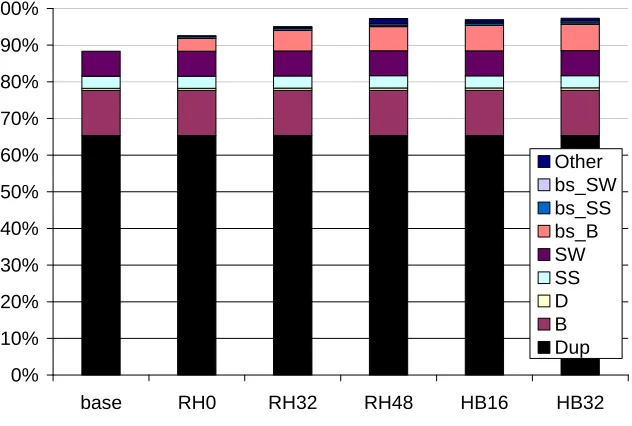
This section explores the coverage benefits of the new Slipstream recovery approaches. All coverages in Figure 2-13 are for Slip+SS+SW_ORT_ret, varying only the recovery model. The first bar reiterates coverage of base recovery (base). The next three bars show coverages with ROB-head (RH) recovery, i.e., when a checker instruction detects a fault, the processor restarts both threads from the instruction at the head of the ROB. The number after RH indicates whether or not our second technique, ROB occupancy management, is used and what the occupancy threshold is. RH0 means there is no threshold hence no occupancy management. RH32 and RH48 correspond to ROB-head recovery with ROB occupancy targets of 32 and 48 instructions by the full thread, respectively.
RH0 increases coverage to 95%, up from 88% with base recovery. This is due to partial coverage of non-checkers, for the first time. RH32 and RH48 increase coverage of non-checkers even further. By deferring retirement of non-checkers, RH32/RH48 increases the chances that non-checkers are indirectly checked before retirement. Coverage reaches 97% and 98% for RH32 and RH48, respectively. However, a potential drawback of ROB occupancy management is performance degradation, which is explored further in Section 2.6.4.
0% 10% 20% 30% 40% 50% 60% 70% 80% 90% 100%
base RH0 RH32 RH48 HB16 HB32
Other bs_SW bs_SS bs_B SW SS D B Dup
Figure 2-13. Coverage of Slip+SS+SW_ORT_ret for various recovery approaches..
2.6.4 Performance
Figure 2-14 shows the performance of (1) single-thread execution (Single), (2) Slipstream with full duplication (Slip-Full), (3) Slipstream with partial duplication and base recovery (Slip:base), and (4) Slipstream with partial duplication, using Slip+SS+SW_ORT_ret and various recovery models (Slip+:*). Single and Slip-Full show the two extremes between full performance and full fault tolerance. Slip-Full achieves 100% fault tolerance, but at the price of 14% average slowdown. Among benchmarks with IPCs above 2.5 (bzip, gap, gcc, perl, and vortex), where the processor is utilized moderately well by a single thread, the average slowdown of Slip-Full is 18.5%.
processor quite well with a single thread and both Slip-Full and Slip:base cause a significant slowdown. Slip:base underperforms because gap has little instruction removal as can be seen in Figure 2-11: 87% of instructions are duplicated. Finally, bzip, gcc, gzip, parser, perl, and vortex show mild to significant slowdown with Slip-Full, yet Slip:base performs comparably to Single. In some cases Slip:base outperforms Single, which is not unexpected since Slipstream is known to enhance performance on both CMP and SMT substrates [16].
0 1 2 3 4
bzip gap gcc gzip mcf
pars
er
perl twol
f
vorte
x
vpr Avg
IP
C
Single Slip-Full Slip:base Slip+:RH0 Slip+:RH32 Slip+:RH48 Slip+:HB16 Slip+:HB32
Figure 2-14. Performance comparisons.
On average, Slip:base is only 1.3% slower than Single, whereas Slip-Full is 14% slower. Among 2.5+ IPC benchmarks, Slip:base is only 2.7% slower, whereas Slip-Full is 18.5% slower.
deferred. Perl, twolf, and vortex show slightly more performance with Slip+:* compared to Slip:base. This is due to slight timing perturbations caused by converting silent stores to loads in Slip+.
2.7 Using Only Branch Predictions
In this section, the forward-slice analysis framework is applied to estimate the dynamic instruction coverage of a ReStore-like architecture. In particular, there is only a single thread and confident branch predictions are used to check corresponding branches and their backward slices.
0 10 20 30 40 50 60 70 80 90 100 R H 0 H B 3 2 H B 6 4 H B 1 2 8 R H 0 H B 3 2 H B 6 4 H B 1 2 8 R H 0 H B 3 2 H B 6 4 H B 1 2 8 R H 0 H B 3 2 H B 6 4 H B 1 2 8 R H 0 H B 3 2 H B 6 4 H B 1 2 8 R H 0 H B 3 2 H B 6 4 H B 1 2 8 R H 0 H B 3 2 H B 6 4 H B 1 2 8 R H 0 H B 3 2 H B 6 4 H B 1 2 8 R H 0 H B 3 2 H B 6 4 H B 1 2 8 R H 0 H B 3 2 H B 6 4 H B 1 2 8 R H 0 H B 3 2 H B 6 4 H B 1 2 8
bzip gap gcc gzip mcf parser perl twolf vortex vpr Avg
% o f in s tr u c ti o n s c o v e re d bs_B+b bs_b bs_B b B D
Figure 2-15. Coverage for Single+B(+b).
Coverage can be maximized by rolling back for all branch mispredictions. This means both confident (B) and unconfident (b) correctly predicted branches are checkers (that is, all correctly predicted branches). This covers additional instructions, bs_b (in backward slice of b) and bs_B+b (in backward slice of B and b) in Figure 2-15. On average, coverage for Single+B+b is 40% with HB128 recovery.
0 10 20 30 40 50 60 70 80 90 100 R H 0 H B 3 2 H B 6 4 H B 1 2 8 R H 0 H B 3 2 H B 6 4 H B 1 2 8 R H 0 H B 3 2 H B 6 4 H B 1 2 8 R H 0 H B 3 2 H B 6 4 H B 1 2 8 R H 0 H B 3 2 H B 6 4 H B 1 2 8 R H 0 H B 3 2 H B 6 4 H B 1 2 8 R H 0 H B 3 2 H B 6 4 H B 1 2 8 R H 0 H B 3 2 H B 6 4 H B 1 2 8 R H 0 H B 3 2 H B 6 4 H B 1 2 8 R H 0 H B 3 2 H B 6 4 H B 1 2 8 R H 0 H B 3 2 H B 6 4 H B 1 2 8
bzip gap gcc gzip mcf parser perl twolf vortex vpr Avg
% o f in s tr u c ti o n s c o v e re d bs_b bs_B b B D
Figure 2-16. Optimistic coverage for Single+B(+b).
Performance of Single+B and Single+B+b is shown in Figure 2-17. The performance of Single+B+b is not shown with a dedicated bar, rather, it is shown with a negative error bar with respect to the Single+B bar. Peformance of Single (no coverage) and Slip-Full (full coverage) are shown for comparison.
0 0.5 1 1.5 2 2.5 3 3.5 4
bzip gap gcc gzip mcf
pars
er
perl twol
f
vorte
x
vpr avg
IP
C
Single
Single+B:RH0 Single+B:HB32 Single+B:HB64 Single+B:HB128 Slip-Full
Figure 2-17. Performance of Single+B(+b).
The performance degradation of Single+B+b (negative error bar) is severe, because all mispredictions cause rollbacks. For the same reason, performance is very sensitive to the rollback distance. Nonetheless, for some benchmarks and rollback distances, Single+B+b outperforms Slip-Full (albeit with less coverage).
2.8 Summary
Chapter 3: Inherent Time Redundancy
In this chapter, a new approach is proposed that exploits repetition inherent in programs to provide low-overhead transient fault protection in a processor. Programs possess inherent time redundancy (ITR): the same instructions are executed repeatedly at short intervals. This program repetition presents an opportunity to discover low-overhead fault checks in a processor. The key idea is to record microarchitectural events which depend purely on program instructions, and confirm the occurrence of those events when instructions repeat. The recorded microarchitectural events must depend purely on instructions being executed. For example, the decode signals generated upon fetching and decoding an instruction are the same across all instances. Recording and confirming them to be the same can detect faults in the fetch and decode units of a processor. Similarly, recording and confirming correct issue ordering among instructions in a trace can detect faults in the out-of-order scheduler of a processor, similar to Timestamp-based Assertion Checking (TAC) [43].
In this chapter, it will be shown that ITR can be leveraged to detect transient faults in the fetch and decode units of a processor pipeline, avoiding costly approaches like structural duplication or explicit time redundant execution.
The chief contributions made in this chapter are as follows:
2. An ITR cache is proposed to record microarchitectural events pertaining to a trace of instructions. The key novelty is that misses in the ITR cache do not directly lead to a loss in fault detection. Only evictions of unreferenced, missed instances lead to a loss in fault detection coverage. Microarchitectural support is developed to use the ITR cache for protecting the fetch and decode units of a high-performance processor. 3. On fault detection, it is shown that accurate identification of the correct recovery
strategy is possible: either a lightweight flush and restart of the processor, or a more expensive program restart.
4. It is shown that the ITR-based approach compares favorably to conventional approaches like structural duplication and time redundant execution, in terms of area and power.
The rest of the chapter is organized as follows. Section 3.1 characterizes repetition in SPEC2K benchmarks. Section 3.2 discussed the ITR cache. Section 3.3 discusses detailed microarchitectural support to exploit ITR for protecting the fetch and decode units of a superscalar processor. In Section 3.4 the ITR cache design space is explored to achieve high fault coverage. In Section 3.5, fault injection experiments are performed to further evaluate fault coverage. In Section 3.6, area and power overheads of the ITR approach are compared to other fault tolerance approaches. Section 3.7 summarizes the chapter.
3.1 Characterizing Program Repetition in SPEC2K Benchmarks
graphs plot the number of dynamic instructions contributed by static traces. Static instructions are unique instructions in the program binary, whereas dynamic instructions correspond to the instruction stream that unfolds during execution of the program binary.
A relatively small number of static instructions contribute a large number of dynamic instructions. For instance, in most integer benchmarks, less than five hundred static traces contribute nearly all dynamic instructions (e.g., in bzip, 100 static traces contribute 99% of all dynamic instructions). Gcc and vortex are the only exceptions due to the large number of static traces. Floating point benchmarks are even more repetitive, as seen in Figure 3-2 (e.g., in wupwise, 50 static traces contribute 99% of all dynamic instructions).
An important aspect of repetition is the distance at which traces repeat. This is characterized in Figure 3-3 (integer benchmarks) and Figure 3-4 (floating point benchmarks). Here, instructions are grouped into traces like before, and the number of dynamic instructions between repeating traces is measured. The graphs show the number of dynamic instructions contributed by all static traces that repeat within a particular distance. Distances are shown at increasing intervals of five hundred dynamic instructions.



![Figure 3-9. Die photo of the IBM S/390 G5 processor (Source: [51]).](https://thumb-us.123doks.com/thumbv2/123dok_us/1444855.1177024/83.612.120.488.214.577/figure-die-photo-ibm-s-g-processor-source.webp)