ISSN(Online): 2320-9801 ISSN (Print) : 2320-9798
I
nternational
J
ournal of
I
nnovative
R
esearch in
C
omputer
and
C
ommunication
E
ngineering
(An ISO 3297: 2007 Certified Organization)
Vol. 4, Issue 10, October 2016
Feature Extraction in Face Recognition using
SVM-LBP Detection Technique
Puja1, Er. Rachna Rajput2
Research Scholar, M.Tech, Dept. of CSE, Guru Kashi University, India¹
Assistant Professor, Dept. of CSE, UCCA, Guru Kashi University, India²
ABSTRACT: Face recognition is a type of biometric software application by using which, we can analyzing, identifying or verifying digital image of the person by using the feature of the face of the person that are unique characteristics of each person. These characteristics may be physical or behavior. The physiological characteristics as like finger print, iris scan, or face etc and behavior characteristics as like hand-writing, voice, key stroke etc. Face recognition is very useful in many areas such as military, airports, universities, ATM, and banks etc, used for the security purposes. There are many techniques or algorithms that are used features extraction in face recognition. In this paper, There are two main categories that may serve as a solution for this problem: feature-based and image-based approaches. In this thesis, three different feature-based oriented solutions are compared. In our, as studied worked on both face detection and recognition techniques to develop an algorithms for them. There are conditions where we define face detection and recognition methods that is Edge based, Skin fusion based and template matching SVM-LBP method in which we recognize an unknown test image by comparing it with the known training images stored in the database as well as give information regarding the person recognized. These techniques works well under robust conditions like complex background, different face positions. We have taken skin color as a tool for detection. This technique works well for Indian faces which have a specific complexion varying under certain range. We have taken real life examples and simulated the algorithms in MATLAB successfully.
KEYWORDS: - Face recognition, Features extraction, SVM-LBP, feature-based, Image based.
I. INTRODUCTION
The face is our primary focus of attention in social life playing an important role in conveying identity and emotions. We can recognize a number of faces learned throughout our lifespan and identify faces at a glance even after years of separation. This skill is quite robust despite of large variations in visual stimulus due to changing condition, aging and distractions such as beard, glasses or changes in hairstyle.
Computer vision, in general, aims to duplicate (or in some cases compensate) human vision, and traditionally, have been used in performing routine, repetitive tasks, such as classification in massive assembly lines. Today, research on computer vision is spreading enormously so that it is almost impossible to itemize all of its subtopics. Despite of this fact, one can list relevant several applications, such as face processing (i.e. face, expression, and gesture recognition), computer human interaction, crowd surveillance, and content-based image retrieval. All of these applications, stated above, require face detection, which can be simply viewed as a preprocessing step, for obtaining the “object”. In other words, many of the techniques that are proposed for these applications assume that the location of the face is pre-identified and available for the next step.
Template Matching
ISSN(Online): 2320-9801 ISSN (Print) : 2320-9798
I
nternational
J
ournal of
I
nnovative
R
esearch in
C
omputer
and
C
ommunication
E
ngineering
(An ISO 3297: 2007 Certified Organization)
Vol. 4, Issue 10, October 2016
In [20], Miao et al. proposed a hierarchical template matching method for face detection. Initially, the input image is rotated from −20o to 20o degrees to handle rotation. Then, each rotated image form a mosaic at different scales in which edges are extracted using Laplacian operator. The face template consists of six facial components of two eyebrows, two eyes, nose, and mouth.
Face candidates are located by matching templates of face models represented in edges. In the final step, some heuristics are used to determine existence of a face. Experiments show better detection performance for images containing single face, rather than multiple. Kwon et al. [50] proposed a detection method based on snakes and tem-plates. In this approach, an image is first convolved with a blurring filter then with morphological operator to enhance
edges. A modified n-pixel snake is used to find and eliminate small curve segments. Each candidate is approximated
using an ellipse and for each of these candidates, a deformable template method is used to find detailed features. If a sufficient number of facial features are found, and their ratio satisfies the ratio tests based on the template, a face is considered to be detected. Lanitis et al. [3] established a detection method utilizing both shape and intensity information. In this approach, training images are formed in which contours are manually labeled with sampled points, and vector sample points are used as shape feature vectors to be detected. They use a point distribution model (PDM) together with the principal components analysis (PCA) to characterize the shape vectors over an ensemble of individuals. A face shape PDM can be used to detect face in test images using active shape model search to estimate face location and shape parameters. The shape patch is then deformed to the average shape, and intensity parameters are extracted. Then the shape and intensity parameters are used together for measuring Euclidian distance from the face-ness.
Generalized Knowledge Rules
In generalized knowledge-based approaches, the algorithms are developed based on heuristics about face appearance. Although, it is simple to create heuristics for describing the face, the major difficulty is in translating these heuristics into classification rules in an efficient way. If these rules are over detailed, they may come up with missed detections; on the other hand, if they are more general they may introduce much false detection. In spite of this, some heuristics can be used at an acceptable rate in frontal faces existed on uncluttered back-grounds. Yang and Huang [12] used a hierarchical knowledge-based method to detect faces. Their system consists of three level rules going from general to detail. This method does not report a high detection rate, their ideas for mosaicing (multi-resolution), and multiple level rules have been used by more recent methods.
II. LITERATURE SURVEY
ISSN(Online): 2320-9801 ISSN (Print) : 2320-9798
I
nternational
J
ournal of
I
nnovative
R
esearch in
C
omputer
and
C
ommunication
E
ngineering
(An ISO 3297: 2007 Certified Organization)
Vol. 4, Issue 10, October 2016
raise face recognition rate by fusing the phase and magnitude of Gabor's representations of the face as a new representation, by using the face recognition algorithm, the principal component Analysis approach and Support Vector Machine(SVM) that are used in this paper as a new classifier for pattern recognition. The algorithms that are proposed in by the author are tested on the public and largely used databases of FRGCv2 face and ORL databases. The algorithm PCA is a global method that is used to implement contrasts with a strong sensitivity to changes in lighting, poses and facial expression (by using the number of poses for each person). The author combines the magnitude and the phase of Gabor is used to extract the characteristic vector, the algorithm PCA used for recognition and SVM used to classify faces. Through this approach, it makes the PCA an algorithm effective and commonly used in reducing dimensionality where it can then be used to upstream other algorithms to improve the results of our application. V.Pali, et al. (2013), the author proposes a method of genetic algorithm (GA) that is on based neural network for feature and in this paper, there are four stages or algorithms are used to get the best results. PCA is used for dimensionality reduction that is Eigen face approach; LDA is used for feature extraction. LDA and PCA methods used for dimensionality reduction and feature extraction which overcomes the small sample size (SSS) problem of LDA. Genetic Algorithm based feature selection and last is Back propagation Neural Network (BPNN) is used for the classification of face images to a particular class. The author do this experiment on database of 80 images and a test database of 40 images and achieved a recognition rate of 97.5% with a small execution time of 10 ms to 20 ms. These methods increase the rate of execution of the system. A. Singh, et al. (2012, the author proposed a method that is combination of four face recognition algorithms that are PCA, LDA, ICA and SVM on AT&T and IFD database to study their performance in terms of accuracy, training time, testing time, total execution time and model size. The author gives the comparison of these methods of face recognition. In this paper, the author observed that recognition rate of the ATT database is higher as compare to IFD database, is due to the nature of images contain in the IFD. The four algorithms of face recognition i.e. PCA, LDA, ICA and SVM which are used in this paper gives the result that are, SVM has the highest (95.6%) rate of accuracy of recognition on ATT database while in case of IFD database LDA (86.3%) marginally ahead from SVM (85.4%).
III. METHDOLOGY Algorithm for face detecting using Template Matching with LBP and SVM
Various Steps of that are used for face detection are as below:
Step 1: Load the image and get the image into RGB color space and process it to convert into Gray scale.
Step 2: Apply filter such as median filter to remove noise from the tested image.
Step 3: Now, Extraction of various parts of the faces such as face, eye, nose, mouth, etc. are detected by using Extract features object detector and places the bounding boxes on the object which is to be detected.
Step 4: Now, apply LBP technique to recognize the face identification for exact matching of face from a tested image with histogram technique is saved in the training dataset that is to be loaded by SVM mean support vector machine.
Step 5: Tested Image with feature extraction is saved as in above step is loaded for classification to recognize or identify exact face from the database.
IV. RESULTS
In this chapter, experimental results concerning training and evaluation will be introduced. In training experiments, SVM with LBP of the learning methods provide several features enabling a control for learning efficiency. For testing, besides using some different constants, both of the methods share the same testing setup. Here three techniques have been worked out having different results on the base of parameters.
ISSN(Online): 2320-9801 ISSN (Print) : 2320-9798
I
nternational
J
ournal of
I
nnovative
R
esearch in
C
omputer
and
C
ommunication
E
ngineering
(An ISO 3297: 2007 Certified Organization)
Vol. 4, Issue 10, October 2016
Implementation using SVM- LBP Face Detection
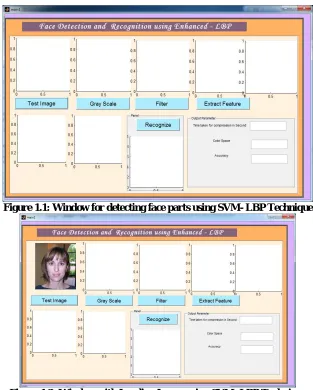
Graphical representation is shown below using SVM- LBP detecting used for face identifying. In this, various parts of face is also detected. In this, five buttons are shown. First button is used for loading the original image. Second button is used for Gray scale conversion. Third button is used for showing filtered image as filtering through median filter. Fourth button is for extraction of face only. At last, fifth button extract feature shows the various parts of faces to be recognized or identified.
Figure 1.1: Window for detecting face parts using SVM- LBP Technique
Figure 1.2: Window with Loading Image using SVM- LBP Technique
ISSN(Online): 2320-9801 ISSN (Print) : 2320-9798
I
nternational
J
ournal of
I
nnovative
R
esearch in
C
omputer
and
C
ommunication
E
ngineering
(An ISO 3297: 2007 Certified Organization)
Vol. 4, Issue 10, October 2016
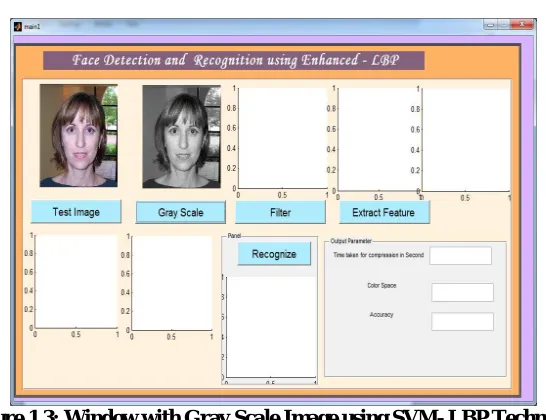
Figure 1.3: Window with Gray Scale Image using SVM- LBP Technique
Below Figure 1.3, shows the Gray Scale image. Figure 1.4, shows the window with Filtered image after removing noise form it.
ISSN(Online): 2320-9801 ISSN (Print) : 2320-9798
I
nternational
J
ournal of
I
nnovative
R
esearch in
C
omputer
and
C
ommunication
E
ngineering
(An ISO 3297: 2007 Certified Organization)
Vol. 4, Issue 10, October 2016
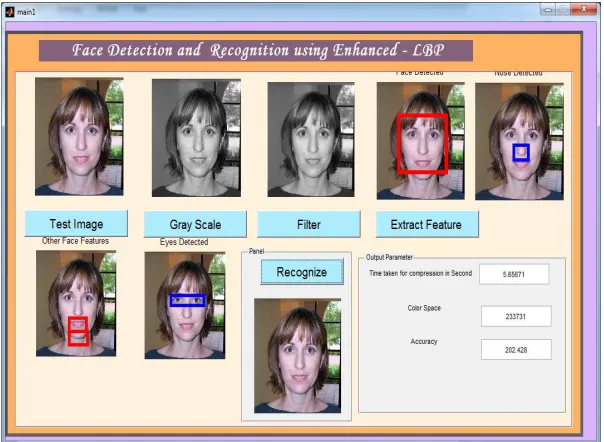
Figure 1.5: Window showing various parts of faces using SVM-LBP technique
Figure 1.5, shows the window showing all parts of face as detected in first row with face and nose. Second row with image detecting as mouth and eyes.
Figure 1.6: Window recognizing exact faces using SVM-LBP technique Discussion
ISSN(Online): 2320-9801 ISSN (Print) : 2320-9798
I
nternational
J
ournal of
I
nnovative
R
esearch in
C
omputer
and
C
ommunication
E
ngineering
(An ISO 3297: 2007 Certified Organization)
Vol. 4, Issue 10, October 2016
Figure 1.7: Original Images d Dataset
Figure 1.7, shows the original images dataset for detection of face appearance as feature extraction.
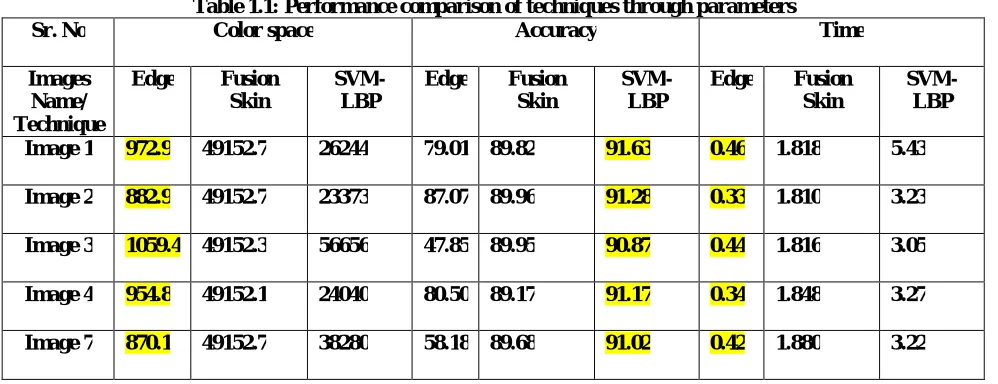
Table 1.1: Performance comparison of techniques through parameters Sr. No Color space Accuracy Time Images
Name/ Technique
Edge Fusion Skin
SVM-LBP
Edge Fusion Skin
SVM-LBP
Edge Fusion Skin
SVM-LBP Image 1 972.9 49152.7 26244 79.01 89.82 91.63 0.46 1.818 5.43 Image 2 882.9 49152.7 23373 87.07 89.96 91.28 0.33 1.810 3.23 Image 3 1059.4 49152.3 56656 47.85 89.95 90.87 0.44 1.816 3.05 Image 4 954.8 49152.1 24040 80.50 89.17 91.17 0.34 1.848 3.27 Image 7 870.1 49152.7 38280 58.18 89.68 91.02 0.42 1.880 3.22
This thesis is mainly focused on face detection using SVM-LBP, Edge and fusion skin methods which simply take face detection as a pattern recognition problem. Prior face knowledge and any other knowledge-based heuristics are ignored and a prediction is only made according to the learned characteristics from training images. Additionally, theoretic and common practical adaptations of learning field for face detection task are studied and main steps for a face detection learning scheme are outlined ranging from training through testing.
In order to make a comprehensive study, Edge, SVM-LBP and Fusion Skin based face detection systems are implemented, and experimented in training and evaluation phases with a comparative insight. The first Edge detection techniques, shows the better results according to the performance of parameters such as time taken and color space. Second SVM-LBP techniques, shows best results in accuracy as high. Color space means the different colors form representation of RGB as numerically. It specifies the color percentages of red, green, and blue hues mixed together. It should be Low as to have accurate color specification. Time compared to be taken less is shown by edge technique. Accuracy means what is true percentage for accurate to detect objects which referred.
V.CONCLUSION
Experimental results in the training phase showed that both Edge and SVM- LBP face classifiers are able separate examples included in face and non-face training data from each other. Thus, both applied an implicit surface division with the help of adjustments for internal weights. Experiments concerning efficiency of these divisions, showed trained tested images have similar generalization (true detection rate over total number of false detections) abilities. While Accuracy in generalization value of SVM-LBP is slightly higher than other techniques as counterpart. Hence, it is possible to state SVM-LBP and Edge detection techniques is best than Fusion skin technique.
ISSN(Online): 2320-9801 ISSN (Print) : 2320-9798
I
nternational
J
ournal of
I
nnovative
R
esearch in
C
omputer
and
C
ommunication
E
ngineering
(An ISO 3297: 2007 Certified Organization)
Vol. 4, Issue 10, October 2016
VI. FUTURE SCOPE
There exist several directions for researches in the future. Further improvements can be made in terms of training examples for achieving a better generalization. Additionally, more informative features can be used instead of intensity values. For example, a simple quantization for gray levels may also achieve better evaluation results. Moreover, utilization of color values instead of gray levels may also improve learning mechanism, but in that case lighting variations must be sufficient large in the training sets. Internal dynamics may be further studied in order to achieve improvements, and to design different adaptations for other visual tasks.
REFERENCES
[1] A. Albiol, C. A. Bouman, and E. J. Delp. Face detection for pseudose mantic labeling in video databases. Proceedings International Conference on Image Processing, 1999.
[2] A. Jacquin and A. Eleftheriadis. Automatic location tracking of faces and facial features in video sequences. IEEE Proc. of Int. Workshop on Automatic Face- and Gesture-Recognition, Jun 1995.
[3] A. Lanitis, C. J. Taylor, and T.F Cootes. An automatic face identification system using flexible appearance models. Image and Vision Computing, 13:393–401, 1995.
[4] A. L. Yuille, P. W. Hallinan, and D. S. Cohen. Feature extraction from faces using deformable templates. Int. J. Computer Vision, 8:99–111, 1992.
[5] A. Singh, B.K Singh and Manish Verma, “Comparison of Different Algorithms of Face Recognition”, 2012.
[6] Bartlett M. S., Movellan J. R., and Sejnowski T. J., “Face Recognition by Independent Component Analysis”, IEEE Transactions on Neural Networks, vol. 13, pp. 1450-1464, 2002.
[7] D. Roth, M.-H. Yang, and N. Ahuja. A snow-based face detector. Advances in Neural Information Processing Systems, 12, 2000. [8] Divyarajsinh N. Parmar, Brijesh B. Mehta, “Face Recognition Methods & Applications”, Jan-Feb 2013.
[9] E. Helomas and B. K. Low. Face detection: A survey. Computer Vision and Image Understanding, 83:236–274, 2001. [10] F. Bellakhdhar, Kais Loukil and Mohamed ABID, “Face recognition approach using Gabor Wavelets, PCA and SVM”, 2013. [11] F. Luthon and M. Lievin. Lip motion automatic detection. Scandinavian Conference on Image Analysis, 1997.
[12] G. Yang and T. S. Huang. Human face detection in complex background. Pattern Recognition, 27:53–63, 1994
[13] H. A. Rowley. Neural network-based face detection. PhD thesis, Carnegie Mellon University Computer Science Dep., May 1999.
[14] H. Wang and S.-F Chang. A highly efficient system for automatic face region detection in mpeg video. IEEE Trans. on Circuits and Systems for Video Technology, pages 615–628, 1994.
[15] I. Craw, H. Ellis, and J. R. Lishman. Automatic extraction of face feature. Pattern Recognition Lett., pages 183–187, Feb 1987.
[16] J.-C. Terrillon, M. Shirazi, H. Fukamachi, and S. Akamatsu. Comparative performance of different skin chrominance models and chrominance spaces for the automatic detection of human faces in color images. in Proceedings Fourth IEEE International Conference on Automatic Face and Gesture Recognition, 2000
[17] J. Cai and A. Goshtasby. Detecting human faces in color images. Image and Vision Computer, 18:63–75, 1999.
[18] J. Choi, S. Kim, and P. Rhee. Facial components segmentation for extracting facial feature. Proc. 2.nd Int. Conf. on Audio- and Video-based Biometric Person Authentication, 1999.
[19] J. L. Crowley and F. Berard. Multi-model tracking of faces for video communications. IEEE Proc. of Int. Conf. on Computer Vision and Pattern Recognition, Jun 1997.
[20] J. Miao, B. Yin, K. Wang, L. Shen, and X. Chen. A hierarchical multi-scale and multi-angle system for human face detection in a complex background using gravity-center template. Pattern Recognition, 32:1237–1248, 1999.
[21] J. Wang and T. Tan. A new face detection method based on shape information. Pattern Recog. Lett, 21:463–471, 2000. [22] J. Yang and A. Waibel. A real-time face tracker. IEEE Proc. of the 3rd Workshop on Applications of Computer Vision, 1996. [23] K..D. Kadam, “Face Recognition using Principal Component Analysis with DCT”, 2014.
[24] K. Sobottka and I. Pitas. Extraction of facial regions and features using color and shape information. Proc. of Int. Conf. on Pattern Recognition, 1996.
[25] K. Sung and T. Poggio. Example-based learning for view-based human face detection. IEEE Transactions on Pattern An. and Ma. In., 20(1):39– 51, Jan 1998.
[26] M.-H. Yang and N. Ahuja. Detecting human faces in color images. Proc. of the 1th IEEE Conf. on Image Processing, pages 127–130, 1998. [27] M. J. T. Reinders, P. J. L. van Beek, B. Sankur, and J. C. A. van der Lubbe. Facial feature localization and adaptation of a generic face model for model-based coding. Signal Processing: Image Communication, pages 57–74, 1995.
[28] M.Turk, A.Pentland, “Eigen faces for Recognition”, Journal of Cognitive Neuro sicence, III (1), pp. 71-86, 1991.
[29] Mr. Vivek Pali, Mr. Lalit Kumar Bhaiya, “Genetic Algorithm Based Feature Selection and BPNN Based Classification for face recognition”, Volume 3, Issue 5, May 2013.
[30] N. Oliver, A. Pentland, and F. Berard. A real-time face and lips tracker with facial expression recognition. IEEE Trans. on Pattern Recognition, 33:1369–1382, 2000.
[31] Preeti S. Subramanyam, Sapana A Fegade, “Face and Facial Expression recognition- A Comparative study”, 2013.
ISSN(Online): 2320-9801 ISSN (Print) : 2320-9798
I
nternational
J
ournal of
I
nnovative
R
esearch in
C
omputer
and
C
ommunication
E
ngineering
(An ISO 3297: 2007 Certified Organization)
Vol. 4, Issue 10, October 2016
[35] R. Kjedsen and J. Kender. Finding skin in color images. Proc. of the 2nd Int. Conf. on Automatic Face and Gesture Recognition, pages 312– 317, 1996.
[36] R. O. Duda, P. Hart, and D. G. Stork. Pattern Classification. Wiley-Interscience, 2 edition, 2001. [37] S Dhawan, Himanshu Dogra,”Feature Extraction technique for Face recognition”, 2012.
[38] S. Kawato and J. Ohya. Real-time detection of nodding and head-shaking by directly detecting and tracking the between-eyes. Proceedings Fourth IEEE International Conference on Automatic Face and Gesture Recognition, 2000.
[39] S. Kim, N. Kim, S. C. Ahn, and H. Kim. Object oriented face detection using range and color information. Proc. of the 3rd Int. Conf. on Automatic Face and Gesture Recognition, pages 76–81, 1998.
[40] S Kumar Bhattacharyya, Kumar Rahul, “Face Recognition by Linear Discriminant Analysis”.
[41] S. McKenna, S. Gong, and H. Liddell. Real-time tracking for an integrated face recognition system. Workshop on Parallel Modelling of Neural Operators, Nov 1995.
[42] S. Satoh, Y. Nakamura, and T. Kanade. Name-it:naming and detecting faces in news videos. IEEE Multimedia, 6:22–35, 1999 [43] T. M. A. and Pentland A. P., “Face Recognition Using Eigen faces”, IEEE CVPR, pp. 586- 591, 1991.