ISSN(Online): 2320-9801
ISSN (Print): 2320-9798
I
nternational
J
ournal of
I
nnovative
R
esearch in
C
omputer
and
C
ommunication
E
ngineering
(An ISO 3297: 2007 Certified Organization)
Vol. 4, Issue 8, August 2016
A Comparative Study of Power Management
Techniques in Wireless Sensor Network
Ashita Vermani, Harshita Tiwari
Assistant Professor, Dept. of Electronics & Telecommunication., College of Engineering Roorkee, Roorkee, India
Assistant Professor, Dept. of Electronics & Telecommunication., College of Engineering Roorkee, Roorkee, India
ABSTRACT:Wireless sensor networks have become increasingly popular due to their wide range of applications. A Wireless Sensor Network (WSN) comprises many sensor nodes each one containing a processing unit, one or more sensor, a radio for data communication and power unit usually equipped with a low capacity battery. All sensors present in wireless sensor network are battery operated devices and being micro-electronic device have limited battery power. This paper presents a survey of various techniques for power management in wireless sensors and introduces the reader to the most well known available methods that can be used to save energy.
KEYWORDS:Power-saving strategies, energy consumption, energy management, wireless sensor networks.
I. INTRODUCTION
Sensors link the physical with the digital world by capturing and revealing real world phenomena and converting these into a form that can be processed, stored, and acted upon. Recent advances in micro-electro-mechanical systems (MEMS) technology, wireless communications, and digital electronics have enabled the development of cost, low-power, multifunctional sensor nodes that are small in size and communicate untethered in short distances. A Wireless Sensor Network (WSN) can be defined as a network of small embedded devices, called sensors, which communicate wirelessly following an ad hoc configuration.
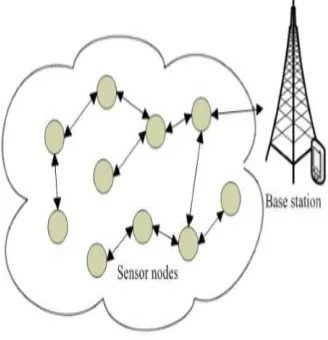
A wireless sensor node consists of sensing, computing, communication, actuation and power components. These components are integrated on a single or multiple boards and packed in a few cubic inches. When many sensors cooperatively monitor large physical environments, they form a wireless sensor network (WSN). A WSN usually consists of ten to thousands of such nodes that communicate through wireless channels for information sharing and cooperative processing. Sensor nodes communicate not only with each other but also with a base station (BS) using their wireless radios, allowing them to disseminate their sensor data to remote processing, visualization, analysis, and storage systems. For example, Figure1 shows two sensor fields monitoring two different geographic regions and connecting to the Internet using their base stations[1].
ISSN(Online): 2320-9801
ISSN (Print): 2320-9798
I
nternational
J
ournal of
I
nnovative
R
esearch in
C
omputer
and
C
ommunication
E
ngineering
(An ISO 3297: 2007 Certified Organization)
Vol. 4, Issue 8, August 2016
Possible applications of sensor networks are of interest to the most diverse fields. Environmental/Habitat monitoring, Acoustic detection, Seismic Detection, Military surveillance, Inventory tracking, Medical monitoring, Smart spaces, Process Monitoring are a few examples.
A sensor network design is influenced by many factors, which include fault tolerance; scalability; production costs; operating environment; sensor network topology; hardware constraints; transmission media; and power consumption. The constraint most often associated with sensor network design is that sensor nodes operate with limited energy budgets. Typically, they are powered through batteries, which must be either replaced or recharged (e.g., using solar power) when depleted. For some nodes, neither option is appropriate, that is, they will simply be discarded once their energy source is depleted. Whether the battery can be recharged or not significantly affects the strategy applied to energy consumption. As a consequence, the first and often most important design challenge for a WSN is energy efficiency. This requirement permeates every aspect of sensor node and network design. This paper presents some previously published surveys related to power saving techniques in WSN and their description and finally the conclusion from them.
II. POWER MANAGEMENT IN WIRELESS SENSOR NETWORK
The main task of a sensor node in a sensor field is to detect events, perform quick local data processing, and then
transmit the data. Power consumption can hence be divided into three domains: (i) sensing,
(ii) communication, and (iii)data processing.
One of the important factor that need to be consider in sensor networking is the battery lifetime mounted with sensor nodes because while performing above three tasks sensor node consumes power & hence its overall performance depends upon optimum utilization of battery.
Energy consumption is one of the biggest constraints of the wireless sensor node and this limitation combined with a typical deployment of large number of nodes have added many challenges to the design and management of wireless sensor networks. They are typically used for remote environment monitoring in areas where providing electrical power is difficult. Therefore, the devices need to be powered by batteries and alternative energy sources. Because battery energy is limited, the use of different techniques for energy saving is one of the hottest topics in WSNs. sensor nodes in WSNs are usually battery powered but nodes are typically unattended because of their deployment in hazardous, hostile or remote environments. A number of power- saving techniques must be used both in the design of electronic transceiver circuits and in network protocols.
A sensor node consumes mostly its energy in transmitting and receiving packets. In wireless sensor networks, the main power supply of the sensor node is battery. Hence, if power is low then sensor node sends message to its neighbour node that power is low & can’t be use for routing & then saves remaining power for sensing.
Another point of concern in communication networks is the transmission of messages to meet the requirements set by Quality of Service (QoS) parameters. Quality of service controls include message delay, message due dates, bit error rates, packet loss, economic cost of transmission, transmission power, etc. There can not be a set protocol design for QoS standard networks due to the different capabilities of the applications in its particular setting. Therefore, there QoS parameters are subjected to the constraints set by the hardware, purpose of communication and energy.
Since, the aim of this survey is to study the techniques which provide optimum utilization of battery to increase its lifetime. Several methods to achieve low power consumption has been discussed in this paper. Each technique has its advantage as well as disadvantage, but the technique with high quality performance will be a choice in sensor network.
III. DIFFERENT TECHNIQUES USED IN POWER MANAGEMENT A Cluster Technique:
Jau-Yang Chang and Pei-Hao Ju provide a clustering technique whose aim is to reduce the data transmission distance
ISSN(Online): 2320-9801
ISSN (Print): 2320-9798
I
nternational
J
ournal of
I
nnovative
R
esearch in
C
omputer
and
C
ommunication
E
ngineering
(An ISO 3297: 2007 Certified Organization)
Vol. 4, Issue 8, August 2016
(a) LEACH
Low energy adaptive clustering hierarchy is a protocol in which complete network is sub-divided into no. of clusters. Each cluster consists one cluster head & no. of cluster heads. Cluster head has been choosen on the basis of predetermined probability.Only cluster head communicates directly with the base station & non-cluster heads sense the environment & send the data to cluster head which compresses the data received by no. of non-cluster heads to transmit to base station. This consumes the comparatively low energy to transmit the data over a long distance. Clustering network is shown in fig. 2 [2].But the major drawback of this technique is the non-uniformity in clusters which reduces its efficiency. To overcome this drawback a technique called SECA has been developed as shown in fig.3 [2].
Figure 2: clustering network
(b) SECA
SECA is a technique consisting of uniform clusters. It is based on calculating the average distance between the sensor nodes & measuring their residual energy in order to select cluster head. The lifetime of wireless sensor networks is extended by using the uniform cluster location and balancing the network loading among the clusters. In this algorithm, the operation includes two phases: set-up and steady-state phases.
The main goal of set up phase is to create clusters and find cluster head nodes. During the set-up phase, the BS collects the information of the position and energy level from all sensor nodes in the networks. Based on the characteristics of stationary sensor nodes, the suitable initial means of points for clusters can be obtained. Fig.3 shows SECA set up phase, C be the center location for all sensor nodes.[2]
Figure 3: SECA set up phase
ISSN(Online): 2320-9801
ISSN (Print): 2320-9798
I
nternational
J
ournal of
I
nnovative
R
esearch in
C
omputer
and
C
ommunication
E
ngineering
(An ISO 3297: 2007 Certified Organization)
Vol. 4, Issue 8, August 2016
B. Dynamic Technique
I.F. Akyildiz, W. Su*, Y. Sankarasubramaniam, E. Cayirci proposed an approach based on the fact that battery consumes more power when it is turned on so according to this method battery will be switched off when not in use. During transmission of data, Mixers, frequency synthesizers, voltage control oscillators, phase locked loops (PLL) and power amplifiers, all consume valuable power in the transceiver circuitry. It is important that in this computation we not only consider the active power but also the start-up power consumption in the transceiver circuitry. The start-up time, being of the order of hundreds of micro-seconds, makes the start-up power non-negligible. Equation below shows the relation for total power consumption during transmission[3].
Pc= Nt [ Pt (Ton +Tst) + Pout(Ton)] + Nr[Pr [Ron + Rst)] eq. (1)
Where, Pt=Pr is the power consumed by the transmitter/receiver; Pout, the output power of the transmitter; T=Ron, the transmitter/receiver on time; T=Rst, the transmitter/receiver start-up time and NT=R, the number of times transmitter/receiver is switched on per unit time, which depends on the task and medium access control (MAC) scheme used. Ton can further be rewritten as L=R, where L is the packet size and R, the data rate.
The main problem occurs with dynamic power management is that the start-up time consumes irrevalent power when battery is switch on due to transreciever circuitry. And start up time dominates active tie if packet size is reduced. Hence, Dynamic power management is efficient only if battery remain switched off for above some threshold value because sometimes if the no. of transitions between on/off are much larger, then the power consumption is much more than it left switched on in active mode. High Consuming sensor technique is an improvement over DPM presented in next section.
C. High Consuming Sensor Technique
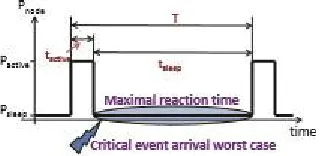
Vana Jeliˇ ci´c proposed a technique based on duty cycle & using separate wake up receiver. Duty cycle (D) of a node’s activity is defined as the fraction of time when the node is active. In duty-cycled operation, a node follows a sleep-wake up-sample-compute-communicate cycle, where the majority of the cycle is spent in the low- power sleep state .Figure 4, shows duty cycling of sensor node activity[4].
Figure 4: duty-cycling of sensor node activity
This process, which relies on hardware support for implementing sleep states, permits the average power consumption of a node (Pavg) to be reduced by many orders of magnitude. Equation for duty cycle can be written as[4]:
where, D = Duty cycle; tactive = active time ; T= total time eq. (2)
where, tsleep = Inactive time eq.(3) Power consumption of the node depends on the duty cycle as shown below:[4]
eq. (4)
Power in inactive state (Psleep) is usually significantly lower than the power in active state,below equation shows the approximate average power consumption[4]-
ISSN(Online): 2320-9801
ISSN (Print): 2320-9798
I
nternational
J
ournal of
I
nnovative
R
esearch in
C
omputer
and
C
ommunication
E
ngineering
(An ISO 3297: 2007 Certified Organization)
Vol. 4, Issue 8, August 2016
common requirement that they do not require continuous sampling or communication (WSNs are often defined by their
low data-rate and communication frequency); hence, duty cycles of 1–2 % are common [4]. It is essential that events and packets are not missed while the node is asleep , requiring that careful thought is given to duty- cycled operation. The process of duty-cycled operation can also be applied to communications, whereby an active node only receives and transmits for a small portion of the active time. This form of duty-cycling is managed by the Medium Access Control layer (MAC) of the communication protocol.
There is 3 ways to transmit data also known as rendezvous schemes-
a) Pure synchronous: The nodes’ clocks are presynchronized such that the wake-up time of each node is known a priori. This scheme requires recurrent time synchronization that consumes considerable energy. Moreover, the sensors wake up even if there is no packet to transmit or receive, which results in idle listening or overhearing.
b) Pseudo-asynchronous (or cycled receiver): Source nodes usually wake up and emit a preamble signal that indicates the intention of data transmission. The preamble time is long enough to coincide with the wake-up schedule of the destination node. Upon waking up and sensing the preamble, the destination node recognizes the intended packet transmission. In this scheme time synchronization is not required, but sensors still follow a duty cycle and consume considerable energy with preamble signaling.
c) Pure asynchronous: Sensor nodes reside in deep sleep and can be woken up by their neighbors on demand with very low-power wake-up receivers. Whenever a node intends to send a packet, first it wakes up the destination node and then
sends the packet. Therefore, wake-up receivers are a solution to the redundant energy consumption caused by rendezvous.
Problems encountered in design and implementation of wake-up radios include: limited reception range or very high transmission energy requirements, higher than desired receiver power consumption and false wake-ups caused by interference from other sources of transmission in the chosen frequency bands.
D. CRT Based Packet Splitting Technique
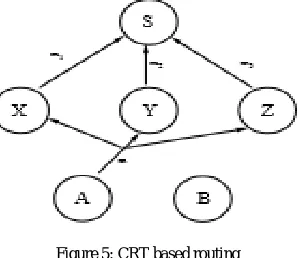
This method on which research conducted by Giuseppe Campobello, Alessandro Leonardi and Sergio Palazzo merges routing & data aggregation techniques & it is primarily aimed to reduce no. of transmitting bits using chinese remainder theorem that consumes lower energy. It is a novel approach which splits the original messages in several packets such that each node in the network will forward only small sub-packets. The splitting procedure is realized applying the Chinese Remainder Theorem (CRT) algorithm, which is characterized by a simple modular division between integers. The sink node, once all sub- packets (called CRT components) are received correctly, will recombine them, thus reconstructing the original message.[5]
Figure 5: CRT based routing
In CRT, a system can be formulated as m=mi(mod pi) & assuming there exist M which is a product of prime no.s {m1,m2,m3….,mN} such that m<M which solves simultaneous congruent equations.
Consider a system[5]-
m=1(mod 3) m=4(mod 5) m=1(mod7)
Here, m = 64 solves the system .According to the CRT, the number m can be alternatively identified with the set of
ISSN(Online): 2320-9801
ISSN (Print): 2320-9798
I
nternational
J
ournal of
I
nnovative
R
esearch in
C
omputer
and
C
ommunication
E
ngineering
(An ISO 3297: 2007 Certified Organization)
Vol. 4, Issue 8, August 2016
bits are needed to represent each mi. Therefore if, instead of m, mi numbers, are forwarded in a wireless sensor network, the maximum energy consumed by each node for the transmission can be substantially reduced.
If the maximum number of bits of a CRT component, i.e. wCRTmax = max(⌈log2(pi)⌉), & w the number of bits in the original message (m) a theoretical maximum energy reduction factor (MERF) given by below equation[5]-
eq. (5)
Using equations system (1), MERF= (7-3)/7 =0.57 i.e. 57% energy can be saved. Hence, CRT splitting is more efficient than simple splitting.To maximize MERF minimum prime set has been used satisfying condition M ≥ 2^w, if N = 4
and m is a 40- bits word (w = 40) then MERF in this case is 0.725. There is also another smallest consecutive primes that satisfy the condition pi ≥ 2^w,if N=4 & w=40 then MERF will be 0.65. We call this set as the Minimum Primes Set with one admissible failure. The MERF obtained with the new set is 0.65 i.e. MERF is reduced by about 11%. However with this choice it is possible to reconstruct the original message m even if a component is lost (i.e. if we have one failure).
The drawback of CRT based routing is that in case of big packets a tradeoff between complexity, energy efficiency & mask overhead should be taken into account.
IV. CONCLUSION & FUTURE WORK
This paper presents the various issues in power management of WSN. Different power management techniques have been discussed to overcome these issues. According, to this survey we can conclude that the most efficient method for power management is SECA. In future work, a combination of SECA with wake up receiver can be designed which can decrease the power consumption to a higher extent.
REFERENCES
[1] Chong, C.Y., Kumar, S.P., 2003. Sensor networks: evolution, opportunities, and. challenges. Proceedings of the IEEE 91 (8),1247– 1256.
[2] Jau-Yang Chang and Pei-Hao Ju, “An efficient cluster-based power saving scheme for wireless sensor networks,” Journal on “Wireless Communications and Networking” 2012.
[3] I.F. Akyildiz, W. Su, Y. Sankarasubramaniam, E. Cayirci Broadband ON “Wireless Sensor Network-a survey”, Atlanta, GA 30332, USA. Computer Networks 38 (2002) 393–422
[4] A.P. Chandrakasan et al., “Design Considerations for Distributed Microsensor Systems,” Proc. Custom Integrated Circuits Conf., IEEE, Piscataway, NJ, 1999, pp. 279-286.
[5] Farnaz Dargahi, Amir Masoud Rahmani,Sam Jabehdari, “Nodes’ Credit based directed Diffusion for wireless sensor networks ” in International Journal of Grid and Distributed Computing, Dec 2008.
[6] A. Sinha and A. Chandrakasan, “Dynamic power management in wireless sensor networks,” IEEE Design & Test of Computers, March-April 2001.[7] G. Campobello, A. Leonardi, S. Palazzo, “On the Use of Chinese Remain-der Theorem for Energy Saving in Wireless Sensor Networks”. Proc. of IEEE International Conference on Communications (ICC 2008), Beijing,China, May 2008.
[8] M. Stemm and R. H. Katz, “Measuring and Reducing EnergyConsumption of Network Interfaces in Hand-Held Devices,” IEICE transactions on Communications, special Issue on Mobile Computing, vol. E80-B, no. 8, pp. 1125–31, 1997.
[9] I.F. Akyildiz, W. Su, Y. Sankarasubramaniam, and E. Cayirci, “A survey on sensor networks,” in IEEE Communications Magazine,pp. 102–114, Aug. 2002.
[10] S. Slijepcevic and M. Potkonjak, Power efficient organization of wireless sensor networks, in: IEEE International Conference on communications, Helsinki, Finland (June 2001).
[11] B. Chen, K. Jamieson, H. Balakrishnan, and R. Morris,“Span: An Energy-Efficient Coordination Algorithm for Topology Maintenance in Ad Hoc Wireless Networks,” in MOBICOM 2001, July 2001.