University of Windsor University of Windsor
Scholarship at UWindsor
Scholarship at UWindsor
Electronic Theses and Dissertations Theses, Dissertations, and Major Papers
2012
Analytical Study on the Dynamic Characteristics of Cable
Analytical Study on the Dynamic Characteristics of Cable
Networks
Networks
Javaid Ahmad University of Windsor
Follow this and additional works at: https://scholar.uwindsor.ca/etd
Recommended Citation Recommended Citation
Ahmad, Javaid, "Analytical Study on the Dynamic Characteristics of Cable Networks" (2012). Electronic Theses and Dissertations. 5345.
https://scholar.uwindsor.ca/etd/5345
Analytical Study on the Dynamic Characteristics of Cable
Networks
By
Javaid Ahmad
A Thesis
Submitted to the Faculty of Graduate Studies
through the Department of Civil and Environmental Engineering
in Partial Fulfillment of the Requirements for
the Degree of Master of Applied Science at the
University of Windsor
Windsor, Ontario, Canada
2012
Analytical Study on the Dynamic Characteristics of Cable Networks
By:
Javaid Ahmad
APPROVED BY:
______________________________________________
Dr. N. Zamani, Outside Department Reader
Department of Mechanical, Automotive and Material Engineering
______________________________________________
Dr. F. Ghrib, Department Reader
Department of Civil and Environmental Engineering
______________________________________________ Dr. S. Cheng, Advisor
Department of Civil and Environmental Engineering
______________________________________________ Dr. C. Lee, Chair of Defense
Department of Civil and Environmental Engineering
DECLARATION OF CO-AUTHORSHIP/PREVIOUS
PUBLICATIONS
This thesis includes 3 original manuscripts, 2 already submitted and 1 soon to be
submitted to peer reviewed journals. In addition, a conference paper has already been
published based on part of the work presented in Chapters 2 and 3. They are listed as
follows:
Thesis Chapter Publication Title Publication
Status Chapters 2 and
3 (selected parts)
Javaid Ahmad, Shaohong Cheng, 2011. Analytical
Study on In-plane Modal Properties of a General Cable
Network. The 9th International Symposium on Cable
Dynamics, Shanghai, China, pp. 32-39.
Published
Chapter 2 Javaid Ahmad, Shaohong Cheng, 2012. Analytical
Study on In-plane Modal Behaviour of Stay Cables
Connected by Cross-ties: Part I: Basic Cable Network,
Journal of Sound and Vibration
Submitted
Chapter 3 Javaid Ahmad, Shaohong Cheng, 2012. Analytical
Study on In-plane Modal Behaviour of Stay Cables
Connected by Cross-ties: Part II: General Cable
Network, Journal of Sound and Vibration
Submitted
Chapter 4 Javaid Ahmad, Shaohong Cheng, 2012. In-plane Free
Vibration of a Two-cable Network with Flexible
Cross-tie , Journal of Structural Engineering, ASCE
To be submitted
I hereby certify that I am the sole author of this thesis and that no part of this thesis has
I certify that, to the best of my knowledge, my thesis does not infringe upon
anyone’s copyright nor violate any proprietary rights and that any ideas, techniques,
quotations, or any other material from the work of other people included in my thesis,
published or otherwise, are fully acknowledged in accordance with the standard
referencing practices. Furthermore, to the extent that I have included copyrighted
material that surpasses the bounds of fair dealing within the meaning of the Canada
Copyright Act, I certify that I have obtained a written permission from the copyright
owner(s) to include such material(s) in my thesis and have included copies of such
copyright clearances to my appendix.
I declare that this is a true copy of my thesis, including any final revisions, as
approved by my thesis committee and the Graduate Studies office, and that this thesis has
ABSTRACT
Bridge stay cables are vulnerable to dynamic excitations by wind. There are different
countermeasures to suppress unfavorable bridge stay cable vibrations and one of the
effective countermeasures is to connect stay cables by cross-ties to form a cable
network. However, the dynamic behaviour of a cable network is not clearly
understood and most of the current designs are based on physical tests and numerical
simulations. In this thesis, an effort has been made to understand the in-plane free
vibration of a cable network. Three analytical models have been developed to
investigate the in-plane free vibration of a basic cable network with a rigid transverse
cross-tie, a general cable network with a single line of rigid transverse cross-ties, and a
basic cable network with a flexible transverse cross-tie. The key system parameters of
a cable network have been identified, which include the segment ratio, the frequency
ratio, the mass-tension ratio, the length ratio, the cross-tie flexibility parameter, and
the total number of interconnected cables. Extensive parametric study has been
conducted to evaluate the role of each parameter in affecting the performance of a
cable network. All the analytical model results are verified by numerical simulations
DEDICATION
I would like to dedicate my work to my mother and the memory of my father who
made this work easy for me, and to my wife, Riffat, my children, Usama, Sara and
ACKNOWLEDGEMENTS
I would like to express my deepest appreciation and gratitude to my research supervisor, Dr.
S. Cheng, for her patient guidance, fruitful discussions, and kind support during the course of
this study. I believe such a technical research would not have been possible without her kind
supervision.
Also I would like to thank Dr. Faouzi Ghrib for his valuable advice and comments on my
research project.
The comments by Dr. N. Zamani are also assets for me to complete this project.
Finally, I would like to thank my family, Riffat, Usama, Sara and Talha, for their love,
TABLE OF CONTENTS
DECLARATION OF ORIGINALITY iii
ABSTRACT v
DEDICATION vi
ACKNOWLEDGEMENTS vii
LIST OF TABLES xi
LIST OF FIGURES xii
NOMENCLATURE xv
CHAPTER 1 Introduction 1
1.1 Background 1
1.2 Motivations 5
1.3 Objectives 6
1.4 Organization 7
REFERENCES 8
CHAPTER 2 10
Analytical Study on In-plane Modal Behavior of Stay Cables Connected by Cross-ties:Part I:
Basic Cable Network 10
2.1 Introduction 10
2.2 In-plane Free Vibration of a Basic Cable Network 14
2.2.1 Description of the system 14
2.2.2 In-plane free vibration of a single taut cable 16
2.2.3 Formulation of system equation 17
2.3 Finite Element Model 21
2.4 Applications to basic cable networks with different configurations 22
2.4.1 Twin-cable network 22
2.4.2 Symmetric two-cable network with unequal length main cables 34 2.4.3 Asymmetric two-cable network with a rigid cross-tie at arbitrary location 43
CHAPTER 3 54
Analytical Study on In-plane Modal Behavior of Stay Cables Connected by Cross-ties: Part II:
General Cable Network 54
3.1 Introduction 54
3.2 In-plane Free Vibration of a General Cable Network 56
3.2.1 Description of the system 56
3.2.2 Formulation of the system equation 57
3.3 Applications to General Cable Networks with Different Configurations 61 3.3.1 Symmetric SMT two-cable network with a single line of rigid cross-ties at
mid-span 62
3.3.2 Symmetric SMT four-cable network with a single line of rigid cross-ties at
mid-span 66
3.3.3 Symmetric DMT four-cable network with a single line of rigid cross-ties at
mid-span 70
3.4 Parametric Study 76
3.4.1 Length ratio 78
3.4.2 Segment ratio 82
3.4.3 Frequency ratio 86
3.4.4 Mass-tension ratio 89
3.4.5 Number of main cables 92
3.5 CONCLUSIONS 93
REFERENCES 96
CHAPTER 4 99
In-plane Free Vibration of a Two-cable Network with Flexible Cross-tie 99
4.1 Introduction 99
4.2 Formulation of analytical model 101
4.2.1 Description of the system 101
4.2.2 Derivation of the system equation 102
4.3 Applications to cable networks with different configurations 106 4.3.1 Twin-cable network with a flexible cross-tie at arbitrary location 106 4.3.2 Symmetric SMT two-cable network with flexible cross-tie at mid-span 114 4.3.3 Symmetric DMT two-cable network with a flexible cross-tie at mid-span 118
4.4 Conclusion 121
5.1 Summary 124
5.2 Basic cable network with a transverse rigid cross-tie 124
5.3 General cable network with a single line of rigid transverse cross-ties 125
5.4 Basic cable network with a transverse flexible cross-tie 127
5.5 Suggestions for future work 128
LIST OF TABLES
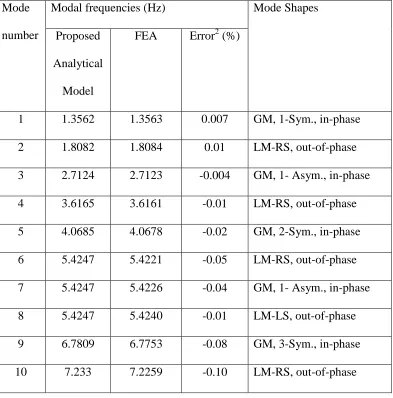
Table 2-1 In-plane modal properties of a twin-cable network with a rigid
cross-tie at mid-span
32
Table 2-2 In-plane modal properties of twin-cable network with a rigid cross-tie
at quarter span
33
Table 2-3 In-plane modal properties of a symmetric SMT two-cable network
With unequal cable lengths and a rigid cross-tie at mid-span
38
Table 2-4 In-plane modal properties of a symmetric DMT two-cable network
with unequal cable lengths and a rigid cross-tie at mid-span
41
Table 3-1 In-plane modal properties of a symmetric SMT two-cable network
with system parameters as frequency ratio η2=0.833 and segment ratio εj=1/2 (j=1 to 4)
65
Table 3-2 In-plane modal properties of a symmetric SMT and a symmetric
DMT four-cable network (ηi=0.833, i=2, 3, 4) with a single line of
rigid cross-ties at mid-span (εj=1/2, j=1 to 8)
74
Table 4-1 Comparison of the in-plane modal properties of a symmetric twin-
cable network with rigid (ψ1=0) and flexible cross-tie (ψ1=1.0) at
quarter span
112
Table 4-2 In-plane modal properties of a symmetric SMT two-cable network
with system parameters as frequency ratio η2=0.88, segment ratio
j=1/2 (j=1 to 4) and flexibility parameter ψ1=1.0
117
Table 4-3 Comparing in-plane modal properties of a symmetric SMT cable
network with rigid and flexible cross-tie with system parameters as
frequency ratio η2=0.88, segment ratio j=1/2 (j=1 to 4) and flexibility
parameter ψ1=1.0
LIST OF FIGURES
Figure 2-1 Schematic diagram of the mathematical model of a basic cable network 15
Figure 2-2 Schematic diagram of a symmetric twin-cable network with rigid cross-tie
at arbitrary point
22
Figure 2-3 Non-dimensional modified system frequency, Ω / π, as a function of the
non-dimensional cross-tie position, ε, for a twin-cable SMT network
24
Figure 2-4 First ten modes of a symmetric twin-cable system with a rigid cross-tie at
mid-span
28
Figure 2-5 First ten modes of a symmetric twin-cable system with a rigid cross-tie at
quarter span from the left end
30
Figure 2-6 Symmetric SMT two-cable network with unequal length main cables and a
rigid cross-tie at mid-span
34
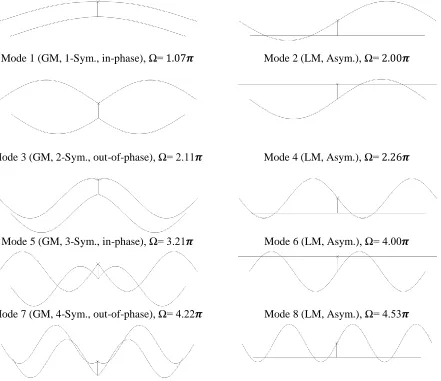
Figure 2-7 First ten modes of a symmetric SMT two-cable network with unequal
length main cables and a rigid cross-tie at mid-span
36
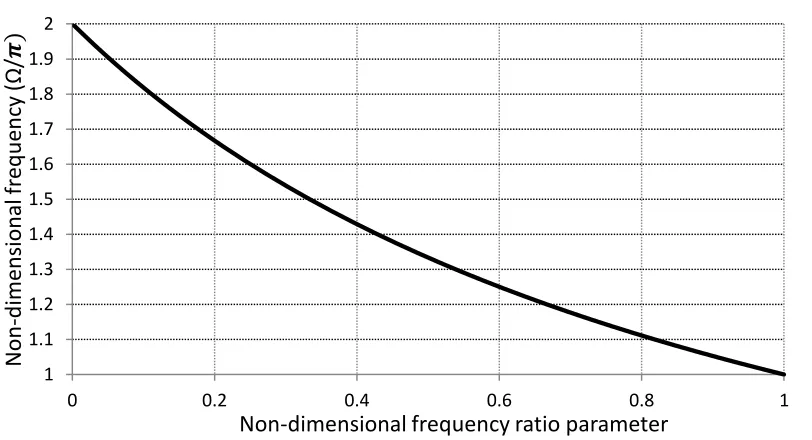
Figure 2-8 Non-dimensional modified frequency, Ω/π, as a function of frequency ratio
parameter, η, for a symmetric SMT two-cable network
37
Figure 2-9 First ten modes of a symmetric DMT two-cable network 41
Figure 2-10 Asymmetric two-cable network with a rigid cross-tie at arbitrary location 43
Figure 2-11 2-11 First ten modes of an asymmetric two-cable network (H1=H2,
m1=m2, L1=0.8L2, rigid cross-tie locates at one-fifth from the left end)
46
Figure 3-1 Schematic diagram of the mathematical model of an extended cable
network
56
Figure 3-2 Schematic diagram of the mathematical model of a general cable network 61
Figure 3-3 Schematic diagrams of three SMT cable networks having the same system
parameters
63
Figure 3-4 First ten modes of a symmetric SMT two-cable network (network-2) 65
Figure 3-5 First ten modes of a symmetric SMT four-cable network 69
Figure 3-6 First ten modes of a symmetric DMT four-cable network 73
Figure 3-7 Schematic diagram of the mathematical model of a two-cable network 76
parameter, λ, for three different cross-tie positions (Symmetric DMT cable network, γ2=0.67)
Figure 3-8b Non-dimensional modified frequency, Ω/π, as a function of the length ratio
parameter, λ, for three different cross-tie positions (Symmetric SMT cable network, γ2=1.0)
79
Figure 3-8c Non-dimensional modified frequency, Ω/π, as a function of the length ratio
parameter, λ, for three different cross-tie positions (Symmetric DMT cable network, γ2=1.5)
79
Figure 3-9a Non-dimensional modified frequency, / , as a function of the segment
ratio parameter ε for three symmetric SMT cable networks(γ2=1.0)
83
Figure 3-9b Non-dimensional modified frequency, / , as a function of the segment
ratio parameter ε for three symmetric DMT cable networks(γ2=0.667)
83
Figure 3-9c Non-dimensional modified frequency, / , as a function of the segment
ratio parameter ε for three symmetric DMT cable networks(γ2=1.5)
84
Figure 3-10a Non-dimensional modified frequency, / , as a function of the frequency
ratio parameter, ƞ, for four symmetric SMT cable networks with different
number of main cables (N=2, 3, 4, 5) and rigid cross-tie position at
mid-span (ε=1/2)
87
Figure 3-10b Non-dimensional modified frequency, / , as a function of the frequency
ratio parameter, ƞ, for four symmetric SMT cable networks with different
number of main cables (N=2, 3, 4, 5) and rigid cross-tie position at 1/3
span (ε=1/3)
87
Figure 3-11a Non-dimensional modified frequency, / , as a function mass-tension
parameter, γ, for four symmetric DMT cable networks with different
number of main cables (N=2, 3, 4, 5) and rigid cross-tie position at
mid-span (ε=1/2)
90
Figure 3-11b Non-dimensional modified frequency, / , as a function mass-tension
parameter, γ, for four symmetric DMT cable networks with different
number of main cables (N=2, 3, 4, 5) and rigid cross-tie position at 1/3
span (ε=1/3)
Figure 4-1 Schematic diagram of the mathematical model of a basic cable network
with flexible cross-tie
100
Figure 4-2 Schematic diagram of a symmetric twin-cable network with flexible
cross-tie at arbitrary point
106
Figure 4-33 Evolution of first three right segment (RS) modes of a symmetric twin-cable network with cross-tie located at quarter span and flexibility parameter ψ1
varies from 0 to 1.0
108
Figure 4-4 Transformation of first ten modes of a symmetric twin-cable network as flexibility parameter Ψ1 varies from 0 to 1.0 and cross-tie locates at quarter
span
111
Figure 4-5 Symmetric SMT two-cable network with unequal length main cables and
flexible cross-tie
113
Figure 4-6 First ten modes of a symmetric SMT cable network with system parameters as frequency ratio η2=0.883, segment ratio εj=1/2 (j=1 to 4) and flexibility
parameter ψ1=1.0
116
Figure 4-7 First ten modes of a symmetric DMT cable network with system parameters as Frequency ratio η2=0.88, mass-tension ratio γ2=1.25, segment ratio
j=1/2 (j=1 to 4) and flexibility parameter as ψ1=1.0
NOMENCLATURE
cross-sectional area of main cable (s)
coefficients of cable segment displacement
coefficients of cable segment displacement
coefficients of cross-tie displacement
E modulus of elasticity
EA axial rigidity
f modified fundamental frequency of the coupled cable network fundamental frequency of the ith main cable in the cable network
pre-stressed force in the main cables in the cable network
pre-stressed force in the ith main cable in the cable network h additional cable tension due to dynamic vibration
span lengths of the main cables in the cable work
span length of the ith main cable in the cable work length of the cross-tie in the cable work
, segment lengths of the main cables in the cable network
mass density of the main cables in the cable network
mass density of the ith main cable in the cable network O2 horizontal offset of the second main cable
cable tension under static condition.
longitudinal displacement function of the cross-tie in-plane transverse displacement function of the cable segments
horizontal distance measured from the support as indicated
i wave number of the i th
main cable in the cable network.
β wave number of the cross-tie. β
inextensibility parameter
angle of inclination of the cable to the horizontal axis
ω circular modified fundamental frequency of the coupled cable
network
ω fundamental frequency of the ith main cable in the cable network additional cable tension induced by cable vibration
frequency ratio parameter
frequency ratio parameter related to the ratio of frequency of the longest cable in the network to the frequency of the ith cable in the network
η frequency ratio parameter of the cross-tie
segment ratio parameter
mass-tension ratio parameter related to the ratio of ‘mass-tension’
product of the given cable to the longest cable in the network
i mass-tension ratio parameter of the ith cable in the cable network
i
Ω Non-dimensional frequency of the modified coupled cable
CHAPTER 1
Introduction
1.1 Background
The idea of using inclined cables to support a bridge span is not new but the methodology is. The
Egyptians used the same idea in their sailing ships (Troitsky, 1977). In the early 17th and 18th
century, different simple bridges having a deck supported by inclined bars or cables (Troitsky,
1977) were designed. In spite of all these innovative ideas, cable-stayed bridges were not
successful until the late 20th century.
One of the main achievements of the recent advancement in bridge engineering is the
design of cable-stayed bridges with much longer span length due to the ambitions of human to
cross wider space. The complex behaviour of cable–stayed bridges when subjected to dynamic
loads, such as wind, traffic or seismic excitations is a long standing issue in bridge industry. The
nonlinear interaction between local cable vibrations and bridge deck vibrations can lead to very
large amplitude cable vibrations or high amplitude of deck vibrations. These can in turn cause
problems related to structural safety, user discomfort or fatigue damage. Besides, wind-induced
cable vibrations are identified as one of the critical dynamic problems associated with
cable-stayed bridge at present. The initiative and the amplitude of excitation depend on the flow
characteristics of wind, geometry and dynamic properties of the cable. Based on their
mechanisms, wind-induced cable vibrations can be categorized as rain-wind-induced vibration,
vortex-induced vibration, buffeting, wake galloping, high-speed vortex excitation and dry
inclined cable galloping.
Suppressing vibrations of bridge stay cables is of prime importance since stay cables are
cables would have a considerable impact on the serviceability and life span of the entire bridge.
Therefore, to control cable vibrations, different countermeasures are adopted, which can be
classified as the aerodynamic type and the mechanical type. The aerodynamic type of
countermeasures aims at changing the aerodynamic behaviour of the stay cables by modifying its
cross-sectional shape. Experimental results show that by using spiral wire around the cable
surface (Zhan et al, 2008), dimpled surface (Verlogeux, 1998) and the helical wire whirling
surface (Bosdogianni & Olivari, 1996), the amplitude of cable vibration could be reduced
significantly. On the other hand, the mechanical type of countermeasures is directed to enhance
damping property and stiffness of the cable(s). External dampers installed near the cable-deck
anchorage are used to help dissipate kinetic energy of an oscillating cable and increase the
structural damping of the attached cable (Pacheco et al, 1993; Krenk, 2000; Tabatabai and
Mehrabi, 2000; Zhan et al, 2008; Cheng et al, 2010). The cross-ties or transverse secondary
cables , used to connect a problematic stay cable with its neighbour(s) and thus form a cable
network, serves to increase the stiffness and thus natural frequencies of the cable, so that the
critical wind velocity at which aerodynamic instability of the cable would initiate can be
increased. The cross-ties can also be used to reduce cable sag variation among stays of different
lengths (Gimsing, 1993). So far, cross-ties have been successfully used on a number of
cable-stayed bridges to control cable vibrations, such as the Faro Bridge in Denmark, the Normandie
Bridge in France, the Yobuko Bridge in Japan (Virlogeux, 1998), the Fred Hartman Bridge
(Caracoglia and Jones, 2005b) and the Dames Point Bridge in USA (Kumarasena et al., 2007).
After installing the cross-ties, no problematic cable vibrations have been reported. The
adds extra damping to the system and eliminates some of the lower modes of vibration that could
be excited.
However, the cross-tie solution is proposed more recently, studies on the mechanisms and
dynamic behaviour of a cable network system is still limited.
Ehsan and Scanlan (1989) used the finite element approach to understand the behaviour
of a cable network. According to their study, the main function of the cross-ties in a cable
network is to help transferring energy from a more vulnerable cable to its neighbours. Virlogeux
(1998) reported an unexpected behaviour of cross-ties on Foro Bridge in Denmark. He addressed
the issues of transverse cable stiffness, cable tension and cable internal damping. He suggested
that equivalent static analysis sometimes could be efficient in design recommendation.
Yamaguchi and Nagahawatta (1995) performed a set of physical tests on a simple cable
network using two cables, with different lengths, connected through a transverse cross-tie. It was
found that the fundamental frequency of the modified cable network was higher than that of the
top individual cable. It was also found that the modal damping of their simple cable network was
always greater than that of a single main cable without cross-tie. This modal damping increment
was found to be more significant with flexible (soft) cross-ties as compare to the rigid (stiff)
ones.
Caracoglia and Jones (2005a, 2005b) developed an analytical model to study the in-plane
free vibration of a cable network. In their model, the taut cable assumption was applied to the
main cables and the cross-ties were simplified as either rigid or linear spring cross-ties. In their
problem formulation, the equations of motion of the main cables were considered but the
equations of motion of the cross-ties were not. However, the system equation was solved
work, and their roles on the dynamic performance of a cable network were not investigated. In a
subsequent piece of work (Caracoglia and Zuo, 2009), the same approach was applied to the
cable networks with different configurations. But again, a clear reveal of the important system
parameters and their effects on the behaviour of a cable network was lacking.
Bosch and Park (2005) simulated the performance of stay cables with cross-ties using the
finite element approach. Among their findings, it is interesting to note that the effectiveness of
the cross-ties depends on the deployment geometry, the quantity, the size, and the anchorage
conditions. It was also observed that when main cables were connected with cross-ties, local
modes which were densely populated over a narrow band of frequency range, were induced. In
addition, the simulation results indicated that the combined use of cross-ties and external
dampers would not necessarily earn the cumulative benefits of both when they are applied
separately.
Sun et al (2007) performed a set of physical tests on a scaled model of cable network
using three cables connected through a cross-tie. The different factors such as the cross-tie
stiffness, the tensioning method and the pretension of the cross-ties were considered to see the
behaviour of their cable network. It was among their findings that stiff type of cross-tie mainly
contributed to enhance the in-plane stiffness of a cable network while the soft type of cross-tie
was more effective in increasing the system damping.
More recently, a simplified analytical model was developed by Zhou et al (2011) to study
the free vibration of a cable network. In this model, only the target cable was included in the
1.2 Motivations
Though the strategy of using cross-ties to suppress the unfavourable cable vibrations has
already been implemented on some cable-stayed bridges and a number of successful practical
examples were reported in the literature (Faro Bridge in Denmark, the Normandie Bridge in
France, the Yobuko Bridge in Japan, the Fred Hartman Bridge and the Dames Point Bridge in
USA), the dynamic behaviour of such a cable network system is not fully understood.
Majority of the existing studies were based on either physical tests or numerical
simulations. In the knowledge of the author, only few studies (Caracoglia and Jones, 2005a;
2005b; Zhou et al, 2011) attempted analytically. The model developed by Zhou et al (2011) was
really simple and had the major flaw by ignoring influence of the neighbouring cables. The
model proposed by Caracoglia and Jones (2005a), though easy to understand, the form of the
derived characteristic equations corresponding to different network configurations were
complicated for understanding the behaviour of a cable network. As far as the finite element
simulation is concerned, it is an effective tool to find the final results but needs a lot of effort in
the parametric study where the redistribution of nodes and elements of a cable network is
required. Further, the roles of different system parameters cannot be clearly explained and the
exact relations between them are hard to conclude.
It is also noted that studies of a general cable network including n number of cables
connecting through cross-tie are not available in the literatures. Therefore, there is a great need
to develop an analytical model of a general cable network that can include all the essential
components in this structural system and identify the key system parameters as well as their roles
All these above motivated the present study, of which an analytical model of a general
cable network consisting of n horizontal cables and a single line of transverse cross-ties will be
developed and the system equation will be solved analytically. The key system parameters will
be identified. The impact of different system parameters on the in-plane modal behaviour of a
cable network will be extensively investigated.
1.3 Objectives
The objectives of the current study are proposed as follows:
1. Propose an analytical model to describe the in-plane modal behaviour of a basic cable
network, which consists of two stay cables connected through a single rigid transverse
cross-tie.
2. Develop a finite-element model for the basic cable network to verify the proposed
analytical model.
3. Apply the proposed analytical model to study in-plane modal behaviour of basic cable
networks with different configurations.
4. Extend the analytical model of a basic cable network to a general cable network
consisting of n horizontally laid main cables connected by a single line of rigid transverse
cross-ties. Develop system equation and analytical solutions. Validate the general cable
network model using finite element approach.
5. Identify the key system parameters in a general cable network. Conduct parametric study
to extensively explore the role of each system parameters in affecting the dynamic
behaviour of a cable network.
6. Develop an analytical model of a basic cable network of which two horizontally laid
cross-tie model and study the effect of cross-tie flexibility on the dynamic behaviour of a
cable network.
1.4 Organization
The material presented in this thesis is divided into five chapters. The first chapter,
Chapter 1, includes an introduction of the studied problem, a brief review of the existing studies,
a discussion about the motivations that led to the current study, and the objectives to be achieved.
Chapters 2, 3, and 4 are prepared in the form of journal papers, with each contains its own
introduction, literature review, methodology, main results, and conclusions. Chapter two (Journal
paper 1) is focused on developing an analytical model of a basic cable network with a rigid
transverse cross-tie, and its application to basic cable networks of different configurations.
Chapter 3 (Journal paper 2) is dedicated to a general cable network with a single line of rigid
transverse cross-ties. An analytical model describing the in-plane free vibration of a general
cable network is proposed, from which the key system parameters are identified. An extensive
parametric study is conducted to investigate the role of each parameter on affecting the modal
behaviour of a network system. In Chapter 4 (Journal paper 3), the flexibility of cross-tie is the
main interest. An analytical model of a basic cable network with flexible cross-tie is developed.
The role of cross-tie flexibility on the in-plane stiffness of a cable network is discussed. The last
chapter, Chapter 5, concludes the present work and also provides recommendations for the future
REFERENCES
[1] Bosch, H. R., Park, S. W. (2005). “Effectiveness of External Dampers and Crossties in
Mitigation of Stay Cable Vibrations.” Sixth International Symposium on Cable
Dynamics, 115-122.
[2] Bosdogianni, A., Olivari, D. (1996), Wind- and rain- induced oscillations of cables of
stayed bridges. Journal of Wind Engineering and Industrial Aerodynamics, Vol. 64,
171-185.
[3] Caracoglia, L., Jones, N. P. (2005a). “In-plane dynamic behavior of cable networks. Part
1: formulation and basic solutions.” J. Sound and Vibration, 279, 969–991.
[4] Caracoglia, L., Jones, N. P. (2005b). “In-plane dynamic behavior of cable networks. Part
2: formulation and basic solutions.” J. Sound and Vibration, 279, 994–1014.
[5] Caracoglia, L., Zuo, D. (2009). “Effectiveness of cable networks of various
configurations in suppressing stay-cable vibration.” J. Engineering Structures, 31, 2851–
2864.
[6] Cheng, S., Darivandi, N., and Ghrib, F. (2010). “The design of an optimal viscous
damper for a bridge stay cable using energy-based approach.” J. Sound and Vibration,
329, 4689-4704.
[7] Ehsan, F., Scanlan, R. H. (1989). “Damping stay cables with ties”, 5th US-Japan Bridge
Workshop, 203-217.
[8] Gimsing, N. J. (1993). Cable supported Bridges, Concept and Design, Willy, New York.
[9] Krenk, S. (2000). “Vibrations of a taut cable with an external damper.” ASME J. Applied
[10] Kumarasena, S., Jones, N., Irwin, P., Taylor, P. (2007). Wind-Induced Vibration of
Stay-Cables. McLean, VA: Federal Highway Administration, FHWA-RD-05-083.
[11] Pacheco, B. M., Fujino, Y., Sulekh, A. (1993). “Estimation curve for modal damping in
stay cables with viscous damper.” J. Structural Engineering, ASCE, 119(6), 1961–1979.
[12] Tabatabai, H., Mehrabi, A. (2000). “Design of mechanical viscous dampers for stay
cables.” J. Bridge Engineering, ASCE, 5(2), 114-123.
[13] Troitsky, M. S., ‘Cable-Stayed Bridges Theory and design’. Granada Publishing Limited,
1977.
[14] Virlogeux, M. (1998). “Cable vibrations in cable-stayed bridges. Bridge Aerodynamics.”
Larsen & Esdahl (eds), Balkema, Rotterdam, 213-233.
[15] Yamaguchi, H., Nagahawatta, H. D. (1995) “Damping effects of cable cross-ties in
cable-stayed bridges.” J. Wind Engineering and Industry Aerodynamics, 54/55, 35-43.
[16] Zhan, S. et al. (2008). “Experimental study of wind– rain-induced cable vibration using a
new model setup scheme.” J. Wind Engineering and Industrial Aerodynamics, 96, 2438–
CHAPTER 2
Analytical Study on In-plane Modal Behavior of Stay Cables Connected by
Cross-ties: Part I: Basic Cable Network
2.1 Introduction
One main achievement in the recent advancement in bridge engineering is the design of
cable-stayed bridges with much longer span length due to the ambitions of human to cross wider
space and the rapid development of materials and technology. Light weight of structural
components and the use of longer spans result in more slender elements and structures which are
susceptible for vibrations under various types of dynamic excitations. A typical example is the
cables on cable-stayed bridges. They run directly from a bridge deck up to a tower, forming a
unique "A" shape. Mainly due to their high flexibility, light mass and very low inherent
damping, these cables are unable to dissipate much of the excitation energy, which renders large
amount of accumulation.
The complex behavior of cable–stayed bridges when subjected to dynamic loads, such as
wind, traffic or seismic excitation, is a long standing issue in bridge engineering. The nonlinear
interaction between local cable vibrations and bridge deck vibrations can lead to very large
amplitude cable vibrations or high amplitude of deck vibrations (e.g. Lilien and Pinto da Costa,
1974; Macdonald and Georgakis, 2002; Caetano and Cunha, 2003; Sun et al, 2003). These can
in turn cause problems related to structural safety and user discomfort.
Different solutions have been used on site to suppress undesired cable vibrations. Surface
treatment is applied to cables to change their aerodynamic features. A study (Zhan et al, 2008) on
rain-wind induced cable vibration showed that by using spiral wire around the cable surface, the
suppressed by modifying cable-surface with parallel longitudinal projections in order to prevent
the formation of water rivulets (Matsumoto et al, 1992). Besides, mechanical types of solutions
including installation of external dampers and connection of a few cables by cross-ties have been
implemented on site with different levels of effectiveness.
The structural behaviour of a cable when attached transversely with an external damper
and the optimum design of such a cable-damper system have been extensively studied by many
researchers (e.g. Pacheco et al, 1993; Krenk, 2000; Tabatabai and Mehrabi, 2000; Main and
Jones, 2002; Fujino and Hoang, 2008; Cheng et al, 2010). However, the mechanism of cross-tie
solution is yet well understood. When cross-tie(s) are applied on site, the cables which are
vulnerable (or have experienced) large amplitude vibrations are connected to their neighboring
cables through transverse secondary cables or cross-ties to form a cable network. Such a strategy
aims at reducing the effective length of the problematic cable to increase its in-plane stiffness
and natural frequencies. Besides this, the adoption of cross-ties also adds extra damping to the
target cable which would help to eliminate excitation of vibrations in some lower modes. The
cable sag variation among cables of different lengths is also found to be reduced with the
introduction of cross-ties (Gimsing, 1993).
So far, cross-ties have been successfully used on a number of cable-stayed bridges to
control cable vibrations, such as the Faro Bridge in Denmark, the Normandie Bridge in France,
the Yobuko Bridge in Japan (Virlogeux, 1998), the Fred Hartman Bridge (Caracoglia and Jones,
2005b) and the Dames Point Bridge in USA (Kumarasena et al, 2007). After installing the
cross-ties, no problematic cable vibrations have been reported. However, studies on the dynamic
Ehsan and Scanlan (1989) used the finite element approach for the solution of a
three-dimensional cable network problem and studied the redistribution of oscillation energy in a cable
network consisting of a number of stay cables connected by cross-ties. According to their study,
the main function of the cross-ties in a cable network is to help transferring energy from a
problematic cable to its neighbours.
Virlogeux (1998) described the unexpected behaviour of cross-ties on the Normandie
Bridge in France where one of the cross-ties was broken. It was not clear what caused the failure
of this cross-tie. However, when these cross-ties were replaced by stronger ones with higher
tension, the performance was found to be satisfactory. In another case reported by the same
author, the installation of extremely low damping cross-ties was found to successfully suppress
the rain-wind-induced vibrations of bridge stay cables.
Yamaguchi and Nagahawatta (1995) performed a set of physical tests on a simple cable
network, of which two main cables of different lengths were connected through two transverse
cross-ties symmetrically. It was found that the fundamental frequency of the cable network was
higher than that of the top individual main cable (the longer ones) and increased monotonically
with the prestress in the cross-tie. The modal damping of the cable network was always greater
than that of a single main cable without cross-tie. This modal damping increment was found to
be more significant when more flexible (soft) cross-ties were used.
Caracoglia and Jones (2005a) developed an analytical procedure to study the in-plane
free vibration of a cable network. In the formulation, the taut cable assumption was applied to the
main cables and the cross-tie was simplified as either rigid or a linear spring. The approach was
implemented numerically for a number of simplified two-cable networks and a more complicated
important system parameters in a typical cable network cannot be identified clearly through
numerical simulation. In addition, the high cost associated with reconstruction of numerical
model limited the capability of the approach for an extensive parametric study. In a more recent
work (Caracoglia and Zuo, 2009), this analytical procedure was applied to cable networks of
different configurations to determine the effectiveness of the cross-tie solution.
Bosch and Park (2005) simulated the performance of a group of stay cables connected by
cross-ties using the finite element software, SAP 2000. Interestingly, it was found that the
effectiveness of the cross-ties depended on their deployment geometry, the quantity, the size, and
the anchorage conditions with the main cables. It was observed from the numerical simulation
that when cables were connected by transverse cross-ties, vibration modes densely populated
over a narrow band of frequency range would be induced. In addition, it was found that the
combined use of cross-ties and external dampers would not necessarily produce the sum of
benefits when they are used separately.
In an experimental study by Sun et al (2007), a scaled cable network model of three main
cables connected by a transverse cross-tie was tested. The effect of different factors such as the
cross-tie stiffness, the tensioning method and the pretension of the cross-ties were evaluated. It
was found that while the stiff type of cross-tie mainly contributed to enhance the in-plane
stiffness of a cable network and thus its modal frequencies, the soft type of cross-tie is more
effective in increasing the system damping.
A simplified analytical model was proposed lately by Zhou et al (2011) to study the free
vibration of a cable network. Only the target cable was included in the model, and the effects of
In majority of the previous studies, either physical tests or numerical simulations were
conducted to explore the dynamic behaviour of a cable network. In the knowledge of the authors,
very few studies (e.g. Caracoglia and Jones, 2005a; 2005b; Zhou et al, 2011) attempted
analytically. In the case of Caracoglia and Jones (2005a; 2005b), the proposed analytical
procedure was implemented numerically. Thus, the key system parameters as well as their
contributions to the performance of a cable network could not be clearly explained. Nevertheless,
these information will be essential to the design of such a vibration control strategy.
In the present paper, an analytical model of a basic cable network consisting of two
horizontally laid taut cables connected by a rigid vertical cross-tie will be developed. The
solution to the system equation will be derived analytically, based on which the key system
parameters and their relations with the dynamic response of the cable network can be explicitly
identified from the system characteristic equation. Examples of a number of two-cable networks
with typical configurations and various system properties will be presented. The in-plane modal
behaviour of these basic cable networks will be extensively examined. The proposed analytical
model and approach will be extended to a more general cable network in a companion paper
(Ahmad and Cheng, 2012).
2.2 In-plane Free Vibration of a Basic Cable Network
2.2.1 Description of the system
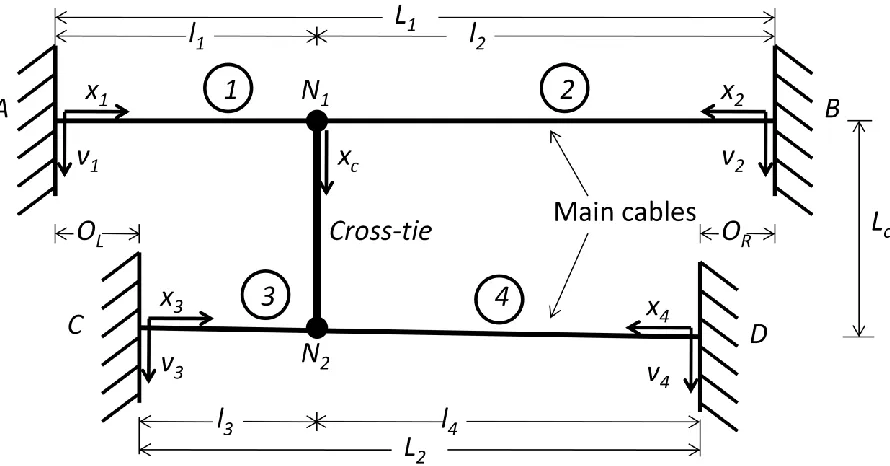
The proposed mathematical model of a basic cable network comprised of two
horizontally laid main cables having different lengths L1 and L2, with L1 being the length of the
longer one. Both cables are connected through a vertical cross-tie of length Lc, which divides
each cable into two segments, as shown in Figure 2-1. The mass per unit length of the two cables
offset of the second cable on the left end is denoted by OL and that on the right by OR. The
cross-tie is located at l1 from the left end of cable AB. The downward vertical displacements of the
main cables and the cross-tie are defined as positive.
Figure 2-1 Schematic diagram of the mathematical model of a basic cable network
The analytical model of a basic cable network is developed based on the following
assumptions: a) The main cables are idealized as taut cables; b) The additional dynamic tensions
in the main cables are neglected; c) The main cables are fixed at both ends; d) The main cables
have the in-plane transverse vibration as their dominant motion, the longitudinal vibration is
neglected; e) The cross-tie has the longitudinal vibration as its dominant motion, the transverse
motion is neglected; f) The cross-tie is rigid. The last assumption is made not only to simplify the
formulation and solution, but considers the fact that the fundamental frequency of a cable
network will only be slightly decreased when choosing a flexible cross-tie as oppose to a rigid
2.2.2 In-plane free vibration of a single taut cable
As can be seen from Figure 2-1, when the cable network vibrates in the vertical direction,
the two main cables are expected to oscillate transversely, where the cross-tie will be subjected
to axial vibration. Therefore, the equation of motion describing the in-plane transverse vibration
and axial vibration of a single taut cable will be briefly reviewed first.
Since the additional cable tension due to its motion is neglected, the in-plane free
vibration of a single taut cable in the transverse direction can be expressed as (Irvine, 1974)
(2-1)
where H, m and v are the pre-stressed force, the unit mass and the in-plane transverse
displacement in main cable(s), respectively.
whereas that for the in-plane longitudinal motion is (Humar, 2001)
(2-2)
where E, A and u are the modulus of elasticity, the cross-sectional area the longitudinal
displacement in secondary cable(s) or cross-tie(s), respectively.
By applying the Bernoulli-Fourier method to the in-plane transverse displacement to
separate the time-dependent and spatial coordinate variables, gives . Its
second derivatives with respect to time t and spatial coordinate x are respectively
and
Substitute the above two equations into Eq. (2-1) and simplify it, gives
where and is the circular frequency of cable vibration. Solution to Eq. (2-3) is
in the form of
(2-4)
where A and B are constants, which can be determined from boundary conditions.
Since the cable is suspended horizontally and fixed at both ends, .
Applying these boundary conditions to Eq. (2-4) gives A=0 and B . The constant B
cannot be zero in order for a non-trivial solution, thus
(2-5)
Similarly, the in-plane axial displacement u in Eq. (2-2) can be expressed as
, by separating the variables. Its second derivatives with respect to time t
and spatial coordinate x are respectively
and
Substitute the above two equations into Eq. (2-2), yields
(2-6)
where and is the circular frequency of cable vibration. Solution to Eq. (2-6)
is in the form of
(2-7)
where C and D are constants determined from boundary conditions.
2.2.3 Formulation of system equation
In the basic cable network model shown in Figure 2-1, there are four main cable
segments vibrating in the transverse direction and one cross-tie in the axial direction. Applying
and , and the non-dimensional system frequency Ω = , where and are the fundamental frequency of the ith (i=1, 2) cable and the cross-tie, respectively and f is the
fundamental frequency of the cable network yet to be determined. The wave numbers and in
Eqs. (2-5) and (2-7) can be expressed as Ωη and Ωη . Thus, Eqs. (2-5) and (2-7)
can be rewritten as
Ωη i=1, 2 (2-8a)
Ωη i=1, 2 (2-8b)
Ωη Ωη (2-8c)
where i is the numbering of the main cables; and are the shape function constants of the
four main cable segments shown in Figure 2-1, and C, D are the shape function constants of the
cross-tie. It is worth noting that based on the definition, frequency ratio η1 of the first main cable
(the longer one) is 1. Eqs. (2-8a) and (2-8b) represent respectively the response of the left and the
right segments of the two main cables in Figure 2-1, whereas Eq. (2-8c) is for the cross-tie. The
six unknown shape function constants B1, B2, B3, B4, C and D can be determined using the
following conditions:
Compatibility conditions
; (2-9a)
(2-9b)
(2-9c)
(2-9d)
Equilibrium conditions
+ + (9-e)
Applying the above compatibility and equilibrium conditions to Eq. (2-8) and expressing the
resulting equations in the matrix form, yields
(2-10)
where ε (i=1, 2) applies to the left segments of both main cables with ε
being their segment ratios; and ε (i=1,2) applies to the right segments of
both main cables with the corresponding segment ratios as ε ; applies to
the cross-tie and (i=1, 2) is the mass-tension ratio parameter of the ith cable.
To obtain non-trivial solution to the system equation, Eq. (2-10), the determinant of the 66
coefficient matrix on the left hand side of the equation should be zero, i.e.
This leads to
sin( )cos( )sin( )sin( )sin( )+ cos( )sin( )sin( )sin( )sin( )
+ sin( )sin( )sin( )cos )sin( )+ sin( )sin( )cos )sin( )sin( ) =0
The term sin( ) is common in all terms and therefore the above equation can be written as,
sin( )cos( )sin( )sin( )+ cos( )sin( )sin( )sin( )
Its further simplification generates
sin( )cos( )+ cos( )sin( )]
+ sin( )sin( )[sin( )cos )+cos )sin( )]} =0
Now, by using sin of A + B, the above equation can be rewritten as,
+ ] =0
By definition of , ε ε and ε ε
By definition of ε, ε ε
Similarly, ε ε
Substituting the values of and yields,
sin( )[ sin( )sin( )sin( ) + sin( )sin( )sin( )] = 0 (2-11)
This equation is the system equation of a basic cable network where two horizontally suspended
taut cables are connected transversely through a rigid cross-tie. It has two sets of solutions. The
first set, which can be determined from sin( ) =0, represents the behaviour of the cross-tie. It
is of no interest to the present study and therefore is dropped. The second set of solution can be
obtained from
sin( )sin( )sin( ) + sin( )sin( )sin( ) = 0 (2-12)
which is the characteristic equation of the basic cable network in Figure 2-1. It can be
observed from Eq. (2-12) that the left hand side of the equation is the summation of two terms.
Each term is the product of four sub-terms which are the mass-tension ratio parameter of one of
the main cables, the Sine term of that main cable and the Sine terms of both segments of the
This equation can be applied to a basic cable network having any arbitrary configurations
and properties to study its in-plane modal behaviour and to evaluate how the dynamic response
of a cable would be altered once connected to its neighbours through a rigid cross-tie.
2.3 Finite Element Model
To verify the proposed analytical model and the solution for the in-plane modal
behaviour of a basic cable network, a finite element model is developed independently. The
commercial finite element software package ABAQUS 6.9 is used for this purpose. This
software is capable to numerically simulate the performance of structural members in static, free
vibration, linear and non-linear dynamic analysis.
In the developed model, both main cables and the cross-tie are modeled as
two-dimensional elements with two degrees-of-freedom along transverse and axial directions at each
node. The beam element B21 from the ABAQUS element library is chosen to model the main
cable. This element is a shear-deformable (Timoshenko) beam and can be used for thin or thick
members. The rigid beam element RB2D2 is selected to simulate the behaviour of the rigid
cross-tie. It is a two-dimensional, two-node rigid element. All the cables used in the numerical
examples in the current study have lengths varying between 48 m to 100 m. From the sensitivity
analysis, it was concluded that 50 to 100 elements per cable, depending on the cable length, is
adequate to model the cable behaviour.
In order to ensure the accuracy of the results, the material properties of the numerical
model must be defined to be compatible with the assumptions made for the analytical model. In
the analytical model, the main cables are idealized as taut strings. Therefore, the material
properties of the main cables in the finite element model are selected in such a way which would
introduced by Irvin (1974) to describe the static and dynamic behavior of cables. It accounts for
the geometric and elastic effects and is defined as λ2=(mgL/H)2L/[HLe/(EA)], where Le is the
effective length of the cable due to sagging effect. The value of λ2 varies from a very small
number (close to 0), for the taut flat cable, to a very large number (for example, 1000) in the case
of an inextensible cable. The cross-tie is idealized as a rigid connector in the analytical model.
Therefore, it is taken as the rigid body in the finite element model. The two main cables are fixed
at both ends and the initial stress is introduced to simulate the effect of pretension. All boundary
conditions are defined when building the finite element model and the initial stress is applied as
the initial condition.
For free vibration analysis, the FREQUENCY procedure in the ABAQUS software is
adopted, which uses an eigenvalue technique to extract natural frequencies and the
corresponding mode shapes of a structure. LANCZOS is used as the Eigen solver. In the output,
the eigenvectors are normalized such that the largest displacement value in each vector is unity.
2.4 Applications to basic cable networks with different configurations
In this section, the proposed analytical model of a basic cable network will be applied to
two-cable network systems with different configurations and cable properties. Results will be
compared with those obtained from numerical simulations using the finite element model
described in Section 2.3.
2.4.1 Twin-cable network
2.4.1.1 Cross-tie at arbitrary location
In this type of configuration, assume the cross-tie is located at a distance l1, with l1≠l2,
Figure 2-2 Schematic diagram of a symmetric twin-cable network with rigid cross-tie at arbitrary point
Since the main cables are twin cables, so , and = .
Therefore, the frequency ratios are the segment ratios are and
, and the mass-tension ratios are . Because the mass-tension
ratio parameter γ, is the same for both cables, it is termed as the same-mass-tension ratio or SMT
cable network. Substitute these values into Eq. (2-12), gives
= 0
or = 0 (2-13)
Obviously, three sets of solution are present for Eq. (2-13). The first set, yielded from
, generates roots of =nπ, where n=1, 2, 3…. It describes the global modes of the entire cable
network system, of which the two main cables vibrate independently at the same natural
frequency of a single cable. The odd values of n generate the modified system frequency as
, and the even values of n generate the modified system frequency as
. Clearly, the expression of the system frequency associated with the global modes,
i.e. , is not a function of the segment ratio . This suggests that if the cross-tie is rigid, the
the position of the cross-tie. In these global modes, both main cables vibrate in the same shape as
that of a single cable at this frequency.
The second and the third sets of solution are functions of the segment ratio , i.e. the
cross-tie position. They have the form of
ε (2-14a)
and ε (2-14b)
where n = 1, 2, 3… . The modified frequency given by Eq. (2-14a) results from the vibrations of
cable segment 1 in main cable 1 and its counterpart in main cable 2, i.e. segment 3, while the
other two main cable segments are at rest. Similarly, vibrations of cable segments 2 and 4 in
Figure 2-2 are associated with the frequency given by Eq. (2-14b). In this study, these two types
of local modes are categorized as the left-segment mode (when the left segments are vibrating
and the right ones are at rest, designated as ‘LS’ mode) and the right-segment mode (when the
right segments are vibrating and the left ones are at rest, designated as ‘RS’ mode). For cross-tie
position other than the mid-span, i.e. ε , it can be seen that the frequencies of lower order
modes of one equation in Eq. (2-14) may be the same as those of the higher order ones of the
other equation, i.e. they form complimentary pairs. Caracoglia and Jones (2005a) denoted these
‘LS’ and ‘RS’ modes as the ‘complimentary-pseudo-symmetric’ and the ‘pseudo-symmetric’
modes. For cross-tie position at the mid-span, frequencies and mode shapes of the LS modes are
the same as those of the RS modes.
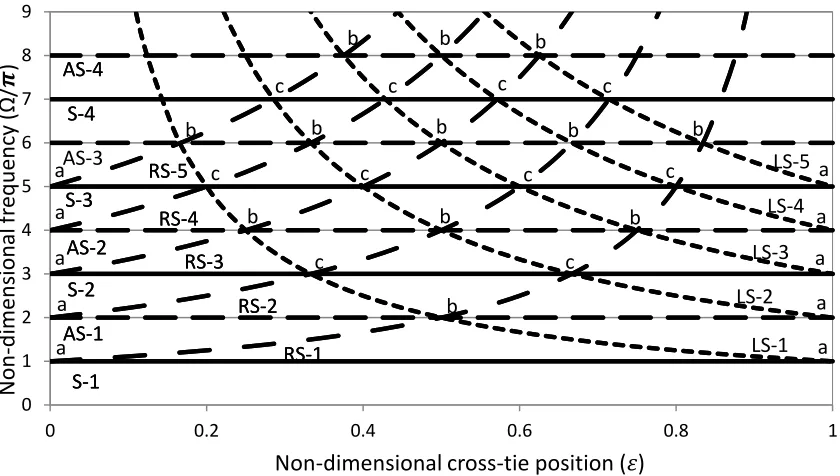
The impact of the cross-tie position, i.e. the segment ratio ε, on the system frequency of a
Figure 2-3. Non-dimensional modified system frequency, / , as a function of the non-dimensional cross-tie position, , for a twin-cable SMT network: S (global symmetric, solid
line), AS (global asymmetric, broken line), RS (local, right segment, dash-dot line) and LS (local, left segment, dotted line) modes
As can be observed from the figure, while the frequencies of the global modes, which are
independent of the cross-tie position, remain as constants nπ (n=1, 2, 3…), as the cross-tie moves
from the left end of the main cables towards right, the frequencies of the local LS modes
gradually decrease and those of the local RS modes increase. The frequency variation of the local
LS modes and RS modes are symmetric about the center line of ε and complimentary
with each other. At certain cross-tie positions, more than one global or local modes have the
same modal frequency. Thus, the Ω-ε curve of these modes will intersect with each other at those
locations. Three types of intersections can be observed from Figure 2-3.
The first type of intersection, symbolized by “a”, represents the extreme cases of cross-tie
location either at the left (ε or the right (ε support of the main cables. When ε ,
the lengths of the main cable left segments are zero. Thus, the local RS modes are the same as 0 1 2 3 4 5 6 7 8 9
0 0.2 0.4 0.6 0.8 1
N o n -d ime n sion al fr eq u en cy (Ω / 𝝅 )
Non-dimensional cross-tie position (𝜀) S-1 AS-2 S-3 AS-1 S-2 RS-1 RS-3 LS-2 AS-4 LS-3 S-4 AS-3 RS-2 LS-1 LS-4 RS-4
RS-5 LS-5
a a S-1 AS-2 S-3 AS-1 S-2 RS-1 RS-3 AS-4 S-4 RS-2 RS-4 RS-5 b b b a a a b b c c c c c a a b b b a a a b
b b
b
c
c c
the global modes. Similarly, the lengths of the right cable segments become zero when ε ,
and the local LS modes are the same as the global ones.
The second type of intersection, denoted by “b”, represents the coexistence of a pair of
complimentary local RS mode and LS mode, along with an asymmetric global mode. The
corresponding cross-tie position can be found by equating the frequency of the asymmetric
global mode with one of the local modes in the complimentary pair. Use the case of the second
asymmetric global mode as an example, its frequency remains as a constant when ε increases
from 0 to 1, which is shown in Figure 2-3 as a horizontal broken line Ω=4π. There are three Type
II intersection points on this horizontal line. The one on the left represents the coexistence of the
first LS mode, the third RS mode and the second asymmetric global mode. The frequency of the
first LS mode can be computed from Eq. (2-14a) by substituting n=1, which gives Ω=π/ε. By
equating it with the frequency of the second asymmetric global mode, yields π/ε , based on
which the location of the cross-tie can be determined as ε . Similarly, the cross-tie
locations corresponding to the other two intersection points “b” are found to be ε and
ε , respectively.
The third type of intersection is symbolized by “c”, it is associated with the coexistence
of a complimentary pair of local RS and LS modes and a symmetric global mode. The cross-tie
location where these three modes coexist can be determined by equating the frequency of the
symmetric global mode with one of the local modes in the complimentary pair. For example, for
the two intersection points “c” on the horizontal solid line of Ω=3π, the corresponding cross-tie
positions are ε and ε , respectively.
In addition, results in Figure 2-3 clearly indicate that because of the modal property
is very sensitive at the vicinity of these intersections. A minor shift of the cross-tie position could
lead to a drastic switch between a local mode and a global mode, or a local LS mode and the
complimentary RS mode.
2.4.1.2 Special case 1: Cross-tie at mid-span
This is a special case of the twin-cable system discussed in Section 2.4.1.1, of which the cross-tie
is placed at the mid-span. This condition yields the same segment ratio for all four main cable
segments, i.e. 1/2 (j=1 to 4) and thus Ω/2 (j=1 to 4). Substitute these values into Eq.
(2-13), gives
(2-15)
It is worth pointing out that when studying the same type of twin-cable network,
Caracoglia and Jones (2005a) derived the characteristic polynomial of the system (Eq. (2-9) in
the reference), which, by setting it as zero, would give the modal frequencies of a twin-cable
network with a rigid cross-tie placed at the mid-span. This characteristic polynomial, though
looks slightly different in form, is actually the same as Eq. (2-15) derived independently above.
Apparently, Eq. (2-15) has three sets of solution. The first set can be derived from
and gives the global modes of the cable network, as discussed in Section 2.4.1.1. The
second and the third set solutions to Eq. (2-15), both derived from the condition of
, are the same in terms of the magnitude of the modified system frequency. However, the
associated mode shapes corresponding to these two sets are totally different. The second set
condition origins from . It generates the modified system frequency of
. These are the same as the frequencies of the asymmetric global
main cable 1 and segment 3 in main cable 2, while segment 2 and segment 4 in these two main
cables remain at rest. On the other hand, the third set condition, which is
, though gives the same modified system frequencies as those from the second set, represents
vibrations of segment 2 in cable 1 and segment 4 in cable 2 with segment 1 and segment 3 at
rest.
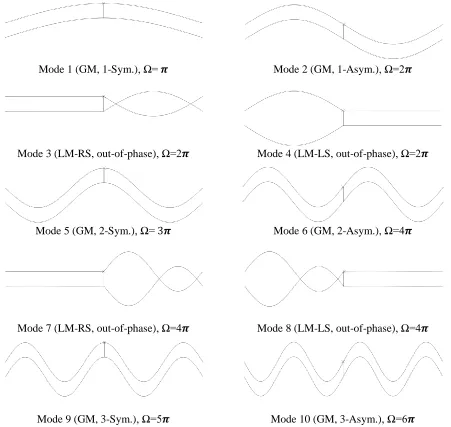
The mode shapes, i.e. the vectors of the normalized modal amplitudes, can be determined
by substituting the frequency values into Eq. (2-10). The odd values of n generate symmetric
modes, i.e. [1 1 1 1]T, while the even values of n generate three different possible vectors of
normalized modal amplitudes as explained above, i.e.
a) [1 -1 1 -1]T: Asymmetric global modes with in-phase motion of both cables;
b) [0 -1 0 1]T: Local modes with out-of-phase motion of right segments of the main cables;
c) [1 0 -1 0]T: Local modes with out-of-phase motion of left segments of the main cables.
Figure 2-4 portrays the first ten modes of this type of basic cable network. Modes 1 to 4
in the figure show the mode shape defined by the above four normalized modal amplitude
Mode 1 (GM, 1-Sym.), Ω= Mode 2 (GM, 1-Asym.), Ω=2
Mode 3 (LM-RS, out-of-phase), Ω=2 Mode 4 (LM-LS, out-of-phase), Ω=2
Mode 5 (GM, 2-Sym.), Ω= 3 Mode 6 (GM, 2-Asym.), Ω=4
Mode 7 (LM-RS, out-of-phase), Ω=4 Mode 8 (LM-LS, out-of-phase), Ω=4
Mode 9 (GM, 3-Sym.), Ω=5 Mode 10 (GM, 3-Asym.), Ω=6
Figure 2-4 First ten modes of a symmetric twin-cable system with a rigid cross-tie at mid-span (GM: global mode, LM: local mode, Sym.: symmetric, Asym.: asymmetric, RS: right segment,
LS: left segment)
2.4.1.3 Special case 2: Cross-tie at quarter span
In this special case of a twin-cable system, the cross-tie locates at the quarter span from the left
support. This condition gives the segment ratio of the four main cable segments as
Again, three sets of solution are available. The first set, , is exactly the same
as that discussed in the previous two subsections. This supports that the global modes in a SMT
twin-cable network with rigid cross-tie are independent of the cross-tie position. The second and
the third sets of solution are responsible for the local left-segment (LS) and the local
right-segment (RS) modes respectively and these are also discussed in Section 2.4.1.1. The first ten