© 2014, IJCSMC All Rights Reserved 482 Available Online atwww.ijcsmc.com
International Journal of Computer Science and Mobile Computing
A Monthly Journal of Computer Science and Information Technology
ISSN 2320–088X
IJCSMC, Vol. 3, Issue. 8, August 2014, pg.482 – 490
REVIEW ARTICLE
Efficient Image Retrieval Using
Different Content Based Image
Retrieval Methods: A Review
Priyanka Srivastava
1, Dr. K.S.Patnaik
21
Lecturer, Computer Science Department, Usha Martin Academy, India 2
Associate Professor, Computer Science and Engineering Department, Birla Institute of Technology, Mesra, India 1
[email protected]; 2 [email protected]
_____________________________________________________________________________________ ABSTRACT- In this paper, we reviewed different methods used in Content-based image retrieval, to resolve the problem of efficient and similar digital image retrieval from large databases with high precision. Uses of different features like texture, color, shape have been focused in different ways to implement better and faster retrieval of data through different CBIR methods. Methods like Statistical scaled Product Metric (SFPM), Fractal-scaled Product Metric (FPM), local tetra patterns (LTrPs) have been focused to maximize the accuracy of CBIR systems and to enhance similarity queries.
Keywords- Content-based image retrieval (CBIR), local binary pattern (LBP), local derivative pattern (LDP), local tetra pattern (LTrP), Statistical Fractal-scaled Product Metric (SFPM), Fractal-scaled Product Metric (FPM), Proto Object (PO), Relevance Feedback (RF)
I. INTRODUCTION
A.
Motivation
The tremendous growth of digitization due to Web cameras, digital cameras, mobile
phones and other electro nic devices is making the image database management
extremely tedious and clumsy task.
© 2014, IJCSMC All Rights Reserved 483
Content-based image retrieval (CBIR) is one of the common methods for such
applications. The fundamental step of CBIR is its feature extraction whose effectiveness
depends upon the method adopted for extracting features from given images. The
features in CBIR includes color, texture, shape, faces, spatial layout, etc., to represent and
index the image database, classified as general features or primitive features such as color,
texture, shape and domain-specific features or logical features such as human faces,
fingerprints, etc.
Earlier, introduction of picture archiving and communication system (PACS) [4] has
contributed to the effective use of digital images. But image retrieval in PACS is no t fast
and steady as expected by the user. Most solutions in PACS are based on metadata as
image height, width, type of compression used to store it. Therefore, CBIR techniques
have been exclusively researched in the last f e w years to retrieve a s p e c i f i c i m a g e
a s r e s u l t b y i n p u t t i n g query images i r r e s p e c t i v e o f t e x t b a s e d s e a r c h
and i t manages digital picture archives based on their visual characteristics.
Now-a-days, different techniques of CBIR came in existence to remove the problem of
partial occlusion (accurate object are not retrieved as it is hidden by other object), non
rigid motion, over segmentation [2]. A non-rigid motion is a motion that is flexible. The
result of various objects having non-rigid motion does not resemble the original object in
some respect
.B.
Background
CBIR, image retrieval is mainly performed for analyzing similarity among different
images using distance function w h i c h compares the feature vectors to quantify how
close (similar) two vectors are, focusing the queries. F e a t u r e v e c t o r a r e n u me r ic a l
v a lu e o f d i f fe r e nt fe a t u r e s o f a n i ma g e . Major issues in CBIR systems includes
how to define a feature vector(signature) which denotes image content and how to
determine the similarity between a pair of images based on their signatures.
The visual properties of an image s u c h a s color, texture, shape is being extracted by
image segmentation algorithms [4] also called feature extractors or image descriptors, either
globally or locally (region of interest). It computes a number of numeric values,
representing features or signatures of the images. The signature is then processed through a
function to measure the similarity between signatures of different images. Examples can
include histogram for color, Haralick descriptors for texture, and Zernike moments for
shape [4]. Zernike polynomials state a precise mathematical model to capture the global
shape of images while preserving enough information. Zernike moments of an image
are the projections of the image pixel onto a base function which does not changes with
respect to image size, rotation, translation.
However, the use of large number of extractors leads to “dimensionality curse”,
which r e d u c e the query accuracy and retrieval speed. Therefore, suitable methods
which combine feature extractors without degrading the results are needed.
A su it able approach is to combine multiple descriptors by estimating the similarity for
each of them in a base level and then aggregates the partial similarities using a
composition function.
© 2014, IJCSMC All Rights Reserved 484
to measure the similarity in a way human being would perceive or recognize [8]. It
includes integrating low level features with other media, like audio, text, etc. which are
more natural to human being, and therefore at a higher level. For a given query, the
Relevance feedback (RF) is the most powerful tools to narrow the semantic gap problem [7]
and thus improves the performance of a CBIR system. CBIR system first retrieves a list
of different images according to a predefined similarity metrics, often defined by the
distance between query vector and feature vectors of images in a database [15]. It focuses on
the correlation between a user and a search engine by analyzing similar or dissimilar images
with the query image, which can be positive and negative feedbacks by the user
respectively [5], and the system will refine the query with new list of images but it is
having several shortcomings. To address the challenges encountered by traditional RF
approaches many studies have been attempted by resorting to the user information
provided by a number of users. Therefore, besides the low-level visual features of images,
each pair can also be related with a set of similar or dissimilar pairwise constraints
decided by users. This new approach of utilizing user feedback log data [3] which can
be achieved when the system can accumulate RF information provided by a number of
users with similar and dissimilar pairwise constraints, for image retrieval is termed as
collaborative image retrieval (CIR) whose basic purpose is to enhance the performance
of CBIR system.
Different approaches of CBIR mainly works within three categories in a unified framework, i.e., unsupervised learning, supervised learning with explicit class labels, weakly supervised learning with pairwise constraints (or side information). Unsupervised learning method does not use any class label information and normally prohibit the internal distribution of data. Supervised learning approaches can effectively explore certain collections of data with explicit class labels. Almost all weakly supervised learning approaches [3] can only learn distance metric from the training data that are viewed in the forms of pairwise constraints (or side information), in which each pairwise constraint determines whether the corresponding two samples are similar or dissimilar for a defined task.
II. DIFFERENT METHODS USED FOR CBIR
A. Fractal-scaledProductMetric(FPMmethod)
Every feature extractors generate signatures compared by metrics which in turn
generate metric space. n metric spaces can be aggregated as, M
i= (S
i, δ
i), 1 ≤ i ≤ n, defining
a metric over the Cartesian product of
M1 ×M2 × ... ×Mn, called product metric. The
FPM method calculates the scale factors (or weights w
i) as given in equation 1 between the
composed metrics based on correlation fractal dimension of each original metric space
prepared by the extracted descriptors. By knowing correlation fractal dimension of a
dataset, prediction of its properties which are similar to that of a dimensional dataset is
done with approximately the same embedded dimension
.
The composition distance function Δ between two images x, y is the aggregation of
individual distances
i (xi
, y
i ) as
( ) ∑
(
)
equation (1)
Where w
iis the weight associated with respective descriptor.
© 2014, IJCSMC All Rights Reserved 485
among the attributes of a dataset, the fractal dimension gives an estimate of a lower bound
for the number of features needed in a similarity search to record the essentiality of data
information. The FPM method performs normalization to shrink the effects of the range
difference in the similarity computation by using the largest known distance dmaxi for
each descriptor.
FPM metric can be given as:
( ) ∑
( )equation(2)
Here, D
2is correlation fractal dimension, dmax
iis the largest known distance between all
pairs of elements considering every descriptor, i denotes the descriptor but this approach is
quadratic on the number of elements.
B. StatisticalFractal-scaledProductMetric(SFPM)
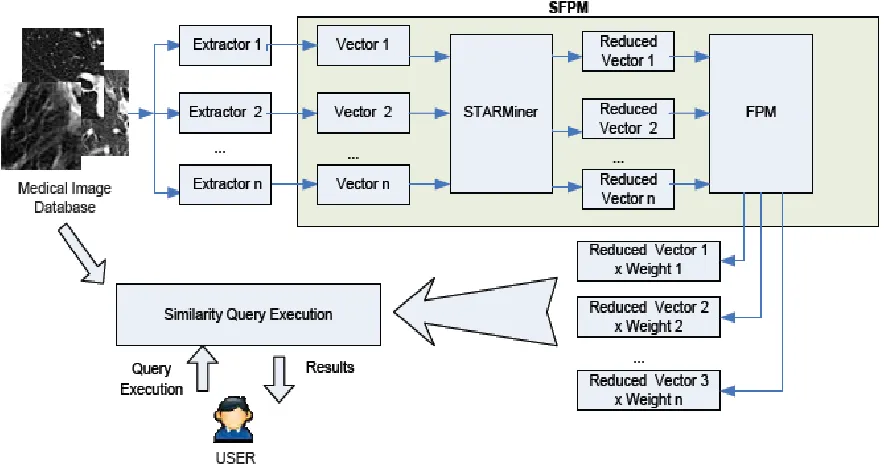
The Statistical Fractal-scaled Product Metric technique [4] maximizes the query accuracy with minimum number of features used to perform the query. This method combines statistical approach (association rule mining) to perform feature selection and fractal theory approach (FPM) to find the most suitable weight of features which speed up data searching.
first step involves the submission of images from the database to a set of feature extractors where image being represented by its feature vectors which then proceed to feature selection process through the StARMiner algorithm [4], inducing reduced set of features for each extractor. StARMiner, termed as Statistical Association Rule Miner. It produce more semantically significant patterns. Spatio-Temporal Association Rules (STARs) describes how objects move between regions over time [9]. The reduced feature vector’s properties are analyzed using the fractal theory (FPM method), producing scale factors for multi-descriptors. Lastly, it is submitted to CBIR system for execution of the similarity queries asked by the user, thus improves the correctness of the result and the speed of the query execution [4].
© 2014, IJCSMC All Rights Reserved 486
SFPM starts its process by StARMiner, which does a significant reduction in the number of features of the feature vectors. StARMiner algorithm is used to determine statistical association rules from a dataset (image) to select the most relevant features by removing noise and redundant features, making a new and enhanced sketch of the images with query precision.
Let T be the collection of data of medical images, x an image class, Tx T where Tx is the subset of
images of class x and F is a feature.Let μF (Z) and σF (Z) be the mean and standard deviation of the values
of feature F respectively, of subset of images Z. StarMiner uses three edges, Δμmin as the minimum
allowed difference between the average of the feature F in images from class x and in the remaining dataset, γmin as the minimum confidence to reject the hypothesis H0 and Δσmax as the maximum standard
deviation of F allowed in a given class. StARMiner algorithm follows rules of the form x → F, if the following equations satisfied [4].
μf (Tx) − μf (T − Tx) ≥ Δμmin
σf (Tx) ≤ Δσmax
H0 : μf (Tx) = μf (T − Tx)
Here, x → F relates a feature F with a class x, where values of F have statistically distinct behavior in images of class x. It indicates that F is a prominent feature to distinguish images of class x from the remaining image as it is having particular and uniform behavior in images of a given class.
Let T be the collection of data of medical images, x an image class, Tx T where Tx is the subset of
images of class x and F is a feature.Let μF (Z) and σF (Z) be the mean and standard deviation of the values
of feature F respectively, of subset of images Z. StarMiner uses three edges, Δμmin as the minimum
allowed difference between the average of the feature F in images from class x and in the remaining dataset, γmin as the minimum confidence to reject the hypothesis H0 and Δσmax as the maximum standard
deviation of F allowed in a given class. StARMiner algorithm follows rules of the form x → F, if the following equations satisfied [4].
μf (Tx) − μf (T − Tx) ≥ Δμmin
σf (Tx) ≤ Δσmax
H0 : μf (Tx) = μf (T − Tx)
Here, x → F relates a feature F with a class x, where values of F have statistically distinct behavior in images of class x. It indicates that F is a prominent feature to distinguish images of class x from the remaining image as it is having particular and uniform behavior in images of a given class.
Let T be the collection of data of medical images, x an image class, Tx T where Tx is the subset of
images of class x and F is a feature.Let μF (Z) and σF (Z) be the mean and standard deviation of the values
of feature F respectively, of subset of images Z. StarMiner uses three edges, Δμmin as the minimum
allowed difference between the average of the feature F in images from class x and in the remaining dataset, γmin as the minimum confidence to reject the hypothesis H0 and Δσmax as the maximum standard
© 2014, IJCSMC All Rights Reserved 487
Let T be the collection of data of medical images, x an image class, Tx T where Tx is the subset of images of class x and F is a feature. Let μF (Z) and σF (Z) be the mean and standard deviation of the values of feature F respectively, of subset of images Z. StarMiner uses three edges, Δμmin as the minimum allowed difference between the average of the feature F in images from class x and in the remaining dataset, γmin as the minimum confidence to reject the hypothesis H0 and Δσmax as the maximum standard deviation of F allowed in a given class. StARMiner algorithm follows rules of the form x → F, if the following equations satisfied [4].
Let T be the collection of data of medical images, x an image class, Tx T where Tx is the subset of
images of class x and F is a feature.Let μF (Z) and σF (Z) be the mean and standard deviation of the values
of feature F respectively, of subset of images Z. StarMiner uses three edges, Δμmin as the minimum
allowed difference between the average of the feature F in images from class x and in the remaining dataset, γmin as the minimum confidence to reject the hypothesis H0 and Δσmax as the maximum standard
deviation of F allowed in a given class. StARMiner algorithm follows rules of the form x → F, if the following equations satisfied [4].
μf (Tx) − μf (T − Tx) ≥ Δμmin
σf (Tx) ≤ Δσmax
H0 : μf (Tx) = μf (T − Tx)
Here, x → F relates a feature F with a class x, where values of F have statistically distinct behavior in images of class x. It indicates that F is a prominent feature to distinguish images of class x from the remaining image as it is having particular and uniform behavior in images of a given class.
C. Local Tetra Pattern
For texture classification and its retrieval, Local Tetra Pattern (LTrP) [1] emerged as a silver line. The LTrP describes the spatial distribution of the local texture by the use of direction of the center gray pixel gc. The Local Binary Pattern(LBP), Local Derivative Pattern(LDP), and Local Ternary Pattern(LTP)
extract information based on the distribution of edges, which is having only two directions i.e. positive direction or negative direction. But local tetra patterns (LTrPs) focus on four direction code i.e. it differentiates the edges in more than two directions [11]. It calculates the directionality of all pixels by the use of 0. and 90. derivatives of LDPs. LBP and LTP determines the relationship between the referenced pixel and its surrounding neighbors by computing gray-level difference. But LTrP encodes the relationship between the referenced pixel and its neighbor pixel based on the directions being calculated using the first-order derivatives in vertical and horizontal directions. It present a statistical view of the texture retrieval problem by combining the two related tasks, named as feature extraction (FE) and similarity measurement (SM) [11].
Suppose an image as I, the first-order derivatives along 0. and 90. directions are denoted as I1e(gp) where
e=0.,90.. Let gc be the center pixel of image I, and gh and gv denote the horizontal and vertical
neighborhoods of gc, respectively. The first-order derivatives at the center pixel gc can be calculated as:
1 0
.
(gc) = I(gh) - I( gc)
1 90
.
© 2014, IJCSMC All Rights Reserved 488
LBP is an efficient texture operator which labels the pixels of an image by using the neighborhood of each pixel and considers the result as a binary number. To capture texture information of the face appearance, LBP descriptor is incorporated into multiscale heat-kernel.
Provided a center pixel in the image, the LBP value is computed by analyzing its gray value with its neighbors, based on
Where gc is the gray value of the center pixel, gp is the gray value of its center neighbors, P is the total
number of neighbors, and R is the radius of the neighborhood.
Zhang et al. introduced the feasibility and effectiveness of LDPs for face recognition using high order local patterns. It considers the LBP as the nondirectional first-order local pattern operator and extended it to (n-1)th order derivative. The LDP contains more detailed discriminative features in comparison of LBP.
LDP involves two different phases. In the first phase, image of the face is decomposed into different orientation and scale using multiscale and multiorientation Gabor filters. In the second phase, LBP analysis is used for neighboring relationship description not only in image space but also in different scale and orientation responses [1].
D. Content-Based Scalability with JPEG 2000
Image being characterized by mathematical curves and straight lines and which is being used at all resolutions and at all sizes is termed as scalable image. A prominent example which provides scalability with respect to quality, resolution and color component in the transfer of images is JPEG2000 (an image compression standard and coding system). An image is composed of several object regions. Initially, identification and description of semantic object region is done, and then addition of information to what is being coded for meaningful interpretation to both humans and computers. The two main areas are, object- based coding and region-based coding.
However scalability with respect to semantic content is done by region based bit allocation mechanism within the JPEG2000 using the concept of proto objects which also bridges the semantic gap between object-based and region-based approaches. Proto Object is defined as a volatile unit of visual information which can be bounded into a coherent and stable object when accessed by focused attention.
© 2014, IJCSMC All Rights Reserved 489
An object-based coding of generic scene content requires segmentation methods which can be defined as the classification or clustering an image into several parts or regions according to the features of image [10], to determine pixels with markup tags specifying what each set of pixels represents. Another option is lower level process of region-based coding, which focus on image regions as semantic unit defined by their statistical properties.Statistically homogeneous regions can be taken out by pixel-level segmentation techniques and the shape of a region needs to be coded using shape coding algorithms. To transmit the background separately from the foreground, there is the requirement of refined motion analysis and prediction strategies which is not an efficient method.
The proposed JPEG2000 system to support the content-based scalability, as shown in Fig. 3, we first fragment an input image into PO regions and BG regions, and then amend both the construction of an operational RD curve in the coding pipeline and the implementation of an efficient rate control scheme in terms of PO regions. Two major modifications being made in standard JPEG2000 system are as follows: 1) Use of PO region segmentation instead of tile partition. 2)Analyzing he quality layer in terms of PO regions.
This segmentation also provides accurate rate control scheme including scalability with respect to content. Walther et al. gave the origin of PO region segmentation. By extracting particular image region around the focus of attention, a PO can be obtained. Then updated saliency map is obtained by setting the saliency value of the locations belonging to the PO region to zero. Second PO region is obtained by performing the same PO region finding process on the updated saliency map. The above process repeats until the maximum saliency value of the updated saliency map becomes less than the predefined threshold.Finally, the pixels not assigned to any PO regions in the saliency map belong to BG regions.
III. CONCLUSIONS
From the above mentioned review, it has been resulted that SFPM have decreased the feature vector size up to 65% and improved its query precision up to 27% as compared to FPM approach. Thus it is well-suited to improve the quality of content based query in CBIR systems. JPEG 2000 rate control approach efficiently reduces the computational complexity and memory usage and produce high quality image. Performance analysis determines that LTrP improves the retrieval result from 70.34% to 75.9% in terms of average precision. But still more focus is required to enhance the CBIR methods which can include semantic features irrespective of low level features.
REFERENCES
[1] S. Murala, R. P. Maheshwari and R. Balasubramanian, “Local Tetra Patterns: A New Feature Descriptor for Content-Based Image Retrieval,” IEEE Transactions on Image Processing, vol. 5, pp. 2874-2886, May 2012.
[2] J. Xue, C. Li and N. Zheng, “Proto-Object Based Rate Control for JPEG2000: An Approach to Content-Based Scalability,” IEEE Transactions on Image Processing, vol. 20(4), pp. 1177-1184, April 2011. [3] L. Zhang, W. Lipo and L. Weisi “Conjunctive Patches Subspace Learning With Side Information for
Collaborative Image Retrieval,” IEEE Transactions on Image Processing, vol. 21(8), pp. 3707-3720, Aug. 2012.
[4] R. Bueno, M. X. Ribeiro, A. J. M. Traina and C. Traina, “Improving Medical Image Retrieval through Multi-Descriptor Similarity Functions and Association Rules”, IEEE 23rd International Symposium, pp. 309-314, Oct. 2010.
© 2014, IJCSMC All Rights Reserved 490
[6] K.S. Patnaik, A. Mustafi, “Perceptual resemblance of facial images: a near set approach”, Indian Journal of Computer Science and Engineering, vol. 1(3), pp. 152-156, 2010.
[7] G. Quellec, M. Lamard, G. Cazuguel, B. Cochener and C. Roux, “Fast Wavelet-Based Image Characterization for Highly Adaptive Image Retrieval”, IEEE Transactions On Image Processing, vol. 21(4), pp.1613-1623, April 2012.
[8] C. Zhang and T. Chen, “From Low Level Features To High Level Semantics”, Handbook of Video Databases: Design and Applications, 2003.
[9] F. Verhein, “Mining Complex Spatio-Temporal Sequence Patterns”, In SDM, vol. 9, pp. 605-616, 2009. [10]M. X. Ribeiro, A.G. Balan, J.C. Felipe, A.J. Traina and Jr.C. Traina“Mining Statistical Association Rules
to Select the Most Relevant Medical Image Features,” In Mining complex data , pp. 113-131, 2005. [11]S. Anitha, “Content Based Image Retrieval Using Local Tetra Pattern,” International Journal of
Electronics, Communication & Instrumentation Engineering Research and Development, vol. 3(1), pp.219-228, Mar 2013.
[12]V. G. Ukinkar, “A New Content Based Image Retrieval Technique Using Local Tetra Patterns: A Review”, International Journal Of Pure And Applied Research In Engineering And Technology, Vol. 1(8), pp.687-697, 2013.
[13]A. Azeem, M. Sharif, M. Raza and M. Murtaza, “A Survey: Face Recognition Techniques under Partial Occlusion,” Int. Arab J. Inf. Technol., vol. 11(1), pp. 1-10, 2014.
[14]H. Zhang, Z. Chen, W.Y. Liu and M. Li, “Relevance Feedback in Content-Based Image Search”, PRIS, 2001.