Human Oriented Content Based Image Retrieval
using Clustering and Interactive Genetic
Algorithm
Ms. Vaishali N. Pahune Ms. Nikita Umare
Department of Computer Science and Engineering Department of Computer Science and Engineering Abha Gaikwad College of Engg,Nagpur Abha Gaikwad College of Engg,Nagpur
Abstract
Digital image libraries and other multimedia databases have been dramatically extended in recent years. The development of a content based image retrieval (CBIR) system is an important research topic which aims to retrieve the desired images effectively and precisely from a large image database. The proposed human oriented CBIR system that uses the interactive genetic algorithm (IGA) with K-means algorithm to infer which images in the databases would be of most interest to the user. Color, texture, and edge, of an image which are three image features are utilized in this approach. An interactive mechanism by IGA provides to better capture user’s intention. Here different features are considered which are as follows: from the hue, saturation, value (HSV) color space low-level image features color features, as well as texture and edge descriptors, are used in this approach the query-by-example strategy has been adopted as a search technique.(i.e. the user provides an image query). In addition, the hybrid of user’s subjective evaluation and essential characteristics of the images in the image matching against only considering human judgment is taken. The IGA (Interactive Genetic Algorithm) is employed to reduce the gap between the retrieval results and the users’ expectation which help the users to identify the images that are most satisfied to user’s needs. A clustering algorithm, definitely the k-means, is used to cluster the database into classes. Images with similar features are clustered to one class. From the experimental results, it is evident that the proposed system surpassed its counterpart, other existing systems, in terms of precision, recall and retrieval time.
Keywords: Image retrieval, Interactive genetic algorithm (IGA), K-means, Visual features
________________________________________________________________________________________________________
I. INTRODUCTION
Information Retrieval:
In recent years, especially in the last decade, the rapid development in computers, storage media and digital image capturing devices enable to collect a large number of digital information and store them in computer readable formats. The large numbers of images have posed increasing challenges to computer systems to store and manage data effectively and efficiently. In the meanwhile, the advances of software and hardware technology have eased the problem of maintaining large information collections including books, journals, newspapers, videos, audios, images and satellite pictures accessible for computer users. Although the advent in internet makes it possible for the human to access this huge amount of information easily, but the rule is that the more information available about a given topic, the more difficult to locate accurate and relevant information easily. For this reason the need and the demand for an efficient and accurate information retrieval system has increased and attracted much interest among the researchers in recent years.
Information Retrieval Problem as Image Retrieval Problem:
Nowadays, virtually all spheres of human life including commerce, government, academics, hospitals, crime prevention, surveillance, engineering, architecture, journalism, fashion and graphic design, and historical research use information as images. These images and their data are categorized and stored on computers as a large collection referred to as image database. Image data include the raw images and information extracted from images by automated or computer assisted image analysis.
To retrieve any image, we have to search for it among the database using some search engine. Then, this search engine will retrieve many of images related to the searched one. The main problem encounters user here is the difficulty of locating his relevant image in this large and varied collection of resulted images. This problem referred to as image retrieval problem. To solve this problem, text-based and content-based are the two techniques adopted for search and retrieval in an image database.
Text-Based Image Retrieval:
task. Another problem is that keyword is subjective and not unique and different people have different perception about an image, that is, text-based retrieval is non-standardized. To overcome these problems and others, the image contents, features of the image, like color, texture and shape that are automatically extracted from the images themselves have been used for image retrieval. This method is called content-based image retrieval (CBIR) . CBIR enables the elimination of the difficulties that exist in traditional text-based query for large image database and then the system will provide better indexing and return more accurate results.
Content-Based Image Retrieval:
Content-based image retrieval (CBIR), also known as query by image content (QBIC) is the application of computer vision techniques to image retrieval problem, that is, problem of searching for digital images in large databases. It aims to finding images of interest from a large image database using the visual content of the images. "Content-based" means that the search will analyze the actual contents of the image rather than the metadata such as keywords, tags, and/or descriptions associated with the image. The term 'content' in this context might refer to colors, shapes, textures, or any other information that can be derived from the image itself. The main unit of CBIR is an image retrieval technique that used to retrieve from the database the most similar images to the query image.
Research Contribution:
With the rapid increase of the volume of digital image collections, CBIR is becoming an active research area. The design and development of effective and efficient CBIR systems are still a research problem with many important issues like:
Make semantic gap between image representation and image semantics narrow as much as possible.
Get sufficient generalization performance and high accuracy.
When we want to develop an efficient algorithm for CBIR, some problems have to be solved.
The first problem is to select the features that will represent the images. Naturally, the images are rich with information and features that can be used for image retrieval. But we must choose and extract the most important features that lead to a good retrieval result.
Since most of previously designed CBIR system may suffer from insufficient generalization performance and unsatisfactory accuracy, the goal of our research is to propose a new CBIR system that has a good generalization performance, high accuracy and adequate speed.
The major contributions of this thesis can be summarized as follows:
1) Our thesis proposes novel system architecture for CBIR system which combines techniques includes content-based image retrieval, multi-features analysis,as well as data mining techniques. To our best knowledge in this field, this is the first model or one of the first models that combine content-based, multi-features extraction, k-means clustering and GA to build a CBIR system.
2) As we said before, implementation of a CBIR system with one images' feature descriptor doesn’t give sufficient retrieval accuracy. In our thesis, to increase the performance of the system, a fusion of multiple features (color, texture and shape) as a descriptor for the image is used to compute the distance between two images.
3) Most CBIR systems use scale images. If the image database or the query image is a color image, they convert it to gray-scale image. However, when some systems use the color of the image as its feature, they derive the histogram from the color space of the image. In our research, the color moments will be used for extracting the image features
4) Low-level texture features are extracted using a gray level co-occurrence matrix (GLCM), which is a simple and effective method for representing texture.
5) Shape is known to play an important role in human recognition and perception and object shape features provide a powerful clue to object identity. Histogram is the most commonly used characteristic to represent the global feature composition of an image. Since edges play an important role for image perception, it is frequently used as a feature descriptor in image retrieval. The Edge Histogram Descriptor is such an example; which represents the spatial distribution of five types of edges, namely four directional edges and one non-directional edge. To increase efficiency of the proposed system, edge features that include these five categories are used as shape features.
6) Assigning equal weights for each feature can’t achieve good results in terms of average precision, and recall. This problem can be solved by assigning different weights to each feature and optimize these weights using IGA with a suitable fitness function to select optimum weights of features.
Thesis Organization:
In the present process color, texture, and edge, of an image which are three image features are utilized in our approach. An interactive mechanism by IGA provides to better capture user’s intention.
Thesis is divided into several sections.
The chapter 1 includes introduction of content based image retrieval scheme, overview of process work, research contributions to make efficient method for retrieval. Lastly it gives the idea about how the work is organized.
The chapter 2 contains literature survey and research review.
The chapter 3 describes problem definitions and research methodology. It includes various content based image retrieval methods which were previously implemented with its merits and demerits. Also, overall concepts and the analysis of the problem i.e. problem definition and research methodology.
The chapter 4contains the experimental set up which is required for running the process. It includes hardware requirements, software requirements. It introduces MATLAB with its tools identification. Also it focuses on advantages of using MATLAB.
The chapter 5 concludes simulation results and comparative analysis with other works.
The chapter 6 gives the plan of research.
The chapter 7 concludes the thesis work. It also shows how the future work can be conducted on this topic.
The chapter 8 contains the references of the thesis work.
II. SIMULATION RESULTS
This section presents the experimental results of the proposed Content Based Image Retrieval method for retrieval of image using interactive genetic algorithm. The input image is selected as a color document image. The method outlined in this paper is tested by coding the algorithm in MATLAB R2012a. It has a free utility to open, display, modifies and save various image file formats, is used for resizing test images. Visual quality of the reconstructed secret image is the factor measured to demonstrate feasibility of ‘distortion free’ approach.
Experimental Process and Results:
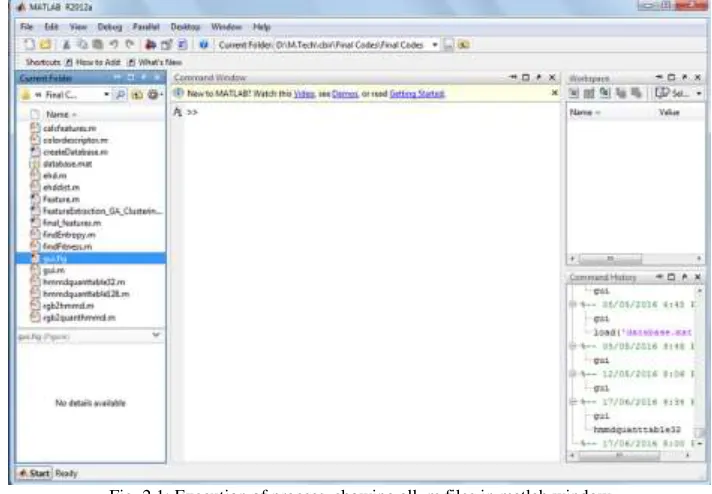
All the relevant files (calcfeatures.m, colordescriptor.m, Create Database.m, feature.m, feature Extraction_GA_Clustering.m, ehd.m, ehddist.m, find Entropy.m, Find Fitness.mgui.metc) is opened, as illustrated below.
Fig. 2.1: Execution of process, showing all .m files in matlab window
In the figure 2.1 the all .m files are listed which are present in current folder. All the. m files are store in cbir folder which can be browse from current folder. The list will display at left side of the matlab window. Some of the matlab files are feature Extraction. which is code for feature extraction for color, texture and edge feature exctraction .Database.mat is a database for storing the features of images. Find fitness. m code is used to calculate fitness of any image.
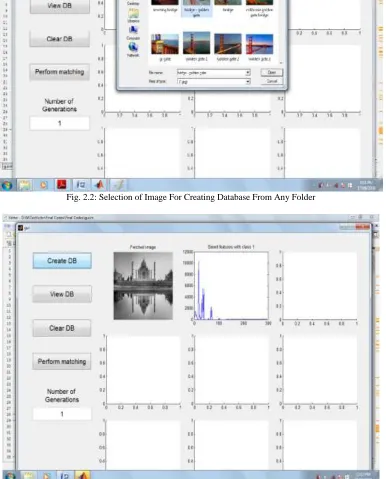
Fig. 2.2: Selection of Image For Creating Database From Any Folder
Fig. 2.3: storing image in database
When we click on “Create DB” button the window appear which is asking for the selection of image. There are few folders are available which content Category from images are to be select. After selecting image, the features of image i.e. color, texture and shape features is stored in database in different category we have to select particular category for the image. The features of images will store in particular that category.
Then the features of query image is compare with the features image in database for the matching performance. In figure 2.3 one image has been selected for storing purpose.
Fig. 2.4: viewing database image which we required
After creating database user can view the image of database by ‘view DB’. In which user will be ask for entering entry number. When user will view any entry it will show the features of that entry image. Below ‘view DB’ there is another button i.e. ‘Clear DB’. This command button is used to delete all the entries in the database.
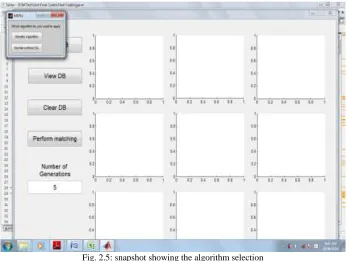
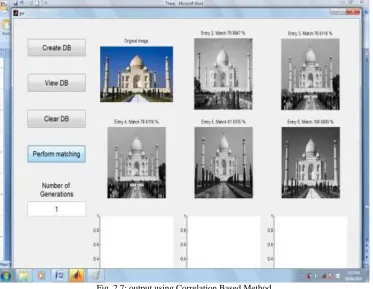
In proposed system we used interactive genetic algorithm is used but for comparison we are using here genetic algorithm and normal without GA as follows.
Fig. 2.5: snapshot showing the algorithm selection
Fig. 2.6: output using Interactive Genetic Algorithm
In this figure the interactive genetic algorithm is used in which user will be ask for how many images he/she wants then images will display according to that request. Here the fitness function is used for finding the fitness of images. The result of the algorithm is number of images with matching percentages so that user will get exactly same images which image he/she searching for.
Fig. 2.7: output using Correlation Based Method
Precision and Recall of Proposed Approach:
To evaluate the effectiveness of the proposed approach, we examined how many relevant images to the query were retrieved. The retrieval effectiveness can be defined in terms of precision and recall rates. Experiments are run five times, and average results are reported. In every experiment, an evaluation of the retrieval precision is performed so that ten images that were randomly selected from each specific category of the database are used as query images. For each query image, relevant images are considered to be those and only those which belong to the same category as the query image. Based on this concept, the retrieval precision and recall are defined as
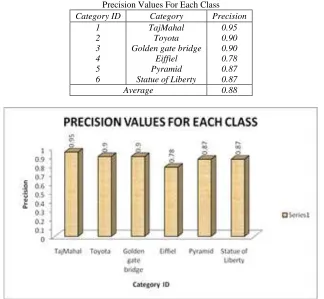
where NA(q) denotes the number of relevant images similar to the query, NR(q) indicates the number of images retrieved by the system in response to the query, and Nt represents the total number of relevant images available in the database. Here, we used the top 20 retrieved images to compute the precision and recall. When each precision and recall for ten images are obtained, we discard the best value and the worst one and then average these values to obtain the average precision and average recall. Figs. 2.6 and 2.7 show them, respectively. In Fig. 2.7, we observe that the tendency of average precision for the randomly selected images in each specific category is toward higher value with the proposed approach. The same phenomenon appears in fig 2.1.1.
TABLE - 2.1.1 Precision Values For Each Class Category ID Category Precision
1 2 3 4 5 6 TajMahal Toyota Golden gate bridge
Eiffiel Pyramid Statue of Liberty
0.95 0.90 0.90 0.78 0.87 0.87
Average 0.88
Fig. 2.7: Retrieval average precision of the proposed approach. Table - 5.2.2
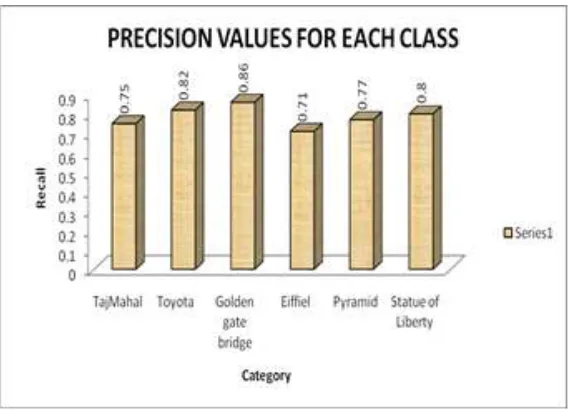
Recall Values For Each Class Category ID Category Recall
1 2 3 4 5 6 TajMahal Toyota Golden gate bridge
Eiffiel Pyramid Statue of Liberty
0.75 0.82 0.86 0.71 0.77 0.80
Fig. 2.8: Retrieval average recall of the proposed approach.
III. CONCLUSION AND FUTURE SCOPE
In contrast to conventional approaches that are based on visual features, our method will be provide an interactive mechanism to bridge the gap between the visual features and the human perception. The color distributions, the mean value, the standard deviation, and image bitmap are used as color information of an image. In addition, the entropy based on the GLCM and edge histogram are considered as texture descriptors to help characterize the images. In particular, the IGA has to be implement which can be considered and used as a semi automated exploration tool with the help of a user that can navigate a complex universe of images. Experimental results of the proposed approach have shown the significant improvement in retrieval performance. A very good average retrieval precision of about 88% and average recall rate of about 78% is achieved using the proposed CBIR system. Further work include implementing the CBIR system considering more low-level image descriptors high-level semantics in the proposed approach is in progress ,which might prove to be very fast and precised one.
REFERENCES
[1] Chih-Chin Lai, Ying Chuan Chen, “A User-Oriented Image Retrieval System Basedon Interactive Genetic Algorithm,” IEEE Transactions on Instrumentation And Measurement, Vol. 60, No. 10, October 2011.
[2] Santhosh P. Mathew, Valentina E. Balas, Zachariah K. P. “A Content-based Image Retrieval System Based on Polar Raster Edge Sampling Signature”, Springer, Vol. 11, No. 3, 2014.
[3] ArvindNagathan,Manimozhi, JitendranathMungara“Content-Based Image Retrieval System using Feed- Forward Back propagation Neural Network”, IJCSNS, Vol.14 No.6, June 2014.
[4] Anita NanasahebLigade,Manisha R. Patil“Optimised Content Based Image Retrieval Using Genetic AlgorithmWith Relevance Feedback Technique”(IJCSEITR) ISSN 2249-6831 ,Vol. 3, Issue 4, Oct 2013, 49-54
[5] S.Selvam,S.Thabasukannan“Design of an Architecture for Optimizing Image Retrieval by using GeneticAlgorithm”(CAE),ISSN : 2394-4714 Vol. 1, Jan-2015
[6] N. Jhanwar, S. Chaudhuri, G. Seetharaman, and B. Zavidovique, “Content based image retrieval using motif Co-occurrence matrix,” Image is.Comput, vol. 22, no. 14, pp. 1211–1220, Dec. 2004.
[7] X. S. Zhou,T. S. Huang,“Relevance feedback in content-based image retrieval: Some recent advances,” Inf. Sci.,vol.148, no.1–4, pp. 129–137,Dec. 2002. [8] A. W. M. Smeulders, M. Worring, S. Santini, A. Gupta, and R. Jain,“Content-based image retrieval at the end of the early years,” IEEE Trans.Pattern Anal.
Mach. Intell., vol. 22, no. 12, pp. 1349–1380, Dec. 2000.
[9] S. Antani, R. Kasturi, and R. Jain, “A survey of the use of pattern recognitionmethods for abstraction, indexing and retrieval of images and video,”Pattern Recognit., vol. 35, no. 4, pp. 945–965, Apr. 2002.
[10] X. S. Zhou and T. S. Huang, “Relevance feedback in content-based image retrieval: Some recent advances,” Inf. Sci., vol. 148, no. 1–4, pp. 129–137,Dec2002. AGPCE CSE 2015-16
[11] H.-W. Yoo, H.-S. Park, and D.-S. Jang, “Expert system for color image retrieval,” Expert Syst. Appl., vol. 28, no. 2, pp. 347–357, Feb. 2005.
[12] T.-C. Lu and C.-C. Chang, “Color image retrieval technique based on color features and image bitmap,” Inf. Process. Manage., vol. 43, no. 2, pp. 461–472, Mar. 2007.
[13] A. Vadivel, S. Sural, and A. K. Majumdar, “An integrated color and intensity co-occurrence matrix,” Pattern Recognit. Lett., vol. 28, no. 8, pp. 974–983, Jun. 2007.
[14] M. H. Pi, C. S. Tong, S. K. Choy, and H. Zhang, “A fast and effective model for wavelet subband histograms and its application in texture image retrieval,” IEEE Trans. Image Process., vol. 15, no. 10, pp. 3078–3088, Oct. 2006.
[15] M. Kokare, P. K. Biswas, and B. N. Chatterji, “Texture image retrieval using new rotated complex wavelet filters,” IEEE Trans. Syst., Man, Cybern. B, Cybern., vol. 35, no. 6, pp. 1168–1178, Dec. 2005.
[16] M. Antonelli, S. G. Dellepiane, and M. Goccia, “Design and implementation of Web-based system for image segmentation and CBIR,” IEEE Trans. Instrum. Meas.,vol. 55, no. 6, pp. 1869–1877, Dec 2006.
[17] J. Han, K. N. Ngan, M. Li, and H.J. Zhang, “A memory learning framework for effective image retrieval,” IEEE Trans.ImageProcessing,vol. 14, no. 4, pp. 511–524, Apr. 2005.
[19] Miguel Arevalillo-Herraez, Francesc J. Ferri, Salvador Moreno-Picot “An interactive evolutionary approach for content based image retrieval”Proceedings of the 2009 IEEE International Conference on Systems, Man, and Cybernetics San Antonio, TX, USA - October 2009.
[20] Mehwish Rehman, Muhammad Iqbal, Muhammad Sharif and MudassarRaza“Content Based Image Retrieval: Survey” World Applied Sciences Journal 19 (3): 404-412, 2012,ISSN 1818-4952.
[21] Y. Liu, D. Zhang, G. Lu, and W.Y.Ma, “A survey of Content based image retrieval with high-level semantics,” Pattern Recognit., vol. 40,no. 1,pp. 262–282, Jan. 2007.
[22] Devyani P. Bhamare, Swati A. Abhang“Content Based Image Retrieval: A Review”International Journal Of Computer Science And Applications Vol. 8, No.2 , Apr‐June 2015.
[23] H.W. Yoo, H.S. Park, and D.S. Jang, “Expert system for color image retrieval,” Expert Syst. Appl., vol. 28, no. 2, pp. 347–357, Feb. 2005.
[24] S. Liapis and G. Tziritas, “Color and texture image retrieval using chromaticity histograms and wavelet frames,” IEEE Trans. Multimedia, vol. 6,no. 5, pp. 676–686, Oct. 2004.
[25] T.C.Lu, C.C. Chang, “Color image retrieval technique based on color features and image bitmap,” Inf. Process. Manage., vol. 43, no. 2,pp. 461–472, Mar. 2007.
[26] S.-B. Cho, “Towards creative evolutionary systems with interactive genetic algorithm,” Appl. Intell., vol. 16, no. 2, pp. 129–138, Mar. 2002.
[27] A. Vadivel, S. Sural, and A. K. Majumdar, “An integrated color and intensity co-occurrence matrix,”PatternRecognitLett., vol. 28, no. 8,pp. 974–983, Jun. 2007.
[28] M. H. Pi, C. S. Tong, S. K. Choy, and H. Zhang, “A fast and effective model for wavelet subband histogram and its application in texture image retrieval,” IEEE Trans. Image Process., vol. 15, no.10, pp. 3078–3088,Oct. 2006.
[29] S. Shi, J.-Z. Li, and L. Lin, “Face image retrieval method based onimproved IGA and SVM,” in Proc. ICIC, vol. 4681, LNCS, D.-S. Huang,L. Heutte, and M. Loog, Eds., 2007, pp. 767–774.
[30] M. Kokare, P. K. Biswas, and B. N. Chatterji, “Texture image retrieval using new rotated complex wavelet filters,” IEEE Trans. Syst., Man, Cybern. B, Cybern.,vol. 35, no. 6, pp. 1168–1178,Dec.2005.
[31] M. Pi,H. Li, “Fractal indexing with the joint statistical properties and its application in texture image retrieval” IET Image Process., vol. 2,no. 4, pp.218– 230, Aug. 2008.
[32] S. Liapis,G. Tziritas, “Color and texture image retrieval usingchromaticity histograms and wavelet frames” IEEE Trans. s Multimedia, vol. 6,no. 5, pp. 676– 686, Oct. 2004.
[33] Y. D. Chun, N. C. Kim, and I. H. Jang, “Content-based image retrieval using multiresolution color and texture features,” IEEE Trans. Multimedia,vol. 10, no. 6, pp. 1073–1084, Oct. 2008.
[34] S.-F. Wang, X.-F. Wang, and J. Xue, “An improved interactive geneticalgorithm incorporating relevant feedback,” in Proc. 4th Int. Conf. Mach.Learn. Cybern., Guangzhou, China, 2005, pp. 2996–3001.
M. Arevalillo-Herráez, F. H. Ferri, and S. Moreno-Picot, “Distance-based