Standard Rules Based Approach to Classify
Phishing Websites
Pavan Kumar S.C, Anitha .G
M. Tech Student, Dept. of CSE, U.B.D.T College of Engineering, Davangere, India
Associate Professor, Dept. of CSE, U.B.D.T Engineering College, Davangere, India
ABSTRACT: Phishing is emphatically an empowering hacking munitions stockpile for any software engineer. Phishing is the endeavour to extricate the most significant data, forexample, passwords, username and MasterCard data by taking on the appearance of adependable element in an electronic correspondence. Here we use the Rules ofData mining approach to identify the individual features of the websites based on the generating a training dataset from all the features of various websites, We finally use the machine learning techniques tool to perform classification on the combinations of the features results.
KEYWORDS: Phishing, Legitimate Websites, Online Trading
I. INTRODUCTION
Phishing insinuates traps that try to trap customers into revealing individual information, for instance, money related equalization numbers, passwords, portion card numbers, or Social Security numbers. This attempt traps are harsh social building mechanical assemblies planned to influence caution in the pursuer. These traps attempt to trap recipients into responding or clicking instantly, by attesting they will lose something (e.g., email, money related parity). Such a case is always normal for a phishing trap, as tried and true associations and affiliations will never take these sorts of exercises through email. EBay and PayPal are two of the most centred around associations, and online banks are in like manner fundamental targets. Phishing is commonly done using email or content, and routinely directs customers to a site, disregarding the way that phone contact has been used too. Tries to deal with the creating number of reported phishing events join institution, customer get ready and concentrated measures.
Phishing is an email distortion procedure in which the guilty party passes on true blue looking email attempting to amass individual and budgetary information from recipients. Frequently, the messages appear to begin from comprehended and trustworthy Web districts.
One kind of phishing try is an email message communicating that you are getting it on account of beguiling development for you, and asking for that you "click here" to affirm your information.
Phishing traps are foul social building devices planned to instigate caution in the peruse. These traps attempt to trap recipients into responding or clicking rapidly, by ensuring they will lose something.
To make phishing messages show up just as they are really from a without a doubt comprehended association, they consolidate logos and other perceiving information taken clearly from that association's site.II. RELATED WORK
identify phishing sites utilizing the term-recurrence backwardsdocument frequency (TF-IDF) data recovery measures.TF-IDF produces weights thatsurvey the term significance to a record, by tallying its recurrence. A website page isviewed as honest to goodness on the off chance that it is incorporated into the N tops seeking results. N was set to 30 in the trialsthis approach is helpful in recognizing true legitimate locales. This approach fails because of lot mathematical calculations to bedone
.
In [9] Proposes on tentatively differentiating cooperative classification calculations, that is, Multi-class Classification , and Classification Based Association (CBA) in view of Association Rule (MCAR) with other conventional classification calculations (C4.5, PART and so on.). The researcher have assembled 26 unique elements from different sites and after that sorted them into 6 criteria in Table. To assess them chose highlights, the creators led tests utilizing the accompanying data mining procedures, MCAR, CBA, C4.5, PRISM, PARTand JRip .Later, in 2010, the creators utilized 27 components to construct a model in light of fluffy rationale. In addition, the principles were built up based on human experience, which is one of the issues we plan to determine in our undertaking. Besides, the site was classier into five unique classes that is, (extremely real, real, suspicious, phishy and exceptionally phishy), yet the creators did not clear up what is the fine line that separates between these classesThe outcomes demonstrated an essential connection between 'Area Identity' and "URL" highlights. There was insignificient impact of the 'Page Style' on 'Social Human Factor' related component. Despite the fact that this is a promising arrangement, it neglects to elucidate how the elements were separated from the site, absolutely highlights identified with human-variables.In [1]proposed new approach for classification Data mining is the extraction of the covered information from broad databases. It is a competent development with new fantastic potential to separate basic information in the dataconveyance focus. Protecting insurance against data mining figuring is another examination zone. It looks at the responses of data mining techniques that induce from the insurance spread of persons and affiliations. Insurance shielding data mining is thecreating field that secures sensitive data. Request is one of the standard procedures of datamining. Request is a data mining strategy used to expect bundle enlistment for data cases. Game plan incorporates finding chooses that bundle the data into disjoint social occasions.A classification rule is a strategy in which the segments of the people set are each delegated to one of the classes. A gathering standard or classifier is a limit that can be evaluated for any possible regard especially given the data it will yield a similar portrayal. In a twofold request, the segments that are not viably gathered are named false positives and false negatives.
III.PROPOSED ALGORITHM
A. Design Considerations:
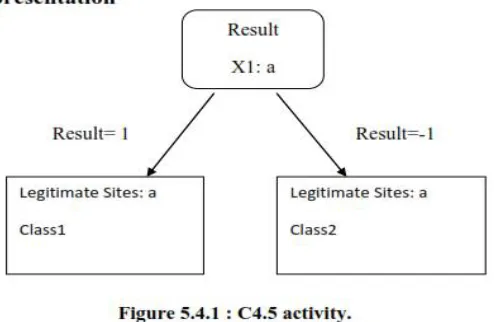
Generally the C4.5 algorithm is used for invariant decision trees generation, but in ourconcept we are using C4.5 to classify the two different types of websites using a training dataset, how it is classified and results are shown according to our class of work done to classification. The implementation of the C4.5 is done using the WEKA using the Ruleset Generation performs using this Waikato university tool. The process of results are handled by C4.5 for identifying Phish and legitimate websites is demonstrated so it is called Rules based text Categorization technique.It is similar approach to ID3 algorithm that is to classify the training dataset according to normalized final results in the examples in the dataset. The higher level task of Rules generalisation is done using Waikato university tool of WEKA to show the results of activities performed by C4.5.
B. Description of the Working Nature:
How actually select the websites is done using the Phistank website, this website helps intrack of various websites of phishing and legitimate websites are obtained by search in Google. Each of the websites is observed with their nature to identify features to classify. Initially the collection of different features is done for generating the sample dataset by using online information in website database of ALEXA and WHOIS database useful in providing information about the Address bar features, Abnormal features andDomain features are obtained; finally the webpage features are extracted using JavaScript.
help of weka tool we will picture the analysis ofthese website database of how many websites are correctly classified and how many of them are incorrectly classified using rules of data mining approach.
C4.5 program use to take the set of input data labelled according to requirement is takenand generates output using the Ruleset generated, the resultant values are again tested for quantify its classification approach. It is important to note that C4.5 algorithm is an extension towards development of ID3 algorithm presently most of them use this Standard Rules Based Approach To Classify Phishing Website approach in classification techniques there is also one more name to C4.5 is called as aStatistical classifier.
IV.PSEUDO CODE
Step 1: Base cases are identified on which classification starts. Step2: For each attribute say a.
2.1 identifying the normalized information got from splitting of an attribute. Step3: Let a_ best of the attributes highest normalized information gained.
Step4: Creates a decision node to splits about the best one.
Step5: recursively on the sub lists are generated with the splitting on a_ best node, and also add these nodes as children. Step6: End
V. EXPERIMENTAL RESULTS
confusion matrix about the results of two kinds of sites and the incorrectly identified sites numbers are show clearly with error pointers.
The Figures shown below describe the flow of the project idea, Figure1 is the idea of developing a training dataset based on the websites data collected from the internet source, and with help of this source we classify the different types of sites. Figure2 is the whole idea flow of working the training data generated is shown the websites taken to collect various information regarding sites details later on the collected data is processed as shown in first diagram, finally results are combined to execute the classification process. Figure3 depicts the user interface of machine learning tool , and also there is loaded dataset can be observed in the picture. Last diagram Figure4 showing the final result outcomes from the execution using the C4.5 algorithm results of classification information about legitimate and phishing sites
Fig1.Pre-processing Results Fig2. System Architecture
VI.CONCLUSION AND FUTURE WORK
Here presented a System of classification websites into two categories of phishing andlegitimate websites through the various features collected from internet source, and analysing these features to decide the type of website and combing these results of websites identification for further classification. As shown in performance test, here two algorithms are used are Ripper and C4.5 are for classification of websites and analysing the accuracy of these two algorithms ability to correctly classifying the nature of websites is identified. One challenge of this system is to combining to two parts that is identification and classification, the technology advancement helps us to collect the required information through online sites and analysing them and has to perform classification also by itself for further activities, so it useful to develop a tool like this identify the nature websites before you go on accessing them, it will be useful for general user.
REFERENCES
1. S.Vijayarani, M.Divya, an Efficient Algorithm for Classification Rules/ijcst/Vol.2, ISSue4,oCT.- DeC.2011
2. PhishTank. [Cited 2011 November 25]. Available at: http://www.phishtank.com/, 2006
3. Alexa the Web Information Company. [Cited 2012 January 26]. Available at:Http://www.alexa.com/
4. Hall, M., Frank, E., Holmes, G., Pfahringer, B., Reutemann, P., Witten,I.H.: ‘Waikato Environment for Knowledge Analysis’, available
from:http://www.cs.waikato.ac.nz/ml/weka/
5. WhoIS. Available at: http://www.who.is/
6. Aburrous, M., Hossain, M.A., Dahal, K., Fadi, T.: ‘Predicting phishingwebsites using classification mining techniques’. Proc. Seventh Int.
Conf. Information Technology, Las Vegas, Nevada, USA, 2010,pp. 176–181
7. yahoo Directory. Available at: http://www.dir.yahoo.com/
8. Rasmussen, R., Aaron, G.: ‘Global phishing survey: trends and domainname use 2H2009 [Survey]’, Lexington, available at:
http://www.antiphishing.org/reports/APWG_GlobalPhishingSurvey_2H2009.pdf,2010
9. Pan, Y., Ding, X.: ‘Anomaly based web phishing page detection’. Proc. 22nd Annual Computer Security Applications Conf. (ACSAC’06),
December 2006, , pp. 381–392