A Model to Simulate the Interaction between Groundwater and Surface Water S. E. Howington, R. C. Berger, J. P. Hallberg, J. F. Peters, and A. K. Stagg
U.S. Army Engineering Research and Development Center Waterways Experiment Station
Vicksburg, MS
E. W. Jenkins and C. T. Kelley
Center for Research in Scientific Computation and Department of Mathematics North Carolina State University
Raleigh, NC
Abstract
A numerical model is being constructed to simulate the movement of water and
constituents within a coupled groundwater and surface water system. The model is designed to run on all DoD HPC platforms. Local mesh refinement and coarsening and
domain-decomposition preconditioners have been integrated into the model. The model has been exercised successfully on several test problems. Presently, the model is being applied to an instrumented watershed.
Scientific Problem
The Department of Defense (DoD) is required to assess the environmental impact of its activities at both present and formerly used facilities. When warranted, the DoD must enact remedial measures to address environmental problems. The potential costs associated with environmental remediation at DoD sites is staggering. In addition to the cost of remediation, the DoD risks reduced or prohibited access to its training facilities unless environmental concerns are addressed adequately. For these reasons, accurate environmental assessments and effective remedial designs are essential.
Technical Approach
The ADH (ADaptive Hydrology) groundwater model, constructed at the Engineering Research Development Center (ERDC), is being extended for use as the model foundation. Knowledge gained through the creation of the HIVEL2D surface-water model, also at the ERDC, is helping develop a new surface water modeling capability within the ADH framework. The new model is named SWGW.
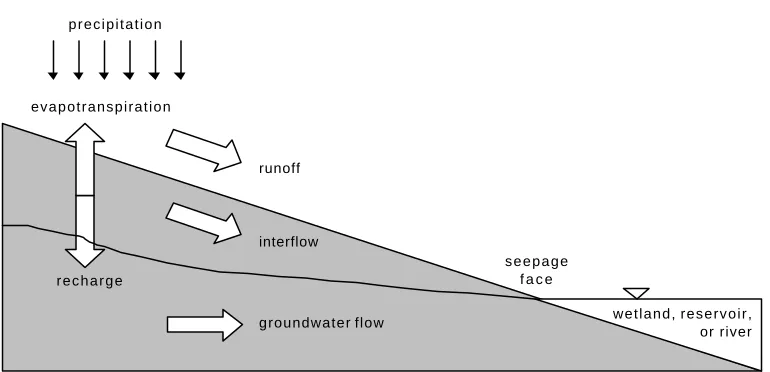
SWGW couples three-dimensional, unsaturated groundwater modeling to two-dimensional, shallow water modeling at the surface. Previous attempts to account for the interaction of groundwater and surface water have linked a saturated groundwater flow model with an overland flow model through a one-dimensional (vertical) representation of the
unsaturated zone. Such a one-dimensional unsaturated flow interface typically uses a simplified depiction of the unsaturated flow as wet-dry interface propagation or, even simpler, as a homogenized-volume represented by a constitutive equation. The SWGW model is a technical advance because it maintains full three-dimensionality in the unsaturated zone, permitting the simulation of perched aquifers, inter-formation flow (lateral flow in the unsaturated zone), and infiltration processes in heterogeneous systems. The drawback in taking this approach is the large computational effort required.
Brief Model Description
SWGW approximates the solution to the Richards equation for groundwater flow and the diffusive wave equation for surface water flow. The Richards equation is a combined water balance and momentum equation for saturated and partially saturated soil. This equation is non-linear because some of the coefficients (saturation and relative permeability) depend on the unknown head. The diffusive wave equation for overland flow arises by neglecting the acceleration terms in the full St. Venant equations (for example, Singh, 1996).
Finite elements are used to discretize the domain. The approximation is piecewise linear in space and piecewise constant in time. Groundwater flow is solved in three dimensions using tetrahedra. The diffusive wave equation is approximated on triangles that comprise a surface of the three-dimensional groundwater flow mesh. Nodes located on the overland flow face are dual valued, with an overland flow head and a groundwater head. The two flow regimes communicate through boundary fluxes computed at the surface of the groundwater system. By communicating only through fluxes, the model avoids a problem found in other models coupling groundwater and surface water. Many of these models switch boundary conditions, using Dirichlet (head) boundaries when the depth in the surface water is non-zero, and Neumann (flux) boundaries for recharge when the surface water has zero depth. Presently, the two flow regimes update their fluxes only at each time step. As model testing proceeds, it may be necessary to enforce this communication at each non-linear iteration.
Mesh Refinement/Coarsening
surface water system, or a contamination front in either system, for example. Capturing these phenomena with a fixed-mesh model would require extremely fine mesh resolution throughout the domain. Such resolution is not practical for many problems and is not efficient use of resources for most problems. For these reasons, the SWGW model uses local mesh
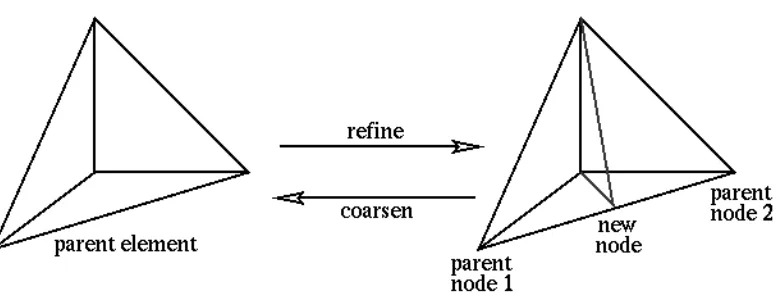
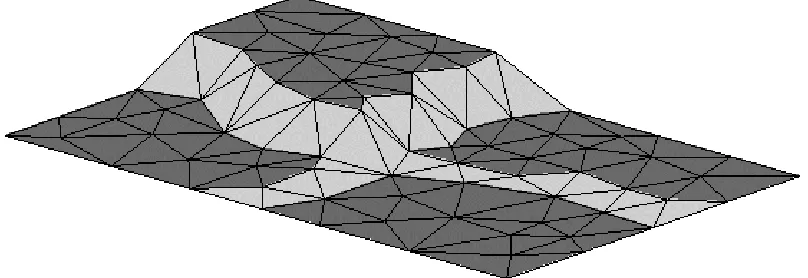
refinement and coarsening to add and delete resolution, as needed, to capture steep gradients. Splitting or merging elements is based on an explicit error indicator. Presently, the model uses an inexpensive, gradient-based indicator, but more accurate (and costly) indicators (Schmidt, 1997) are available in the model. Elements slated for refinement are divided using the edge bisection scheme by Liu and Joe (1995) (Figure 2). Edges are ranked by the refinement level of its nodes and by their length. The ‘oldest’ edge in an element is split first. If all elements are the same ‘age’, the longest edge is split first.
Parallelization
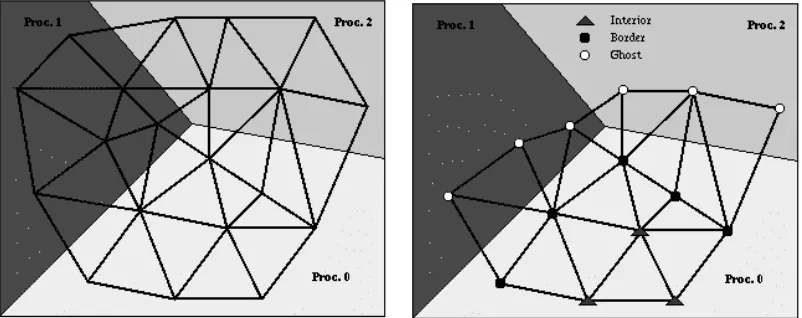
SWGW has been constructed to take advantage of parallel computer architectures. The domain is subdivided in a data parallel scheme shown by a simple example in Figure 3. Nodes are distributed to processors uniquely. Elements that fall on processor boundaries are shared. Ghost nodes are created for those nodes that reside off processor, but contribute to a shared element. Border nodes are on-processor, but are seen as ghost nodes by another processor. Thus, border nodes must communicate information with other processors.
Processor partitions generally will contain elements that are spatially adjacent to each other because this tends to minimize inter-processor communication. Therefore, as the mesh is refined locally near a large gradient, a majority of the additional elements and nodes can be created on only a few processors. Thus, local mesh adaption creates an inherent workload imbalance among the processors. Periodic repartitioning is needed to maintain the load balance for the dynamic system. Mesh refinement occurring on one processor must be communicated to other affected processors.
Inter-processor communication is handled with the standard Message Passing Interface (MPI) libraries to ensure the model=s portability among many HPC machines. Thus far, the model has been run on the Cray T3E, IBM SP, and SGI Origin 2000 at the Major Shared Resource Center in Vicksburg.
Matrix Preconditioners
inexact Newton’s method is used to linearize the problem. Thus, a linear system must be solved for each Newton iteration and several Newton iterations may be required for each time step.
A general concern exists with the solution of these large linear systems. The number of iterations required to solve the system grows with problem size for most schemes. Therefore, the work required for matrix assembly, etc. increases linearly with the number of processors, but the work required to solve the system can grow more rapidly. With clever preconditioning of the linear system, this growth in the number of iterations can be dramatically reduced (Tompson et al, 1994).
A domain-decomposition approach was chosen to precondition the linear system because these are well suited for parallel implementation. When these subdomains are overlapping, these are known as Schwarz preconditioners. The preconditioner options in SWGW are:
• Point Jacobi
• One-level Additive Schwarz
• Two-level Additive Schwarz
• Two-level Hybrid Schwarz
Point Jacobi preconditioning makes no use of domain decomposition. The remaining
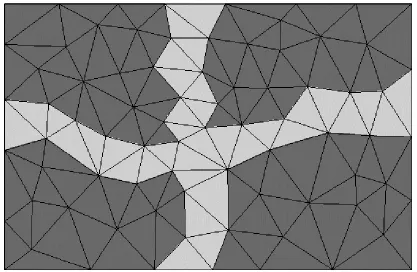
preconditioners divide the domain into overlapping subdomains. Figure 4 shows a sample fine mesh and four subdomains.
One-level additive Schwarz is simply a block Jacobi preconditioner. A fine-mesh solve on each subdomain is followed by an interpolation back to the full preconditioning matrix. To extract each subdomain from the larger system, one must assume boundary condtions. Zero Dirichlet boundary conditions are used on the subdomain boundaries. Two-level additive Schwarz schemes add a full-domain coarse mesh solve to the subdomain solves. Basis functions for the fine mesh elements are summed to create a single basis function for that subdomain (Jenkins et al, in preparation). This summed basis function for one of the four subdomains in the sample mesh is shown in Figure 5. The coarse problem consisting of a single matrix entry per subdomain is solved. Parallelizing the coarse mesh is not yet required because each processor can perform the coarse solve independently. The two-level additive and two-level hybrid schemes combine the fine and coarse mesh information differently. This domain decomposition approach is, effectively, a simple, multigrid preconditioner on an unstructured mesh, without the complexity of creating, maintaining, and parallelizing multiple, nested, meshes.
Application
The SWGW model has been applied to several example problems and application to a field site is underway. Among the example problems are drainage through a heterogeneous soil column and rainfall/runoff in a simple test basin. The column problem is intended to demonstrate the model’s capabilities in simulating drainage in heterogeneous soil. The simple test basin is being used to explore the fluxes across the ground surface and evaluate the performance of the overland flow model.
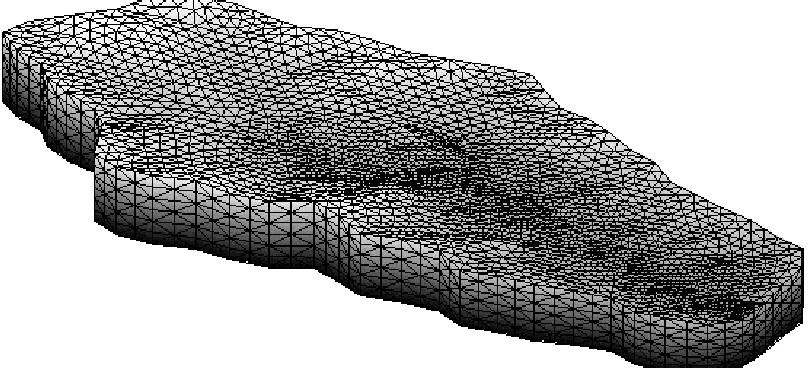
basin at Camp Shelby near Hattiesburg, MS has been studied extensively. The numerical mesh to be used in the initial simulations for this field site is shown in Figure 6. Rain will be applied to the surface and flux in the creek will be compared to measured discharge.
Additional Benefits
This work was motivated by the need to simulate the interaction between groundwater and surface water. However, by adopting a strategy that attaches problem-specific routines (groundwater flow equations and overland flow equations) to a single, computational engine, several software development and maintenance advantages have become apparent. The computational engine contains matrix solvers, mesh adaption routines, generic finite element routines, and parallel communication routines. These difficult and time-consuming parts of the code remain virtually unaffected by many changes to the groundwater or surface water routines.
Another major issue with a development of this magnitude is code maintenance. If written in a modular fashion, a single code may perform simulations for groundwater, surface water, or coupled systems with little overhead penalty. Therefore, this code may circumvent the need to maintain individual codes, which often contain similar modules. By sharing related modules, advancing capabilities are kept in step for each of the potential applications. Our hope for the future is to extend the model to include other components of the hydrologic system. The difficulty lies in keeping the code at a manageable size and in keeping the components
sufficiently modular to permit enhancements and maintenance.
Status and Plans
The SWGW model presently solves coupled groundwater and surface water flow using a diffusive wave approximation for overland flow. The model is being tested against simple problems for which analytical approximations are possible and against data from instrumented watersheds. Plans exist to upgrade the surface water model to solve the full shallow water equations. A method to handle canals efficiently in one dimension will be explored. A constituent flux will be added at the boundary between the flow regimes to accommodate constituent transport between surface and subsurface waters.
Because the mesh partitioning among subdomains (not simply among processors) defines the coarse mesh for the Schwarz preconditioner, the partitioning scheme deserves careful study. Preliminary simulations indicate that the convergence rate is sensitive to the shape of these subdomains. Likewise, there is a delicate balance when choosing the number of subdomains. Having too many subdomains creates a very large coarse mesh problem, while too few subdomains requires the solution of large problems for each subdomain.
Funding for this effort is provided by the DoD High Performance Computing Modernization Office through the Common High-performance Software Support Initiative (CHSSI). The Army Research Office is funding solver research at North Carolina State University that is directly benefiting this development. Permission was granted by the Chief of Engineers to publish this information.
References
Howington, S. E., Peters, J. F., Illangasekare, T. H., and R. S. Maier (1997) “Discrete Network Modeling for Field Scale Flow and Transport Through Porous Media,” Technical Report 97-21, Waterways Experiment Station, Vicksburg, MS.
Jenkins, E. W., Schmidt, J. H., Stagg, A. R., Howington, S. E., Berger, R. C., Hallberg, J. P., Kelley, C. T., and M. D. Tocci, “Newton- Krylov-Schwarz Methods for Hydrology,” in preparation.
Kelley, C. T. (1995) Iterative Methods for Linear and Nonlinear Equations, no. 16 in Frontiers in Applied Mathematics, SIAM, Philadelphia.
Liu, A. and B. Joe (1995) “Quality Local Refinement of Tetrahedral Meshes Based on Bisection.” SIAM Journal of Scientific Computing, 16(6), pp. 1269-1291.
Schmidt, J. H. (1995) A 3-D Adaptive Finite Element Method for Transport Processes, Master’s Thesis, The University of Texas at Austin, Austin, TX.
Singh, V. P. (1996) Kinematic Wave Modeling in Water Resources, Surface Water Hydrology. John Wiley and Sons, New York.
Tompson, A. F. B. and L. W. Gelhar. (1990) “Numerical Simulation of Solute Transport in Three-Dimensional, Randomly Heterogeneous Porous Media.” Water Resources Research, 26(10), pp. 2541-2562.
Tompson, A. F. B., Ashby, S. F., Falgout, R. D., Smith, S. G., Fogwell, T. W., and G. A. Loosmore. (1994) “Use of High Performance Computing to Examine the Effectiveness of Aquifer Remediation”. In Proceedings of the X International Conference on
p r e c i p i t a t i o n
r e c h a r g e
runoff
interflow
s e e p a g e f a c e
wetland, reservoir, or river evapotranspiration
groundwater flow