PLEASE SCROLL DOWN FOR ARTICLE
This article was downloaded by: [North Carolina State University]On: 26 May 2009
Access details: Access Details: [subscription number 783677828] Publisher Taylor & Francis
Informa Ltd Registered in England and Wales Registered Number: 1072954 Registered office: Mortimer House, 37-41 Mortimer Street, London W1T 3JH, UK
Molecular Physics
Publication details, including instructions for authors and subscription information: http://www.informaworld.com/smpp/title~content=t713395160
An efficient procedure for the study of inhomogeneous liquids
F. Lado aa Department of Physics, North Carolina State University, Raleigh, NC 27695-8202, USA
First Published:February2009
To cite this Article Lado, F.(2009)'An efficient procedure for the study of inhomogeneous liquids',Molecular Physics,107:4,301 — 308 To link to this Article: DOI: 10.1080/00268970802603531
URL: http://dx.doi.org/10.1080/00268970802603531
Full terms and conditions of use: http://www.informaworld.com/terms-and-conditions-of-access.pdf This article may be used for research, teaching and private study purposes. Any substantial or systematic reproduction, re-distribution, re-selling, loan or sub-licensing, systematic supply or distribution in any form to anyone is expressly forbidden.
INVITED ARTICLE
An efficient procedure for the study of inhomogeneous liquids
F. Lado*
Department of Physics, North Carolina State University, Raleigh, NC 27695-8202, USA
(Received 20 October 2008; final version received 31 October 2008)
A complete description of an inhomogeneous fluid requires knowing not only its density(r) at any pointrin space, but also its pair distribution functiong(r1,r2). These can be found from coupled integral equations, but
even in cases with homogeneity in two of the three dimensions, such solutions in direct space are cumbersome enough to have earned the task a reputation as ‘computationally intensive’. Here we propose using purpose-built basis functions that are orthogonal with weight function(r) to expedite the work. We find that these not only produce a satisfying simplification of the formalism, but also reduce the computing effort needed to something on the order of 1% of that of the earlier calculations in direct space.
Keywords: inhomogeneous liquids; integral equations; Ornstein–Zernike equation; special orthogonal polynomials
1. Introduction
A complete description of an inhomogeneous fluid requires knowing not only its density(r) at any pointr in space, but also its pair distribution functiong(r1,r2)
describing the spatial correlation of two fluid particles at locations r1and r2. By the definition of
inhomoge-neous, this latter quantity is no longer just a function of
r12¼ jr1r2j and therein lies the special challenge of
solving Ornstein–Zernike (OZ) type integral equations for such systems. In many cases, the symmetry of a specific system will allow the general inhomogeneous OZ equation [1],
hðr1,r2Þ ¼cðr1,r2Þ þ Z
dr3hðr1,r3Þðr3Þcðr3,r2Þ, ð1Þ
to be partially deconvoluted using an integral transform, leaving a final one-dimensional integral unevaluated. (Here h(r1,r2)¼g(r1,r2)1 is the
inho-mogeneous pair correlation function and c(r1,r2) the
inhomogeneous direct correlation function effectively defined by the OZ equation.) Written in discrete form on a finite grid with summation replacing integration, this final equation for the transforms can then be interpreted as a matrix problem in direct space and solved accordingly. This usually entails a large number of spatial grid points and so the inhomogeneous liquid problem has acquired a reputation as computationally intensive (by integral equation standards, leaving aside simulation). In this note, for the Festschrift on the occasion of Jean-Jacques Weis’ retirement, we describe
how the remaining integral can also be analytically evaluated and the OZ equation reduced to an algebraic relation among expansion coefficients alone, just as for homogeneous molecular liquids, with an attendant sharp reduction in computing effort. This simplifica-tion is accomplished by the construcsimplifica-tion of tailored functions designed to be orthogonal with weight function(r).
The inhomogeneous OZ equation, coupled with an exact relation between the one-body and two-body functions (described below), was first solved for fluids in contact with a single hard wall by Sokolowski [2,3] and by Plischke and Henderson [4,5]. Liquids between two parallel walls (a planar slit) have been extensively and elegantly studied by Kjellander and Sarman [6–9]. These works all use a Hankel transform to eliminate two of the three integrals in the inhomogeneous OZ equation. Attard [10] has shown how the two angular integrals can be eliminated using a Legendre transformation for fluids with spherical inhomogene-ity. A clever application is then created by letting the spherical inhomogeneity arise from a fluid particle fixed at the origin of coordinates, so that an n-body distribution function in the inhomogeneous liquid becomes an (nþ1)-body distribution function in the original homogeneous system. Familiar approxima-tions now made at the nominal two-body level produce far better results [11–14] than when made at the conventional two-body level in a homogeneous formulation.
*Email: [email protected]
ISSN 0026–8976 print/ISSN 1362–3028 online ß2009 Taylor & Francis
DOI: 10.1080/00268970802603531 http://www.informaworld.com
In the next section, we describe a procedure that eliminates the surviving one-dimensional integral that complicates the task in the works cited above and finally converts the OZ equation into a purely alge-braic expression for the expansion coefficients alone. For specificity, we use the language of a planar slit; revising the notation for other geometries is straight-forward. Applications of the procedure are left to later works.
2. Reducing the OZ equation to algebra
A planar slit of width L is allowed to have indefinite wall extent so no boundary conditions are needed in the plane of the walls. The inhomogeneity then occurs perpendicular to the wall planes, which we denote conventionally as the zdirection. The density is now a one-dimensional function, (z), and pair functions such as h(r1,r2) can be described using coordinates
R12[(x1x2)2þ(y1y2)2]1/2, z1, and z2: thus,
h(r1,r2)¼h(R12,z1,z2), etc. The OZ equation now
reads
hðR12,z1,z2Þ ¼cðR12,z1,z2Þ þ Z L=2
L=2
dz3ðz3Þ
Z
dR3hðR13,z1,z3ÞcðR32,z3,z2Þ: ð2Þ
The first step in simplifying this equation is to use the homogeneity of the pair functions in the R plane to deconvolute it with a Hankel transform [2–9]:
^
hðK,z1,z2Þ ¼ Z
dRhðR,z1,z2ÞeiKR
¼2p
Z 1
0
dR R hðR,z1,z2ÞJ0ðKRÞ, ð3Þ
hðR,z1,z2Þ ¼ 1
ð2pÞ2 Z
dKh^ðK,z1,z2ÞeiKR
¼ 1
2p
Z 1
0
dK Kh^ðK,z1,z2ÞJ0ðKRÞ, ð4Þ
where J0(x) is the Bessel function of order zero.
We then obtain
^
hðK,z1,z2Þ ¼c^ðK,z1,z2Þ
þ ZL=2
L=2
dz3ðz3Þh^ðK,z1,z3Þc^ðK,z3,z2Þ,ð5Þ
with one remaining integral. This is the version of the OZ equation that all earlier papers have used. In practice, of course, the equation must be solved on a finite grid of points on the zaxis. If we use Nz
points, their spacing isz¼L/(Nz1) and the discrete
version is
^
hijðKÞ ¼c^ijðKÞ þ
X
Nz=2
k¼Nz=2
zkh^ikðKÞc^kjðKÞ, ð6Þ
wherej¼(zj),hˆij(K)¼hˆ(K,zi,zj), etc., with zj¼jz.
A more symmetric version of the equation can be obtained by multiplying through with (ij)1/2. In any
case, one now has a matrix equation that can be manipulated using standard matrix techniques. Since a large number of grid points is generally needed for an accurate numerical representation, the result is a calculation that is often deemed to be ‘computation-ally intensive’.
The usual remedy for this sort of problem is an expansion of thezdependence in orthogonal functions, with the critical expectation that far fewer expansion coefficients will be needed than grid points on the z
axis. Here that would ordinarily mean expansions in plane waves (using periodic boundary conditions),
EmðzÞ eimð2pz=LÞ
¼Tm½cosð2pz=LÞ þiVm½cosð2pz=LÞ, ð7Þ
wheremis a positive or negative integer. (For brevity, we will put
cosð2pz=LÞ ð8Þ
in the remainder of this work.) We recognize here
Tm()¼cos[m(2z/L)] as the type I Chebyshev
poly-nomial of order m and Vm()¼sin[m(2z/L)] the
associated Chebyshev function (not a polynomial) of orderm[15]. The familiar exponential functionsEm(z)
of course have the orthonormalization
1
L ZL=2
L=2
dz EmðzÞEm0ðzÞ ¼mm0, ð9Þ
where the asterisk denotes complex conjugate, for m,
m0positive or negative integers. But if we now put into
Equation (5)
^
hðK,z1,z3Þ ¼ X1
m1,m3¼1 ^
Hm1m3ðKÞEm1ðz1ÞE
m3ðz3Þ, ð10Þ
and similarly forcˆ(K,z3,z2), the integral that turns up
is not Equation (9), but rather
1
L ZL=2
L=2
dzðzÞEmðzÞEm0ðzÞ,
and the invaluable property of orthogonality is lost. The essential proposal of this work is that one should simply replace the familiarEm(z) with specially
302 F. Lado
constructed basis functions Em(z) that are specifically
designed to be orthogonal with weight function (z). Preferring a dimensionless weight function, we define the mean density
¼1
L ZL=2
L=2
dzðzÞ, ð11Þ
and put ðzÞ ¼fðzÞ. Then the tailored orthogonal functions will be constructed to satisfy
1
L ZL=2
L=2
dz fðzÞEmðzÞEm0ðzÞ ¼mm0, ð12Þ
again form,m0positive or negative integers, whilef(z)
itself is normalized to unity,
1
L ZL=2
L=2
dz fðzÞ ¼1: ð13Þ
Now we may put
^
hðK,z1,z3Þ ¼ X1
m1,m3¼1 ^
hm1m3ðKÞEm1ðz1ÞE
m3ðz3Þ, ð14Þ
and similarly for cˆ(K,z3,z2), so that the OZ equation
finally becomes a relation among expansion coeffi-cients alone,
^
hm1m2ðKÞ ¼c^m1m2ðKÞ þL X1
m3¼1 ^
hm1m3ðKÞc^m3m2ðKÞ:
ð15Þ
We note that coefficients of all pair functions satisfy the symmetries
^
cm1m2ðKÞ ¼c^m2m1ðKÞ ¼c^m2m1ðKÞ ¼c^m1m2ðKÞ, ð16Þ
where m m. As usual, it is numerically preferable to eliminatehfrom the OZ equation and solve instead for the continuous ‘series’ function [16] s¼hc, for which we obtain
^
sm1m2ðKÞ ¼L X1
m3¼1
½s^m1m3ðKÞ þc^m1m3ðKÞc^m3m2ðKÞ:
ð17Þ
This is finally solved for the sˆm1m2(K); in matrix
notation,
^
SðKÞ ¼LC^ðKÞC^ðKÞ½ILC^ðKÞ1, ð18Þ
whereSˆ(K) andCˆ(K) are square matrices with elements
sˆm1m2(K) and cˆm1m2(K), respectively, and I is the unit
matrix. (Given the symmetries (16), only one-quarter
of the elements ofCˆ(K), etc., are unique.) The notable feature of Equation (18) is that it isidenticalto that of a homogeneous system. All of the inhomogeneity is built into the basis functions.
The construction of the tailored basis functions
Em(z),
EmðzÞ ¼ TmðÞ þiVmðÞ, ð19Þ
EmðzÞ ¼ EmðzÞ, ð20Þ
for m0, where Tm() and Vm() are the needed
generalized Chebyshev functions, is outlined in Section 4. We turn first to the relationship between
(z) and the pair functions.
3. Calculating the density profile
There are three exact equations that connect the one-body and two-body functions. Triezenberg and Zwanzig [17], Lovett et al. [18], and Wertheim [19] have shown that
d lnðz1Þ dz1
¼ dvextðz1Þ
dz1
ZL=2
L=2
dz2ðz2Þ
Z
dR2hðR12,z1,z2Þ
dvextðz2Þ dz2
¼ dvextðz2Þ
dz1
ZL=2
L=2
dz2ðz2Þh^ð0,z1,z2Þ
dvextðz2Þ
dz2
, ð21Þ
wherevext(z) is the external potential (here the walls of
the planar slit) and ¼(kBT) 1
the inverse Kelvin temperature, with kB Boltzmann’s constant.
Alternatively, passing through the OZ equation, this can be written as
d lnðz1Þ dz1
¼ dvextðz1Þ
dz1 þ
ZL=2
L=2
dz2
Z
dR2cðR12,z1,z2Þ dðz2Þ
dz2
¼ dvextðz1Þ
dz1 þ
ZL=2
L=2
dz2ðz2Þc^ð0,z1,z2Þ
d lnðz2Þ
dz2
: ð22Þ
The third exact equation is the first member of the Yvon–Born–Green hierarchy [20], which, for the sake of brevity, we will not examine here.
Becausef(z) is highly structured or even discontin-uous in the vicinity of the walls, we will solve for the
smoother and continuous combination f(z) exp[vext(z)]. We work first with Equation (21) and put
ln½fðzÞevextðzÞ ¼X 1
m¼0
AmTmðÞ, ð23Þ
^
hð0,z1,z2Þ ¼ X1
m1,m2¼1 ^
hm1m2ð0ÞEm1ðz1ÞE
m2ðz2Þ, ð24Þ
where we now seek to calculate the coefficients Am.
(Note that A0 is determined by normalization.)
We have for Equation (21),
X1
m¼1
Am dTmðÞ
dz ¼ X1
m1,m2¼1
h^m1m2ð0ÞEm1ðzÞ
ZL=2
L=2
dz0fðz0ÞEm2ðz0Þdvextðz
0Þ
dz0 : ð25Þ
Now multiply this equation by ði=LÞfðzÞEm0ðzÞ and integrate over z. Then again invoking the orthonorm-ality integral, Equation (12), we arrive at the simple matrix equation
X1
m¼1
Dm0mAm¼Hm0: ð26Þ
Here we have defined
Dm0m¼ 2
L ZL=2
0
dz fðzÞVm0ðÞ dTmðÞ
dz , ð27Þ
Hm0 ¼ L
X1
m¼1
½h^m0mð0Þ h^m0mð0Þ 2
L
ZL=2
0
dz fðzÞVmðÞ
dvextðzÞ
dz , ð28Þ
and have used symmetry to simplify the integrals and the summation in Equation (28). A final matrix inversion in Equation (26) yields the coefficients Am
for the logarithm of the density profile.
Equation (22) works out in a similar fashion, with an extra matrix multiplication at the end. Since we havef(z) exp[vext(z)] as our objective, we first add and
subtract vext(z2) under the derivative d/dz2 on the
right-hand side of (22). This gives
d dz1
ln½fðz1Þevextðz1Þ
¼ ZL=2
L=2
dz2fðz2Þc^ð0,z1,z2Þ
d
dz2
ln½fðz2Þevextðz2Þ
ZL=2
L=2
dz2fðz2Þc^ð0,z1,z2Þ
dvextðz2Þ dz2
: ð29Þ
Again expanding functions as in Equations (23) and (24), we now have
X1
m¼1
Am dTmðÞ
dz ¼ X1
m¼1 X1
m1,m2¼1
c^m1m2ð0ÞAmEm1ðzÞ
ZL=2
L=2
dz0fðz0ÞEm 2ðz
0ÞdTmð0Þ
dz0
X
1
m1,m2¼1
c^m1m2ð0ÞEm1ðzÞ
ZL=2
L=2
dz0fðz0ÞEm 2ðz
0Þdvextðz0Þ
dz0 , ð30Þ
which we once more follow with a multiplication by
ði=LÞfðzÞEm0ðzÞand integration overz. This yields
X1
m¼1 X1
m00¼1
½m0m00Lc^m0m00ð0ÞDm00mAm
¼ X
1
m00¼1
c^m0m00ð0Þ
ZL=2
L=2
dz fðzÞVm00ðÞ
dvextðzÞ dz : ð31Þ
Now put
Qm0m¼
X1
m00¼1
½m0m00Lc^m0m00ð0ÞDm00m, ð32Þ
Cm0¼ L
X1
m¼1
½c^m0mð0Þ c^m0mð0Þ
2
L ZL=2
0
dz fðzÞVmðÞ
dvextðzÞ
dz , ð33Þ
so that the Am are again found by a simple matrix
inversion, now of
X1
m¼1
Qm0mAm¼Cm0: ð34Þ
Using the OZ Equation (15), one can show that Equations (26) and (34) are identical. Calculating the
Amseparately from both could be useful as an internal
numerical check.
4. Constructing the orthogonal functions
The familiar procedure for constructing a new set of orthogonal functions from a given complete set is the Gram–Schmidt method [15]. Thus, starting with the standard polynomials Tm()¼cos[m(2z/L)], the first
three (unnormalized) new polynomials of that are orthogonal with weight function f(z) can be explicitly written as
p0ðÞ ¼1, ð35Þ
304 F. Lado
p1ðÞ ¼T1ðÞ 1p0ðÞ, ð36Þ
p2ðÞ ¼T2ðÞ
3212þ1
2221þ1
p1ðÞ 2p0ðÞ,
ð37Þ
where the
j¼
2
L ZL=2
0
dz fðzÞTjðÞ ð38Þ
are modified moments of f(z). For computer calcula-tions, however, each new application of these succes-sive subtractions reduces the numerical precision, so that, in practice, this method becomes unusable beyond a small number of new polynomials.
Here we follow instead a robust approach described by Press and Teukolsky [21], based on works of Sack and Donovan [22] and Wheeler [23]. The monic version of the Chebyshev polynomials
Tm(),m()¼Tm()/2m1form40, have by
construc-tion a leading coefficient of unity. With1()0 and
0()1, they satisfy a standard recursion relation,
mþ1ðÞ ¼ ðTmÞmðÞ Tmm1ðÞ,
m¼0, 1, 2,. . ., ð39Þ
with Tm¼0 for all m and T1 ¼1=2, Tm¼1=4 for
m41. The Press–Teukolsky algorithm then uses these monic coefficientsT
m,Tm along with the set
T j ¼
2
L Z L=2
0
dz fðzÞjðÞ, ð40Þ
or Tj ¼j=2j1 forj40, to recursively generate a new set of coefficientsamandbmsuch that, withP1()0
andP0()1, the monic polynomialsPm() generated
with these coefficients,
Pmþ1ðÞ ¼ ðamÞPmðÞ bmPm1ðÞ,
m¼0, 1, 2,. . ., ð41Þ
are orthogonal with weight function f(z). Thus to construct n polynomials Pm() for m¼1 through m¼n, we need the coefficients am, bm for m¼0
through m¼n1.
The key ingredient for this is the matrix [21]
kj¼ Pkjj
2
L Z L=2
0
dz fðzÞPkðÞjðÞ: ð42Þ
(Note thatkj¼0 fork4j.) It is clear that1,j¼0 for
alljand0j¼ Tj forj¼0,. . ., 2n1. Then the earlier recursions yield a recursion for thekj,
kj¼k1,jþ1þ ðjak1Þk1,j
þjk1,j1bk1k2,j, ð43Þ
for k¼1,. . .,n1 and j¼k,. . ., 2nk1. We set
a0¼0þ T1= T0 and b0¼0; then putting kþ1,k1¼0
andkþ1,k¼0 yields, respectively,
bk¼
kk
k1,k1
, ð44Þ
ak¼kþ
k,kþ1
kk
k1,k
k1,k1
, ð45Þ
for k¼1,. . .,n1, and the n monic polynomials
P1(),. . .,Pn() are determined by recursion,
Equation (41).
A final normalization yields the desired generalized Chebyshev polynomials,
T0ðÞ ¼1,
TmðÞ ¼
PmðÞ
½2hPmj Pmi1=2
, m¼1,. . .,n: ð46Þ
The algorithm further generates the roots1,2,. . .,n
ofTn()¼0 and the weightswjfor then-point Gauss–
Chebyshev quadrature,
2
L ZL=2
0
dz fðzÞFðÞ X
n
j¼1
wjFðjÞ: ð47Þ
The quadrature is exact if F() is a polynomial of degree less than or equal to 2n1, such as in Equation (27).
A similar procedure can now be followed for the generalizationUm() of type II Chebyshev polynomials Um() [15]. For this we need the corresponding monic
coefficients, U
m¼0 andUm¼1=4, for all m, and the modified moments
U j ¼
2
L ZL=2
0
dz fðzÞsin2ð2pz=LÞUjðÞ
2j : ð48Þ
It is easy to show that
U
0 ¼1=2 T 2, U
j ¼ Tj=4 Tjþ2, j40:
ð49Þ
The construction of theUm(), normalized to 1/2 with
weight functionf(z) sin2(2z/L), then follows precisely that of the Tm(), so we finally get the desired Vm()¼sin(2z/L)Um1().
By construction, then, these generalized Chebyshev functionsTm() andVm() satisfy
1
L Z L=2
L=2
dz fðzÞTmðÞTm0ðÞ ¼
1, m¼m0¼0,
1=2, m¼m06¼0,
0, m6¼m0, 8
> < > :
ð50Þ
1
L ZL=2
L=2
dz fðzÞVmðÞVm0ðÞ ¼
0, m¼m0¼0,
1=2, m¼m06¼0,
0, m6¼m0, 8
> < > :
ð51Þ
1
L ZL=2
L=2
dz fðzÞTmðÞVm0ðÞ ¼0, for allm,m0: ð52Þ
Collectively, Equations (50)–(52) give rise to the orthonormalization of Em(z) expressed in
Equation (12).
5. An illustration
In this section, we illustrate some practical details regarding the formal tailored polynomials discussed above. As noted earlier, actual applications will be left to later work.
For purposes of illustration we choose a system of hard spheres of diameterbetween parallel hard walls a distance Lapart [6,9]. The external potential is then
vextðzÞ ¼
0, jzj ðLÞ=2,
1, ðLÞ=25jzj L=2,
ð53Þ
so that the initial (non-interacting) density profile of the system is
fðzÞ ¼ L L H
L
2 þz
H L
2 z
, ð54Þ
whereH(x) is the Heaviside unit step function and the prefactor is chosen for normalization, Equation (13). In this case, we can calculate the needed T
j ¼
ð2=LÞR0L=2 dz fðzÞjðÞanalytically. We obtain T
0 ¼1, ð55Þ
T j ¼
Lsinðjp=LÞ jpðLÞ
1 2
j1
, j40, ð56Þ
and the appropriate Tm[cos(2z/L)] are then
con-structed following the recipe in Section 4.
We have arbitrarily chosen L¼5 for these calculations and show in Figure 1 the first four special polynomials T1(),. . .,T4() generated for this case
(omitting the trivial T0()¼1). They are seen to be
quite changed from the original constant-amplitude Chebyshev form, Tm()¼cos[m(2z/L)]. Similarly,
the corresponding first four generalizations of
Vm()¼sin[m(2z/L)], V1(),. . .,V4(), seen in
Figure 2, also display variable amplitudes, though of course they still vanish at the end points. Note that the integral common to both Equation (28) and (33) picks
up the values of these latter functions at the cutoff,
z¼(L)/2:
2
L ZL=2
0
dz fðzÞVmðÞ
dvextðzÞ dz
¼ 2
L ZL=2
0
dz fðzÞevextðzÞV
mðÞ
devextðzÞ
dz
¼2 L
ZL=2
0
dz fðzÞevextðzÞV
mðÞ z
L
2
¼ 2
L Vm cos
L
L p
: ð57Þ
It is clear from the earlier sections that the proce-dure proposed here at least yields a satisfying simpli-fication of the formalismused to solve the prescribed equations for a full description of an inhomogeneous fluid. The practical question, however, is whether it
−4 −2 0 2 4 6 8
−2 −1 0 1 2
Tm (z)
z/s
Figure 1. Tailored orthogonal polynomials T1(), T2(), T3(), T4() generalizing the ChebyshevTm()¼cos[m(2z/
L)] constructed for the rectangular (ideal) density profile of Equation (54) for slit widthL¼5; herecos(2z/L).
−2 −1 0 1 2
−2 −1 0 1 2
z/s
Vm (z)
Figure 2. Tailored orthogonal functionsV1(), V2(),V3(), V4() generalizing the Chebyshev Vm()¼sin[m(2z/L)] constructed for the rectangular (ideal) density profile of Equation (54) for slit widthL¼5; herecos(2z/L).
306 F. Lado
also produces a significant reduction in computing time for these solutions, perhaps even putting such calculations on a par with those of homogeneous systems. This is essentially a question of how the number of coefficients, sayn, used in an expansion like (23) compares with the number of grid points, say Nz,
needed for an equally good representation of the same function directly on the z axis. In a real calculation, Equation (23) would be used to find ln{f(z)exp[vext(z)]} from the calculated Am. Here we
are going to turn that around, create a realistic model of a continuous density profile on the z grid, and see how many coefficientsAmare required to reproduce it.
For the modeled density profile we turn to the Percus–Yevick (PY) equation for hard spheres [20]. Specifically, we start with the continuous function
gHS(r) exp[vHS(r)] that the PY equation produces at
3¼0.8 with a grid interval r¼0.02, cut out the section fromr¼0.5 tor¼3.0, and call that the left half of our modeled density profile, f0(z) exp[vext(z)],
over the intervalz¼ 2.5toz¼2.5withz¼0.02. Then we simply fold that piece over to produce the symmetric right half; the result is shown in Figure 3. This continuous density profile is not a very familiar quantity. If, however, we now truncate this shape at
(L)/2 (that is, multiply by exp[vext(z)]), we get
the discontinuous density profilef0(z) seen in Figure 4.
This is indeed a familiar quantity. Specifically, it strongly resembles (by design) the density profile computed by Kjellander and Sarman [9] for a hard sphere fluid between hard walls at separation L¼5
and shown as their Figure 1(e). Thus, the data for Figure 3 will serve as our realistic test profile. It is based on Nz¼250 grid points; we then use
fourth-order interpolation to obtain the test density profile at the n points needed for the Gauss–Chebyshev quad-rature below.
Applying the expansion of (23) to our test profile, we have
ln½f0ðzÞevextðzÞ ¼ Xn1
m¼0
AmTmðÞ, ð58Þ
where we are still using the special polynomials Tm()
constructed for the f(z) of Equation (54) and sampled in Figure 1. Thus, multiplying this equation by (1/L)
f(z)Tk() and integrating over zproduces, fork40,
Ak¼ 2
L ZL=2
L=2
dz fðzÞln½f0ðzÞevextðzÞTkðÞ
¼2X
n
j¼1
wjln½f0ðzjÞevextðzjÞTkðjÞ, ð59Þ
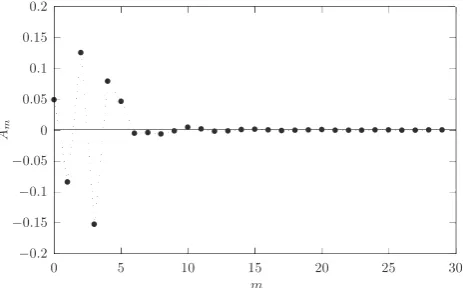
after invoking Equations (50) and (47). The quadrature is now evaluated for successive values ofk; the results are shown graphically as Am vs. m in Figure 5, for
which we have usedn¼30. It seems clear that, holding
n fixed at 30, fewer than the 30 coefficients Am
(numbered 0 through 29) seen in the figure would actually suffice in the expansion (58). In fact, we anticipate that the cutoff limits for single index expansions such as (23) or double index expansions such as (14) may be set at some integer nc that is
meaningfully smaller than the given n, which is kept larger to set the parameters for the Gauss–Chebyshev quadratures.
We conclude that the number nc of coefficients
needed in the tailored orthogonal functions procedure put forward in this work will be about an order of magnitude smaller than the number of grid pointsNz
needed for the direct space procedures used in earlier works. Since much of the numerical effort involves
0 2 4 6 8 10 12 14
−2 −1 0 1 2
f0
(z)e
b
vext(z)
z/s
Figure 3. Continuous test profilef0(z) exp[vext(z)] for hard
spheres between hard walls with a slit width L¼5, constructed using gHS(r) exp[vHS(r)] from the Percus–
Yevick equation for hard spheres at3¼0.8. See text.
0 0.5 1 1.5 2 2.5 3 3.5 4 4.5
−2 −1 0 1 2
f0
(z)
z/s
Figure 4. Discontinuous test profile f0(z) for hard spheres
between hard walls with a slit width L¼5 obtained by truncation of the form in Figure 3 atz¼ (L)/2.
matrix operations, of order N2
z in Equation (6) vs. n2c in Equation (15), we may reasonably conclude that solutions obtained using the tailored orthogonal functions will require on the order of 1% of the computational effort of those earlier works. That should make equations for inhomogeneous fluids as readily solvable as their more familiar homogeneous cousins.
References
[1] D. Henderson, in Fundamentals of Inhomogeneous Fluids, edited by D. Henderson (Dekker, New York, 1992), Chap. 4.
[2] S. Sokolowski, J. Chem. Phys.73, 3507 (1980). [3] S. Sokolowski, Mol. Phys.49, 1481 (1983).
[4] M. Plischke and D. Henderson, Proc. R. Soc. Lond. A
404, 323 (1986).
[5] M. Plischke and D. Henderson, J. Chem. Phys.84, 2846 (1986).
[6] R. Kjellander and S. Sarman, Chem. Phys. Lett. 149, 102 (1988).
[7] R. Kjellander and S. Sarman, Mol. Phys. 70, 215 (1990).
[8] R. Kjellander and S. Sarman, Mol. Phys.74, 665 (1991). [9] R. Kjellander and S. Sarman, J. Chem. Soc. Faraday
Trans.87, 1869 (1991).
[10] P. Attard, J. Chem. Phys.91, 3072 (1989). [11] P. Attard, J. Chem. Phys.91, 3083 (1989). [12] S.A. Egorov, J. Chem. Phys.112, 7138 (2000).
[13] E. Lomba, S. Jorge, and M. A´lvarez, Phys. Rev. E63, 011203 (2000).
[14] J.M. Brader, J. Chem. Phys.128, 104503 (2008). [15] G. Arfken, Mathematical Methods for Physicists
(Academic Press, Orlando, 1985).
[16] M.S. Green, J. Chem. Phys. 33, 1403 (1960); ibid. 39, 1367 (1963). Green classified the diagrams in the density expansion ofg(r) ev(r)by analogy with electric circuits as ‘series’, ‘parallel’, or ‘bridge’, the last because of the resemblance of the first diagram to a Wheatstone bridge. The ‘parallel’ terms can be summed in direct space and disappear. The name ‘series’ is nowadays seldom used but the ‘bridge’ name incongruously survives.
[17] D.G. Triezenberg and R. Zwanzig, Phys. Rev. Lett.28, 1183 (1972).
[18] R. Lovett, C.Y. Mou, and F.P. Buff, J. Chem. Phys.65, 570 (1976).
[19] M.S. Wertheim, J. Chem. Phys.65, 2377 (1976). [20] J.P. Hansen and I.R. McDonald, Theory of Simple
Liquids(Academic Press, London, 1986).
[21] W.H. Press and S.A. Teukolsky, Comp. Phys. 4, 423 (1990).
[22] R.A. Sack and A.F. Donovan, Num. Math. 18, 465 (1971/72).
[23] J.C. Wheeler, Rocky Mount. J. Math.4, 287 (1974). Figure 5. CoefficientsAmfor the expansion of Equation (58)
as a function of integerm.
308 F. Lado
![Figure 1. Tailored orthogonal polynomials TT 1(�), T 2(�), 3(�), T 4(�) generalizing the Chebyshev Tm(�) ¼ cos[m(2�z/L)] constructed for the rectangular (ideal) density profile ofEquation (54) for slit width L ¼ 5�; here � � cos(2�z/L).](https://thumb-us.123doks.com/thumbv2/123dok_us/1213934.1152527/7.609.318.552.64.212/tailored-orthogonal-polynomials-generalizing-chebyshev-constructed-rectangular-ofequation.webp)
![Figure 3. Continuous test profile fconstructed usingspheres between hard walls with a slit widthYevick equation for hard spheres at0(z) exp[�vext(z)] for hard L ¼ 5�, gHS(r) exp[�vHS(r)] from the Percus– ��3 ¼ 0.8](https://thumb-us.123doks.com/thumbv2/123dok_us/1213934.1152527/8.609.318.553.285.428/figure-continuous-fconstructed-usingspheres-widthyevick-equation-spheres-percus.webp)