ABSTRACT
PETHERBRIDGE, DONNA TUCKER. A Concerns-based Approach to the Adoption of Web-based Learning Management Systems. (Under the direction of Dr. Brad Mehlenbacher).
With the increasing availability of LMSs on campuses, greater numbers of higher education faculty members may integrate LMS tools into their instructional activities. The purpose of this study was to explore the influence of selected variables on faculty members’ concerns in the adoption of LMSs in a higher educational setting. Additionally, this study asked faculty to identify professional development support and interventions to help them utilize LMSs.
This study utilized the Concerns Based Adoption Model (CBAM) as its theoretical framework. A non-experimental, cross-sectional survey design was used to address the research questions, incorporating the Stages of Concern Questionnaire (SoCQ) in
conjunction with questions developed by the researcher. Stepwise regression analysis was used to identify potential variables predictive of faculty member’s concerns regarding the use of LMSs. Additionally, a qualitative analysis explored faculty needs related to using LMSs, and selected SoCQ analyses provided additional insight into faculty concerns.
Overall, the study found that faculty members’ highest concerns were unrelated, self, and task concerns, with a slight tailing-up of impact-refocusing concerns. Individual
LMS technologies support student learning, peer support, financial support, and improvements to the system as necessary for their use of LMSs.
A CONCERNS-BASED APPROACH TO THE ADOPTION OF WEB-BASED LEARNING MANAGEMENT SYSTEMS
By
DONNA TUCKER PETHERBRIDGE
A dissertation submitted to the Graduate Faculty of North Carolina State University
in partial fulfillment of the requirements for the Degree of
Doctor of Education
ADULT AND COMMUNITY COLLEGE EDUCATION
Raleigh, North Carolina 2007
APPROVED BY:
_______________________________ ________________________________ Dr. James Burrow Dr. Diane Chapman
_______________________________ _______________________________ Dr. David Covington Dr. Brad Mehlenbacher
DEDICATION
For mom and dad, who for as long as I can remember, have always encouraged me to continue my education, who have supported me in so many ways, and who have said
BIOGRAPHY
Donna Tucker Petherbridge holds a B.A. degree in English, with a concentration in Education and a minor in Psychology from Elon University, Elon, North Carolina (1992) and a M.I.S. degree in Information Science from North Carolina Central University (1997). Her current research interests include faculty training and support, technology and student learning, and the evaluation of technology in instructional settings.
Donna works as the Director of Instructional Services in Distance Education and Learning Technology Applications (DELTA) at North Carolina State University, leading a team of training and production specialists in supporting faculty, staff, and students teaching and learning with technology. She has over nine years of experience in supporting higher educational faculty members in leveraging technology to support a variety of teaching methodologies. Additionally, she has experience teaching at both the K-12 and higher education levels.
ACKNOWLEDGEMENTS
No one gets to this point without the support of many others. Many people in my life, both personally and professionally, have helped me to achieve this goal, and to them I am grateful.
I would like to acknowledge and thank each of the members of my committee, all of whom have been helpful and supportive of my work. Dr. David Covington was generous enough to join my committee later in the process when another committee member left the university. He helped improve my writing with many useful suggestions, reminding me that a dissertation really should not be a mystery novel ☺. Dr. Jim Burrow has been with me since the very beginning, serving as my chair until his retirement from the university, and then remaining on as a member of my committee. He is the reason that I applied for the doctoral program after completing a few classes in Training & Development to “test the waters,” and he has always given me amazingly detailed and insightful feedback that has pushed me out of my comfort zone. Dr. Diane Chapman has been a friend, mentor,
confidant, and the person I could always rely on for a number of ad hoc meetings to discuss how my research was going, and how I might improve upon what I was doing. A special thanks for her constant support, and I look forward to our continued work together.
I am also thankful for several good faculty friends, especially Mark Darhower and Harriette Griffin, who were always willing to lend a supportive ear as well as provide feedback on what I was doing as I went through this process. Nancy Welchel from University Planning and Analysis also deserves recognition for her help in obtaining the sample for this survey, and for her general advice and support. Additionally, I must thank Dr. Duane Akroyd, for the fantastic graduate seminar class which really helped shape my initial research ideas. Furthermore, I need to say thank you to my DELTA colleagues who
understood when I needed to take some time away from work to focus on my research (especially Lou Harrison, who constantly said to me, “aren’t you supposed to be writing?” and Stacy Smith and David Howard, who, along with Lou, listened to the “trial presentation run” without laughing . . . much). Finally, I simply could not have done this work without the support of Katherine Dexter Willis, Librarian Extraordinaire. When I needed research articles or support in searching for materials, Katherine proved to be masterful at finding needles in haystacks. She is simply an amazing resource.
Personally, there were so many outside of school who helped make this possible for me. Thanks to numerous friends for understanding when I gave the same excuse over and over about not being able to go out with them (sorry, I’m writing, or, sorry, I have a class, or sorry, my brain is fried). Thanks also to Center Stage Dance Studio in Garner, for providing a refuge where I could write while my daughter danced, and where I could put on my own dance shoes when I needed to relieve some stress.
I must also thank my parents, Don and Carol Tucker, of Laurel Springs, North Carolina. They have always supported me and made me believe that you can achieve
educational goals, and I know that my dad (NC State CALS alumni, 1957, Animal
Husbandry) must be happy to know that finally, all four of his children (David Tucker, Crop Science, 1996; Deborah Tucker Sessoms, Mechanical Engineering & Multidisciplinary Studies Ben Franklin Scholar, 1997; Della Tucker, Forest Management, 2002), will have a degree from his alma mater. As a rural North Carolina farming family, we understand first hand the value of a land-grant institution’s mission to serve the people of North Carolina, something my father cherished as a first generation college graduate who hitchhiked back and forth from his home to NC State so he could take care of his cattle while attending school. Go WolfPack!!!
TABLE OF CONTENTS
Page
LIST OF TABLES...x
LIST OF FIGURES ... xii
CHAPTER I: INTRODUCTION & BACKGROUND ...1
Introduction...1
Theory and Conceptual Framework...4
Problem Statement ...12
Purpose Statement...14
Research Questions...15
Significance of the Study ...16
Definition of Terms...19
Abbreviations...27
CHAPTER II: LITERATURE REVIEW ...28
Introduction...28
Supporting Faculty Using Technology in Higher Education...29
Learning Management Systems ...32
A Participant-based Approach to Change...37
Selected Personal Characteristics of Faculty Members ...52
Selected Technographic Characteristics of Faculty Members...57
Selected Contextual Characteristics...64
Concerns-based Professional Development Interventions...73
Measuring Concerns ...86
Summary of the Literature Review...101
CHAPTER III: METHODOLOGY ...106
Research Design...106
Population and Sample ...107
Instrumentation ...108
Pilot Testing ...129
Data Collection ...132
Data Analysis ...143
CHAPTER IV: FINDINGS ...150
Study Purpose & Questions ...150
Summary of Overall Findings...151
Respondent Demographics ...156
SoCQ Analysis...158
Reliability Analysis...168
Quantitative Research Questions ...170
Regression Analysis...173
Unrelated Concerns Analysis...174
Self Concerns Analysis ...180
Task Concerns Analysis...189
Impact Concerns Analysis ...194
Qualitative Question Analysis ...208
CHAPTER V: SUMMARY, CONCLUSIONS AND RECOMMENDATIONS...231
Introduction...231
Summary of the Research ...231
Question One Analysis & Discussion...233
Question Two Analysis & Discussion ...235
Question Three Analysis & Discussion ...240
Question Four Analysis & Discussion...244
Question Five Analysis & Discussion ...252
Overall Conclusions Drawn from the Research...265
Professional Development Interventions and Support Needed by Faculty...269
Implications for Technology Support Staff ...270
Implications for Administrators...275
Recommendations for Future Research ...278
Final Comments ...282
LIST OF REFERENCES...283
APPENDIXES ...297
Appendix A: Questionnaire Used in the Study...298
Appendix B: Initial Email to Faculty Members Selected for Study Participation ...306
Appendix C: Second Version of Initial Email to Faculty Members Selected for Study Participation ...308
Appendix D: Cover Letter Sent with Mailed Questionnaire ...310
Appendix F: Final Email to Faculty Members Selected for
Study Participation...314
Appendix G: Invitation to Participate in Pilot Email ...316
Appendix H: NC State University IRB Permission for Study...318
Appendix I: Frequencies ...320
Appendix J: Unrelated Concerns Score Analysis ...327
Appendix K: Self-Informational Concerns Score Analysis...334
Appendix L: Self-Personal Concerns Score Analysis ...339
Appendix M: Task Concerns Score Analysis ...346
Appendix N: Impact-Consequence Concerns Score Analysis...353
Appendix O: Impact-Collaboration Concerns Score Analysis ...358
Appendix P: Impact-Refocusing Concerns Score Analysis...365
Appendix Q: Self-Personal Concerns and Tenure Status Analysis ...372
LIST OF TABLES
Table 1.1 Stages of Concern about the innovation ... 7
Table 2.1 Course categories, based on course level and enrollment ... 71
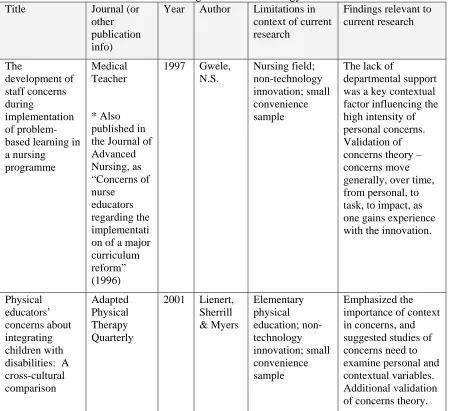
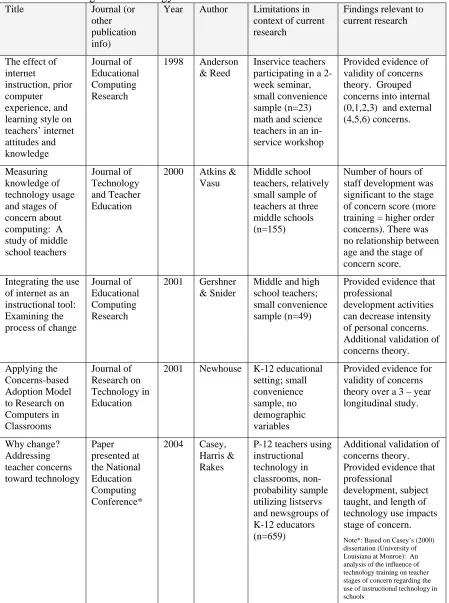
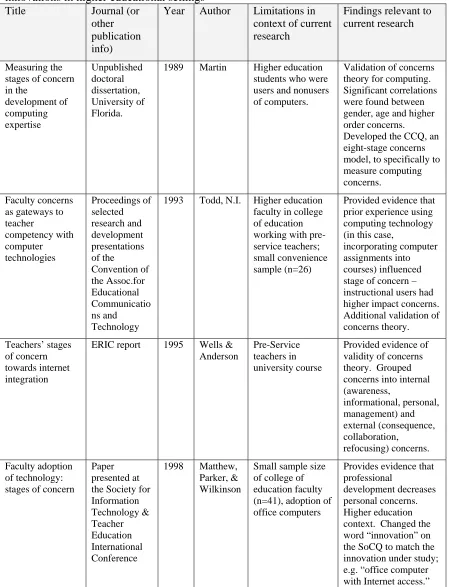
Table 2.2 Outline of selected studies utilizing the SOC framework & SoCQ in non-educational and K-12 educational settings for non-technology innovations... 96
Table 2.3 Outline of selected studies utilizing the SOC framework & SoCQ in K-12 educational settings for technology innovations... 97
Table 2.4 Outline of selected studies utilizing the SOC framework for technology innovations in higher educational settings ... 98
Table 2.5 Outline of selected studies addressing the reliability and validity of the SOC framework & SoCQ ...100
Table 3.1 Coefficients of internal reliability for the SOCQ, n=830 ...111
Table 3.2 Prior instructional technology use scale ...117
Table 3.3 Attitudes toward using technology in teaching scale...119
Table 3.4 Perceived administrative support of technology scales ...122
Table 3.5 Faculty status (rank modifier, rank, and tenure status)...124
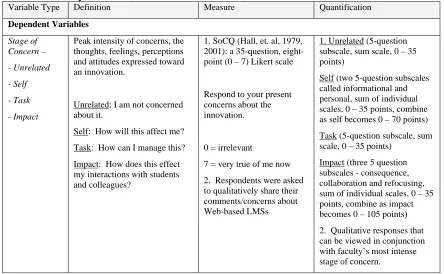
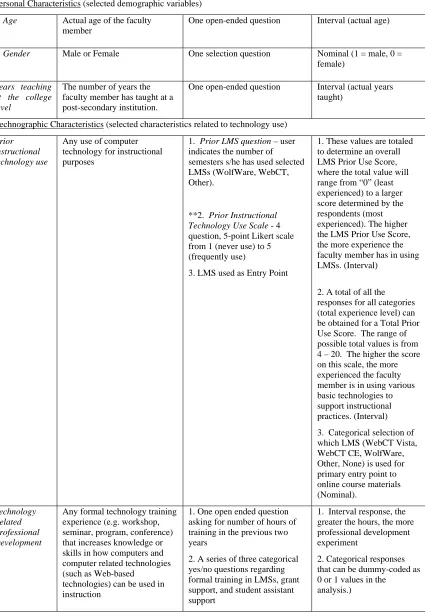
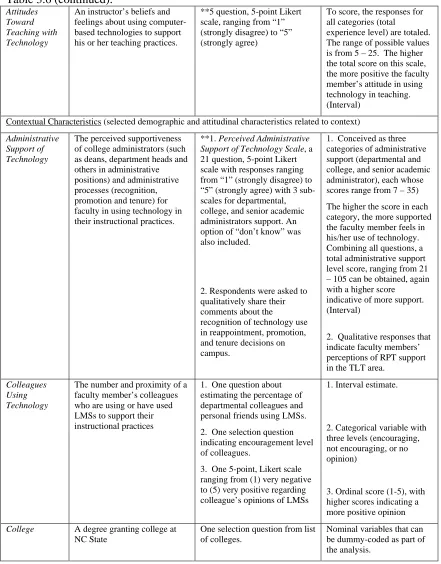
Table 3.6 Study variables, definition of variables, and variable measurement ...125
Table 4.1 Respondents’ post secondary teaching experience and age...158
Table 4.2 Coefficients of internal reliability for Stages of Concern Questionnaire from researcher’s study, n=353 ...169
Table 4.3 Regression model summary for independent variables and unrelated-awareness concerns scores...175
Table 4.4 Regression coefficients for independent variables and unrelated-awareness concerns score ...176
Table 4.6 Regression coefficients for independent variables and
self-informational concerns score ...182 Table 4.7 Regression model summary for independent variables
and self-personal concerns score ...185 Table 4.8 Regression coefficients for independent variables
and self-personal concerns score ...186 Table 4.9 Regression model summary for independent variables
and tasks concerns score ...190 Table 4.10 Regression coefficients for independent variables
and tasks concerns score ...191 Table 4.11 Regression model summary for independent variables
and impact-consequence concerns score ...195 Table 4.12 Regression coefficients for independent variables and
impact-consequence concerns score ...196 Table 4.13 Regression model summary for independent variables and
impact-collaboration concerns score...199 Table 4.14 Regression coefficients for independent variables and
impact-collaboration concerns score...200 Table 4.15 Regression model summary for independent variables and
impact-refocusing concerns score...204 Table 4.16 Regression coefficients for independent variables and
impact-refocusing concerns score...205 Table 4.17 Respondents’ articulated needs for support/intervention at
given Stage of Concern...229 Table 5.1 Intervention strategies for addressing user concerns
LIST OF FIGURES
Figure 1.1 Factors potentially influencing the intensity of faculty
concerns regarding LMSs ... 11
Figure 3.1 Tenure status of total sample...138
Figure 3.2 Tenure status of respondents ...138
Figure 3.3 Gender composition of total sample...139
Figure 3.4 Gender composition of respondents ...139
Figure 3.5 College composition of respondents and total sample ...140
Figure 4.1 Mean percentile stage score for all respondents (n=353)...160
Figure 4.2 Mean percentile stage score comparisons by gender (n=104 females, 245 males)...161
Figure 4.3 Mean percentile stage score comparisons by age...162
Figure 4.4 Mean percentile stage score comparisons by number of years taught ...163
Figure 4.5 Mean percentile stage score comparisons by tenure status ...164
Figure 4.6 Mean percentile stage score comparisons by college...165
Figure 4.7 Mean percentile stage score comparisons by colleagues’ attitudes toward LMSs ...166
Figure 4.8 Mean percentile stage score comparisons by respondents’ attitudes toward TLT...167
CHAPTER I: INTRODUCTION & BACKGROUND
Introduction
The national Campus Computing Survey identifies the need to help faculty integrate technology into instruction as one of the most important information technology issues facing higher education (Green, 2004). As technology continues to pervade higher education, and with incoming students expecting technologically-literate faculty members and access to technology-enhanced courses (Morrison & Twigg, December, 1997), college campuses are faced with the challenge of supporting an increasing number of faculty members integrate technology into their instruction (Green, 2001, 2004).
While higher education faculty members, compared to K-12 educators, have been typically slow to integrate technology and pedagogy, the growing interest in distance and distributed education (DE) means that higher education faculty members are increasingly using, and expected to use, various technologies to support instruction, from discipline-specific software to institutionally-standardized systems (Baldwin, 1998; Cornell, 1999; Gandolfo, 1998). The expansion of DE has been impacted by both the rapid growth of personal computing and the prevalence of the World Wide Web, establishing a new trend in online or learning (Chapman, 2005; Mason, 2000). With the move toward increasing e-learning instruction, based Learning Management Systems (LMS) that provide Web-based communication, assessment, and management tools have been created to support online courses (Kvavik, Caruso, & Morgan, 2004; Morgan, 2003; Olsen, 2001).
discussion (synchronous chatrooms and asynchronous discussion boards), assessment (quizzing and homework submission), and management (gradebooks and file management) tools often used to design and deliver online courses, and are the most expensive software involved in establishing an institution’s distributed education or e-learning initiatives (Dobbs, 2002). Over one-fourth of all college courses are using the tools available via LMSs, with the expectation that number will rise (Green, 2002). With the increasing availability and use of LMSs on campuses, and under pressure from below (student expectations) and above (administrative demands), greater numbers of higher education faculty members may feel compelled to integrate LMS tools into their instructional activities (Grant, 2004; Kvavik, Caruso, & Morgan, 2004).
(Baldwin, 1998; Bradshaw, 2002; Dusick & Yildirim, 2000; Gray, 1997; P.L. Rogers, 2000). Faculty members’ negative attitudes toward technology have been well documented as an important barrier to technology use (Brickner, 1995; Butler & Sellbom, 2002; Pajo & Wallace, 2001; P.L. Rogers, 2000), and, thus, stand as a key issue to be addressed as higher education institutions move forward with the adoption of new technologies.
According to Lawler & King (2000), change “does not occur in a vacuum” (p. 2), and understanding the organizational climate for change, and the faculty’s feelings toward
change, is important in effecting change. To support the faculty members’ adoption of (or decision to use) LMSs, administrators and Technology Support (TS) staff need an
understanding of the technological change from the faculty members’ perspectives in order to encourage faculty members to use these systems effectively (Dusick & Yildirim, 2000; Surry & Land, 2000). TS staff need an appreciation of faculty members’ concerns (e.g. their emotions, perceptions, attitudes, and feelings toward the technology) in order to better design support structures and programs that will facilitate the successful adoption of the innovation and minimize faculty frustration, anxiety, and resistance (Hall & Hord, 1987, 2001; Pajo & Wallace, 2001; Surry & Land, 2000).
adoption of the innovation, minimize faculty resistance and negativity, and also respect the feelings of the individual user, the adoption facilitation strategies for an LMS implementation need to utilize a user-centered, participant-based approach (Cornell, 1999; Surry & Land, 2000).
Theory and Conceptual Framework
For TS staff and change facilitators involved in leading an institutional
implementation of a LMS, it is useful to frame the process within the context of a change theory that may provide a better understanding of the individuals involved in the innovation adoption. While a number of potentially relevant and useful change and diffusion models exist, the Concerns Based Adoption Model (CBAM) (Hall, George, & Rutherford, 1979; Hall & Hord, 1987, 2001), a participant-based change model that has been used a number of times in studying the adoption of educational innovations, seems an appropriate model for framing the examination of technological change for faculty adopting LMSs. This model enjoys widespread acceptance in educational research, and it maintains a participant-based focus on understanding an individual’s attitudes, perceptions, thoughts and considerations toward using a new innovation (Adams, 2002; Ansah & Johnson, 2003; Casey, 2000; Casey, Harris & Rakes, 2004; Dobbs, 2004; Gershner & Snider, 2001; Gwele, 1997; Lienert, Sherrill, & Myers, 2001; Newhouse, 2001; Signer, Hall & Upton, 2000; Todd, 1993). The model was initially framed via observations of K-12 educators and college professors as they adopted and implemented educational innovations (Hall & Hord, 1987).
involved in the change process (Sashkin & Ergermeier, 1992). The central underlying assumption of CBAM asserts that an important factor in any change process is the people involved, as an organization cannot change until the individuals within it change (Hall & Hord, 1987, 2001). This assumption may especially hold true for higher educational organizations, which are structurally organized as professional bureaucracies (Birnbaum, 1988). According to Birnbaum (1988), professional bureaucracies are slow to respond to change, and “waves of reform typically produce little impact because professionals often view any change in their surroundings as an annoying distraction from their chosen work” (Birnbaum, 1988, p. 77). Furthermore, Kershaw (1996), commenting on technology adoption in higher education, notes: “change cannot occur without individual members of the
institution’s . . . faculty making the decision to alter their taken-for-granted ways of doing things” (p.48).
In investigating the personal side of change, the CBAM model provides a way of examining the various levels of user concerns related to the adoption of a new innovation via what is known as “Stages of Concern” (SOC) (Hall & Hord, 2001). The SOC defines
potential users, or adopters’ concerns, as composite representations of thoughts, feelings, preoccupations, and considerations relating to a particular issue (Hall, George, & Rutherford, 1979; Hall & Hord, 1987; 2001). Importantly, potential users’ concerns seem to play an important role in the adoption process of higher education innovations, and must be
innovation is managed), and impact (concerns about how the innovation impacts others) questions that individuals confronted with a new innovation will have.
Hall, George & Rutherford’s (1979), and Hall & Hord’s (1987, 2001) research indicates that the four, broad stages of concern (unrelated, self, task, and impact) can be further divided into seven specific categories of concern (unrelated-awareness,
Table 1.1 Stages of Concern about the innovation (adapted from Hall & Hord, 1987, p. 60; 2001, pp. 61 & 63)
Stage of Concern
Stage 6: Refocusing. Exploring the possibilities of an innovation, even considering major changes or replacements with an alternative. An individual at this stage will have definite ideas about options, additions or replacements for the innovation.
An Expression of Concern Might Be: I have some ideas about what would work better. Stage 5: Collaboration. The focus is on using the innovation with like-minded colleagues. An Expression of Concern Might Be: How can I work with others using this innovation?
Impact
Stage 4: Consequence. Consideration is on the impact of the innovation on students, including student outcomes and performance.
An Expression of Concern Might Be: How is my use of this innovation impacting student learning?
Task Stage 3: Management. The focus here is on the actual tasks of using the innovation. Issues related to scheduling, time demands, organizing and managing the innovation are forefront. An Expression of Concern Might Be: I seem to be spending all my time formatting materials to use.
Stage 2: Personal. The individual is worried about his or her ability to meet the demands of using the innovation and how the innovation might affect his or her role. Individuals may also be concerned with recognition, rewards, policies, and conflicts with existing structures. An Expression of Concern Might Be: How will using this innovation affect me?
Self
Stage 1: Informational. Individuals are generally aware of the innovation and are interested in learning more about it.
An Expression of Concern Might Be: I think I would like to know more about it.
Unrelated Stage 0: Awareness. The individual has little or no concern or involvement with the innovation at this time.
An Expression of Concern Might Be: I am not concerned about it.
It is possible for an individual to express concerns at more than one stage simultaneously; for example, an individual can have personal concerns about how the innovation will affect his daily work, and impact concerns regarding how the innovation will change the way he works with his students or colleagues. Concerns must become lower in intensity at one stage in order to become more intense at another stage, and while ideally the intensity of concerns moves from personal concerns to impact concerns, it is possible for personal concerns to increase during later stages of the innovation adoption process, causing backward movement. An understanding of an individual’s concerns about an innovation involves identifying the peak SOC; in other words, pinpointing the stage that is currently the most intense for the individual and thus the focus of the individual’s energy and time (Hall & Hord, 2001).
that change has a personal side experienced by all involved in the implementation of the innovation. As the integration of LMSs into teaching practices can be a significant, personal change for faculty members, challenging existing pedagogical methods and traditions (Katz, 2003), applying a participant-based change model that has a solid foundation in relevant literature (e.g. Adams, 2002; Atkins & Vasu, 2000; Bluhm & Kishner, 1998; Chimezie, 1987; Cicchelli & Baecher, 1985, 1989; Crawford, 2003; Dooley, 1999; Gershner & Snider, 2001; Newhouse, 2001; Todd, 1993; Whiteside & James, 1985), and that focuses on change in a personalized way from the perspective of the individual, seems valid as an initial step in successfully engaging faculty with new technologies (Ali, 2003; Engeldinger & Love, 1998; Rice & Miller, 2001).
Various research has found the conceptualization of the SOC useful in identifying the most intense area of concern of those involved in an innovation in a range of fields from education to nursing and has provided an understanding of some of the characteristics of potential adopters (e.g. age, gender, amount of training, disciplinary area, departmental support) that may influence their most intense concerns, and has provided some information for developing interventions that can support the faculty and staff involved in the process of adopting an innovation (Adams, 2002; Atkins & Vasu, 2000; Horsley & Loucks-Horsley, 1998; Rakes & Casey, 2002). According to a number of studies, an individual’s concerns will differ in strength depending on a variety of factors, such as his or her use of the
innovation and participation in professional development activities related to the innovation (Adams, 2002; Casey, Harris & Rakes, 2004; Hall & Hord, 2001; Todd, 1993).
for this study. Based on a review of the literature, a study of selected personal (age, gender, years teaching), technographic (prior instructional technology use, technology related professional development, attitudes toward teaching with technology), and contextual (administrative support of technology, colleagues using technology, college, department, course size, course level, academic rank) characteristics of faculty members that may influence the faculty member’s current, intense stage of concern (unrelated, self, task and impact) is proposed (see Figure 1.1). This study is an exploratory study seeking to understand which of these variables might be predictive of concern’s scores.
Problem Statement
While a number of studies have examined the concerns of individuals adopting new innovations, existing research does have identifiable limitations. One issue in the existing technology adoption research is the role of demographic variables such as age, gender, and experience on the job (in this case, as an instructor) in relationship to expressed concerns. In examining the concerns of innovation adopters, Hall, George & Rutherford (1979) note that traditional demographic variables have no significant relationships with concerns; however, when examining computer-related innovations, several authors have found that demographic variables can correlate with concerns (Adams, 2002; Martin, 1989; Sells-Lewallen, 2000). Related literature regarding computer use and technology adoption often notes correlations between age, gender, experience, and computer use; thus, it seems plausible that for the adoption of computer-related innovations, demographic variables may be predictive of user concerns (Kagima & Hausafus, 2000; Mitra, Steffensmeier, Lenzmeier, & Massoni, 1999).
Hall & Hord (2001) further observe that conditions (e.g. contextual conditions such as academic discipline and administrative support) and interventions (e.g. professional
technology, is often cited as a key primary barrier for faculty integrating technology (Butler & Sellbom, 2002; Fabry & Higgs, 1997; Frey & Donehue, 2003; Jones, Lindner, Murphy, & Dooley, 2002; Pajo & Wallace, 2001; P.L. Rogers, 2000), and may have an impact on faculty members’ concerns. Additionally, literature examining the diffusion of innovations has noted the value of peer influence as a contextual variable; that is, if a colleague is using an
innovation, then it may increase the awareness and use of the innovation of the current non-user (Goldfield, 2001; Kozma, 1978; Rogers, 1995).
While few studies examine the role of contextual variables’ relationships with the intensity of higher educational users’ technology concerns, several studies have looked at conditions, such as prior experience (Todd, 1993) and professional development (Adams, 2002; Casey, 2000), that may contribute to higher levels of user concerns. While these studies found positive correlations between prior experience and training with task and impact concerns, they may be limited methodologically, having generalized their findings from small sample sizes (Todd, 1993), convenience sampling (Adams, 2002), and self-selecting sampling (Casey, 2000). Additionally, most studies have relied primarily on
descriptive statistics and correlations to examine relationships between selected variables and user concerns, with few exploring the collective influence of variables on user concerns.
and few studies found in the literature review specifically address the concerns of higher education faculty members adopting a LMS (Dobbs, 2004; Signer, Hall & Upton, 2000; Todd, 1993). Additionally, while relevant literature does make a number of
recommendations for appropriate interventions based on the intensity of user concerns (Hall & Hord, 1987; Hall & Hord, 2001), these have not been specifically applied to the adoption of LMSs in a higher education context, taking into considerations faculty member’s concerns about LMSs.
Purpose Statement
The purpose of this study was to examine the influence of selected personal (age, gender, years teaching), technographic (prior instructional technology use, technology related professional development, attitudes toward teaching with technology), and contextual
Research Questions The study sought to answer the following research questions:
1. What personal (age, gender, years teaching), technographic (prior instructional technology use, technology related professional development, attitudes toward teaching with technology), and contextual (administrative support of technology, colleagues using technology, college, course size, course level, academic rank) characteristics are predictive of higher education faculty members’ unrelated concerns regarding LMSs?
2. What personal (age, gender, years teaching), technographic (prior instructional technology use, technology related professional development, attitudes toward teaching with technology), and contextual (administrative support of technology, colleagues using technology, college, course size, course level, academic rank) characteristics are predictive of higher education faculty members’ self concerns regarding LMSs?
3. What personal (age, gender, years teaching), technographic (prior instructional technology use, technology related professional development, attitudes toward teaching with technology), and contextual (administrative support of technology, colleagues using technology, college, course size, course level, academic rank) characteristics are predictive of higher education faculty members’ task concerns regarding LMSs?
4. What personal (age, gender, years teaching), technographic (prior instructional technology use, technology related professional development, attitudes toward teaching with technology), and contextual (administrative support of technology, colleagues using technology, college, course size, course level, academic rank) characteristics are predictive of higher education faculty members’ impact concerns regarding LMSs?
Significance of the Study
Allen & Seaman (2003) report that “among all U.S. higher education students in Fall 2002, 11 percent took at least one online course” and “over one-third of these students … took all of their courses online” (p. 1). To support online and DE courses, LMSs are
becoming increasingly important in the landscape of higher education. Additionally, a recent study from EDUCAUSE noted that 83 percent of all students surveyed had taken a class (either face-to-face or online) that used an LMS (Kvavik, Caruso, & Morgan, 2004). As institutions of higher education continue to spend substantial amounts of money, investing in hardware, software and other infrastructure resources, there is growing interest in the level of adoption of these systems. According to Green (2002), one-fourth of all college courses use some type of LMS, yet as Olsen (2001) notes, the top commercial contenders in the LMS industry (e.g. Blackboard) are becoming much more expensive as the tools become more flexible. The previously mentioned EDUCAUSE study (Kvavik, Caruso, & Morgan, 2004) importantly notes that “higher education’s investment in technology is paying less than optimal returns because . . . faculty don’t have the skills or motivation to use it effectively” (p. 75). Additionally, some of the literature reviewed noted low adoption rates of LMSs in particular institutional contexts despite institutional initiatives to use these systems (Bennett & Bennett, 2003; Kvavik, Caruso, & Morgan, 2004; Mills & Ragan, 2000; Morgan, 2003). As more universities continue to allocate significant resources, from the purchasing of LMS licenses to paying salaries of TS staff to support LMSs, quickly diffusing the adoption of LMSs has become a priority on many higher education campuses (Bennett & Bennett, 2003).
individual faculty member’s innovation adoption concerns and perceptions of barriers, such as perceived lack of administrative support for technology, that faculty members encounter as they implement LMSs. An understanding of faculty concerns in the implementation process may help change facilitators support the TS staff responsible for providing
appropriate professional development activities for faculty surrounding the implementation the LMS systems.
Approaching an LMS implementation from a user-centered approach, the CBAM framework emphasizes change as an individually experienced developmental process within an organizational context and recognizes the personal side of change, acknowledging the feelings and perceptions of those undergoing the change process (Hall & Hord, 1987; Hall & Hord, 2001). The SOC component of the CBAM, which addresses the intensity of user concerns, has been validated in a variety of educational change studies examining the adoption of innovations from whole language curriculum implementations to the integration of technology in the classroom since initial development of the model in the 1970s (Adams, 2002; Casey, Harris, & Rakes, 2004; McKinney, Sexton, & Meyerson, 1999; Rakes & Casey, 2002). In considering the adoption of LMSs in higher education, understanding the differing user concerns is valuable in understanding the individual faculty member’s adoption
experience that can inform appropriate faculty development activities to support and sustain the adoption of the LMS. Specifically, exploring how a combination of personal,
technographic and contextual characteristics influence a faculty member’s most intense, or peak stage of concern, can help TS staff plan for professional development programs and interventions that may appropriately address the major characteristics identified as
While several of the existing studies examining the SOC focus on computer integration and elements that are included in LMSs, such as Web-based communication tools, limited studies have specifically explored higher education faculty members’ concerns as an institution begins implementing a new LMS (Dobbs, 2004; Signer, Hall & Upton, 2000). Furthermore, few studies have examined selected contextual characteristics such as administrative support of technology and peer use of technology that may be important to understanding faculty members’ LMS adoption patterns (Dobbs, 2004; Signer, Hall & Upton, 2000; Todd, 1993). Understanding the potential relationships of personal, technographic, and contextual characteristics that affect faculty member’s unrelated, personal, task and impact concerns will be important in understanding the adoption patterns of those involved in an LMS implementation, and relevant in pinpointing primary user concerns that may help inform professional development activities.
Definition of Terms
Adoption
Adoption is the decision to use an innovation (Rogers, 1995); in this case, a LMS.
Change Facilitator
According to Rogers (1995), a change facilitator, also known as a change agent, develops a need for change, establishes two-way communication with a client, provides information to the client, creates an intent to change, supports the intent into translatable action, supports the stabilization of adoption and prevents its discontinuance, serving as a catalyst during the innovation decision process.
Concerns
Concerns are a combined representation of feelings, preoccupation, reflection and
contemplation concerning a particular issue (Hall, George & Rutherford, 1979; Hall & Hord, 1987; Hall & Hord, 2001).
Concerns-Based Adoption Model (CBAM)
where clients are in the change process, including the Stages of Concern Questionnaire (SoCQ) (Hall, George, & Rutherford, 1979; Hall & Hord, 1987; Hall & Hord, 2001).
Contextual Characteristics
Hall & Hord (1987) state that context is “critical in understanding the change process” (p. 15), as contexts will create challenges and opportunities unique to the given situation. Contextual variables examined in this study include perceived administrative support of technology, colleagues using technology, college, course size, course level, and academic rank. One contextual variable, the perceived lack of administrative support for technology, is often cited as a key primary barrier for faculty integrating technology (Butler & Sellbom, 2002; Fabry & Higgs, 1997; Frey & Donehue, 2003; Jones, Lindner, Murphy, & Dooley, 2002; Pajo & Wallace, 2001; P.L. Rogers, 2000). Additionally, literature examining the diffusion of innovations has noted the value of peer influence as a contextual variable; that is, if a fellow faculty member is using the innovation, then it may increase the awareness and use of the innovation of the current non-user (Goldfield, 2001; Kozma, 1978; Rogers, 1995).
(1) Perceived administrative support of technology is defined as the perceived supportiveness of college administrators (such as deans, department heads and senior academic administrative positions) and administrative processes
(recognition, promotion and tenure) for faculty in using technology in their instructional practices.
(2) Colleagues using technology is defined as the number and proximity of a faculty member’s colleagues who are using or have used LMSs to support their
(3) College is defined as a degree granting college at the university. Colleges conferring degrees include: Agriculture and Life Sciences, Design, Education, Engineering, Humanities & Social Sciences, Management, Natural Resources, Physical & Mathematical Sciences, Textiles, and Veterinary Medicine.
(4) Course size is defined as the approximate number of students in a typical course. (5) Course level is defined as the academic level (e.g. 100, 200, 300, 400, or 500+) of
the course.
(6) Academic rank is defined as the actual rank, the rank modifier, and the tenure status of the faculty member. Ranks include professor, associate professor, assistant professor, instructor, and lecturer. Modifiers include visiting and adjunct. Tenure status includes tenured, and tenure-track, non-tenured, and non tenure-track.
Distributed Learning/Distributed Education
Faculty Members
Faculty members are defined as adults serving in an instructional role on a full-time basis (full-time instructional faculty on 9 or 12 month contracts) during a given academic year, as identified by the national Integrated Postsecondary Education Data System (IPEDS). Both undergraduate and graduate students and other groups, such as technical support staff, secretaries, program assistants, administrators, and part-time IPEDS faculty are excluded.
Innovation
An idea, practice or object that is perceived as new to an individual or another unit of adoption (Rogers, 1995).
Interventions
Planned actions or events that influence the use of an innovation (Hall, Zigarmi, & Hord, 1973).
Instructional Technology
Hardware and software used for teaching and learning; the application of technology to the solution of instructional challenges.
Learning Management Systems
assessments and tracking usage of both students and content (quizzing tools, homework tools, tracking tools, gradebook); and tools that store content and structure content delivery (content storage, selective release of materials). WebCT and Blackboard are two of the largest commercial vendors of this software for higher education use (Butler & Sellbom, 2002; Morgan, 2003; Olsen, 2001).
Personal Characteristics
Demographic factors that are of a personal nature; for example, questions about income, age, race, education, or employment (O’Sullivan, Rassel & Berner, 2003). Demographic
questions in this study include: age, gender and years teaching at the college level. (1) Age is defined as the actual age of the faculty member.
(2) Gender is defined as whether the faculty member is male or female.
(3) Years teaching at the college level is defined as the number of years the faculty member has taught at a post-secondary institution.
Peak Stage of Concern
The CBAM stage with the highest score (0-35) on the SoCQ, and therefore is the most intense, or primary concern, of the individual (Hall, George & Rutherford, 1979).
Primary instructional technology barriers
instruction, inadequate technical support, lack of administrative support/leadership, lack of recognition, awards, stipends (financial support), promotion and tenure, institutional support and culture, and lack of training (Allison & Scott, 1998; Day, 2000; Ertmer, Addison, Lane, Ross, & Woods, 1999; Miller, Martineau, & Clark, 2000). In this study, primary barriers examined will include the technographic characteristic of technology related professional development and the contextual characteristic of perceived administrative support.
Secondary (second-order) instructional technology barriers
Secondary, or second order barriers, sometimes referred to as individual resistance as they are intrinsic in nature, identified in the literature include faculty fear of change, negative attitudes toward technology use, and uncertainty if technology can really impact student learning (Butler & Sellbom, 2002; Miller, Martineau, & Clark, 2000). These barriers exist within the individual instructors who are often reluctant to acknowledge the existence of these barriers. Many times secondary barriers are hidden within primary barriers which are often easier to identify and then address (Brickner, 1995). In this study, a secondary barrier examined will be the technographic characteristic of attitudes toward technology use in instruction.
Secondary Stage of Concern
This is the stage in the CBAM which has the second highest score (0-35) on the SoCQ, and therefore is the second most intense, or secondary concern, of the individual.
Stages of Concern (SOC)
Stages of Concern Questionnaire (SoCQ)
A quantitative tool used to collect data about the concerns of individuals involved in an innovation.
Technographic Characteristics
Mitra & Hullet (1997) proposed that in studying the effectiveness of computers, “the notion of demographics should be expanded to include attributes that deal specifically with
technology use and exposure” (p. 381). Technographics can include prior exposure to technology, level of use and categories of technology use, attitudes toward technology, and a variety of factors that may address the technological characteristics of people.
Technographic characteristics included in this study are prior instructional technology use, technology related professional development, and attitude toward using technology in teaching.
(1) Prior instructional technology use will be defined as the prior use of computer technology for instructional purposes.
(2) Technology related professional development will be defined as any formal training experience (e.g. workshop, seminar, program, conference) that increases knowledge or skills in how computers and computer related technologies (such as Web-based technologies) can be used in instruction.
Technology Support (TS) staff
As technology in education becomes more pervasive, today’s higher education colleges and universities employ both information technology staff (staff traditionally associated with programming and infrastructure support functions) and instructional technology (staff primarily concerned with the application of emerging hardware and software to support teaching and learning) support staff (Hall & Hord, 2001). For the purposes of this study, these staff are referred to collectively as Technology Support (TS) staff. TS staff are primarily responsible for a variety of professional development interventions to aimed at supporting faculty using technology, including one-to-one support, help desk (email and phone) support, and more traditional training interventions (such as workshops and seminars).
Web-based
Abbreviations CBAM: Concerns Based Adoption Model
DE: Distance Education
LMS: Learning Management System
RDCTE: Research and Development Center for Teacher Education SEDL: Southwest Educational Development Laboratory
SOC: Stages of Concern
CHAPTER II: LITERATURE REVIEW
Introduction
The theoretical framework of this study is based primarily on Hall, George & Rutherford’s (1979) and Hall & Hord’s (1987, 2001) Concerns Based Adoption Model’s (CBAM) theorized Stages of Concern (SOC) about the intensity of user concerns regarding innovations, but relies in part on elements and vocabulary from Rogers’ (1995) Diffusion of Innovations Model. Independent variables include selected personal characteristics of faculty members (age, gender, years teaching at the college level), selected technographic characteristics of faculty members (prior instructional technology use, technology related professional development, and attitudes toward teaching with technology), and selected contextual characteristics (perceived administrative support of technology, colleagues using technology, college, academic rank, course level and course size). The dependent variable of interest is the most intense stage of concern (unrelated, self, task, or impact) of faculty
members regarding the adoption of Learning Management Systems (LMSs).
The literature review is organized into eight main sections: supporting faculty using technology in higher education, Learning Management Systems, a participant-based
of higher education faculty members’ selected personal, technographic, and contextual characteristics to their most intense concerns when adopting a LMS, thus this study assists in augmenting the understanding of these relationships. Other studies reviewed in the literature included small samples (Todd, 1993), and self-selecting or convenience samples (Adams, 2002; Casey, 2000) rather than random sampling, and little exploration of variables beyond correlations; however, this study utilized random sampling, regression methodologies, and a qualitative analysis to augment existing knowledge of the influence of personal,
technographic, and contextual characteristics on a faculty member’s level of concern. As more universities continue to allocate significant resources, through financing the cost of LMS licenses and the personnel required to support LMS use, understanding how to effectively support the diffusion of LMS use has become a priority on higher education campuses (Bennett & Bennett, 2003; Kvavik, Caruso, & Morgan, 2004). Findings from this study, which sought to understand the concerns of faculty members undergoing the adoption of a new LMS, can support campuses undergoing the LMS adoption process.
Supporting Faculty Using Technology in Higher Education
As technology becomes increasingly integrated into higher education, teaching and learning paradigms are shifting. Green (2000) states that technology is “nearly ubiquitous on college campuses” (p. 1), with students expecting to work with computers when attending college, and faculty using computers and posting Web syllabi to support their courses. Many students may not even physically need to come to campus as online education, often
While a number of of today’s college and university faculty members are actively supporting and embracing these changes, some faculty, many of whom received their own education and training prior to the widespread use of computers, and certainly prior to the emergence of full-fledged LMSs, remain “entrenched in times gone by, laying claim to their testament that their content is static (sacred?)” (Cornell, 1999). These are the faculty
members unwilling to adopt their practices to accept technology, resistant to any change affecting their instructional practices. Far from leading the revolution, these faculty members do not accept technology integration into their everyday practices and often actively oppose any changes to traditional methodologies (Powers, Anderson, & Love, 2000). Amidst this technological revolution, and perhaps even empowered by it, the familiar teacher centered paradigm, the “sage on the stage,” is giving way to the “guide on the side,” yet another shift for faculty well-established in a lecture paradigm (Katz, 2003).
Even as some higher education faculty are struggling to use technology in their teaching practices, technology support (TS) staff are discovering that assisting faculty goes well beyond troubleshooting standardized hardware and software. Rather, support can entail providing directions on how to use a particular tool to support an instructional practice; for example, how to create and manage online student groups or how to facilitate online
technologies, staff traditionally associated with information technology may also find that some part of their role involves supporting or implementing learning technologies in today’s higher education environment (Carnevale, 2004). In recognizing that there are often as many “information technology” staff supporting faculty in utilizing hardware and software for teaching and learning as “instructional technology” staff who may be more clearly designated to perform this role, this study combines both groups into “technology support” (TS) staff to refer to any staff member who allocates some percentage of their time, however small, to supporting faculty using instructional technologies (defined as hardware and software used for teaching and learning). As faculty and TS staff often work in teams to create DE courses (Carnevale, 2004), it is evident that both faculty and TS staff need an understanding of how various learning technologies can be utilized in instruction (Morgan, 2003). In order for TS staff to effectively work with faculty on integrating technology into their instructional practices, TS staff need an understanding of the various concerns faculty have as they begin adopting new technologies in order to successfully support faculty adoption of technology (Ali, 2003; Bullock & Schomberg, 2000; Engeldinger & Love, 1998; Surry & Land, 2000).
technology stemming from a perceived lack of administrative support). Additionally, as faculty members’ resistance to technology has been noted as a key secondary barrier to technology implementation (Brickner, 1995; Butler & Sellbom, 2002; Pajo & Wallace, 2001; P.L. Rogers, 2000), both change facilitators and TS staff supporting the innovation must understand the implementation of the innovation from the faculty members’ perspective, in order for the change process to be a supportive partnership where an individual’s feelings and concerns are acknowledged, as opposed to a top-down mandate where faculty members undergoing the change feel ignored in the process. To successfully implement LMSs on campus, change facilitators and TS staff will need to understand, respect, and address faculty member’s concerns, and use what they learn about faculty members concerns to inform effective interventions.
Learning Management Systems (LMSs)
Part of the changing technological landscape in higher education, which includes the pervasiveness of computing and a growth in e-learning that involves both faculty and TS staff members is the advent and use of LMSs (Chapman, 2005; Morgan, 2003; Olsen, 2001). LMSs play an increasingly important role in higher education, challenging faculty, staff and administrators alike as new teaching, learning, and service paradigms are explored in various forms of distributed education.
Chapman (2005) notes that a consistent literature definition for an LMS is elusive, possibly because the LMSs in use may have been developed for the nuances of a specific
organization, purchased from a vendor, or are some conglomerate of both, thus varying in both back-end, platform applications and front-end toolsets. Additionally, the issue is confusing because of similar systems appearing on the market that manage learning objects, offer publishing functions, and provide space for virtual learning communities (Chapman, 2005).
online gradebooks), and student management tools (student profiles and tracking information) (Chapman, 2005; Paulsen, 2002).
In a higher educational context, LMSs are being used to support distance learning courses as well as face-to-face classes, and are considered by institutions as important tools for supporting instruction (Maslowski, Visscher, Collis & Blowman, 2000). Eighty percent of public, four-year colleges make LMSs available to their faculty (Lynch, 2002), and over one-fourth of all college courses are using the tools available via LMSs (Green, 2002). A recent ECAR study (Kvavik, Caruso & Morgan, 2004) indicates that around ninety percent of a given institution’s students will have some experience with an LMS, though, as noted by Lynch (2002) and Green (2002), the actual number of faculty users and courses in the
systems is relatively low. With the increasing availability and use of LMSs on campuses, and under pressure from below (student expectations) and above (administrative demands), greater numbers of higher education faculty members may feel compelled to integrate LMS tools into their instructional activities, making the use of LMS tools ubiquitous not only in an e-learning context, but in conjunction with face-to-face classes as well (Coates, 2005; Grant, 2004; Lynch, 2002; Kvavik, Caruso & Morgan, 2004).
An initial glimpse of LMS use may give the impression that LMSs primarily support distance education (DE) via e-learning. After all, many LMSs were initially developed in the context of supporting online learning or e-learning courses and programs (Harrington,
computing, readily available Internet connections with increasing bandwidth, the increasing technology fluency of adult learners, the demand for flexible access instruction, the desire to capitalize on a growing adult education market, institutional interest in reducing constraints on campus facilities, institutional beliefs that DE courses reduce costs, and a learning paradigm shift that views online learning as an acceptable teaching and learning approach (Chapman, 2005; Harasim, 2000; Howell, Williams & Lindsay, 2003; Smith, 1998).
Though formal DE courses in the United States have existed in some form or another since the late 1800s, and have been offered in a variety of formats, the Internet is now the dominant DE delivery mechanism, and one that is often preferred by some students (Howell, Williams & Lindsay, 2003). For example, at the University of Berkeley, California,
enrollments by students in DE courses rose 58% between 1995 and 2002, and at the
University of Central Florida, students rate fully online courses as more satisfying than other types of courses, and indicate that they are more likely to take a DE course again as opposed to other types of courses offered (Bates & Poole, 2003). While other modes of DE delivery exist, such as cable, dvds, and video, the use of these modes tends to remain stable each year, while the use of the Internet has seen double-digit percentage increases over the past 5-years at other institutions (R.C. Swanson, personal communication, August 3, 2005). As the Internet is now the DE medium of choice, LMSs are becoming the delivery mechanisms of choice.
Web-based DE courses, while 44% indicated that their institution’s LMS was being used to support traditional face-to-face courses, and around one-third indicated that the LMSs were used for hybrid courses (Harrington, Gordon & Schibik, 2004). Additionally, Bates & Poole (2003) indicate that WebCT (now Blackboard) estimated that 80% of their LMS users are enhancing their classroom teaching as opposed to teaching DE courses. According to Maeroff (2002), hybrid courses, which combine the features of both classrooms and online courses, reducing class meetings to interact part of the time online, will become the rule rather than the exception in higher education, and faculty not using LMSs to support their face-to-face classes will be viewed as behind the times. When utilized in conjunction with the classroom, LMS systems expand the walls of the classroom to allow a variety of activities to take place that augment the course, including connection with experts around the world, access to electronic resources, the availability of notes and lectures prior to attending class, or after class, for review, and perhaps most importantly, opportunities for interaction and
collaboration beyond the context of the classroom (Bates & Poole, 2003; Miller, 2001; Schrum, 2002).
As institutions realize that LMSs can potentially add value to how students engage with their studies whether in a face-to-face or online course (Coates, 2005), higher
supports, whether a face-to-face or a DE course, or some combination in between, institutions must now focus on how LMSs promote student learning and engagement (Coates, 2005; Oliver, 2001; Weigel, 2005).
Often, the integration of LMSs is a large scale change for instructors, challenging existing pedagogical methods and traditions. Katz (2003) notes that the change management aspect required in the adoption of a LMS is significant and the challenge will be moving faculty from a “preoccupation with the adoption of existing course structures and the master of difficult new technology to thoughtful experimentation with customizable pedagogies” (p. 56). A recent EDUCAUSE study (Kvavik, Caruso & Morgan, 2004) also acknowledges that adopting an LMS presents challenges for the campus, indicating that both students and faculty will need training and support to effectively use these systems. To support the successful adoption of these systems, encouraging faculty to use these systems efficiently and creatively while diffusing the innovation across campus, administrators and TS staff need a clear understanding of the technological change from the faculty member’s perspective and an understanding of the individual faculty member’s concerns in order to design support structures and programs that will facilitate the adoption of the innovation (Cornell, 1999; Surry & Land, 2000).
A Participant-based Approach to Change
Higher education organizations are structurally organized as professional bureaucracies, and thus, are often slow to respond to change (Birnbaum, 1988). As Birnbaum notes, faculty members are wary of new innovations, and “waves of reform typically produce little impact because professionals often view any change in their
tend to resist new innovations, especially when they perceive a lack of empowerment in directing the impact of the innovation (Dooley & Murphrey, 2000).
Surry & Land (2000) note that much of the change literature focuses on the organizational or technological aspects of change, suffering from a “technological determinism” bias, which theorizes that technology is the primary driving force in social change and that simply providing access to the technology with some support is sufficient in facilitating a successful change (p. 146). However, in a higher education environment, where faculty resistance to technology is already noted as a barrier to using technology (Jones, Lindner, Murphy, & Dooley, 2002; Wolski & Jackson, 1999), and where faculty members are concerned about technology’s impact on the reappointment, promotion and tenure process (Day, 2000), the faculty members, and not solely the technology and technologists, should lead the way (Gilbert, 1995). Using a participant-based model for adopting LMSs, then, would likely decrease resistance to the innovation and establish the kinds of effective collaborations needed to promote and sustain an adoption of the innovation (Powers, Anderson & Love, 2000).
Understanding that utilizing a participant-based approach to technology adoption can decrease instructor anxiety and support the adoption process (Anderson & Reed, 1998), participant-based frameworks will be examined and utilized in this study; one (Rogers, 1995) which gives insight into the concept of the diffusion of innovations, provides both a
Both Roger’s (1995) general Diffusion of Innovations model and Hall & Hord’s (2001) CBAM theory, specifically the SOC component of the model, provide an understanding of how the implementation of an innovation may occur, and provide a framework for change facilitators to follow as they provide incentives and appropriate interventions to facilitate participant-based change.
Rogers’ (1995) Diffusion of Innovations
As Rogers’ (1995) Diffusion of Innovations model is a well-known and established framework for innovation studies and is often referenced in literature related to higher educational innovations (Adams, 2002; Bennett & Bennett, 2003; Dooley, 1999; Hagner, 2001; D.L. Rogers, 2000), providing a vocabulary and a paradigm for understanding the adoption of innovations and acceptance or resistance to change, it is worth examining this model in some detail. When encountering obstacles in innovation diffusion, this model and its principles, developed from a synthesis of several hundred research studies, can assist change facilitators leading an innovation in understanding key issues involved in the
innovation process, including the attributes of innovations that help or hinder their adoption, categories of adopters, the innovation-decision process that occurs in using an innovation, and the power of opinion leaders in the adoption process.
Rogers’ (1995) notes that the words “innovation” and “technology” are often used as synonyms. Technology is described as a “design for instrumental action that reduces the uncertainty in the cause-effect relationships involved in achieving a desired outcome” (Rogers, 1995, p. 12). According to Rogers (1995), a technology usually has two elements; (1) a hardware aspect which is the material or tool, and (2) a software aspect which is the information base of the tool. While it is often easy to visualize and even count the hardware aspect of an innovation (e.g. one can tally the number of computers in a faculty member’s office, or the number of accounts on a LMS server), the software aspect, the way information is exchanged using the tool or the way the tool is used to solve certain problems, is more difficult to observe.
At whatever point an innovation-decision is made, Rogers’ (1995) theory of innovation diffusion holds that there will be an increased rate of diffusion and adoption (defined as the relative speed in which an innovation is adopted) depending on how the potential adopter perceives the following five attributes of the innovation:
(1) Relative advantage: is the innovation perceived as better than what is currently available
(2) Compatibility: the extent that the innovation is well-matched with existing values and needs
(3) Complexity: the extent that the innovation is easy to comprehend and use (4) Trialability: the degree that a potential user can experiment with the innovation
without totally committing to its use
While the attributes of innovation will influence the rate of adoption, so will the characteristics of the individuals involved in the process. Rogers (1995) suggests that an individual reacts differently to change based on his or her personal traits or predispositions. He developed a classification scheme of the “Individual Innovativeness” of potential
adopters based on their receptivity to an innovation which has been frequently cited in higher education literature (Hagner, 2001). The bell curve of adopter categories outlined by Rogers (1995) is as follows:
(1) Innovators (2.5% of the system): risk takers who can tolerate uncertainty and are willing to try something new
(2) Early adopters (13.5% of the system): respected opinion leaders; their adoption of an innovation is essential to the adoption by the larger, early majority group (3) Early majority (13.5% of the system) careful individuals unwilling to risk time or
resources who interact frequently with their peers
(4) Late majority (34% of the system): suspect of change; difficult to move without influence
(5) Laggards (16% of the system): adamant in resisting change, often isolated and suspicious of innovation, pressure is needed to force change.
1. Knowledge – individual is exposed to the innovation and gains some understanding of how it works
2. Persuasion – an opinion or attitude, either favorable or unfavorable, is formed toward the innovation
3. Decision – individual engages in activities that lead to a decision to either reject or accept the innovation
4. Implementation – individual uses the innovation
5. Confirmation – individual seeks reinforcement for the decision that has been made, and may decide to continue using or reject the innovation
6. Discontinuance – the decision to reject after previously adopting an innovation, which may occur for two reasons: (a) something better comes along, or (b) the user is dissatisfied with the innovation.
system, and as members of the system, their belief in the value of the innovation is paramount to others in the system seeing the innovation’s value (Rogers, 1995). While change agents, or facilitators, also seek to have influence over a system, as outsiders, they are often mistrusted or resisted by a system. Change agents who seek to encourage the adoption of an innovation in a system will often seek out the system’s opinion leaders, recruiting the opinion leaders to help sway the larger group.
Concerns Based Adoption Model (CBAM)
with the central underlying assumption of CBAM asserting that the single most important factor in any change process is the people involved (Hall & Hord, 1987, 2001).
In a review of educational change models, Sashkin & Egermeier (1992) observe that the CBAM model is a “major tool that has contributed to research and improved management of change in school settings” (p. 19), and note that this widely accepted and utilized model empowers individuals experiencing change by valuing their concerns and not attempting to address change solely through organizational mandate. This model, which was developed to recognize and assess instructor concerns regarding educational innovations, provides the primary theoretical underpinning for this study. Under the assumption that innovation is a process and not a one-time event, and stating that the adoption of innovations is, at its core, about people and their individual concerns, Hall, George & Rutherford (1979) and Hall & Hord (1987, 2001) developed the CBAM based on earlier work done by Frances Fuller (1969), who originally proposed the idea of calling one’s feelings and perceptions “concerns” (as cited in Hall & Hord, 2001). Fuller (1969), in her work with pre-service teachers,
initially proposed a model for teacher education based on understanding a teacher’s unrelated (focused on completely different things), self (focused on personal questions about the innovation), task (focused on the management of the innovation), and impact (focused on students using the innovation) concerns. Fuller (1969) initially defined concerns to include the emotions, perceptions, attitudes, and feelings people experienced when confronting a new innovation.