STOKES' SECOND PROBLEM FOR ROTATING MHD FLOW OF A MAXWELL FLUID IN A POROUS MEDIUM
1
ILYAS KHAN, 2ZULKHIBRI ISMAIL, 3ARSHAD KHAN AND 4*
SHARIDAN SHAFIE 1
College of Engineering Majmaah University, P.O. Box 66, Majmaah 11952, Saudi Arabia.
1,2,3
Department of Mathematical Sciences, Faculty of Science, Universiti Teknologi Malaysia, 81310 UTM Johor Bahru, Johor, Malaysia
1
[email protected], [email protected], 3
[email protected],4*[email protected] *Corresponding author: [email protected]
Abstract. An analysis is presented to establish the exact solution of Stokes' second problem for magnetohydrodynamic (MHD) rotating flows of Maxwell fluid in a porous medium. Based on modified Darcy's law the expressions for dimensionless velocity are obtained by using Laplace transform method. The derived steady and transient solutions satisfying the involved differential equations and imposed boundary and initial conditions. The influence of various parameters on the velocity has been analyzed in graphs and discussed.
Keywords: Maxwell fluid; MHD rotating flow; Porous medium; Exact solutions.
1.0 INTRODUCTION
in the non-Newtonian fluids present a problematic and more nonlinear equations than the Navier-Stokes equations. The resulting equations add further complexities when magnetohydrodynamic flows in a porous space have been taken into account. Ample applications for the flows of non-Newtonian fluids in a porous medium are encountered in irrigation problems, heat-storage beds, biological systems, process of petroleum, textile, paper and polymer composite industries. In addition, the rotating flows are more significant in geophysical, cosmical and astrophysical applications. Over the last few decades, a great multitude of studies have been devoted to the flows of non-Newtonian fluids in a porous medium (e.g. [1-15] to mention just few recent attempts). Although there is a reasonable literature on the rotating flows of non-Newtonian fluids [16-25] but only few investigations have been presented for the transient rotating flows of non-Newtonian fluids [26-30] in a porous medium. Hence it is the objective of this study to put forward such analysis. In view of such motivation, we discuss the unsteady MHD and rotating flow of a Maxwell fluid bounded by an oscillating plate. The fluid occupies a porous medium. The governed mathematical problem is solved for the steady and unsteady solutions. The obtained results are plotted and analyzed carefully.
2.0 PROBLEMSTATEMENT
Let us consider the Cartesian coordinates
x y z, ,
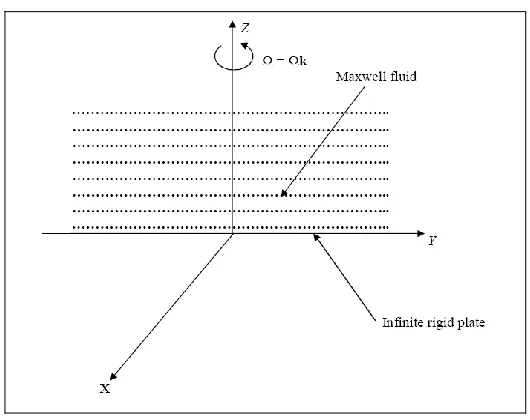
with the rigid oscillating plate at z0. Incompressible, MHD and homogeneous Maxwell fluid fills the semi infinite porous space z0. Here zaxis is taken normal to the plate. The fluid and plate both are at rest at t0and for t 0, the whole system (i.e. fluid and plate) exhibits a rigid body rotation with the constant angular velocity about the zaxis. In addition, the plate at z0 also performs oscillations. The fluid is electrically conducting by constant magnetic field applied in the
2 0
0 0
2
2
,
1 2 1 ,
,
, ; , 0,
F z t B
i F z t
t t t
F z t
F z t z t
k z
(1)
subject to the following initial and boundary conditions
, 0
, 0 0 ; 0,
F z
F z z
t
(2)
0, 0cos
0 or
0, 0sin
0 ; 0,F t U t F t U t t (3)
, 0 ; ; 0.F z t z t (4) In above expressions, F u iv, indicates the fluid density, the dynamic
viscosity, the electrical conductivity, 0 the relaxation time, U0 the amplitude of oscillations, 0 the oscillating frequency, k
0 the permeability and
0 1
the porosity of the porous medium.
3.0 SOLUTIONOFTHEPROBLEM
Setting
2
0 0 0
2
0 0
, zU , tU , ,
F G U U
(5)
the problem statement in dimensionless variables becomes
2 2
0 0
2 2
, , ,
, 0; , 0,
G z t G z t G z t
a b G z t
(6)
( , 0)
( , 0) 0; 0,
G G
(7)
0, cos
or (0, ) sin
; 0,G G (8)
, 0 ; ; 0,G (9) with
2 2 2
2 0 0 2 0 0
2 2 2
0 0 0
2 2
0 0 0 0
1
, , , ,
1
1 2 , 2 ,
B U
M
U K kU U
a i M b i M
K (10)
and the kinematic viscosity. The solutions of problems consisting of Eqs. (6)-(9) are
2 2
0 0
2 2
( , ) exp ,
c
q
G q q a q b
q
(11)
2 2
0 0
2 2
( , ) exp ,
s
G q q a q b
q
(12)
where the subscripts c and s have been used for the cases of cosine and sine oscillations of the plate.
We rewrite Eqs. (11) and (12) as follows
1 3
( , ) ( ) ( , ),
c
G q G q G q (13)
2 3
( , ) ( ) ( , ),
s
1( ) 2 2, 2( ) 2 2,
q
G q G q
q q
(15)
2 23 0 0
2 2
( , ) exp
exp exp
exp ,
G q q a q b
q b q b a
q b (16) 2
2 1 1 1 0 0
1 2 1 2
4
, , , .
4 2
a b
a b a
a b a b
Using G1
L G q1{ 1( )},G2
L G q1{ 2( )},G3( , ) L G1{ 3( , )} q andemploying the convolution theorem [33] we have
1 3 1 3
0
2 3 2 3
0
( , ) ( )( ) , d ,
( , ) ( )( ) , d .
c
s
G G G G s G s s
G G G G s G s s
(17)By inverse Laplace transformation in Eqs. (15) and (16) we get [33]
1 cos , 2 sin .
G G (18)
2 2
3
exp 2 2
1
0, for 0 , ( , )
, for .
b
b
G e
a I a
(19)
Insertion of above expressions in Eqs. (17) leads to the following results
2
2
2
exp cos 2
1
0, for 0 ,
cos ( , )
d , for ,
b c bs s s e G
a I a s s
2
2
2
exp sin 2
1
0, for 0 ,
sin , for
( , ) d . b s bs s s e G
a I a s s
(21)We note that the above starting solutions are meaningful for both small and large times. The last term in each expression approaches zero when is large. Hence this term shows the transient behavior of the velocity. Using
, ,
d
, ,
d
, ,
d ,f s s f s s f s s
(22)the corresponding steady state (Gcs, Gss) and transient solutions (Gc,Gs) can be written as
( , ) ( , ) ( , ), ( , ) ( , ) ( , ),
c cs c s ss s
G G G G G G (23)
( , ) m cos , ( , ) m sin ,
cs ss
G e n G e n (24)
2
2
2
exp cos 2
1
0, for 0 , ( , )
d , for ,
ct
bs s
s
G
a I a s s
(25) 2
2
2
exp sin 2
1
0, for 0 , ( , )
d , for ,
st
bs s
s
G
a I a s s
(26) where
1 1 2 2 2 21 ; 1 .
2 2
m n
The result in Stokes' first problem (i.e. when 0) is
2 2 2 2 2 2 exp 2 2 1 1 1 2 20, for 0 ,
( , )
d , for ,
s
c
s
G
e I s s
(27)For 1 0,
K
M Eq. (26) reduces to the dimensionless velocity field given by Eq. (43) in [31]. When M 0 and K , then Eqs. (19) and (20) corresponding to hydrodynamic fluid in a nonporous space and non-rotating frame become
2
2
2
exp cos 2
1
0, for 0 ,
cos ( , )
d , for ,
b c bs s s e G
a I a s s
(28)
2
2
2
exp sin 2
1
0, for 0 ,
sin , for
( , ) d . b s bs s s e G
a I a s s
(29)It is found that the above expressions are similar to that of Eqs. (20) and (21) in [31]. For viscous fluid [32], Eqs. (17), (18) and (20 can be easily recovered
from Eqs. (23)-(25) when 1 0.
K
M
4.0 GRAPHICALRESULTSANDDISCUSSION
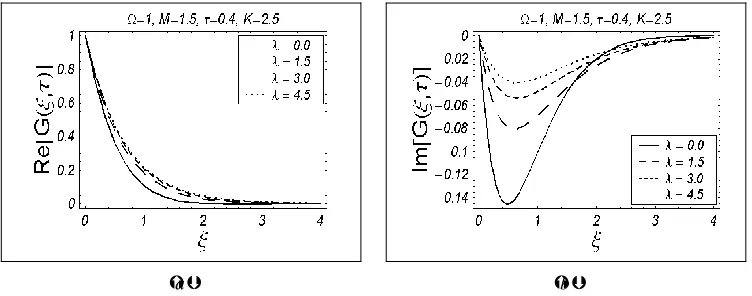
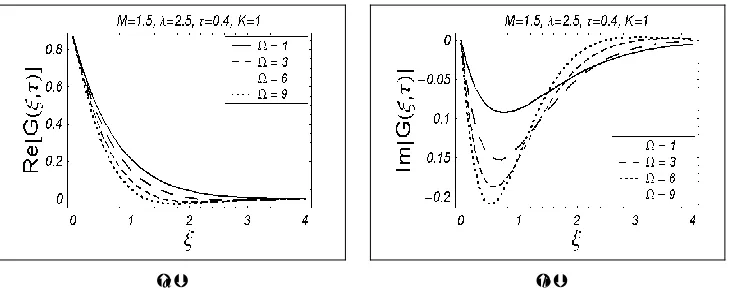
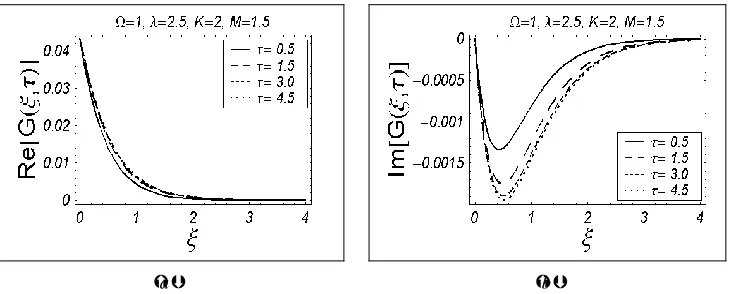
In this section we are interested to predict the real and imaginary parts of velocity for various parameters of interest including , M K, , and . For this aim we display Figs. 2-6. Here the Figs. 2-6 have been potrayed for the
cosine oscillation of a plate. The variation of on the velocity is shown in Fig. .
2 It can be seen that the amplitude of velocity increases and boundary layer thickness decreases for the real part of velocity. However, imaginary part of velocity decreases when is increased. Fig. 3 presents the effects of M and one can note that an increase in M reduces the flow velocity and the boundary layer thickness. This is because of the reason that the magnetic force acts as a resistive force to flow. It can be also noted from the governing Eq. (1) that increasing the porosity Kyields an effect opposite to that of M. Fig. 4 obviously indicates this phenomenon. This is in accordance with the fact that an increase in permeability of the porous medium reduces the drag force which causes an increase in the velocity. The effects of is clearly shown in Fig. 5. It is observed that effects of
on the real part of velocity is similar to that of M. However, the behaviors of
and M on the imaginary part of velocity are not similar. Fig. 6 depicts the variation of the velocity for different values of . It is noted that the variation of time on the velocity is similar to that of K. However, the real part of velocity reduces to the steady state more quickly than the imaginary part of velocity.
a b
a b
Fig. 3: Influence of the MHD parameter M on the velocity field.
a b
Fig. 4: Influence of the porosity parameter K on the velocity field.
a b
a b
Fig. 6: Influence of time on the velocity field.
5.0 CONCLUSION
Motivated by the transient solutions for the problems in a rotating frame, we have studied the flow of Maxwell fluid over an oscillating rigid plate. The steady and transient solutions are developed. The derived expressions satisfy the prescribed initial and boundary conditions. It is noticed that the fluid rheological character, angular velocity and magnetic parameter are capable of changing the flow patterns significantly. Many flows cases for instance the Stokes first problem and viscous fluid are shown as the limiting cases of the present investigation.
ACKNOWLEDGMENTS
REFERENCES
[1] D. Vieru, M. Nazar, C. Fetecau and C. Fetecau, New exact solutions corresponding to the first problem of Stokes' for Oldroyd-B fluids. Computers and Math. Appl., 55:1644-1652, 2008. [2] D. Vieru, T. Hayat, C. Fetecau and C. Fetecau, On the first problem of Stokes' for Burgers' fluid,
II: The cases γ = λ2 /4 and γ > λ2 /4. Appl. Math. Comput., 197:76-86, 2008.
[3] M. Khan, S.H. Ali, T. Hayat and C. Fetecau, MHD flows of a second grade fluid between two side walls perpendicular to a plate through a porous medium. Int. J. Nonlinear Mech., 43:302-319, 2008.
[4] M. Hussain, T. Hayat, C. Fetecau and S. Asghar, On accelerated flows of an Oldroyd-B fluid in a porous medium. Non-Linear Anal. Real World Appl., 9:2403-2414, 2008.
[5] M. Hussain, T. Hayat, S. Asghar and C. Fetecau, Oscillatory flows of second grade fluid in a porous space. Non-Linear Anal. Real World Appl., 11:2403-2414, 2010.
[6] S. Srinivas and M. Kothandapani, The influence of heat and mass transfer on MHD peristaltic flow through a porous space with compliant walls. Appl. Math. Comput., 213:197-208, 2009. [7] T. Hayat, M. Mustafa and I. Pop, Heat and mass transfer for Soret and Dufour's effect on mixed
convection boundary layer flow over a stretching vertical surface in a porous medium filled with a viscoelastic fluid. Comm. Nonlinear Sci. Num. Simul., 15:1183-1196, 2010.
[8] M. Khan, M. Saleem, C. Fetecau and T. Hayat, Transient oscillatory and constantly accelerated non-Newtonian flow in a porous medium. Int. J. Nonlinear Mech., 44:27-30, 2009.
[9] D. Srinivasacharya, N. Srinivasacharyulu and O. Odelu, Flow and heat transfer of couple stress fluid in a porous channel with expanding and contracting walls. Int. Commun. Heat Mass Trans., 36:180-185, 2009.
[10] C. Y. Cheng, Double-diffusive natural convection along a vertical wavy truncated cone in non-Newtonian fluid saturated porous media with thermal and mass stratification. Int. Comm. Heat Mass Trans., 35:985-990, 2008.
[11] T. Hayat, S. Iram, T. Javed and S. Asghar, Shrinking flow of second grade fluid in a rotating frame: An analytic solution. Comm. Nonlinear Sci. Num. Simul., 15:2932-2941, 2010.
[12] A.F. Dizaji, M.R. Salimpour and F. Jam, Flow field of a third-grade non-Newtonian fluid in the annulus of rotating concentric cylinders in the presence of magnetic field. J. Math. Anal. Appl., 337:632-645, 2008.
[13] Mahdy, Soret and Dufour effect on double diffusion mixed convection from a vertical surface in a porous medium saturated with a non-Newtonian fluid. J. Non-Newtonian Fluid Mech., 165:568-575, 2010.
[14] H. A. Attia, Rotating disk flow and heat transfer through a porous medium of a non-Newtonian fluid with suction and injection. Comm. Nonlinear Sci. Num. Simul., 13:1571-1580, 2008. [15] R. Ellahi and S. Afzal, Effects of variable viscosity in a third grade fluid with porous medium: An
analytic solution. Comm. Nonlinear Sci. Num. Simul., 14:2056-2072, 2009.
[16] P. Puri and P. K. Kulsherstha, Rotating flow of non-Newtonian fluids. Applicable Anal., 4:131-140, 1974.
[17] T. Hayat, K. Hutter, S. Nadeem and S. Asghar, Unsteady hydromagnetic rotating flow of a conducting second grade fluid. Z. Angew. Math. Phys., 55:626-641, 2004.
[18] S. Abelman, T. Hayat and E. Momoniat, On the Rayleigh problem for a Sisko fluid in a rotating frame. Appl. Math. Comput., 215:2515-2520, 2009.
[20] K. Fakhar, Y. Cheng, J. Xiaoda and L. Xiaodong, Lie symmetry analysis and some new exact solutions for rotating flow of a second-order fluid on a porous plate. Int. J. Eng. Sci., 44:889-896, 2006.
[21] P. Puri and P.K. Kulshrestha, Rotating flow of non-Newtonian fluids. Appl. Anal., 4:131-140, 1974.
[22] T. Hayat and K. Hutter, Rotating flow of a second order fluid on a porous plate. J. Nonlinear Mech., 39:767-777, 2004.
[23] T. Hayat, K. Hutter, S. Asghar and A. M. Siddiqui, MHD flows of an Oldroyd-B fluid. Math. Comput. Modelling, 36:987-995, 2002.
[24] T. Hayat, M. I. Hameed, S. Asghar and A. M. Siddiqui, Some steady MHD flows of the second order fluid. Meccanica, 39:345-355, 2004.
[25] T. Hayat and S. Abelman, A numerical study of the influence of slip boundary conditions on rotating flow. Int. J. Comput. Fluid Dyn., 21:21-27, 2007.
[26] T. Hayat, C. Fetecau and M. Sajid, On MHD transient flow of a Maxwell fluid in a porous medium and rotating frame. Phys. Lett. A, 372:1639-1644, 2008.
[27] T. Hayat, S. B. Khan and M. Khan, Exact solution for rotating flows of a generalized Burgers' fluid in a porous space. Appl. Math. Model., 32:749-760, 2008.
[28] T. Hayat, C. Fetecau and M. Sajid, Analytical solution for MHD transient rotating flow of a second grade fluid in a porous space. Non-Linear Anal. Real World Appl., 9:1619-1627, 2008. [29] S. Abelman, E. Momoniat and T. Hayat, Steady MHD flow of a third grade fluid in a rotating
frame and porous space. Non-Linear Anal. Real World Appl., 10:3322-3328, 2009.
[30] T. Hayat, S. B. Khan, M. Sajid and S. Asghar, Rotating flow of a third grade fluid in a porous space with Hall current. Nonlinear Dyn., 49:83-91, 2007.
[31] C. Fetecau, M. Jamil, C. Fetecau and I. Siddique, A note on the second problem of Stokes' for Maxwell fluids. Int. J. Nonlinear Mech.,44:1085-1090, 2009.
[32] C. Fetecau, D. Vieru and C. Fetecau, A note on the second problem of Stokes for Newtonian fluids. Int. J. Nonlinear Mech., 43:451-457, 2008.