cision Procedures for Distributed Computing. (Under the direction of Professor Munindar P. Singh).
Current service-oriented architectures lack business-level software abstractions. As a result, existing implementations are unnecessarily rigid. This dissertation takes as its point of departure the idea that agents who offer and consumer business services enter into commitments with one another. These commitments give meaning to the interaction among the agents. Commitments support a semantic notion of compliance and enable flexible enactment of business processes.
Interoperability refers to the ability of agents to engage in interaction with one another. In open systems, where agents are autonomous and heterogeneous, ensuring in-teroperability is critical. Traditionally, inin-teroperability has been formulated in low-level terms. This dissertation presents commitment alignment as a key form of business-level interoperability. Agents are aligned if whenever the creditor of a commitment infers the commitment, the debtor infers it too. A misalignment precludes any possibility of successful engagement among agents—their interaction would break down.
This dissertation formally characterizes alignment in multiagent settings. It presents the causes of misalignment, namely, autonomy, distribution, and heterogeneity. Autonomy means that agents communicate asynchronously; distribution refers to the fact that in dis-tributed systems, some agents may have more information than others; and heterogeneity refers to the fact that agents may have incompatible interfaces.
by
Amit Khushwant Chopra
A dissertation submitted to the Graduate Faculty of North Carolina State University
in partial fulfillment of the requirements for the Degree of
Doctor of Philosophy
Computer Science
Raleigh, North Carolina 2008
APPROVED BY:
Dr. Rada Y. Chirkova Dr. S. Purushothaman Iyer
DEDICATION
BIOGRAPHY
Amit was born in Mumbai to Asha and Khushwant Chopra. His family moved to Pune sometime in the late eighties in pursuit of a better life.
Amit obtained his B.E. in Computer Engineering from the Pune Institute of Com-puter Technology in 1999. Until July 2001, he worked at Persistent Systems (Pune) as a software engineer. Amit then moved to the United States to pursue graduate studies in Computer Science at North Carolina State University. In 2006, he took a break from grad-uate studies and poverty to work at IBM’s WebSphere Technology Institute. In January 2009, Amit will join the University of Trento (Italy) as a postdoctoral researcher.
ACKNOWLEDGMENTS
I am deeply indebted to my advisor Munindar Singh. Munindar read countless drafts, corrected numerous mistakes, and provided astute guidance. As I move on to newer pastures, I hope I have imbibed some of Munindar’s enthusiasm, work ethic, vision, and generosity.
I am grateful to Professors Chirkova, Iyer, and Vouk for the time and effort they expended as my committee members. Over the years, I have benefitted amply from their questions and suggestions.
I have benefitted greatly from interactions with former and current colleagues at NC State, especially Nirmit Desai (IBM Research) and Ashok Mallya (eBay). Scott Gerard and Pankaj Telang have happily served as sounding boards for my ideas. Chris Hazard provided useful comments on various drafts and presentations.
I have had several interesting discussions on agent interoperability with Matteo Baldoni, Cristina Baroglio, and Viviana Patti (all at the University of Torino). Michael Winikoff (University of Otago) and Gal Kaminka (Bar Ilan University) gave me useful advice, technical and professional. I also had fruitful discussions about my work with Annie Ant´on, James Lester, Laurie Williams, and Tao Xie (all at NC State).
A special thanks goes out to the staffs of the Department of Computer Science and the Office of International Services at NC State. They made all administrative procedures relatively painless.
Ashok Mallya, Mrudula Neginhal, Vishwas Puttasubbappa, Hemant Ramnani, and Amit Sharma gave me the gift of unwavering friendship. For that, I’m deeply grateful.
I have been away from my parents for a long time now. My mother, especially, has felt the pangs of my absence. I owe her much.
Soon I will be leaving the shores of the United States, and I do not know if I will ever have the opportunity to come live here again. I feel a sense of gratitude towards the people of the United States—living here has been a singularly liberating experience.
TABLE OF CONTENTS
LIST OF TABLES . . . vii
LIST OF FIGURES . . . viii
1 Introduction: Commitments . . . 1
1.1 Trends in Business Processes . . . 2
1.1.1 Orchestration . . . 2
1.1.2 Choreography . . . 4
1.2 Commitment Protocols . . . 6
1.2.1 Commitments . . . 7
1.2.2 Protocol Specification . . . 8
1.2.3 Compliance and Flexibility . . . 9
1.3 Dissertation Topic: Commitment Alignment . . . 10
1.3.1 Causes of Misalignment . . . 12
1.3.2 Results . . . 12
1.4 Organization . . . 13
2 Commitment Alignment . . . 14
2.1 Commitments . . . 14
2.1.1 Reasoning Postulates for Commitments . . . 14
2.1.2 Commitment Operations . . . 15
2.1.3 Messages . . . 15
2.1.4 Commitment Strength . . . 16
2.2 Agents and Communication . . . 17
2.3 Formalizing Alignment . . . 18
2.3.1 Quiescence . . . 18
2.3.2 Integrity . . . 19
2.3.3 Alignment . . . 21
3 Handling Autonomy and Distribution . . . 22
3.1 Introduction . . . 22
3.1.1 Motivation . . . 23
3.1.2 Contributions . . . 26
3.1.3 Organization . . . 26
3.2 Principles of Alignment . . . 27
3.3 Formalization of the Principles . . . 30
3.3.1 Inform . . . 32
3.3.2 Two-Party Operations . . . 32
3.3.4 Notifications . . . 36
3.3.5 Priority . . . 37
3.4 Correctness Proof . . . 38
3.5 Discussion . . . 39
3.5.1 Generality of Approach . . . 39
3.5.2 Applications . . . 41
3.5.3 Multiagent Belief Consistency . . . 42
3.5.4 Service-Oriented Architectures . . . 43
4 Handling Heterogeneity . . . 44
4.1 Introduction . . . 44
4.1.1 Commitments . . . 46
4.1.2 Commitment-Based Interoperability . . . 46
4.1.3 Contributions and organization . . . 48
4.2 Technical Framework . . . 48
4.2.1 Constitutive Specifications . . . 48
4.2.2 Operational Semantics . . . 50
4.3 Constitutive Interoperability . . . 52
4.3.1 Definition . . . 52
4.3.2 Decision Procedure . . . 53
4.4 Discussion . . . 63
5 Discussion . . . 65
5.1 Commitments and Agent Communication . . . 65
5.2 Software Engineering . . . 66
5.2.1 Architecture and Patterns . . . 67
5.2.2 Software Components and Interoperability . . . 69
5.3 Future Work . . . 70
5.3.1 Metacommitments . . . 70
5.3.2 Richer Interface Language . . . 71
5.3.3 Tools and Middleware for Enterprises . . . 71
LIST OF TABLES
Table 1.1 A commitment protocol. . . 9
Table 1.2 Comparison of approaches . . . 10
Table 3.1 Constraints on agent behavior . . . 35
Table 4.1 Constitutive specifications of a customer and merchant. . . 49
Table 4.2 Offer . . . 53
Table 4.3 Offer with antecedent and consequent rules . . . 54
Table 4.4 Antecedent coverage: merchant uses fewer messages . . . 59
Table 4.5 No antecedent coverage: customer uses fewer messages . . . 60
Table 4.6 Offer with jumbled but adequate meanings . . . 61
Table 4.7 Making an unconditional commitment . . . 61
Table 4.8 Consequent coverage . . . 61
Table 4.9 Consequent coverage: case of adequate meaning . . . 62
LIST OF FIGURES
Figure 1.1 A merchant’s business process, modeled in BPMN . . . 3
Figure 1.2 A choreography specified as a state machine . . . 5
Figure 1.3 An alternative, more flexible choreography . . . 6
Figure 1.4 Interaction and meaning . . . 9
Figure 1.5 Flexible enactment . . . 11
Figure 2.1 Quiescence. . . 19
Figure 2.2 Notifying about detaches . . . 20
Figure 3.1 Scenarios (B),(C), and (D) end in misalignment . . . 24
Figure 3.2 Proposed approach . . . 28
Figure 3.3 Race between cancel and detach . . . 30
Figure 3.4 The delegate and assign patterns. . . 34
Figure 3.5 Detach notifications . . . 36
Figure 3.6 Discharge notification . . . 37
Figure 4.1 Program analysis graph for agents in Table 4.2 . . . 58
Figure 4.2 Program analysis graph for agents in Table 4.3 . . . 58
Figure 4.3 Program analysis graph for agents in Table 4.4 . . . 59
Figure 4.4 Program analysis graph for agents in Table 4.5 . . . 60
Figure 4.5 Program analysis graph for agents in Table 4.8 . . . 62
Chapter 1
Introduction: Commitments
Today, the world is witnessing an explosive growth in the number and richness of online services. We use such services daily—when we are pay our utility bills, make airline and hotel reservations, buy and sell things on eBay, manage our bank accounts . . .the list is endless. The growth is not limited to consumer facing services; more and more organizations are conducting their procurement and sales processes electronically. The proliferation of such services belies the complexity of their construction. Most service enactments involve multiple autonomous and heterogeneous organizations. For example, booking an airline ticket involves not just the user, the travel agency, and the airline, but also various credit card companies and banks, each with their own independently designed information systems. This raises the tremendous challenge of interoperation: how can we ensure interoperation between such diverse business organizations?
The question of interoperability squarely puts the focus on the modeling of inter-actions among organizations. In open settings, such as the Web, accommodating flexible interaction is as much a concern as interoperability. From a business point of view, it makes sense that an organization offering services on the Web should be able to interact and con-duct business with the widest possible set of organizations, and be able to take advantage of opportunities and handle exceptions. However, there is a certain tension between inter-operability and flexibility. Flexibility means that more interactions are supported, which makes determining interoperability tougher.
supports flexible interactions. Our approach recognizes the lack of business-level abstrac-tions in current approaches for modeling interacabstrac-tions, and fills that gap. This chapter lays the groundwork for the results in this dissertation.
1.1
Trends in Business Processes
Traditionally business processes were used to automate the internal operations of an organization. The operations were modeled as workflows. Workflow management sys-tems [Georgakopoulos et al., 1995] such as MQSeries, Lotus Notes, FlowMark, and Staffware were used to enact and manage the flows. This was before the e-business era, and the typ-ical applications were form processing, office automation, computer-supported cooperative work, and the paperless office.
As the potential of e-business became apparent, organizations sought not only to automate their internal operations, but also to automate interactions with their busi-ness partners. Interoperation posed the biggest challenge: how do heterogeneous software components representing different organizations interact meaningfully? That gave rise to approaches such as EDI (Electronic Data Interchange). The EDI standard describes data formats for documents such as a purchase order. The business organizations participating in an EDI process agree upon the documents to be transmitted and how they should be used. Automated supply chains emerged in this stage. The problem with EDI, however, was that it resulted in preconfigured, highly customized, and inflexible processes. Instead of achiev-ing interoperation among the participants, EDI resulted in integration of the participants’ information systems—thoroughly less desirable.
Web services emerged to address the problem of heterogeneity in a more elegant way. A Web service is an application with a published interface that clients can use to interact with it. Interfaces are the basis of interoperation; a client has simply to act accord-ing to the interface to avail of the Web service. Two principal approaches for weavaccord-ing Web services into business processes emerged: orchestration andchoreography.
1.1.1 Orchestration
loops, conditional branching, fork, join, and so on. BPEL [2003] is a widely used and industry-supported language for writing such workflows. OWL-S [Martin et al., 2007] is another language designed for orchestrating services, with a special emphasis on Semantic Web. BPMN [2008] is a graphical notation for expressing orchestrations. Orc [Cook and Misra, 2007] is a minimal orchestration language with only three coordination primitives using which complex orchestrations may be built.
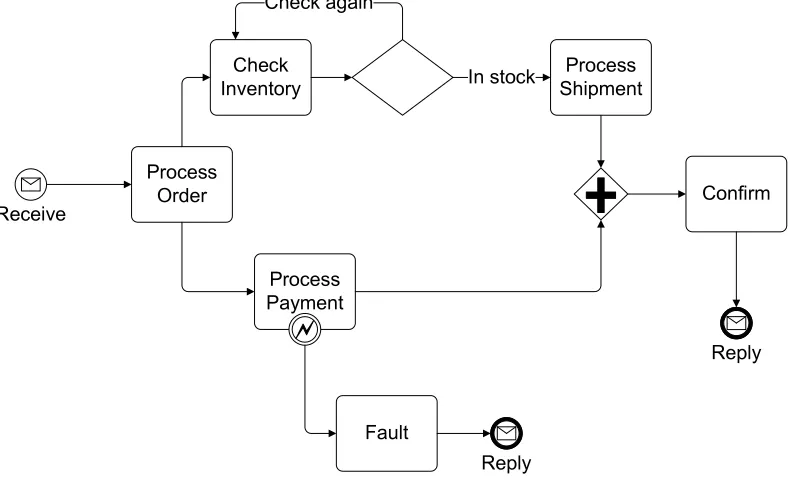
Figure 1.1 shows the workflow of a merchant in BPMN notation. The merchant receives an order from a customer, following which the merchant invokes theProcess Order
service. After the order is processes, the merchant invokes theCheck Inventoryand Process Paymentservices in parallel. If the item ordered is not in the inventory, the merchant checks again. Otherwise, the item is shipped to the customer. If the payment is processed as well, the merchant sends a confirmation to the customer and exits the workflow.
Figure 1.1: A merchant’s business process, modeled in BPMN
We make the following observations about orchestration-based approaches.
processes an order. An orchestration is, in fact, the implementation of a particular participant. Notice how the internal policies of merchant, as indicated by the decision node representing the inventory check, is mixed with service invocations. Whether to invoke services concurrently or serially is also an internal policy matter for the merchant.
• Orchestration is an invocation-based approach. Services are treated on par with com-putational objects. In Figure 1.1, the merchant invokes the Process Order, Check
Inventory, Process Payment, and Process Shipment services to fulfill an order. Inter-actions with other participants in the overall business process find no place in an orchestration. For example, in Figure 1.1, participants that one might reasonably expect to be involved in an order fulfillment process, such as a bank and a shipper, find no place. Not just that, even the customer is not explicitly represented. True, such participants may be behind the services that are invoked. However, a service is not the same as a participant. Participants have autonomy and can be engaged, whereas services are merely invoked.
1.1.2 Choreography
A choreographyprescribes how the participants in a business process interact by specifying the flow of messages between them. This is achieved by using control and data flow constructs, not unlike those used for specifying orchestrations.
A choreography may be understood as the interaction protocol among the par-ticipants. Typically, a choreography is specified in terms of roles rather the participants themselves. Participants adopt roles, that is, bind to the roles, in the choreography. This promotes reusability.
WS-CDL [2005] and ebBP [2006] are the leading industry supported choreogra-phy standardization efforts. UML [Huget and Odell, 2005] is another leading approach for specifying choreography. A choreography may also be specified formally: as state ma-chines [Yellin and Strom, 1997; Benatallah et al., 2004], Petri Nets [Cost et al., 1999], stat-echarts [Dunn-Davies et al., 2005], processes in the π-calculus [Canal et al., 2003], or via more declarative approaches [Singh, 2003; van der Aalst and Pesic, 2006].
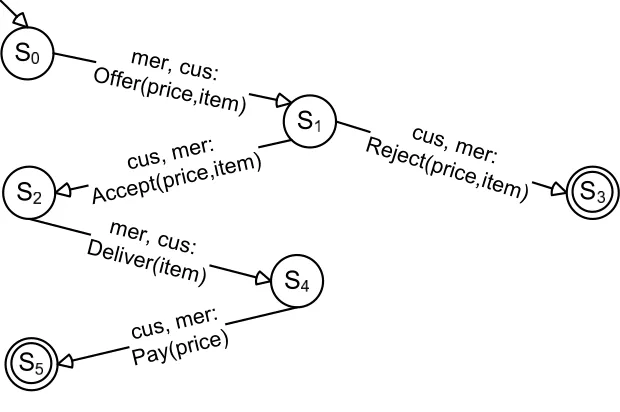
(cus) as a state machine. The transitions are labelled with messages; the prefix mer,cus
indicates a message from the merchant to the customer, and cus,mer indicates a message from the customer to the merchant. This choreography supports two executions. One execution represents the scenario where the customer rejects the merchant’s offer. The other execution represents the scenario where the customer accepts the offer, following which the merchant and the customer exchange the item and the payment for the item.
Figure 1.2: A choreography specified as a state machine
We make the following observations about choreographies.
• A choreography specifies only the interactions among participants. In doing so, it ab-stracts away from some of the implementation details of the participants. For example, Figure 1.2 does not reflect the internal policies based upon which the customer accepts an offer. Further, a choreography specifies the interactions ofall the participants in a business process.
• Choreography is an interaction-oriented approach. It acknowledges autonomy by giv-ing first-class status to participants and their interactions.
HL7; TWIST]. We find this trend encouraging; however, this approach also falls short in supporting autonomy.
Consider the choreography in Figure 1.3. The dotted paths indicate two addi-tional executions that are not supported by the choreography in Figure 1.2. The executions depict the scenarios where the customer sends the payment upon receiving an offer and after sending accept, respectively. These additional executions are just as sensible as the original ones. However, in the context of the choreography in Figure 1.2, these executions are trivially noncompliant. The reason is that checking compliance with choreographies is purely syntactical—the messages have to flow between the participants exactly as pre-scribed. Clearly, this curbs the participants’ autonomy and flexibility.
Figure 1.3: An alternative, more flexible choreography
1.2
Commitment Protocols
[Chopra and Singh, 2004; Singh et al., 2004; Desai et al., 2005; Winikoff et al., 2005], [Desai et al., 2007b]. Computationally, each participant is modeled as anagent; interacting agents carry out a service engagement by creating and manipulating commitments to one another.
1.2.1 Commitments
A commitment is of the form C(debtor,creditor,antecedent,consequent), where debtor andcreditor are agents, andantecedent andconsequent are propositions. A commit-mentC(x, y, r, u) means thatx is committed toy that ifr holds, then it will bring aboutu. If r holds, then C(x, y, r, u) is detached, and the commitment C(x, y,⊤, u) holds (⊤ being the constant for truth). If u holds, then the commitment is discharged and doesn’t hold any longer. All commitments are conditional; an unconditional commitment is merely a special case where the antecedent equals⊤. Examples 1–3 illustrate these concepts. In the examples, Bookie is a bookseller, and Alice is a customer.
Example 1 (Commitment)C(Bookie,Alice,$12,BeatingtheOdds) means that Bookie com-mits to Alice that if she pays $12, then Bookie will sends her the book Beating the Odds.
Example 2 (Detach) If Alice makes the payment, that is, if $12 holds, then
C(Bookie,Alice,$12,BeatingtheOdds) is detached. In other words,C(Bookie,Alice,$12, BeatingtheOdds)∧$12⇒C(Bookie,Alice,⊤,BeatingtheOdds).
Example 3 (Discharge) If Bookie sends the book, that is, if BeatingtheOdds holds, then bothC(Bookie,Alice,$12,BeatingtheOdds) andC(Bookie,Alice,⊤,BeatingtheOdds) are dis-charged. In other words, BeatingtheOdds⇒ ¬C(Bookie,Alice,$12,BeatingtheOdds)∧ ¬C(Bookie,Alice,⊤,BeatingtheOdds).
Importantly, commitments can be manipulated, which supports flexibility. The commitment operations are reproduced below (from [Singh, 1999]). create,cancel, and release are two-party operations, whereas delegate and assignare three-party opera-tions.
• cancel(x, y, r, u) is performed by x, and it causesC(x, y, r, u) to not hold. • release(x, y, r, u) is performed by y, and it causes C(x, y, r, u) to not hold. • delegate(x, y, z, r, u) is performed byx, and it causesC(z, y, r, u) to hold. • assign(x, y, z, r, u) is performed by y, and it causes C(x, z, r, u) to hold.
We introduce inform(x, y, r) as an operation performed by x to inform y that the r holds. It is not a commitment operation, but may indirectly affect commitments by causing detaches and discharges. In relation to Example 2, when Alice informs Bookie of the payment by performinginform(Alice,Bookie,$12), then the proposition $12 holds, and causes a detach of C(Bookie,Alice,$12,BeatingtheOdds). A complete, formal treatment of commitments is presented in Chapter 2.
A commitment arises in a social or legal context. The context defines the rules of encounter among the interacting parties, and often serves as an arbiter in disputes and imposes penalties on parties that violate their commitments. For example, eBay is the context of all auctions that take place through their service; if a bidder does not honor a payment obligation for an auction that it has won, eBay may suspend the bidder’s account.
1.2.2 Protocol Specification
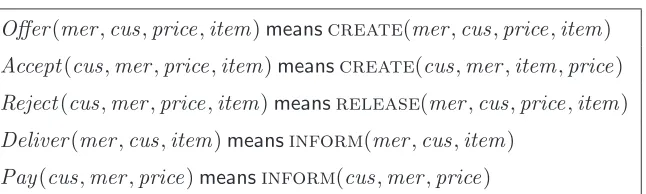
Table 1.1 shows the specification of a commitment protocol between a merchant and a customer (omitting sort and variable declarations). It simply states what the mean-ings of the messages are in terms of commitments between the merchant and customer. For instance, the message Offer(mer,cus,price,item) means the creation of the commit-mentC(mer,cus,price,item), meaning the merchant commits to delivering the item if the customer pays the price; Reject(cus,mer,price,item) means a release of the commitment; Deliver(mer,cus,item) means that the proposition item holds.
Table 1.1: A commitment protocol
Offer(mer,cus,price,item)meanscreate(mer,cus,price,item) Accept(cus,mer,price,item)meanscreate(cus,mer,item,price) Reject(cus,mer,price,item)meansrelease(mer,cus,price,item) Deliver(mer,cus,item)meansinform(mer,cus,item)
Pay(cus,mer,price)meansinform(cus,mer,price)
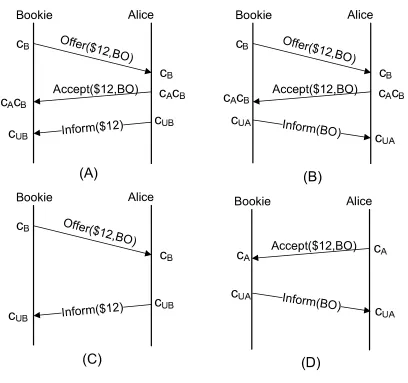
the Create message realizes the create operation. Likewise, for other operations and inform.) In the figure, the merchant and customer are played by Bookie and Alice, re-spectively; cB and cU B are the commitments C(Bookie,Alice,$12,BeatingtheOdds) and
C(Bookie,Alice,⊤,BeatingtheOdds) respectively;BO is abbreviation forBeating the Odds.
Figure 1.4: Interaction and meaning
1.2.3 Compliance and Flexibility
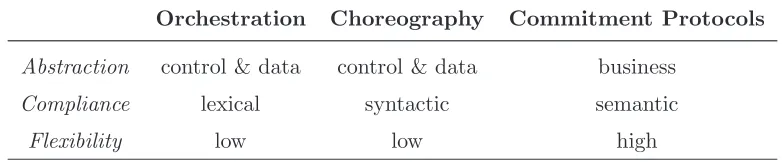
Table 1.2: Comparison of approaches
Orchestration Choreography Commitment Protocols
Abstraction control & data control & data business
Compliance lexical syntactic semantic
Flexibility low low high
customer may return damaged goods for credit; and so on. Conversely, a customer would be in violation if he keeps the goods but fails to pay. In this manner, commitments sup-port business-level compliance and don’t dictate specific operationalizations [Desai et al., 2005]. By contrast, without business meaning, exercising any such flexibility would result in noncompliant executions.
Figure 1.5 shows some of the possible enactments based on the protocol in Ta-ble 1.1. Figure 1.5(B) reflects the execution where the book and payment are exchanged in Figure 1.2;cAandcU AareC(Alice,Bookie,BeatingtheOdds,$12) andC(Alice,Bookie,⊤,$12), respectively. Figures 1.5(A) and (C) reflect the additional executions supported in Fig-ure 1.3; FigFig-ure 1.5(D) reflects a new execution that we hadn’t considered before, one where Alice sends an Accept even before receiving an offer. All these executions are compliant executions in terms of commitments, and thus supported by the protocol in Table 1.1.
Table 1.2 summarizes the three approaches.
1.3
Dissertation Topic: Commitment Alignment
A challenge that arises in distributed systems is that of state alignment. Alignment is closely related to the problem of consistency in distributed systems. Consistency in a distributed system is typically achieved by synchronizing the nodes in the system. For example, as is common in business process implementations, a two-phase commit protocol is used to synchronize the parties. By alignment, we mean that the agents involved in an interaction should have a consistent view of their commitments to each other. If agents cannot even agree about their commitments to each other, one can hardly expect that they’d be able to engage in business, that is, interoperate with each other.
commit-Figure 1.5: Flexible enactment
ment in which it is the creditor, the debtor of the commitment also infers that commitment. Let’s consider some examples of misalignment.
Example 5 Alice commits to Bob that if the sky is clear at 5PM, then she will meet him at the lake. At 5PM, Bob observes (a message from the environment) that the sky is clear, and therefore infers that Alice is unconditionally committed to meeting him at the lake. However, Alice does not know that the sky is clear, and therefore does not infer the unconditional commitment. Bob and Alice are thus misaligned.
Example 6 For Alice, anOffermessage from Bookie counts as a commitment from Bookie to ship a book in return for payment. Whereas for Bookie, Offer does not count as any such commitment; but an explicit Accept from Alice does. Thus, when Bookie sends Alice an Offer message, Alice infers the commitment, but Bookie does not—a misalignment.
1.3.1 Causes of Misalignment
There are three possible causes of misalignment.
Autonomy Agents are autonomous. This means that they are free to send messages. In turn, this means that communication between them is asynchronous. Thus, in general, agents observe messages in different orders. If their observations are incompatible, it may cause a misalignment. This is the cause of misalignment in Example 4.
Distribution In a distributed system, some agents may have more information than others. This is the cause of misalignment in Example 5: Bob knows that the sky is clear, but Alice does not.
Heterogeneity Agents may assign incompatible meanings to the messages they are ex-changing. To be able to successfully interact, the agents must agree on what their communications count as. Heterogeneity is the cause of misalignment in Example 6.
1.3.2 Results
Our contributions are the following.
2. We address the challenge of autonomy by defining the semantics of commitment op-erations. We handle distribution by putting local constraints on the behaviors of agents. Under the semantics and the constraints together, we prove that autonomy and asynchrony cause no misalignments.
3. We delineate two criteria that any approach for alignment must meet: autonomy com-patibility and semanticity. Both autonomy compatibility and semanticity are crucial in arriving at a general solution for alignment. Our formalization meets both these criteria.
4. To handle heterogeneity, we formalize the interfaces of agents in terms of commit-ments, and present a decision procedure which determines if agents’ interfaces are compatible.
If no misalignment happen due to autonomy and distribution, and if the interfaces of agents are compatible (for the interface language we use), then no misalignment occurs.
1.4
Organization
Chapter 2
Commitment Alignment
We present reasoning postulates for commitments, and a general model of asyn-chronous communication. Finally, we characterize alignment itself.
2.1
Commitments
Below, x,y, etc are variables over agents; p, q, r, etc. are propositional variables; ∨,∧,¬,→,↔are the usual propositional connectives; ⊤and⊥are the constants for truth and falsity, respectively;⊢ is the usual propositional inference symbol. Read ⇒asimplies. A commitment is of the formC(x, y, r, u). Ifr holds, thenC(x, y, r, u) isdetached, and the commitmentC(x, y,⊤, u) holds. Ifuholds, then the commitment isdischarged and doesn’t hold any longer. All commitments are conditional; an unconditional commitment is merely a special case where the antecedent equals⊤.
2.1.1 Reasoning Postulates for Commitments
Reasoning postulates for commitments are reproduced below [Singh, 2008]. For brevity, we omit the agents when they can be understood from the context. Further, when the postulates uniformly use the debtor x and creditor y, we write C(r, u) instead of
C(x, y, r, u).
B1. discharge. u→ ¬C(r, u)
B3. augment. FromC(r, u)∧s⊢r, infer C(s, u) B4. l-disjoin. C(r, u)∧C(s, u)→C(r∨s, u) B5. r-conjoin. C(r, u)∧C(r, v)→C(r, u∧v) B6. consistency. ¬C(r,⊥)
B7. nonvacuity. Fromr ⊢u, infer¬C(r, u) B8. weaken. C(r, u∧v)∧ ¬u→C(r, u)
Notice that B1 covers the discharge of commitments. B2 generalizes their detach. Semanticity means that alignment must not fail in the face of reasoning postulates B1–B8. That is, we must make sure that the effects of the various messages on commitments are consistent with respect to the above postulates.
2.1.2 Commitment Operations
The commitment operations are reproduced below (from [Singh, 1999]). create, cancel, andreleaseare two-party operations, whereasdelegateand assignare three-party operations.
• create(x, y, r, u) is performed by x, and it causes C(x, y, r, u) to hold. • cancel(x, y, r, u) is performed by x, and it causesC(x, y, r, u) to not hold. • release(x, y, r, u) is performed by y, and it causes C(x, y, r, u) to not hold. • delegate(x, y, z, r, u) is performed byx, and it causesC(z, y, r, u) to hold. • assign(x, y, z, r, u) is performed by y, and it causes C(x, z, r, u) to hold.
2.1.3 Messages
Let us define the set of messages that agents can exchange. Let Φ be a set of atomic propositions. Inform(x, y, p) is a message from x to y, where p is conjunction over Φ. In the commitment operations, r is a DNF formula over Φ (for example, (φ0 ∧
Create(x, y, r, u) and Cancel(x, y, r, u) are messages from x to y; Release(x, y, r, u) from y to x;Delegate(x, y, z, r, u) fromx to z; and Assign(x, y, z, r, u) fromy to x.
Supposec=C(x, y, r, u). ThenCreate(c) stands forCreate(x, y, r, u). We similarly defineDelegate(c, z), Assign(c, z),Release(c, y), andCancel(c, x).
All atomic propositions are stable, that is, if an atomic proposition holds, it holds forever. In English, stability corresponds to the perfective aspect, for example, book has been delivered,payment has been made, and so on [Singh, 2008]. Propositions with explicit time, such as the book is delivered by 3PM are also stable. Thus each atomic proposition corresponds to the occurrence of an event: when the proposition holds, the corresponding event is said to have occurred. A commitment, however, is not a stable proposition. A commitment may come to not hold because it was discharged, cancelled, or released, leaving the agents sensitive to race conditions over commitments.
2.1.4 Commitment Strength
We’ll use the following commitments frequently.
• cB =C(Bookie, Alice,$12, BeatingtheOdds)
• cG=C(Bookie, Alice,$12, GamblingT ips)
• c0 =C(Bookie, Alice,$12, BeatingtheOdds∧GamblingT ips)
• c1 =C(Bookie, Alice,$12∨coupon, BeatingtheOdds)
• c2 =C(Bookie, Alice,$12∧coupon, BeatingtheOdds)
Intuitively,c0 is a stronger commitment thancB (an additional book for the same price); c1 is stronger than cB (two ways to obtain a book instead of one); cB is stronger thanc2 (fewer conditions need to be satisfied to obtain a book). Definition 1 captures this
intuition.
Definition 1 C(x, y, r, u) is stronger thanC(x, y, s, v), denoted byC(x, y, r, u)C(x, y, s, v), iff s⊢r andu⊢v.
Thus, for example, c0 cB. If C(x, y, r, u) C(x, y, s, v) but C(x, y, s, v) 6
deductively. For example, if c1 holds, then by B3, cB holds as well. Similarly, if c0 holds,
then by B8,cB holds as well—unlessBeatingtheOddsholds already in which case according to B1, cB cannot hold.
2.2
Agents and Communication
Agents communicate by messaging. Below m,m′,m
0, . . . are variables over
mes-sages. Assumptions A1–A4 model communication.
A1. Communication ispoint-to-point. Below m(x, y) indicates a messagem from x to y.
A2. An agent observes all and only those messages that it sends or receives. Observa-tions are ordered serially. All observations pertain to messages. Observations of the environment are treated as messages fromEnv.
A3. Messaging is reliable. Messages are neither created nor destroyed by the infrastruc-ture.
A4. Messaging is ordered. Any two messages sent by an agent to the same recipient are received in order.
An agent x’s observation sequence hm0, . . . , mnix describes the sequence of mes-sages x observes in a particular execution. Let A be a system of k agents. Then, O = [O0, . . . , Ok−1] is anobservation vector overA, where theOis are the observation sequences, one for each of the k agents. Below, o is a variable over observation vectors; ox, etc. are variables over a particular agent’s observation sequence. A3 and A4 impose validity re-quirements on vectors.
Definition 2 An observation vector O over A is valid iff ∀x, y∈ A: (1) if m(x, y) occurs in Oy, then m(x, y) occurs in Ox; and (2) ifm1(x, y) occurs in Oy, and m0(x, y) precedes
m1(x, y) in Ox, then m0(x, y) precedesm1(x, y) inOy.
Conditions (1) and (2) in Definition 2 capture A3 and A4, respectively. This paper considers only valid observation vectors.
observations). Then an observation vector represents the state of the system. OA, the set of all possible observation vectors for system A, is the set of all possible executions ofA.
2.3
Formalizing Alignment
Alignment means that whenever an agent infers a commitment from its observa-tions in which it is the creditor, then the debtor must also infer the commitment from its observations. An execution of a multiagent system is a progression of the system from one (system) state to another. Every time an agent sends or receives a message, the system progresses to a new state. Although we would like to consider all possible executions of the system, we need to ensure that we verify alignment only at well-defined milestones; otherwise, we would falsely claim misalignment. The appropriate milestones are expressed via quiescence andintegrity.
Figure 2.2(B) exemplifies our graphical notation. We represent an execution as a sequence diagram. Each point where a message is sent or received is annotated with the commitments inferred immediately after the observation. If C(r, u) holds and C(r, u)
C(s, v), we only show C(r, u). Each agent’s vertical line may be annotated at the top to indicate initial conditions of the interaction.
2.3.1 Quiescence
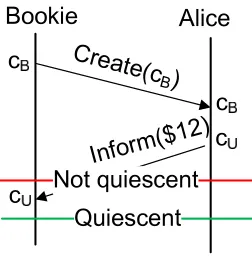
A system state is quiescent if no messages are in transit. In considering only quiescent states, we ensure the agents are “synced” up when we verify their alignment. Without quiescence, alignment is generally impossible because some agents may not yet have observed messages destined for them.
Figure 2.1: Quiescence
This means that there are no messages in transit in the system. Definition 3 states that an observation vector isquiescent if and only if every sent message has been received.
Definition 3 An observation vector O ∈ OA is quiescent iff∀x, y∈ A, ifm(x, y) occurs in Ox, then m(x, y) occurs inOy.
2.3.2 Integrity
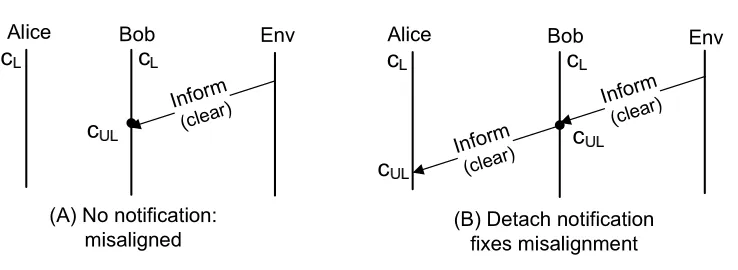
Consider Figure 2.2(A). Initially, Alice is committed to Bob that if the sky is clear, then she will meet him at the lake, meaningcL=C(Alice, Bob, clear,lake). We model Bob’s observation of the sky as a message that Bob receives from the environment Env. Now, Bob infers the unconditional commitment cUL=C(Alice, Bob,⊤,lake) whereas Alice does
not yet infercUL(maybe because she is in a basement and cannot look at the sky). Thus,
Bob and Alice would be misaligned. The main problem is that Bob has received some vital information that Alice might not have.
Figure 2.2: Notifying about detaches
We now show how to specify integrity constraints on observations. Chapter 3 specifies the integrity constraints relevant to alignment. First though, some preliminaries. LetOx be an observation sequence of the formh. . . , mix. Then, for any messagem′,Ox;m′ is the concatenation ofOxwithm′, and is of the formh. . . , m, m′ix. LetS(Ox) be the set of propositions that can be inferred from the observation sequenceOx. (Chapter 3 formalizes
S(Ox).) If p 6∈ S(Ox), we say ¬p ∈ S(Ox). The empty condition ε is trivially in S(Ox).
S(Ox) may be thought of as thestate ofx after observing the messages in Ox.
⌊m[B:A]m′⌋
x is an integrity constraint on the observations of agent x. Here, B andA are thebefore andafter conditions for the trigger m, andm′ is theeffect ofm if the before and after conditions are met.
Definition 4 Consider a constraint ⌊m[B :A]m′⌋
x. m′ is an enabled effect of m with respect to an observation sequence oand the constraint iffB ∈ S(o) and A∈ S(o;m).
An observation sequenceOx is integral with respect to a set of constraints iff for any prefix o;m of Ox, o;m;M is a prefix of Ox, where M contains an interleaving of the enabled effects ofm with respect too and the set of constraints.
An observation vector is integral with respect to a set of constraints iff each ob-servation sequence in it is integral with respect to the set of constraints.
between the trigger and its enabled effects; however, those observations are not visible for the purposes of alignment.
2.3.3 Alignment
Now we formally define alignment—that agents would agree about whatever com-mitments as might result from any messages they might exchange. Definition 5 formalizes the notion of alignment by considering all potential observations of all agents.
Definition 5 A multiagent system A isaligned (written [hAi]) iff ∀O∈ OA such that O is quiescent and integral, ∀x, y∈ A:C(x, y, r, u)∈ S(Oy)⇒C(x, y, r, u)∈ S(Ox).
Chapter 3
Handling Autonomy and
Distribution
Chapter 2 characterized commitment alignment. This chapter proposes the princi-ples thatensurealignment despite distribution. In other words, if agents compute according to these principles, alignment is guaranteed. The principles essentially say how the commit-ments of agents should be computed, and how the agents must act to maintain alignment. We formalize the principles using the technical framework presented in Chapter 2, and prove that under the principles (and the communication model introduced in Chapter 2), any multiagent execution is aligned.
3.1
Introduction
C(debtor,creditor,antecedent,consequent) means the debtor commits to the cred-itor that if antecedent holds, then the consequent will hold. An important insight in agent communication is that the interactions among agents may be understood in terms of their effects on the agents’ commitments. For example, an offer for a copy of the bookBeating the Odds from Bookie to Alice may be interpreted as C(Bookie, Alice,$12, BeatingtheOdds). In other words, Bookie commits that if Alice pays $12, then Bookie will deliver the book.
agents remain aligned with respect to their commitments. Crucially, it turns out that even well-designed, well-behaved agents may become misaligned simply because of the distributed nature of the given system. Previous approaches have largely ignored this problem or addressed it through restrictive, ad hoc assumptions. However, as commitment protocols expand into real-life distributed settings, a rigorous treatment becomes essential.
We consider realistic, distributed settings where agents communicate via asyn-chronous messaging. Asynchrony means that an agent is never blocked from sending a message. In such a system, the messages that the agents send each other may cross on the wire. Thus, in general, the agents may observe different messages in different orders. Since messages are understood in terms of their effects on commitments, the agents involved would become misaligned, i.e., come to conflicting conclusions about which commitments hold and which do not.
It is crucial to develop a formalization of commitments that ensures alignment despite asynchrony. First, distributed computing infrastructure is necessarily asynchronous. Large-scale systems exhibit high latency making synchronous interactions simply intractable in practice. Second, any formalization that works despite asynchrony also works in “more synchronous” settings, that is, those imposing additional constraints on agent behavior—for example, one where agents take turns sending messages. Third, asynchrony is inherently compatible with agent autonomy simply because an agent is never blocked from sending a message and, more pertinently, from acting upon its commitments.
In the absence of a formalization that supports reasoning about commitments in distributed settings, all research in applications of commitments is bound to report results that are either not general enough or are unduly complex. Such a formalization is currently missing; this paper seeks to fill this gap.
3.1.1 Motivation
addresses the second problem. Let’s consider some examples to highlight the problem.
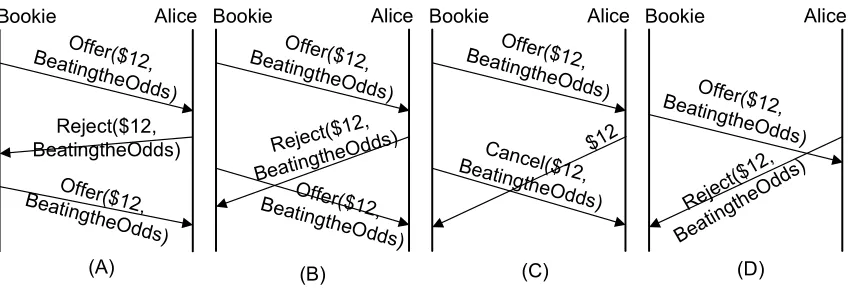
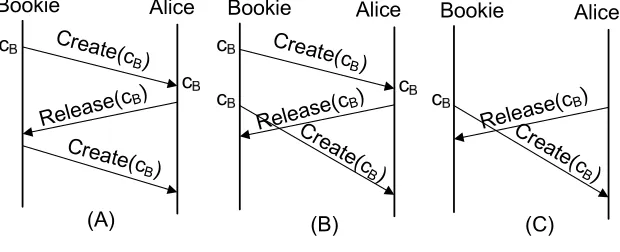
Example 7 (Figure 3.1(A)). Bookie sends Alice (a message that expresses) an offer that if she pays $12, then Bookie will deliver to her a copy of the book Beating the Odds. Alice sends Bookie a rejection of the offer. Upon receipt, Bookie resends the offer.
As is typical in commitment protocols, Bookie’s offer creates a commitment from Bookie to Alice for the bookBeating the Odds in return for $12. In Example 7, both Alice and Bookie observe the messages in the same order, and therefore remain aligned.
Example 8 (Figure 3.1(B)). Bookie makes Alice an offer. Not seeing a response from Alice, Bookie resends the offer. Suppose that, in the meantime, Alice sends Bookie a rejection of the offer. Then the rejection crosses Bookie’s repetition of the offer.
Figure 3.1: Scenarios (B),(C), and (D) end in misalignment
Example 9 (Figure 3.1(C)). Bookie makes an offer that Alice accepts and sends the pay-ment for. In the meantime, Bookie cancels the offer. Bookie’s cancellation and Alice’s payment cross.
In Example 9, upon sending the payment, Alice infers that Bookie is committed to sending her a copy of the book. Later, when Alice sees Bookie’s cancel message, she regards it as spurious. However, Bookie sees the payment only after he has canceled its offer. So Bookie considers Alice’s payment late. The result is that Alice infers an unconditional commitment for the book from Bookie, but one that Bookie does not infer. A race between cancellation and payment causes misalignment.
Example 10 (Figure 3.1(D)) Here, Bookie sends an offer, but in the meantime Alice sends a rejection.
In the scenario in Example 10, Bookie infers the offer was rejected because that is the message it last sees, whereas Alice infers the offer exists because that is the message she last sees. Admittedly, the scenario is pathological: it makes no sense for Alice to reject an offer that Bookie never made. However, scenarios where messages arrive unexpectedly can occur when multiple parties are involved, and messages happen to be delayed differently on different paths. This is analogous to when one receives a group reply to an email before receiving the original email.
As the above examples demonstrate, asynchrony throws a major challenge in the face of alignment. Even agents who are perfectly designed and who assign identical mean-ings to messages may end up misaligned. Another way to cast this problem is in terms of the commitment operations, which show how to manipulate commitments [Singh, 1999]. Exist-ing formalizations of the operations, e.g., [Desai et al., 2007b], do not support reasonExist-ing in distributed settings.
acknowledgment-based approach, for example, to effect a cancellation or discharge of a commitment, the debtor would have to seek the creditor’s approval, which completely begs intuition.
Others suggest unique identifiers—there is no comprehensive proposal—for each commitment, and reference these identifiers from the update operations on commitments [Flores et al., 2004; Rovatsos, 2007]. Commitment identifiers fail to meet semanticity. Se-manticity means that the proposal should accommodate general reasoning about commit-ments. For example, with identifiers, if C(id0, x, y, r, u) and C(id1, x, y, r, v) hold,
seman-tically it still ought to be the case that C( , x, y, r, u∧v) holds (‘ ’ is some identifier). To reason with identifiers, one would need to track dependencies for commitments a la dis-tributed truth maintenance ( [Huhns and Bridgeland, 1991]). Any such approach would be more complex than the approach presented here, without being more general.
3.1.2 Contributions
Our primary contribution is a formalization consisting of three elements: (1) mes-saging patterns that communicate the commitment operations; (2) a semantics of the op-erations that determines each participating agent’s inferences regarding commitments; and (3) constraints on agent behavior described as messages the agents must send under specific circumstances. We prove that our formalization eliminates misalignments, and illustrate its intuitiveness and generality with the help of various examples.
Our contribution also lies in delineating two criteria that any approach for align-ment must meet: autonomy compatibility and semanticity. Both autonomy compatibility and semanticity are crucial in arriving at a general solution for alignment. Our formaliza-tion meets both these criteria. In particular, our formalizaformaliza-tion does not rely upon using commitment identifiers as introduced above. However, its generality means that identifiers may be used as domain modeling artifacts if necessary.
3.1.3 Organization
3.2
Principles of Alignment
The misalignments in Figure 3.1 are due to the na¨ıve semantics that upon observing Create(r, u), an agent infersC(r, u); upon observing Release(r, u) or Cancel(r, u) an agent infers¬C(r, u).
We propose five principles that guarantee alignment. These principles are informed by the nature both of commitments and of distributed systems. Let us first consider three principles that address the misalignments in Figure 3.1.
Novel Creation. Observing Create(r, u) should have no effect if a stronger commitment
C(s, v) has held before.
Complete Erasure. Observing Release(r, u) should have no effect if a strictly stronger commitment C(s, v) holds. If no such C(s, v) holds, then each weaker commitment
C(r′, u′) is released. Cancel(r, u) is analogous.
Accommodation. Observing Release(r, u) has the effect that each weaker commitment
C(s, v) is treated as if it has held before. Cancel(r, u) is analogous.
Figure 3.2 shows how these principles restore alignment to the misaligned scenarios of Figure 3.1. Figure 3.2 showsoffer asCreate(cB), and reject asRelease(cB).
Contrast Figures 3.1(A) and 3.2(A). In both figures, Bookie and Alice remain aligned at the end. However, in Figure 3.1(A), Bookie and Alice both infercB, whereas in Figure 3.2(A), neither of them infers cB. Novel Creation supports Figure 3.2(A): the first offer causes cB and resending the offer after receiving a reject has no effect.
that Alice’s release of the offer makes it appear as if the offer had been made before, and hence when Bookie’s actual offer arrives,Novel Creationensures the offer has no effect.
Figure 3.2: Proposed approach
Novel Creationmeans that resending a Create of a previous commitment has no effect. In that case, how can Bookie again offer Alice essentially the same deal that she has rejected before? Circumstances might have changed, and Bookie might want to see if Alice will accept the offer this time around.
A possible domain modeling approach is to include identifiers on the conditions involved so as to distinguish the offers. In practice, we would place such identifiers anyway, so as to distinguish commitments made to different parties, e.g., to ensure that a different copy of the book would be delivered to each customer and each customer will pay for her purchase. Such identifiers do not apply on commitments and do not interfere with reasoning about commitments. In Example 11, at the end, both Alice and Bookie infer that the id1
commitment holds and the id0 commitment doesn’t.
Example 11 Bookie sends Create(Bookie, Alice,$12(id0), BeatingtheOdds(id0)). Alice
sends Release(Bookie, Alice,$12(id0), BeatingtheOdds(id0)). To offer the “same” deal
again, Bookie sendsCreate(Bookie, Alice,$12(id1), BeatingtheOdds(id1)).
Example 12 Bookie makes Alice the offercB. Alice rejects the offer thus releasing Bookie fromcB. However, Bookie is persistent, and it makes Alice the stronger offer c0 (two books
for the same price). This automatically resurrectscB to ensure consistency.
Example 13 Alice rejects Bookie’s improved offer.
When Alice sends Release(c0), Complete Erasure means that this not only
removesc0, but alsocB and cG. Notice that partial releases are unsuccessful. Because c0 is
stronger thancB,Release(cB) has no effect—c0 continues to hold.
Notification. This principle ensures that two agent’s states are compared only when both or neither has received vital information. This leads to two requirements. One, a creditor must notify relevant debtors of detaches, and a debtor must notify relevant creditors of discharges. Two, until an agent sends its pending notifications, it doesn’t have a well-defined visible state. Reducing the visible states proves crucial because we can define alignment as agreement between the concerned agents at such states.
Figure 2.2(B) shows how alignment is preserved. The bold dot along Bob’s lifeline indicates that Bob must send the clear notification to Alice. The middle state where Bob has detached the commitment but not notified Alice is excluded from consideration—it is not visible for the purposes of alignment. In this manner, we avoid a false negative claim about alignment. This case is of a creditor notifying the debtor of a detach. The case where a debtor notifies a creditor of a discharge is similar.
Priority. It is possible that a debtor cancels a commitment concurrently with the creditor detaching it.
There is no fundamental reason to prefer the creditor’s or the debtor’s viewpoint. For each commitment, the parties involved simply have to agree on what takes priority: cancel over detach, or detach over cancel. Detach priority means that the debtor considers its cancellation of a commitment to be overridden by the detach of the commitment. Cancel priority means that the creditor considers its detach of a commitment to be overridden by the debtor’s cancellation of the commitment. Our theory handles both alternatives, and shows what the agents must do in each case. Consider a commitment C(r∧s, u). Suppose detach has priority over cancel. If the debtor observes a message that brings about s (a detach) after it has cancelled C(r ∧s, u), then it must send Create(r,u). Alternatively, suppose that cancel has priority over detach. If the creditor has already detachedC(r∧s, u) by sending a message that brings abouts, and it then observes a cancellation forC(r∧s, u), then the creditor must sendReleaseC(r, u).
Figure 3.3: Race between cancel and detach
The protocol that Alice and Bookie are enacting would specify whether cancel or detach has priority for cB. If detach has priority, then, as Figure 3.3(B) shows, Bookie considers its cancellation to be overridden by the detach, and creates cU. If cancel has priority, then, as Figure 3.3(C) shows, Alice considers the detach to be overridden by the cancellation, and releases Bookie from cU.
3.3
Formalization of the Principles
We introduce stable propositionscreated(x, y, r, u), released(x, y, r, u), and
of delegateand assign. We adopt the postulates B9–B13 in addition to B1–B8.
B9. released(r, u)→created(r, u) B10. cancelled(r, u)→created(r, u)
B11. created(r, u) and C(r, u) C(s, v)⇒created(s, v) B12. released(r, u) and C(r, u)C(s, v)⇒released(s, v) B13. cancelled(r, u) and C(r, u)C(s, v)⇒cancelled(s, v)
Let’s consider some examples to see how B9–B13 work. Supposecreated(c0) holds;
by B11, created(cB) and created(cG) hold. Suppose released(c0) holds; by B9, created(c0)
holds too; by B12,released(cB) and released(cG) hold; by B9, created(cB) and created(cG) hold. Cancelled commitments are treated as analogous to released commitments.
Let’s see how B9–B13 relate to the principles introduced earlier. B12 and B13 relate toComplete Erasure. If a commitment is released or if it is cancelled, all weaker commitments are released or cancelled, as may be the case. B9 and B10 (together with B12 and B13) portrayAccommodation: if a commitment has been cancelled or released, treat all weaker commitments as if they had held. B11 relates toNovel Creation. It ensures that once created(r, u) holds, all commitments weaker than C(r, u) are also considered created.
Now we define the semantics of the operations themselves in terms of S(o), the set of propositions that can be inferred from the observation sequence o. For any set of propositionsQ,Q∗is the deductive closure ofQ. QΠis theatomic projectionofQsuch that a propositionq belongs toQΠ
if and only if two conditions are satisfied: (1)q belongs toQ, and (2)q is either an atomic proposition, or of the formC(r, u), or of the formcreated(r, u) orreleased(r, u) orcancelled(r, u).
LetS(ox) be the current state of x. The general pattern for computing the state
S(ox;m) is the following. First modify S(ox) by adding or removing propositions relevant to m. Let S′(ox;m) be the resulting set . S(ox;m) is (S′(ox;m)∗)Π, in other words, the atomic projection of the deductive closure of S′(o
x;m). Let us facilitate this pattern by introducing the notation Q⊙, theatomic closure of Q, to mean (Q∗)Π
3.3.1 Inform
B14 is the semantics ofInform(r): r holds upon observing it.
B14. S(o;Inform(r)) = (S(o)∪ {r})⊙
3.3.2 Two-Party Operations
The messages Create(r, u),Release(r, u), and Cancel(r, u) realize the correspond-ing operations.
B15 and B16 give the semantics of Create(r, u). B15 states that if created(r, u) or the consequentualready hold, then upon observingCreate(r, u), we insertcreated(r, u), and compute its atomic closure to obtain the resulting state. In particular,C(r, u) does not hold in the resulting state. The condition related to consequent u is present because the consequent of the commitment and the commitment both holding together is inconsistent according to B1. Hence, if u holds, Create(r, u) has no effect. Conversely, B16 states that if neither created(r, u) nor u holds in the current state, then upon observingCreate(r, u), we insert C(r, u) andcreated(r, u), and compute the atomic closure to obtain the resulting state.
B15. created(r, u) ∈ S(o) or u∈ S(o)⇒ S(o;Create(r, u)) = (S(o)∪ {created(r, u)})⊙ B16. created(r, u) 6∈ S(o) and u6∈ S(o)⇒ S(o;Create(r, u)) =
(S(o)∪ {C(r, u),created(r, u)})⊙
Let ⌈⌈C(r, u)⌉⌉ denote the set {C(s, v)|C(r, u) C(s, v)}, that is, the set of com-mitments weaker than C(r, u). According to B17, upon observingRelease(r, u), we remove all commitments weaker than C(r, u), insert released(r, u), and then compute the atomic closure to obtain the resulting state. B18 analogously gives the semantics of Cancel(r, u).
B17. S(o;Release(r, u)) = ((S(o)\ ⌈⌈C(r, u)⌉⌉)∪ {released(r, u)})⊙ B18. S(o;Cancel(r, u)) = ((S(o)\ ⌈⌈C(r, u)⌉⌉)∪ {cancelled(r, u)})⊙
3.3.3 Three-Party Operations
Clearly, any implementation of delegate and assignmust involve at least two messages. Figure 3.4(A) exemplifies the message pattern for delegation. Bookie (the del-egator) delegates cB to Charlie (the delegatee). Bookie sends Delegate(cB, Charlie) to Charlie. Let d cB = C(Charlie, Alice,$12, BeatingtheOdds). Upon its receipt, Char-lie sends Create(d cB) to Alice, thus fully realizing the delegation. Figure 3.4(B) ex-emplifies the message pattern for assignment. Here, Alice (the assignor) wants to as-sign cB from Bookie to Bob (the assignee). Alice sends Assign(cB, Bob) to Bookie. Let
a cB=C(Bookie, Bob,$12, BeatingtheOdds). Upon its receipt, Bookie sendsCreate(a cB) to Bob, thus fully realizing the assignment.
B19 and B20 state the semantics ofDelegate and Assign messages, respectively: observing either of these messages has no direct effect on the agent.
B19. S(o;Delegate(x, y, z, r, u)) =S(o) B20. S(o;Assign(x, y, z, r, u)) =S(o)
The computation ofS(o) is closed under B14–B20.
In the delegate and assign patterns, the initiating messages—DelegateandAssign, respectively—are instructions to an agent to create a new commitment. R1 and R2 in Table 3.1 capture the instructional nature of the delegate and assign messages, respec-tively, as integrity constraints. Each row in Table 3.1 is in fact, a constraint on agent behavior, and is of the form ⌊Trigger[Before : After]Effect⌋Agent. For example, R1 is
⌊Delegate(x, y, z, r, u)[ε:ε]Create(z, y, r, u)⌋z. R3–R8 are explained below.
There are a few points of note about delegation and assignment as presented here.
• R1 and R2 have nothing to do with restoring alignment. That the Create must follow the instruction simply alludes to the atomicity of delegation and assignment as operations.
For the same reason, assignment does not involve a notification from the assignor to the assignee.
• The new commitment must be explicitly created by the debtor—the delegatee in the case of delegation and the debtor in the case of assignment. This reflects upon a principled approach for manipulating commitments, by reusing the semantics of Create above.
• If Bookie delegates cB twice to Charlie, then the second time Charlie need not send a Create: such a message would be useless under Novel Creation. This paper sacrifices optimization in favor of simplicity.
Considerations of when a commitment operation may successfully occur are be-yond our scope (for delegation, [Norman and Reed, 2001] offers an interesting discussion). This papers assumes that all operations are successful. Hence, even though Figure 3.4(A) showscB to hold before delegation is initiated, that should not be interpreted as a success precondition for delegation. Even if Bookie did not infer cB initially, Bookie’s delegate message to Charlie would still cause Charlie to send the create message to Alice.
Table 3.1: Constraints on agent behavior
# Name Agent Trigger Before After Effect
R1 Delegate z Delegate(x, y, z, r, u) ε ε Create(z, y, r, u)
R2 Assign x Assign(x, y, z, r, u) ε ε Create(x, z, r, u)
R3 Detach1 y Inform(z, y, s) C(x, y, r∧s, u) ∧ ¬C(x, y, r, u) ∧ ¬s s Inform(y, x, s)
R4 Detach2 y Create(x, y, r∧s, u) ¬C(x, y, r∧s, u) ∧s C(x, y, r∧s, u) Inform(y, x, s)
R5 Discharge1 x Inform(z, x, u) C(x, y, r, u) ∧ ¬u u Inform(x, y, u)
R6 Discharge2 x Create(x, y, r, u) ¬C(x, y, r, u) ∧ u′ whereu⊢u′ ε Inform(x, y, u′)
R7 D-Priority x Inform(z, x, s) cancelled(x, y, r∧s, u) ∧ ¬C(x, y, r∧s, u)
∧ ¬s
s Create(x, y, r, u)
R8 C-Priority y Cancel(x, y, r∧s, u) s∧ C(x, y, r∧s, u) ∧ ¬C(x, y, r′, u′) such
thatC(x, y, r′, u′)≻C(x, y, r, u)
3.3.4 Notifications
Recall that Notification states that creditors must notify debtors of detaches, and debtors must notify creditors of discharges. Two cases arise for each kind.
Detach1 (R3). yinfersC(x, y, r∧s, u) and¬C(x, y, r, u)∧¬s, meaning that the commitment is not detached yet. ythen observesInform(s) from somez. As a result,C(x, y, r∧s, u) is detached, andyinfersC(x, y, r, u). ymust now informxabout the detach by sending Inform(y, x, s).
Detach2 (R4). y infers s and ¬C(x, y, r∧s, u), and then observes Create(x, y, r∧s, u). Therefore,y infersC(x, y, r∧s, u). C(x, y, r∧s, u) is detached upons; hence,y infers
C(x, y, r, u). y must now informx about the detach by sendingInform(y, x, s).
Figure 3.5: Detach notifications
Figure 2.2(B) illustrates R3. When Bob receives Inform(clear), R3 kicks in and ensures Alice is notified, thus preserving alignment. Figure 3.5(A) is another example of R3 at work. Here Alice and Sarah are committed to meeting Bob at the lake if the sky is clear (cL and cLS, respectively). At some point, Bob figures the sky is clear and therefore infers
that both Alice and Sarah are now unconditionally committed to meet him (cUL andcULS,
respectively). R3 ensures that both Alice and Sarah are notified that the clear condition has been met, thus preserving alignment. Figures 3.5(B) illustrates R4. Here, Bob already infers clear. So when Bob receives Create(cL), Bob infers that Alice is unconditionally committed (cUL). R4 kicks in and ensures Alice is notified.
Discharge2 (R6). x infers u′. x then sends Create(x, y, r, u) such that u⊢ u′. x will not inferC(x, y, r, u′) becauseu′ holds. However,ymay not yet inferu′. Therefore,ymay infer C(x, y, r, u′). Hence,x must now sendInform(x, y, u′).
Figure 3.6: Discharge notification
Figure 3.6 illustrates the usage of R5. Alice is committed to both Bob and Sarah to be at the lake (cLandsL, respectively). When Alice gets to the lake, she discharges those commitments. R5 kicks in and ensures that both Bob and Sarah are informed accordingly so that they also consider their respective commitments discharged.
In Figure 3.4(A), after Alice observes the create message from Charlie, suppose Alice sends BookieInform($12) (if she already inferred $12, then upon observing the create, R4 would apply). This detaches cB. Then R3 kicks in and ensures that Alice also sends CharlieInform($12). This should not be taken to mean that Alice sends $12 each to Bookie and Charlie—the proposition $12 is semantically no different than the proposition clear. An analogous argument can be made for the scenario in Figure 3.4(B). Suppose that after Bookie sends the create message, it sendsInform(BeatingtheOdds) to Alice. Now R5 would ensure that Bookie also sent Inform(BeatingtheOdds) to Bob.
3.3.5 Priority
Below, we formalize the implications of detach priority and cancel priority for a commitment C(x, y, r∧s, u).
not know about the cancellation yet. Therefore, the debtor must act as if the commitment has been detached. Hence, it must now sendCreate(x, y, r, u).
Cancel Priority (R8). yinferssandC(x, y, r∧s, u). Therefore, it also infersC(x, y, r, u). y then observes Cancel(x, y, r∧s, u). It could be that x sentCancel(x, y, r∧s, u) without knowing that s holds, and therefore x may not infer C(x, y, r, u). To fix this possible misalignment, y must now send Release(x, y, r, u). y though does not have to send the release if a commitment strictly stronger than C(x, y, r, u) holds. Sending the release then will be ineffective because of Complete Erasure.
Figure 3.3(B) illustrates the case of detach priority to fix the misalignment of Figure 3.3(A), whereas Figure 3.3(C) illustrates the case of cancel priority.
It could be that in the case of detach priority, Alice cheats by sending the payment even after receiving the cancel. Analogously, in the case of cancel priority, Bookie could cheat and get away with it. In settings where the parties are mutually untrustworthy, we can imagine the use of techniques such as secure mediators to ensure that neither party deceives the other.
R1–R8 are weak and locally executable constraints on an agent’s behavior because they only call for an agent tosend messages. They involve neither receiving a message nor synchronizing with another agent.
3.4
Correctness Proof
Now it remains to show that under the assumptions we have made, the formaliza-tion of commitment operaformaliza-tions we have proposed guarantees that any multiagent system is aligned. Notice that a commitment is strengthened only through aCreate or anInform (as detach). A commitment is removed or weakened only through a Release orCancel, or an Inform (as discharge).
Theorem 1 For anyA, A1–A4, B1–B20 and R1–R8 guarantee alignment, that is, [hAi]. Proof. A is aligned at the outset, i.e., in the observation vector of empty se-quences, when no agent has made any observations. Inductively, assume that A is aligned up to a quiescent, integral observation vectorO. Consider two agents, xand y inA.
debtor doesn’t; and (2) if y continues to infer a commitment as creditor that it previously inferred, but its debtor no longer does.
For (1), consider a commitment added by y, i.e., C(x, y, r, u) ∈ S(Oy′)\ S(Oy). Without loss of generality, assume C(x, y, r, u) is maximally strong, i.e., no other commit-ment added by y is strictly stronger than C(x, y, r, u). This means O∆y includes receiving a detach (Inform) or a create message. For a detach, by integrity, y would have sent a message to x, which would have landed within Ox∆ to ensure quiescence. A create would have originated from x. In either case, the quiescence ofO′ ensures that Ox′ ⊢C(x, y, r, u). For (2), consider a commitment not added byybut removed byx, i.e.,C(x, y, r, u) ∈ S(Oy) and C(x, y, r, u) ∈ S(Ox)\ S(O′x). Without loss of generality, assume C(x, y, r, u) is maximally strong, i.e., no other commitment removed by x is strictly stronger than
C(x, y, r, u).
Because C(x, y, r, u) ∈ S(Oy), by our inductive hypothesis, C(x, y, r, u) ∈ S(Ox). Hence, if C(x, y, r, u) 6∈ S(Ox′), this means O∆
x includes receiving a discharge or release, or sending a cancel message. The release would be sent by y, thusC(x, y, r, u)6∈ S(Oy′). The cancel would be sent to y and the discharge would be propagated to y to ensure integrity. Therefore, by quiescence, C(x, y, r, u)6∈ S(O′
y).
3.5
Discussion
We delineated the problem of commitment alignment in multiagent systems and proposed a solution to it. Our solution consists of three parts: (1) messaging patterns to im-plement commitment operations in a distributed setting, (2) a semantics of the commitment operations, and (3) local constraints on agent behavior. We have adopted a general model of multiagent systems where communication is asynchronous but reliable. Our formalization of the commitment operations meets both autonomy compatibility and semanticity.
3.5.1 Generality of Approach
is given a new identifier and update operations on commitments reference those identi-fiers [Flores et al., 2004; Rovatsos, 2007]. We reject the use of commitment identiidenti-fiers because identifiers are a syntactic embellishment and, for the sake of generality, we are interested in a purely semantic solution. To illustrate our point, even if we used identifiers, if C(id0, x, y, r, u) and C(id1, x, y, r, v) hold, semantically it still ought to be the case that
C( , x, y, r, u∧v) holds (’ ’ means some identifier). In the interest of obtaining a purely semantic solution, we advocate that if identifiers have to be used, then they should be used as a parameters of the propositional content of commitments as we did in Example 11, where we used timestamps as identifiers. Reasoning about identifiers may be needed in some cases, for example, when a merchant combines two orders into one because they are shipping to the same party and the same address [Wang and Miller, 2005]. Such specialized reasoning can be built on top our scheme.
The delegate and assign operations deserve special mention. Even if the dele-gatee ignores the delegate message, there won’t be a misalignment (see B19). Hence, it would appear that there is no need to impose a restriction that upon receiving the message the delegatee must send a create message. By contrast, we conceptualize delegation as an indivisible operation, and we assume that the necessary conditions exist for successful delegation [Castelfranchi, 1998; Norman and Reed, 2001]. An analogous argument can be made for assign. Norman and Reed, in particular, distinguish between responsibility for bringing about a state of affairs versus responsibility for doing an action, and relate the distinction to that between extensional and whole-hearted satisfaction [Norman and Reed, 2001]. Commitments are tied to responsibility in that, broadly speaking, an agent is re-sponsible for that to which it is committed. However, unlike Norman and Reed, we only model commitments to states of affairs, not to actions.
Winikoff [2007] studies how commitments may be implemented in a distributed setting. However, his solution only allows for a monotonically increasing set of commit-ments, and does not support discharge, release, and cancel.