78:12–2 (2016) 87–92 | www.jurnalteknologi.utm.my | eISSN 2180–3722 |
Jurnal
Teknologi
Full Paper
P
ARAMETER
E
STIMATION FOR A
M
ECHANISTIC
M
ODEL OF
H
IGH
D
OSE
I
RRADIATION
D
AMAGE
U
SING
N
ELDER
-M
EAD
S
IMPLEX
M
ETHOD AND
G
ENETIC
A
LGORITHM
Fuaada Mohd Siam
*, Mohamad Hidayad Ahmad Kamal, Farhana
Johar
Mathematical Science Department, Faculty of Science, Universiti
Teknologi Malaysia, 81310 UTM Johor Bahru, Johor,Malaysia
Article history Received 19 September 2016 Received in revised form
14 November 2016 Accepted 8 November 2016
*Corresponding author
[email protected]
Graphical abstract
Abstract
Radiation therapy is one of the cancer cells treatments that use high-energy radiation to shrink tumors and kill cancer cells. Radiation therapy kills cancer cells by damaging their DNA directly or creates charged particles within the cells that can in turn damage the DNA. As a side effect of the treatment, the radiation therapy can also damage the normal cell that located at parts of our body. The main goals of radiation therapy are to maximize the damaging of tumors cell and minimize the damage of normal tissue cell. Hence, in this study, we adopt an existing model of high dose irradiation damage. The purpose of this study is to estimate the six parameters of the model which are involved. Two optimization algorithms are used in order to estimate the parameters: Nelder-Mead (NM) simplex method and Genetic Algorithm (GA). Both methods have to achieve the objective function which is to minimize the sum of square error (SSE) between the experimental data and the simulation data. The performances of both algorithms are compared based on the computational time, number of iteration and value of sum of square error. The optimization process is carried out using MATLAB programming built-in functions. The parameters estimation results shown that Nelder-Mead simplex method is more superior compare to Genetic Algorithm for this problem.
Keywords: Parameter estimation, Irradiation damage, Nelder-Mead simplex method,
Genetic algorithm, Sum of square error
© 2016 Penerbit UTM Press. All rights reserved
1.0 INTRODUCTION
It is important to be able to account for the effects of radiation on living tissues. In radiation oncology, ionising radiation (IR) is used as a therapeutic weapon against cancer. During the treatment, one needs simultaneously to maximise damage to the tumour by directly killing tumour cells, and to minimise the damage and the exposure of normal tissue to radiation. Radiation not only can be directly dangerous to sensitive tissue such as the spinal cord, but its non-targeted effects can lead to secondary cancers.
In radiation treatment, one of the tools that are routinely used in prescribing the radiation dose is the
linear-quadratic (LQ) relation, which relates irradiated cell survival rates to the radiation dose, given as
2
lnS DD .
Most irradiated mammalian cell survival data can be well approximated by a curve of the LQ formula. LQ was first obtained by Kellerer and Rossi in 1972 from the theory of dual radiation action (TDRA) [1]. In this theory, the damage coefficient (LQ parameter)
1 (Gy )
, the initial slope of the cell survival curve, describes the lethal lesions produced by one-track action; whereas the damage coefficient (LQ parameter) 2
(Gy )
two-track action (quadratic component of cell killing) [2].
2.0 METHODOLOGY
2.1 Mathematical Modeling
Over the past 50 years, several models of varying degrees of complexity have been developed to analyze ionizing radiation damage to DNA and to mammalian cells. All are based on the concept of the random nature of energy deposition by radiation. The main assumptions adopted in these models can be summarized as follows: 1) the DNA in the cell is the most important cell component for preserving the cell reproductive capacity; 2) ionizing radiation inflicts damage mainly by breaking molecular bonds in the DNA, causing DSBs; 3) such lesions can be repaired or be misrepaired [3].
In 1946, Lea’s [1] proposed the target theory of cell killing which leads to LQ formula. By 2010 several models had been proposed in order to provide more realistic model [4-7]. In 2016, [3] developed a mechanistic model high dose irradiation damage to DNA in mammalian cells. The model considered a population of cells structured by the number of DNA DSBs (double strand breaks) and the misrepair due to ionizing. Part of their work, they suggested a model parameter estimation algorithm using Nelder-Mead (NM) simplex and Simulated Annealing (SA) methods. The parameter estimation procedure allows us to relate the clinically useful parameters of the LQ relation (
and
) to the aspect of cellular activity that can be manipulated experimentally. They reported that the NM simplex algorithm is more superior than the SA algorithm in order to estimate the model parametersIn this paper, using the model suggested in [3], the six parameters in the model will be estimated by using two optimization algorithms: NM simplex algorithm and Genetic Algorithms (GA). Both methods have to achieve the objective function which is to minimize the sum of square error (SSE) between the experimental data and simulation data. The performances of both algorithms are compared based on the computational time, number of iteration and value of sum of square error.
2.2 Nelder-Mead Simplex Method
For the last 40 years, the Nelder-Mead simplex algorithm has been used to solve parameter estimation problems [8]. This method is applicable for non-smooth objective functions where function values are noisy and random.
Nelder-Mead simplex method has been used to solve many optimization problems. In 2008 Ahad Ouria and Mohammad M. Toufiqh employed Nelder-Meal simplex algorithm in unconfined seepage problem [9]. Seepage problem is one of the most important issues
in designing and construction of a dams and hydraulic structures. Nelder-Mead simplex method is used to calculate the polynomials coefficients minimizing an error function which is introduced based on the conditions on the phreatic line.
Complex engineering optimisation problems are characterized by calculation intensive system simulations and difficulties in estimating sensitivities. One of the fundamental difficulties in engineering design is the multiplicity of local solutions. This has triggered great efforts to develop global search algorithms. Global optimiser however has a prohibitively high numerical cost for real problems. Therefore, [10] has built an improved Nelder-Mead simplex algorithm and makes the local optimiser become more effective. Globalized Bounded Nelder-Mead (GBNM) algorithm is particularly adapted to tackle multimodal and discontinuous optimisation problems for which it is uncertain that a global optimisation can be afforded.
Most of chemical processes are operated under continuously changing conditions and thus the optimal operating conditions change with time. However, most of the methods deal only with static optimum or optimum that moves so slowly. [11] modified the traditional Nelder-Mead simplex method and extended it to allow tracking of moving optimum. The improve method correspond to better result and the solution called dynamic simplex algorithm.
Gene expression is the method which information from the gene is used for the generation of gene product. Gene expression data is used to interpret genetic code of a sample. The expression levels of various genes can be represented by using Microarray technology. DNA molecules of various genes are placed in discrete spots of a microscope slide. [12] suggested that work clustering gene expression data is done through an Advanced Nelder-Mead (ANM) algorithm by introducing new spread-out operation.
The “simplex” refers to a shape with j1 points where
j is the number of fit parameters
that are to be estimated. This algorithm works with several rules: Reflection, Expansion, Contraction, and Shrink.Suppose we have an objective function
f x y
( , )
tobe minimized. Here we have a 2-simplex, a triangle with vertices:Vk (xk,yk),k1, 2, 3. Following the
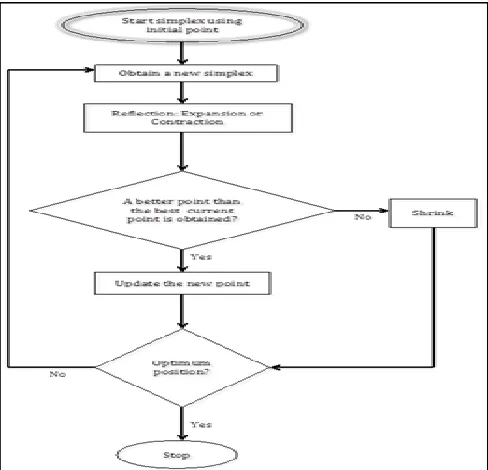
algorithm in [3], the flowchart of the NM simplex algorithm is presented in Figure 1.
2.3 Genetic Algorithm
Genetic Algorithm (GA) was developed by an American scientist name John Henry Holland in 1960s which mimic some processes observed in natural evolution. In the field of artificial intelligence, Genetic Algorithm (GA) is a method for solving both constrained and unconstrained optimization problems. Genetic Algorithm can solve problems that are not well suited for standard optimization algorithms, including problems in which the objective function is discontinuous, nondifferentiable, stochastic, or highly nonlinear.
Genetic Algorithm generates solutions to optimization problems using techniques inspired by natural evolution, such as inheritance, mutation, selection, and crossover. A solution generated by genetic algorithm is called a chromosome, while collection of chromosome is referred as a population. A chromosome is composed from genes and its value can be either numerical, binary, symbols or characters depending on the problem want to be solved. These chromosomes will undergo a process called fitness function to measure the suitability of solution generated by Genetic Algorithm with problem. Some chromosomes in population will mate through process called crossover thus producing new chromosomes named offspring which its genes composition are the combination of their parent.
In a generation, a few chromosomes will also mutate in their gene. The number of chromosomes which will undergo crossover and mutation is controlled by crossover rate and mutation rate value. Chromosome in the population that will maintain for the next generation will be selected based on Darwinian evolution rule and chromosome with higher fitness value will have greater probability of being selected again in the next generation. After several generations, the chromosome value will converge to a certain value which is the best solution for the problem [13].
Genetic Algorithm method have been applied and implemented by many types of case studies. It can be used to design bridge structures, for maximum strength/weight ratio, or to determine the least wasteful layout for cutting shapes from cloth. They can also be used for online process control, such as in a chemical plant, or load balancing on a multi-processor computer system [14].
Besides, Gordini [15] used the Genetic Algorithm approach in order to predict the small and medium-sized enterprises (SMEs) bankruptcy. Meanwhile, it also uses to efficiently detect various types of network intrusions which are an Intrusion Detection System (IDS) [16].
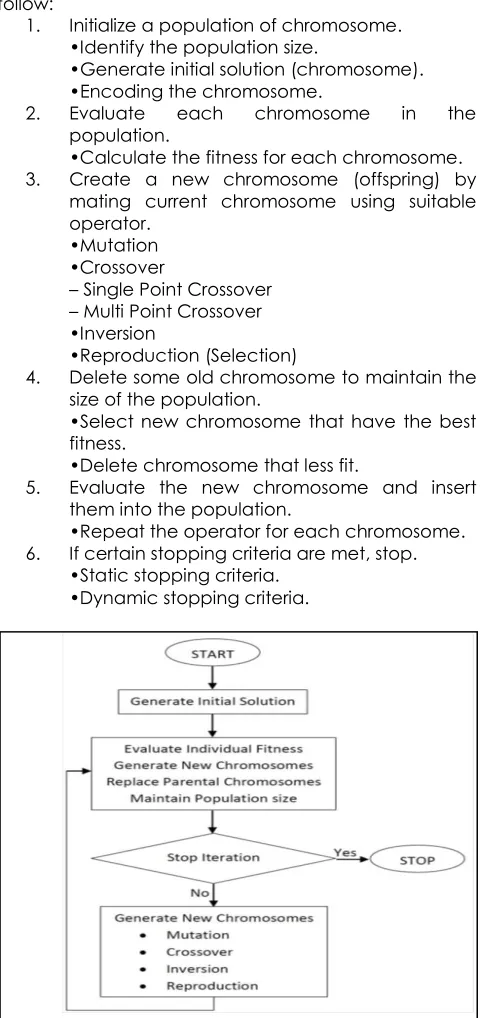
According to [17], the main idea of Genetic Algorithm is the evolution takes place on chromosomes and there are chromosomal encoding and decoding processes that related to our study. The basic terminologies in Genetic Algorithm as well as main step to estimate the parameter for every model can be presented in Figure 2 and summarized as follow:
1. Initialize a population of chromosome. •Identify the population size.
•Generate initial solution (chromosome). •Encoding the chromosome.
2. Evaluate each chromosome in the population.
•Calculate the fitness for each chromosome. 3. Create a new chromosome (offspring) by
mating current chromosome using suitable operator.
•Mutation •Crossover
– Single Point Crossover – Multi Point Crossover •Inversion
•Reproduction (Selection)
4. Delete some old chromosome to maintain the size of the population.
•Select new chromosome that have the best fitness.
•Delete chromosome that less fit.
5. Evaluate the new chromosome and insert them into the population.
•Repeat the operator for each chromosome. 6. If certain stopping criteria are met, stop.
•Static stopping criteria. •Dynamic stopping criteria.
Parameter Estimation procedures using NM and GA algorithms:
Step 1 :Set randomly the initial parameters value.
Step 2 :Based on the initial parameters values in Step 1, objective function is calculated using the model suggested by [3].
Step 3 :The objective function is then computed in the NM simplex method and GA method.
The steps of the NM simplex and GA procedures are explained in Section 3 and Section 4.
3.0 RESULT AND DISCUSSION
In order to determine the efficiency of the algorithms, the performance of NM and GA methods which based on the value of SSE, computational time and number of iterations are presented in the following tables.
The results of parameters estimation for 100 random initial points for both NM simplex method and GA are presented in Table 1. The mean of sum of square error (SSE) for 100 run also provided.
Table 1 The estimated parameter values (mean) and sum of square error (SSE) using NM simplex method and GA
Method
Estimated Parameters Values
SSE
1
2p
maxV
K
MNM 2.0034 8.4986 0.0054 0.8719 1.4475 4.1049 0.001667
GA 2.3143 1.1208 0.0034 0.8910 1.3189 1.7885 0.009887
The results in Table 2 show that Nelder-Mead simplex method is more superior than Genetic Algorithm for the value of SSE. It is clearly seen in the table, the values for each estimated parameters for both methods are close except for parameter α_1. In particular, the value of the objective function (SSE) by NM method is much smaller than provided by GA.
To verify the efficiency of the methods in estimating the model parameters, the correlation between experimental and simulation data are obtained from the estimated parameter. Statistically, correlation can be explained as the degree to which two or more attributes or measurements on the same group of elements show a tendency to vary together [18].
In addition, the estimated values for
model andmodel
from the model are also calculated and compared with experimental
exp and
exp. These are obtained by using MATLAB programming.Table 2 The correlation between
model and
exp, andmodel
and
expvalues for LQ relation when
exp 0.2790and
exp 0.0357.Method Correlation, 2
r
LQ Parameter (Mean)
model
modelNM 0.999876 0.276518 0.0359
GA 0.999479 0.249251 0.0392
From Table 2, the results show the values of the correlation, 2
r
between estimated survival data and experimental data are close to 1 which corresponding to an excellent fit for both methods. These indicate that value of the LQ parameters for estimated survivalmodel
and
model are close to
exp and
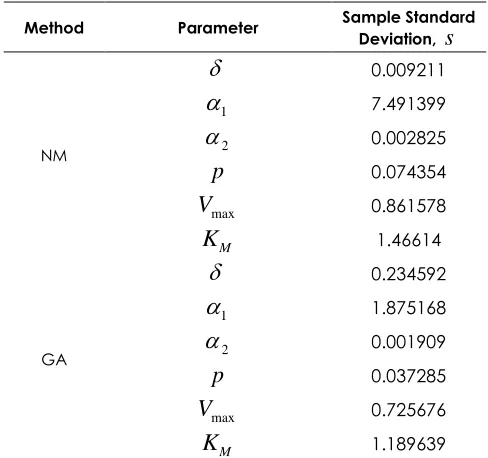
exp.The values of sample mean and sample standard deviation of each parameter which corresponds to the results in Table 1 is calculated to show variations of the set of data values. See Table 3 for details.
Table 3 The sample standard deviation,
s
of the estimated value of each parameter data using Nelder-Mead simplex method and Genetic AlgorithmMethod Parameter Sample Standard Deviation,
s
NM
0.0092111
7.4913992
0.002825p
0.074354max
V
0.861578M
K
1.46614GA
0.2345921
1.8751682
0.001909p
0.037285max
V
0.725676M
K
1.189639The result of sample mean and standard deviation are described in Table 3 for each estimated parameter. As shown, the values of sample standard deviation for
1 andK
M using both methods are larger than 1. These indicate that the estimated values for
1 andK
M are more spread out.estimate parameters on each point, the computational time for each point will be recorded along the optimization process.
Table 4 The computational time in minimize the objective function (SSE) using NM simplex method and Genetic Algorithm
Method Mean of Time Profile (s)
NM 274.8
GA 777.5
Table 4 show the computational time for both algorithms in minimizing SSE values. Noted here that computational time for Nelder-Mead simplex method is shorter than computational time by Genetic Algorithm. The longer time might be taken due to the complexity of the algorithm in optimizing the six parameters.
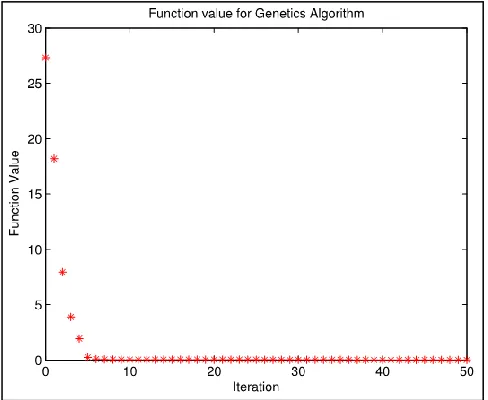
Apart of the computational time, other criteria need to be considered is the number of iteration. The iteration is counted until it converges to a minimum value of SSE which is close to zero. Average numbers of iteration for both methods with the same starting point are considered in comparing the efficiency of each algorithm. See Figure 3 and Figure 4 for the graphs which are describing the number of iteration versus sum of square error values using both Nelder-Mead simplex method and Genetic Algorithm, respectively.
Rrrrrrrrrrrrrrrrrrrrrrrrrrrrrrrrrrrrrrrrrrrrrrrrrrrrrrrrrrrrrrrrrrrrrrrrrrrrrrrrrrrrrrr rrrrrrrrrrrrrrrrrrrrrrrrrrrrrrrrrrrrrrrrrrrrrrrrrrrrrrrrrrrrrrrrrrrrrrrrrrrrrrrrrrrrrrrr rrrrrrrrrrrrrrrrrrrrrrrrrrrrrrrrrrrrrrrrrrrrrrrrrrrrrrrrrrrrrrrrrrrrrrrrrrrrrrrrrrrrrrrr rrrrrrrrrrrrrrrrrrrrrrrrrrrrrrrrrrrrrrrrrrrrrrrrrrrrrrrrrrrrrrrrrrrrrrrrrrrrrrrrrrrrrrr
Figure 3 Graph of the objective function with number of iteration for Nelder-Mead simplex method
Figure 4 Graph of the objective function with number of iteration for Genetic Algorithm
Next, as shown in Table 5, the 95% confidence intervals (CIs) for the six parameters of the model (details about the CI can be found in [3]). The CI computation is only on the estimation result obtained by the NM simplex technique since in our case the NM simplex is a superior optimizer.
Table 5 The 95% confidence interval for the six parameters of the model for number of survival cell using NM simplex method
Parameter Parameter, (Mean) Estimated 95% Confident Interval
0.009211 (2.001617,2.005227)1
7.491399 (7.030309,9.966937)2
0.002825 (0.00487,0.005955)p
0.074354 (0.857406,0.886552)max
V
0.861578 (1.278665,1.616403)M
K
1.46614 (3.817546,4.392274)All the results shown all estimated parameters using both algorithms provide LQ shape of survival. These mean that both methods Nelder-Mead simplex method and Genetic Algorithm are applicable in parameter estimation for the high dose irradiation damage model.
In addition the value of the correlation 2
r
(see Table 2) is close to 1 which corresponds to an excellent fit between simulation and experimental data for both algorithms.4.0 CONCLUSION
As a summary, when the parameter values of the model of high dose irradiation damage are unknown, the NM simplex technique provides the lowest value of the objective function (SSE). In addition the value of the correlation between estimated survival data and experimental data
r
2 are close to 1 whichcorresponds to an excellent fit. The algorithm also performs the shortest computational time of the optimization runs till convergence and obtains a fewer number of iteration to converge to the minimum value of the objective function.
Therefore, all the results shown in this section indicate that the NM simplex algorithm gave a reasonable estimate of all of the parameters. The 95% confident intervals of the value of each parameter are presented in Table 5.
Acknowledgement
The authors would like to thank Universiti Teknologi Malaysia for the completion of this article. The second author would also like to thank Ministry of Higher Education (MOHE) Malaysia for his MyMaster Scholarship.
References
[1] Ballarini. F. 2010. From DNA Radiation Damage To Cell
Death: Theoretical Approaches. Journal of Nucleic Acids. 3:
7-15.
[2] Sachs, R. K. Hahnfeldt, P. and D. J. 1997. Brenner. The Link
Between Low-LET Dose-Response Relations And The
Underlying Kinetics Of Damage
Production/Repair/Misrepair. International Journal of
Radiation Biology. 72: 351-374.
[3] Siam, F. M. Grinfeld, M. Bahar, A. Rahman, H. A. Ahmad,H.,
Johar. F. 2016. A Mechanistic Model Of High Dose
Irradiation Damage. Mathematics and Computers in
Simulation. DOI:10.1016/j.matcom.2016.02.007.
[4] Albright, N. 1989. A Markov Formulation Of The
Repair-Misrepair Model Of Cell Survival. Radiation Research. 118(1):
1-20.
[5] Chadwick, K. H. and Leenhout, H. P. 1973. A Molecular
Theory Of Cell Survival. Physic Medical Biology. 18(1): 78-87.
[6] Bromfield, G. P., Meng, A., Warde P., and Bristow R. G. 2003.
Cell Death In Irradiated Prostate Epithelial Cells: Role Of
Apoptotic And Clonogenic Cell Kill. Prostate Cancer and
Prostatic Diseases. 6: 73-85.
[7] Curtis, S. B. 1986. Lethal And Potentially Lethal Lesions
Induced By Radiation - A Unified Repair Model. Radiation
Research. 106: 252-270.
[8] Price, C., Byatt, D., Coope, I. 2003. 40 Years Of The
Nelder-Mead Algorithm. University of Canterbury, New Zealand.
[9] Ouriaa, A. and Toufigha, M. 2009. Application Of
Nelder-Mead Simplex Method For Unconfined Seepage Problems.
Applied Mathematical Modelling. 33(9): 3589-3598.
[10] Luersena, M. A., and Richec, R. L. 2004. Globalized
Nelder-Mead Method For Engineering Optimization. Computers &
Structures. 82: 2251-2260.
[11] Xiong, Q., and Jutan, A. 2003. Continuous Optimization
Using A Dynamic Simplex Method. Chemical Engineering
Science. 58: 3817-3828.
[12] Pandi, M., and Premalatha, K. 2004. An Advanced
Nelder-Mead Simplex Method For Clustering Of Gene Expression
Data. International Journal of Computer, Electrical,
Automation, Control and Information Engineering. 8(4): 1-9.
[13] Hermawanto, D. 2013. Genetic Algorithm For Solving Simple
Mathematical Equality Problem. Retrieved from Cornell University Library website: https://arxiv.org/abs/1308.4675.
[14] International Conference on Systems, Man and Cybernetics
Evolving to Systems, Humans, Organizations, and Their Complex Interactions. 2000. Cybernetics Evolving to Systems, Humans, Organizations, and Their Complex
Interactions. SMC 2000 Conference Proceedings; Vol. 3.
Piscataway. NJ: IEEE Service Center.
[15] Gordini, N. 2014 A Genetic Algorithm Approach For Sees
Bankruptcy Prediction: Empirical Evidence From Italy. Expert
Systems with Applications. 41(14): 6433-6445.
[16] Hoque, M. S., Mukit M. A., and Bikas M. A. 2012. An
Implementation Of Intrusion Detection System Using
Genetic Algorithm. International Journal of Network Security
& Its Applications. 4(2): 1-12.
[17] Mitchell, M. 1998. An Introduction to Genetic Algorithms. 1st
Edition. London, England: First MIT Press Paperback Addition.
[18] Archdeacon, T. J. 1994. Correlation And Regression Analysis