
Article
1
Ni(NH
3)
2(NO
3)
2– A 3-D network through bridging nitrate units
2
isolated from the thermal decomposition of nickel hexammine
3
dinitrate.
4
Joachim Breternitz 1,2, Agata Godula-Jopek 3,4 and Duncan H. Gregory 1 *
5
1 WestCHEM School of Chemistry, University of Glasgow, University Avenue, G12 8QQ, Glasgow, UK;
6
7
2 Helmholtz-Zentrum Berlin für Materialien und Energie, Department Structure and Dynamics of Energy
8
Materials, Hahn-Meitner-Platz 1, 14109 Berlin, Germany; [email protected]
9
3 Airbus Group Innovations, XCXDI, 81663 Munich, Germany; [email protected]
10
4 Institute of Chemical Engineering, Polish Academy of Sciences, 44100 Gliwice, Poland
11
* Correspondence: [email protected]; Tel.: +44-141-330-8128
12
13
Abstract: Nickel nitrate diammine, Ni(NH3)2(NO3)2, can be synthesised from the thermal
14
decomposition of the nickel nitrate hexammine, Ni[(NH3)6](NO3)2. The hexammine decomposes in
15
2 distinct steps; the first releases 4 equivalents of ammonia while the second involves the release of
16
NOx, N2 and H2O to yield NiO. The intermediate diammine compound can be isolated following
17
the first deammoniation step or synthesised as a single phase from the hexammine under vacuum.
18
Powder X-ray diffraction (PXD) experiments have allowed the structure of Ni(NH3)2(NO3)2 to be
19
solved for the first time. The compound crystallises in orthorhombic space group Pca21 (a = 11.0628
20
(5) Å, b = 6.0454 (3) Å, c = 9.3526 (4) Å; Z = 4) and contains 11 non-hydrogen atoms in the asymmetric
21
unit. Fourier Transform Infrared (FTIR) spectroscopy demonstrates that the bonding in the ammine
22
is consistent with the structure determined by PXD.
23
Keywords: crystal structure; ammine complex; structure determination; ammonia storage;
24
vibrational spectroscopy.
25
26
1. Introduction
27
Ammonia is increasingly being considered as a safe, readily available alternative to hydrogen as
28
an energy vector with an energy density of 13.6 GJ m-3 (at 10 bar) [1] and the added advantage of
29
possible storage at high gravimetric and volumetric capacities. Ammonia itself contains 17.6 wt%
30
hydrogen and could be employed as a hydrogen carrier, releasing hydrogen via catalytic cracking.
31
Metal ammine salts are attracting considerable interest as potential ammonia storage materials
32
[2]. Transition metal salts readily form ammoniate complexes (ammines) with variable and
33
controllable ammonia content [3]. The highest capacity (gravimetric density of ammonia) materials -
34
typically hexammines - can be synthesised simply by the ambient temperature and pressure
35
ammoniation of the respective transition metal salts. In an earlier study, we identified nickel salts as
36
a promising group of ammonia storage materials [4]. Associated with this work, we were able to
37
demonstrate that reaction of ammonia with nickel nitrate hexahydrate induces ligand exchange and
38
the growth of nickel nitrate hexammine crystals [5]. The thermal decomposition of nickel nitrate
39
hexammine has been discussed previously in the literature [6,7] and the products of the
40
decomposition tentatively identified. The structure of the proposed thermodynamically stable
41
intermediate decomposition product nickel diammine nitrate has remained unknown. In this work,
42
we revisit the thermal decomposition of [Ni(NH3)6](NO3)2 and determine the conditions for synthesis
43
of the respective diammine Ni(NH3)2(NO3)2. The successful preparation of the compound as a single
44
phase has allowed us to determine its crystal structure for the first time and to perform a vibrational
45
spectroscopy analysis of its bonding.
46
2. Results and Discussion
47
2.1. Thermal decomposition of [Ni(NH3)6](NO3)2
48
49
Figure 1. (a) Simultaneous thermal analysis of [Ni(NH3)6](NO3)2 showing the thermogravimetric
50
(blue) and differential thermal analysis (black) profiles. (b) Evolved gas analysis by mass spectrometry
51
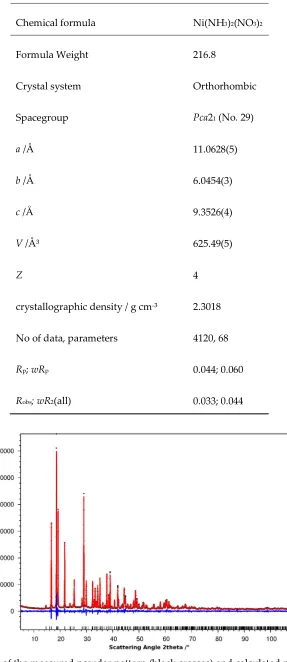
for (i) m/z = 17 (NH3+, black), (ii) m/z = 28 (N2+, red), (iii) m/z = 44 (N2O+, blue), (iv) m/z = 30 (NO+,
52
green), (v) m/z = 46 (NO2+,brown),(vi) m/z = 18 (H2O+, olive) and (vii) m/z = 2 (H2+, navy). The baselines
53
are displaced along the y-axis for better visibility. The corresponding temperature is given by the
54
dotted line.
55
The nickel hexammine, [Ni(NH3)6](NO3)2, was prepared using our previously published method
56
and its complete characterisation is discussed therein [5]. [Ni(NH3)6](NO3)2 was studied by
57
simultaneous thermal analysis that combined thermogravimetry (TG), differential thermal analysis
58
(DTA) and evolved gas analysis by mass spectrometry (MS) in the same experiment (Figure 1). The
59
thermal decomposition of the material is evidently complex and clear steps are, especially at higher
60
temperatures, hard to distinguish. Considering the evolved gas mass spectra (Figure 1b), the initial
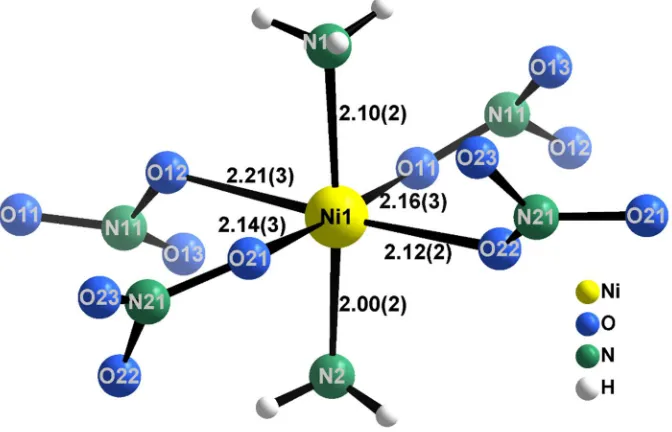
61
decomposition that occurs below approximately 200 °C can be attributed exclusively to loss of
62
ammonia, but not all the ammonia ligands are apparently removed before further decomposition
63
products (from the decomposition of the nitrate anion) are detected. Therefore, the continued mass
64
loss from the sample in the region of 200 - 300 °C must be interpreted in terms of simultaneous loss
65
of further ammonia from the ammine complex in addition to nitrogen and nitrous oxides from the
66
nitrate anions. From the identity of the evolved gases in the mass spectra, there is evidently reaction
67
between fragments from the ammonia ligands and nitrate anion. It is interesting that no ammonia
68
evolution is detected at temperatures above 300 °C, where N2, N2O, NO and H2O prevail. Ultimately
69
only H2O is released at high temperature. These observed gaseous products match well to those
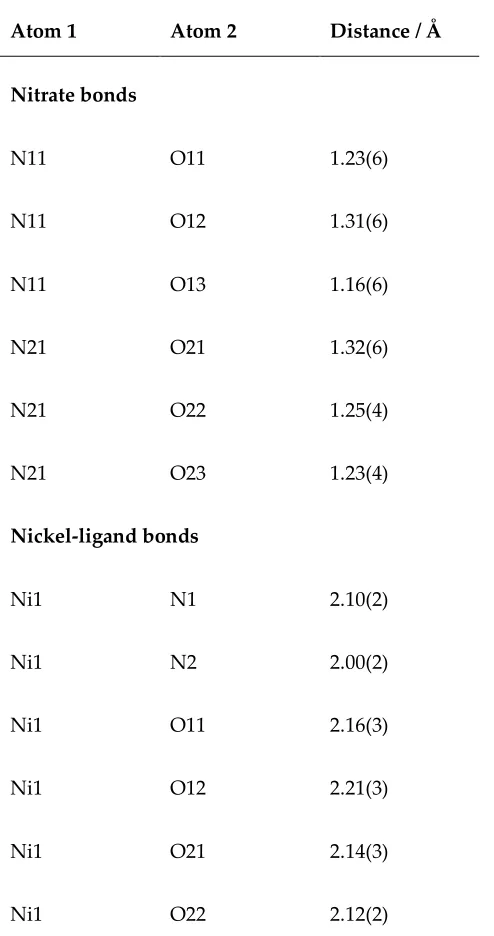
70
observed previously for the decomposition of the hexammine nitrate in either argon or helium [6, 7].
71
It could be concluded that [Ni(NH3)6](NO3)2 firstly loses ammonia to form lower ammine
72
complexes, before loss of the remaining ammonia molecules coincides with the decomposition of the
73
nitrate anions into nitrogen and nitrous oxides. This would leave a solid product of nickel hydroxide,
74
Ni(OH)2, which itself further decomposes into nickel oxide with the loss of water (in the final step).
75
The first decomposition mass loss (Table 1) of 11.8 % corresponds well to the theoretical mass loss for
76
the formation of the hypothetical tetrammine nickel nitrate, [Ni(NH3)4](NO3)2 (11.94 %). The second
77
step, however, itself is not large enough to account for the formation of either the triammine or
78
endotherms observed in the DTA trace below 300 °C would suggest that 2, 1 and 1 equivalents of
80
ammonia are lost resulting in the formation of the diammine and the weight loss by the end of the
81
third endotherm (of ca. 23 wt%) corresponds well to this assumption, even though the mass is not
82
constant at this point. There is thus no clear endpoint after the ammonia release and the sharp change
83
in slope of the mass loss likely originates from the immediate onset of nitrate anion decomposition
84
close to 300 °C. Steps 3 and 4 lie rather close to the expected mass losses for the formation of Ni(OH)2
85
(67.44 %) and NiO (73.77 %) and hence underline the decomposition of the nitrate anion at higher
86
temperatures. Given these results (most notably the DTA and MS data), we decided to use 200 °C as
87
the lowest possible temperature for the formation of the diammine nickel nitrate while avoiding the
88
decomposition of the nitrate anions. To drive the ammonia desorption, we performed the thermal
89
treatment under mild dynamic vacuum to facilitate the removal of ammonia from the system.
90
Table 1. TG-STA-MS analysis results for [Ni(NH3)6](NO3)2.
91
Step Cumulative mass
change / % TG Temperatures / °C
DTA peak temperatures / °C
Gases evolved (from MS)
Onset Final
1 -11.8 107 179 173 NH3
2 -16.9 187 208 198 NH3
3 -23.4 208 262 257 NH3
4 -63.1 272 316 309 NH3, N2, N2O, NO
5 -72.7 321 375 336 H2O
92
2.2. Crystal structure solution of Ni(NH3)2(NO3)2
93
When assessing the powder X-ray diffraction pattern of the thermal decomposition product, it
94
showed sharp reflections, but bore no similarities to previously described crystal structures in the
95
system. Attempts to automatically index the pattern using the programs Ito [8], Treor [9], Dicvol [10]
96
and McMaille [11] were successful and yielded consistent results, giving an orthorhombic cell with a
97
≈ 11.1 Å, b ≈ 6.0 Å and c ≈ 9.4 Å. In our experience, the use of more than one indexing program greatly
98
increases the confidence of the found solutions and can help to detect potential supercell solutions.
99
Following successful indexing, the pattern was treated using Jana2006 [12] and a sequence of Le
100
Bail fitting without symmetry assumptions (in space group P1), preliminary space group assignment
101
and Le Bail fitting in the assigned symmetry was performed. The structure solution was performed
102
via the Superflip routine [13] with subsequent Rietveld refinement both within Jana2006 (Table 2,
103
Figure 2). Given the limitations of powder X-ray diffraction in the accurate refinement of lighter atom
104
parameters, the thermal ellipsoids were modeled isotropically. The thermal parameters for N1 and
105
N2 (the crystallographically inequivalent nitrogen atoms in the ammonia molecules) were
106
constrained to equal values, as were those of O21 and O22 (bridging oxygen atoms within one of the
107
two inequivalent nitrate groups). The hydrogen atoms of the ammonia molecules were modelled as
108
riding on the nitrogen atoms and their Uiso was constrained to be 1.2 times the Uiso of the N atoms (as
109
Table 2. Refinement Details for Ni(NH3)2(NO3)2.
111
Chemical formula Ni(NH3)2(NO3)2
Formula Weight 216.8
Crystal system Orthorhombic
Spacegroup Pca21 (No. 29)
a /Å 11.0628(5)
b /Å 6.0454(3)
c /Å 9.3526(4)
V /ų 625.49(5)
Z 4
crystallographic density / g cm-³ 2.3018
No of data, parameters 4120, 68
Rp; wRp 0.044; 0.060
Robs; wR2(all) 0.033; 0.044
112
113
Figure 2. Plot of the measured powder pattern (black crosses) and calculated pattern (red line).
114
The difference plot, (Iobs - Icalc) is denoted by the blue line and the theoretical peak positions are shown
115
2.3. Crystal structure of Ni(NH3)2(NO3)2
117
Ni(NH3)2(NO3)2 crystallises in the orthorhombic, non-centrosymmetric space group Pca21 (a =
118
11.0628(5) Å, b = 6.0454(3) Å, c = 9.3526(4) Å, V = 625.49(5) Å3) with eleven non-hydrogen atoms in the
119
asymmetric unit (Figure 3). The structure consists of a 3-dimensional network of compressed
120
[Ni(NH3)2(NO3)4/2] octahedra, with the ammonia ligands trans- to one-another in the axial positions.
121
The octahedra are connected through four bridging nitrate anions per metal centre (and hence each
122
individual nitrate ligand bridges two metal centres, Figure 4). This structure type presents the first
123
evidence of bridging nitrate ligands in octahedral ammine complexes. In fact, the only other crystal
124
structures of ammine complexes containing nitrates as ligands are the copper nitrate di- and
125
monoammines [14] and platinum diammine dinitrate [15], where the nitrate and ammonia ligands
126
are coordinated to the metal centres in a square-planar geometry. Unlike these copper and platinum
127
compounds, which achieve three-dimensional connectivity through hydrogen bonds,
128
Ni(NH3)2(NO3)2 is connected in all 3 dimensions via bridging nitrate anions.
129
130
(a) (b)
Figure 3. Representation of a unit cell of Ni(NH3)2(NO3)2 along (a) the crystallographic b-direction
131
and (b)the crystallographic a-direction. Ni (gold), N (green) and O (blue) atoms are represented by
132
their thermal spheres at 90% probability, while H (white) atoms are given as generic balls.
133
134
Figure 4. Coordination sphere around the nickel centre (Ni1) in the crystal structure of
135
Ni(NH3)2(NO3)2. The Ni-ligand distances are given in Å. Ni (gold), N (green) and O (blue) atoms are
136
represented by their thermal spheres at 90% probability, while H (white) atoms are given as generic
137
Table 3. Interatomic distances in Ni(NH3)2(NO3)2.
139
Atom 1 Atom 2 Distance / Å
Nitrate bonds
N11 O11 1.23(6)
N11 O12 1.31(6)
N11 O13 1.16(6)
N21 O21 1.32(6)
N21 O22 1.25(4)
N21 O23 1.23(4)
Nickel-ligand bonds
Ni1 N1 2.10(2)
Ni1 N2 2.00(2)
Ni1 O11 2.16(3)
Ni1 O12 2.21(3)
Ni1 O21 2.14(3)
Ni1 O22 2.12(2)
140
As expected from the presence of two different ligands in the first coordination sphere, the
141
[Ni(NH3)2(NO3)4/2] octahedra are not regular (Figure 4, Table 3). The two Ni-N bonds are shorter
142
(2.00(2) Å and 2.10(2) Å) than the equivalent Ni-O bonds (2.12(2) Å – 2.22(3) Å) and the angles deviate
143
slightly from the ideal octahedral values, resulting in compressed octahedra along the axial direction.
144
Further, the N-O distances in the nitrate anion are also strongly anisotropic and range from 1.16(6) Å
145
- 1.32(6) Å. It is likely that the differences in the nitrate bond lengths are caused by comparatively
146
strong hydrogen bonding interactions between the ammonia ligands and the terminal oxygen atoms
147
in the nitrate anions (eight N-H···O hydrogen bonds with H···O ≤ 2.57 Å). The nitrate anion itself is
148
also distorted in the plane of the nitrogen and oxygen atoms, departing from an ideal trigonal planar
149
(D3h) geometry with out-of-plane torsion angles <(O11-O12-O13-N11) = -12(5)° and
<(O21-O22-O23-150
N21) = -14(4)°. It should be noted that the relatively large errors on the values of these torsion angles
151
suggest that the crystallographic evidence for the breaking of the D3h nitrate anion symmetry is not
152
in itself incontrovertible. Breaking of the symmetry, be it through the torsion of the molecule or the
153
2.4. IR spectroscopy of Ni(NH3)2(NO3)2
155
The ammonia vibrational modes in diammine nickel nitrate are very similar to those in
156
diammine nickel chloride and hexammine nickel nitrate (Figure 5, Table 3). A notable exception,
157
however, is that the symmetric deformation band, δs(HNH), in hexammine nickel nitrate is split for
158
the diammine compounds. This can be understood in terms of the more pronounced hydrogen
159
bonding in the diammine complexes as compared to hexammine nickel nitrate. This is consistent with
160
the symmetry inequivalence of the two ammonia ligands in Ni(NH3)2(NO3)2 and hence supports the
161
crystallographic model (where the two ammonia nitrogen positions are inequivalent).
162
Inclusion of nitrate anions within the first coordination sphere leads to an inevitable lowering of
163
the molecular symmetry compared to the free nitrate anion [16] and hence leads to the appearance of
164
further bands in the infrared spectrum [17]. Regarding the nitrate anion modes, several
165
supplementary IR bands are observed in diammine nickel nitrate as compared to the equivalent
166
hexammine (Figure 5). This can be attributed to the different bonding environments of the species.
167
While the nitrate anion in hexammine nickel nitrate is not coordinated directly to the complex and
168
therefore exists with ideal D3h molecular symmetry, the same is not true for diammine nickel nitrate.
169
The supplementary bands can be explained most clearly by comparison to the IR spectrum of
170
Ni(en)2(NO3)2 [17]. Most significantly, the appearance of the symmetric stretching mode (ν1) at 1048
171
cm-1 is a clear and unambiguous indicator of the breaking of the ideal D3h symmetry of the NO3- anion.
172
Whereas this mode is inactive for a trigonal species of D3h symmetry (since the dipole moment does
173
not change), it becomes active when the three-fold rotation axis is lost (resulting in either C2v or Cs
174
symmetry). This occurs when the ligand is coordinated to a metal and the three nitrate oxygen atoms
175
are no longer equivalent. Two further vibration modes that are degenerate for D3h symmetry, the
176
asymmetric stretching mode (ν3) and the in-plane bending mode (ν4), lose their degeneracy and are
177
observed as separate bands in the IR spectrum of Ni(NH3)2(NO3)2. Furthermore, two sets of
178
combination modes (ν1+ν3 and ν1+ν4) appear with the aforementioned fundamental modes and the
179
supplementary out-of-plane mode ν2.
180
181
182
Figure 5. FTIR spectrum of Ni(NH3)2(NO3)2 (red) in comparison with the spectra of Ni(NH3)2Cl2 [4]
183
given in blue and Ni(NH3)6(NO3)2 [5] given in black.
184
Table 3. Assignment of the infrared bands in Ni(NH3)2(NO3)2 in comparison to the documented
186
values of Ni(en)2(NO3)2 [17], Ni(NH3)2Cl2 [4] and Ni(NH3)6(NO3)2 [5].
187
Band Wavenumber / cm-1
Ni(NH3)2(NO3)2 Ni(en)2(NO3)2 [17] Ni(NH3)2Cl2 [4] Ni(NH3)6(NO3)2 [5]
νa(NH3) 3375 3346 3364
νs(NH3) 3296 3265 3282
2δa(HNH) 3195 3167 3167
ν1+ν3(NO3) 2475 2455
ν1+ν3(NO3) 2330 2320
ν1+ν4(NO3) 1765 1762, 1741
δa(HNH) 1616 1607 1616
ν3(NO3) 1417 1420
1329
ν3(NO3) 1303 1303
δs(HNH) 1250 1281
δs(HNH) 1229 1239 1202
ν1(NO3) 1048 1033,1034
ν2(NO3) 812 818 823
ν4(NO3) 751 728
ν4(NO3) 721 708
ρ(NH3) 643 675 648
188
3. Materials and Methods
189
3.1. Synthesis
190
Ni(H2O)6(NO3)2 (AnalaR – BDH Chemicals, 99 %) was used as supplied. The title compound was
191
synthesised through thermal decomposition of Ni(NH3)6(NO3)2, made from Ni(H2O)6(NO3)2 as
192
described previously [5]. Ni(NH3)6(NO3)2 was heated under mild dynamic vacuum (ca. 10-2 bar) to
100 °C for 30 minutes in order to remove any remaining humidity from the compound. The complex
194
was then further heated to 200 °C for 2 h under the same conditions to decompose the hexammine
195
into the diammine. The completeness of the reaction could be followed by observing the change of
196
the compound colour from purple to green.
197
3.2. Thermal analysis
198
Thermal analyses were conducted on a Netzsch 409 PC STA instrument under flowing argon
199
gas (BOC, 99.998 %) coupled to a Hiden Analytical HPR 20 mass spectrometer. Combined STA-MS
200
studies were conducted at a heating rate of 5 K min-1. The STA instrument was located inside an
201
Argon filled glove box (UNIlab, MBraun) with O2 and H2O levels below 3 ppm to avoid possible
202
reactions of samples with moist air. The samples were loaded into Al2O3 sample holders.
203
3.3. Fourier transform infrared (FTIR) spectroscopy
204
Infrared spectra were collected on an attenuated total reflection Fourier-transform infrared
205
spectrometer (ATR-FTIR) in the wavenumber range of 4000–600 cm-1 on an FTIR-8400S (Shimadzu).
206
24 accumulated spectra were collected with a resolution of 2 cm-1.
207
3.4. Powder X-ray diffraction
208
Samples of the hexammine and diammine were loaded into glass capillaries (Hilgenberg, 0.7
209
mm diameter) and flame-sealed. Samples was measured in Debye-Scherrer geometry on a Bruker D8
210
Advance diffractometer with Cu-Kα1 radiation (5° ≤ 2θ ≤ 108°, step size = 0.025°). Powder data were
211
analysed as discussed in section 2.2.
212
213
4. Conclusions
214
From an investigation of the thermal decomposition of Ni(NH3)6(NO3)2 it was possible to
215
determine the synthetic conditions required to isolate the diammine nickel nitrate. Ni(NH3)2(NO3)2.
216
Subsequent synthesis enabled the phase-pure polycrystalline diammine to be obtained and structure
217
solution to be performed from powder X-ray diffraction data. Ni(NH3)2(NO3)2 crystallises in the
218
orthorhombic space group Pca21 and forms a novel structure type in which Ni centres are
219
octahedrally coordinated by ammonia and nitrate in axial and equatorial positions respectively. The
220
latter ligands bridge to form a 3-dimensional network. Using vibrational spectroscopy, we could both
221
substantiate the chemical inequivalence of the two trans-ammonia ligands and confirm the
222
involvement of the nitrate groups as ligands via signature bands attributable to the breaking of the
223
ideal D3h trigonal planar symmetry. Following similar strategies should facilitate the isolation and
224
characterisation of further metal nitrate ammines and clarify the reaction pathways involved in
225
deammoniation.
226
Supplementary Materials: The following are available online at www.mdpi.com/link: cif-file for
227
Ni(NH3)2(NO3)2.
228
Acknowledgments: D.H.G. thanks Airbus Group Innovations for funding a studentship for J.B.
229
Author Contributions: J.B. and D.H.G. conceived and designed the experiments; J.B. performed the experiments
230
and analysed the data; J.B, A.G.J. and D.H.G. authored the paper. A.G.J and D.H.G supervised the research.
231
Conflicts of Interest: The authors declare no conflict of interest.
232
References
233
1. Zamfirescu, C.; Dincer, I. Using ammonia as sustainable fuel. J. Power Sources 2008, 185, 459-465,
234
2. Sørensen, R. Z.; Hummelshøj, J. S.; Klerke, A.; Reves, J. B.; Vegge, T.; Nørskov, J. K.; Christensen, C. H.
236
Indirect, Reversible High-Density Hydrogen Storage in Compact Metal Ammine Salts. J. Am. Chem. Soc.
237
2008, 130, 8660–8668, DOI: 10.1021/ja076762c.
238
3. Reardon, H.; Hanlon, J. M.; Grant, M.; Fullbrook, I.; Gregory, D. H. Ammonia Uptake and Release in the
239
MnX2–NH3 (X = Cl, Br) Systems and Structure of the Mn(NH3)nX2 (n = 6, 2) Ammines. Crystals 2012, 2,
193-240
212, DOI:10.3390/cryst2020193.
241
4. Breternitz, J.; Vilk, Y.E.; Giraud, E.; Reardon, H.; Hoang, T.K.A.; Godula-Jopek, A.; Gregory, D. H. Facile
242
Uptake and Release of Ammonia by Nickel Halide Ammines. ChemSusChem 2016, 9, 312-321, DOI:
243
10.1002/cssc.201600140.
244
5. Breternitz, J.; Farrugia, L.J.; Godula-Jopek, A.; Saremi-Yaramahdi, S.; Malka, I.E.; Hoang, T.K.A.; Gregory,
245
D.H. Reaction of [Ni(H2O)6](NO3)2 with gaseous NH3; crystal growth via in-situ solvation. J. Cryst. Growth
246
2015, 412, 1-6, DOI: 10.1016/j.jcrysgro.2014.11.021.
247
6. Migdał-Mikuli, A.; Mikuli, E.; Dziembaj, R.; Majda, D.; Hetmańczyk, Ł. Thermal decomposition of
248
[Mg(NH3)6](NO3)2, [Ni(NH3)6](NO3)2 and [Ni(ND3)6](NO3)2. Thermochim. Acta 2004, 419, 223–229, DOI:
249
10.1016/j.tca.2004.01.035.
250
7. Mikuli, E.; Migdał-Mikuli, A.; Majda, D. Thermal decomposition of polycrystalline [Ni(NH3)6](NO3)2. J.
251
Therm. Anal. Calorim. 2013, 112, 1191-1198, DOI: 10.1007/s10973-012-2640-8.
252
8. Visser, J. W. A fully automatic program for finding the unit cell from powder data. J. Appl. Crystallogr. 1969,
253
2, 89–95, DOI: 10.1107/S0021889869006649
254
9. Werner, P.-E.; Eriksson, L.; Westdahl, M. TREOR, a semi-exhaustive trial-and-error powder indexing
255
program for all symmetries. J. Appl. Crystallogr. 1985, 18, 367–370, DOI: 10.1107/S0021889885010512.
256
10. Boultif, A.; Louër, D. Indexing of powder diffraction patterns for low-symmetry lattices by the successive
257
dichotomy method. J. Appl. Crystallogr. 1991, 24, 987–993, DOI: 10.1107/S0021889891006441.
258
11. Le Bail, A. Monte carlo indexing with mcmaille. Powder Diffr. 2004, 19, 249–254, DOI: 10.1154/1.1763152.
259
12. Petříček, V.; Dušek, M.; Palatinus, L. Crystallographic Computing System JANA2006: General features. Z.
260
Kristallogr. - Cryst. Mater. 2014, 229, 345–352, DOI: 10.1515/zkri-2014-1737.
261
13. Palatinus, L.; Chapuis, G. SUPERFLIP - a computer program for the solution of crystal structures by charge
262
flipping in arbitrary dimensions. J. Appl. Crystallogr. 2007, 40, 786–790, DOI: 10.1107/S0021889807029238.
263
14. Morozov, I. V.; Korenev,Y. M.; Troyanov, S. I. Synthesis and crystal structure of New Amminecopper(II)
264
Nitrates: [Cu(NH3)2](NO3)2 and [Cu(NH3)](NO3)2. Z. Anorg. Allgem. Chem. 1996, 622, 2003-2007, DOI:
265
10.1002/zaac.19966221132.
266
15. Lippert, B.; Lock, C.; Rosenberg, B.; Zvagulis, M. cis-Dinitratodiammineplatinum(II), cis-Pt(NH3)2(NO3)2.
267
Crystalline structure and vibrational spectra. Inorg. Chem. 1977, 16, 1525–1529, DOI: 10.1021/ic50172a057.
268
16. Addison, C. C.; Logan, N.; Wallwork, S. C.; Garner, C. D. Structural aspects of co-ordinated nitrate groups.
269
Q. Rev., Chem. Soc. 1971, 25, 289–322, DOI: 10.1039/QR9712500289.
270
17. Curtis, N. F.; Curtis, Y. M. Some Nitrato-Amine Nickel(II) Compounds with Monodentate and Bidentate
271
Nitrate Ions. Inorg. Chem. 1965, 4, 804–809, DOI: 10.1021/ic50028a007.
2 showing the thermogravimetric (blue) and differential thermal analysis (black) profiles](https://thumb-us.123doks.com/thumbv2/123dok_us/7905653.1312566/2.595.80.519.184.345/figure-simultaneous-thermal-analysis-thermogravimetric-differential-analysis-profiles.webp)
2.](https://thumb-us.123doks.com/thumbv2/123dok_us/7905653.1312566/3.595.75.519.256.490/table-tg-sta-ms-analysis-results-for-ni.webp)
![Figure 5. FTIR spectrum of Ni(NH3)2(NO3)2 (red) in comparison with the spectra of Ni(NH3)2Cl2 [4] given in blue and Ni(NH3)6(NO3)2 [5] given in black](https://thumb-us.123doks.com/thumbv2/123dok_us/7905653.1312566/7.595.117.478.448.715/figure-ftir-spectrum-comparison-spectra-given-given-black.webp)
![Table 3. Assignment of the infrared bands in Ni(NH3)2(NO3)2 in comparison to the documented values of Ni(en)2(NO3)2 [17], Ni(NH3)2Cl2 [4] and Ni(NH3)6(NO3)2 [5]](https://thumb-us.123doks.com/thumbv2/123dok_us/7905653.1312566/8.595.81.510.99.678/table-assignment-infrared-bands-comparison-documented-values-nh.webp)
