Low Resource Dependency Parsing:
Cross-lingual Parameter Sharing in a Neural Network Parser
Long Duong,12Trevor Cohn,1 Steven Bird,1 and Paul Cook3
1Department of Computing and Information Systems, University of Melbourne 2National ICT Australia, Victoria Research Laboratory
3Faculty of Computer Science, University of New Brunswick
[email protected] {t.cohn,sbird}@unimelb.edu.au [email protected]
Abstract
Training a high-accuracy dependency parser requires a large treebank. How-ever, these are costly and time-consuming to build. We propose a learning method that needs less data, based on the observa-tion that there are underlying shared struc-tures across languages. We exploit cues from a different source language in order to guide the learning process. Our model saves at least half of the annotation effort to reach the same accuracy compared with using the purely supervised method.
1 Introduction
Dependency parsing is a crucial component of many natural language processing systems, for tasks such as text classification ( ¨Ozg¨ur and G¨ung¨or, 2010), statistical machine translation (Xu et al., 2009), relation extraction (Bunescu and Mooney, 2005), and question answering (Cui et al., 2005). Supervised approaches to dependency parsing have been successful for languages where relatively large treebanks are available (McDonald et al., 2005). However, for many languages, anno-tated treebanks are not available. They are costly to create, requiring careful design, testing and subsequent refinement of annotation guidelines, along with assessment and management of annota-tor quality (B¨ohmov´a et al., 2001). The Universal Treebank Annotation Guidelines aim at providing unified annotation for many languages enabling cross-lingual comparison (Nivre et al., 2015). This project provides a starting point for developing a treebank for resource-poor languages. However, a mature parser requires a large treebank for train-ing, and this is still extremely costly to create. In-stead, we present a method that exploits shared structure across languages to achieve a more accu-rate parser. Structural information from the source
resource-rich language is incorporated as a prior in the supervised training of a resource-poor tar-get language parser using a small treebank. When compared with a supervised model, the gain is as high as 8.7%1 on average when trained on just
1,000 tokens. As we add more training data, the gains persist, though they are more modest. Even at 15,000 tokens we observe a 2.9% improvement. There are two main approaches for building dependency parsers for resource-poor languages: delexicalized parsing and projection (T¨ackstr¨om et al., 2013). The delexicalized approach was pro-posed by Zeman et al. (2008). A parser is built without any lexical features, and trained on a tree-bank in a resource-rich source language. It is then applied directly to parse sentences in the tar-get resource-poor languages. Delexicalized pars-ing relies on the fact that identical part-of-speech (POS) inventories are highly informative of de-pendency relations, enough to make up for cross-lingual syntactic divergence.
In contrast, projection approaches use parallel data to project source language dependency rela-tions to the target language (Hwa et al., 2005). McDonald et al. (2011) and Ma and Xia (2014) ex-ploit both delexicalized parsing and parallel data. They use parallel data to constrain the model which is usually initialized by the English delexi-calized parser.
In summary, existing work generally starts with a delexicalized parser and uses parallel data to im-prove it. In this paper, we start with a source lan-guage parser and refine it with help from depen-dency annotations instead of parallel data. This choice means our method can be applied in cases where linguists are dependency-annotating small amounts of field data, such as in Karuk, a nearly-extinct language of Northwest California (Garrett et al., 2013).
1We use absolute values herein.
SOFT-MAX LAYER
HIDDEN LAYER
WORDS POS TAGS ARC LABELS
MAPPING LAYER
CONFIGURATION (STACK, QUEUE, ARCS)
Eword Epos Earc W1
W2
SOURCE - LANGUAGE PARSER TARGET - LANGUAGE PARSER
SOFT-MAX LAYER
HIDDEN LAYER
WORDS POS TAGS ARC LABELS
MAPPING LAYER
CONFIGURATION (STACK, QUEUE, ARCS)
Eword Epos Earc W1
[image:2.595.76.525.66.193.2]W2
Figure 1: Neural Network Parser Architecture from Chen and Manning (2014) (left). Our model (left and right) with soft parameter sharing between the source and target language shown with dashed lines.
2 Supervised Neural Network Parser
In this section we review the parsing model which we use for both the source language and target lan-guage parsers. It is based on the work of Chen and Manning (2014). This parser can take advan-tage of target language monolingual data through word embeddings, data which is usually available for resource-poor languages. Chen and Manning’s parser also achieved state-of-the-art monolingual parsing performance. They built a transition-based dependency parser (Nivre, 2006) using a neural-network. The neural network classifier decides which transition is applied for each configuration. The architecture of the parser is illustrated in Figure 1 (left), where each layer is fully connected to the layer above. For each configuration, the se-lected list of words, POS tags and labels from the Stack, Queue and Arcs are extracted. Each word, POS or label is mapped to a low-dimension vec-tor representation (embedding) through the Map-ping Layer. This layer simply concatenates the embeddings which are then fed into a two-layer neural network classifier to predict the next pars-ing action. The set of parameters for the model
isEword, Epos, Elabelsfor the mapping layer, W1
for the cubic hidden layer andW2for the softmax output layer.
3 Cross-lingual parser
Our model takes advantage of underlying structure shared between languages. Given the source lan-guage parsing structure as in Figure 1 (left), the set of parameters Eword will be different for the target language parser shown in Figure 1 (right) but we hypothesize that Epos, Earc, W1 and W2 can be shared as indicated with dashed lines. In particular we expect this to be the case when lan-guages use the same POS tagset and arc label sets,
as we presume herein. This assumption is moti-vated by the development of unified annotation for many languages (Nivre et al., 2015; Petrov et al., 2012; McDonald et al., 2013).
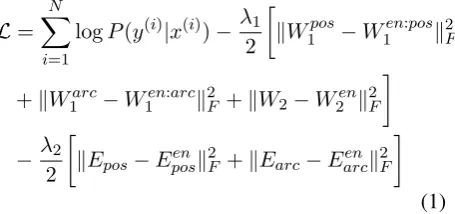
To allow parameter sharing between languages we could jointly train the parser on the source and target language simultaneously. However, we leave this for future work. Here we take an alternative approach, namely regularization in a similar vein to Duong et al. (2014). First we train a lexicalized neural network parser on the source resource-rich language (English), as de-scribed in Section 2. The learned parameters are Een
word, Eposen, Earcen, W1en, W2en. Second, we incor-porate English parameters as a prior for the tar-get language training. This is straightforward when we use the same architecture, such as a neural network parser, for the target language. All we need to do is modify the learning objec-tive function so that it includes the regularization part. However, we don’t want to regularize the part related toEen
word since it will be very differ-ent between source and target language. Letting W1 = (W1word, W1pos, W1arc), the learning objec-tive over training data D = {x(i), y(i)}N
i=1, be-comes:2
L=XN
i=1
logP(y(i)|x(i))−λ1
2
kW1pos−W1en:posk2
F
+kWarc
1 −W1en:arck2F +kW2−W2enk2F
−λ2
2
kEpos−Eposenk2F +kEarc−Earcenk2F
(1) This is applicable where we use the same POS
2All other parameters, i.e. Wword
1 andEword, are
[image:2.595.302.530.598.705.2]Train Dev Test Total cs 1173.3 159.3 173.9 1506.5 de 269.6 12.4 16.6 298.6 en 204.6 25.1 25.1 254.8 es 382.4 41.7 8.5 432.6 fi 162.7 9.2 9.1 181.0 fr 354.7 38.9 7.1 400.7
ga 16.7 3.2 3.8 23.7
hu 20.8 3.0 2.7 26.5
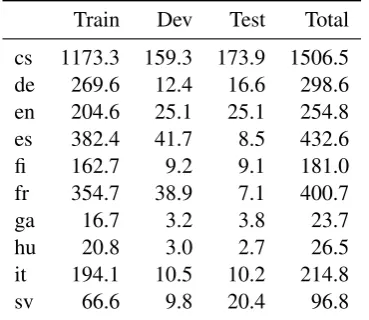
[image:3.595.90.275.63.223.2]it 194.1 10.5 10.2 214.8 sv 66.6 9.8 20.4 96.8 Table 1: Number of tokens (×1,000) for each lan-guage in the Universal Dependency Treebank col-lection.
tagset and arc label annotation for the source and target language. The same POS tagset is required so that the source language parser has similar structure with the target language parser. The re-quirement of same arc label annotation is mainly needed for evaluation using the Labelled Attach-ment Score (LAS).3 We fit two separate
regular-ization sensitivity parameters, λ1 and λ2, since they correspond to different parts of the model.λ1 is used for the shared (universal) part, while λ2 is used for the language specific parts. Together λ1 andλ2 control the contribution of the source language parser towards the target resource-poor model. In the extreme case where λ1 andλ2 are large, the target model parameters are tied to the source model, except for the word embeddings Eword. In the opposite case, where they are small, the target language parser is similar to the purely supervised model. We expect that the best values fall between these extremes. We use stochastic gradient descent to optimize this objective func-tion with respect toW1, W2, Eword, Epos, Earc.
4 Experiments
In this part we want to see how much our cross-lingual model helps to improve the supervised model, for various data sizes.
4.1 Dataset
We experimented with the Universal Depen-dency Treebank collection V1.0 (Nivre et al., 2015) which contains treebanks for 10 languages.4
3However, same arc-label set also informs some informa-tion about the structure.
4Czech (cs), German (de), English (en), Spanish (es), Finnish (fi), French (fr), Irish (ga), Hungarian (hu), Italian
These treebanks have many desirable properties for our model: the dependency types and coarse POS are the same across languages. This removes the need for mapping the source and target lan-guage tagsets to a common tagset. Moreover, the dependency types are also common across lan-guages allowing LAS evaluation. Table 1 shows the dataset size of each language in the collection. Some languages have over400ktokens such ascs, frandes, meanwhile,huandgahave only around
25ktokens.
4.2 Monolingual Word Embeddings
We initialize the target language word embeddings Eword of our neural network cross-lingual model with pre-trained embeddings. This is an advantage since we can incorporate monolingual data which is usually available for resource-poor languages. We collect monolingual data for each language from the Machine Translation Workshop (WMT) data,5 Europarl (Koehn, 2005) and EU Bookshop
Corpus (Skadin¸ˇs et al., 2014). The size of mono-lingual data also varies significantly. There are languages such as English and German with more than 400 million words, whereas, Irish only has 4 million. We use the skip-gram model from
word2vecto induce 50-dimension word
embed-dings (Mikolov et al., 2013). 4.3 Coarse vs Fine-Grain POS
Our model uses the source language parser as the prior for the target language parser. The require-ment is that the source and target should use the same POS tagset. It is clear that information will be lost when using the coarser shared-POS tagset. Here, we simply want to quantify this loss. We run the supervised neural network parser on the coarse-grained Universal POS (UPOS) tagset, and the language-specific fine-grained POS tagset for languages where both are available in the Univer-sal Dependency Treebank.6 Table 2 shows the
average LAS for coarse- and fine-grained POS tagsets with various data sizes. For the smaller dataset, using the coarse-grained POS tagset per-formed better. Even when we used all the data, the coarse-grained POS tagset still performed rea-sonably well, approaching the performance ob-tained using the fine-grained POS tagset. Thus, the choice of the coarse-grained Universal POS tagset (it), Swedish (sv)
Tokens Coarse UPOS Fine POS
1k 46.8 42.3
3k 54.3 52.4
5k 56.9 55.8
10k 59.9 59.8
15k 61.5 61.4
[image:4.595.314.520.60.219.2]All 74.7 75.2
Table 2: Average LAS for supervised learning us-ing the modified version of the Universal POS tagset and the fine-grained POS tagset across vari-ous training data sizes.
instead of the original POS tagset is relevant, given that we assume there will only be a small tree-bank in the target language. Moreover, even when we have a bigger treebank, using the UPOS tagset does not hurt the performance much.7
4.4 Tuning regularization sensitivity
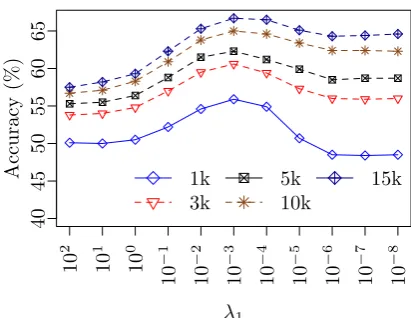
As shown in equation 1, λ1 and λ2 control the contribution of the source language parser toward the target language parser. We tune these parame-ters separately using development data. Firstly, we tuneλ1by fixingλ2 = 0.1. The reason for choos-ing such a large value of0.1is that we expect the POS and arc label embeddings to be fairly simi-lar across languages. Figure 2 shows the average LAS for all 9 languages (except English) on dif-ferent data sizes using difdif-ferent values ofλ1. We observed thatλ1= 0.001gives the optimum value on the development data consistently across differ-ent data sizes. We compare the performance at two extreme values ofλ1. For small data size, at 1k to-kens, λ1 = 100 is better than when λ1 = 10−8. This shows that when trained using a small data set, the source language parser is more accurate than the supervised model. However, at 3k tokens, the supervised model is starting to perform better. We now fixλ1 = 0.001to tuneλ2 in the same range as λ1. However, the average LAS didn’t change much for different values of λ2. It ap-pears thatλ2has very little effect on parsing accu-racy. This is understandable sinceλ2affects only a small number of parameters (POS and arc embed-dings). Thus, we chooseλ1 = 0.001andλ2= 0.1 for our experiments.
7This is because UPOS generalizes better, and when ag-gregating with lexical information, it has similar distinguish-ing power compared with the fine-grained POS tagset.
10
2
10
1
10
0
10
−
1
10
−
2
10
−
3
10
−
4
10
−
5
10
−
6
10
−
7
10
−
8
λ1
40
45
50
55
60
65
Accuracy
(%)
1k
[image:4.595.94.270.64.170.2]3k 5k10k 15k
Figure 2: Sensitivity of regularization parameter λ1against the average LAS measured on all 9 lan-guages (except English) on the development set for various data sizes (tokens)
4.5 Learning Curve
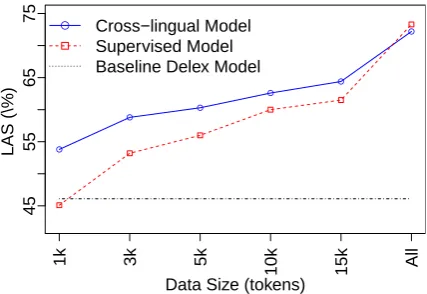
We choose English as our source language to build different target parsers for each language in the Universal Dependency Treebank collection. We train the supervised neural network parser as men-tioned in Section 2 on the Universal Dependency English treebank using UPOS tagset. The UAS and LAS for the English parser is 85.2% and 82.9% respectively, when evaluated on the English test set. We use the English parser as the prior for our cross-lingual model, as described in Section 3. Figure 3 shows the learning curve for both the supervised neural network parser and our cross-lingual model with respect to our implemention of McDonald et al.’s (2011) delexicalized parser, i.e. their basic model which uses no parallel data and no target language supervision. Overall, both the supervised model and the cross-lingual model are much better than this baseline. For small data sizes, our cross-lingual model is superior when compared with the supervised model, giving as much as an 8.7% improvement. This improvement lessens as the size of training data increases. This is to be expected, because the supervised model becomes stronger as the size of training data in-creases, while the contribution of the source lan-guage parser is reduced. However, at 15k tokens we still observed a 2.9% average improvement, demonstrating the robustness of our cross-lingual model. Using our model also reduced the standard deviation ranges on each data point from 12% to 7%.
●
●
●
●
●
●
1k 3k 5k
10k 15k All
Data Size (tokens)
45
55
65
75
LAS (\%)
● Cross−lingual Model
[image:5.595.77.291.61.208.2]Supervised Model Baseline Delex Model
Figure 3: Learning curve for cross-lingual model and supervised model with respect to the baseline delexicalized parser from McDonald et al. (2011): thex-axis is the size of data (number of tokens); they-axis is the average LAS measured on 9 lan-guages (except English).
the same accuracy compared with the supervised model. For example, we only need 1k tokens in order to surpass the supervised model perfor-mance on 3k tokens, and we only need 5k tokens to match the supervised model trained on 10k to-kens. The error rate reduction is from 15.8% down to 6.5% for training data sizes from 1k to 15k to-kens. However, when we use all the training data, the supervised model is slightly better.
5 Conclusions
Thanks to the availability of the Universal Depen-dency Treebank, creating a treebank for a target resource-poor language has becoming easier. This fact motivates the work reported here, where we assume that only a tiny treebank is available in the target language. We tried to make the most out of the target language treebank by incorporating a source-language parser as a prior in learning a neural network parser. Our results show that we can achieve a more accurate parser using the same training data. In future work, we would like to investigate joint training on the source and target languages.
Acknowledgments
This work was supported by the University of Melbourne and National ICT Australia (NICTA). Trevor Cohn is the recipient of an Australian Re-search Council Future Fellowship (project number FT130101105).
References
Alena B¨ohmov´a, Jan Hajiˇc, Eva Hajiˇcov´a, and Barbora Hladk´a. 2001. The Prague Dependency Tree-bank: A Three-Level Annotation Scenario. In Anne Abeill´e, editor,Treebanks: Building and Us-ing Syntactically Annotated Corpora, pages 103– 127. Kluwer Academic Publishers.
Razvan C. Bunescu and Raymond J. Mooney. 2005. A shortest path dependency kernel for relation ex-traction. InProceedings of the Conference on Hu-man Language Technology and Empirical Methods in Natural Language Processing, HLT ’05, pages 724–731, Stroudsburg, PA, USA. ACL.
Danqi Chen and Christopher Manning. 2014. A fast and accurate dependency parser using neural net-works. InProceedings of the 2014 Conference on Empirical Methods in Natural Language Processing (EMNLP), pages 740–750, Doha, Qatar. ACL. Hang Cui, Renxu Sun, Keya Li, Min-Yen Kan, and
Tat-Seng Chua. 2005. Question answering passage retrieval using dependency relations. In Proceed-ings of the 28th Annual International ACM SIGIR Conference on Research and Development in Infor-mation Retrieval, SIGIR ’05, pages 400–407, New York, NY, USA. ACM.
Long Duong, Trevor Cohn, Karin Verspoor, Steven Bird, and Paul Cook. 2014. What can we get from 1000 tokens? a case study of multilingual pos tag-ging for resource-poor languages. InProceedings of the 2014 Conference on Empirical Methods in Natu-ral Language Processing (EMNLP), pages 886–897, Doha, Qatar. ACL.
Andrew Garrett, Clare Sandy, Erik Maier, Line Mikkelsen, and Patrick Davidson. 2013. Develop-ing the Karuk Treebank. Fieldwork Forum, Depart-ment of Linguistics, UC Berkeley.
Rebecca Hwa, Philip Resnik, Amy Weinberg, Clara Cabezas, and Okan Kolak. 2005. Bootstrapping parsers via syntactic projection across parallel texts.
Natural Language Engineering, 11:311–325. Philipp Koehn. 2005. Europarl: A Parallel Corpus for
Statistical Machine Translation. In Proceedings of the Tenth Machine Translation Summit (MT Summit X), pages 79–86, Phuket, Thailand.
Xuezhe Ma and Fei Xia. 2014. Unsupervised depen-dency parsing with transferring distribution via par-allel guidance and entropy regularization. In Pro-ceedings of the 52nd Annual Meeting of the Associa-tion for ComputaAssocia-tional Linguistics (Volume 1: Long Papers), pages 1337–1348. Association for Compu-tational Linguistics.
Ryan McDonald, Slav Petrov, and Keith Hall. 2011. Multi-source transfer of delexicalized dependency parsers. In Proceedings of the Conference on Em-pirical Methods in Natural Language Processing, EMNLP ’11, pages 62–72.
Ryan McDonald, Joakim Nivre, Yvonne Quirmbach-Brundage, Yoav Goldberg, Dipanjan Das, Kuz-man Ganchev, Keith Hall, Slav Petrov, Hao Zhang, Oscar T¨ackstr¨om, Claudia Bedini, N´uria Bertomeu Castell´o, and Jungmee Lee. 2013. Uni-versal dependency annotation for multilingual pars-ing. In Proceedings of the 51st Annual Meeting of the Association for Computational Linguistics (Vol-ume 2: Short Papers), pages 92–97, Sofia, Bulgaria. ACL.
Tomas Mikolov, Ilya Sutskever, Kai Chen, Greg S. Corrado, and Jeff Dean. 2013. Distributed repre-sentations of words and phrases and their composi-tionality. In C.j.c. Burges, L. Bottou, M. Welling, Z. Ghahramani, and K.q. Weinberger, editors, Ad-vances in Neural Information Processing Systems 26, pages 3111–3119.
Joakim Nivre, Cristina Bosco, Jinho Choi, Marie-Catherine de Marneffe, Timothy Dozat, Rich´ard Farkas, Jennifer Foster, Filip Ginter, Yoav Gold-berg, Jan Hajiˇc, Jenna Kanerva, Veronika Laippala, Alessandro Lenci, Teresa Lynn, Christopher Man-ning, Ryan McDonald, Anna Missil¨a, Simonetta Montemagni, Slav Petrov, Sampo Pyysalo, Natalia Silveira, Maria Simi, Aaron Smith, Reut Tsarfaty, Veronika Vincze, and Daniel Zeman. 2015. Univer-sal dependencies 1.0.
Joakim Nivre. 2006. Inductive Dependency Parsing (Text, Speech and Language Technology). Springer-Verlag New York, Inc., Secaucus, NJ, USA. Levent ¨Ozg¨ur and Tunga G¨ung¨or. 2010. Text
classifi-cation with the support of pruned dependency pat-terns. Pattern Recognition Letters, 31(12):1598– 1607.
Slav Petrov, Dipanjan Das, and Ryan McDonald. 2012. A universal part-of-speech tagset. In Proceedings of the Eighth International Conference on Lan-guage Resources and Evaluation (LREC’12), Istan-bul, Turkey.
Raivis Skadin¸ˇs, J¨org Tiedemann, Roberts Rozis, and Daiga Deksne. 2014. Billions of parallel words for free: Building and using the eu bookshop corpus. In
Proceedings of the 9th International Conference on Language Resources and Evaluation (LREC-2014), Reykjavik, Iceland. European Language Resources Association (ELRA).
Oscar T¨ackstr¨om, Ryan McDonald, and Joakim Nivre. 2013. Target language adaptation of discrimina-tive transfer parsers. In Proceedings of the 2013 Conference of the North American Chapter of the Association for Computational Linguistics: Human Language Technologies, pages 1061–1071, Atlanta, Georgia. ACL.
Peng Xu, Jaeho Kang, Michael Ringgaard, and Franz Och. 2009. Using a dependency parser to improve smt for subject-object-verb languages. In Proceed-ings of Human Language Technologies: The 2009 Annual Conference of the North American Chap-ter of the Association for Computational Linguistics, pages 245–253, Boulder, Colorado. ACL.