IJEDR1603151
International Journal of Engineering Development and Research (www.ijedr.org)940
Performance Enhancement of Distributed Network
System By Phase-Wise Dynamic Task Allocation
1Khalid Gheyas, 2Malik Azizullah, 3Marghoob Ahmed Usmani 1Research scholar,2Lecturer,3Design Engineer
1,2Department of Electronics and Communication Engineering, Alfalah School of Engineering & Technology, Dhauj ,Faridabad 3EMF Pvt. Ltd, Shaheen Bagh, Okhla, New Delhi
________________________________________________________________________________________________________
Abstract - A Distributed Computing System (DCS) is a combination of application and system programs that exchanges
data across a number of independent terminals connected by a communication network. In task allocation two types of approaches are available and these are dynamic and static. Dynamic approach of task allocation is much better as compare to static, since it makes the best use of available computational resources in DCS. Task allocation problem can be describe as ‘m’ number tasks are required to execute on ‘n’ number of processors where number tasks (m) is always greater than number of processors (n) (m>n). Proposed algorithm is tested in MATLAB environment and it is noticed that obtained results are better as compared to past algorithms.
Key words - Distributed Network, Dynamic Allocation, Performance, Residing cost, Reallocation cost
________________________________________________________________________________________________________
I.INTRODUCTION
The word distributed in terms such as "distributed system", "distributed programming", and “distributed algorithm” Distributed Computing System (DCS) utilizes a network of many terminals in which each accomplish a partial operation of a task. Terminals are connected through communication channel either wireless or wired. DCS provides the facility of utilizing remote computing resources or data not reside in local terminals and also useful to increase the performance by providing facilities for distributed processing. DCS provide a higher performance, better reliability and better results over centralized network systems. In a DCS, the tasks of an application program must be allocated to processors to utilize the computational power and resources of the system in optimize manner. A computer program that runs in a distributed system is called a distributed program and distributed
programming is the process of writing such programs. There are many alternatives for the message passing mechanism, including pure HTTP, RPC-like connectors and message queues
Figure 1: (a), (b): a distributed system (c): a parallel system
II. DISTRIBUTED ALGORITHM
IJEDR1603151
International Journal of Engineering Development and Research (www.ijedr.org)941
The objective of this research is to find out a task allocation problem in Distributed Computing System (DCS) or develop a task allocation model that can minimize the overall system cost with allocation approach. This research offer a mathematical model that allocates the as tasks executes in various phases. During the particular task execution rest of other task are residing in the particular phase. Execution cost for each phase [EC], inter task communication cost [ITCC], residence cost [RC] of each task on different processors and relocation cost [REC] for each task are considered to design a allocation model. To achieve cost optimization in DCS allocation method finds an allocation with minimum allocation cost.IV. TECHNIQUE:
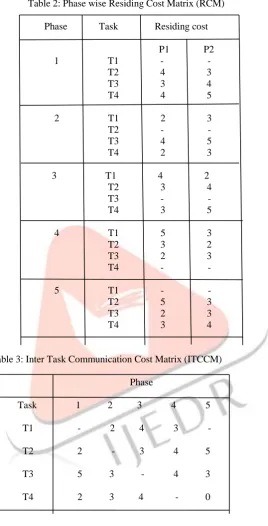
This research considers a distributed computing system consisting of a set T = {t1, t2, t3, t4,…tm} of m tasks to be allocated on a set P = {p1, p2, p3, …pn} of n processors divided into k phases with criteria tasks m are more than the number of processors n (m>n). Execution cost for phase wise of each processor is given in the form of Execution Cost Matrix ECM (,,) of order k x m x n. The Residing Cost for residing the unexecuted tasks on the processor is mentioned in Residing Cost Matrix RCM (,,) of order k x m x n. The Inter Task Communication Cost between executing and non-executing tasks are also considered and is mentioned in the Inter Task Communication Cost Matrix ITCCM(,) of order m x k and during the processing a task is re-allocate from one processor to another processor then it also obtained some cost i.e. reallocation cost and it is given in the Reallocation Cost and all other task if they are on different processors also taken into the consideration and mentioned in Inter Task Communication Cost Matrix
ITCCM(,) or order m x k. During the execution an allocated task is shifted from one processor to another processor during the next phase then some cost is incurred in reassignment process at the end of each phase and it is known as reallocation cost.
Table 1: Phase wise Execution Cost Matrix (ECM)
Phase task execution cost
P1 P2
1 T1 7 5 T2 - - T3 - - T4 - -
2 T1 - - T2 8 7 T3 - - T4 - -
3 T1 - - ECM (,,) = T2 - - T3 5 6 T4 - -
4 T1 - - T2 - - T3 - - T4 5 4
5 T1 9 7 T2 - - T3 - - T4 - -
IJEDR1603151
International Journal of Engineering Development and Research (www.ijedr.org)942
Table 2: Phase wise Residing Cost Matrix (RCM)
Phase Task Residing cost
P1 P2 1 T1 - -
T2 4 3
T3 3 4
T4 4 5
2 T1 2 3
T2 - - T3 4 5
T4 2 3
RCM (,,) = 3 T1 4 2
T2 3 4
T3 - - T4 3 5
4 T1 5 3
T2 3 2
T3 2 3
T4 - - 5 T1 - - T2 5 3
T3 2 3
T4 3 4
Table 3: Inter Task Communication Cost Matrix (ITCCM) Phase Task 1 2 3 4 5
T1 - 2 4 3 -
T2 2 - 3 4 5
IRCC (,) = T3 5 3 - 4 3
T4 2 3 4 - 0
Table 4: Reallocation Cost Matrix (RECM) Phase Task 1 2 3 4 5
T1 3 4 2 3 -
RECM(,) = T2 3 4 2 3 -
T3 2 3 5 3 -
IJEDR1603151
International Journal of Engineering Development and Research (www.ijedr.org)943
V. ConclusionThis research paper presented an allocation model for execution of tasks in Distributed Network System (DNS) and provides the optimal solution in order to get minimum costs for task allocation. This allocation model considers the several factors of execution cost, residing cost, reallocation cost, inter task communication cost and most important execution phases. In dynamic model a tasks completes its execution in various phase so presented dynamic allocation model provide optimal solution phase wise. The presented technique is applied on the several sets of input data and it is noticed that technique has no constraints and useful in all cases. This research paper considered phases and each phase has the tasks are to be processed by the processors hence phase wise optimal costs are generated. In the given example, there are five phases and each phase has the equal numbers of tasks. Optimal allocation has been generated along with phase wise optimal costs. The overall optimal cost calculated here are 118. The optimal cost of give example is mentioned in Table 5:
Table 5
This research paper evaluates time complexity of the present algorithm as it is a major factor to show the performance of the algorithm. the betterment of the present algorithm as mentioned in Table 6.
Table 6
Figure 2: Number of Processors = 3 Phase wise cost
for presented algorithm
Phase Executing Task Processor Assigned Task Phase wise cost
for algorithm
07 1 t1 p1 t3 * t4 07
21
P2
t2 * t1 21
25 2 t2 p1 t3 * t1 25
23
P2
t2 * t4 23
17 3 t3 p1 t4 * t2 17
93
P2
t3 * t1
4 t4 pl t4 * t3
P2 t1 * t2
5 t1 pl t2 * t3
P2 t1 * t4
Overall Optimal Cost 118
Processo s (n) Tasks (m) Phase s (k) Complexity [20] algorithm O(m2n2k) Complexity of present algorithm O(mnk)
3 4 3 432 36
3 5 4 900 60
3 6 5 1620 90
3 7 6 2646 126
IJEDR1603151
International Journal of Engineering Development and Research (www.ijedr.org)944
VI. REFERENCES1. Faizul Navi Khan, Kapil Govil, “ Distributed T ask Allocation Scheme for Performance Improvement in Mobile Computing Network”, International Journal of Trends in Computer Science, Vol. 2 Issue 3, pp: 809-817, 2013
2. Harendra Kumar, M. P. Singh, P. K. Yadav, "Optimal Tasks Assignment for Multiple Heterogeneous Processors with Dynamic Re-assignment", International Journal of Computers & Technology, Vol 4, No. 2, pp. 528-535, 2013
3. A.Y. Hamed, "Task Allocation for Maximizing Reliability of Distributed Computing Systems Using Genetic Algorithms", International Journal of Computer Networks and Wireless Communications, Vol. 2 No.5, pp.560-569, 2012
4. Manisha Sharma, Harendra Kumar, Deepak Garg, "An Optimal Task Allocat ion Model through Clustering with Inter-Processor Distances in Heterogeneous Distributed Computing Systems", International Journal of Soft Computing and Engineering, Vol. 2
No.1, pp.50-55, 2012
5. Monika Choudhary, Sateesh Kumar Peddoju, "A Dynamic Optimization Algorithm for Task Scheduling in Cloud
Environment", International Journal of Engineering Research and Applications (IJERA), Vol. 2, Issue 3, pp: 2564 2568, 2012
6.Sunita Bansal, Bhavik Kothari, Chittaranjan Hota, "Dynamic Task-Scheduling in Grid Computing using Prioritized Round Robin Algorithm", IJCSI International Journal of Computer Science Issues, Vol. 8, Issue 2, pp. 472-477, 2011
7. Geir Horn , B. John Oommen, "Solving multi constraint assignment problems using learning automata", IEEE Transact ions on Systems, Man, and Cybernetics, Part B: Cybernetics, vol. 40 No.1, pp.6-18, 2010
8. P Visalakshi, S N Sivanandam, "Dynamic Task Scheduling with Load Balancing using Hybrid Particle Swarm Optimization", Int. J. Open Problems Compt . Math., Vol 2, No. 3, pp. 475-488, 2009
9. Bassel Arafeh, Khalid Day, Abderezak Touzene, "A multilevel partitioning approach for efficient tasks allocation in