COMPETITIVE I TELLIGE CE PRACTICES A D PERFORM CE OF
FIRMS LISTED 0 THE NAIROBI SECURITIES EXCHAGE, KENYA
BY
WAITHAKA PAUL
D86/CTY 127690/2013
A THESIS SUBMITTED TOTHE SCHOOL OF BUSINESS IN PARTIAL
FULFILLMENT OF TH REQUIREMENTS FOR THE AWARD OF THE DEGREE OF DOCTOR OF PHILOSOPHY IN BUSINESS ADMINISTRATIO (STRATEGIC
MA AGEME T) OF KE YATTA UNIVERSITY
DECEMBER 2015
other University or institution. No part of this thesis may be reproduced without
prior permission of the author and/or Kenyatta University.
Signature ..~~~.. Date...~:":.~.::-:~.~.~
~.?
....
Waithaka PaulDepartment of Business Administration
We confirm thai the work reported in this thesis was carried out by the candidate
under our guidance as the appointed university supervisors
Signature ..~ ~ Date
\l.r:-:\.
~C
.
Dr Hannah Bula
Department of Business Administration
Kenyatta University
Signature ~ Date ..
J.ll~\.l.{
.
Dr. Linda Kimencu
Department of Business Administration
ii
Dedication
Acknowledgement
The successful writing of this thesis has been through the help and encouragement of
many persons. First, I am grateful to God for His providence and faithfulness. Special
gratitude go to my two supervisors, Dr. Hannah Bula and Dr. Linda Kimencu, who
spared their valuable time to read through the document and for offering constructive criticism, guidance and encouragement throughout the time I was preparing it. Special
thanks go to Dr. Stephen Muathe, the Chairman, Business Administration Department,
Dr. James Kilika, Dr Jane Wanjira, Dr Mary Ragui, Dr Philip Wambua, Dr. Lucy
Kamau, Dr. Rosemary James, Dr. Job Omagwa, Dr. Nyambura Mbuthia, Dr. Jedidah
Muli, Dr. Samuel Maina, Dr. Lawrence, Wainaina and Dr. Anne Muchemi, who
constantly encouraged and challenged me to complete the research successfully.
The others who are worthy of mention are led by my wife, Mercy Wairimu, who was
constantly by my side, encouraging and supporting me in every wy she could. One of
my daughters, Carol Wanjugu, and son Joash Wamai, assisted in keying in the report,
and the other daughter, Faith Wangari, helped in proofreading. Special thanks also go to
I' my fellow doctoral students, Rosemarie Wanyoike, David Kiiru, Elishiba Murigi and Moses Wandera, who were a source of inspiration to me and had a way assisting me
whenever I got into difficulties as I conducted the research. Without their close
companionship, the journey would have been very lonely. To my employer, Kenyatta
University, thank you for paying my fees and giving me support and time to complete
iv
Table of Contents
Declaration i
Dedication ii
Acknowledgement iii
List of Tables ix
List of Figures xiii
Operational Definition of Terms xiv
Abbreviations and Acronyms xvii
Abstract xviii
CHAPTER ONE 1
INTRODUCTION 1
1.1 Background of the Study .1
1.1.1 Concept of Competitive Intelligence 3
1.1.2 Competitive Intelligence and Firm Performance 9
1.1.3 Organizational Factors 11
1.1.4 Performance of Firms at the Nairobi Securities Exchange 13
1.2 Statement of the Problem 15
1.3 Objectives of the Study 17
1.3.1 General Objective 17
1.3.2 Specific Objectives 17
1.4 Significance of the Study 19
1.4.1 Theoretical Implications 19
1.4.2 Practical Implications 19
1.4.3 Policy Implications .20
1.5 Scope of the Study 20
1.6 Limitations of the Study 20
1.7 Organization of the Study 21
CHAPTER TWO : 22
LITERATURE REVIEW 22
2.1 Introduction 22
2.2 Theoretical Review 22
2.2.1 Dynamics Capability-Based Theory .22
2.2.2 The Diffusion of Innovations Theory 24
2.2.3 Porter's Five Forces Model 26
2.2.4 Resource-Based Theory : 27
2.2.5 Grand Unified Theory of the Firm 29
2.3 Empirical Literature 30
2.3.1 Strategy Orientation Competitive Intelligence Practice 30
2.3.2 Tactics Oriented Competitive Intelligence Practice 33
2.3.3 Technology-Oriented Competitive Intelligence Practice 35
vi
2.3.5 Role of Organizational Factors .43
2.3.6 Business Firm's Performance 45
2.4 Summary of Literature and Research Gap .47
2.5 Conceptual Framework 58
CHAPTER THREE 60
RESEARCH METHODOLOGy 60
3.1 Introduction 60
3.2 Research Philosophy 60
3.3 Research Design : : 61
3.4 Empirical Model 61
3.5 Target Population 64
3.6 Data Collection Instruments 65
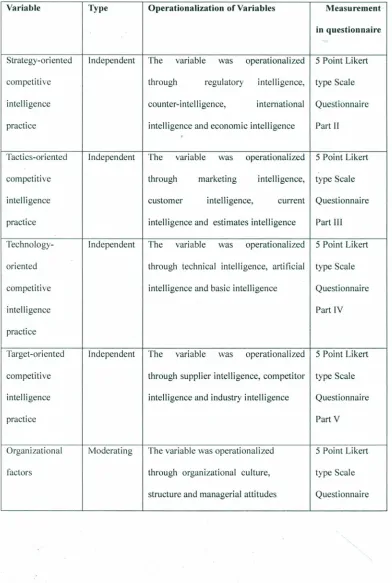
3.7 Operationalization and Measurement of Variables 66
3.7.1 Validity of the Research Instrument 67
I' 3.7.2 Reliability ofthe Research Instrument.. 68
3.8 Data Analysis and Presentation 69
3.8.1 Diagnostic Tests : 71
3.9 Ethical issues 74
CHAPTER FOUR 75
RESEARCH FINDINGS AND DISCUSSIONS , 75
4.1 Introduction ~ 75
4.2 Questionnaire Response Rate 75
4.3. Respondents' Biographic Information 76
4.3.1 Characteristics ofthe Sampled Firms 78
4.4 Descriptive Statistics 82
4.4.1 Strategy-Oriented Competitive Intelligence 89
4.4.2 Tactics-Oriented Competitive Intelligence 93
4.4.3 Technology-Oriented Competitive Intelligence 95
4.4.4 Target Oriented Competitive Intelligence 99
4.4.5 Organizational Factors : 101
4.4.6 Firm Non-Financial Performance 103
4.5 Diagnostic Tests 109
4.5.1 Normality Diagnostic Test 109
4.5.2 Linearity Test 110
4.5.3 Multicollinearity Test 111
4.6 Test of Hypotheses 112
4.6.1 Strategy-Oriented Competitive Intelligence Practice and Performance of
Firms Listed on the Nairobi Securities Exchange 112
4.6.2 Tactics-Oriented Competitive Intelligence Practice and Performance of Firms
Listed on the Nairobi Securities Exchange 115
4.6.3 Technology-Oriented Competitive Intelligence Practice and Performance of
viii
4.6.4 Target-Oriented Competitive Intelligence Practice and Performance of Firms
Listed on the Nairobi Securities Exchange .121
4.6.5 Effect of Competitive Intelligence Practices (CIPs) on Non-Financial Performance of Firms Listed on the Nairobi Securities Exchange .124
4.6.5.1 Return on Assets 128
4.6.5.2 Return on Equity 131
4.6.6 Moderating effect of Organizational Factors on the Relationship between Competitive Intelligence Practices and Performance of Firms Listed on the NSE ... 134
CHAPTER FIVE : 143
SUMMARY, CONCLUSIONS AND RECOMMENDATIONS 143
5.1 Introduction 143
5.2 Summary 143
5.3 Contribution of the Study to Knowledge .145
5.4 Conclusions 148
I' 5.5 Recommendations for Policy Implications 150
5.6 Suggestions for Further Research .152
APPENDICES 165
Appendix I:Researcher's Introductory Cover Letter. .165
Appendix II: Questionnaire 166
Appendix III: Document Review Guide (ROA) and (ROE) 175
Appendix IV:Firms Listed at the Nairobi Securities Exchange 178
List of Tables
Table 2.1: Summary of Literature and Research gaps 51
Table 3:1 Decision-Making Criterion for Moderation 64
Table 3:2 Operationalization and Measurement of Variables 66
Table 3:3 Test of Reliability, of the Instrument 69
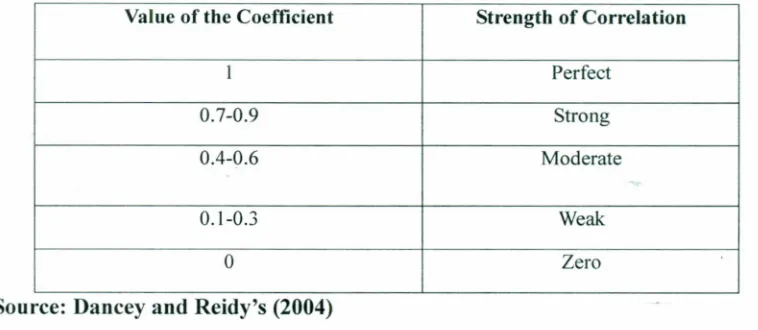
Table 3.4 Dancey and Reidy's Strength of Pearson's Correlation coefficient
Categorization 71
Table 3.5: Summary of Data Analysis Techniques 72
Table 4.1: Respondents' Demographic Characteristics 78
Table 4:2: Characteristics of the Firms 82
Table 4:3: Methods Used in Collecting Information for Competitive Intelligence 84
Table 4.4: Main Source of Information for Competitive Intelligence 85
Table 4:5: Methods the Firm Uses to Disseminate Competitive Intelligence 87
Table 4:6: Techniques Used by Firms to Analyze Information for Competitive
Intelligence 89
<Table 4.7: Strategy-Oriented Competitive Intelligence Practice 92
Table 4.8: Tactics-Oriented Competitive Intelligence Practice 95
Table 4.9: Technology-Oriented Competitive Intelligence Practice 98
Table 4.10: Target-Oriented Competitive Intelligence Practice l 00
Table 4.11: Impact of Organizational Factors .103
Table 4.12: Firm Non-Financial Performance 105
Table 4.13 Qualitative DataAnalysis 108
x
Table 4.14: Results of Linearity Diagnostic Test. : 111
Table 4.15: Results of Multi-colliniearity Diagnostic Test 112
Table 4.16: Model Summary for Strategy Oriented Competitive Intelligence Practice
and Performance of Firms Listed on the Nairobi Securities Exchange 113
Table 4.17: Strategy-Oriented Competitive Intelligence Practice ve.rsus Performance of
Firms Listed on the Nairobi Securities Exchange .114
Table 4.18: Coefficients for Strategy Oriented Competitive Intelligence
Practice 115
Table 4.19: Model Summary for Tactics Oriented Competitive Intelligence Practice
Performance of Firms Listed on-the Nairobi Securities Exchange .116
Table 4.20: Tactics-Oriented Competitive Intelligence Practice versus Performance
of Firms Listed on the Nairobi Securities Exchange 116
Table 4.21: Coefficients for Tactics-Oriented Competitive Intelligence Practice 118
Table 4.22: Model Summary for Technology-Oriented Competitive Intelligence Practice
and Performance of Firms Listed on the Nairobi SecuritiesExchange .119
Table 4.23: Technology-Oriented Competitive Intelligence Practice versus Performance
of Firms Listed on the Nairobi Securities Exchange : .119
Table 4.24: Coefficients for Technology-Oriented Competitive Intelligence Practice ... .121
Table 4.25: Model Summary for Target-Oriented Competitive Intelligence Practice
and Performance 'of Firms Listed on the Nairobi Securities Exchange .122
Table 4.26: Target-Oriented Competitive Intelligence Practice versus Performance
Table 4.27: Coefficients for Target Oriented Competitive Intelligence Practice 124 Table 4.28: Model Summary for Competitive Intelligence Practices and Non- Financial
Performance of Firms Listed on Nairobi Securities Exchange 126
Table 4.29: F-test for Multiple Regression Model.. 127
Table 4.30: Overall Regression Model Coefficients 128
Table 4.31: Model Summary of Competitive Intelligence Practices and Return on
Assets (ROA) .129
Table 4.32: F-test for Multiple Regression Model and Return on Assets (ROA) 130
Table 4.33: Overall Regression Model versus Return on Assets (ROA) Coefficients .
... .. 131
Table 4.34: Model 'Summary of Competitive Intelligence Practices and Return on
Equity (ROE) 132
Table 4.35: F-test for Multiple Regression Model and Return on Equity (ROE) .132
Table 4.36: Overall Regression Model versus Return on Equity (ROE) Coefficient... 134
Table 4.37: Model Summary for Competitive Intelligence Practice (CIP) and
Performance of Firms Listed on the Nairobi Securities Exchange .135
Table 4.38: Competitive Intelligence Practices (CIP) versus Performance of Firms
Listed on the Nairobi Securities Exchange 136
Table 4.39: Coefficients of Competitive Intelligence Practices (CIP) 137 Table 4.40: Model Summary for Competitive Intelligence Practice (CIP) and
Organizational Factors Performance of Firms Listed on the Nairobi Securities
Exchange ~ : 138
xii
Organizati onal Factors 139
Table 4.43: Model Summary for Target Oriented Competitive Intelligence Practice (CIP) ,Organizational Factors and Interaction Term on Performance of Firms
Listed on the Nairobi Securities Exchange 140
Table4.44: Competitive Intelligence Practices (CIP), Organizational Factors and Interaction Term versus Performance of Firms Listed on the Nairobi Securities
Exchange 141
Table 4.45: Coefficients of Competitive Intelligence Practices (CIP) and
List of Figures
Figure 1.1:The Scope oflntelligence 8
Artificial Intelligence
Basic Intelligence
Business blind Spots
Competitive Intelligence
Competitive Advantage
Corporate Espionage
xiv
Operational Definition of Terms
A computer system that is capable to mImIC human intelligence; it can understand natural language and it is capable of solving problems, learning, adapting, recognizing, classifying, self-improvement and reasoning.
Knowledge designed to help managers of firms listed on .the NSE make informed decisions and to substantiate
recommendations to top management.
Conventional wisdom which no longer holds true, but which still continues to guide business strategy.
The collection, transmission,
.
analysis and dissemination of publicly available, ethically and legally obtained relevant information for the purpose of producing actionable knowledge for the improvement of corporate decision making and action.A sustained superior performance gained by a firm listed on the NSE through exploiting its unique blend of activities, assets, attributes, market conditions and relationships which differentiate an organization from its competitors.
Counter-Intelligence Activities that are concerned with identifying and counteracting the threats posed by hostile intelligence services or organizations.
Current Intelligence A perishable product designed to provide users with the first exposure to new developments such as news on an innovation.
Early warning Intelligence Information that provides inking of emerging opportunities and threats in advance
Estimated Intelligence Knowledge that offers likely scenarios based on qualitative -views of the business analysts
Firm Performance The level of efficiency and effectiveness in the utilization of resources towards the achievement of organizational goals. The performance was evaluated in both financial and non-financial measures. Firm profitability indices measures in financial terms were used, while customer satisfaction and goal achievement were the non-financial terms used.
International Intelligence Collecting and analyzing information on regional trading I'
blocs and firms operates internationally as a way of discovering opportunities and threats from the international arena.
StrategyOriented
Competitive Intelligence
Tactics Oriented
Competitive Intelligence
Target-Orien ted
competitive Intelligence
Technology-Oriented
Competitive Intelligence
Technical Intelligence
xvi
Knowledge about the organization's environment that has implications for its long-term viability and success, usually extending several years.
Knowledge about the organization's environment that has implications for its short-term viability and success in the immediate future.
Knowledge about the organization's environment that has implications for its specifically identified competitors in its niche market.
The sub-division of intelligence concerned with
translating research findings and other scientific knowledge into devices, materials, products, processes or services,
CIPs
CIR
CSFs
FMGCR
GIA
GLC
NSE
SCIP
SEWs
ROA
ROE
R&DSWOT
UK
VIF
I' WEF
Abbreviations and Acronyms
Competitive Intelligence Practices
Competitive Intelligence Review Critical Success Factors
Frequency Modulated
Global Competitiveness Ranking Global Intelligence Alliance Government Link Companies Nairobi Securities Exchange
Strategic and CompetitiveIntelligence Professionals Strategic Early Warnings
Return on Assets Return on Equity
Research and Development
Strengths, Weaknesses, Opportunities and Threats United Kingdom
xviii
Abstract
Performance is critical for every listed firm, as it enhances shareholder's value and capability to generate earnings from invested capital. Some of the firms listed on the Nairobi Securities Exchange (NSE) have been performing poorly as indicated by the rising number of firms issuing profit warnings. The competitive business environment is continuously working to drive down the rate of return on invested capital. To counter these competitive forces, firms have resorted to gathering information at their disposal and converting it into competitive intelligence through analysis and human judgment. This study sought to determine the effect of competitive intelligence practices on performance of firms listed on the NSE. The specific objectives of the study were: to determine how strategy-oriented, tactics-oriented, technology-oriented and target
-oriented competitive intelligence practices affect the performance of firms listed on the NSE. Firm performance was evaluated using both financial and non-financial measures.
The non-financial measures used in the study were goal achievement and customer satisfaction, while Return on Assets (ROA) and Return on Equity (ROE) were the financial measures used. Both descriptive and explanatory survey research designs were used in this study, they allow the researcher to capture a population's characteristics and test hypothesis. The study was guided by a positivism research philosophy. The target population was the sixty firms listed on the Nairobi securities exchange. Primary data was collected using a semi-structured questionnaire; while secondary data was obtained from the firm's published annual reports available at the NSE using a document review guide. Quantitative data was analyzed using both descriptive and inferential statistics. In descriptive statistics, data was summarized using percentages, means and standard deviations, while in inferential statistics; multiple regression analysis was done using SPSS. The findings indicate that competitive intelligence practices have a positive and a statistically significant effect on the non-financial performance of firms listed on the Nairobi Securities Exchange. The intelligence practices were found to have a positive but statistically insignificant effect on the financial performance of listed firms. Organizational factors were found to be an explanatory variable in the relationship between the competitive intelligence practices and performance of firms listed on the NSE. Managers of listed firms should raise the utilization level of competitive "intelligence practices to enable the firms to make accurate predictions on changes in the
business environment, compete better in the marketplace against rivals, improve on innovation and automation, track competitors' activities and improve the competitiveness of their firms by identifying threats and opportunities before they become obvious. The study suggests that future researches should focus on extending knowledge on competitive intelligence practices to non-listed corporate sector firms to support the generalization of the findings to all sectors in the economy.
NYATTA
--
-
_.
UNIVERSITV
_
LIBRAR'f
CHAPTER ONE
INTRODUCTION
This chapter provides the background of the study, the concept of competitive
intelligence, performance of firms listed on the Nairobi securities exchange,
statement of the problem, objectives of the study, research hypotheses, significance, scope and limitations of the study. The organization of the study is also covered in
this chapter.
1
.1
Background of the StudyFirms today are experiencing an increasingly competitive environment created by
.
globalization, advances in technology, social and economic changes as well as fast
shortening product life cycle that has ledto hyper-competition (Muthama & Ngugi, 2012). Increased competition in an industry leads to lower levels of activity in
organizations, hence negatively impacting on performance (Assefa, Hermes &
Meesters, 2010). While Al-Rfou (2012) established a positive relationship between competition and firm performance, a negative relationship cannot be ruled out in
highly competitive industries (Odhiambo, Kibera & Musyoka, 2015). The " complexity in the business environment requires that managers adopt strategic
management processes that they feel will facilitate the optimal positioning and
performance of the firm in its competitive environment.
Strategic management processes make such positioning possible by allowing more
accurate anticipation of environmental changes and improved preparedness for
2
excels, survives or dies. It is a stream of decisions and actions which lead to the development of strategies to help achieve corporate objectives. The role of strategic
managers is to make the best use of the firm's resources in a changing environment. The strategies that the company's managers pursue have a major impact on its
performance relative to that of its competitors.
The challenge for the management of many organizations today is how to improve performance and deal with the changing competitive landscape. An organization's management's desire is to see tangible results and positive return on their
investment in given activities and may complain if they perceive lack of
.
understanding of how a given activity actually contributes to performance (Kaplan
& Norton, 1992). There is a need to evaluate performance with the primary
objective of providing valid and reliable data on it. Measuring performance is essential to enabling researchers and managers to evaluate the specific actions of
firms, and how firms perform over time (Sabina, 2009).
The competitive environment in which the firms operate makes it difficult for them
to raise their level of performance and maintain a sustained competitive advantage
(Shih, Liu & Hsu, 2010). For firms to compete effectively in today's environment
that is in a state of flux, there isneed for advanced competencies that support
strategic decision-making by providing accurate and timely information on
opportunities and threats, competitor assessment that supports strategic planning
1.1.1 Concept of Competitive Intelligence
Competitive intelligence has a strong underpinning in military science and has a
rich history dating back more than 5,000 years (Tao & Prescott, 2000). The analogy
between the business world and the battlefield is not something beyond
comprehension; indeed today it is common to speak of competition intrade as war.
Since the end of the Cold War, competitive intelligence once used in the military
environment rapidly infiltrated into the business environment (Deng & Luo, 2010).
When the Cold War came to an end in 1990, downsizing occurred in the United
States of America armed forces and related intelligence activities, which resulted in
many qualified intelligence officers seeking to apply their skills in other arenas. One
arena where they found a home was in business organizations (CrR, 1999). Hence
the widespread use of competitive intelligence in business organizations today.
Majority Of business organizations today have some form of -competitive intelligence activity taking place, whether performed formally or informally. The
firms practising it formally are found to have created a specific unit that carries out
intelligence activities. In other firms, employees collect information informally from
,-their contacts outside the firm which is then passed on to managers for integration in
the making of strategic decisions. MacMillan (1982) argues that competitive
intelligence would always be important-to a firm, but also noted that the importance
switches over time under different circumstances. Thus, there is need to tailor
competitive intelligence to suit the needs of the organization. Teo and Choo (2001)
state that competitive intelligence is a set of practices or formalized processes in an
organization, aimed at gatheri~g information about competition so as to stay one
4
of new initiatives. It offers sales people new insights when bidding for contracts,
and itaffords executives perpetual monitoring of the market place and rivals.
Hannula and Pirttimaki (2003) argue that a competitive edge is gained through the
ability to anticipate information, turn it into knowledge, and craft it into intelligence
that is relevant to the business environment, and actually using the knowledge.
Hannula and Pirttmaki (2003) conclude that all organizations have to make do with
imperfect information; however, those who are most efficient in processing and
utilizing information gain competitive edge over those who do not. It is clear that
what turns information to intelligence ~sprocessing it into forecast and utilizing it in
future-oriented decisions. Intelligence must be marshaled to create meaningful.
analysis, provide robust forecasts and the development of winning strategies. The
ultimate goal of competitive intelligence practices is to facilitate effective strategic
decision-making that leads to strategic actions.
Intelligence is a problem-solving process that involves information gathering and
analysis, interpretation, and speculative consideration of future developments, ,
-patterns, risks and opportunities through the exercise of human judgment
(McDowell, 2009). Competitive analysis forms- new communication links, both
inside and outside the firm. Intelligenceis information that has been analyzed for
strategic decision-making. Competitive intelligence can be viewed both as a process
and a product. As a process, it is the set of legal and ethical methods for collecting,
developing, analyzing and disseminating actionable information pertaining to
that can affect a company's plans, decisions and operations (Yap, Rashid &Sapuan, 2011 ).
Competitive intelligence as a product is information about the present and future behavior of competitors, suppliers, customers, technologies, government, market and the general business environment (Wright, Bid & Fleisher, 2009). The different products, according to Dugal (1998), are: current intelligence, basic intelligence, technical intelligence, early warning intelligence, estimates intelligence, targeted
intelligence, crisis intelligence, foreign or international intelligence and counter-intelligence. Yap and Rashid (2011) indicated that other intelligence products are
.
competitor intelligence, economic intelligence, customer intelligence and regulatory intelligence.
Peyrot, Childs, Van Doren, and Allen (2002) argue that the greater the perceived competitiveness of an organization's environment, the higher the level of competitive intelligence use. Gilad (2008) viewed intelligence as a perspective on
facts, not the facts themselves. Uniquely among other corporate functions, ~ competitive intelligence has a specific perspective of external risks and
opportunities to the overall performance of the firm, and as such, it is part of an
organization's risk management activity, not information activity.
6
opportunities and threats (Gilad, 2004). Johns and Van Doren (2010) state that the practice of competitive intelligence enables an enterprise to remain competitive by improving its strategic decision-making and therefore performs better than its
competitors. The objective of competitive intelligence is not to steal a competitor's
trade secrets or other proprietary property-this is known as corporate espi
onage-but to acquire information legally and ethically.
McDowell (2009) argues that no matter how intelligence is generated or used, conventional wisdom dictates that the practice should be driven by established principles. The practice should hold an integral flexibility that allows modification to suit the environment in which the intelligence is applied. Moreover, there are three categories of competitive intelligence practices: tactical, operational or target
and strategic. Other scholars such as McGonagle and Vella (2002) identified four distinct categories of competitive intelligence practices, namely: strategy-oriented,
tactics-oriented, technology-oriented and target-oriented competitive intelligence practices. The importance of these practices to an organization was found to depend on the contestability of its markets, the organizational culture and the personality and biases of its top decision-makers and the reporting structure of competitive
intelligence within the company. This study adopted the practices identified by McGonagle and Vella (2002), since it has widespread use in strategic management literature and has a sufficient level of abstraction to apply across a variety of
organizations and industries (Shortell &Zajac, 1990).
on the competitive, economic, legal, and political environments In which an
organization and its competitors operate now and inthe future. It may also involve developing competitive intelligence on candidates for potential mergers and
acquisitions as well as for strategic alliances and partnerships. Tactics-oriented
competitive intelligence deals with current activities and short-term plans
identifiable in the marketplace. It provides managers with information on the market
where competitors face off for customers and consumers. It permits organizations to
fine-tune marketing efforts, including field-force support to respond faster to
changes in the market.
,
Technology-oriented competitive intelligence permits a firm to respond to threats
from competitors as well as to identify and exploit opportunities resulting from
technological and scientific changes. It is usually focused on technological trends
and scientific breakthroughs and can develop information on opportunities as well
as threats for the firm (McGonagle & Vella, 2002). This type of competitive
intelligence supports innovation strategies as well as research and development, and
has become a growth area within competitive intelligence (Santo &Correia, 2010).
I' Target-oriented competitive intelligence is about competitors, their capabilities, current activities, plans, and intentions. It is most often used when competitive
intelligence efforts are best focused on a small number of competitors that a firm faces in several market niches. It encompasses elements of what was sometimes
called business intelligence or competitor intelligence. Figure 1.1 below shows a
8
Corporate Planning &
Development: Strategic Intelligence
Sourcing:
Supplier Intelligence
Supplier Industry Intel Iizence
Market &Sales: Market and ,---31!!:-__ -,Product
Intelligence
R&D:
Technology
Intelligence
Supplier Intelligence
Corporate Communication:
'
--
_..,...-_
---
l
MediaIntelligence
'-- Value chainanalysis Figure 1.1: The Scope ofIntelligence
Source: GIA White Paper 112004
The practice of competitive intelligence has been viewed by various practitioners in strategic management as a cycle. Wright, Eid and Fleisher (2009) argue that there are a number of models currently utilized by firms in an effort to organize their competitive intelligence activities. Among these, the process-driven approach, also referred to as the intelligence cycle, is mostly used (Miller, 2007). The typical competitive intelligence cycle is generally considered to be a continuous process
consisting of five phases, namely; planning and direction, collection, analysis, dissemination and feedback. McGonagle (2007) argues that the classic competitive intelligence model no longer serve the needs of practitioners, nor pay attention to the dynamics of the rapidly evolving environment within which many of them operate.
In France, Japan, Sweden and the United States of America, competitive
management and has become a major technique for achieving competitive
advantage (Gatsoris, 2010). These countries are also developed in terms of the role that government plays in supporting competitive intelligence activities. Sweden is often referred to as a leader in competitive intelligence (Viviers, Saayman &Muller, 2005). The small number of significant Swedish international companies all share information to work towards strengthening their overall competitive position.
1.1.2 Competitive Intelligence and Firm Performance
Scholars have long argued that competitive intelligence activities are highly associated with results. Some of the arguments
.
supporting this point suggest thatcompetitive intelligence is a condition for survival (Vezmar, 1996); it is vital for strategy (Gieskes, 2000); it is fundamental for proactive behavior and competitive advantage (Miller, 2000); it is an absolute imperative for business (Kahaner, 1997);
an administrative priority (Marceau & Sakwa, 1999); it is important for profitable
and sustainable growth (Prescott & Miller, 2001); and it is fundamental for the
success of firms (Shaker & Gembicki, 1999; Lackman, Seban & Lanasa, 2000). Rouach and Santi (2001), based on the review of cases where competitive
intelligence brought positive impacts on firm. performance in different areas,
concluded that the advantages of competitive intelligence activities to any firm can
hardly be over-rated. Cappel and Boone (1995) established that businesses that emphasized competitive intelligence generally outperformed those that did not. The
10
Competitive intelligence practices can be a source of sustained competitive
advantage by enabling a firm to develop, implement and monitor strategies that
create as well as protect shareholders' value in the long term (Protiviti, 2011). It is a
valuable and performance-enhancing contributor to the process of strategy
development, focused on identifying, developing and sustaining resources and
capabilities that create competitive advantage. Competitive intelligence practices
can make a measurable impact on both the on-going activities and long-term
performance of the firm. The practices enable a firm to manage emerging
opportunities and risks in a proactive manner to gain competitive advantage and
enhance business performance.
The performance construct is probably the most widely used dependent variable in
research, yet it remains vague and loosely defined (Chen hall & Langfield-Smith,
2007). Measurement of a business firm's performance is not an easy task, since
organizations have multiple objectives of profitability, productivity, employee
satisfaction, growth, social responsibility and ability to adapt to the ever-changing
environment, among others. Traditionally, performance has been conceptualized in
I' terms of financial measures, but some scholars have proposed broader performance
constructs that incorporate non-financial measures, including customer service,
market performance, innovation, goal achievement and employee involvement
(Stivers, Covin, Hall & Smalt, 20I0).
Financial measures are objective, simple and easy to understand and compute, but,
in most cases, they suffer from being historical and not readily available in the
(Chong, 2008). The widely accepted indicators of financial performance are
financial ratios such as Return on Assets (ROA), Return on Equity (ROE) and
growth in sales (Adekunle & Sunday, 2010). Non-financial performance measures,
though subjective in nature, serve as complements to the financial measures (Covin
& Slevin, 1989). The combination of these two measures help managers to gain a
wider perspective on measuring and comparing performance, in particular the extent
of effectiveness and efficiency in utilization of resources, competitiveness and
readiness to face the growing external pressures, including globalization.
Measuring corporate performance has ?een a major challenge for both scholars and
practitioners. The Sink and Turtle model (1989) proposes that the performance of an
organization isa complex interaction among seven criteria: effectiveness, efficiency,
quality of products, productivity, quality of work life, innovation and productivity.
Kaplan and Norton (1996) balanced score card indicates that corporate performance
includes both financial and non-financial measures such as customer satisfaction,
improved business processes, innovativeness and employee job satisfaction and
wellbeing. The non-financial measures enable management to measure the role of
intangible assets towards creating a successful company and making improvement.
In this study, performance was evaluated using- both financial and non-financial
measures.
1.1.3 Organizational Factors
Organizational factors could be viewed as the company's capabilities and processes
at coordinating its resources and putting them into productive use. These
12
generally, a company's capabilities are a product of its structure, processes, control and hiring system. They specify how and where within the company decisions are made, the kind of behaviours that the company rewards, and its cultural norms and values (Hill & Jones, 2010). Organizational culture is a critical element in the successful implementation of any corporate strategy. It is about values, beliefs and ideas about what kinds of goals the members of the organization should pursue and about appropriate kind or standard of behavior organizational members should use to achieve these goals (Murphy, 2005). From organizational values develop
organizational norms, guidelines or expectations that prescribe the appropriate behaviour of employees in particular· situations and control the behavior of organizational members towards one another. Culture shapes and influences the way members behave, and this is crucial for competitive intelligence processes.
Implementing a company's strategies successfully depends on the organizational design, the processes of selecting the right combination of structure, control system
and culture. Firms need to monitor and oversee the organizational design process to achieve competitive advantage. Murphy (2005) noted that effective organizational structure enables a firm to economize on costs of collecting, analyzing and
disseminating information as well as enhancing the ability -of the company's value creation function to achieve superior efficiency, quality, innovativeness and responsiveness to customer needs.
process. Strategic leadership is about how managers can effectively lead the
strategy-making process. In most firms, there are three main levels of management:
corporate, business, and functional. General managers are found at the first two of
these levels, but their strategic roles differ, depending on their spheres of
responsibility. At each of these levels, managers as decision makers have the
responsibility of integrating competitive intelligence in the decisions taken as they
seek competitive advantage for their firms. Managers at each level in organizations
conduct and receive intelligence relating to variables in the environment that are
continuously shifting (Fielding, 2006). Competitive intelligence activities allow
managers to respond quickly to changes in customer preferences, competitor's
strategies and technological advancement.
1.1.4 Performance of Firms at the Nairobi Securities Exchange
A stock exchange is a marketplace in which securities, commodities, derivatives and
other financial instruments are traded. The core function of an exchange is to ensure
fair and orderly trading, as well as efficient dissemination of price information for
any securities trading on that exchange (Capasso, 2006). Singh (1997) stated that
stock markets are established to be a means of accelerating economic growth
through increased domestic savings and improvement of the quantity and quality of
investment. Security exchanges give companies,. governments and other groups a
14
There are 60 companies listed on the Nairobi securities exchange (NSE, 2014).
These are grouped into eleven sectors: agricultural sector; automobiles and
accessories; banking, commercial and services; construction and alIied; energy and
petroleum; insurance, investment; manufacturing and allied; telecommunication and
technology; and growth and enterprise market segment. The securities' exchange
also lists treasury bonds issued by the Government of Kenya (GoK), and
occasionally, there are privately issued corporate bonds as well. The level of
performance is influenced by various factors, such as corporate governance,
regulatory framework and the slow level of economic growth. Performance keeps
alternating between bull runs when the prices for most stocks keep rising and
bearish season when prices either stagnate or generally decline.
The World Economic Forum (WEF) has been ranking various countries on their
level of competitiveness in comparison with others for a number of years. The
ranking is based on a long list of criteria, among them ethical behavior of firms,
strength of investor protection, integrity of auditing and reporting standards, the
protection of minority shareholders, the productivity of the workforce and corporate
governance (GeR, 2013). Kenya's competitiveness has been progressively
declining among the participating countries (Mugwe, 2013). Kenya's ranking on
this index has been low and declining in the last four years. In 2010 it was ranked
99, in 2011 it was ranked 102, in2012 itwas ranked 106 and in 2013 it was ranked
96 out of the 144 countries that participated in the evaluation. Among the key
factors taken into consideration while ranking the countries is the performance of
negative publicity adversely affect investor perception of the securities exchange
and the country.
The practice of competitive intelligence enables listed firms to monitor changes and
trends in the business environment so as to formulate appropriate strategies. Porter
(1979) noted that the essence of strategy formulation is coping with competition.
Competitive intelligence aids listed firms to formulate strategies that enable
competitors wrestle for market share and profitability in a number of ways,
including price competition, advertising and promotion. In addition to existing
competitors, potential competition from new entrants or substitute products are
monitored, since such indirect competition could inflict very credible threats to any
firm.
1
.
2
Statement of the ProblemThe Nairobi Securities Exchange (NSE) has been performing poorly in recent years
and has not managed to make significance contribution towards accelerating the
economic growth of the country (Ngugi, Amanja &Amaana, 2009). In the recent past, there has been an increase in the number of listed firms that have been issuing
profit warning. In 2011, only two out of sixty firms operating at the NSE issued a
profit warning. In the financial year 2012, the number rose to ten. In the financial
year 20l3, thirteen companies issued profit warnings (Juma, 2014). The rising
number of listed firms issuing profit warnings is an indicator of the fact that the
16
Issuing profit warning results in significant decline of stock prices, thereby eroding
investors' value, leading to heavy losses (Kiminda, Githinji & Riro, (2014); Nyabundi, (2013). Asudi (2012) noted that there are significant negative market reactions to profit warning announcements because market participants would
presumably interpret it as bad news. The performance of the listed firms is among
the factors considered while ranking the competitiveness of a country (GeR, 2013).
Therefore, the poor performance of listed the firms has contributed to the low and
declining ranking of the country's overall competitiveness internationally. This has
forced management to consider using new initiatives with the objective of
demolishing the competitors' advantage (Devers, 2003). One such initiative is the
adoption of competitive intelligence practices (Yap, Rashid &Sapuan 2013).
Wright, Fleisher and Madden (2008) used the four competitive intelligence practices
that are used in this study and found that the state of competitive intelligence
practices in the pharmaceutical industry in the United Kingdom was both
fragmented and embryonic. The views of both senior management and other
departmental heads on the contribution of competitive intelligence practices to the
firm's overall performance of firms in the industry were mixed and inconclusive,
indicating the need for further research.
In Kenya, studies on competitive intelligence are generally limited. These studies
are, however, descriptive and case-based in nature, were done on specific firms or
industries and used profitability as the measure of performance, leaving out
non-financial measures. Mugo, Wanjau and Ayodo (2012) found that product intelligence
intelligence practice used by Equity bank was found to have an impact on profitability. A case study was used in the research and that makes it hard to
generalize the findings to firms in different contexts. Muthama and Ngugi (2012)
established that competitive intelligence practices play a vital role in the overall
profitability of mobile telecommunication companies in Kenya. Technology
intelligence was the most utilized bythe firms.
While these studies focused on product, market and technology intelligence
according to Mugo et aI., (2012); Ngugi &Muthama, (2012); and Ngugi, Gakure &
Mugo (2012), the current study focused on strategy-oriented, tactics-oriented,
technology-oriented and target-oriented competitive intelligence practices, since
these practices have a wider scope and are applicable to a variety of industries.
Concerning the contextual gap among NSE listed companies and the limited
empirical review, the study aimed to establish the effects of competitive intelligence
practices on firms listed at the Nairobi securities exchange and relate it to the firms'
performance, measured in both financial and non-financial terms.
1.3 Objectives of the Study
1.3.1 General Objective
The objective of this study was to determine the effect of competitive intelligence
practices on the performance of firms listed on the Nairobi securities exchange.
1.3.2 Specific Objectives
The specific objectives of this study were:
18
the performance of firms listed on the Nairobi Securities Exchange.
(ii)To establish the effect of tactics-oriented competitive intelligence practice on the
performance of firms listed on the Nairobi Securities Exchange.
(iii)To assess the effect of technology-oriented competitive intelligence practice on
the performance of firms listed on the Nairobi Securities Exchange.
(iv)To determine the effect of target-oriented competitive intelligence practice on
the performance of firms listed on the Nairobi Securities Exchange.
(v)To determine the moderation effect of organizational factors on the relationship
between competitive intelligence practices and performance of firms listed
on the Nairobi Securities Exchange.,
1.3.3 Research Hypotheses
To examine how each of the independent variables affects the response variable, this
study tested the following null hypotheses:
Hot: Strategy-oriented competitive intelligence practice has no effect on the
performance of firms listed on the Nairobi Securities Exchange.
H02: Tactics-oriented competitive intelligence practice has no effect on the
performance of firms listed on the Nairobi Securities Exchange.
H03: Technology-oriented competitive intelligence practice has no effect on the
performance of firms listed on the Nairobi Securities Exchange.
H04: Target-oriented competitive intelligence practice has no effect on the
performance of firms listed on the Nairobi Securities Exchange.
Hos: Organizational factors have no moderating effect on the relationship between
_-competitive intelligence practices and performance of firms listed on the Nairobi Securities Exchange.
1.4 Significance of the Study
The findings of this study will be of importance to the following:
1.4.1 Theoretical Implications
Since empirical studies in the field are limited but growing, this study adds to the existing body of knowledge and contributes to the empirical research in competitive intelligence. It provides present and future researchers with a basis and insights into the level of competitiveness in the business environment in the country. The study identified the need to carry out a research on the effect of competitive intelligence practices on non-listed firms, and further research on it has been recommended.
1.4.2 Practical Implications
Management of firms listed at the Nairobi Securities Exchange limited will gain an
understanding of the extent to which competitors are utilizing competitive intelligence practices in their operations. The management of the listed firms should consider raising the current levels of competitive intelligence activities which were I'
found to be too low to enable firms reap the benefits. The management of the listed firms should increase the amount of resources devoted to competitive intelligence activities as they were found to be low. The firms without a functional unit
20
innovate and automate process and generally improve competitiveness of listed
firms.
1.4.3 Policy Implications
The findings of this study will enable the firms' management to appreciate the role
played by competitive intelligence practices, especially in a globalized economy.
Capital Markets Authority (CMA), the regulator of the listed firms, should
formulate policies that ensure effective utilization of competitive intelligence to
improve competitiveness among listed firms.
1.5 Scope of the Study
This study was conducted on all the eleven sectors with the sixty firms that are
listed on the Nairobi securities exchange making the population of the study. The
target population for this study was the directors or managers in-charge of strategy
or planning in the firms listed on the Nairobi Securities Exchange; hence, they were
the unit of observation. The study variables were: strategy-oriented competitive
intelligence practice, tactics-oriented competitive intelligence practice,
technology-oriented competitive intelligence practice, and target-oriented competitive
intelligence practice. The study also had organizational factors moderating the
relationship between competitive intelligence practices and performance of firms
listed on the Nairobi Securities Exchange. Data collection was carried out between
January and April 2015.
1.6 Limitations of the Study
Nairobi Securities Exchange has only a small number of listed firms, making the
members of senior management in the firms who are very busy, making the task of
getting them to complete the questionnaires a challenge. This challenge was
circumvented by booking appointments well in advance to enable them have ample
time to re-organize their schedules. There are limited empirical studies in this
discipline done locally, and to overcome this limitation, the researcher reviewed
studies from other parts of the world.
1.7Organization of the Study
The research report is organized In five chapters. Chapter One provides an
introduction and background of the study, the statement of the problem, objectives
and hypothesis of the study, significance and scope of the study. Chapter Two is an
extensive literature review on the major research variables, namely,
strategy-oriented competitive intelligence practice, tactics-oriented competitive intelligence
practice, technology-oriented competitive intelligence practice, target-oriented
competitive intelligence practice and firm performance. It culminates with
conceptual framework depicting hypothesized relationships between the variables.
Chapter Three discusses the research methodology that was used in the study.
Chapter Four presents and discusses the findings of the study. Chapter Five outlines
the summary, conclusions and recommendations, based on the study and
22
CHAPTER TWO
LITERATURE REVIEW
2.1 Introduction
This chapter presents a review of the literature that is relevant to this study. The
review focused on major themes that emerged repeatedly in literature. Specifically,
it covers the theories on w.hich the study is based and empirical literature, summary of literature and research gaps and the conceptual framework.
2.2 Theoretical Review
This study was underpinned by the following theories: Dynamic Capabilities
Theory, Diffusions of Innovations Theory, Porter's Five Forces Model, the
Resource-Based Theory, and the Grand Unified Theory of the Firm.
2.2.1 Dynamics Capability-Based Theory
Dynamics Capability-Based Theory advocates for competing on capabilities or
competencies rather than making traditional resources investments as a more
appropriate method for achieving competitive advantage. Day and Nedungadi
(1994) argue that a company should be viewed as a bundle of competencies or
capabilities as well as resources. In a broad sense, capabilities refer to the
organizational processes by which available resources are developed, combined, and
transformed into values offered in the market. Teece, Pisano and Shuen (1997)
conceptualized dynamic capabilities as idiosyncratic factors which give rise to
In order to achieve competitive advantage and superior performance in the marketplace, especially where the competitive landscape is shifting, companies should identify, seek, develop, and enhance dynamic capabilities. Dynamic capabilities transform resources into new sources of competitive advantage, as they are processes that enable companies to obtain new resource configurations and generate new and innovative forms of competitive advantage. They also embrace
collective learning in the organization, especially how to coordinate diverse production skills and integrate multiple stream of technologies. Eisenhardt and Martin (2000) perceive dynamic capabilities as the organizational and strategic routines by which companies achieve new resources configurations as markets emerge, collide, split, evolve and die.
Dynamic capabilities enable an organization to integrate, reconfigure, gain and release resources to match and even create market change (Wang & Pervaiz, 2007). These dynamic capabilities could be functional capabilities, to do with focusing on the increases of functional knowledge and routines, such as performing distribution logistics and advertising campaigns more efficiently than competitors; and ,. integrative capabilities, to do with combining. different functional capabilities
together with external resources and using them effectively. Some authors suggest that organizational learning, innovation and adaptation to the environment play an important role in the evolution of companies and industries (Barnett & Burgelman,
1996).
24
intelligence. Competitive intelligence practices enhance a firm's ability in
developing actionable foresight regarding competitive dynamics and non-market
factors that can be used to enhance competitive advantage. Competitive dynamics
refers to the evolution of a firm's industry, and the moves and countermoves of the
competitors, suppliers, customers, alliance partners, and potential competitors.
Competitive intelligence practices enables firms collect information onthese players
in itsenvironment and formulate strategies to cope with them. Dynamics capability
allows a firm to remain cognizant of competitor's intentions and anticipated market
developments by carefully monitoring critical events inthe environment. This could
occur through talking to customers, suppliers, industry experts and other
knowledgeable parties.
2.2.2 The Diffusion of Innovations Theory
The Diffusion of Innovations Theory explains the importance of technology
intelligence in the process of identifying and exploiting scientific and technological
opportunities, exerting a significant influence on the ability to innovate and is
viewed as a major source of competitive advantage. The theory is normally applied
to the dispersion of technical innovation over a period of time by members of a
social system. Karshenas and Stoneman (1995) indicate that the three main elements
of the diffusion model are: identification of stages of diffusion, characteristics of
innovation that impact upon the rate of diffusion, and the adopter's strategy. The
innovation decision process is a process that occurs while individuals participate in
In the current competitive environment, innovation is generally considered a firm's core value creation capacity and one of the most important competitive weapons
(Sandvik & Sandvik, 2003). Product innovation represents the provision of
solutions to market threats and opportunities, creating the basis for survival and success of the firm well into the future (Hult, 2004). The positive effect of innovation on the firm's performance has been explained by the fact that through innovation, the company faces up to the changes in the environment (Agarwal, 2003). Furthermore, innovation has a positive effect on sales growth and the occupation of the firm's manufacturing capacity (Sandvik & Sandvik, 2003).
Technology-oriented competitive intel,ligence practice focuses on the potential for
exploitation of opportunities resulting from scientific and technological changes to
production processes and delivery methods. It is highly relevant where research and development and technological innovation are key industry drivers and the main sources of-competitive advantage. Technology-oriented competitive intelligence in some sectors, such the pharmaceutical sector, is key to delivering high returns from an efficient and effective research and development (R&D) effort.
Canongia, Antunes, Nazare, and Pereira (2004) argued that competitive intelligence
26
development would need to be integrated with other business processes to create a competitive advantage for the business.
Technology intelligence assists in identifying opportunities that competitors do not see, as well as assessing the costlbenefit of potential and existing technologies and forecast future developments. Managers, as the users of technology competitive intelligence, should pay attention to the firm's capability to innovate, which should
be understood, both in terms of technical features of the innovations and the corporate values, past experiences and the needs ofthe firm.
2.2.3 Porter's Five Forces Model
Porter's (1980) work on the analysis of competitive forces affecting firms, which focused on tracking specific competitor behavior and linking competitor analysis to
competitive strategy, created the background for the development of competitive intelligence as a business discipline (Peyrot, Childs, Van Doren, & Allen, 2002). Porter took aperspective of scanning the external environment to gather intelligence on competitors. He (Porter) then developed the Five Forces Model to explain the forces that shape competition in an industry. This well-defined analytical framework
helps strategic managers to link remote factors and their effects on a firm's operating environment. Porter (1980) identified customers, suppliers, potential
entrants, current competitors and substitute products as competitors that may be more or less prominent or active, depending on the industry.
Thompson and Strickland (2003) argued that the collective strength of these forces
different bundles of resources in some way unique to themselves and imperfectly
mobile implies that to varying degrees, they cannot be easily and readily copied,
bought, or sold in.the marketplace. Therefore, to achieve competitive advantage
and, thereby, high performance, companies should seek resources that are valuable,
rare, inimitable and non-substitutable. In essence, this theory suggests superior
performance through enhanced competitive advantage gained by the use of unique,
high value and rare organizational resources.
Resources can be classified as physical, human and organizational. Wilk and
Fensterseifer (2003) categorize them under tangibles, which can be observed and
.
.
evaluated with clarity, such as physical resources; and intangible resources, which
cannot be directly observed and evaluated, such as reputation of the firm. Resources
can also be categorized as tangible resources" which include financial and-physical
assets; and intangible resources, that is, assets like reputational and intellectual
assets, and skills, which include capabilities. Jtami (19'87)' introduced invisible
assets, which are necessary for competitive advantage. These include
information-based resources, such as technology, customer trust, brand image, control of
distribution, corporate culture, and managerial skills.
From a firm's perspective, competitive intelligence can help in understanding how
and where to find unique resources and capabilities that can help it compete
effectively. Thus, this theory is applicable to the study, since every firm require
resources to enable it acquire, process, analyze, disseminate and implement
competitive intelligence. Competitive intelligence units can help a firm to
29
caches, assess a rival's ability to imitate strategy or assist a company to assess how to uniquely bundle resources to create value for customers. This theory isapplicable in this study since the amount and scope of competitive intelligence needed by a firm largely depends on itsstrategic orientation (Zinkhan &Gelb, 1985). This is due to the fact that without the correct insights, it is impossible to draw correct useful conclusions on the requirements for key assets and competences (Powell & Bradford, 2000) .
.
2.2.5 Grand Unified Theory of the Firm
The Grand Unified Theory of the Firm was postulated by Park and Shin (2004). The theory offers the firm a framework. for understanding the nature of the firm, making
.
it essential for developing corporate strategies and building 'corporate competitiveness, which encompasses all elements of the firm. The Grand Unified Theory of the Firm offers a comprehensive view to the firm and provides better insights on' corporate strategies and performance. As Porter (1990) indicated, thereason why firms succeed or fail is the central question in strategy, and any effort to
understand success must rest on an underlying theory of the firm and an associated theory of strategy.
The theory enables firms to improve their performance and competitiveness by applying this theory to their costs-and-benefits drivers. Firm success is manifested in attaining a competitive position or a series of competitive positions that lead to
scale and scope. Competitive intelligence practices playa critical part in gathering
information about a competitor's production systems to enable a firm take cost
advantage of its economies of scale. This information is important for firms
pursuing cost-leadership business level strategies, as it enables the firm to make and
sell goods or services at lower prices than its competitors (Hill & Jones, 2010). In
essence, 'economies of scale allow a firm to gain competitive advantage in its
operating performance and earn above-average returns.
The economies of scope stem from the synergy effects of related businesses, where
competitive intelligence permits a firm to evaluate potential candidates for merger,
acquisition or strategic partnerships and alliances. This is especially useful to
industrial organization of large groups with interests in multiple sectors and
organized inter-penetration of business. Diversification enables a firm to enter into
new industries, distinct from the firm's core or original industry, to make new kinds
of products that are sold profitably to customers in these new industries (Hill &
Jones, 2012). Diversification aims to find ways to use a firm's existing strategies
and distinct competencies to make products or offer services that are highly valued
by customers in the new industry' that it enters, thereby imparting positively on its
performance.
2.3Empirical Literature
2.3.1 Strategy Orientation Competitive Intelligence Practice
Strategy-oriented competitive intelligence practices focuses on the longer-term
issues affecting the companies' competitiveness over several years. The actual time
31
and how quickly it is changing. This type of intelligence work involves, among other things, the identification of weak signals and application of methodology in a process called Strategic Early Warning (SEW). Strategy-oriented intelligence analysts identify macro trends within the external environment. McDowell (2009) states that strategy-oriented competitive intelligence can be a source of sustained competitive advantage by enabling a firm to develop, create as well as protect shareholder value over the longer term.
In a study on the use of competitive intelligence practices by South African firms, Viviers, Saayman, Muller & Calof (2002) found that South African firms were very poor in the formal organization and processing intelligence. In most companies, the marketing department was responsible for the competitive intelligence function and
firms were found to recognize the importance of getting information from people in and outside the firms. Most employees .were found to have regularly reported
competitive information to appropriate managers, although the information was rarely validated. The study found that the responding South African firms had the right attitude towards competitive intelligence. Most respondents agreed that competitive intelligence could be used to create competitive advantage for their
companies and that senior management supported intelligence activities. However, respondents indicated that employees did not understand what competitive intelligence was and only marginally agreed that senior managers use competitive intelligence regularly in planning and strategic decision-making.
distinguished by satisfaction of customer needs, intelligence gathered through
conducting primary research, information gathered and translated to strategic action,
and there was an intelligence unit charged with the specific mandate and located
where it would have the greatest impact. Using the findings, the researchers
developed best-practice typology for effective competitive intelligence practices in
an organization. The model developed in that study has been used in a number of
studies, such as the study by Viviers, Saayman & Muller (2005); the one by Wright,
Eid& Fleisher (2009; and that of Santos &Correia, (2010).
Inan investigation on the acquisition and strategic use of competitive intelligence in
Malaysian listed firms, Yap & Rashid (2011) found out that more than half of the
,
surveyed firms had formal competitive intelligence units. The units were found to
be located within the marketing or market research or corporate planning
departments. It was found that on average, the units employed between two to five
full-time employees and that the top source of competitive intelligence for managers
were newspapers and periodicals, the internet, extranets and customers. The
intelligence acquired was mostly used for making strategic decisions. The study
applied the best practice model developed by Wright et aI., (2002). However,
concerning the identification of the top source of information, the study contradicted
the findings of Wright et aI., (2002), where respondents stated that the sources were
determined by the type of intelligence required.
In a study that examined perceived environmental uncertainty and competitive
intelligence practices, Yap, Rashid & Sapuan (2013) found that where managers had