© 2014, IJCSMC All Rights Reserved
526
Available Online atwww.ijcsmc.com
International Journal of Computer Science and Mobile Computing
A Monthly Journal of Computer Science and Information Technology
ISSN 2320–088X
IJCSMC, Vol. 3, Issue. 8, August 2014, pg.526 – 531
RESEARCH ARTICLE
Providing Security and Efficient
Privacy-Preserving Public Auditing
Poli Reddy
1, B. Bala Krishna
2¹M.Tech 2
ndYear, Dept. of CSE, TITS affiliated to JNTU, HYDERABAD, TS, INDIA
²Assistant Professor, Dept. of CSE, TITS affiliated to JNTU, HYDERABAD, TS, INDIA
1
[email protected];
2[email protected]
Abstract - During this paper, we advise a privacy-preserving public auditing system for knowledge storage safety in cloud computing. victimization cloud storage, users will tenuously store their knowledge and revel in the on-demand high-quality applications and services from a shared pool of configurable dividing resources, while not the burden of native knowledge storage and preservation. However, the actual fact that users not have physical possession of the outsourced knowledge makes the info integrity protection in cloud computing a tough task, expressly for users with forced computing possessions. Moreover, users ought to be able to simply use the cloud storage as if it's native, while not distressing concerning the requirement to verify its dependability. Thus, facultative public audit ability for cloud storage is of vital importance in order that users will resort to a third-party auditor (TPA) to see the integrity of outsourced knowledge and be worry free. To firmly introduce a lively TPA, the auditing method ought to usher in no new vulnerabilities toward user knowledge privacy, and introduce no any on-line drawback to user. during this paper, we tend to propose a secure cloud storage system supporting privacy-preserving public auditing. we tend to any spread our result to change the TPA to perform audits for multiple users at the same time and with efficiency. General security and performance analysis show the projected schemes square measure demonstrably secure and extremely well-organized. Our primary experiment conducted on Amazon EC2 instance any
demonstrates the quick performance of the look.
© 2014, IJCSMC All Rights Reserved
527
I. INTRODUCTIONCloud Computing has been visualized because the next-generation design of IT enterprise, owing to its long list
of extraordinary benefits within the IT history: on-demand self-service, world network access, location freelance
resource pooling, prompt resource physical property, usage-based valuation and transfer of risk. As a disrupting
technology with intense effects, Cloud Computing is reworking the terribly nature of however businesses use
info technology. One major side of this paradigm shifting is that knowledge is being centralized or outsourced
into the Cloud. From users’ perception, as well as each people and enterprises, storing knowledge remotely into
the cloud in an exceedingly versatile on-demand. manner brings appealing benefits: relief of the burden for
storage management, entire knowledge access with freelance geographical locations, and turning away of capital
expenses on hardware, software, and personnel maintenances, etc. whereas these advantages of victimization
clouds square measure indisputable, owing to the opacity of the Cloud—as separate structure entities, the
interior operation details of cloud service suppliers (CSP) might not be far-famed by cloud users—data
outsourcing is additionally relinquishing user’s final management over the fate of their knowledge.
II. EXISTING SYSTEM
To firmly introduce an efficient third party auditor (TPA), the subsequent 2 basic needs need to be met: TPA
ought to be able to with efficiency audit the cloud knowledge storage while not hard the native copy of
information, and introduce no extra on-line burden to the cloud user The third party auditing method ought to
usher in no new vulnerabilities towards user knowledge privacy. CLOUD computing has been visualized
because the next generation info technology (IT) design for enterprises, owing to its long list of unprecedented
benefits within the IT history: on-demand self-service, present network access, location freelance resource
pooling, speedy resource physical property, usage-based valuation and transference of risk.
DISADVANTAGES:
Correctness of the info within the cloud is being place in danger
Data integrity
III. PROPOSED SYSTEM
In this paper, we tend to utilize the general public key based mostly homomorphism appraiser and
unambiguously integrate it with random mask technique to realize a privacy-preserving public auditing system
for cloud knowledge storage security whereas keeping all on top of needs in mind. To support economical
handling of multiple auditing tasks, we tend to any explore the technique of additive combination signature to
increase our main result into a multi-user setting, wherever TPA will perform multiple auditing tasks at the same
time. in depth security and performance analysis shows the projected schemes square measure demonstrably
secure and extremely economical. we tend to conjointly show the way to extent our main theme to support batch
auditing for TPA upon delegations from multi-users. Public auditing theme that provides a whole outsourcing
answer of knowledge—not only the data itself, however conjointly its integrity were checking. Once introducing
© 2014, IJCSMC All Rights Reserved
528
discuss 2 easy schemes and their demerits. Then, we tend to gift our main theme and show the way to extent our
main theme to support batch auditing for the TPA upon delegations from multiple users.
ADVANTAGES
Public audit ability
Storage correctness
Privacy conserving
Batch auditing
Lightweight.
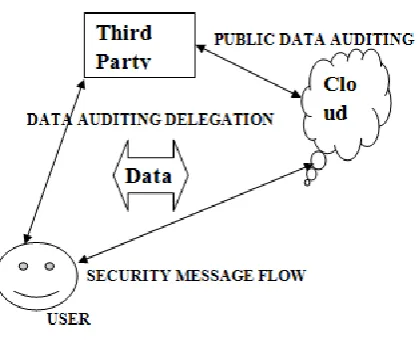
To fully make sure the knowledge integrity and save the cloud users’ computation resources likewise as on-line
drawback, it's of vital importance to change public auditing service for cloud knowledge storage, in order that
users could facilitate to associate freelance third-party auditor (TPA) to audit the outsourced knowledge once
required.
FIGURE 1: SYSTEM DESIGN
IV. RELATEDWORK
The TPA, World Health Organization has capability and capabilities that users don't, will sometimes check the integrity of all the info hold on within the cloud on behalf of the users that provides a lot of easier and cheap way for the users to confirm their storage correctness within the cloud. Lately, the notion of public auditability has been projected within the context of guaranteeing remotely hold on knowledge integrity below completely different system and security models. Public auditability permits associate exterior party, additionally to the user himself, to validate the correctness of remotely hold on knowledge. Moreover, coding doesn't fully solve the matter of protective knowledge privacy against third-party auditing however simply reduces it to the advanced key management house and computation resources (we won't differentiate cesium and CSP hereafter); the third-party auditor, World Health Organization has experience and talents that cloud users don't have and is trusty to assess the cloud storage service dependability on behalf of the user upon demand. Users trust the cesium for cloud knowledge storage and maintenance. They will conjointly smartly move with the cesium to access and update their hold on knowledge for varied application functions.
© 2014, IJCSMC All Rights Reserved
529
likewise because the on-line burden doubtless brought by the periodic storage correctness verification, cloud users could choice to TPA for guaranteeing the storage integrity of their outsourced knowledge, whereas expecting to stay their knowledge personal from TPA.
PRIVACY PRESERVING PUBLIC AUDITING SCHEME
To realize privacy-preserving public auditing, we tend to propose to unambiguously incorporate the hemimorphy linear appraiser with random masking technique. In our protocol, the linear grouping of sampled blocks within the server’s response is disguised with randomness generated by the server. With random masking, the TPA has all the required info to make up an accurate cluster of linear equations and thus cannot derive the user’s knowledge content, regardless of what number linear groupings of an equivalent set of file blocks is collected. On the opposite hand, the accuracy validation of the block-authenticator pairs will still be allotted in an exceedingly new means which is able to be shown presently, even with the presence of the randomness. Our proposal makes use of a public key-based HLA, to produce the auditing protocol with public auditability. Explicitly, we tend to use the HLA projected in, that relies on the short signature theme projected by Boneh, Lynn, and Sachem. Properties of our protocol. it's simple to visualize that our protocol achieves public auditability. There’s no classified keying material or states for the TPA to stay or maintain between audits, and therefore the auditing protocol doesn't position any potential on-line burden on users.
AUDITING STRUCTURES
BATCH AUDITING --With the institution of privacy-preserving public auditing, the TPA could at the same time handle multiple auditing upon completely different users’ allocation. The individual auditing of those tasks for the TPA is tedious and really inefficient. Given K auditing allocations on K distinct knowledge files from K completely different users, it's a lot of profitable for the TPA to batch these multiple tasks along and audit at just once. Keeping this traditional demand in mind, we tend to slightly modify the protocol in an exceedingly single user case, and bring home the bacon the buildup of K verification equations (for K auditing tasks) into one, as shown in . As a result, a secure batch auditing protocol for synchronous auditing of multiple tasks is obtained.
BATCH AUDITING EFFICIENCY - Support for batch auditing provides associate straight line proficiency analysis on the batch auditing, by considering solely the full variety of coupling operations. However, on the real-world facet, there square measure extra more cost-effective operations needed for batching, like integrated exponentiations and multiplications. Thus, whether or not the advantage of removing pairings considerably outweighs these extra operations remains to be verified. to urge a full read of batching potency, we tend to conduct a scheduled batch auditing take a look at, wherever the quantity of auditing tasks is inflated from one to or so two hundred with intervals of eight.
IDENTIFICATION OF VALID RESPONSES
© 2014, IJCSMC All Rights Reserved
530
APPLICATION TO VERSION CONTROL SYSTEMThe on top of theme permits TPA to continuously keep the new tree root for auditing the updated file. however it's price noting that our mechanism is simply extended to figure with version management theme, wherever each current and former versions of the info file F and therefore the corresponding authenticators square measure hold on and want to be audited on demand. One potential means is to want TPA to stay tracks of each the present and former tree roots generated by the user, denoted as fTR1 MHT; TR2 MHT; . . . ; TRV MHT g. Here, V is that the variety of file versions and TRV MHT is that the root associated with the foremost current version of the info file F. Then, whenever a chosen version v (1 nine v nine V ) of information file is to be audited, the TPA simply uses the corresponding TRv MHT to perform the auditing. The cloud server ought to conjointly keep track of all the versions of information file F and their authenticators, so as to properly answer the auditing request from TPA. Note that cloud server ought not to replicate each block of information move into each version, as several of them square measure the similar once updates. However, the way to with efficiency manage such block storage in cloud isn't at intervals the scope of our paper.
CONCLUSION
In this paper, we provide a privacy-preserving public auditing system for knowledge storage security in cloud
computing. we tend to operate the hemimorphy linear appraiser and random concealing to ensure that the TPA
wouldn't learn any info concerning the info content hold on on the cloud server throughout the effective auditing
technique, that not solely eliminates the burden of cloud user from the tedious and doubtless exclusive auditing
task, however conjointly improves the users’ worry of their outsourced knowledge leak. As TPA could instantly
handle multiple audit sessions from completely different users for his or her outsourced knowledge records, we
tend to any prolong our privacy-preserving public auditing protocol into a multiuser scenario, wherever the TPA
will perform many auditing tasks in an exceedingly batch manner for improved potency. in depth analysis
displays that our systems square measure demonstrably secure and extremely economical. Our initial
experiment conducted on Amazon EC2 case any demonstrates the quick performance of our style on each the
cloud and therefore the tax assessor facet. we tend to leave the whole implementation of the mechanism on
business public cloud as a crucial future extension, that is foreseeable to robustly deal with terribly giant scale
knowledge and therefore encourage users to simply accept cloud storage services a lot of with confidence.
REFERENCES
[1] C. Wang, Q. Wang, K. Ren, and W. Lou, “Privacy-Preserving Public Auditing for Storage
Security in Cloud Computing,” Proc. IEEE INFOCOM ’10, Mar. 2010.
[2] P. Mell and T. Grance, “Draft NIST Working Definition of Cloud Computing,”
http://csrc.nist.gov/groups/SNS/cloudcomputing/index.html, June 2009.
[3] M. Armbrust, A. Fox, R. Griffith, A.D. Joseph, R.H. Katz, A. Konwinski, G. Lee, D.A. Patterson,
A. Rabkin, I. Stoica, and M. Zaharia, “Above the Clouds: A Berkeley View of Cloud Computing,”
Technical Report UCB-EECS-2009-28, Univ. of California, Berkeley, Feb. 2009.
WANG ET AL.: PRIVACY-PRESERVING PUBLIC AUDITING FOR SECURE CLOUD
STORAGE 373
[4] Cloud Security Alliance, “Top Threats to Cloud Computing,”
http://www.cloudsecurityalliance.org, 2010.
[5] M. Arrington, “Gmail Disaster: Reports of Mass Email Deletions,”
http://www.techcrunch.com/2006/12/28/gmail-disasterreportsof-mass-email-deletions/, 2006.
© 2014, IJCSMC All Rights Reserved